Let the little children come to Me…

…and don’t stop them, because the kingdom of God belongs to such as these. I assure you: Whoever does not welcome the kingdom of God like a little child will never enter it.

Luke 18:16-17, HCSB


I know that as a GrandBob, I am extremely biased.

But watching my two grandchildren play this afternoon with laughter, passion, and innocence, I am both reminded and challenged by the words of Jesus…

What about you?

Nordstrom’s Customer Service Rulebook

One five by seven index card.

One paragraph.

One rule.

We’re glad to have you with our Company. Our number-one goal is to provide outstanding customer service. Set both your personal and professional goals high. We have great confidence in your ability to achieve them.

Nordstrom Rules: Rule #1: Use your good judgment in all situations. There will be no additional rules.


What about your organization?

Do your values so permeate your organization that rules are minimized?

Clarity is Audible

When you read or hear the word “clarity”, the odds are that your next thoughts have something to do with vision, imagery, or similar metaphors.

Will Mancini, author of “Church Unique” and founder of the consulting group Auxano, refers to himself as a “clarity evangelist.” One of the central tenants of his work is clarity, and he uses powerful visual images to illustrate.

The concepts of clarity are a regular part of my conversations with churches. In the last month, I have talked about clarity with large and small churches; rural and urban churches; traditional and contemporary churches. Clarity transcends all these groupings as a necessary ingredient of successful churches.

In the midst of all this conversation about clarity, a comment was made to me that literally stopped me in my tracks:

Clarity is audible, too

This astute and wise church leader was telling me that our words – verbally – were very important in his context, maybe even more so than images and other visual elements. He demonstrated this the next day in a powerful, passionate sermon that was a masterpiece of the spoken word. He schooled me though the use of:

  • The dynamics of voice
  • Volume
  • Inflection
  • Pacing and tempo
  • Eliminating verbal graffiti

Leaders who communicate with clarity radiate passion, conviction, and enthusiasm – and people respond.

What Weeding a Flower Bed Reminded Me About Leadership

I have been in Nashville TN for the last several days on a business trip. Though I wrapped up late yesterday afternoon, I planned some extra time with my mother, who lives about 20 miles from Nashville. We went out for dinner last night and I asked her what she needed doing around the house.

This is the first time I have been back “home” since my father passed away and was buried in early March. Though my mother and I talk several times each week, I knew that there were things to do for her.

Consequently, by mid-morning I found myself pulling weeds in the numerous flower gardens around the house. Both my parents liked flowers and the wildlife they attracted. My dad in particular, was what you might call a natural gardener when it came to flowers. He didn’t believe in formal landscapes and flower beds “just so.” His method was more “that looks like a good place for a few flowers.”

As I was working in around the flower beds all morning, I was reminded of the countless times I had seen my dad as he was going from one place to another in our yard just stop and pull a weed out and toss it on the ground – to be chopped up by the mower later. There wasn’t a rhyme or reason to his actions; it was just something he did.

Small consistent actions over time make a big difference.

My dad had been in declining health since late last year, and had not been able to be out in the yard, there was a lot to do. By noon I was ready for a break. Sitting and drinking several glasses of water I thought about my Dad and how his constant weeding meant that the flower gardens looked pretty good all of the time; now, they looked overgrown.

I’m certainly nowhere near the gardener my Dad was. My several hours of work will make them look good for a few weeks maybe, and then they will have to be weeded again.

But once again, my Dad is my teacher.

Leaders need to understand that consistent, small actions invested in your team will pay big dividends along the journey.

Thanks, Dad.

Simplicity Never Stands Still

To achieve great things, two things are needed: a plan, and not quite enough time.

– Leonard Bernstein

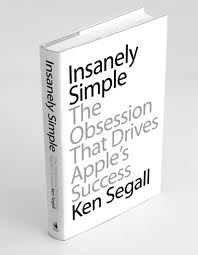
Former ad agency creative director Ken Segall’s new book Insanely Simple is written from a unique perspective: developing marketing campaigns for technology giants like IBM, Dell, Intel, – and Apple. It was the stark contrast of Apple’s ways that made Segall appreciate the power of Simplicity – and inspired him to help others benefit from it.

In the chapter entitled “Think Motion,” Segall refers to Apple’s practices of fast-tracking project and marketing development.  Apple has grown to point where it does a tremendous number of things at once, and in doing so has built one of the world’s greatest juggling acts. Apple:

  • lives in constant motion
  • never stops thrilling its audience
  • never lets things get old

The best illustration of this comes from an example of Segall’s work with both Dell and Apple on similar ventures – developing a new branding campaign.

Apple set out to create a brand campaign in 1997.

   Dell set out to create a brand campaign in 2008.

Apple wanted to start its campaign immediately.

   Dell pondered a schedule that would take months.

Apple’s brand team was led by its CEO.

   Dell’s brand team was led by a committee.

Apple trusted a small group of smart people.

   Dell trusted a small group of incompatible people.

Apple knew exactly who it was.

   Dell need to figure out who it was.

Steve Jobs was an active participant.

   Michael Dell would look in when the project was complete.

Apple’s brand team required only the CEO’s approval.

   Dell’s brand team required each division’s approval.

Apple took a month to conceive and create a campaign.

   Dell required a month just to talk about strategies.

Apple ended up with the Think Different campaign.

   Dell ended up with a stack of presentation boards stored neatly in a dark closet.

Simplicity – represented in the above example by Apple’s actions – is a fundamental requirement when you’re trying to achieve lofty goals. As Dell discovered, a fractured, leaderless group without an urgent mandate is Simplicity-proof.

Will you walk the straight path of Simplicity or choose the dark, winding road of Complexity?

Small is the Ultimate Efficiency

When process is king, ideas will never be. It takes only Common Sense to recognize that the more layers you add to a process, the more watered down the final work will become.

– Ken Segall, Insanely Simple

Ken Segall was the creative director at several ad agencies, working for big-name tech companies like IBM, Intel, and Dell. However, it was his work with Apple over a period of years that gives him a unique perspective of the stark contrast of Apple’s ways that made him appreciate the power of Simplicity. Segall recently released a book about these lessons – Insanely Simple. More than just another repetition of Apple lore, it chronicles an outsider’s long relationship with Apple and Steve Jobs that will provide leaders in any organization with the powerful tools of Simplicity.

Simplicity’s Best Friend: Small Groups of Smart People

While working with Apple, Segall often experienced the strict enforcement of one of Simplicity’s most important rules: Start with small groups of smart people – and keep them small. Every time the body count in a meeting or working on a project goes higher, you’re simply inviting Complexity to take a seat at the table.

This small-group principle is a key to Apple’s ongoing success and key to any organization that wants to nurture quality thinking. The idea is pretty basic: Everyone in the room should be there for a reason. Segall distilled years of observing and practicing this idea down into two “Laws of Small.”

The quality of work resulting from a project is inversely proportional to the number of people involved in the project.

The quality of work resulting from a project increases in direct proportion to the degree of involvement by the ultimate decision maker.

To even speak of putting process before creativity did not happen in an environment like Apple’s. A better idea is a better idea – no matter where it fell in the process. The high value placed on ideas is one of the things that Steve Jobs burned into the Apple culture and it will likely continue to guide the company into the future.

How would small groups of smart people work in your organization?

Blunt is Simplicity. Meandering is Complexity.

Clarity propels an organization. Not occasional clarity but pervasive, twenty-four-hour, in-your-face, take-no-prisoners clarity.

– Ken Segall, Insanely Simple

Ken Segall is a former ad agency creative director who worked for Apple during Steve Jobs’ return to the helm of the iconic tech company. He also worked for many of the largest tech companies around: IBM, Dell, and Intel among others. He’s seen both sides of the fence, so to speak, and it’s not a pretty sight.

Insanely Simple: The Obsession That Drives Apple’s Success is an amazing book detailing Apple’s return to brilliance under Steve Jobs. It’s loaded with personal stories and practical applications that your organization will find both fascinating and useful.

Like the necessity of being brutally honest in your communications.

According to Segall, Steve Jobs told you what was on his mind and he couldn’t care less how you might feel about it. Despite a general perception that Jobs was the nasty tyrant who demanded allegiance, barked commands, and instilled fear in those around him, this was an incomplete portrait. He could also be funny, warm, and even charming.

There is a huge difference between being brutally honest and simply being brutal.

Simplicity at Apple is the name of the game, and it requires that you be honest and never hold back. If you demand the same from those you work with, everyone will know where they stand.

One hundred percent of your group’s time will be focused on forward progress – and there will be no need to decode what people are really saying.

Learn the Powerful Lessons of Simplicity

Simplicity isn’t just a design principle at Apple – it’s a value that permeates every level of the organization.

-Ken Segall, Insanely Simple

Ken Segall was the creative director at several ad agencies, working for big-name tech companies like IBM, Intel, and Dell. However, it was his work with Apple over a period of years that gives him a unique perspective of the stark contrast of Apple’s ways that made Segall appreciate the power of Simplicity.

The obsession with Simplicity is what separates Apple from other technology companies. Led by Steve Jobs’ uncompromising ways, you can see Simplicity in everything Apple does: the way it’s structured, the way it innovates, and the way it speaks to its customers.

Insanely Simple gives you a true insider’s perspective on Apple’s obsession with Simplicity. Here are just a few of the topics covered:

  • Think Small – swearing allegiance to the concept of “small groups of smart people” raises both morale and productivity
  • Think Minimal – distilling choices to a minimum brings clarity to a company and its customers – as Jobs proved when he replaced over twenty product models with a lineup of four
  • Think Motion – keeping project teams in constant motion focuses creative thinking on well-defined goals and minimizes distractions
  • Think Iconic – using a simple, profound image to symbolize the benefits of a product or idea creates a deeper impression in the minds of customers

Segall introduces the book with the concept of The Simple Stick – a core value within Apple. Sometimes it’s held up as inspiration; other times it’s wielded like a club. In all cases, it’s a reminder of what sets Apple apart from other technology companies and what makes Apple stand out in a complicated world: a deep, almost religious belief in the power of Simplicity.

If you are a leader in ChurchWorld, you know about and fight the battle of Simplicity every day. It may seem like a losing battle, but you need to know that the results are worth the effort.

The simpler way isn’t always the easiest. Often it requires more time, more money, and more energy. It may require you to step on a few toes along the way. But more often than not, Simplicity leads to better results.

Simplicity needs a champion – someone who’s willing to stand up for its principles and strong enough to resist the overtures of Simplicity’s evil twin, Complexity.

Simplicity needs a leader who is willing to guide the process with both head and heart…

…someone like you?

To read more about Insanely Simple, go to the top of the page and click on the orange title of tomorrow’s post.

Parking is More Than Just Cars

Yesterday’s post introduced the concept of parking teams and how important they are to welcoming guests, members and attenders to your campus. Today I want to expand the parking concept beyond just cars.

I lead the Guest Services (Parking) Teams at Elevation Church’s Uptown location. As the “first face” of Elevation, my crew and I get weekly opportunities to practice guest services and make a lasting first impression. We don’t just park cars; we also:

  • Sanitize all touch points and spray air freshener in the elevator cabs and stairwells of the parking deck we use
  • Pick up trash along the route from the parking deck to the theater
  • Put up 22 parking signs (3 different types) in a 2 block area around the theater
  • Pull the parking ticket from the dispenser and personally hand it to guests entering the deck and welcome them to Elevation
  • When possible, push the call button so the elevator is waiting for guests to take them from the parking deck levels to the ground floor
  • Hold the door for guests entering and leaving the parking garage elevator lobby
  • Validate parking for all Elevation guests
  • Provide VIP (our first time guests) and family parking right next to the theater
  • Know what’s going on Uptown so we can help any and everyone who has a question (sporting events, concerts, special activities, etc.)
  • Provide umbrellas to guests when it’s raining for the walk from the parking deck to the theater
  • Give a verbal greeting to everyone coming and going – in at least three different locations
  • Be alert to any special needs and radio them ahead to the VIP tent
  • As guests are leaving, we take the validated ticket from them and feed it into the dispenser, giving them a verbal blessing as they head out of the garage

And that’s just the parking team!

Elevation’s audacious Guest Services Team also has Greeters, a First Impressions Team, VIP Tent, and Connections Tent (but that’s another part of the journey).

All this BEFORE a guest has stepped into the theater for worship.

Your church is different from my campus – you probably don’t have a parking garage. But you do have parking lots – and that is an excellent opportunity for you to make a powerful first impression.

Take the principleParking is your first opportunity to make an impact on your guests – and apply it to the context of your place. What will you do this week to implement/change/improve your parking team?

Do not underestimate the power and influence of the first impression your parking lot makes!

The First Face of Your Church…

…should be in the parking lot.

Guests and members coming to your church should see an energetic, welcoming, smiling group of people helping you pull into the parking lot and getting safely to the buildings. I admit my bias: I serve as the Parking Team Coordinator for Elevation Church’s Uptown Campus, so I’m all over this thing called parking.

You should be too, because it’s often the “first impression” your guests receive of your church.

At Elevation Church, our worship experiences begin in the parking lot. You may have thought that church parking lots, and the teams that staff them weekly, were just about cars, orange vests, and two-way radios. We see it differently: we’re the first face of Elevation, and we are connectors to the current of the power of God.

The parking teams at Elevation have a vision that is the same as the church’s: So that people far from God will be raised to life in Christ. We fulfill that vision by welcoming everyone to our six campuses, giving them the first of several audacious welcomes for the day. We remove every barrier possible so that they can be a part of a powerful worship experience. As a Parking Team Coordinator at one campus, and after surveying our other campus team leaders, here’s why we think parking is a very important part of what happens at Elevation Church. From the first few sections of our parking manual:

Purpose: The Parking Team exists so that people far from God will be filled with life in Christ.

Goal: We will “WOW” every guest by exceeding their expectations.

Strategy: Create and ensure a quick, easy, and stress-free parking experience.

Our priority is to help traffic enter and exit smoothly but more importantly to honor people and get them excited about Elevation.

Our basic parking guidelines are very simple:

  • Make eye contact
  • Smile
  • Wave
  • Go the extra mile to make someone else smile

So are our suggestions for moving traffic:

  • When you move, they move.
  • Keep the main line of entrance traffic flowing the majority of the time.
  • Quickly help those that are stopping to ask questions and get them moving again.
  • Be aware of pedestrian traffic and be considerate of those going the wrong way.
  • Stay visible.
  • Wear your vest and make motions with the entire arm instead of just the forearm

The parking teams may have a single vision, and simple guidelines, but we express them differently at each campus. Even though we are one church in six locations and there are a lot of similarities, there are a lot of differences in the parking lots. For example, consider the locations:

  • Providence and Northwestern – high schools, with limited entrances and exits and multiple lots
  • University City – a YMCA with limited designated parking
  • Matthews – retail shopping center with shared designated parking areas
  • Blakeney – mixed development with five means of egress in multiple lots
  • Uptown – parking garage with two entrances

Our locations alone make a big difference in how we serve as a parking team. Here are some interesting parking factors anyone with a parking team might consider:

  1. Our parking teams have more fun than you can pay for!
  2. We understand the power of a great first impression.
  3. We understand the letdown of a poor first impression.
  4. Safety is at the top of our list; juggling lines of moving cars and walking people is always a balancing act.
  5. Multiple parking lots with many entrances and exits (Blakeney, Matthews, University City, Rock Hill and Providence Campuses) are great-until you try to staff all them at once.
  6. Traffic cones are a wonderful invention (see #5).
  7. People sometimes pay more attention to a traffic cone than a person in a vest directing traffic flow.
  8. Parking teams have to know everything about the church in order to answer guest’s questions.
  9. Sharing parking spaces with retail stores (Blakeney, Matthews Campuses) is a science – and an art.
  10. Checklists help parking teams do it right, every time.
  11. Grace helps the parking team deal with situation when #10 doesn’t work.
  12. Safety orange is everybody’s favorite color!
  13. With large multiple lots, two-way radios help direct traffic flow efficiently
  14. Parking garages (Uptown Campus) are a whole different world, especially when they also serve two very large nightclubs.
  15. When in parking areas with major attractions nearby, the parking team will be asked directions, times, etc. A little knowledge and a great smile make a great first impression even when someone isn’t coming to Elevation.

All Parking Teams do is help guests find spaces to park their cars, right? At Elevation, there’s so much more to being a part of the parking team.

We serve everyone with audacious, radical hospitality – “just” by parking cars!