Living the Dash

Hollis Donald “Doc” Adams

08/09/27 – 02/25/12

The dates above are important – they are the bookends of my father’s life. They mark a beginning and an end of his physical existence.

But it’s the dash that really tells the stories of his life.

Today and tomorrow will be filled with dozens of these stories. Family and friends are gathering from near and far to celebrate his life. 

Stories like… 

  • Born in rural Middle Tennessee on the eve of the Great Depression – becoming a part of the Greatest Generation
  • Raised on the grounds of the Hermitage, Andrew Jackson’s home outside of Nashville, where his father kept the livestock – and learning to love and care for animals early on
  • Educated in Mt. Juliet, TN – where I later attended the same schools (and had one of the same teachers)
  • Entered the Army Air Corps in the last months of WW II – and began a life-long love of military history, which he passed on to me, and I passed on to my son, who is carrying it to a new level – Airman First Class Jason Adams
  • After his Army service, he started a business with his brother – a Gulf gasoline station, which for the next 44 years was the major part of his life of service to others
  • Enjoyed a vacation in Florida in 1953, impressing a certain young school teacher from Missouri by saying he “dabbled in oil”
  • After marrying that young teacher and bringing her back to TN, they began a family of two boys
  • Educating those boys in some of his background – hunting, fishing, working with animals, helping others; but also encouraging and challenging them to find their own paths
  • Along with his wife, raising those two boys with a love for God and His Church
  • Launching those boys “out of the nest” to begin lives and families of their own

And that’s just a hint of the dash my father lived.

My father never regretted any of the dash he lived – and I hope I will be able to say the same one day.

 

Saying Goodbye

While visiting my son, daughter-in-law, and granddaughter in New Mexico (where my son is stationed at Cannon AFB), my father passed away.

My wife and I flew back to Charlotte today, and tomorrow morning we head to Tennessee with two of our children, while the other two join us for the memorial services later this week.

I’ll have some thoughts to share later this week…

The Lessons of Innovation

The January issue of Fast Company magazine featured articles on Generation Flux. I thoroughly enjoyed it, posting several applications to ChurchWorld:

The March issue has arrived, focusing on the world’s 50 Most Innovative Companies. Again, there are some great lessons for ChurchWorld – starting with Editor Robert Safian’s lead editorial. He linked his feature story from the Generation Flux issue to themes that emerged in the Top 50 list. Here are the top eight themes:

  1.  Growth should be a tactic, not a strategy
  2. Big companies need to be nimble as startups
  3. Tech is disruptive in unexpected places
  4. Design is a competitive advantage
  5. Social media makes products and services better
  6. Data is power
  7. Money is flowing
  8. Copycats are history

These themes emerged from business names you will recognize, but the truths behind them also have application in your organization – or they should.

Tomorrow: a closer look at these themes and how they are impacting ChurchWorld.


Be a Curator

You don’t make a great museum by putting all the art in the world into a single room. 

That’s a warehouse

What makes a museum great is the stuff that’s not on the walls. Someone says no. A curator is involved, making conscious decisions about what should stay and what should go. There’s an editing process. There’s a lot more stuff off the walls than on the walls. The best is a sub-sub-subset of all the possibilities.

It’s the stuff you leave out that matters.

So constantly look for things to remove, simplify, and streamline. Be a curator. Stick to what’s truly essential. Pare things down until you’re left with only the most important stuff. Then do it again. You can always add stuff back in later if you need to.

What will you curate today?

The inspirational words above come from the book Rework by Jason Fried and David Heinemeier, the founders of 37signals.

If you don’t own it, you should.

The artwork is by illustrator Mike Rohde.


The Unwritten Rules of Visual Thinking

We can solve our problems with pictures.

With that simple proposition, author and visual thinking consultant Dan Roam invites the reader to a four-day workshop on visual thinking in his book “Unfolding the Napkin.”

Central to his idea are the unwritten rules of visual thinking:

  1. Whoever is best able to describe the problem is the person most likely to solve it.
  2. We can’t solve a problem that overwhelms us. To understand what we’re seeing, we need to break it into bite-size pieces.
  3. Problems don’t get solved by the smartest or the fastest or the strongest; they get solved by the one who sees the possibilities.
  4. The more human your picture, the more human the response.

Sound too simplistic to be true? Maybe.

But I saw it begin to work last night in a client meeting involving a several million dollar project and a two-year brick wall.

I’m a believer.

Got problems? You need pictures!

The Power of the Humble Napkin

Any problem can be made clearer with a picture, and any picture can be made using the same simple set of tools and rules. (The Back of the Napkin, Dan Roam)

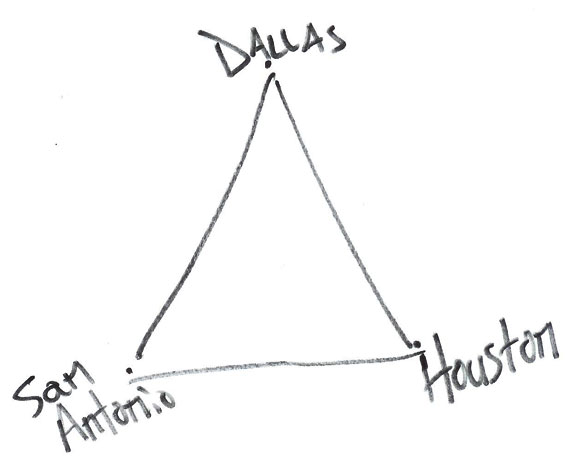
When Herb Kelleher was brainstorming about how to beat the traditional hub-and-spoke airlines, he grabbed a bar napkin and a pen. Three dots to represent Dallas, Houston, and San Antonio. Three arrows to show direct flights.

Problem solved.

The napkin sketch made it easy to sell Southwest Airlines to investors and customers – and the rest is history.

Sitting in Hardees yesterday eating a late lunch, I couldn’t help but notice the napkin dispenser.

What will you create today?

Want to know more about visual thinking?

Think Visual

Your Visual Thinking Toolkit

The Art of Visualization

Valentine’s Day in the Future

Well, at least what scientists are telling us how chocolate will change in the future…

2014Melt-Proof Wrappers. Candy companies are developing wrappers that prevent chocolate from melting in temperatures up to 104 degrees.

20163D Chocolate Printer. Using edible purees in place of ink, engineers have created a printer that creates totally edible forms.

2018Low-Fat Chocolate. Through selective breeding of cacao trees, scientists hope to grow beans with less fat.

2021Cookie-Baking Robot. Scientists have created a robot that can mix up a batch of cookies and pop them in the oven; it takes 2 1/2 hours currently.

2032$20 Candy Bars. Some industry experts say the world is running out of affordable chocolate, primarily because of declining production.

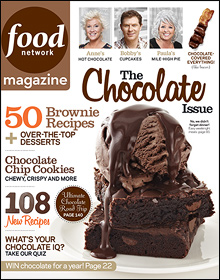
The delicious (except for the final one) tidbits above came from the Food Network Magazine March 2012 issue.

I hope you have enjoyed these enticing chocolate posts (start here to see the whole series) on Valentine’s Day 2012!

Now, it’s off for a late dessert date with my Valentine!


Beware of Bite Size Chocolate Bars

During a three-year study by researchers in Canada, people showed more restraint when eating regular-size candy bars than when eating mini ones. Bite-size snackers tended to eat four or five treats – about 50 percent more than the full-sized candy bar eaters consumed.

That’s why I only eat regular sized candy bars!

Okay, so I define regular size a little different from most people…

I’m Only Trying to be Generous

People with a sweet tooth are sweeter.

According to a study by Gettysburg College psychology professor Brian Meier, if you treat yourself to chocolate, you’re probably a more generous person. In his study, researchers gave subjects either a piece of chocolate, a cracker, or no food at all and then asked the subjects to volunteer for something and estimate how much time they could give.

The chocolate eaters offered 42 percent more time than the cracker group and almost 68 percent more than the subjects who ate nothing, During another part of the study, subjects prejudged others based on whether they liked sweets; those who did were ranked more agreeable.

According to Meier, “It’s hard to imagine people fighting while eating chocolate.”

I agree; pass me a Hershey’s bar, please.