Your VALUES Guide Why You Do What You Do

Remember the last time you sat down to do a jigsaw puzzle? The work proceeds in two basic steps. First, you put the edges together. Finding all of the little pieces with straight edges is the easiest way to begin. As you piece together the top and bottom and sides, the puzzle is framed up within a relatively short period of time.

The second part of the process is now ready to begin, because you have defined the basic shape and outline of the puzzle. Before building the frame, it would have been exceedingly difficult to put many of the middle pieces together. But now, all of those elusive jigsaw shapes and unclear image fragments have perspective and boundaries.

Even though the frame makes the puzzle-building project easier, more work remains. You pick up awkward shape after awkward shape, twisting and turning them and turning again, until you get just the right fit and-snap-the image develops, one piece at a time. After a long journey that may take days or even months, the final image emerges.

Articulating your church’s vision is like working on a jigsaw puzzle.

Auxano co-founder Will Mancini developed the Vision Frame concept to show you how to articulate your vision the same way you would build a puzzle: in two basic steps.

This SUMS Remix will introduce the Vision Frame, guiding you to first think about the four outer edges – the components of your church’s identity that frame everything else you do. These edges anchor the second part of the process (a future SUMS Remix), which involves the direction of living and articulating the dynamic vision of your Church Unique through the daily work of turning and twisting the pieces of the organization. The edges of the frame are definitive, but the middle of the puzzle is dynamic. The fixed nature of step one, building the frame, anchors the fluid nature of step two, where your vision picture slowly develops into the better intermediate future God has entrusted to you. 

THE QUICK SUMMARYThe Advantage by Patrick Lencioni

There is a competitive advantage out there, arguably more powerful than any other. Is it superior strategy? Faster innovation? Smarter employees? No, New York Times best-selling author, Patrick Lencioni, argues that the seminal difference between successful companies and mediocre ones has little to do with what they know and how smart they are and more to do with how healthy they are.

In this book, Lencioni brings together his vast experience and many of the themes cultivated in his other best-selling books and delivers a first: a cohesive and comprehensive exploration of the unique advantage organizational health provides.

Simply put, an organization is healthy when it is whole, consistent, and complete, when its management, operations, and culture are unified. Healthy organizations outperform their counterparts, are free of politics and confusion, and provide an environment where star performers never want to leave.

Lencioni’s first non-fiction book provides leaders with a groundbreaking, approachable model for achieving organizational health complete with stories, tips, and anecdotes from his experiences consulting to some of the nation’s leading organizations. In this age of informational ubiquity and nano-second change, it is no longer enough to build a competitive advantage based on intelligence alone. The Advantage provides a foundational construct for conducting business in a new way, one that maximizes human potential and aligns the organization around a common set of principles.

A SIMPLE SOLUTIONValues: Why are we doing it?

A church without values is like a river without banks – just a large puddle. It is missing an opportunity for white-water movement. As with any organization, your church has a set of shared motives, or values, underneath the surface of everyday activity. The problem is that they stay weak because they are unidentified and unharnessed in guiding the future.

The role of the leader is to identify the most important values and pull them above the waterline of people’s perception. Once they are in clear view, the leader can nurture their development, enabling the church to do more of what it does best. Once your people know and own the values, it’s like creating the banks of a river to channel energy and momentum. 

As you clarify your deeply held values, they become tools for shaping culture only to the extent that they are captured and carried. 

If an organization is intolerant of everything it will stand for nothing.

The importance of creating clarity and enabling a company to become healthy cannot be overstated. More than anything else, values are critical because they define a company’s personality. They provide employees with clarity about how to behave, which reduces the need for inefficient and demoralizing micromanagement.

That alone makes values worthwhile. But beyond that, an organization that has properly identified its values and adheres to them will naturally attract the right employees and repel the wrong ones. This makes recruiting exponentially easier and more effective, and it drastically reduces turnover.

An important key to identifying the right, small set of behavioral values is understanding that there are different kinds of values. Among these, core values are by far the most important, and must not be confused with others.

Core values are the few – just two or three – behavioral traits that are inherent in an organization. Core values lie at the heart of the organization’s identity, do not change over time, and must already exist. In other words, they cannot be contrived.

An organization knows that it has identified its core values correctly when it will allow itself to be punished for living those values and when it accepts the fact that employees will sometimes take those values too far. Core values are not a matter of convenience. They cannot be extracted from an organization anymore than a human being’s conscience can be extracted from his or her person. As a result, they should be used to guide every aspect of an organization, from hiring and firing to strategy and performance management.

Patrick Lencioni, The Advantage

A NEXT STEP

Values Defined

Values are the motivational flame of the church. They are the shared convictions that guide your actions and reveal your strengths. Values answer, “Why do we do what we do at our church?” They are springboards for daily action and filters for decision-making. Values represent the conscience of the organization. They distinguish your philosophy of ministry and shape your culture and ethos.

While values are a leadership tool like the mission, they are not expressed verbally everywhere and all the time. Therefore, people coming to church will encounter the atmosphere that is shaped by values before they hear the values themselves. Ideally, values will define the experience for an attender before they are a conscious thought. Values are “what Joe feels” at the church.

Values Reminders

  • Anchor your values in reality (actual vs. aspirational is 3:1)
  • Consider not “what we do” but “what characterizes everything we do”
  • Remember “a river without banks is just a large puddle”
  • Avoid ideas of individual spiritual growth and think “organizational glue”
  • Do the organizational “checkbook test” – prove the value with church finances
  • Capture uniqueness and personality, be distinct
  • Think essence not event
  • Articulate at four levels: name, definition, “demonstrated by” statements, and scriptural support

Gather the team and ask this question: If a new guest was to report back after six months of consistent worship attendance, what would they saw we truly value based on their experience and observation? How does this influence our current values language or inspire us to create new values?

Excerpt taken from SUMS Remix 115-2, released March 2019


Part of a weekly series on 27gen, entitled Wednesday Weekly Reader

Regular daily reading of books is an important part of my life. It even extends to my vocation, where as Vision Room Curator for Auxano I am responsible for publishing SUMS Remix, a biweekly book “excerpt” for church leaders. Each Wednesday on 27gen I will be taking a look back at previous issues of SUMS Remix and publishing an excerpt.

>>Purchase SUMS Remix here<<

>> Purchase prior issues of SUMS Remix here<<

If You Think Reading is Boring, You’re Doing It Wrong

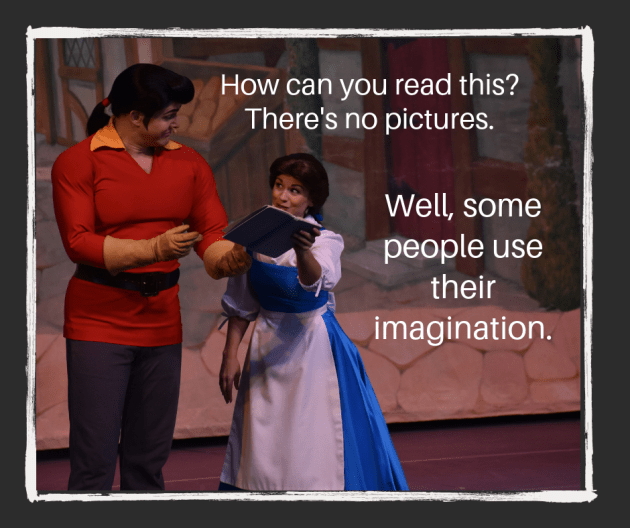
They may be hand-drawn animation, or computer-generated imagery, or even real actors in a stage play or musical.

Whatever the media, there’s a powerful story – and life lessons – from the characters in Beauty and the Beast.

To Gaston, a book with no pictures might as well have blank pages.

To Belle, a good story doesn’t need pictures to be understood.


No matter how busy you may think you are, you must find time for reading, or surrender yourself to self-chosen ignorance.

– Confucius


Need book ideas? How about trying SUMS Remix?

Regular daily reading of books is an important part of my life. It even extends to my vocation, where as Vision Room Curator for Auxano I am responsible for publishing SUMS Remix, a biweekly book “excerpt” for church leaders. Published since 2012, we have looked at over 480 books for solutions to common problems leaders face every day.

Each Wednesday on 27gen I typically take a look back at previous issues of SUMS Remix and publish an excerpt.

>>Purchase an annual subscription to SUMS Remix here for only $48<<

>> Purchase prior issues of SUMS Remix here<<


Are You Asking the Right Questions?

Our capacity for learning is a part of being a human being. From birth, we are on a fast track of learning – movement, speech, understanding, and so forth. Unfortunately, many people equate “learning” with “schooling,” and when you’re done with school, you’re done with learning.

We are uniquely endowed with the capacity for learning, creating, and growing intellectually – and it doesn’t have an expiration date tied to an event, like graduation.

The practice of lifelong learning has never been more important to leaders than it is today. The necessity of expanding your knowledge through lifelong learning is critical to your success.

Take reading, for example. Many of the most successful people in today’s organizations read an average of 2-3 hours per day. No longer limited to books, reading is a lifelong learning activity that can be done online anywhere at anytime.

Learning is the minimum requirement for success as a leader. Because information and knowledge on everything is increasing every day, your knowledge must also increase to keep up.

Learning how to learn is more important than ever. Dedicate yourself to trying and learning new ideas, tasks, and skills. You don’t need to be aware of everything all the time but learning new skills faster and better – that in itself is a tough skill to master.

THE QUICK SUMMARY – The Book of Beautiful Questions by Warren Berger

From the bestselling author of A More Beautiful Question, hundreds of big and small questions that harness the magic of inquiry to tackle challenges we all face–at work, in our relationships, and beyond.

By asking questions, we can analyze, learn, and move forward in the face of uncertainty. But “questionologist” Warren Berger says that the questions must be the right ones; the ones that cut to the heart of complexity or enable us to see an old problem in a fresh way.

In The Book of Beautiful Questions, Berger shares illuminating stories and compelling research on the power of inquiry. Drawn from the insights and expertise of psychologists, innovators, effective leaders, and some of the world’s foremost creative thinkers, he presents the essential questions readers need to make the best choices when it truly counts, with a particular focus in four key areas: decision making, creativity, leadership, and relationships.

The powerful questions in this book can help you:
– Identify opportunities in your career or industry
– Generate fresh ideas in business or in your own creative pursuits
– Check your biases so you can make better judgments and decisions
– Do a better job of communicating and connecting with the people around you

Thoughtful, provocative, and actionable, these beautiful questions can be applied immediately to bring about change in your work or your everyday life.

A SIMPLE SOLUTION

Nothing has such power to cause a complete mental turnaround as that of a question. Questions spark curiosity, curiosity creates ideas, and ideas lead to making things better.

Questions are powerful means to employ (read unleash) creative potential – potential that would otherwise go untapped and undiscovered.

When we are confronted with almost any demanding situation, in work or in life, simply taking the time and effort to ask questions can help guide us to better decisions and a more productive course of action. But the questions must be the right ones – the ones that cut to the heart of a complex challenge or enable us to see an old problem in a new light.

Questions can help steer you in the right direction at critical moments when you’re trying to 1) decide on something; 2) create something; 3) connect with other people; and 4) be a good and effective leader.

Decision-making demands critical thinking – which is rooted in questioning. It’s up to each of us to make more enlightened judgments and choices. Asking oneself a few well-considered questions before deciding on something can be surprisingly effective in helping to avoid the common traps of decision-making.

Creativity often depends on our ability, and willingness, to grapple with challenging questions that can fire the imagination. For people within an organization trying to innovate by coming up with fresh ideas for a new offering or an individual attempting to express a vision in a fresh and compelling way, the creative path is a journey of inquiry.

Our success in connecting with others can be improved dramatically by asking more questions – of ourselves and of the people with whom we’re trying to relate. While many of us tend to rely on generic “How are you?” questions, more thoughtful and purposeful questions can do a better job of breaking the ice with strangers or bonding with clients and colleagues.

Leadership is not usually associated with questions – leaders are supposed to have all the answers – but it is becoming increasingly clear that the best leaders are those with the confidence and humility to ask the ambitious, unexpected questions that no one else is asking. Today’s leaders must ask the questions that anticipate and address the needs of an organization and its people, questions that set the tone for curious exploration and innovation, and questions that frame a larger challenge others can rally around.

Warren Berger, The Book of Beautiful Questions

A NEXT STEP

Developing the art of questioning does not require an advanced degree. As a matter of fact, one of the best ways to learn how to become a better questioner is to learn from the typical four-year-old girl.

If you have ever been a parent, you understand this. Studies show that children at this age may ask anywhere from 100 to 300 questions per day. While it may seem like child’s play, it’s actually a complex, high-order level of thinking. It requires enough awareness to know that one does not know – and the ingenuity to begin to do something about it.

Ask “why.”

To begin to develop the abilities of a better questioner, consider the broad questions developed by author Warren Berger in each of the four areas listed above.

Decision-making

  • Why do I believe what I believe? (And what if I’m wrong?)
  • Why should I accept what I’m told?
  • What if this isn’t a “yes or no” decision?
  • How would I later explain this decision to others?

Creativity

  • Why create?
  • Where did my creativity go?
  • What is the world missing?
  • What if I allow myself to begin anywhere?

Connecting with others

  • Why connect?
  • What if I go beyond “How are you?”
  • How might I listen with my whole body?
  • What if I advise less and inquire more?

Leadership

  • Why do I choose to lead?
  • What’s going on out there – and how can I help?
  • Am I looking for what’s broken – or what’s working?
  • Do I really want a culture of curiosity?

Excerpt taken from SUMS Remix 113-3, released February 2019


Part of a weekly series on 27gen, entitled Wednesday Weekly Reader

Regular daily reading of books is an important part of my life. It even extends to my vocation, where as Vision Room Curator for Auxano I am responsible for publishing SUMS Remix, a biweekly book “excerpt” for church leaders. Each Wednesday on 27gen I will be taking a look back at previous issues of SUMS Remix and publishing an excerpt.

>>Purchase SUMS Remix here<<

>> Purchase prior issues of SUMS Remix here<<


Your Organization’s Mission is Question Zero

Remember the last time you sat down to do a jigsaw puzzle? The work proceeds in two basic steps. First, you put the edges together. Finding all of the little pieces with straight edges is the easiest way to begin. As you piece together the top and bottom and sides, the puzzle is framed up within a relatively short period of time.

The second part of the process is now ready to begin, because you have defined the basic shape and outline of the puzzle. Before building the frame, it would have been exceedingly difficult to put many of the middle pieces together. But now, all of those elusive jigsaw shapes and unclear image fragments have perspective and boundaries.

Even though the frame makes the puzzle-building project easier, more work remains. You pick up awkward shape after awkward shape, twisting and turning them and turning again, until you get just the right fit and-snap-the image develops, one piece at a time. After a long journey that may take days or even months, the final image emerges.

Articulating your church’s vision is like working on a jigsaw puzzle.

Auxano co-founder Will Mancini developed the Vision Frame concept to show you how to articulate your vision the same way you would build a puzzle: in two basic steps.

Here is the first of four parts introducing the Vision Frame, guiding you to first think about the four outer edges – the components of your church’s identity that frame everything else you do. These edges anchor the second part of the process (a future SUMS Remix), which involves the direction of living and articulating the dynamic vision of your Church Unique through the daily work of turning and twisting the pieces of the organization. The edges of the frame are definitive, but the middle of the puzzle is dynamic. The fixed nature of step one, building the frame, anchors the fluid nature of step two, where your vision picture slowly develops into the better intermediate future God has entrusted to you. 

THE QUICK SUMMARY – Mission Drift: The Unspoken Crisis Facing Leaders, Charities, and Churches by Peter Greer and Chris Horst

Without careful attention, faith-based organizations drift from their founding mission. It’s that simple. It will happen. 

Why do so many organizations wander from their mission, while others remain Mission True? Can drift be prevented? In Mission Drift, HOPE International executives Peter Greer and Chris Horst show how to determine whether your organization is in danger of drift, and they share the results of their research into Mission True and Mission Untrue organizations.

Even if your organization is on course, it’s wise to look for ways to inoculate yourself against drift. You’ll discover what you can do to prevent drift or get back on track and how to protect what matters most.

A SIMPLE SOLUTION

The first side to Auxano’s Vision Frame is the missional mandate, defined as a clear and concise statement that defines what the church is ultimately supposed to be doing. The Mission answers “question zero” – the question before all other questions. Why do we exist? What is our raison d’etre? The Mission is your church’s compass and guiding North Star. As such, it provides direction and points everyone in that direction. The mission is like the heartbeat of the organization. It should touch members on an emotional level and act like a cohesive force and binding agent. 

Without careful attention, faith-based organizations will inevitably drift from their founding mission. Slowly, silently, and with little fanfare, organizations routinely drift from their original purpose, and most will never return to their original intent.

In its simplest form, true organizations know why they exist and protect their core at all costs. They remain faithful to what they believe God has entrusted them to do. They define what is immutable: their values and purposes, their DNA, their heart and soul.

That doesn’t mean Mission True organizations don’t change. And it doesn’t mean they aren’t striving for excellence. In fact, they understand their core identity will demand they change. And their understanding of Scripture will demand they strive for the very highest levels of excellence. But growth and professionalism are subordinate values. To remain Mission True is to adapt and grow, so long as that adaptation and growth does not alter the core identity.

Mission True organizations decide that their identity matters and then become fanatically focused on remaining faithful to this core.

The pressures of Mission Drift are guaranteed. It is the default, the auto-fill. It will happen unless we are focused and actively preventing it.

The Gospel of Jesus Christ is the very thing our world so desperately needs. And the infusion of the Gospel in our organization is what we most need to protect.

Peter Greer and Chris Horst, Mission Drift: The Unspoken Crisis Facing Leaders, Charities, and Churches

A NEXT STEP

Mission Defined

The mission is the guiding compass of the church. The mission answers the question, “What are we ultimately supposed to be doing?” It makes the overall direction of the church unquestionable and points everyone in that direction. The mission is also like a golden thread that weaves through every activity of the church. Therefore, it brings greater meaning to the most menial functions of ministry.         

Mission Icon as a Compass

The average guy, Joe, will encounter the mission first by hearing it everywhere by many different people. So we say that mission is “what Joe hears” at the church.

Mission Reminders

  • Aim for clear, concise, compelling, catalytic and contextual
  • Remind people that the church exists for those outside of it
  • Reflect your Kingdom Concept
  • Don’t think “billboard marketing” but “military mission” – it’s internal, not external language
  • Promote “be the church” not “go to church”
  • Create the big world of ministry with the best, few words (words create worlds)

Gather the team and ask this question: How does our current mission measure up to the bullets above? What is missing from our mission?

Excerpt taken from SUMS Remix 115-1, released March 2019.


Part of a weekly series on 27gen, entitled Wednesday Weekly Reader

Regular daily reading of books is an important part of my life. It even extends to my vocation, where as Vision Room Curator for Auxano I am responsible for publishing SUMS Remix, a biweekly book “excerpt” for church leaders. Each Wednesday on 27gen I will be taking a look back at previous issues of SUMS Remix and publishing an excerpt.

>>Purchase SUMS Remix here<<

>> Purchase prior issues of SUMS Remix here<<


Real Learning Always Starts With Unlearning

Our capacity for learning is a part of being a human being. From birth, we are on a fast track of learning – movement, speech, understanding, and so forth. Unfortunately, many people equate “learning” with “schooling,” and when you’re done with school, you’re done with learning.

We are uniquely endowed with the capacity for learning, creating, and growing intellectually – and it doesn’t have an expiration date tied to an event, like graduation.

The practice of lifelong learning has never been more important to leaders than it is today. The necessity of expanding your knowledge through lifelong learning is critical to your success.

Take reading, for example. Many of the most successful people in today’s organizations read an average of 2-3 hours per day. No longer limited to books, reading is a lifelong learning activity that can be done online anywhere at anytime.

Learning is the minimum requirement for success as a leader. Because information and knowledge on everything is increasing every day, your knowledge must also increase to keep up.

Learning how to learn is more important than ever. Dedicate yourself to trying and learning new ideas, tasks, and skills. You don’t need to be aware of everything all the time but learning new skills faster and better – that in itself is a tough skill to master.

THE QUICK SUMMARY –Unlearn by Barry O’Reilly

The transformative system that shows leaders how to rethink their strategies, retool their capabilities, and revitalize their businesses for stronger, longer-lasting success.

There’s a learning curve to running any successful business. But once you begin to rely on past achievements or get stuck in outdated thinking and practices that no longer work, you need to take a step back―and unlearn. This innovative and actionable framework from executive coach Barry O’Reilly shows you how to break the cycle of behaviors that were effective in the past but are no longer relevant in the current business climate, and now limit or may even stand in the way of your success.

With this simple but powerful three-step system, you’ll discover how to:

  1. Unlearn the behaviors and mindsets that prevent you and your businesses from moving forward.
  2. Relearn new skills, strategies, and innovations that are transforming the world every day.
  3. Break through old habits and thinking by opening up to new ideas and perspectives to achieve extraordinary results.

Packed with relatable anecdotes and real-world examples, this unique resource walks you through every step of the unlearning process. You’ll discover new ways of thinking and leading in every industry. You’ll identify what you need to unlearn, what to stop, what to keep, and what to change. By intentionally and routinely applying the system of unlearning, you’ll be able to adapt your mindset, adopt new behaviors, acquire new skills, and explore new options that will totally transform your performance and the business you lead. This book will help you let go of the past, and encourage your teams and organization to do the same. When you think big but start small, choose courage over comfort, and become curious to tackle uncertainty, you can achieve new levels of success you never dreamed possible.

Good leaders know they need to continuously learn. But great leaders know when to unlearn the past to succeed in the future. This book shows you the way.

A SIMPLE SOLUTION

As futurist Alvin Toffler once wrote, “The illiterate of the 21st century will not be those who cannot read and write, but those who cannot learn, unlearn and relearn.”

Welcome to the 21st century. Living in our time requires different skills, one of the most important of which is unlearning activities, skills and formerly productive (or wise) activities such that new learning can take place.

One problem is that they’ve been focused on the wrong thing. The problem isn’t learning: it’s unlearning. In every aspect of business, we are operating with mental models that have grown outdated or obsolete, from strategy to marketing to organization to leadership. To embrace the new logic of value creation, we have to unlearn the old one.

Highly effective leaders are constantly searching for inspiration and for new ideas. But before any real breakthroughs can happen, we need to step away from old models, mindsets, and behaviors that are limiting our potential and current performance.

The system of unlearning is based on a three-step approach to individual and collective growth that I have dubbed the Cycle of Unlearning.

Adopting the Cycle of Unlearning doesn’t rely on being smart, or lucky, or desperate, or all of the above. It relies only on you – your courage and commitment to use it intentionally in your work and your life to achieve extraordinary results.

Step One: Unlearn

There are a variety of reasons why individuals get struck doing the same things over and over again; the main one is the erroneous belief that doing what brought you success today will bring you success tomorrow. Unfortunately, the systems, models, and methods that work today can actually limit your ability to change – and succeed – tomorrow.

Do you have the courage to recognize that what you are doing is not working, be willing to accept it, let go, and try something different?

Unlearning does not lead with words; it leads with actions. You must first embrace your purpose by clarifying your why and your what.

This first step in the Cycle of Unlearning requires courage, self-awareness, and humility to accept that your own beliefs, mindsets, or behaviors are limit your potential and current performance and that you must consciously move away from them.

Step Two: Relearn

As you unlearn your current limiting but ingrained methods, behaviors, and thinking, you can take in new data, information, and perspectives. And by considering all this new input, you naturally challenge your existing mental models of the world. By exploring difficult tasks, you will discover a tremendous amount about yourself.

There are three challenges to relearning effectively, and we create many of these challenges ourselves:

  1. You must be willing to adapt and be open to information that goes against your inherent beliefs.
  2. You may need to learn how to learn again.
  3. You must create an environment for relearning to happen outside your comfort zone.

Step Three: Breakthrough

Once you learn how to relearn and open yourself up to new information flows, networks, and systems from every possible source, you are poised to develop the kind of breakthrough thinking that has the potential to vault you into the lead.

As we break free of our existing mental models and methods, we learn to let go of the past to achieve extraordinary results. We realize that the world is constantly evolving, innovating, and progressing, so too must we. Our breakthroughs provide an opportunity to reflect on the lessons we have learned from relearning and provide a springboard for tacking bigger and ore audacious challenges.

This process can be as simple as asking yourself what went well, not so well, and what you would do differently if you were to try and unlearn the same challenge again.

Barry O’Reilly, Unlearn

A NEXT STEP

Unlearning does not mean you will be forgetting old knowledge and ways; instead, it’s all about creating a new mental model or paradigm. New learning does not eliminate the old; it adds new skills and knowledge to what’s already in place.

Unlearning is an ongoing and continuous habit that must become a deliberate practice.

Author Barry O’Reilly has developed a series of “Unlearning Prompts” throughout his book. Using the following as examples, develop similar prompts that you can instill and practice on a regular basis:

  • When was the last time you truly unlearned how you ____________ (fill in the blank)?
  • What prompted it?
  • Did you recognize it, seek to uncover it, or be informed of it?
  • How can you make unlearning in this area more intentional?
  • What is the first small step you can take to get started?

Excerpt taken from SUMS Remix 113-2, released February 2019.


Part of a weekly series on 27gen, entitled Wednesday Weekly Reader

Regular daily reading of books is an important part of my life. It even extends to my vocation, where as Vision Room Curator for Auxano I am responsible for publishing SUMS Remix, a biweekly book “excerpt” for church leaders. Each Wednesday on 27gen I will be taking a look back at previous issues of SUMS Remix and publishing an excerpt.

>>Purchase SUMS Remix here<<

>> Purchase prior issues of SUMS Remix here<<


Leaders Acknowledge the Paradox of Expertise

It has been said that all leaders live under the same sky, but not all view the same horizon. Some leaders see a wider horizon and keep their eye on the emerging skyline. Continual learning contributes to their sense of adventure and their ability to steer their organization. Others, however, unknowingly wear blinders. The shifting horizons don’t signal new opportunities because they are unanticipated and out of view.

In this sense, strategic planning is often limited because it keeps blinders on leadership. Auxano founder Will Mancini calls this “fallacy of predictability.” The assumption is that the near future will resemble the recent past. But rapid cultural change has meddled with this assumption. Change now happens so fast that the planning processes of yesteryear are obsolete. Unfortunately, not even the future is what it used to be.

If the North American church is going to avoid the slow but sure death guaranteed by “we’ve always done it that way,” it will have to shift its understanding of both the past that was and the future that is not going to be more of the same.

According to Reggie McNeal, the churches that prepare for the new world will ride the wave of the growth that is possible. Those who don’t prepare will continue to plan their way into cultural irrelevance, methodological obsolescence, and missional ineffectiveness in terms of being kingdom outposts.

THE QUICK SUMMARY – Simply Brilliant by William C. Taylor

Far away from Silicon Valley, in familiar, traditional, even unglamorous fields, ordinary people are unleashing extraordinary advances that amaze customers, energize employees, and create huge economic value. Their secret? They understand that the work of inventing the future doesn’t just belong to geeks designing mobile apps and virtual-reality headsets, or to social-media entrepreneurs hoping to launch the next Facebook. Some of today’s most compelling organizations are doing brilliant things in simple settings such as retail banks, office cleaning companies, department stores, small hospitals, and auto dealerships.

William C. Taylor, cofounder of Fast Company and best-selling author of Practically Radical, traveled thousands of miles to visit these hotbeds of simple brilliance and unearth the principles and practices behind their success. He offers fascinating case studies and powerful lessons that you can apply to do ordinary things in extraordinary ways, regardless of your industry or profession.

As Taylor writes: “The story of this book, its message for leaders who aim to do something important and build something great, is both simple and subversive: In a time of wrenching disruptions and exhilarating advances, of unrelenting turmoil and unlimited promise, the future is open to everybody. The thrill of breakthrough creativity and breakaway performance . . . can be summoned in all sorts of industries and all walks of life, if leaders can reimagine what’s possible in their fields.” Simply Brilliant shows you how.

A SIMPLE SOLUTION

Most artists look for something fresh to paint; frankly I find that quite boring. For me it is much more exciting to find fresh meaning in something familiar. -Andrew Wyeth

Andrew Wyeth did not look constantly for fresh things to paint; rather, he was excited to find fresh meaning in things that were familiar. The beginning point in ascertaining vision is nothing less than the work of scrutinizing the obvious.

This represents a paradigm shift for leaders. Many leaders see what is, and accept it without looking for deeper or newer meanings. When leaders are “successful” at something, the tendency is to move on to the next thing. After all, you don’t mess with success.

Expertise is powerful…until it gets in the way of innovation. In a world being remade before our eyes, leaders who make a big difference are the ones who challenge the logic of their field – and of their own success.

One of the sobering lessons of the great transformations in business, leadership, and society in the last few decades is that the people and organizations with the most experience, knowledge, and resources in a particular field are often the last ones to see and seize opportunities for something dramatically new.

The storyline has become so familiar that the questions almost answer themselves: All too often, what we know limits what we can imagine.

Cynthia Barton Rabe, a former innovation strategist at Intel, coined a memorable term to describe this debilitating form of strategic blindness. Too may companies and leaders, often the best companies and most successful leaders, struggle with what she calls the “paradox of expertise” – the frustrating reality that the more deeply immersed you are in a market, a product category, or a technology, the harder it becomes to open your mind to new models that may reshape everything. Past results may not be the enemy of subsequent breakthroughs, but they can constrain the capacity to grasp the future.

In other words, the more closely you’ve looked at the field, and the longer you’ve been looking at it in the same way, the more difficult it can be to see new patterns, prospects, or possibilities.

There is a more sustained way to transcend the paradox of expertise, a mindset that draws on the best of what’s come before without closing off what may come next. It’s called “provocative competence,” and it comes from the world of jazz.

William C. Taylor, Simply Brilliant

A NEXT STEP

In his captivating book “Yes to the Mess,” Frank J. Barrett combines his accomplishment as a jazz musician with a background in teaching at the Naval Postgraduate School. In drawing all sorts of leadership lessons from jazz, Barrett states that so-so musicians allow themselves to fall into the competency trap by “relying on licks that have been greeted enthusiastically in past performances, to become in effect imitations of themselves.”

Great musicians manage to “outwit their learned habits by putting themselves in unfamiliar musical situations demanding novel responses.” According to Barrett, provocative competence is “leadership that enlivens activity and rouses the mind to life.”

In jazz, as well as on your church team, we need leaders who do this—men and women who support imaginative leaps, who can create a context that enhances creative possibilities and triggers glimpses, sudden insights, bold speculation, imaginative ventures, and a willingness (even an insistence) that people explore new possibilities before there is certainty and before they fully comprehend the meaning of what they are doing.

Schedule a future team meeting and walk through the five elements of “provocative competence” by discussing the following:

  • Provocative competence is an affirmative move. The leader must first hold a positive image of what others are capable of. This often means seeing other people’s strengths better than they see their own strengths. It’s important to create a holding culture, an environment that provides enough stability and reassurance so that people know there is a safety net, someone to watch their backs as they branch out.
  • Provocative competence involves introducing a small disruption to routine. It is an art to introduce just enough unusual material or thought that it engages people to be mindful – to pay attention in new ways. Timing is critical: Too much disruption on a regular basis will cause it to soon be ignored; too little would seem to be just a stunt.
  • Provocative competence creates situations that demand activity. Leaders push their teams to try and try again to keep trying and discovering as they go. There’s not “sitting this one out” or taking a break to figure everything out.
  • Provocative competence facilitates incremental reorientation by encouraging repetition. Think of it as a comfort zone – but not one that is too comfortable. Even while people are leaning on old habits, they have to attend to new options, and start to manage and process information within a newer, broader context.
  • Provocative competence is analogic sharpening of perspectives and thought processes. Your team should start to make parallel links with seemingly unrelated contexts and see linkages between seemingly disparate ideas.

Saying, “yes to the mess” means finding affirmation in the best of what already exists. Every group, every individual has some strength, some moment of exceptional performance that has the potential to make a difference at some point. Truly gifted leaders—those who practice and exhibit provocative competence—are able to uncover this potential even when it is well hidden, even when the individuals in question can’t see it in themselves.

Excerpt taken from SUMS Remix 110-2, published February 2019.


Part of a weekly series on 27gen, entitled Wednesday Weekly Reader

Regular daily reading of books is an important part of my life. It even extends to my vocation, where as Vision Room Curator for Auxano I am responsible for publishing SUMS Remix, a biweekly book “excerpt” for church leaders. Each Wednesday on 27gen I will be taking a look back at previous issues of SUMS Remix and publishing an excerpt.

>>Purchase SUMS Remix here<<

>> Purchase prior issues of SUMS Remix here<<

Learning is the Minimum Requirement for Success as a Leader

Our capacity for learning is a part of being a human being. From birth, we are on a fast track of learning – movement, speech, understanding, and so forth. Unfortunately, many people equate “learning” with “schooling,” and when you’re done with school, you’re done with learning.

We are uniquely endowed with the capacity for learning, creating, and growing intellectually – and it doesn’t have an expiration date tied to an event, like graduation.

The practice of lifelong learning has never been more important to leaders than it is today. The necessity of expanding your knowledge through lifelong learning is critical to your success.

Take reading, for example. Many of the most successful people in today’s organizations read an average of 2-3 hours per day. No longer limited to books, reading is a lifelong learning activity that can be done online anywhere at anytime.

Learning is the minimum requirement for success as a leader. Because information and knowledge on everything is increasing every day, your knowledge must also increase to keep up.

Learning how to learn is more important than ever. Dedicate yourself to trying and learning new ideas, tasks, and skills. You don’t need to be aware of everything all the time but learning new skills faster and better – that in itself is a tough skill to master.

THE QUICK SUMMARY – Never Stop Learning by Bradley R. Statts

Keep learning, or risk becoming irrelevant.

It’s a truism in today’s economy: the only constant is change. Technological automation is making jobs less routine and more cognitively challenging. Globalization means you’re competing with workers around the world. Simultaneously, the Internet and other communication technologies have radically increased the potential impact of individual knowledge. The relentless dynamism of these forces shaping our lives has created a new imperative: we must strive to become dynamic learners. In every industry and sector, dynamic learners outperform their peers and realize higher impact and fulfillment by learning continuously and by leveraging that learning to build yet more knowledge.

In Never Stop Learning, behavioral scientist and operations expert Bradley R. Staats describes the principles and practices that comprise dynamic learning and outlines a framework to help you become more effective as a lifelong learner. The steps include:

  • Valuing failure
  • Focusing on process, not outcome, and on questions, not answers
  • Making time for reflection
  • Learning to be true to yourself by playing to your strengths
  • Pairing specialization with variety
  • Treating others as learning partners

Replete with the most recent research about how we learn as well as engaging stories that show how real learning happens, Never Stop Learning will become the operating manual for leaders, managers, and anyone who wants to keep thriving in the new world of work.

A SIMPLE SOLUTION

Today, the world moves much faster than it did even five to 10 years ago, and there’s more competition than ever. A vast majority of people will inevitably find themselves feeling like they’re falling behind if they’re not constantly investing in themselves. Or they might even feel unemployable at one point or another in their careers. This is true for many professions. A feeling of staleness can encroach as new technologies continue to be developed and implemented in the workplace, and the younger generation comes in with new skills, reshaping the modern workplace.

Learning isn’t a moment in time, nor is it just about acquiring a set of skills or generalized knowledge. It’s not specific to a certain domain you function in.

To succeed in this rapidly changing environment requires continual learning – how to do existing tasks better and how to do entirely new things.

Failing to learn and adapt means being left behind. This creates meaningful risk for our organizations, ourselves, and our children. It’s not just knowledge that’s necessary – it’s using that knowledge to build more knowledge. In other words, to learn.

Key Elements to Becoming a Dynamic Learner

Valuing failure – Dynamic learners are willing to fail in order to learn.

Process rather than outcome – Dynamic learners recognize that focusing on the outcome is misguided, because we don’t know how we got there, whereas a process focus frees us to learn.

Asking questions rather than rushing to answers – Dynamic learners recognize that “I don’t know” is a fair place to start – as long as we quickly follow with a question.

Reflection and interaction – Dynamic learners fight the urge to act for the sake of acting and recognize that when the going gets tough, the tough are rested, take time to recharge, and stop to think.

Being yourself – Dynamic learners don’t try to conform; they’re willing to stand out.

Playing to strengths – Dynamic learners don’t try to fix irrelevant weaknesses; they play to their strengths.

Specialization and variety – Dynamic learners build a T-shaped portfolio of experiences – deep in one area (or more) and broad in others.

Learning from others –Dynamic learners recognize that learning is not a solo exercise.

Bradley R. Statts, Never Stop Learning

A NEXT STEP

To succeed in this new environment requires continual, lifelong learning. At its simplest, lifelong learning requires learning how to do existing tasks better and how to do entirely new things.

In order to risk becoming irrelevant, create a plan to become a lifelong learner.

Set aside some time where you can be undisturbed for at least two hours. Draw a line in the middle of four chart tablets, and write two of the key elements listed above on each half.

Without a lot of processing, proceed to list activities and ideas that you are currently practicing in each area in one color marker. Step back and reflect on what you have written.

Now, using a different color marker, list activities and ideas that you aspire to in each of the eight areas.

When you have completed this task, read what you have written down aloud. In each of the eight areas, circle two activities and ideas that you will focus on improving or developing in the next 90 days.

Before you end this time, look ahead on your calendar 90 days, and block some time out to repeat this exercise.

Excerpt taken from SUMS Remix 113-1, released March 2019.


Part of a weekly series on 27gen, entitled Wednesday Weekly Reader

Regular daily reading of books is an important part of my life. It even extends to my vocation, where as Vision Room Curator for Auxano I am responsible for publishing SUMS Remix, a biweekly book “excerpt” for church leaders. Each Wednesday on 27gen I will be taking a look back at previous issues of SUMS Remix and publishing an excerpt.
>>Purchase SUMS Remix here<<

>> Purchase prior issues of SUMS Remix here<<

Utilizing Four Different Modes of Design Thinking

According to the authors of Solving Problems with Design Thinking, most leaders harbor a deep, dark secret: They believe in their hearts that they are not creative, and find themselves short on delivering innovation ideas to their organizations.

In today’s seemingly rampant innovation mania, managers and leaders cannot appear unimaginative, let alone fail to come up with brilliant solutions to vexing problems on a whim.

For most of us there will be no Moses-like parting of the waters of the status quo that we might safely cross the Red Sea of innovation. Drowning is more likely our fate.  

– from Solving Design Problems

There is hope.

Instead of trying to part the waters, leaders need to build a bridge to take us from the current reality to a new future.

In other words, we must manufacture our own miracles.

The technology for better bridge building already exists, right under our noses. It’s called design thinking.

This approach to problem solving is distinguished by the following attributes:

  • It emphasizes the importance of discovery in advance of solution generation using market research approaches that are empathetic and user driven
  • It expands the boundaries of both our problem definition and our solutions
  • It is enthusiastic about engaging partners in co-creation
  • It is committed to conducting real-world experiments rather than just running analyses using historical data

And it works.

Design thinking is capable of reliably producing new and better ways of creatively solving a host of organizational problems.

THE QUICK SUMMARY – The Non-Designer’s Guide to Design Thinking by Kunitake Saso

“Design thinking seems to be an important way of thinking in 21st century business, but I am not sure where to begin.” Do you agree or not? If yes, this book is a good introduction to map the overall picture of learning design thinking.

This book illustrates the key components of mastering design thinking based on the author’s experience at the Institute of Design, Illinois Institute of Technology, one of the most famous Design schools in the world. The author highlights the difference between the business world and design world based on his own experience. His big transition from logical world as a ex- P&G marketers to design world helps non- designers learn design thinking with comparison to business protocol.

The author categorized the key components of design thinking into four parts:

  1. Thinking: Hybrid Thinking
  2. Mindset: Creator Spirit
  3. Process: Human Centered Co-creation
  4. Environment: Switching to Creative Mode through Tools and Space

In later chapters, the author proposes the framework of how to start the career of business design world and finally how the design thinking might influence your well being. This book is a compass for you to start mastering design thinking for all non-designers.

A SIMPLE SOLUTION

Design teaches us how to make things feel real, and most church rhetoric today remains largely irrelevant to the people who are supposed to make things happen.

Church elders and staff can make plans, bring on new staff, invest in the latest conference success story – but they can’t change the organization without a lot of help. The only people who will care enough to help are those for whom strategy is real.

Things that feel real to people are both interesting and personally significant. They are experienced, not just pronounced. While leaders are showing growth spreadsheets, design thinkers are telling stories.

We have a lot to learn from design thinking about how to tell a story that engages an audience, captures the experience dimension and makes the future feel real.

Using the power of design thinking to solve problems is a skill focusing on switching between four modes that make full use of the entire body.

Traveler (Research)

First, you visit somewhere new and unusual. Feel the place with all your senses; keep your curiosity intact while you immerse yourself completely into this world unknown to you. Take notes and snap photos at every opportunity. Record that sense of excitement when experiencing something unusual, so as not to lose it. Imagine a traveler who makes few plans in advance, who prefers strolling around places unknown to him, striking up conversations with strangers and writing about it in his blog.

Journalist (Analysis)

When you come back from the journey you review your memos and photographs like a journalist would after an interview; analyze objective facts and your own subjective interpretation using your left brain, and process it with your gut.

Editor/Artist (Synthesis)

Use all the facts and novel perspectives you acquired from the trip as inspiration to express the user’s problems and values with a poignant slogan, and with a single page compilation of the most memorable photographs, as if you are a magazine editor. Imagine The New Yorker or similar magazine to better understand the process.

Craftsman (Prototyping)

Finally, you use your hands like a craftsman to physically realize an idea for a product or service that you thinks should be present in the worldview you have just imagined. Picture an engineer who likes to make things himself, or a do-it-yourself father, or a creative housewife.

Kunitake Saso, The Non-Designer’s Guide to Design Thinking

A NEXT STEP

Everyone designs who devises courses of action aimed at changing existing conditions into preferred ones.     – Herbert Simon, Nobel Laureate

If we take Simon’s description but simplify the language and tone, we end up with a new definition powerful enough to recast the way organizations think:

Design is change.

According to Simon, anyone who tries to improve a situation is a designer. You don’t need a Master of Fine Arts degree and nine years of experience at a design studio to engage in designing.

You just need to find a situation worth improving and then work through the creative process.

And of course, church leaders don’t have any of those situations, do they?

Marty Neumeier, writing in The Designful Company, reminds us that leaders are designers, too, since leading is the act of moving people from an existing situation to an improved one.

According to Neumeier, while everyone uses design thinking in some situations, certain people are particularly suited to it. They tend to be:

  • Empathetic – able to understand the motivations of individuals and form strong emotional bonds
  • Intuitive – a shortcut for understanding situations. While the logical mind works through sequential steps, the intuitive mind is good for seeing the whole picture
  • Imaginative – new ideas come from divergent thinking, not convergent thinking
  • Idealistic – creative personalities are notorious for focusing on what’s wrong, what’s missing, or what they believe needs to change.

Designful leaders are energized by the ambiguity and uncertainty that comes with constant change. Designful leaders don’t accept the hand-me-down notion that cost cutting and innovation are mutually exclusive, or that short-term and long-term goals are irreconcilable. They reject the tyranny of “or” in favor of the genius of “and.”

Schedule some reflective time by yourself, and read both the four roles in the box quote above as well as the four characteristics above.

At the end of this reflection, when you look in your leadership mirror, do you see a designful leader?


Part of a weekly series on 27gen, entitled Wednesday Weekly Reader

Regular daily reading of books is an important part of my life. It even extends to my vocation, where as Vision Room Curator for Auxano I am responsible for publishing SUMS Remix, a biweekly book “excerpt” for church leaders. Each Wednesday on 27gen I will be taking a look back at previous issues of SUMS Remix and publishing an excerpt.

>>Purchase SUMS Remix here<<

>> Purchase prior issues of SUMS Remix here<<

The Future Belongs to Those Who Prepare for It, Not Just Those Who Plan It

It has been said that all leaders live under the same sky, but not all view the same horizon. Some leaders see a wider horizon and keep their eye on the emerging skyline. Continual learning contributes to their sense of adventure and their ability to steer their organization. Others, however, unknowingly wear blinders. The shifting horizons don’t signal new opportunities because they are unanticipated and out of view.

In this sense, strategic planning is often limited because it keeps blinders on leadership. Auxano founder Will Mancini calls this “fallacy of predictability.” The assumption is that the near future will resemble the recent past. But rapid cultural change has meddled with this assumption. Change now happens so fast that the planning processes of yesteryear are obsolete. Unfortunately, not even the future is what it used to be.

If the North American church is going to avoid the slow but sure death guaranteed by “we’ve always done it that way,” it will have to shift its understanding of both the past that was and the future that is not going to be more of the same.

According to Reggie McNeal, the churches that prepare for the new world will ride the wave of the growth that is possible. Those who don’t prepare will continue to plan their way into cultural irrelevance, methodological obsolescence, and missional ineffectiveness in terms of being kingdom outposts.

THE QUICK SUMMARY – Canoeing the Mountains by Tod Bolsinger

Explorers Lewis and Clark had to adapt. While they had prepared to find a waterway to the Pacific Ocean, instead they found themselves in the Rocky Mountains.

You too may feel that you are leading in a cultural context you were not expecting. You may even feel that your training holds you back more often than it carries you along. Drawing from his extensive experience as a pastor and consultant, Tod Bolsinger brings decades of expertise in guiding churches and organizations through uncharted territory. He offers a combination of illuminating insights and practical tools to help you reimagine what effective leadership looks like in our rapidly changing world.

If you’re going to scale the mountains of ministry, you need to leave behind canoes and find new navigational tools. Now expanded with a study guide, this book will set you on the right course to lead with confidence and courage.

A SIMPLE SOLUTION

Planning assumes predictability in much the same way that a hiker counts on a map to navigate. There are fixed points in the future that can be anticipated, because the mountain pathways and earth-shaped landmarks marks stay relatively fixed over time. Their presence is predictable.

But happens when you encounter something new, and totally unexpected?

In U.S. history, the story of Meriwether Lewis and William Clark and their Corps of Discovery from 1804-1806 documents their journey across the western United States, recently acquired in the Louisiana Purchase. President Thomas Jefferson commissioned the expedition shortly after the Louisiana Purchase in 1803 to explore and to map the newly acquired territory, to find a practical route across the western half of the continent, and to establish an American presence in this territory before Britain and other European powers tried to claim it.

Tod Bolsinger, in his book “Canoeing the Mountains,” uses the story of the Lewis and Clark expedition as a metaphor for leaders today who are planning for the future.

Driven by the belief of explorers over the previous three hundred years, Lewis and Clark knew a water route to the Pacific Ocean was somewhere out there.

They could not have been more disappointed.

What Lewis and Clark actually discovered that three hundred years of experts had been completely and utterly wrong. There was no Northwest Passage. No navigable river. No water route.

The driving assumption of the brightest, most adventurous entrepreneurial and creative leaders regarding this new world had been absolutely mistaken.

Today’s leaders are facing complex challenges that have not clear-cut solutions. These challenges are more systemic in nature and require broad, widespread learning. They can’t be solved through a conference, a video series, or a program. Even more complicated, these problems are very often the result of yesterday’s solutions.

Lewis and Clark’s expedition to explore the newly acquired Louisiana Purchase was built on a completely false expectation. They believed, like everyone before them, that the unexplored west was exactly the same geography as the familiar east. The story of what they did when they discovered that they – and everyone else before them – had been wrong is instructive and inspiring for leaders today.

The story of Lewis and Clark and the Corps of Discovery is the driving metaphor for our present moment in history. In every field, in every business, every organization, leaders are rapidly coming to the awareness that the world in front of us is radically different from everything behind.

In the words of futurist Bob Johansen, after centuries of stability and slow, incremental change, in less than a generation our world has become VUCA: volatile, uncertain, complex, and ambiguous. This VUCA world will only become more so in the days ahead and will require all leaders to learn new skills. What we have learned in our schools, through our experience, from our mentors, and by common sense will only take us so far. We now have to use every bit of what we know and become true learners who are ready to adapt to whatever comes before us.

Adaptive challenges (a phrase by Ronald Heifetz in “Leadership on the Line) are the true tests of leadership. They are challenges that go beyond the technical solutions of resident expert or best practices, or even the organization’s current knowledge. They arise when the world around us has changed but we continue to live on the success of the past.

Tod Bolsinger, Canoeing the Mountains

A NEXT STEP

Author Tod Bolsinger believes that, to live up to their name, local churches must be continually moving out, extending themselves into the world, being the missional, witnessing community we were called into being to be: the manifestation of God’s going into the world, crossing boundaries, proclaiming, teaching, healing, loving, serving, and extending the reign of God.

In short, churches need to keep adventuring or they will die.

Robert Sutton, professor of management science and engineering at the Stanford University School of Engineering, has developed breakthrough thinking – what he calls “weird ideas” – to help organizations foster new ideas while sustaining performance.

Gather your leadership team and work through the following list of his ideas, modified for a ministry setting, to help you think about new ideas and actions.

  • During the early stages of a new ministry idea, don’t study how others have approached it.
  • If you know a lot about a potential problem and how others have solved it in the past, ask people who are ignorant of it to study it and help solve it. Young people, including children, can be especially helpful for this task.
  • Ask new hires (especially those fresh out of school) to solve problems or do tasks that you “know” the answer to or you can’t resolve. Get out of the way for a while to see if they generate some good ideas.
  • Find people working on analogous issues in different organizations, fields, and industries, and ask them how they would solve the problem or do the job.

Excerpt taken from SUMS Remix 110-1, released January 2019


Part of a weekly series on 27gen, entitled Wednesday Weekly Reader

Regular daily reading of books is an important part of my life. It even extends to my vocation, where as Vision Room Curator for Auxano I am responsible for publishing SUMS Remix, a biweekly book “excerpt” for church leaders. Each Wednesday on 27gen I will be taking a look back at previous issues of SUMS Remix and publishing an excerpt.
>>Purchase SUMS Remix here<<

>> Purchase prior issues of SUMS Remix here<<

The Influence of Your Brand Story

Your BRAND is the perception of your organization that lives in the minds of your audiences.

Every interaction your audience has with your church or organization forms thoughts, feelings, and perceptions in their minds. In this understanding of a BRAND, everything speaks—business cards, website, words and posture, interaction with volunteers and staff. All of these things contribute to your audience’s perception of you.

With a strong brand, you communicate effectively and consistently across all communication channels.

The branding process is one way to fully leverage the hard work of getting clear about your vision, seeing it come to life in all of your communication.

THE QUICK SUMMARY – Brand Identity Breakthrough by Gregory V. Diehl

Does your business have a story to tell? It should! Every new product can be unique in its industry. Does yours stand out from the crowd?

After a life of exploring the way people exchange value in over 35 countries, Diehl teaches business owners how to have conversations about brand strategy. In Brand Identity Breakthrough, you will learn how to develop a strong business identity by combining your personality and values with the functionality of your products to become irreplaceable to your audience.

Whether you lead a growing company, or are just starting a business, Brand Identity Breakthrough will give you a smarter way to think about new product development and business model generation. With undeniable, well-organized logic, it will show you how anyone can sell more, and at higher prices, so long as they give customers exactly what they want.

* Learn how to build a unique selling proposition for your product
* Learn the best methods for how to sell a product to customers, no matter what you offer.
* Overcome the sales learning curve, and sell products in both physical and online marketplaces.

A SIMPLE SOLUTION

We live in a world where we are sold to hundreds, maybe thousands, of times a day and have become ridiculously blind to those trying to sell us something.

But we’re always up for a good story. Stories are the most powerful form of inspiration and persuasion in the world.

Great stories are ones that others want to retell. Think about folklore, urban legends, or other stories you have heard. Most of those stories are not from your own experiences or ones that you have created. They are often stories that have been passed along to you by somebody else, who has also gotten it from another person.

Now place the power of stories in terms of your organization and its mission. When you have a mission that is much larger than yourself, you are able to attract the attention of people. People don’t want to be a part of an organization; they want to be a part of a mission. The story you tell should be inspirational and give people a purpose.

Organizations who learn to use stories have a feeling of authenticity and humanity about them, almost a magnetic quality.

If you learn to tell an engaging story about what you do, you will capture the interest of more people, and they will automatically qualify themselves for what you offer as they learn and retain the most important elements.

A good narrative is designed to tap into the natural curiosity and emotional engagement that everybody has within them. It is the exact same way that a truly captivating movie, book, or even a song can draw us in from complete indifference to being fully invested in whatever is going on.

Characters in our head become just as real as the people we know, even though they exist only as information in our memories. It is a universal tendency for all of us to want to give our minds interesting new ideas to play with and engage our emotions.

Your narrative is business is the story that you should be telling the world about why your business exists and how it can change lives. Think about gradually moving away from “what we do” conversations, and weave an engaging story about the motivation, purpose, personality, methodology, and results you offer.

With a strong narrative, you will incite curiosity in strangers who would otherwise ignore you. You will have a stronger personal investment in the actions of your organization because you will believe in what it stands for and what it does. Your actions will make sense within a larger framework of purpose,, which will build upon cumulative progress.

Gregory V. Diehl, Brand Identity Breakthrough

A NEXT STEP

Narratives are mental structures you use to organize information about the world.

Author Gregory Diehl suggests the following questions as a starting point in building a narrative for your brand.

Gather your team together, and write the following four questions at the top of four chart tablets.

  • Define your idea – “Why should this exist?”
  • Define your target – “Who needs this specifically?”
  • Define their needs – “Why should they care?”
  • Define yourself – “Why should they come to us?”

Discuss each of the questions with your team, making notes of the comments for each question.

How can you use the comments to help craft a narrative for your brand?

Excerpt taken from SUMS Remix 109-2, released January 2019.


Part of a weekly series on 27gen, entitled Wednesday Weekly Reader

Regular daily reading of books is an important part of my life. It even extends to my vocation, where as Vision Room Curator for Auxano I am responsible for publishing SUMS Remix, a biweekly book “excerpt” for church leaders. Each Wednesday on 27gen I will be taking a look back at previous issues of SUMS Remix and publishing an excerpt.

>>Purchase SUMS Remix here<<

>> Purchase prior issues of SUMS Remix here<<