The Voice of the Voyage: How X Atencio Defined Disney’s Greatest Dark Rides

Regular readers know of my fondness – no, fanaticism for Walt Disney and the “kingdoms” he created. Having been enamored of Walt Disney since the early 1960s, and expanding the childhood attraction of films and television to visiting parks as a teenager and then as an adult, in all aspects of Disney history, I am truly a Disney nerd.

With that being said, there are two very special attractions found in the U.S. Disney parks that have totally captivated me since my first visit to Walt Disney World in 1975. That captivation means that when I go to the parks, these two attractions are always at the top of my list, and will be ridden many times. (That can be a lot of repeat rides – in one recent year, I was on Disney properties 31 days – more than some seasonal cast members).

You know what I’m talking about, don’t you?

The Pirates of the Caribbean.

The Haunted Mansion.

My attraction to these two attractions may have shown up in various ways…


The Enduring Legacy of Immersion

The Pirates of the Caribbean (1967) and The Haunted Mansion (1969) are not merely rides; they are masterpieces of kinetic storytelling that fundamentally redefined what an immersive theme park experience could be. By blending innovative Audio-Animatronics® technology with sophisticated theatrical techniques – including compelling scripts, iconic theme music, and seamless transitions between scenes – these attractions broke the mold of simple amusement park transportation. 

They set the gold standard by creating completely enveloping, richly detailed worlds that expertly manipulate light, sound, and atmosphere to transport millions of guests from a queue line into a fully realized, three-dimensional narrative. This blend of technical wizardry and timeless, engaging storytelling ensures that their spooky and swashbuckling adventures remain as captivating and popular today as they were over half a century ago.

As I moved from enjoying the attractions to learning all about them, I soon discovered that a single man had a tremendous impact on each. Over the years, as my Disney book collection grew, the name “Xavier “X” Atencio” was mentioned time and again in all phases of their development.

While these references were good, I wanted to know more. X Atencio’s work was a masterclass in immersive attraction design, and I knew there was more to his story.

Finally, his life story is available in a newly released book!


This book, Xavier ‘X’ Atencio: the Legacy of an Artist, Imagineer, and Disney Legend by Tori Atencio McCullough, Kelsey McCullough, and Bobbie Lucas, is a deeply personal and comprehensive celebration of one of the Walt Disney Company’s most versatile and beloved creative minds.

The book provides the most complete look to date at the life and career of Francis Xavier “X” Atencio (1919-2017), an original Disney Imagineer who was honored as a Disney Legend in 1996. The narrative traces X’s journey from his early life to his retirement, set against the backdrop of the historic and creative evolution of The Walt Disney Company.

  • Early Career & Animator: X began his career at Disney at the age of 18 in 1938 as an apprentice animator, contributing to classics like Pinocchio. His work was interrupted by service in the U.S. Army during World War II. Upon his return, he continued to work on animated shorts, including becoming an expert on Goofy, and worked on special projects, including stop-motion for films like Mary Poppins.
  • Transition to Imagineering: In 1965, at Walt Disney’s personal invitation, X officially transferred to WED Enterprises (now Walt Disney Imagineering). Despite initial uncertainty about his new role, he became a pivotal figure in theme park storytelling.
  • Defining Legacy: His most famous and enduring contributions are the attractions for which he wrote the scripts and, crucially, the immortal lyrics for their theme songs:
    • “Yo Ho (A Pirate’s Life for Me)” for Pirates of the Caribbean.
    • “Grim Grinning Ghosts” for The Haunted Mansion.
    • His talents extended to writing scripts and dialogue for attractions like Adventure Thru Inner Space and the Country Bear Jamboree.
  • Later Career & Retirement: X played a key role in the development of EPCOT attractions, including Spaceship Earth and El Rio del Tiempo, and contributed to the opening of Tokyo Disneyland before his retirement in 1984.

The book is uniquely personal, written by his eldest daughter, Tori Atencio McCullough (a former Imagineer herself), his eldest granddaughter, Kelsey McCullough, and a close family friend, Bobbie Lucas. It features a wealth of previously unpublished artwork and photographs from X’s personal collection.


In the annals of Walt Disney Imagineering, few figures possess the quiet, multidisciplinary significance of Francis Xavier Atencio – known to generations of colleagues and fans simply as “X.” Spanning a remarkable 46-year career with The Walt Disney Company, Atencio began as an animator on classic animated films before being personally requested by Walt Disney in 1965 to join the burgeoning creative division known as WED Enterprises (now Imagineering).

This late-career pivot, which saw the animator transform into a narrative architect, was key to shaping the thematic landscape of the Disney Parks. Atencio was initially unsure of the move, recalling, “I went over there reluctantly because I didn’t know what I was getting into”. Yet, Walt believed in his untapped potential, asking Atencio to “stretch his talents” into storytelling. After a brief tenure on small projects , Atencio received the definitive assignment from Walt that would cement his legacy: “I want you to do the script for the Pirates of the Caribbean”.

Atencio’s genius lay in his ability to synchronize script, visual gags, and – most importantly – music, creating attractions that were profoundly immersive and tonally coherent. His dual mastery as both artist and writer positioned him as arguably the first Imagineer to successfully integrate these roles, ensuring the writer’s vision flowed directly into the ride’s auditory and emotional execution. This skill defined the tone of Disneyland’s two foundational dark rides: Pirates of the Caribbean and The Haunted Mansion.

Yo Ho: The Pirate Problem Solver

When Atencio was tasked with scripting Pirates of the Caribbean, Imagineers like Marc Davis had already conceptualized many elaborate, comedic scenes featuring Audio-Animatronics figures. The major internal challenge was figuring out how to thread these vignettes into a single, cohesive narrative and, critically, how to handle the pirates’ morally dubious, often “lecherous behavior” in a family park. Walt Disney was reportedly concerned about the guests’ reaction to the general criminality of the characters.

Atencio provided the definitive solution: a song. He convinced Walt that a rousing sea shanty could “soften up these hardened criminals” and provide a strong sense of continuity that tied the dozens of scenes together. He immediately developed the central concept, drawing inspiration from the classic nautical phrase “Yo-ho-ho and a bottle of rum”. He delivered the melody and the core refrain – “Yo ho, yo ho, a pirate’s life for me” – directly to Walt, who instantly approved. Atencio served as the lyricist, crafting the lyrics that cheerfully recount theft and plunder, and was paired with composer George Bruns to score the music. The resulting song, “Yo Ho (A Pirate’s Life for Me),” became an anthem, reframing scenes of looting and villainy as boisterous, theatrical fun.

Atencio’s connection to the ride went beyond the lyrical. He also provided several vocal performances for the attraction. He voiced the recognizable Talking Skull situated just before the drop into the main ride area, and the drunken pirate who heckles the auctioneer. Furthermore, due to time constraints and the cost of recalling professional voice actors late in development, Atencio’s voice was used for the functional safety spiel in the Disneyland version, ensuring the ride’s audio integrity was maintained under pressure.

Grim Grinning Ghosts: The Playful Macabre

Following the swashbuckling success of Pirates of the Caribbean, Atencio was given the complex task of writing the script and lyrics for The Haunted Mansion. This project was complicated by a deep creative rift among Imagineers: some favored a genuinely terrifying house of horrors, while others advocated for a purely humorous experience.

Atencio mediated this tension by defining a tone of “Playful Macabre.” His central narrative concept was that the mansion’s 999 “happy haunts” weren’t necessarily focused on frightening guests, but primarily wanted to “socialize” with them. Walt Disney approved of this defining concept, recognizing that “Socialize” was the key word that balanced the dread with Disney’s family-friendly ethos.

Atencio’s dialogue set the stage for the attraction’s macabre humor, beginning with the iconic, chilling greeting from the Ghost Host: “Welcome, foolish mortals, to the Haunted Mansion”. He established the central, repeating premise that the ghosts were actively looking for a 1,000th member to join their party, providing a comfortable, repeatable framework for the eerie tour: “Actually, we have 999 happy haunts here — but there’s room for 1,000. Any volunteers?”.

For the attraction’s theme song, Atencio collaborated with composer Buddy Baker to create “Grim Grinning Ghosts (The Screaming Song)”. The title itself was an intentional nod to Shakespeare’s poem Venus and Adonis, setting a tone that deliberately juxtaposed the eerie with the humorous. Like “Yo Ho,” the song acted as a thematic glue, its melody adapted for organs, choirs, and full ensembles to underscore every scene, from the somber opening to the lively graveyard party.

And, as he did with the pirates, Atencio lent his voice to the mansion, providing the vocals for the Coffin Ghost located in the Conservatory scene. Furthermore, his authoritative yet calming voice is still heard in the Disneyland attraction, delivering the emergency spiel with the now-famous phraseology: “Playful spooks have interrupted our tour. Please remain seated in your… Doom Buggy”.

Atencio retired from the Company in 1984, but his legacy remains unsurpassed. As the scriptwriter and lyricist for Pirates of the Caribbean and The Haunted Mansion, he provided the distinct narrative voice and enduring musical themes that continue to captivate guests today. His work established the creative standards for immersive, Audio-Animatronics-based storytelling, earning him the prestigious title of Disney Legend in 1996.


As an amateur Disney historian, I view Xavier “X” Atencio: The Legacy of an Artist, Imagineer, and Disney Legend as an essential and exceptionally satisfying addition to my 500+ volume Disney library, offering an intimate perspective that is often missing from typical corporate biographies.

  • Intimate and Personal Tone: Because the book is written by his family, it offers a beautifully nuanced and warm portrait of the man behind the magic. Readers learn about X’s humility, humor, continuous curiosity, and his devotion to his family, providing a richer understanding of his character alongside his achievements.
  • Inspirational Creative Process: The text does a masterful job of illustrating X’s storytelling philosophy – that Disney stories should be layered, alive, and endlessly rewarding. Reading about his ability to transition seamlessly from animation to theme park lyricist and scriptwriter offers a valuable look at the creative DNA of Disneyland’s most classic attractions.
  • Rich Visual Content: The large-format hardcover is visually gorgeous, featuring rare photos from the Disney archives alongside candid family snapshots. The inclusion of his personal artwork and photos grants a unique look into his private life and professional process.
  • A Well-Deserved Tribute: The book thoroughly documents X’s diversified resume – a man who worked across decades of Disney’s evolution – from animator to one of Walt’s most trusted and versatile Imagineers. His life serves as a lesson in achieving an enormous creative mark through imagination and generosity.

The authors successfully capture the spirit of X Atencio – a Disney fan who greatly admired Walt, but never aspired to be Walt, instead finding and cultivating his own unique genius. For anyone who has ever hummed the tunes of a pirate or a hitchhiking ghost, this book is not just a biography, but a heartfelt thank you to a true Disney Legend whose imagination made the parks sing.


Part of a regular series on 27gen, entitled Wednesday Weekly Reader.

During my elementary school years one of the things I looked forward to the most was the delivery of “My Weekly Reader,” a weekly educational magazine designed for children and containing news-based current events.

It became a regular part of my love for reading, and helped develop my curiosity about the world around us.

The Christmas Boots That Changed Walt Disney’s Life

Long before Mickey Mouse and Disneyland, a thirteen-year-old Walt Disney had simpler dreams: a fashionable pair of high leather boots with metal toes and decorative strips over the laces. It was 1914, and every kid at school seemed to own a pair. 

What Walt couldn’t have known was that this Christmas gift would become a turning point that would shape his entire future – though not in the way anyone expected.


In the Vault of Walt Christmas Edition, author Jim Korkis – one of the most respected chroniclers of Disney history – curates a festive collection of essays exploring how Christmas traditions have woven themselves into the fabric of Disney storytelling, parks, films, and corporate legacy.

The book is structured as a series of standalone chapters, each spotlighting a specific piece of Disney Christmas lore. Topics include:

  • Walt Disney’s personal Christmas traditions, including anecdotes about the Disney family’s holiday rituals at home and in the studio.
  • Behind-the-scenes stories of classic Disney Christmas productions, such as Mickey’s Christmas Carol, Babes in Toyland, and various holiday television specials.
  • The evolution of Disneyland and Walt Disney World holiday celebrations, from early parades and decor to today’s highly orchestrated seasonal events.
  • Obscure and rarely told stories, such as abandoned concepts for Christmas attractions, little-known character appearances, and holiday tie-ins with Disney marketing and merchandising.

True to the Vault of Walt series, the book presents a mixture of deep archival digging, oral histories, and Korkis’s signature informal, conversational storytelling.

As an example, here’s a little-known story from Walt’s childhood that literally changed his destiny…

A Newsboy’s Hard Life

Young Walt’s childhood in Kansas City was far from magical. Working as a newsboy on a route owned by his father Elias, Walt experienced hardships that would stay with him forever. His days began at 3:00 in the morning, when most children were still sleeping soundly. By 3:30 a.m., he’d already be out in the brutal Kansas City winters, trudging through snow and slush to deliver newspapers. He’d barely make it back in time for school, exhausted before his day had truly begun.

When Walt spotted those stylish boots, he saw more than just a fashion statement. He tried to convince his father they were practical – they’d give him better traction in the slush and rain, helping him deliver papers more quickly. But Elias Disney wasn’t buying the argument. Money was desperately tight, and such extravagances were out of the question.

Walt persisted, hoping the boots might appear for his birthday on December 5th. Instead, he received something practical and forgettable. With his birthday falling so close to Christmas, Walt often had to settle for one gift to cover both occasions.

A Mother’s Secret Sacrifice

What Walt didn’t know was that his mother Flora had been quietly setting aside pennies from the housekeeping budget, hiding her savings from her husband. Walt’s older brother Roy had found extra work and contributed his earnings to the cause. Together, they made the impossible possible.

On Christmas morning, there beneath the tree sat a wrapped package. When Walt tore it open, his face lit up with pure joy. The boots were finally his.

Pride Before the Fall

Unable to contain his excitement, Walt immediately put on his prized boots and ran downtown. He positioned himself against a drugstore at the intersection of Thirty-First and Indiana, hoping his school friends might pass by and see his new footwear. It was an unusually warm winter, and the ice had begun to melt.

As darkness fell around six o’clock, Walt started walking home. The streets were filled with chunks of ice – remnants of winter that melted first on the roadway. With his new boots, Walt invented a game to pass the time: kicking the hunks of ice across the street, experimenting with different angles and force.

Then came the kick that changed everything.

Trapped in the Twilight

Walt approached what seemed like just another chunk of ice. But when his boot made contact, he couldn’t pull his foot back. Panic set in as he realized the horrible truth: a large horseshoe nail frozen in that block of ice had pierced straight through his new boot and into his foot. He was stuck to the ice, unable to move.

The street was empty. Everyone was home celebrating with family. Walt yanked and pulled, but without leverage, escape was impossible. He began shouting for help, frantically waving at passing streetcars. People looked at him and continued on their way, assuming he was just a kid playing around.

For more than twenty minutes, Walt remained trapped on that darkening street, fear mounting with each passing moment. Finally, a horse-drawn delivery wagon approached. The driver initially didn’t believe the boy’s cries for help and started to move on – until Walt broke into tears.

The driver got down and assessed the situation. He had to fetch a tool to chop the ice loose, then carried the small, frail boy to a nearby doctor’s office. Without any anesthetic to ease the pain, Walt had to endure the doctor cutting off his boot and using metal pliers to dig out the nail while two men held him down. After cleaning the wound came the dreaded tetanus shot.

Adding insult to injury, Walt’s father had to be called to pick him up and pay the medical bill.

Two Weeks That Shaped a Legacy

Walt spent two weeks laid up on the living room couch with his foot elevated, consumed by guilt and shame. The boots his mother and brother had sacrificed for were destroyed. The family could never afford another pair. Nightmares of being trapped alone on that cold, darkening street haunted his sleep.

With no school, radio, or other entertainment, Walt had only books and a sketch pad given by his aunt. He had once considered becoming a doctor or lawyer, but his exhausting work schedule left him catching catnaps in class and missing important lessons. He lacked the grades for a good college, and his family couldn’t afford tuition anyway.

During those two weeks of convalescence, something crystallized in Walt’s mind. He realized he loved cartooning. His drawings earned chuckles at the local barbershop, where the barber would accept cartoons as payment and display them in the window. His classmates loved his work. Each day, when his mother delivered his homework assignments, she’d drop off his cartoons and return with reports of enthusiastic reactions.

By the time his foot healed, Walt Disney had made a firm decision: he would become a professional cartoonist.

The Gift That Kept Giving

Reluctantly, Elias allowed Walt to take Saturday morning art lessons at the Kansas City Art Institute. When the family moved to Chicago, Walt pursued classes at the Chicago Academy of Fine Arts, studying three nights a week after school. As his daughter Diane later recalled, Walt loved being at a drawing board so much that he’d hold off going to the bathroom until class ended.

Almost three years after that fateful Christmas, Walt returned from serving with the Red Cross Ambulance Corps in France, ready to pursue his cartooning dreams.

Those Christmas boots – longed for, briefly cherished, and tragically destroyed – became the unexpected gift that gave the world Walt Disney. Sometimes the most transformative presents aren’t the ones we keep, but the ones that force us to discover who we’re truly meant to become.


A Gift for Fans of Disney Lore

The Vault of Walt Christmas Edition stands out as one of the more personal and intimate volumes in Korkis’s long-running series. Christmas already carries emotional weight for many readers, and Korkis skillfully blends that sentimentality with his extraordinary knowledge of Disney history.

  • Rich, Primary-Source Material: Korkis’s strength has always been his access – to artists, Imagineers, animators, and studio staff – and he uses it here to paint a vivid picture of how Walt Disney approached the holidays both personally and professionally. Chapters about Walt’s own family are particularly compelling and help humanize a figure many only know in mythic form.
  • Deep Cuts for Enthusiasts: Hard-to-find stories are where this book shines. Fans who think they “know everything” about Disney Christmas will discover, including: abandoned scripts, forgotten televised specials, rare park entertainment initiatives, and internal studio celebrations from the 1940s–1960s. These chapters reflect the best of Disney historiography: carefully researched, yet told with warmth.
  • Accessible for Casual Readers: While Disney historians will appreciate the depth, the writing style makes the book approachable for anyone. The standalone essay format means readers can dip in and out like opening doors on an Advent calendar – each chapter its own small surprise.
  • Tone and Style: Korkis’s voice is friendly, nostalgic, and occasionally humorous. He avoids academic dryness without sacrificing accuracy – a tricky balance he manages well.

As with all Vault of Walt books, the essay structure can feel slightly episodic; readers looking for a single cohesive narrative may prefer other histories. But this format is also part of the series’ charm.

A warm, meticulously researched, and heartfelt exploration of Disney’s holiday heritage.
For anyone fascinated by Disney parks, animation history, or Walt Disney himself, The Vault of Walt Christmas Edition is a delightful seasonal read packed with stories that rarely appear in official company publications. It captures the magic of both Christmas and Disney in equal measure – an ideal addition to any Disney historian’s bookshelf.


Part of a regular series on 27gen, entitled Wednesday Weekly Reader.

During my elementary school years one of the things I looked forward to the most was the delivery of “My Weekly Reader,” a weekly educational magazine designed for children and containing news-based current events.

It became a regular part of my love for reading, and helped develop my curiosity about the world around us.

Sailing Into History: The Legacy of Walt Disney’s “Pirates of the Caribbean”


“You believe in pirates, of course?” Walt Disney once asked on a Disneyland television program. . . . 


Disney Pirates: The Definitive Collector’s Anthology delves behind-the-scenes across ninety years of Disney film, television, and park history. Pirates have captured people’s imaginations for centuries, and Walt Disney believed in pirates as a source of great popular entertainment. Walt’s very first all live-action feature film was based upon Robert Louis Stevenson’s Treasure Island, and even before that, he selected J. M. Barrie’s Peter Pan, in which pirates figure so prominently, as a key feature-length animated film for his studio.

Years later, Pirates of the Caribbean opened in Disneyland just months after Walt had passed away, making it one of the last Disney theme park attractions in which he was personally involved. That attraction ultimately spawned similar versions at Disney parks around the world, one of the most successful series in motion picture history with the five Pirates of the Caribbean films, and a vast themed land at Shanghai Disneyland called Treasure Cove – celebrating the entirety of the Pirates of the Caribbean franchise.


In the early years of Walt Disney’s animation journey, pirates played a significant, albeit subtle, role in shaping the studio’s evolving storytelling. The era from the late 1920s through the 1940s saw Disney experimenting with pirate themes in a way that foreshadowed the company’s later obsession with buccaneers, leading to some of their most iconic characters and stories.

Steamboat Willie (1928) and The Karnival Kid (1929)

While Steamboat Willie may not immediately evoke a traditional pirate narrative, it established crucial elements of rebellious spirit and adventure that mirror the qualities associated with buccaneer life. Released in 1928, Steamboat Willie was the debut of Mickey Mouse and was revolutionary as one of the first synchronized sound cartoons. Mickey’s character, navigating the open river aboard a steamboat, is mischievous, resourceful, and playful – traits that would later echo in pirate personas like Captain Jack Sparrow. This cartoon also debuted “Captain Pete” who personified the evil characteristics of a pirate.

Similarly, in The Karnival Kid (1929), while not explicitly about pirates, Mickey shows a more roguish personality, playing pranks and engaging in clever schemes, themes that align with the pirate archetype of being both lovable and rebellious. These early shorts played with ideas of defying authority and seeking freedom, indirectly reflecting the allure of pirates, who were often portrayed as rejecting societal norms in favor of adventure on the high seas.

The 1930s and the Rise of Pirate-Like Characters

Throughout the 1930s, Disney animation began to experiment more directly with the types of characters and narratives that would later become central to its pirate stories. Pirate-like characters, or those with the spirit of adventure, began appearing in animated shorts that leaned on slapstick humor and whimsical storytelling. For instance, Mickey’s Revue (1932) and The Dognapper (1934) featured wild antics that hinted at the chaotic, adventure-driven lives of pirates. Characters often navigated dangerous, unpredictable situations, much like a pirate at sea.

As Disney refined its animation techniques, the studio’s storytelling became more sophisticated. Many of the cartoons from this era began to reflect deeper themes of exploration, lawlessness, and individualism – key elements of pirate mythology. Characters might not have worn eye patches or wielded cutlasses, but they embodied the traits of adventurous rogues seeking freedom, much like the swashbucklers of classic literature.

Pirate Themes in the 1940s

The 1940s brought even more sophisticated and elaborate storytelling from Disney. By this time, the studio was producing more polished features and integrating pirates and pirate-like characters into its films. Notable examples can be found in the 1940 Pinocchio, where the whale Monstro serves as a stand-in for the threatening forces of the sea, a common antagonist in pirate lore. Similarly, Fantasia (1940) showcased themes of danger and exploration of the unknown—key elements of the pirate experience, although through a more abstract lens.

The pirate ethos of risk, adventure, and freedom resonated with audiences, and Disney continued to build on this foundation in the 1940s. The focus on the seas, high adventure, and rogues was fertile ground for Disney’s future, when they would bring pirates into full focus with later classics like Peter Pan (1953).

Influence on Later Pirate Narratives

These early influences of pirates and pirate-like characters in Disney shorts and features served as the groundwork for what would become some of Disney’s most beloved pirate stories. The fascination with adventure, exploration, and the unknown – captured in the spirit of the pirates, albeit in more subtle forms during this era – evolved into a full-fledged pirate obsession with Treasure Island (1950), Peter Pan (1953), and the ultimate homage to the genre in the form of the Pirates of the Caribbean (2003-2017) franchise.

This period of experimentation and playful engagement with pirate themes in the 1920s through the 1950s laid the foundation for the robust pirate narratives that would become central to Disney’s storytelling legacy, shaping both animated and live-action representations of swashbucklers for decades to come.

Walt Disney’s Last Masterpiece

The Pirates of the Caribbean attraction, which debuted at Disneyland in 1967, marked a pivotal moment not only for the Disney theme parks but for the broader theme park industry. This ride represented a major leap forward in immersive storytelling and technological innovation, setting the standard for what theme park experiences could achieve.

Notably, Pirates of the Caribbean was the last attraction personally overseen by Walt Disney before his death in 1966. Its development became a personal project for Disney, who envisioned a grand, immersive experience that would transport guests to the golden age of piracy. Originally conceived as a walk-through wax museum, the attraction evolved into an elaborate boat ride, utilizing groundbreaking audio-animatronics – a technology that Disney had been developing since the early 1960s. These animatronics gave the pirates lifelike movement and character, adding an unprecedented level of realism to the experience.

Walt Disney’s vision for Pirates of the Caribbean was to bring to life the high-seas adventures depicted in pirate lore, but with a family-friendly, lighthearted twist. The narrative of the ride combined adventure, danger, and humor, introducing visitors to the world of pirates through a series of highly detailed scenes, filled with lifelike pirate characters engaging in swashbuckling antics. From a skeleton-filled treasure cove to a town under siege by drunken, rowdy buccaneers, the ride’s scenes were intricately designed to immerse guests into a whimsical pirate world.

A Groundbreaking Attraction

When Pirates of the Caribbean opened, it was the most technologically advanced theme park attraction in the world. The audio-animatronics allowed for synchronized movement, voice, and facial expressions, enabling the characters to interact with one another and the environment in a way that felt incredibly dynamic. Prior to this, most animatronic figures in theme parks were much simpler, with limited movement and often used only as static props.

The ride’s boat system also revolutionized theme park design. Guests boarded flat-bottomed boats that glided along a water-filled channel, creating a seamless, gentle flow that transported riders through the various pirate scenes. This slow-moving, controlled experience allowed for detailed storytelling, with each set piece and scene carefully designed to unfold in front of the audience at just the right pace. The boat ride system became a hallmark of Disney’s dark ride experiences, influencing many future attractions.

The ride’s music, particularly the iconic song Yo Ho (A Pirate’s Life for Me), became an integral part of the attraction’s charm. Written by Disney legends George Bruns and Xavier Atencio, the song captured the playful spirit of the pirates and became an ear worm for generations of park-goers. The use of music to punctuate the ride’s narrative was a masterstroke, ensuring that the experience was memorable long after guests exited the attraction.

Pirates of the Caribbean’s Impact

The success of the Pirates of the Caribbean attraction had a profound impact on Disney’s approach to themed entertainment. The ride’s storytelling, immersive environment, and advanced technology raised the bar for future attractions, not just at Disney but across the industry. It demonstrated the power of story-driven rides, where narrative, theming, and cutting-edge technology could blend to create experiences that resonated emotionally with guests. Pirates of the Caribbean became a template for future attractions like The Haunted Mansion (1969) and Splash Mountain (1989), which followed similar principles of blending dark ride elements with innovative technology and engaging storylines. Over the decades since the introduction of Pirates of the Caribbean, those same principles have been applied to new attractions based on Disney’s acquisition of the Marvel and Star Wars intellectual properties.

The attraction’s success also helped cement Disneyland’s status as a cultural institution. Pirates of the Caribbean quickly became a must-see for visitors, drawing massive crowds and becoming one of the park’s signature attractions. The ride’s appeal transcended age groups, with both children and adults being captivated by the lively pirate world. Its legacy is such that, over half a century later, it continues to be one of the most popular attractions at Disneyland and at other Disney parks worldwide.

Expansion and Influence

Due to its immense popularity, the Pirates of the Caribbean ride expanded beyond Disneyland. It was replicated and modified at other Disney parks, starting with Magic Kingdom in Walt Disney World (1973) and later at Tokyo Disneyland (1983), Disneyland Paris (1992), and Shanghai Disneyland (2016). Each version of the ride offered slight variations in design and storytelling, but the core experience – a journey through a lively, pirate-filled world – remained intact.

In many ways, the ride also influenced pop culture’s ongoing fascination with pirates. Decades after its debut, the attraction inspired the wildly successful Pirates of the Caribbean film franchise, which debuted in 2003. The films, particularly the character of Captain Jack Sparrow, drew heavily from the ride’s whimsical, adventurous tone. Interestingly, after the success of the films, Disney modified the original ride to include references to the movies, adding characters like Jack Sparrow, Barbossa, and Davy Jones, thus bringing the ride full circle by blending cinematic elements into the classic experience.

A Legacy of Immersive Storytelling

The enduring success of Pirates of the Caribbean lies in its ability to transport guests into a fully realized world. Its attention to detail, from the intricately designed pirate ships and taverns to the expressive, life-like animatronics, immerses visitors in a narrative-driven adventure that transcends the simple mechanics of the ride itself. It exemplifies Disney’s ability to create experiences that are more than just attractions – they are stories that guests feel part of.

In the broader history of theme parks, Pirates of the Caribbean represents a turning point where rides became immersive, cinematic experiences rather than mere amusements. It is not only a beloved attraction but a symbol of Disney’s continued innovation in themed entertainment, inspiring generations of creators to blend technology, art, and storytelling in ways that push the boundaries of what theme parks can achieve.

this post inspired by Disney Pirates: The Definitive Collector’s Anthology, by Michael Singer


If you liked this post, come back tomorrow for a special feature!


Part of a regular series on 27gen, entitled Wednesday Weekly Reader.

During my elementary school years one of the things I looked forward to the most was the delivery of “My Weekly Reader,” a weekly educational magazine designed for children and containing news-based current events.

It became a regular part of my love for reading, and helped develop my curiosity about the world around us.

Reading Between the Ears: Synoptical Reading, Leadership, and the Magic of Disney

Reading is a passion I treasure, and one that I am thankful my father instilled in me.

I love (and practice) the 4 different levels of reading as espoused by Mortimer Adler in his great book, How to Read a Book, but I really like to latch onto a topic and practice synoptical reading. Also known as comparative reading, it is where many books are read, and placed in relation to one another and to a subject about which they all revolve.

For many years, an ongoing topic of synoptical reading has been about Walt Disney (the man) and the “kingdom” he founded.

Under the watchful eye of Engineer Mickey, here’s my new stack of Disney reading that I’m kicking off 2024:

  • The Art of Walt Disney (Disney 100 Celebration Edition)
  • Disney Book of Maps: A Guide to the Magical Worlds of Disney Animation
  • Drawing 100 Years of Disney Wonder
  • The Disney Book (Disney 100 Edition)
  • Hyperion Historical Alliance Annual 2023
  • Disney 100 Storybook Collection
  • Disney, Culture, and Curriculum
  • Disneyland Historical Highlights: 1954-1972
  • The Mouse That Roared
  • Disney Magic: Business Strategy You Can Use at Work and Home

A wonderful collection of older books recently acquired, revised editions celebrating Disney’s 100th anniversary, and brand new works, these books will provide hours of amazing insight into the Disney story.

With these acquisitions, my Disney library is approaching 500 volumes, dating from 1939 to current releases – and I’m still actively researching the subject, regularly discovering new authors and books.

I get it, I really do. Some people think that using anything associated with Walt Disney and the company he created, as it exists today, to illustrate practices for leaders - especially church leaders -is wrong.

I respectfully disagree.

Churches need to look at sources of excellence in any area that can help them fulfill their mission and vision.

In the area of Hospitality and Guest Experiences, there are many great organizations that excel at customer service or guest services. Most of them learned it from a single source.

There is only one organization, in my opinion, that consistently delivers exceptional Guest Experiences, continually upping their game.

That organization is the Walt Disney Company.

Another objection I often hear: “Sure, Disney does a good job; they have a bazillion dollars to spend on keeping Guests happy.” Yes, they do – and I’ve contributed my own share to that bazillion!

But I encourage you to look beyond what you see to the PRINCIPLE behind the action or practice, and more often than not you will find something that you can apply in your organization.

In other words, Excellence Scales.

That’s why I’m reading these books!

#wednesdayweeklyreader #disney #books #bookstagram #reading


Part of a regular series on 27gen, entitled Wednesday Weekly Reader.

During my elementary school years one of the things I looked forward to the most was the delivery of “My Weekly Reader,” a weekly educational magazine designed for children and containing news-based, current events.

It became a regular part of my love for reading, and helped develop my curiosity about the world around us.

Disney at 100: Looking Back, Moving Forward

I can never stand still.
I must explore and experiment…
I resent the limitations of my own imagination.

Walt Disney

There is a blueprint to The Walt Disney Company: the primacy of story, the focus on character, the thrill of adventure, the attention to placemaking, the wonders of the world around us, the magic in beautiful music, and the excitement of experimentation and innovation.

These concepts are what made Walt Disney’s creations so unique and special, and they are still the heart and soul of the stories and experiences that The Walt Disney Company produces today.

With Walt’s shining philosophy as its guiding star, The Walt Disney Company will alway be moving forward to sharing its stories, amaze it fans, and make dreams come true. Even one hundred years is just a beginning.

In the vast landscape of entertainment and creativity, few names evoke the same sense of wonder and nostalgia as the Walt Disney Company. As we celebrate its 100th anniversary, it’s a momentous occasion that calls for reflection and celebration. For a century, Disney has been a beacon of innovation and imagination, enchanting audiences of all ages with its timeless stories, beloved characters, and groundbreaking achievements.

The journey of the Walt Disney Company is not just a corporate success story; it’s a testament to the power of dreams and the relentless pursuit of excellence. Founded in 1923 by Walt Disney and Roy O. Disney, this modest studio in Hollywood has grown into a global entertainment empire, touching the hearts of millions around the world. From the first synchronized sound cartoon, Steamboat Willie, to the much anticipated Wish coming in November, Disney’s influence on animation, film, television, and theme parks has been nothing short of remarkable.

But the significance of Disney extends beyond its business prowess. It’s a cultural touchstone, a source of inspiration, and a cherished part of countless childhoods. It’s a place where dreams come true and where imagination knows no bounds.

In this commemorative series, we embarked on a journey through time, exploring the key milestones, innovations, and moments that have defined the Walt Disney Company’s first century. From the early beginnings that saw the birth of Mickey Mouse to the digital age of streaming and global expansion, each era of Disney’s history holds its unique charm and significance.

We examined the creative genius of Walt Disney, the resilience of the company during challenging times, and the visionary leadership that has kept the magic alive for a hundred years. As we celebrate this remarkable milestone, we can’t help but ponder what the future holds for Disney and how it continues to shape the world of entertainment.

Disney at 100 Article List

As we bring our journey through the 100-year history of the Walt Disney Company to a close, we are left with a profound sense of wonder and admiration for the enduring magic that this iconic company has brought to the world. From its humble beginnings in a small office on Kingswell Avenue to its current status as a global entertainment conglomerate, Disney’s journey is nothing short of remarkable.

The Magic of Storytelling

At the heart of Disney’s success lies the magic of storytelling. It’s a magic that has transported us to enchanted forests, under the sea, to galaxies far, far away, and beyond. It’s a magic that has introduced us to unforgettable characters who have become a part of our lives. Disney’s commitment to storytelling excellence has transcended generations, proving that good stories are timeless.

Innovation and Adaptation

Disney’s ability to innovate and adapt to changing times has been a key driver of its success. From the introduction of synchronized sound in “Steamboat Willie” to the acquisition of Pixar, Marvel, and Lucasfilm, Disney has consistently pushed the boundaries of what’s possible in entertainment. The launch of Disney+ and the streaming revolution is another testament to Disney’s willingness to embrace new technologies and platforms.

The Legacy of Imagination

The legacy of Disney is not just about the past but also about the future. It’s about inspiring generations of dreamers, creators, and innovators to believe in the power of imagination. As the company celebrates its 100th anniversary, it remains committed to fostering creativity and investing in the talent of the future.

The Joy of Shared Experiences

Disney has always been about more than just entertainment; it’s about shared experiences. Whether it’s families coming together to watch a beloved Disney film, friends embarking on adventures in theme parks, or fans connecting over a shared love for iconic characters, Disney has created moments of joy and togetherness that are cherished for a lifetime.

The Promise of the Future

As we look to the future, the Walt Disney Company stands as a symbol of hope, inspiration, and endless possibilities. With plans for new theme park experiences, innovative content on Disney+, and a commitment to diversity and inclusion, Disney continues to shape the world of entertainment and storytelling.

The 100th Anniversary Celebration

As we celebrate the 100th anniversary of the Walt Disney Company, we honor a century of creativity, innovation, and magic. Disney has been a source of joy and inspiration for millions, and its impact on the world of entertainment and popular culture is immeasurable.

So, here’s to the dreamers, the believers, and the magic-makers who have brought us a century of enchantment. Remember that the magic of Disney is not bound by time or place—it’s a timeless, ever-evolving force that continues to capture the hearts of young and old alike.

What must concern us more thoughtfully is subject matter…We must appeal to a far wider range of audience interest than ever before.

Walt Disney

In bidding farewell to this journey through Disney’s history, I eagerly anticipate the stories yet to be told, the dreams yet to be realized, and the joy yet to be shared.

Happy 100th anniversary, Disney – it’s a century worth celebrating!


Walt was alway ahead of any of us, searching for new procedures, new forms of entertainment.

Frank Thomas and Ollie Johnston, Animators, Disney Legends, and coauthors of The Illusion of Life: Disney Animation

Disney at 100: The Leadership Lessons from Walt Disney

Courage is the main quality of leadership, in my opinion, no matter where it is exercised. Usually it implies some risk – especially in new undertakings. Courage to initiate something and to keep it going – pioneering and adventurous spirit to blaze new ways.

Walt Disney

Walt Disney was no stranger to adversity and even failure.

The setbacks, tough times, and even failures of Walt Disney are well-documented. In every case, he led the company bearing his name to greater success in spite of adversity.

March 2020 was a sobering, disconcerting time to be a Cast Member of any Disney organization. As the reality of the COVID pandemic set in, I had conversations with both current and former Cast Members, and to a person, there was been one trait that stood out.

Optimism.

Even when it was hard to see in the increasing numbers of Cast Members laid off, the curtailment of operations, the postponement of work in progress, and the likely cancellation of future planning, optimism is the underlying strength of the Walt Disney Company.

Even now, three years later, there have continued to be many ups and downs.

So where does the optimism come from?

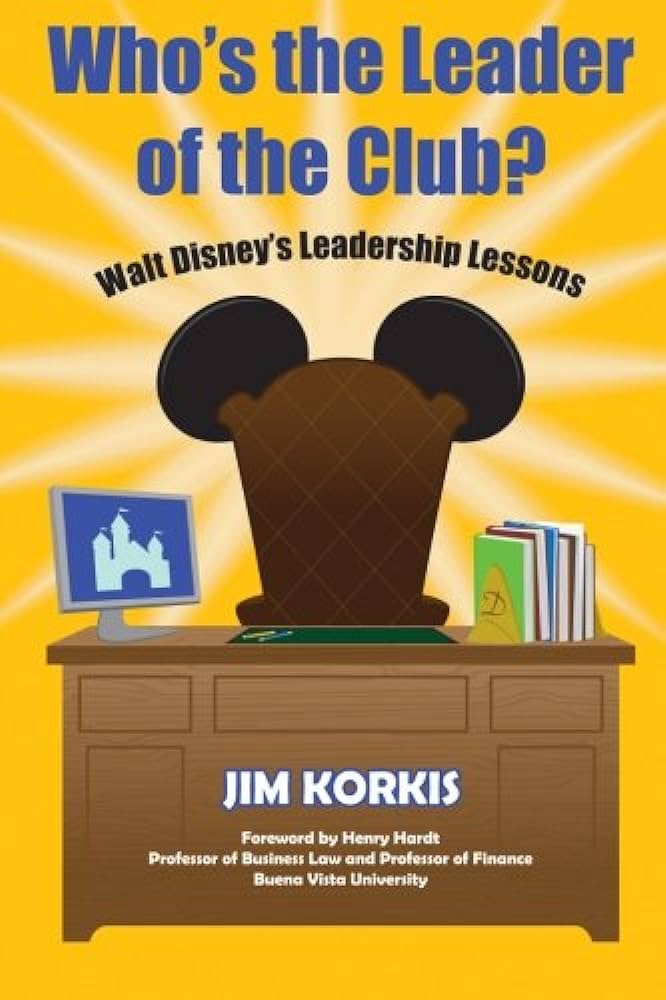
Jim Korkis was a Disney historian and long-time writer and teacher about Walt Disney and the organization he created. Who’s the Leader of the Club: Walt Disney’s Leadership Lessons is a departure for Korkis in that his usual subject matter was about the culture and history of Disney, a topic which he is uniquely qualified to write about.

As a boy, he grew up grew up in Glendale, California, which just happened to be located next to Burbank – the home of the Disney Studios. Korkis was an inquisitive and undaunted fan of Disney who not only watched the weekly Disney television series but took the initiative to write down the names he saw on the end credits.

He matched passion with inquisitiveness and began to look for those names in the local phonebook. Upon finding one, he would call the individual up and ask them about their work. Many were gracious enough to invite Korkis to their homes where he spent hours being enthralled by their stories of their work at the Disney organization.

Fast forward decades, where you will find that Korkis relocated to Orlando FL to take care of aging parents. In his own words,

I got a job at Walt Disney World that included assisting with the professional business programs, where I met many executives who had worked with Walt Disney and been trained by him.

I was often called on to research, design and facilitate customized programs for different Disney clients like Feld Entertainment, Kodak, Toys “R” Us and more that touched on both the connections of the individual companies to Disney history, as well as how Walt did business.

I was tapped to do this work because of my knowledge of Walt Disney and his approach to business.

I got the opportunity to meet with some of Walt’s “original cast.” I was enthralled by their stories and experiences and took detailed notes. Hearing stories about how Walt led and how he expected others to lead with compassion, integrity and common sense made a huge impact on me.

Twenty years later, the result was Who’s the Leader of the Club.

Korkis goes to great lengths to use Walt Disney’s own words, from a variety of published and unpublished interviews, as well as the words of those who personally experienced him in action, to help elaborate and describe the basic concepts.

In doing so, Korkis delivered to us a refreshing breath of fresh air – a business book using the words and actions of a rare genius that are glaringly absent from most organizations today.

68 years after Walt Disney’s death, and on the occasion of the 100th anniversary of the Disney Company, his achievements and legacy continue to inspire new generations.

In my case, it’s actually to re-inspire older generations! As a Baby Boomer, I grew up with “The Wonderful World of Disney” as a weekly television show. As a child, I was taken to see most of the Disney films of the 60’s and early 70’s. As a teenager, I took myself – and then, once I became a father, took my family to see those movies. Though I only visited Walt Disney World once as a teenager, I maintained a fascination with the Disney organization that has continued to grow through the years.

In the early 2000s my vocational role as a consultant with churches took on a specific niche – a focus on guest experiences. That lead to a Disney immersion of research, books, films, on-site visits, and conversations with Disney Cast Members past and present. Over the past decade plus, I have spent over 100 days on Disney properties from coast to coast – and on the oceans. My Disney library numbers over 475+ volumes – the oldest released in 1939; the newest released in the last few weeks.

Vital to that immersion was the work of Jim Korkis – through his books and writings for and about Walt Disney and the Disney organization.

By his own admission, Who’s the Leader of the Club was the most difficult book Korkis has ever written. That may be true from his perspective, but the words and stories flow off the page and into the reader’s conscience in an almost imperceptible manner.

Leaders of any organization would do well to settle in with Who’s the Leader of the Club, and be prepared for a story-filled journey of insight into one of the most creative geniuses of recent history.

Along with the stories the reader will find seven “lessons” about Walt Disney’s leadership. Best of all, Korkis concludes each of the “lesson” chapters with a one page checklist called “What Would Walt Do?” summarizing the key points in the lesson and a space to write notes.

For those who are more curious about the chapters in the book, here is the Table of Contents:

Section One: Disney And Leadership

  • Who Was Walt Disney?
  • What Type of Leader was Walt?
  • Leaders and Managers: Walt and Roy
  • Roy O. Disney and Manager Skills
  • Walt Disney and Leadership Skills

Section Two: Leadership Lessons

  • Lesson One: Know The Story
  • Lesson Two: Share The Story
  • Lesson Three: Take a (Calculated) Risk
  • Lesson Four: Make ‘Em Laugh
  • Lesson Five: Eager To Learn
  • Lesson Six: Understand People
  • Lesson Seven: Live The Story (Integrity)

Section Three: Additional Guidance

  • Walt’s Bad Leadership Traits
  • Walt’s Advice to Leaders
  • Create Leaders
  • Letting People Go
  • Walt and Money
  • Do You Know Your Story?
  • Remembering Walt’s Leadership (Quotes from those who worked for Walt)
  • Final Words from Walt (Quotes from Walt not previously used in the book)
  • Recommended Reading
  • Quotation Sources

Of course, when Korkis wrote the book, he could not have anticipated the  uncertainty caused by the disruption to the Disney “kingdoms” around the world by the pandemic in 2020 and the ongoing uncertainties since then.

Disney emerged from the pandemic a greatly-changed organization – and future generations of families – and leaders – will benefit from it. Recent announcements highlight a 60 billion dollar investment in Disney properties around the world. Only time will tell if they come to fruition.

After all, Walt Disney himself went through countless setbacks, and even failures, before the launch of the Walt Disney Company in 1923…

…and look what that has brought to the world in the 100 years since!

What are you waiting for? It’s time to join the “club!”


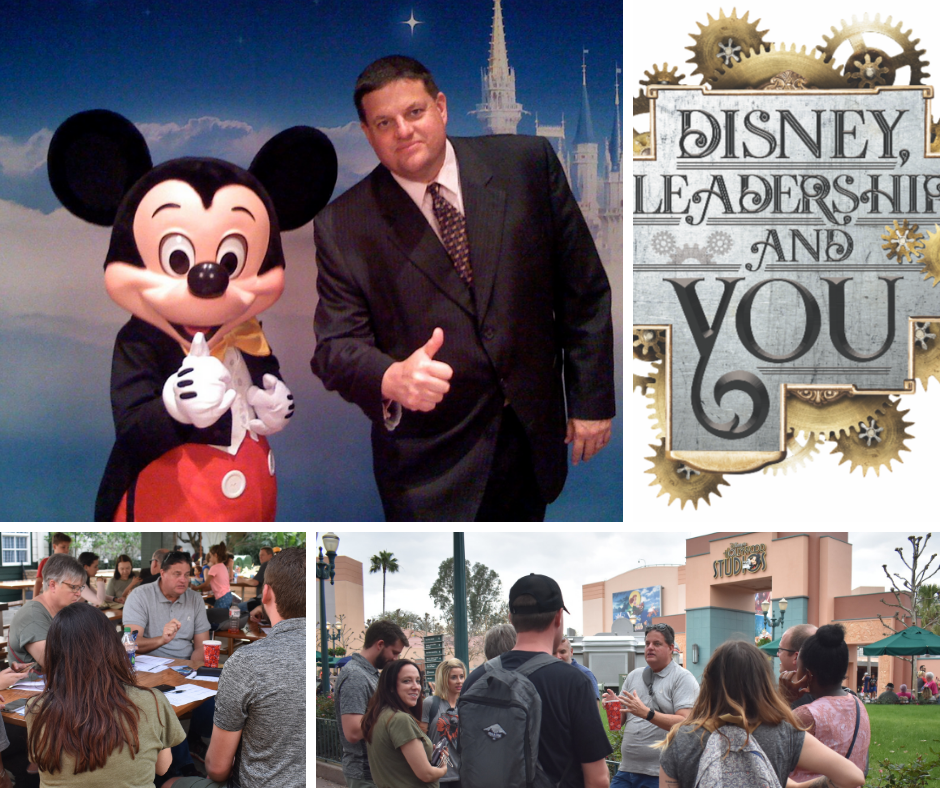
J. Jeff Kober’s book, “Disney, Leadership, and You” is an excellent work that more than delivers on its title.

Drawing from an inquisitive mind and keen insight, Kober has nearly five decades experience with Walt Disney – from both within and without the company – which provide a very readable, practical, and thoroughly enjoyable leadership book that you will find yourself returning to time and again for just the right nugget to use.

I have known of Jeff for years through his writing, and several years ago was grateful to meet him and engage his services for an immersive park experience with a group I was leading. The warmth, wit, and sheer knowledge of Disney, coupled with his ability to instantly link it to practical applications of my group, was one of the highlights of our experience. That same experience has been translated into this book.

If you are a leader in any size or type of organization, the stories Jeff Kober has captured in “Disney, Leadership, and You” should be a valuable addition to your library, a source of personal encouragement, and a wealth of practical training for both you and your team.

The book is divided into four sections:

  1. Defining Leadership
  2. Leaders Attain Results
  3. Leaders Build Relationships
  4. Putting It All Together

In those four sections you will find 18 themed chapters, each chock full of leadership principles illustrated with stories of Disney leaders from all ranks. The principles are solid in themselves, but what makes them memorable is the stories of the Cast Members.

The stories and principles perfectly describe how Disney Cast Members create magic each day through their hard work and respect for Walt Disney’s original vision.

You organization is not Disney, but you can learn from their excellence. “Disney, Leadership, and You” is an extraordinary source of lessons and learning to help you make a dramatic impact on why you do, what you do, and how you do it.


Leadership means that a group, large or small, is willing to entrust authority to a person who has shown judgement, wisdom, personal appeal, and proven competence.

Walt Disney

Research

Disney at 100: Guest Experience Excellence

Do what you do so well that they will want to see it again and bring their friends.

Walt Disney

Cinderella Castle at the Magic Kingdom in Walt Disney World is beautiful from every angle…

…but the most interesting view is underneath.

Deep underneath Cinderella’s castle in the middle of the Magic Kingdom is a utility corridor running from Main Street Square to Fantasyland. There is also a circular corridor running around the circumference of the Magic Kingdom. Though it gives the appearance of a tunnel, and many Cast Members call it a tunnel, these long passageways are really corridors, built on ground level and then covered over with 5 million square yards of dirt and sand dredged to create all the beautiful water features you see around the park. The visible park you see is really the second story of the park – but that’s really another story.

In recent years I have spent over 100 days at Disney parks, museums, and a cruise. Because of proximity, most of that time was at Walt Disney World, with much of the time observing and talking with Cast Members and Guest Experience Managers of all four theme parks. In a one year stretch, I was able to be on Disney property 31 days! During my time onsite, there have been many stories but there is no better summary than this:

Imagine, if you will, that long central corridor described above where almost all Magic Kingdom Cast Members pass through in their work at the park. To one side of that corridor, beginning a long wall of photos, sayings, and displays of the history of Walt Disney World, is a very large, but simple poster with a picture of Walt Disney and these words:

Walt Disney’s vision for a great guest experience:

Safety, Courtesy, Show, Efficiency

In a line past that poster, you will see 4 more large posters, with a smiling Cast Member’s picture on each, with these words below:

  • I practice safe behaviors in everything I do
  • I am courteous and respectful to Guests of all ages
  • I stay in character and perform my role in every story
  • I use my time and resources wisely

Known by various terms but most often called the 4 Keys, they were a result of Walt Disney’s vision for Guest Experiences – first at Disneyland when it opened in 1955, then at the Magic Kingdom in 1971, and at every other theme park, cruise ship, and Disney organization since then.

In literally every conversation I had, the 4 Keys were mentioned – as a group, as individual stories, and how they are used as training tools.

That’s powerful.

These 4 keys are simple service standards, and they can be powerful tools in any organization – but especially in churches that want to provide an Exceptional Guest Experience.

There is power in establishing a framework of values from which everyone in your organization operates. Within that framework, you can empower team members in a way that gives them a sense of ownership and purpose. You create a consistent image across the entire organization.

Disney’s standards have stood the test of time for almost 70 years – shouldn’t you consider creating standards for your organization that will stand the test of time as well?

Yes, you should. And here’s the guide to help you do just that!

Whether they are called clients, customers, constituents, or, in Disney-speak, Guests, all organizations must better serve the people who purchase their products and services or risk losing them. Now, for the first time, one critical element of the methods behind the magic that is the Walt Disney World Resort – quality service – is revealed in Be Our Guest.

Even before Tom Peters and Bob Waterman profiled Walt Disney World Resort in their groundbreaking book In Search of Excellence, the most popular resort destination in the world enjoyed a reputation as a company that sets the benchmark for best business practices.

Be Our Guest outlines proven Disney principles and processes for helping your organization focus its vision and align its people and infrastructure into a cohesive strategy that delivers on the promise of exceptional customer service.

Five years after the publication of Imagineering in 1996, Walt Disney Studios CEO Michael Eisner had finally overcome the hesitations he had for years regarding Disney’s “insider’s secrets” – first with Imagineering, and now with the Guest Services found in the Parks and Resorts. It also marked the 15th anniversary of the Disney Institute – professional development programs delivered to organizations worldwide.

At the time of the publication of Be Our Guest in 2001 (and revised in 2011), the Disney Institute had established a significant presence in the training world for its ability to appeal to leaders in multiple industries, and to customize content into programs that uniquely connected participants to their own heritage, values, people, and guests.

And what better way to highlight the Disney Institute than to shine a spotlight on quality service?

Quality Service means exceeding your guests’ expectations and paying attention to detail.

Be Our Guest has been the invitation for people coming to a Disney theme park long before the song from “Beauty and the Beast” became a box office hit.

It underscores an important element in the Disney vocabulary, that customers are not referred to as such, but rather as Guests. In the Disney nomenclature, the word “Guest” is capitalized and treated as a formal noun.

What’s the difference between treating someone like a customer, and treating someone like a Guest?

The obvious analogy is that we do things differently when we bring Guests into our home. We clean up the house. We dress up. We prepare something special to eat. We host them. We take care of their real needs.

Disney Expects Guests

This principle has to be the starting point, the foundation on which all else is built. Everything – and I mean everything – is done with the Guest in mind. At Walt Disney World, exceeding Guest expectations is the standard call to duty for all cast members, both those “onstage” and “backstage”.

At Disney, everyone is a part of the Guest Experience team.

For years, Disney cast members talked of sprinkling “pixie dust”  to create magical experiences for their Guests. There really wasn’t any pixie dust – but the pixie dust was real in that it is the show that has been created from the moment a Guest arrives on the property until they leave for home.

It’s a practical magic that occurs both onstage (whenever cast members are in public areas of the parks and in front of Guests) and backstage (when they are behind the scenes where the everyday work of operating a city devoted to entertainment is conducted).

The onstage component of practical magic is the response that it produces in Guests when everything comes together in a seamless, seemingly effortless performance. The backstage component is comprised of the nuts and bolts of creating practical magic. Practical magic is whatever it takes to exceed Guest expectations.

Superlative face-to-face service is just one element in the work of exceeding Guest expectations. It means:

  • Paying attention to every aspect of the Guest experience
  • Analyzing that experience from the Guest’s perspective
  • Understanding the needs and wants of the Guest
  • Committing every element of the business – from the design of each element of the infrastructure to the interactions between Guest and cast – to the creation of an exceptional experience for each of them

Exceeding Guests’ expectations is Disney’s service strategy, and paying attention to every detail is the tactic by which it is accomplished.

  • Friendly, helpful Parking Teams
  • Getting you from the parking lot to the park entrance
  • Beautifully maintained landscaping
  • Trash – nonexistent
  • Baby strollers organized and waiting for Guests
  • Team Leaders visible everywhere – leading by example
  • Personalizing and enhancing the Guest Experience
  • Giving a “face” to the place

Disney expects Guests – and plans to exceed their Guests’ expectations every time. What about you?

The Disney organization is perhaps the greatest practitioner of Guest Experiences around today. Books have been written about what the “cast members” at Disney do to make people feel welcome (I know – I’ve read all of them, and own most of them).

As we move into the holiday season, I’m reminded of a very special visit to Walt Disney World about this time of year. My wife and I “opened and closed” the Magic Kingdom (we were there from the opening at 8 AM to closing at midnight) including Mickey’s Very Merry Christmas Party as a part of a wedding anniversary celebration.

Once again, I was amazed at the exceptional attitude of the cast members.

Observing hundreds of Cast Members, dealing with tens of thousands of Guests, there’s only one word to describe their attitude: Magical.

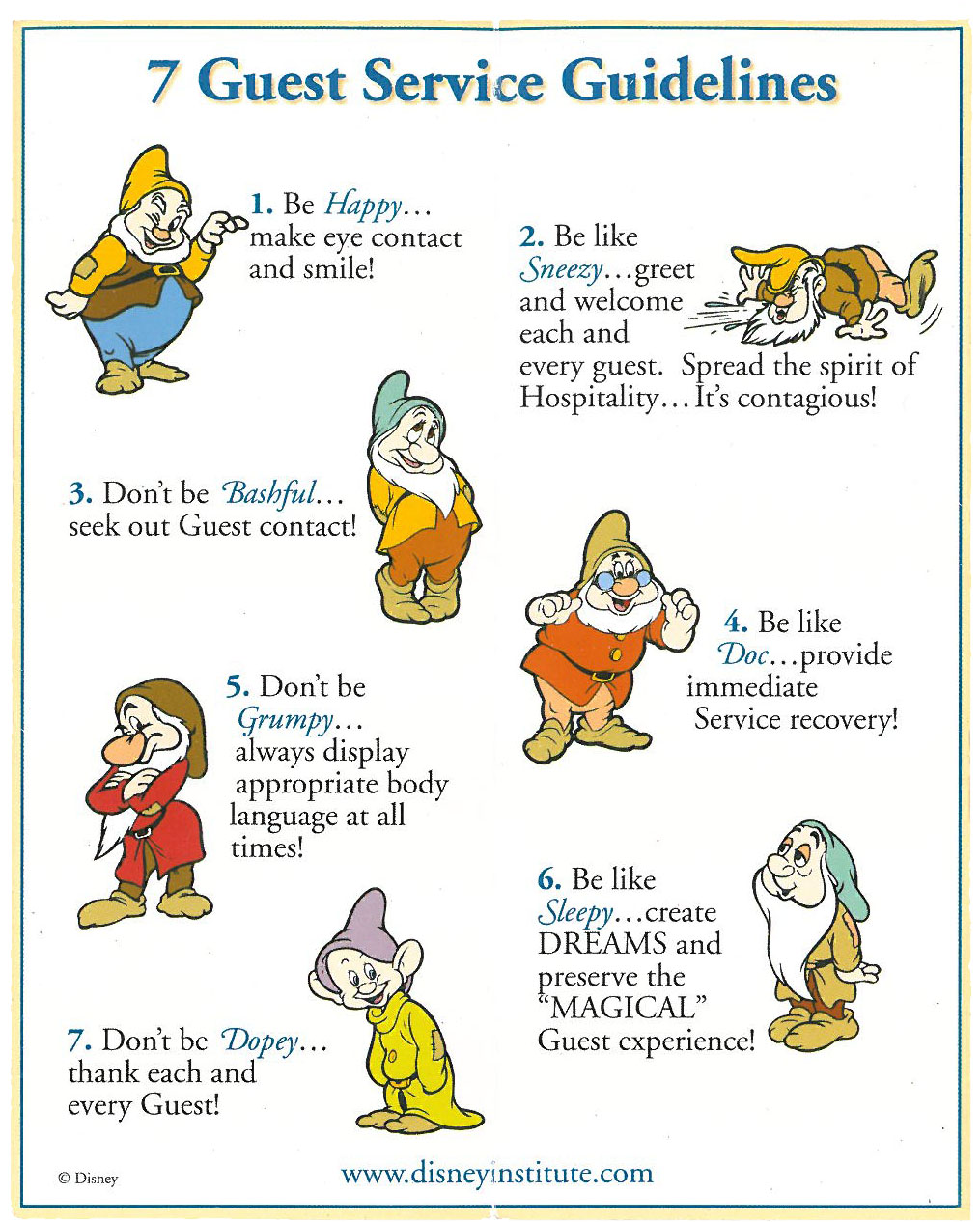
So I’m sure you won’t mind if we go backstage and back in time at Disney to learn about their 7 Guest Service Guidelines – a list of actions that every Disney team member learns during their orientation.

When Disneyland opened in 1955, Disney was looking for a set of generic behaviors that ensured that cast members knew how to act courteously and respect the individuality of each Guest. Over the first ten years, the four values of Safety, Courtesy, Show, and Efficiency became the foundation from which all succeeding service standards were developed.

During the 1960s, these standards were translated into a set of behavioral actions called Guidelines for Guest Services, which became the centerpiece of training for all Disney cast members. Appropriately enough, the seven guidelines were personalized with the characters from the seven Dwarfs:

7 Guidelines for Guest Services

  • Make eye contact and smile
  • Greet and welcome each and every Guest
  • Seek out Guest contact
  • Provide immediate service recovery
  • Display appropriate body language at all times
  • Preserve the “magical” Guest Experience
  • Thank each and every Guest

These seven phrases serve a variety of purposes. First, they define behavior in terms of Guests. They also communicate cast member responsibilities. Finally, they showcase ways to customize service to individual Guests.

Even though these Guidelines don’t exist in this form anymore, my experiences over the years reminded me that the spirit of the Guidelines are very much in practice by cast members today.

Your organization probably won’t have tens of thousands of people coming through your doors every day – but the principles Disney uses as a baseline starting point for training its Cast Members are appropriate your use.

I don’t want the public to see the world they live in while they’re in the park. I want them to feel like they’re in another world.

Walt Disney

References

Disney at 100: Examining the Vision of Walt Disney

Get a good idea, and stay with it. Dog it, and work at it until it’s done, and done right.

Walt Disney

Frequent readers of this site know of my fondness (well, let’s call it what it is – extreme fanaticism) for the genius of Walt Disney and the amazing “kingdom” that bears his name. Recently, I’ve been researching the early history of animation at Disney through various sources, mostly first-person accounts of the animators from the 1930s.

When I had the opportunity, I also spent a few days in Anaheim, CA at Disneyland and Disney California Adventure. In a unique dining experience while talking with Cast Members, I was reminded again of the vision Walt Disney exercised to bring Snow White and the Seven Dwarfs to life.

carthaycirclefb-1

Tucked inside the entrance gates to Disney’s California Adventure is an iconic reproduction of the Carthay Circle Theater in Los Angeles. One of the most important theaters in the Golden Age of Movies during the Twenties and Thirties, it represents the premier of a tremendous achievement by Walt Disney – the first full length animated film, Snow White and the Seven Dwarfs.

Though we now view Snow White and the Seven Dwarfs as an animation classic, in the mid-1930’s the idea of a full-length “cartoon” was unheard of. Walt Disney took one of the biggest risks of his career, putting almost all of his resources – both business and personal – into the film. Called “Disney’s Folly” by most of Hollywood (and more than a few inside Disney Studios itself), the film opened to critical and financial success, paving the way for Disney to continue expanding his creative genius.

With critics becoming more vocal, Walt Disney knew he would have to inspire his team of artists and writers as never before.

The rest is history…

Ken Anderson, Art Director for Snow White, remembered it this way:

Walt approached a group of employees late one afternoon, gave each of them fifty cents, told them to grab dinner across the street and then return to the soundstage that evening. None had any idea of what Walt had in mind.

When they arrived and took their seats on wooden tiers at the back of the room, Walt was standing at the front lit by a single spotlight in the otherwise dark space.

Announcing that he was going to launch an animated feature, he told the story of Snow White, not just telling it but acting it out, assuming the character; mannerisms, putting on their voices, letting his audience visualize exactly what they would be seeing on the screen. 

He became Snow White and the wicked queen and the prince and each of the dwarfs.

Anderson said the performance took over three hours. One animator later claimed, “that one performance lasted us three years. Whenever we’d get stuck, we’d remember how Walt did it on that night.”

– Neal Gabler, “Walt Disney-The Triumph of the American Imagination

But there’s more to the story…

Along about the same time, Disney demonstrated his vision in another way. The new medium of television, though in its infancy, was growing.

According to Keith Gluck, writing for The Walt Disney Family Museum,

Before Walt Disney even understood the new medium of television, he still had the foresight to invest in it. Walt had learned from dealing with shady characters in the past to pay close attention to contracts. When his distribution deal with United Artists was coming to a close, he chose not to renew. UA was insisting on the television rights to all Disney cartoons. “I don’t know what television is, and I’m not going to sign away anything I don’t know about,” Walt said. He ended up signing with RKO Pictures in late 1935.

Snow White and the Seven Dwarfs premiered in 1937, distributed by RKO Pictures. It was a smashing success, and was later given an honorary Academy Award for its groundbreaking achievements. It was no typical Oscar, either – the award instead was one statuette with seven miniature statuettes!

There’s one more piece to this vision puzzle…

Over a decade later, Walt’s interest in television began to develop. In 1948 he spent a week in New York with the specific purpose of watching and learning more about television. By the time he returned to the Studio, he was convinced it was just the forum to help promote his work. He even told Studio Nurse Hazel George, “Television is the coming thing.” While other movie studios were trying to think of ways to thwart the coming of television, Walt was gearing up to embrace it. 

 – Keith Gluck, The Walt Disney Family Museum

By being the first studio producer to become involved with the fledgling medium of television, Disney was able to leverage that partnership into a financing arrangement that allowed him to bring another dream to reality – Disneyland.

Walt had a grander vision of what his shows could do on ABC, and how they could be used to promote Disneyland. Despite pressure from the other studios, Walt and Roy Disney signed a contact with Leonard Goldenson of ABC, in which the network put up $500,000 in cash, guarantee $4.5 million in loans, and receive one-third ownership in Disneyland (which it later sold back to Disney).

– J. Jeff Kober, Disney’s Hollywood Studios: From Show Biz to Your Biz

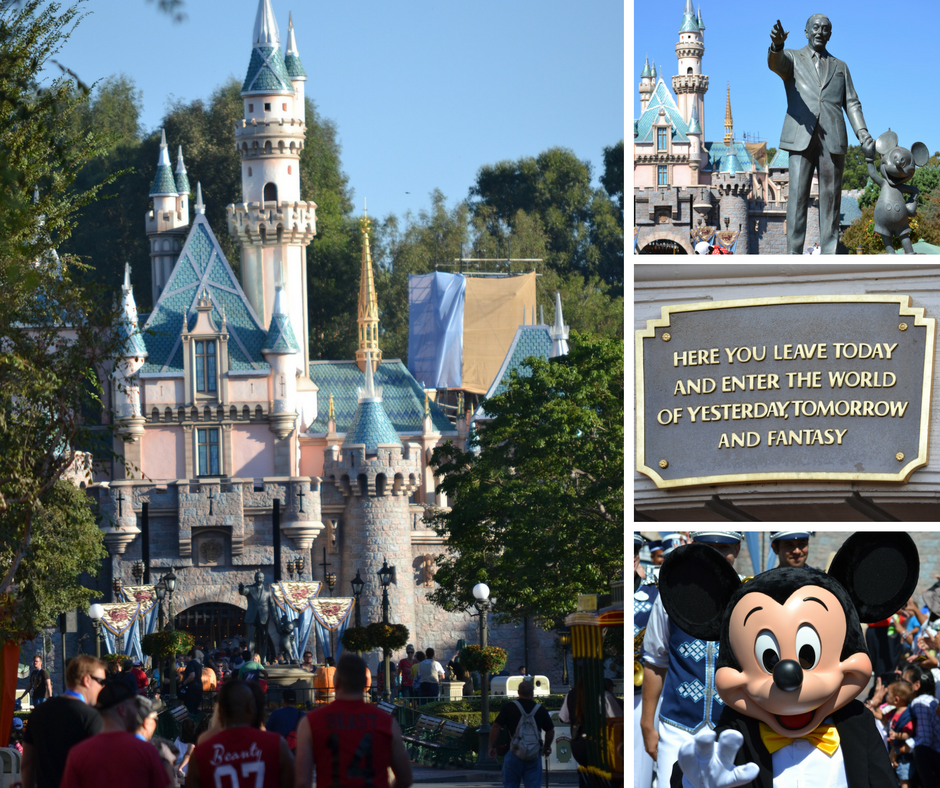
With the opening of Disneyland in 1955, Walt’s vision and imagination took on a reality that people could see, hear, and feel – an experience that changed entertainment forever.

disneyland2-fb-1

Walt Disney’s Vision Lesson for Leaders Today

Walt Disney’s unique vision, personalized in the telling of Snow White, demonstrated in the far-reaching aspects of a contract, and brought to life at Disneyland, can be a model for leaders today.

What vision is burning inside of you, a vision that can captivate your team, influence the influential, and be brought to life in your community?


People often ask me if I know the secret of success and if I could tell others how to make their dreams come true. My answer is you do it by working.

Walt Disney

References

Disney at 100: How Teamwork Makes the Dream Come True

To make the dream of Disneyland come true took the combined skills and talents of hundreds of artisans, carpenters, engineers, scientists, and craftsmen. The dream they built now becomes your heritage. It is you who will make Disneyland truly a magic kingdom and a happy place for the millions of guests who will visit us now in the future.

Walt Disney, to Disneyland Cast Members in 1955

In 2017, I was able to be at Walt Disney World for 31 days – most time spent in the parks and resorts in any calendar year of my long history there.

Thanks to the unexpected generosity of two of my kids, my 2016 Annual Pass was renewed for 2017. That, coupled with a lot of client work in the Central Florida area, was all I needed to have an amazing year of yes, magical, experiences.

Let me unpack this a little: I don’t do attractions that have motion to them (vertigo). Most of those days were solo trips (though I did have some very special time with my wife in April, and my wife and daughter in November). On a few of those days I would drop in for just a few hours – maybe during the evening hours for a single show and a meal. On most of the days, it was a full day experience including a stay in one of the Resorts. On one particular day, I spent almost 20 hours at the Magic Kingdom, beginning with a 5:45 a.m. visit with the Parking Lot Cast Members, and ending at 2 a.m. the next day closing the park out.

As one of my friends put it, “Why?”

Simply put, I am always amazed by the Cast Members as they fulfill Walt Disney’s dream referenced above for Disneyland, and by extension, to all Disney endeavors the world over.

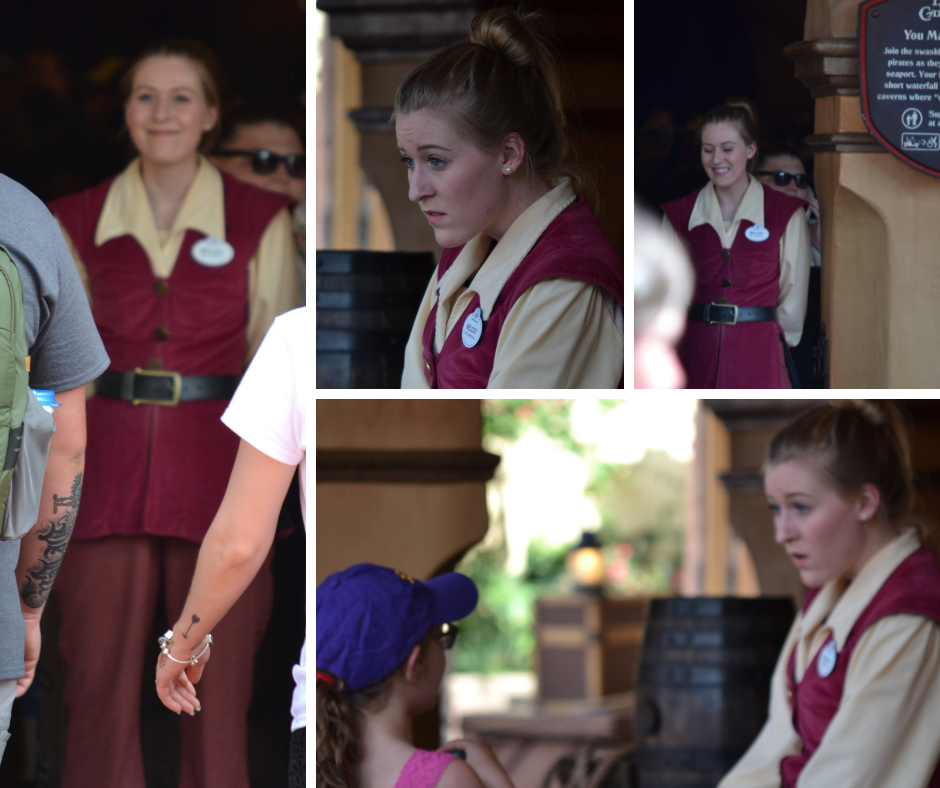
A picture is worth a thousand words:

Start with the image on the left: the Cast Member is smiling at the large crowd headed her way. But as you look at the next two images on the upper right, she is looking downward – seemingly away from the crowd approaching her. As the final image shows in the lower right, her focus all along has been on children right in front of her, but masked by the crowd from my initial viewpoint.

Boom.

The 31 days at Walt Disney World provided me with dozens of conversations with current and former Cast Members just like this. I was able to spend hours just watching interactions between Cast Members and Guests. I photographed thousands of “moments” that tell stories. Whether an hour or a day, my time at Walt Disney World provided an immersion into the excellence of Disney’s Cast Members when it comes to interactions with Guests.

Here are just a few personal stories from my Disney visits that would illustrate this takeaway:

  • The very helpful Cast Members who helped with my Backstage Magic tour arrangements
  • Cast Members at the parking lot ticket booth and in the parking lots who understood I was just being dropped off for the day
  • Bob, the Security Team member who told me I was in for a good day
  • Wayne and Ernesto, our Disney Institute tour guides, who were knowledgeable and passionate about all things Disney
  • The funny and loud Cast Members of the Whispering Canyons restaurant, who fed and entertained us at the same time
  • Cast Members who smiled and greeted us backstage and onstage all day

I could go on and on, but maybe the best story is one from the past:

courtesy Disney Imagineering

In 1978, Disney announced it was opening another part of Walt Disney World in 1982. Not just a new section – this was Epcot, one of Walt Disney’s original dreams for Disney World. And the opening was specific: October 1, 1982.

At the time, Epcot was the largest construction project in the world. Most of the people working on the project did not work for Disney; they worked for all the contractors and subcontractors all over the country.

What Disney decided to do was to make these workers feel as though they were part of the Disney family – to get them to identify with Epcot even though they weren’t actually part of the Disney organization. Here’s how they did it:

They closed down the job site one Sunday a month for over a year. Keep in mind that this was the world’s biggest construction project, moving toward a rock-solid deadline that had been announced almost four years in advance. To shut the place down one day a month was a big deal.

Disney brought in several big circus tents and set the up in what was eventually to be the Epcot parking lot. Food service went in one of the tents – hot dogs, hamburgers, and the whole works – a picnic.

In another tent, the Disney Imagineers created a miniature Epcot: the ground was sculpted to show where the land and water would be; photographs of the work were posted; artists’ renderings showed what the completed project would look like. Everything was kept up-to-date for over a year.

On that one Sunday a month, the project was shut down, and all the construction workers and their families were invited to enjoy the picnic and look around. They would enjoy the food and see what their Dad or Mom was doing.

Disney continued this for over a year so the families could watch it grow and the workers could see what they were creating – not just the big picture, but where their piece happened to fit into the big picture.

This went on all the way through the construction cycle until Epcot opened. The $1.2 billion project came in on time and on budget, with very few snags. This was in part thanks to thousands of people who were not Cast Members, and had little motivation to do so. Disney wasn’t writing their checks; they weren’t giving them benefits. They couldn’t do the traditional things that you normally do to keep employees happy.

Instead, they treated them like Cast Members. And it worked. At the grand celebration of the opening of Epcot, there was a huge celebration with thousands of people attending – most of them the construction workers and their families.

When a rough-necked iron worker is seen wearing mouse ears, you know he understands the dream.


Don’t you love the surprise of getting something extra when you least expect it?

Disney’s Custodial Cast Members are some of my most favorite Cast Members to observe as they go about their role. It’s a very important role, far more than you might think. The Custodial Cast Member is much more than a “janitor” or a “street sweeper.” They are independent for the most part – meaning they have the freedom to move around in different sections of the parks because of their white costumes don’t clash with any theming. They receive extra training because of their visibility and accessibility. Their official title is Custodial Guest Services Cast Member for a reason – their very visible presence in all the parks allows them to answer guest questions, make personal connections, and create artwork…

Wait a minute – create artwork?

That’s what I said! In addition to upholding Walt Disney’s vision for keeping the parks clean for guests, members of the custodial team can also become water artists.

Custodial Cast Members can sign up for a class where they learn to draw various Disney characters with their pan, broom, and a little water.

Not to be outdone, on a recent trip to the Magic Kingdom I even saw a few regular Cast Members practicing a little art magic with masking tape.


Lee Cockerell, former executive vice president of operations at Walt Disney World Resorts, talks about this in his book The Customer Rules:

With a little bit of imagination, you too can delight customers by giving them a little extra when they least expect it. They’ll surprise you in turn by coming back early and often and by singing your praises to others.

Lee Cockerell, The Customer Rules

That’s right – some of the best comments and thanks from Guests go to the Custodial teams. That speaks so powerfully to the culture at Disney.

Now for a tough question – think of the “least desirable role” in your organization. Do those team members have the same passion and culture exhibited by the Custodial Cast Members at Disney?


We train them to be aware that they’re there mainly to help the guest.

Walt Disney

References

Disney at 100: Bringing the Story to Life

From blue sky ideation, to pencil on paper, to digital models, to plaster and paint, Imagineers build dreams. They never say “never,” and the sky is not the limit. That quest has created a new art form and a new kind of artist, one whose canvas is the world itself and whose tools are whatever it takes to turn that world into a fantastic, enveloping story.

Leslie Iwerks, “The Imagineering Story”

The books in my Disney library are a valuable resource for my ongoing quest in learning the story of Walt Disney and the “kingdoms” he created; kingdoms that continue to expand in the 57 years since his passing.

But even books have limitations…

You can dream, create, design, and build the most wonderful place in the world…but it requires people to make the dream a reality.

Walt Disney

Over the years I have been fortunate to make friends among Disney Cast Members, both current and past. A handful of those friends have been Imagineers, and as you may imagine, they are amazing storytellers, creative geniuses, and innovative to the core.

So…learning more about Imagineering? Sign me up – literally!

When the news that a new steaming service called Disney+ was coming in the fall of 2019, I was delighted – so much, that I signed up for a 3-year subscription as soon as they became available.

When the initial programming schedule was released, and included the 6-part series “The Imagineering Story,” I was ecstatic – it was among the first programs I watched on the new service.

When the book The Imagineering Story was announced, I was literally stopped what I was doing and pre-ordered the book.

There’s really no secret about our approach. We keep moving forward – opening new doors and doing new things – because we’re curious. And curiosity keeps leading us down new paths. We’re always exploring and experimenting…we call it Imagineering – the blending of creative imaginational and technical know-how.

Walt Disney

The Imagineering Story continues the behind-the-scenes journeys first revealed in the books Walt Disney Imagineering: A Behind the Dreams Look at Making the Magic Real (1995) and its sequel Walt Disney Imagineering: A Behind the Dreams Look at Making MORE Magic Real (2010).

The book goes deep into the personalities, stories, and adventures of the men and women who brought create magic around the world.

More than just the theme parks (though that would have been awesome enough), every resort hotel, shop and business setting, cruise ship, and entertainment setting exists largely through the men and women of Disney Imagineering.

The Imagineering Story greatly expands the award-winning filmmaker Leslie Iwerks’ narrative of the fascinating history of Walt Disney Imagineering.

The entire legacy of Walt Disney Imagineering is covered from day one through future projects with never-before-seen access and insights from people both on the inside and on the outside. So many stories and details were left on the cutting room floor for the series – this book allows an expanded exploration of the magic of Imagineering.

Every one of the 731 pages was filled with stories that brought the Disney Experience alive.

The experience of Disney – primarily in the theme parks, but now expanded to other resorts, retail shops, and cruise ships – can be traced back to Walt Disney. His untimely death in 1966 could have left a void in the creativity of the Disney empire.

But I believe his greatest act of genius had its origins in 1952, as he began to pull together veterans of film and animation work for a special project that came to be known as Disneyland.

That group of versatile animators and art directors was the foundation of a group that came to be called the Imagineers.

Out of this group, Disney historian Tim Hauser reflects, “came the theories, aesthetics, design, and engineering of Disneyland; the advancement of three-dimensional storytelling; the development of robotic techniques in Audio-Animatronics; and the perpetuation of an ‘architecture of reassurance’ as inspired by Walt Disney’s personal sense of optimistic futurism.”

Today Walt Disney Imagineering remains the design, development, and master-planning branch of company, with over 140 disciplines working toward the common goal of great stories and creating great places.

Walt Disney wanted Disneyland to be essentially a movie that allows you to walk in and join in the fun. Imagineers – many whom had worked with Walt Disney since the 1930s – literally brought those movies to life with their multiple disciplines. He knew from his filmmaking experience that story was everything to the audience. Disney knew he must immerse the theme park guest in living storytelling scenarios.

Designing the Guest’s experience is what Walt Disney’s Imagineers came to call “the art of the show,” a term that applies to what the Imagineers did at every level, from the broadest conceptual outlines to the smallest details, encompassing visual storytelling, characters, and the use of color.

Walt Disney realized that a visit to an amusement park could be like a theatrical experience – in a word, a show. Walt saw that the Guests’ sense of progressing through a narrative, of living out a story told visually, could link together the great variety of attractions he envisioned for his new kind of park. While traveling through their stories, Guests would encounter, and even interact with, their favorite Disney characters, and who would be transformed, as if by magic, from their two-dimensional film existence into this special three-dimensional story world.

As designers, the Imagineers create spaces – guided experiences that take place in carefully structured environments, allowing the Guests to see, hear, smell, touch, and taste in new ways. In effect, Imagineers transform a space into a story place.

Ultimately, the Imagineers gave Guests a place to play, something Walt believed that adults needed as much as children. The design of the Imagineers gives power to the Guests’ imagination, to transcend their everyday routine. Walt Disney insisted that Guests should “feel better because of” their experiences in Disney theme parks, thus establishing the art of the show.

For the Imagineers, that meant considering everything within and relating to the parks as design elements. To build effective story environments and assure Guest comfort, the designers realize that they always had to assume the Guests’ position and point of view, and just as Walt did, to take the Guests’ interests to heart and defend them when others didn’t think it mattered.

It is up to the designers to provide Guests with the appropriate sensory information that makes each story environment convincing. This means that design considerations go beyond the attractions themselves to the service and operations staff, transportation, restaurants, shops, rest rooms – even the trash cans.

Everything Begins With a Story

Storytelling has played a vital role in our survival – allowing us to share information, knowledge, and values from generation to generation. Story is the medium through which we receive our early learning as to right and wrong, good versus evil, reward and punishment, social values, etc.

We respond to storytelling. It engages our attention; no matter how old we get, who doesn’t love a good story?

Understanding this, Walt Disney utilized a technique in the early days of his cartoon films that helped illustrate the flow and continuity of stories – the storyboard.

Storyboards are tools that allowed Walt and his artists to envision a film prior to production. It allowed his team to have a shared vision of the story they were telling and how it would unfold. As a bonus to driving the creative development, it also offered a cost-effective way to experiment with a film early on, so that when production began, costs could be minimized.

Decades later, the tradition of storyboards continues on, though it has long expanded past just films. At Walt Disney Imagineering, rides, shows, and films for Disney’s theme parks around the world are the objects of regular storyboarding.

For each ride, show, or attraction, a logical story sequence is created. Almost every aspect of a project is broken sown into progressive seen sketches, called storyboard panels, that reflect the beginning, middle, and end of a Guest’s park experience.

The boards are eventually covered with every written thought, idea, and rough sketch the Imagineers can come up with.

Starting with brainstorm sessions, the Imagineer’s first thoughts, ideas, images, and feelings about the story they are creating are captured on note cards and quick sketches. For example, here’s an early sketch of Animal Kingdom’s Tree of Life:

courtesy Disney Imagineering

The beauty of the Tree is matched by its engineering marvels as well. It is a massive structure, towering 145 feet into the air with a full canopy of natural-looking leaves, enclosing a 420-seat theater and meeting all building codes, including withstanding 145 mph winds. The engineering feats accomplished, it was time for the  Imagineering team of sculptors to create the magnificent bark of the tree – which is actually representations of animals. That process alone took almost a full year.

courtesy Orlando Sentinel

One of the most amazing pieces of art ever created by Disney’s Imagineers, it is beautiful and meaningful, and captures the essence of Animal Kingdom at a glance. It’s a poetic statement of the majesty of nature, the stunning diversity of animals, and our respect for our place in the world. As you approach the tree and the animal forms begin to reveal themselves, it becomes clear that there is almost no tree at all. That tree is the animal kingdom.

The experience of viewing the Tree of Life is like looking for animals in the clouds. The longer you look, the more you see – maybe even all 325 of them! This effect is the result of very careful planning during the design phase with the use of storyboards.

The storyboards are worked, re-worked, rearranged, and edited until the story is strong and clear. Only then will production proceed – with stunning results:

At Walt Disney Imagineering, everything they do revolves around the story – and storyboards have remained an essential tool in helping them tell the story.

That is the power of story – it is an experience that enables us to escape to another world, to be captivated and be in the moment.

The secret to Disney magic that the Imagineers bring to life is in the story!

Recently celebrating their 70th anniversary, the Imagineers have delivered – time and time again. To date, the Imagineers have built twelve theme parks; dozens of resort hotels; 5 cruise ships with two more under construction; 2 water parks; and ongoing development in existing parks and Disney properties around the world.

The Imagineers bring the Disney magic alive.

The Imagineering Story brings the Imagineers to life.

I have a hard time ranking the books in my Disney library – but The Imagineering Story is going to be in my all-time Top Ten from now on, and a highly-recommended book for anyone who wants a deeper understanding of the creative genius (and occasionally weirdness) of that special and unique blend of artists and engineers who took the dreams of one man, Walt Disney, and brought them to life. 

Walt was a storyteller above all. Walt didn’t write the stories but he envisioned them. He told stories better than anyone else around and he got the people around him to turn his stories into movies and theme park attractions.

Imagineer X. Atencio

References