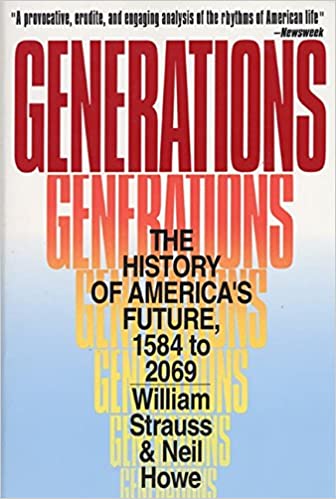
Sometime in the early 1990s, I became aware of a new book by William Strauss and Neil Howe, entitled Generations: The History of America’s Future, from 1584 to 2069. As a student of history, I eagerly dove into the book, studied it, and have revisited it often in the thirty years since.
In Generations, the authors speculate the history of America as a succession of generational biographies, beginning in 1584 and encompassing everyone through the children of today. Their bold theory is that each generation belongs to one of four types, and that these types repeat sequentially in a fixed pattern. The vision of Generations allows us to plot a recurring cycle in American history – a cycle of spiritual awakenings and secular crises – from the founding colonists through today and well into this middle of this century.
Generations come in cycles.Just as history produces generations, so too do generations produce history.
William Strauss and Neil Howe
From the book, a brief description of the four cycles:
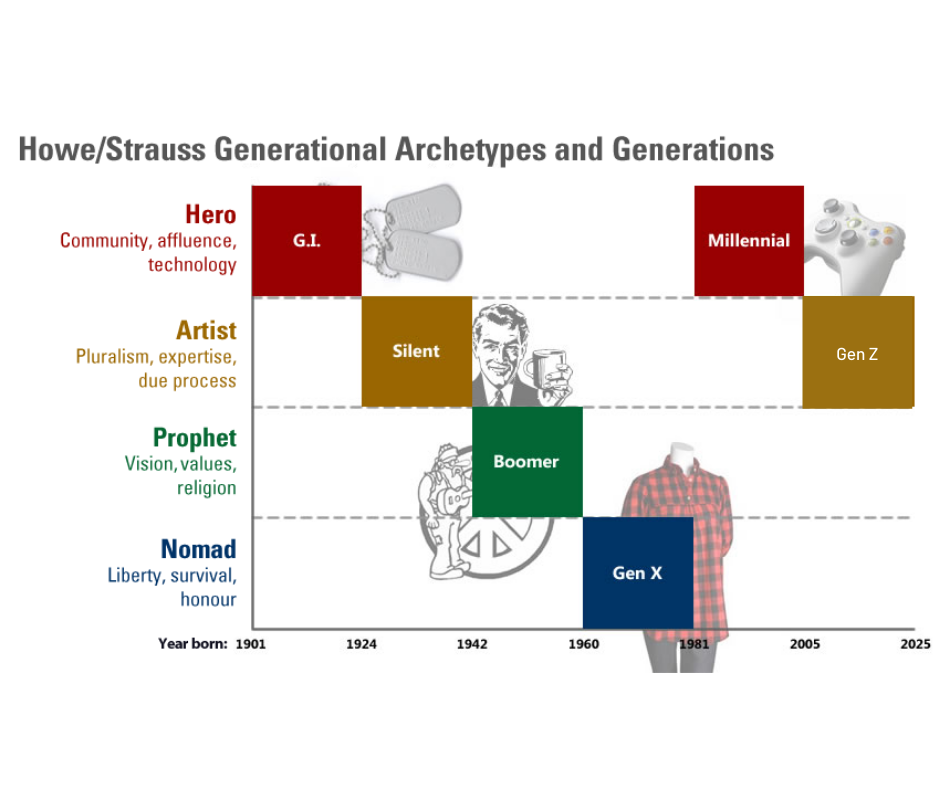
Strauss and Howe labeled the four generational types Prophet, Nomad, Hero, and Artist. With one exception, they have always recurred in a fixed order. During a spiritual awakening, Prophets are moving into rising adulthood while Nomads are appearing as children; during a secular crisis, Heroes are moving into rising adulthood while Artists are appearing as children. Later in life, these generations trigger another social moment and thus keep the cycle turning.
The first and third types are what we call “dominant” in public life – Prophets through redefining the inner world of values and culture, and Heroes through rebuilding the outer world of technology and institutions. The other two types are “recessive” in public life, checking the excesses of their more powerful neighbors – Nomads as pragmatists, Artists as ameliorators.
The passage of four generations, Prophets through Artists, completes one full generational cycle over the course of four, twenty-two year phases of life (a total duration of roughly ninety years). From the 1584 Puritan birth year forward, the authors traced five such cycles through American history – of which three (Colonial, Revolutionary, and Civil War) are fully ancestral, a waning fourth (Great Power) comprises the eldest 28 percent of the American population at the beginning of 1991 (when the book was released), and an emerging fifth (Millennial – the name of the cycle, not the name of the generational cohort) includes the youngest 72 percent. Within these cycles, we identify eighteen generations, from John Winthrop’s Puritans to Jessica McClure’s Millennials – and a recurring pattern of awakenings and crises.
Keep in mind that this was written in 1991.
So, here we are in late 2020, and what does the history of America’s future look like?
From above: during a secular crisis, Heroes are moving into rising adulthood while Artists are appearing as children.
That would be today’s Millennials moving into rising adulthood, and Gen Z appearing as children and teenagers.
So, according to Strauss and Howe, a secular crisis looms.
That pretty much describes 2020, don’t you think?
Here is where the life cycle can help. The story of civilization seldom moves in a straight line, but is rich with curves, oscillations, and mood shifts. The ebb and flow of history often reflect the ebb and flow of generations, each with a different age location, peer personality, and lifecycle story. By viewing history along the generational diagonal, by searching the cycle for behavioral clues, we can apply the mirror of recurring human experience to gaze around the corner of current trends and say something instructive about the decades to come.
William Strauss and Neil Howe
Here’s a timeline visualization of the generational cohorts:
As the leader of a team of three – or three hundred – do you think your team feels appreciated by their coworkers – and you?
Studies have shown that while we expect to get paid for the work we do, and we would all like to make more money, the number one factor in job satisfaction is not the amount of pay but whether or not the individual feels appreciated and valued for the work they do.
There is something deep within the human spirit that longs for appreciation. Without a sense of being valued by supervisors and coworkers, it can be easy to feel like you are a part of a machine or just a number.
While communicating appreciation to employees and colleagues may sound easy, there is more to it than just saying “thank you.”
Imagine a world where almost everyone wakes up inspired to go to work, feels trusted and valued during the day, then returns home feeling fulfilled. This is not a crazy, idealized notion. Today, in many successful organizations, great leaders create environments in which people naturally work together to do remarkable things.
In his work with organizations around the world, Simon Sinek noticed that some teams trust each other so deeply that they would literally put their lives on the line for each other. Other teams, no matter what incentives are offered, are doomed to infighting, fragmentation and failure. Why?
The answer became clear during a conversation with a Marine Corps general. “Officers eat last,” he said. Sinek watched as the most junior Marines ate first while the most senior Marines took their place at the back of the line. What’s symbolic in the chow hall is deadly serious on the battlefield: Great leaders sacrifice their own comfort–even their own survival–for the good of those in their care.
Too many workplaces are driven by cynicism, paranoia, and self-interest. But the best ones foster trust and cooperation because their leaders build what Sinek calls a “Circle of Safety” that separates the security inside the team from the challenges outside.
Sinek illustrates his ideas with fascinating true stories that range from the military to big business, from government to investment banking.
A SIMPLE SOLUTION
According to author Simon Sinek, when we feel like we belong to a group and trust the people with whom we work, we naturally cooperate to face outside challenges and threats.
But when we do not have a sense of belonging, we are forced to invest time and energy to protect ourselves from each other, and in so doing, we inadvertently make ourselves more vulnerable to the outside threats and challenges.
Plus, with our attention facing inward, we will also miss outside opportunities. When we feel safe among the people with whom we work, the more likely we are to survive and thrive.
As leaders, how do we learn to know and trust our team?
Perhaps the most truly valuable thing we can do if we are to truly serve our constituents is to know them personally.
It may be impossible to know all your team in a large organization, but to know the name and details of the life of someone we are trying to help makes a huge difference.
Rule 1. Keep it real – bring people together
The added complications of the virtual world often mean we use the Internet as a means to expedite and simplify communication and the relationships we build. The ability to maintain distance, even complete anonymity, has made it easier to stop acting as humans should – with humanity.
Real, live human interaction is how we feel a part of something, develop trust, and have the capacity to feel for others.
Trust is not formed through a screen – it is formed across a table. There is no such thing as virtual trust.
Rule 2. Keep it manageable – obey Dunbar’s number
Oxford professor and anthropologist Robin Dunbar arrived at the conclusion that people simply maintain more than about 150 close relationships. That magical number is the number of close relationships we are naturally designed to manage. Any more than that starts to cause a break down if rigid social systems, or effective hierarchy and bureaucracy, are not implemented to help manage the scale.
When a leader is able to personally know everyone in the group, the responsibility for their care becomes personal. The leader starts to see those for whom they are responsible as if they were their own family, and likewise, those in the group start to express ownership of their leader.
Rule 3. Meet the people you help
As social animals, it is imperative for us to see the actual, tangible impact of our time and effort for our work to have meaning and for us to be motivated to do it even better. When we are able to physically see the positive impact of the decisions we make or the work we do, not only do we feel that our work was worth it, but it also inspires us to work harder and do more.
In other words, bosses telling us how important the work is, is nowhere near as powerful as us getting to see it ourselves.
Rule 4. Give them time, not just money
Money is an abstraction of tangible resources or human effort. Unlike the time and effort that people spend on something, it is what money represents that gives it its value. Someone who gives us a lot of money, as our brains would interpret their behavior, is not necessarily as valuable to our protection as someone willing to commit their time and energy to us.
What produces loyalty, that irrational willingness to commit to the organization even when offered more money elsewhere, is the feeling that the leaders of the company would be willing, when it matters, to sacrifice their time and energy to help us.
Rule 5. Be patient – the rule of seven days and seven years
Our world is one of impatience. A world of instant gratification. A world ruled by dopamine. Google can give us the answers we want now. We can buy online and get what we want now. We can send and receive information instantaneously. We have gotten used to getting what we want when we want it.
It takes time to get to know someone and build the trust required to sustain a relationship, personal or professional. There’s no hard data on exactly how long it takes to feel like we trust someone. I know it takes more than seven days and fewer than seven years. It is quicker for some and slower for others. No one knows exactly how long it takes, but it takes patience.
Set aside a two-hour time block in your schedule. On each of five chart tablets, write one of the rules above at the top.
Spend twenty minutes on each value, writing a phrase or action that you can use to demonstrate this rule to your team. If needed, place an asterisk by actions that will need more time to develop.
After the five, twenty-minute sessions, use the final twenty minutes to go over the chart tablets and select the one, single most action for that rule that you can implement immediately – and make a pact with yourself to do so.
After one month of implementing this action, call your immediate team together to ask them if they have noticed any difference in your leadership style. If needed, prompt them with a brief comment about “appreciation.”
After a time of discussion with your team, encourage them to go through the same exercise personally, in order to implement the rules with their teams.
After three months, gather your team for a thirty-minute discussion on the “appreciation temperature” of your organization. Celebrate the successes, and challenge your team (and yourself) to keep the process moving forward.
Part of a weekly series on 27gen, entitled Wednesday Weekly Reader
Regular daily reading of books is an important part of my life. It even extends to my vocation, where as Vision Room Curator for Auxano I am responsible for publishing SUMS Remix, a biweekly book “excerpt” for church leaders. Each Wednesday on 27gen I will be taking a look back at previous issues of SUMS Remix and publishing an excerpt.
It is relatively easy to provide a great Guest Experience occasionally. You know, those big holiday events or other special occasions.
But in order to create an exceptional Guest Experience, it is vital that you do this every time.
The only way to achieve a consistently exceptional Guest Experience is if the experiences are designed.
To design something means that it is deliberate, not an accident or luck. Deliberate is a strong, proactive word. Stop and ask yourself these questions:
Is our Guest Experience process deliberate?
Did my team deliberately set out to create and deliver an exceptional Guest Experience?
Is the outcome of the Guest Experience one that we have proactively designed?
By observation, research, and onsite studies in organizations of all sizes and types across the country, in many cases the Guest Experience is not deliberate – it is something that just happens.
Guest Experience leaders care about their guests. Many leaders understand guests and have some insight into their experiences and needs. Often, though, these same leaders struggle to turn insight into action.
Design isn’t just choosing the right images and fonts for your next website revision. It’s a problem-solving process that incorporates the needs of guests, team members, and partners in your mission. It’s a way of working that creates and refines real-world situations.
Design is the secret weapon of organizations that gives them a strategic advantage in figuring out what services their guests need and in defining the exact characteristics of every guest interaction. Design helps you understand how a guest accesses your website, what a guest is likely to do as they approach your campus, and gives you clues about creating a welcoming environment.
Design is the most important discipline that you’ve probably never heard of.
The right Guest Experience changes, implemented the right way, won’t just fall into your lap. You must actively design them. This requires learning – and then sticking to – the steps in a human-centered design process.
THE QUICK SUMMARY – Outside In, by Harley Manning and Kerry Bodine
Customer experience is, quite simply, how your customers perceive their every interaction with your company. It’s a fundamental business driver. Here’s proof: over a recent five-year period during which the S&P 500 was flat, a stock portfolio of customer experience leaders grew twenty-two percent.
In an age when customers have access to vast amounts of data about your company and its competitors, customer experience is the only sustainable source of competitive advantage. But how to excel at it?
Based on fourteen years of research by the customer experience leaders at Forrester Research, Outside In offers a complete roadmap to attaining the experience advantage. It starts with the concept of the Customer Experience Ecosystem—proof that the roots of customer experience problems lie not just with customer-facing employees like your sales staff, but with behind-the-scenes employees like accountants, lawyers, and programmers, as well as the policies, processes, and technologies that all your employees use every day. Identifying and solving these problems has the potential to dramatically increase sales and decrease costs.
A SIMPLE SOLUTION
Organizations that want to produce a high-quality guest experience need to perform a set of sound, standard practices. Harley Manning and Kerry Bodine, in their book Outside In, have developed six high-level disciplines which can be translated into guest experiences: strategy, guest understanding, design, measurement, governance, and culture.
These disciplines represent the areas where organizations that are consistently exceptional at Guest Experiences excel.
Restating a comment from above, the only way to achieve a consistently exceptional Guest Experience is if the experiences are designed.
If you want to deliver an exceptional Guest Experience, you need to begin with the discipline of design.
The discipline of design is key because it lets organizations understand the current customer experience they provide, uncover opportunities for improvement, and track progress over time. It connects the dots starting with what needs to be done to improve customer experience, all the way to the benefits of what has been done.
The human-centered design process starts with research to understand guest needs and motivations. It’s all those activities in the discipline of understanding guests. Analysis is next – synthesizing the data into useful forms. The next phase is ideation, which is just what it sounds like – coming up with ideas. After that, it’s time to prototype – ranging from a simple redesigned guest survey to a full-scale mock-up of your typical guest experience on the weekend. Next, these prototypes are put into action with real people while you observe the results. Finally, you must document the features of the resulting product or service that has evolved.
The practices in the design discipline help organizations envision and then implement customer interactions that meet or exceed customer needs. It spans the complex systems of people, products, interfaces, services, and spaces that your customers encounter in physical locations, over the phone, or through digital spaces like websites and mobile apps.
Design spells the difference between a symphony orchestra performance and a garage band jam session. The orchestra performance is carefully arranged, rehearsed, and executed – just like the customer experience at top organizations. The jam session just sort of happens, with varying levels of quality – like what we’ve all encountered at companies we’ve stopped doing business with over time.
Design Practices
Follow a defined Guest Experience design process any time a new experience is introduced or an existing experience is changed in some way
Use guest understanding deliverables and insights to focus and define requirements for projects that affect Guest Experiences
Engage guests, team members, and partners as part of the experience design process
Use iterative ideation, prototyping, and evaluation as part of the experience design process
Identify the set of complex interdependencies among people, processes, and technologies that shape interactions with guests (the Guest Experience Ecosystem)
At your next Guest Experience team leader’s meeting, make the discipline of design the primary topic.
First, write the six words in bold from the first paragraph above (research, analysis, ideation, prototype, action and document) down the left side of a chart tablet.
Next, come up with a single Guest Experience action you are not currently doing but would like to implement in the next six months, writing the action on the top of another chart tablet.
Now, walk through each of the six steps, writing down ideas or actions needed for each step. At this stage, you don’t have to fully develop the proposed action – you are just creating a “design criteria list” for follow up.
After you have exhausted all ideas, go back and circle no more than three items under each step, representing the most important ones to do.
Identify one leader and two additional members from your team to take the proposed action and run with it. Using both the six steps and the five “Design Practices” noted above, they will recruit additional team members as needed to follow the actions as outlined, and bring a ready-to-proceed recommendation back to the larger team for a decision.
Excerpt taken from SUMS Remix 125, released August 2019.
Part of a weekly series on 27gen, entitled Wednesday Weekly Reader
Regular daily reading of books is an important part of my life. It even extends to my vocation, where as Vision Room Curator for Auxano I am responsible for publishing SUMS Remix, a biweekly book “excerpt” for church leaders. Each Wednesday on 27gen I will be taking a look back at previous issues of SUMS Remix and publishing an excerpt.
People generally see what they look for, and hear what they listen for.
Judge Taylor in Harper Lee’s To Kill a Mockingbird
People are blind to the unexpected, the unusual, the periphery.
That’s all 2020 has been.
We’re at an unprecedented juncture in history: several generations of relatively similar size are sharing the stage and competing for influence. Generations matter because they behave in specific ways related both to when they came of age and to their situation at the current moment. “The creation of a world view is the work of a generation rather than of an individual,” wrote novelist John Dos Passos. “But we each of us, for better or for worse, add our brick to the edifice.”
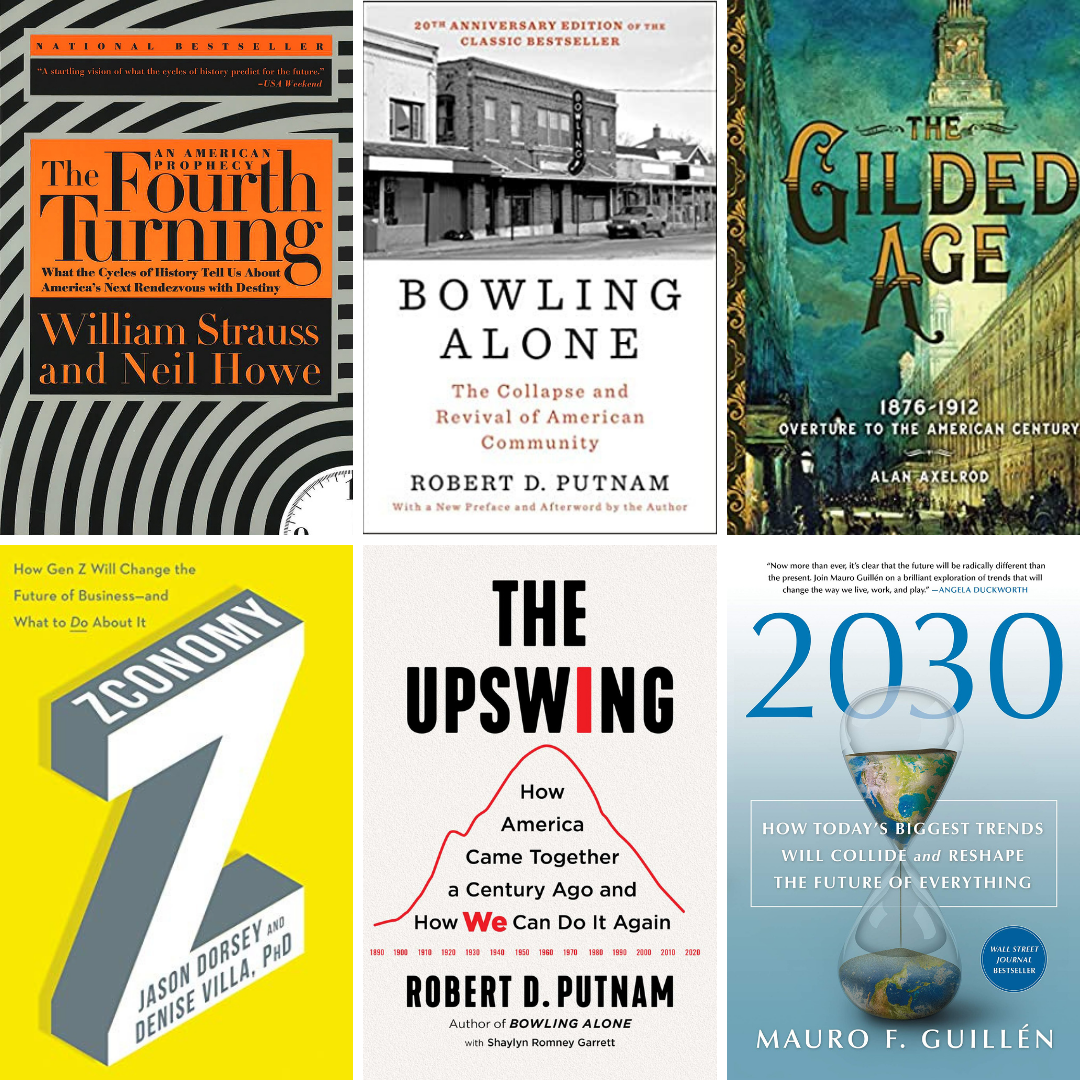
I’m beginning a deep dive into current and future intergenerational dynamics, and the six books below are my starting point.
The Fourth Turning, William Strauss and Neil Howe
William Strauss and Neil Howe will change the way you see the world—and your place in it. With blazing originality, The Fourth Turning illuminates the past, explains the present, and reimagines the future. Most remarkably, it offers an utterly persuasive prophecy about how America’s past will predict its future.
Strauss and Howe base this vision on a provocative theory of American history. The authors look back five hundred years and uncover a distinct pattern: Modern history moves in cycles, each one lasting about the length of a long human life, each composed of four eras—or “turnings”—that last about twenty years and that always arrive in the same order. In The Fourth Turning, the authors illustrate these cycles using a brilliant analysis of the post-World War II period.
First comes a High, a period of confident expansion as a new order takes root after the old has been swept away. Next comes an Awakening, a time of spiritual exploration and rebellion against the now-established order. Then comes an Unraveling, an increasingly troubled era in which individualism triumphs over crumbling institutions. Last comes a Crisis—the Fourth Turning—when society passes through a great and perilous gate in history. Together, the four turnings comprise history’s seasonal rhythm of growth, maturation, entropy, and rebirth.
The Fourth Turning offers bold predictions about how all of us can prepare, individually and collectively, for America’s next rendezvous with destiny.
Bowling Alone, Robert D. Putnam
Twenty years, ago, Robert D. Putnam made a seemingly simple observation: once we bowled in leagues, usually after work; but no longer. This seemingly small phenomenon symbolized a significant social change that became the basis of the acclaimed bestseller, Bowling Alone, which The Washington Post called “a very important book” and Putnam, “the de Tocqueville of our generation.”
Bowling Alone surveyed in detail Americans’ changing behavior over the decades, showing how we had become increasingly disconnected from family, friends, neighbors, and social structures, whether it’s with the PTA, church, clubs, political parties, or bowling leagues. In the revised edition of his classic work, Putnam shows how our shrinking access to the “social capital” that is the reward of communal activity and community sharing still poses a serious threat to our civic and personal health, and how these consequences have a new resonance for our divided country today. He includes critical new material on the pervasive influence of social media and the internet, which has introduced previously unthinkable opportunities for social connection—as well as unprecedented levels of alienation and isolation.
At the time of its publication, Putnam’s then-groundbreaking work showed how social bonds are the most powerful predictor of life satisfaction, and how the loss of social capital is felt in critical ways, acting as a strong predictor of crime rates and other measures of neighborhood quality of life, and affecting our health in other ways. While the ways in which we connect, or become disconnected, have changed over the decades, his central argument remains as powerful and urgent as ever: mending our frayed social capital is key to preserving the very fabric of our society.
The Gilded Age, Alan Axelrod
The Gilded Age—the name coined by Mark Twain to refer to the period of rapid economic growth in America between the 1870s and 1900—offers some intriguing parallels to our own time. Prolific historian Alan Axelrod tackles this subject in a fresh way, exploring “this intense era in all its dimensions. . . . This book will reveal it . . . as, truly, the overture of the ‘American Century.’” He also looks at how it presaged our current era, which many are calling the “Second Gilded Age.” Photographs, political cartoons, engravings, news clippings, and other ephemera help bring this fascinating period into focus.
Zconomy, Jason Dorsey and Denise Villa
Gen Z changes everything. Today’s businesses are not built to sell and market the way Gen Z shops and buys, or to recruit and employ Gen Z the way they find and keep jobs. Leaders need answers now as gen Z is the fastest growing generation of employees and the most important group of consumer trendsetters.
The companies that quickly and comprehensively adapt to Gen Z thinking will be the winners for the next twenty years. Those that don’t will be the losers or become extinct. Zconomy is the comprehensive survival guide on how leaders must understand and embrace Generation Z.
Researched and written by Dr. Denise Villa and Jason Dorsey from The Center for Generational Kinetics, the insights in Zconomy are based on their extensive research, they’ve led more than 60 generational studies, and their work with more than 500 companies around the world.
In Zconomy, Dr. Villa and Dorsey answer: Who is Gen Z? What do employers, marketers, and sales leaders need to know? And, most importantly, what should leaders do now?
This is the critical moment for leaders to understand and adapt to Gen Z or become irrelevant. Gen Z is already reshaping the world of business and this change is only going to accelerate. Zconomy is the definitive manual that will prepare any executive, manager, entrepreneur, HR or marketing professional to successfully unlock the powerful potential of this emerging generation at this pivotal time.
The Upswing, Robert D. Putnam and Shaylyn Romney Garrett
Deep and accelerating inequality; unprecedented political polarization; vitriolic public discourse; a fraying social fabric; public and private narcissism—Americans today seem to agree on only one thing: This is the worst of times.
But we’ve been here before. During the Gilded Age of the late 1800s, America was highly individualistic, starkly unequal, fiercely polarized, and deeply fragmented, just as it is today. However as the twentieth century opened, America became—slowly, unevenly, but steadily—more egalitarian, more cooperative, more generous; a society on the upswing, more focused on our responsibilities to one another and less focused on our narrower self-interest. Sometime during the 1960s, however, these trends reversed, leaving us in today’s disarray.
In a sweeping overview of more than a century of history, drawing on his inimitable combination of statistical analysis and storytelling, Robert Putnam analyzes a remarkable confluence of trends that brought us from an “I” society to a “We” society and then back again. He draws inspiring lessons for our time from an earlier era, when a dedicated group of reformers righted the ship, putting us on a path to becoming a society once again based on community. Engaging, revelatory, and timely, this is Putnam’s most ambitious work yet, a fitting capstone to a brilliant career.
2030, Mauro F. Guillén
Once upon a time, the world was neatly divided into prosperous and backward economies. Babies were plentiful, workers outnumbered retirees, and people aspiring towards the middle class yearned to own homes and cars. Companies didn’t need to see any further than Europe and the United States to do well. Printed money was legal tender for all debts, public and private. We grew up learning how to “play the game,” and we expected the rules to remain the same as we took our first job, started a family, saw our children grow up, and went into retirement with our finances secure.
That world―and those rules―are over.
By 2030, a new reality will take hold, and before you know it:
– There will be more grandparents than grandchildren
– The middle-class in Asia and Sub-Saharan Africa will outnumber the US and Europe combined
– The global economy will be driven by the non-Western consumer for the first time in modern history
– There will be more global wealth owned by women than men
– There will be more robots than workers
– There will be more computers than human brains
– There will be more currencies than countries
All these trends, currently underway, will converge in the year 2030 and change everything you know about culture, the economy, and the world.
According to Mauro F. Guillen, the only way to truly understand the global transformations underway―and their impacts―is to think laterally. That is, using “peripheral vision,” or approaching problems creatively and from unorthodox points of view. Rather than focusing on a single trend―climate-change or the rise of illiberal regimes, for example―Guillen encourages us to consider the dynamic inter-play between a range of forces that will converge on a single tipping point―2030―that will be, for better or worse, the point of no return.
2030 is both a remarkable guide to the coming changes and an exercise in the power of “lateral thinking,” thereby revolutionizing the way you think about cataclysmic change and its consequences.
Many, if not most, leaders consider themselves good speakers. The basics are simple: leaders speak, their audience listens, and then they act on what was said.
Leaders also know that rarely happens, and that there’s really much more to it than that. While it may be easy to speak to groups of all sizes and on many diverse topics, one critical question remains: “Are we connecting with our audience?”
To fully connect with an audience, leaders need to understand “empathy.” While you may not equate the word empathy with excellent communication skills, it actually is the secret to connecting with your audience.
When you are able to put yourself in another person’s shoes, and try to see things from their point of view, their world, and their perspective, you will have a greater chance at both reaching and connecting with them.
THE QUICK SUMMARY
You made a great point — but did anybody hear it?
Probably not, warns high-stakes communication expert Paul Hellman. The average attention span has dropped to 8 seconds.
So whether you’re presenting to a large audience, meeting one-on-one, talking on the phone, or even sending an email, you’ve got to engage others fast, before they tune you out, maybe forever.
Your challenge: to get heard, get remembered and get results.
Through fast, fun, actionable tips, You’ve Got 8 Seconds explains what works and what doesn’t, what’s forgettable and what sticks. With stories, scripts, and examples of good and bad messages, the book reveals three main strategies to get heard in a noisy world:
FOCUS: Design a strong message–then say it in seconds.
VARIETY: Make routine information come alive.
PRESENCE: Convey confidence and command attention.
A SIMPLE SOLUTION
People discover unseen opportunities when they have a personal and empathic connection with the world around them.
Dev Patnaik
How easy is it for you as a leader to imagine yourself in the place of those you lead? Do you intuitively understand the lives and stories of your audience? That may be made easier by the fact that your audience most likely “looks” like you in many areas – socially, economically, and spiritually to name a few. But what if your audience is different than you?
How can you connect with people who aren’t like you?
Yes, it is easier to connect with other people who are like us, but that doesn’t mean leaders can’t understand – and communicate – with people who are different from us.
Most messages, spoken or written, are designed from the speaker’s point of view. That’s upside down. Imagine you’re the audience. What would capture your attention?
The point is, your audience is probably not thinking about you. But to capture attention, you need to think about them. Be the audience.
Your audience, whether you are talking to 100 people at work or one person at home, has three questions, always the same.
Why should I listen (or read this)?
What exactly are you saying?
What should I do with this information?
To fast-focus your message, answer these three questions.
First Audience Question: Why Should I Listen
Fast-focus with a purpose statement.
A purpose statement is like a present. You immediately hook people with something they value. It’s a great way to state what you’re going to talk about and, more importantly, why. Why answers the audience’s question: “Why should we listen?”
Second Audience Question: What Exactly Are You Saying?
Fast-focus with your main message.
Third Audience Question: What Should I Do with This Information?
Fast-focus with a call to action.
A call to action spells out the next step. It’s usually about doing something. But if that doesn’t fit, the next stop could be to think something or feel something.
With the chart and the following suggestions from author Paul Hellman, prepare your next presentation/message/communication with the Fast-Focus concepts.
The Opening – The purpose statement is the hook that entices the audience to pay attention. The agenda statement that follows says how you’ll accomplish the purpose.
The Body – If your audience could only remember one thing, what’s the one thing? Use a limited number of key points to develop the message.
The Close – Close your presentation on a powerful note. What’s the next step? What should the audience do? If there’s nothing to do, then the call to action can also be what to think or what to feel.
Following the delivery of this presentation, pull together two-three associates and ask them to critique this presentation in terms of previous presentations on a similar topic. Listen with an open mind for possible areas of improvement.
Excerpt taken from SUMS Remix 129-3, released October 2019
Part of a weekly series on 27gen, entitled Wednesday Weekly Reader
Regular daily reading of books is an important part of my life. It even extends to my vocation, where as Vision Room Curator for Auxano I am responsible for publishing SUMS Remix, a biweekly book “excerpt” for church leaders. Each Wednesday on 27gen I will be taking a look back at previous issues of SUMS Remix and publishing an excerpt.
First impressions are automatic – taken in and recorded by our senses, often registered for later recall. More often than not, they make an immediate impact on our decision to participate and to return – or not. We may not agree with it or not, but the consumer mentality of the world we live in has moved full force into our church world. Our churches don’t compete with the “world” so much as the experiences of the world.
As you live your life day in and out, you are living the life of a consumer.
Where do you consume?
Where do you shop?
Who provides service for you?
Most importantly, why?
You may stop at your favorite coffee shop for a good cup of coffee – and the conversations you have with the barista and the other regulars in the shop. Your supermarket always has good value and a wide selection of the food your family likes. Clothes from a particular shop just fit better – and the sales associates are always helpful with suggestions. The point is, you have established expectations of each place and the people who work there.
Is it any different for Guests and attendees at your church?
If your goal is to create a space and an experience that will positively impact people, you must first plan and evaluate it from the perspective of its quality. You start that process by examining the daily places and routines in the offices, retail, and recreation spaces of the people you are trying to reach. The homes they live in, the offices they work in and the stores they shop in all communicate a level of expectation they have for their space.
Close your eyes for a moment and think about the last time you truly had a great experience with a company as a consumer, an experience that captured your heart, soul, mind, and spirit. What about it was special? Call it “X” – that “je ne sais quoi” that makes something so special.
The longtime chief marketing officer for Chick-fil-A tells the inside story of how the company turned prevailing theories of fast-food marketing upside down and built one of the most successful and beloved brands in America.
During his thirty-four-year tenure at Chick-fil-A, Steve Robinson was integrally involved in the company’s steady then explosive growth from 184 stores and $100 million in annual sales in 1981 to more than 2,100 stores and more than $6.8 billion in annual sales in 2015. As a member of the marketing team and as chief marketing officer, Robinson was both a witness and participant in the company’s remarkable development into an indelible global success. Now he shares the story of Chick-fil-A’s evolution into one of the world’s most beloved, game-changing, and profitable brands. From the creation of the “Eat Mor Chikin” campaign to the decision to stay closed on Sundays to the creation of the company’s corporate purpose, Robinson provides a front-row seat to the innovative marketing, brand strategies, and programs that created a culture customers describe as “Where good meets gracious.”
Drawing on his personal interactions with the gifted team of company leaders, restaurant operators, and Truett Cathy himself, Robinson explains the important traits that built the company’s culture and have sustained it through recession and many other challenges. He also reveals how every aspect of the company’s approach reflects an unwavering dedication to Christian values and to the individual customer experience. Written with disarming candor and revealing storytelling, Covert Cows and Chick-fil-A is the never-before-told story of a great American success.
A SIMPLE SOLUTION
The famous “My pleasure” response of Chick-fil-A team members arose from an experience by founder Truett Cathy in 2000. In 2003, Truett and his son Dan co-wrote the following leadership message, entitled, “My Pleasure”:
“My Pleasure” is more than just an operating standard and more than just a personal request. “My Pleasure” is an expression from the heart where team members, Operators, or staff members literally show that they want to go the extra mile – that they truly care about the other person. They have enough value in the other person to exceed expectations.
It was a transformative moment, charting a course to a place where a warm greeting would infuse every Chick-fil-A restaurant and create a culture of genuine hospitality.
As we began the journey to create an entirely new service model without the constraints of the fast-food tradition, we asked customers “What makes you feel most cared for? What made you want to come back to Chick-fil-A?”
More than 90 percent of guests answered, “When someone smiles at me, looks me in the eye, and lets me know I’m being cared for and treated with excellence. That’s above and beyond what I expect at a fast-food restaurant.”
If these were the desires of our guests, then we needed to package them in a way that made them easy for team members to remember. So we created the Core 4:
Create eye contact.
Share a smile.
Speak with an enthusiastic tone.
Stay connected to make it personal.
These were the four behaviors we wanted team members to extend whenever they were engaging a guest in a restaurant. When we packaged the request that way, it was amazing to see how teachable it was. Team members got it. The requirements were not lost among the other requirements in the quality guide.
We didn’t want to stop at “smiling and eye contact” and “my pleasure,” so we explored what we might add to take us into the second mile, and we selected three additional behaviors:
Carry eat-in meals to the table.
Check in with guests for any needs.
Carry large orders, such as Chick-fil-A trays, to the car.
These simple, proactive behaviors became our “recipe for service.” As the name implies, this recipe consists of ingredients that are as critical as the ingredients in any of our menu items.
It’s time for a field trip! If you are lucky enough to have a Chick-fil-A restaurant nearby, take your team to lunch. As you prepare to go, instruct the team to be on the lookout for the specific behaviors described above.
If you are not located near a Chick-fil-A, take your team to another local restaurant. As you prepare to go, instruct the team to be on the lookout for specific behaviors mentioned above that may or may not be present.
After lunch, gather your team together for a debrief session. On a chart tablet, list comments by your teams during their experience. Underline the positive ones and circle the neutral or negative ones.
After everyone has had a chance to list their comments, lead a discussion about how the experience may prove instructive for developing your own “recipe for service.” On a separate chart tablet, list the ideas of your team that might comprise your “recipe.”
Review the list, and agree on no more than five actions that you will put into practice immediately. Assign a champion to create and deliver the “recipe” to your hospitality team leaders, and work with the leaders to implement across all teams.
After a six-week period of following the “recipe,” bring all the team leaders together to evaluate, and if necessary, revise the “recipe.” Continue to follow the “recipe” for the next six months, and revisit it again at the end of that period.
Excerpt taken from SUMS Remix 124-2, released August 2019.
Part of a weekly series on 27gen, entitled Wednesday Weekly Reader
Regular daily reading of books is an important part of my life. It even extends to my vocation, where as Vision Room Curator for Auxano I am responsible for publishing SUMS Remix, a biweekly book “excerpt” for church leaders. Each Wednesday on 27gen I will be taking a look back at previous issues of SUMS Remix and publishing an excerpt.
Many, if not most, church staff leaders consider themselves good speakers. The basics are simple: leaders speak, their audience listens, and then they act on what was said.
Church leaders also know that rarely happens, and that there’s really much more to it than that. While it may be easy to speak to groups of all sizes and on many diverse topics, one critical question remains: “Are we connecting with our audience?”
To fully connect with an audience, leaders need to understand “empathy.” While you may not equate the word empathy with excellent communication skills, it actually is the secret to connecting with your audience.
When you are able to put yourself in another person’s shoes, and try to see things from their point of view, their world, and their perspective, you will have a greater chance at both reaching and connecting with them.
Simply Said is the essential handbook for business communication. Do you ever feel as though your message hasn’t gotten across? Do details get lost along the way? Have tense situations ever escalated unnecessarily? Do people buy into your ideas? It all comes down to communication. We all communicate, but few of us do it well.
From tough presentations to everyday transactions, there is no scenario that cannot be improved with better communication skills. This book presents an all-encompassing guide to improving your communication, based on the Exec|Comm philosophy: we are all better communicators when we focus less on ourselves and more on other people. More than just a list of tips, this book connects skills with scenarios and purpose to help you hear and be heard. You’ll learn the skills to deliver great presentations and clear and persuasive messages, handle difficult conversations, effectively manage, lead with authenticity and more, as you discover the secrets of true communication.
Communication affects every interaction every day. Why not learn to do it well? This book provides comprehensive guidance toward getting your message across, and getting the results you want.
A SIMPLE SOLUTION
All leaders aspire to be better communicators. And most times, leaders feel that better communication starts with them. While not wrong, it would be a mistake to think that the focus needs to be on ourselves.
If we put the focus on what the other person is trying to gain from our exchange, we will do a better job communicating, because we will select more pertinent information, drill down to the desire level of detail, and make the information we are sharing more accessible to our audience.
If we want to improve our ability to connect with others, to understand them and to be understood more clearly, the easiest and most effective way to do so is to focus less on ourselves and more on the other person.
This is the single most significant differentiator we can apply to our communication skills to improve our effectiveness.
Your message to the world is, of necessity, your message connecting you to the world.
Your Content: the substance of what you want to convey.
Your Oral Communication Skills: the way you convey your substance.
Your Written Communication Skills: the way you represent yourself when you’re not physically present.
Your Interactions: the settings in which you engage your audience, whether it’s an audience of one or one hundred or one thousand.
Your Leadership: the way you set the tone and relate to others.
Set aside some time for personal reflection on your ability to connect with others by focusing less on yourself and more on the other person.
Using the five statements above, rate yourself on a scale of one to five, where one equals “I really need help in this area” and five equals “I am consistent in this area.”
Use the following suggestions from author Jay Sullivan to improve in each of the areas above in which you scored yourself anything less than a three.
Your Content
Convey a clear message
Tell engaging stories
Organize your content
Your Oral Communication Skills
Make the most of your body language
Listen to understand
Deliver from notes and visuals
Respond to questions
Your Written Communication Skills
Edit for clarity
Structure your documents
Create reader-friendly documents
Write emails that resonate
Your Interactions
Conduct effective meetings
Delegate successfully
Share meaningful feedback
Your Leadership
Lead others with inspiration and influence
Show vulnerability
Excerpt taken from SUMS Remix 129, released October 2019.
Part of a weekly series on 27gen, entitled Wednesday Weekly Reader
Regular daily reading of books is an important part of my life. It even extends to my vocation, where as Vision Room Curator for Auxano I am responsible for publishing SUMS Remix, a biweekly book “excerpt” for church leaders. Each Wednesday on 27gen I will be taking a look back at previous issues of SUMS Remix and publishing an excerpt.
One of the consistent lenses I use to view life through is that of generations.
It comes as a natural part of my curiosity of life, as I am interacting with 5 generational cohorts in my family: my parents and in-laws are from the GI Generation; I am a Baby Boomer; my oldest son and one daughter-in-law are Gen Xers; my other three children, two daughters-in-law and one son-in-law are Millennials; and my 6 grandchildren are Gen Zers. Even though we are spread out across three states (and occasionally, around the world) and do not get to interact as much as we would like, the personal level of generational differences is obvious.
Take the same dynamics as above – 5 generations – and move them into the institutional world, say a church setting, and it won’t be long till you have a generational collision.
If you are a leader in ChurchWorld, how do you deal with the fact that, for the first time in our history, we can have five separate and distinct generations working alongside each other in our churches? The 5th generation, born since the mid-2000’s, is not far behind in taking up a leadership role.
Generational differences are important, but it is all too easy to stereotype these differences. The only way we’ll ever build bridges between generations is to stop stereotyping and get to know who these generations really are and why they are that way.
For the first time in history, we have four different generations in the workplace (and five in families). These generations might as well be from different countries, so different are their cultural styles and preferences. Of the four approaches organizations can take to blending the generations, only one of them works today. Focusing on the “what” escalates tensions, while focusing on the “why” pulls teams together. Knowing the twelve sticking points can allow teams to label tension points and work through them—even anticipate and preempt them. Implementing the five steps to cross-generational leadership can lead to empowering, not losing, key people.
How many different generations do you regularly interact with?
In 2020, 25 percent of the labor force will be over the age of 55 – and they’re not retiring anytime soon. These projections from the Bureau of Labor Statistics at the US Department of Labor indicate that not only will Baby Boomers continue to work alongside their current Generation X and Millennial colleagues, but that they will still be around when Generation Z joins the workforce.
The result? A clash of cultures that will require a new management approach.
Gone are the days when people entered the workforce as young adults, worked until their late 50s, and then moved off into retirement while younger generations took their place. Instead, the average retirement age has steadily been creeping up in recent decades as older employees – in particular, the Baby Boomers – stay in the workforce either by choice or by necessity.
Of course, the implications of the COVID-19 pandemic are still reverberating across home, work, and church settings, so everything is up for grabs!
Before we dive into the discussion, here’s a brief recap of just who comprises the generational cohorts mentioned above. While there’s no set standard, the following descriptions are generally accepted:
Baby Boomers – born in the years 1946-1964, numbering about 76 million people
Generation Xers – born in the years 1965-1980, numbering about 66 million people
Millennials – born in the years 1981-1997, numbering just over 83 million people
Generation Zers – born in the years 1998-present, numbering over 80 million and still growing
Much of the learning, skills and perspective people of all ages need to succeed long-term in their careers is not found in data on the Internet, but rather in conversations and personal relationships with the people they work with.
Tech tools have trained us to search the Internet for answers to everything, but we can’t find most of the non-technical or non-data-based answers we seek there. Learning about perspectives, relationships and experiences comes best from conversations.
In most organizations there are three, four, or even five generations working together with differing expectations about how things are done and by whom. People of different generations are increasingly isolated physically, functionally, or emotionally from each other both by communication styles and media and lack of the perspective that would help them understand why people think and act as they do. You Can’t Google It! facilitates action to promote and foster cross-generational conversation in organizations on both the parts of management and the multi-generational teams that are increasingly the key to productivity, profitability and sustainability.
You Can’t Google It! is a tool to help organizations and individuals remove the stress, frustration, and negative energy that often arises from working with people of different generations, so they understand and are able to accomplish their common goals―faster and profitably. It is about the implications of different generations, and how to move towards closing that gap.
A SIMPLE SOLUTION
Author Phyllis Weiss Haserot pulls no punches in establishing the issue of cross-generational conversations:
As an established professional, do you question the work ethics of young employees and co-workers?
As a young professional, how do you deal with resistance to your ideas from Baby Boomers who think their experience and seniority mean they know it all?
Will your organization be threatened because key personnel will soon reach traditional retirement age?
Are you wondering how to transform intergenerational challenges into an asset for your organization?
Much of the learnings, skills, and perspectives that people of all ages need to succeed – especially in working with each other – are not found in data on the Internet but rather in conversations and personal relationships with the people they work with. The new multigenerational paradigm is meaningful cross-generational conversation.
GENgagementTM can be defined as the state of achieving harmony, mutual involvement and cooperation, flow, and ongoing absorption in work with people of different generations.
GENgagement means getting all of the generations to understand each other, their influences, and their worldview so they can work collaboratively, loyally, and productively.
It is integral to the mission of transforming workplaces into engaged and productive environments for solving problems and being great places to work. Equally important, it helps individuals and organizations develop closer rapport and loyalty bonds with clients and other external stakeholders – the bedrock of any mission-driven organization.
A satisfying and perennial recipe for GENgagement contains these ingredients as integral to the experience for all personnel:
Defining the big picture for everyone
Having a clear purpose and mission
Visioning – what achieving the mission and purpose will look like
Communicating the importance of each person’s role
Living a culture that respects the values of and promises to employees, clients, donors, alumni, etc. every day
Enabling multigenerational input to organization and and market strategy and service delivery
Distribute the following questions from author Phyllis Haserot to your team in advance. After they have had time to read through them, gather the team for an extended conversation about each question.
Help me understand your perspective on work and the marketplace outside of our organization. What factors influence your worldview, the attitude you bring to your work, and your interactions with colleagues?
What would you like to see changed about how our work is done, and how can you help make it more effective? How important is hierarch to you? When is years of experience very important in your role, and when are other factors equally or more important?
What is getting in the way of a more productive and satisfying working relationship? How can I as your teammate help you learn how best to work with me?
What would you say are your core values? Do you think they are significantly different from my generation’s core values? How can we jointly overcome intergenerational tensions?
What strategies for impact and influence at work can we learn from each other?
Use these conversations as a springboard to ongoing cross-generational conversations as a regular part of the leadership development process in your organization.
Excerpt taken from SUMS Remix 127-3, released September 2019.
Part of a weekly series on 27gen, entitled Wednesday Weekly Reader
Regular daily reading of books is an important part of my life. It even extends to my vocation, where as Vision Room Curator for Auxano I am responsible for publishing SUMS Remix, a biweekly book “excerpt” for church leaders. Each Wednesday on 27gen I will be taking a look back at previous issues of SUMS Remix and publishing an excerpt.
Are you:
• Working, working, working?
• Busy taking care of everyone but yourself?
• Wondering what to do with the rest of your life?
• Planning to do what makes you happy someday when you have more time, money, or freedom?
What if someday never happens? As the Buddha said, “The thing is, we think we have time.”
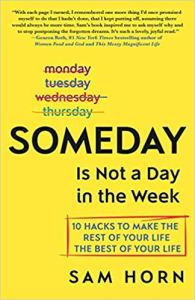
Sam Horn is a woman on a mission about not waiting for SOMEDAY … and this is her manifesto. Her dad’s dream was to visit all the National Parks when he retired. He worked six to seven days a week for decades. A week into his long-delayed dream, he had a stroke. Sam doesn’t want that to happen to you. She took her business on the road for a Year by the Water. During her travels, she asked people, “Do you like your life? Your job? If so, why? If not, why not?”
The surprising insights about what makes people happy or unhappy, what they’re doing about it (or not), and why…will inspire you to carve out time for what truly matters now, not later.
Life is much too precious to postpone. It’s time to put yourself in your own story. The good news is, there are “hacks” you can do right now to make your life more of what you want it to be. And you don’t have to be selfish, quit your job, or win the lottery to do them. Sam Horn offers actionable, practical advice in short, snappy chapters to show you how to get started on your best life ― now.
A SIMPLE SOLUTION
According to author Sam Horn, you don’t need to quit your job, win the lottery, or walk away from your responsibilities to make your life more of what you want it to be.
There are things you can do right here, right now, to be happier, healthier, and more fulfilled.
There are steps you can take to make your life more fulfilling.
It’s time to hack your life by tapping into proven best practices, expedite results and discover a shortcut to success.
Make your “one day” Day One.
The Ten Life Hacks are actions you can take to create a more fulfilling life, sooner, not later. Please note: These hacks are a framework, not a formula.
LIFE HACK 1:Evaluate Your Happiness History
LIFE HACK 2:Generate a Today, Not Someday Dream
LIFE HACK 3: Abdicate Outdated Beliefs and Behaviors
LIFE HACK 4: Initiate Daily Actions that Move Your Life Forward
LIFE HACK 5: Celebrate What’s Right with Life, Right Here, Right Now
LIFE HACK 6: Affiliate with People Who Have Your Back and Front
LIFE HACK 7: Integrate Your Passion and Profession
LIFE HACK 8: Negotiate for What You Want, Need, and Deserve
According to author Sam Horn, the best way to make progress in making your “Someday” is to ask probing questions that prompt you to change – for good.
Listed below are sample questions for each of the ten Life Hacks listed above. Schedule at least thirty minutes a day for the next ten days, and reflect on the questions listed.
LIFE HACK 1: Evaluate Your Happiness History
Play hooky for a day.
How would you spend your free day or afternoon? What would you do if the people you’re responsible for would be taken care of, and there would be no repercussions?
What are three things you would not do on your day of hooky? Why?
LIFE HACK 2: Generate a Today, Not Someday Dream
Put a date on the calendar.
What would you like to experience or achieve by the end of this year? What is your Today, Not Someday dream? When will you launch it? What “do-date” did you put on your calendar?
Now, start filling in the W’s … where, when, who, what, and why. Who will you discuss this with so they can help you fill in the blanks so your dream goes from vague to vividly clear?
Where will you post your dream so it stays “in sight, in mind,” and you are constantly re-inspired to do what you said you wanted to do?
LIFE HACK 3: Abdicate Outdated Beliefs and Behaviors
Let it go, let it go, let it go.
How do you feel when you walk into your home? Where would your home rate on the “Clutter (1) to Clean (10) Scale”? How does that affect you? Do you feel guilty, stressed, or frustrated with how things have piled up? Or do you feel proud and at peace with how well-designed, organized, and beautiful your space is?
How much time do you spend cleaning, repairing, buying, renovating your stuff? Is that a source of enjoyment, a burden and chore, or something in between? Explain.
Are you ready to downsize your home and/or release some belongings? How will you do that? Who else does this have an impact on? How will you negotiate this with them? What could you do with the resources that would be freed up when you have less to take care of?
LIFE HACK 4: Initiate Daily Actions that Move Your Life Forward
Honor the nudges, and connect the dots.
Do you make room for whims? Why or why not? When was a time you honored a nudge and acted on your intuition? What happened as a result?
Do you think this is a lot of hooey? Does your intellect override your instincts? Or, do you agree that if we have a sixth sense that alerts us to what’s wrong, we also have a sixth sense that alerts us to what’s right? What are your beliefs about this?
How will you honor the instincts that have your best interests at heart? How will you connect the dots, act on “coincidences” that beat the odds, and align with congruent individuals and opportunities that “feel right”?
LIFE HACK 5: Celebrate What’s Right with Life, Right Here, Right Now
Get out of your head and come to your senses.
When was the last time you saw something as if for the first or last time? Describe what happened and what it felt like.
Do you have a busy, stressful life? What is the ongoing impact of rushing, rushing, rushing— and always feeling “an hour late and a dollar short”?
Would you say you have “juice” in your camera? Do you look at the world with fresh eyes? When, where, and how will you get out of your head and come to your senses?
LIFE HACK 6: Affiliate with People Who Have Your Back and Front
Launch your ship in public.
So, what is that venture you want to launch? Who has supported you, cheered you on? What have they done to help you achieve your goal and do what’s important to you?
Who has cautioned you, told you (“ for your own good”) that what you want to do won’t work or isn’t a good idea? What impact has that had on you?
How will you take your dream public and give others a chance to jump on your bandwagon? Will you create a vision board and/or host a Today, Not Someday party? Where did you post your vision so it stays “in sight, in mind”?
LIFE HACK 7: Integrate Your Passion and Profession
Don’t wait for work you love – create work you love.
Do you love your job? Do you feel you’re adding value and contributing? How so?
If you don’t find your work satisfying, why not? What talents or skills are you not having an opportunity to use or get credit for?
What are your Four I’s? How could you leverage them into a paying career where you get paid to do what you’re good at? What is your next step? Will you visit crafts fairs to see how other people have turned a passion into a profession? Elaborate.
LIFE HACK 8: Negotiate for What You Want, Need, and Deserve
If you don’t ask, the answer’s always “No.”
When is a time you asked for something you wanted – whether it was a promotion, project lead, or pay raise? How did you prepare? What was the result?
When is a time you waited for someone to “do the right thing,” act on your behalf, or give you what you deserved? As Dr. Phil would say, “How’d that work for you?”
What is a situation you’re unhappy with right now? Which of the Four A’s have you used? How will you alter the situation by using the Five P’s of Persuasion to increase the likelihood of improving this situation?
LIFE HACK 9: Innovate a Fresh Start
Quit watering dead plants.
Is the majority of your life out of your control and not to your liking? How so? Does this challenging time have a timeline? Can you “make your mind a deal it can’t refuse” so you are able to keep things in perspective?
What do you currently do to maintain a positive perspective, to have something to look forward to in bleak times? How do you stay focused on what you can control?
Are there dead plants you can stop watering? What can you quit that is compromising your quality of life? How can you innovate a fresh start if you are going through dark times to keep the light on in your eyes?
LIFE HACK 10: Relocate to Greener Pastures
Come full circle.
When was the last time you were in your hometown? What memories did it bring back? Did you reconnect with people that influenced you? Did it catalyze a new creative direction that could be a satisfying full-circle way to come home to who you truly are?
What used to light you up but now feels like it might be a retreat or regression to “go back there”? Do you worry it’s thinking small instead of thinking big? Could it actually be you’re going “home” to who you are at your core, your best self?
Do you agree that we can be “at home” wherever we are and that “home” is a mindset, not a location? Where do you feel most at home?
Excerpt taken from SUMS Remix 126, released August 2019
Part of a weekly series on 27gen, entitled Wednesday Weekly Reader
Regular daily reading of books is an important part of my life. It even extends to my vocation, where as Vision Room Curator for Auxano I am responsible for publishing SUMS Remix, a biweekly book “excerpt” for church leaders. Each Wednesday on 27gen I will be taking a look back at previous issues of SUMS Remix and publishing an excerpt.








 THE QUICK SUMMARY –
 THE QUICK SUMMARY –