From Cocoa Beans to Cookie Jars: A Journey Through Chocolate Chip History

Which came first – the chocolate chip or the chocolate chip cookie?


Have you ever wondered how a single ingredient would change a recipe? If it weren’t for one curious baker, it would be hard to imagine where we would be without the invention of chocolate chips.

In 1937, Ruth Graves Wakefield of Whitman, Massachusetts must have been curious about what a little bit of chocolate would add to her cookies. While working at the Toll House Inn, she added cut-up chunks of a semi-sweet Nestle chocolate bar to a cookie recipe. The cookies were a huge success and in 1939 Wakefield signed an agreement with Nestle to add her recipe to the chocolate bar’s packaging. In exchange for the recipe, Wakefield received a lifetime supply of chocolateThe Nestle brand Toll House cookies were named for the Inn.

Nestle initially included a small chopping tool with the chocolate bars, too. Starting in 1941, Nestle and other competitors started selling the chocolate in chip or morsel form. For the first time, bakers began making chocolate chip cookies without chopping up the chocolate bar first. 

Chocolate chips originally came in semi-sweet. Later, chocolate producers began offering bittersweet, semi-sweet, mint, white chocolate, dark chocolate, milk chocolate, and white and dark swirled. Today, chips also come in a variety of other flavors that bakers and candy makers use creatively in their kitchens.

While cookies may be the first treat to come to mind, imagination is really the only thing limiting how chocolate chips can be used in baking and candy making. Even savory dishes feature chocolate chips in a variety of ways, too. Had Ruth Graves Wakefield never wondered what a few chopped up chunks of chocolate would be like in her baking, we wouldn’t even have chocolate chip cookies.  


And since it is Wednesday Weekly Reader, here’s a few books on the subject to whet your appetite…


Since Ruth Wakefield’s culinary breakthrough, chocolate chips have undergone a remarkable evolution. Manufacturers capitalized on the growing demand for chocolate chips, introducing standardized, mass-produced morsels available in an array of sizes, shapes, and flavors. Today, consumers can choose from a plethora of options, including milk chocolate, dark chocolate, and even vegan and allergen-free varieties.

Chocolate chips continue to play a versatile role in modern culinary landscapes, transcending traditional boundaries and finding their way into an array of sweet and savory dishes. From classic chocolate chip cookies and brownies to innovative creations like savory mole sauces and gourmet cheese plates, chocolate chips inspire creativity and experimentation in kitchens around the world.

The cultural significance of chocolate chips extends far beyond their practical use in recipes. These tiny morsels have permeated popular culture, appearing in literature, film, television, and advertising as symbols of joy, indulgence, and shared experiences. Furthermore, chocolate chips serve as ambassadors of culinary fusion, inspiring adaptations and variations in cuisines around the world.

The chocolate chip stands as a testament to the enduring power of culinary creativity and cultural exchange. From its humble beginnings to its current status as a beloved culinary staple, the chocolate chip has captured the hearts and taste buds of people around the world. As we savor each delicious bite, let us celebrate the timeless allure of the chocolate chip and the sweet pleasures it brings to our lives.


What is the best chocolate chip cookie you’ve ever had?

For me: my wife Anita has been tinkering over the years with a basic chocolate chip cookie recipe not far off the classic Toll House one, but using white chocolate chips, dried cherries, and almond flavoring, along with slight changes to the other ingredients and altering the cooking time (depending on whether they are primarily for our family, or for others).

I, of course, have the distinguished role of Official Cookie Taste Tester for every batch. When they are still warm from the oven, resting on the cooling racks, and accompanied by an ice-cold glass of milk…

Perfection.


Part of a regular series on 27gen, entitled Wednesday Weekly Reader.

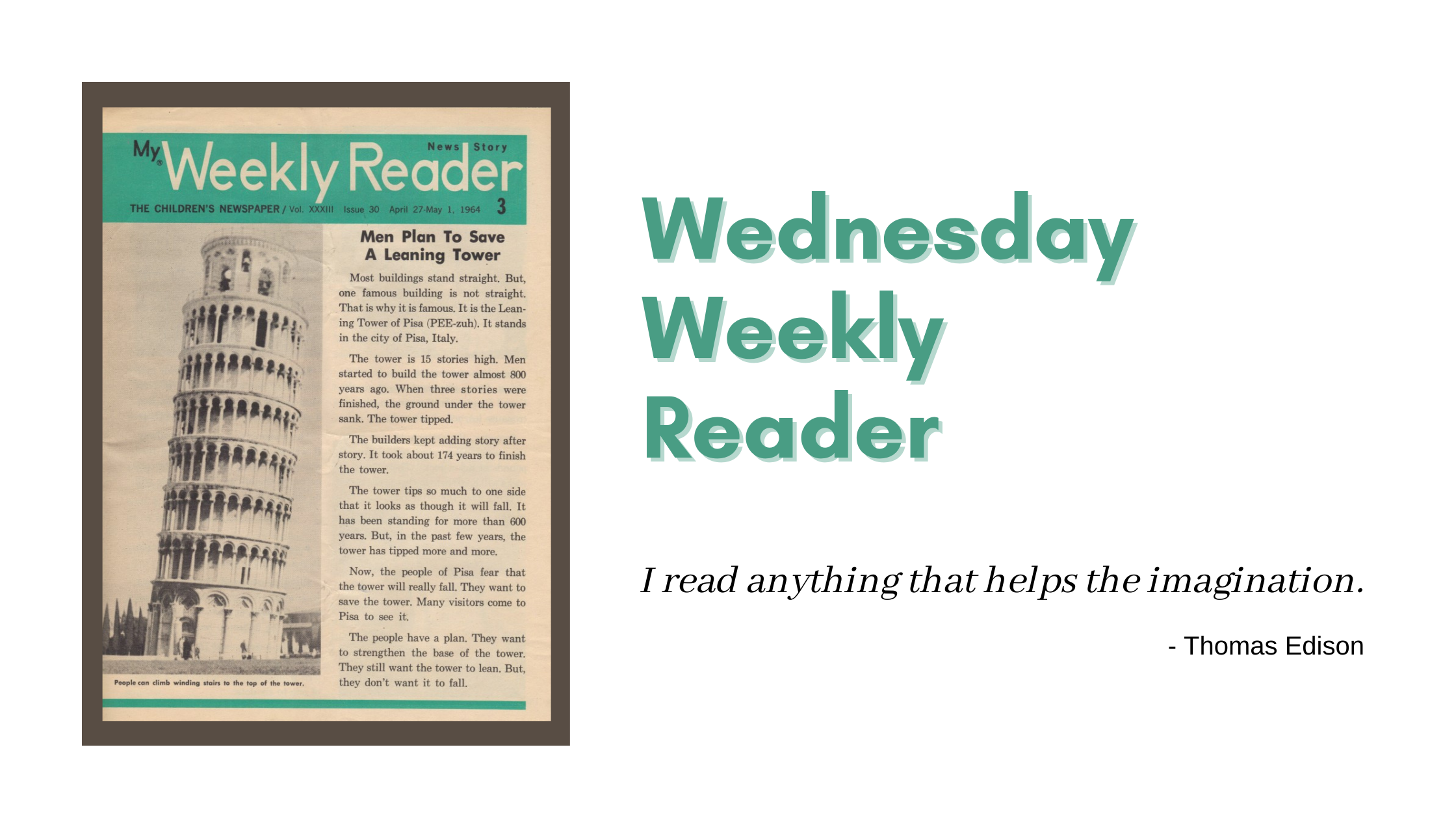
During my elementary school years one of the things I looked forward to the most was the delivery of “My Weekly Reader,” a weekly educational magazine designed for children and containing news-based, current events.

It became a regular part of my love for reading, and helped develop my curiosity about the world around us.

The Art of Cultivating Community: Finding Meaning in Everyday Interactions

You want more. You want to belong to a community that looks out for each other. You believe in your bones we don’t have to live detached, distracted, and divided. The question is, How?

Shannan Martin invites you into deeper connection through simple resets, such as:

Open Door > Perfect Décor. We invite others in, seeking to connect, not impress.

Familiar > Fussy. We serve tacos and pizza like the feasts they are, because fancy is overrated.

Tender > Tough. We greet the world with our hearts exposed and our guards down.

Packed with street-level practices and real-talk storytelling, Start with Hello is your field guide for a life of security, camaraderie, and joy. There is no step too small.


We rely on various figures in our lives to guide us: pastors, priests, and spiritual advisors for matters of faith, doctors and therapists for physical and mental health, and teachers for a wide range of skills, from writing poetry to driving. Yet, there’s a significant gap in our education when it comes to building community. We’re not taught that it’s something we actively create with our own hands, tender hearts, and time. The process isn’t broken down for us, and the tools aren’t readily provided. It might seem like community effortlessly forms for some lucky individuals, leaving the rest of us feeling like we’re missing something.

In Start With Hello, Shannan Martin makes it very clear that she doesn’t offer solutions for anyone’s personal struggles; that’s not the purpose of her book. She still grapples with everyday challenges like lack of sleep or motivation, parenting dilemmas, and domestic disagreements. But what she does confidently share is how profoundly her life has been enriched by living closely connected with others. It’s one of the most genuine truths she has discovered – a truth that has reshaped her worldview and sense of self.

In many ways, Martin’s journey has brought her back to the simplicity and authenticity of her childhood, where quirks and letdowns were expected. It’s also been about discarding the loneliness narrative and embracing a fresh start, akin to opening a new notebook filled with possibilities. She readily shares here missteps, often by overanalyzing and trying too hard. She learned that genuine connections can’t be forced; they thrive on mutual solace and safety.

Martin is discovering how to take the lessons learned and cultivate them, acknowledging that imperfections can serve as fertile ground for growth. Honesty, humility, and humor are invaluable companions on her journey, as is a childlike imagination that dares to believe in better possibilities.

Authentic relationships don’t come with expiration dates; they unfold gradually, enriched by the seemingly insignificant moments. Every interaction holds potential, even if it’s as simple as exchanging a wave with a passing acquaintance. Over time, these small gestures can blossom into meaningful friendships, built on shared experiences and genuine understanding.

Don’t underestimate the power of a genuine connection. You may never bake that perfect coffee cake for your neighbor, but a chance encounter could lead to profound conversations and lasting bonds. It’s all about embracing the kind of person who values human connection and isn’t afraid to extend a friendly greeting.

Start With Hello is organized into the following sections:

  • Awake > Asleep
  • Windows > Mirrors
  • Listening > Talking 
  • Open Door > Perfect Décor
  • Familiar > Fussy 
  • Complexity > Comfort
  • Tender > Tough
  • Practice > Preach
  • Roots > Wheels 
  • Empathy > Everything

In addition to being filled with personal, heart-warming (and sometimes heart-wrenching) stories, each section closes with an “assignment” if you will; a practical action to put both feet and heart to what you’ve just read. Here’s one example from Martin’s section Windows > Mirrors:

The next time you need help, ask for it. This is hands-down my favorite, most foolproof tip for building relationships with the people near you. As we are people taught to solve our own problems, this humble practice cuts to the heart of who we think we want to be. But remember, interdependence is the goal here. Independence is overrated, not to mention lonely. A world where we rely on each other is better, brighter, and safer.

Like everything else worth doing, it will take some practice. Start small. Run next door and ask if they’ll grab your mail while you’re gone for the weekend. Cross the hall and ask for an egg. 

Before running out to buy a small appliance or yard tool that won’t get a lot of use, see if someone nearby has one you could borrow.

The best part? Though this isn’t about keeping score, it can be fun to find creative ways to repay the favor. (I recommend a hefty slice of whatever you baked with that borrowed egg.) 

Showing up needy sets the tone for a life of ordinary connectedness. You go first, and others will follow.

Connection is a circle, not a straight line. From attentiveness to empathy to hope, each feeds the others. I’m convinced staring at something small and beautiful might be the best way to survive this startling world.

Shannan Martin

Diving into the Culinary ABCs: A Whimsical Journey through America’s Food History

I’m always up for a refresher course on my ABCs and a history lesson, especially when food is involved…


An illustrated journey through the lore and little-known history behind ambrosia, Ipswich clams, Buffalo hot wings, and more.

This captivating and surprising tour of America’s culinary canon celebrates the variety, charm, and occasionally dubious lore of the foods we love to eat, as well as the under-sung heroes who made them. Every chapter, organized from A to Z, delves into the history of a classic dish or ingredient, most so common – like ketchup – that we take them for granted.

These distinctly American foods, from Blueberries and Fortune Cookies to Pepperoni, Hot Wings, Shrimp and Grits, Queso, and yes, even Xanthan Gum, have rich and complex back stories that are often hidden in plain sight, lost to urban myth and misinformation.

American Food: A Not-So-Serious History by Rachel Wharton (and illustrated by Kimberly Ellen Hall) digs deep to tell the compelling tales of some of our most ordinary foods and what they say about who we are – and who, perhaps, we are becoming.


Here’s an appetizer sampler of the delightful stories you will discover:

  • The likely African American origin of the original Buffalo wing, during a time when black restaurants received no mainstream press coverage.
  • The Native American roots of New Mexican green and red chile enchiladas, one of the earliest iconic dishes in the United States.
  • The spread of hero, hoagie, and submarine sandwiches along the eastern seaboard, facilitated by Italian longshoremen and black jazz players.
  • The intertwined history of fortune cookies with the internment of Japanese Americans in WWII, evidenced by a 70-year-old set of steam ovens in San Francisco.
  • The Mexican origin of queso, influenced by the fact that South Texas was once part of Mexico.
  • The likely contribution of an enslaved North Carolina cook named Ellen to the creation of ambrosia, a dish associated with the head of the Confederacy.
  • The roots of shrimp and grits in the cuisine of the Gullah-Geechee people of the Low Country’s barrier islands, rather than in Charleston.

As with many origin stories, you’ll have to take them with a grain of salt, as there are often competing (and unverifiable) versions to the birth of a beloved dish. But that’s part of the fun of food history – you can enjoy the results while happily disagreeing on the merits of the origins of the dish!


Part of a regular series on 27gen, entitled Wednesday Weekly Reader.

During my elementary school years one of the things I looked forward to the most was the delivery of “My Weekly Reader,” a weekly educational magazine designed for children and containing news-based, current events.

It became a regular part of my love for reading, and helped develop my curiosity about the world around us.

Building Bridges, Not Fences: Embracing Jesus’ Radical Call to Neighborliness

Somewhere along the way we drifted apart from our next-door neighbors, and now we’re not sure we can get back together again. We lack a clear vision for showing and sharing Jesus’ love with them and how his countercultural values might transform our neighborhoods, including us.

But just imagine. Imagine a neighborhood where people are connected rather than isolated, where wrongs are righted, where mercy brings fences down, and where we become agents in seeing God’s kingdom come.

Believing the beatitudes are Jesus’ invitation into neighborhood flourishing, Neighborhoods Reimagined envisions how these upside-down values can turn our corners right-side-up.

Chris and Elizabeth McKinney never set out to write a book on neighboring (much less two – they released Placed for a Purpose in 2020). They were fine hunkering down like everyone else – except they were’t fine.

Their neediness prompted them to consider connecting with those in proximity, moving them from side-by-side strangers to acquaintances Over time, those casual connections evolved into deeper friendships that could bear weightier conversations.

In time, both Chris and Elizabeth became convinced that the Beatitudes were a “roadway Jesus gives for our flourishing and for living as salt and light in our dark and flavorless world.”


At some juncture, our societal relationship with our immediate neighbors underwent a significant shift. It wasn’t a sudden or intentional breakup; rather, it seemed to occur gradually, almost inadvertently. We might characterize it as mutual, though it was never explicitly acknowledged. Our lives became increasingly busy, our work more demanding, and in the midst of it all, we simply drifted apart, ultimately losing touch for years.

This divergence in neighborly connections is not just a feeling; it’s substantiated by data. A study conducted by Georgetown University in 2005 revealed that nearly half of Americans were unfamiliar with their neighbors. Thirteen years later, in 2018, this figure rose to 68 percent, indicating a substantial decline in neighborly acquaintance. Undoubtedly, the events of the post-2020 era have further exacerbated this trend.

While we claim there’s no animosity, the reality suggests otherwise. There exists a level of mistrust that has developed as our social bonds weakened. This erosion of trust has reached a point where a knock at the door can induce panic. We’ve responded by installing larger peepholes, sophisticated doorbells equipped with cameras, and smart speakers for added security.

Research validates these emerging trust issues. Surveys indicate that less than half of us trust our neighbors, with the youngest demographic, aged 18-29, exhibiting an even higher rate of distrust at 61 percent. Without the buffer of introductions and established relationships, navigating the differences between urban and suburban life becomes awkward, leading us to retreat to our inner circles and online tribes.

The current political and social climate exacerbates these divisions. Our entrenched viewpoints make it exhausting to entertain alternative perspectives. Political discourse, once casual, now feels fraught with tension, prompting the erection of metaphorical fences that inhibit meaningful interaction. In essence, societal norms seem to suggest that maintaining distance and minding our own business is preferable to engaging with neighbors.

Though we may not label our neighbors as adversaries, our collective indifference speaks volumes. Jesus highlighted this tendency in his parable of the Good Samaritan, illustrating how even the most religious individuals can neglect those they don’t truly care for. So, what’s the solution?

Jesus offers a radical alternative through his teachings in the Sermon on the Mount, particularly in the Beatitudes. These statements outline the qualities and blessings bestowed upon those who embody his vision. While applicable to all aspects of life, in Neighborhoods Reimagined, the McKinneys explore how applying the Beatitudes to our neighborhoods could foster significant change.

How could the Beatitudes turn your neighborhood upside down?

Chris and Elizabeth McKinney

Jesus presents a counter-cultural perspective, challenging conventional wisdom with a vision for a renewed humanity rooted in love and compassion. Though seemingly impractical, his teachings offer a transformative pathway for neighborhoods to thrive.

By embracing Jesus’ upside-down kingdom and embodying the Beatitudes, we can cultivate a renewed sense of community and neighborliness. Imperfect though we may be, the transformative power of Jesus’ teachings can reshape our neighborhoods, one relationship at a time.


I first met and talked with the McKinneys after the publication of their first book. Later we had additional conversations as they expanded their network and began a podcast. When I learned they were working on this book, I could not wait to dive into it – and it has surpassed my expectations! With a warm, personable writing style, Chris and Elizabeth invite the reader to pull up a chair and join them on their journey of living out the Beatitudes in their neighborhood, warts and all. I found the end of chapter Reflection and Discussion sections helpful to really let the content sink in and work out how I might apply it in my own neighboring journey. If you are ready to have your neighborhood turned upside down, by all means let Chris and Elizabeth come alongside of you through Neighborhoods Reimagined.


Leadership from the Knees Up: Lessons from Nehemiah

In Nehemiah 1:5, Nehemiah implores, “I beseech Thee, O Lord God of heaven,” as he engages in prayer. When confronted with a need, our initial reaction often mirrors our flawed human nature: How can I resolve this? or Who is to blame for this situation? However, the resolution to any people problem lies not in human reasoning alone but in taking it first to God in prayer. This principle, highlighted in the first chapter of the book of Nehemiah and exemplified in Nehemiah’s life, underscores the vital role of prayer in a leader’s life.

Nehemiah’s approach before the Lord serves as a model for leaders. Firstly, he acknowledges and praises God’s greatness, recognizing Him as the ultimate authority. Secondly, Nehemiah humbly confesses his own involvement in the problem, taking responsibility instead of blaming others. This confession is not a scapegoat for others’ failures but a genuine recognition of personal culpability. Thirdly, he lays claim to God’s promises, citing previous assurances of restoration and protection for His people. Lastly, Nehemiah boldly presents his desires before God, seeking success and favor in his endeavors.

Leaders can learn from Nehemiah’s example of complete reliance on prayer, understanding that effective prayer combines conviction with action. Nehemiah 1 exemplifies the synergy between prayer and proactive engagement. Prayer is not merely words and thoughts but practical, prompting action rooted in faith and dependence on God.

The importance of prayer is underscored by four succinct reasons. Firstly, prayer necessitates patience, compelling us to wait on God’s timing rather than rushing into action. Secondly, prayer brings clarity to our vision, dispelling the fog of uncertainty and enabling us to see situations from God’s perspective. Thirdly, prayer soothes our anxieties, replacing worry with peace as we entrust our concerns to God. Lastly, prayer ignites our faith, fostering trust in God’s ability to intervene where human efforts fall short.

Nehemiah’s reliance on prayer highlights its transformative power in leadership. Through prayer, we invite God into our seemingly insurmountable challenges, trusting in His ability to accomplish what is beyond our capability. Nehemiah’s inclination to kneel before God serves as a poignant reminder for leaders to seek divine guidance and assistance in times of need.

As Charles Swindoll stated, Nehemiah modeled true leadership – from the knees up!


Inspired by Hand Me Another Brick, by Charles R. Swindoll


From Confusion to Clarity: Unlocking True Productivity with Slow Methods

Our current definition of “productivity” is broken. It pushes us to treat busyness as a proxy for useful effort, leading to impossibly lengthy task lists and ceaseless meetings. We’re overwhelmed by all we have to do and on the edge of burnout, left to decide between giving into soul-sapping hustle culture or rejecting ambition altogether. But are these really our only choices?

Long before the arrival of pinging inboxes and clogged schedules, history’s most creative and impactful philosophers, scientists, artists, and writers mastered the art of producing valuable work with staying power.

In this timely and provocative book, Cal Newport harnesses the wisdom of these traditional knowledge workers to radically transform our modern jobs.

Drawing from deep research on the habits and mindsets of a varied cast of storied thinkers – from Galileo and Isaac Newton, to Jane Austen and Georgia O’Keefe – Newport lays out the key principles of “slow productivity,” a more sustainable alternative to the aimless overwhelm that defines our current moment. Combining cultural criticism with systematic pragmatism, Newport deconstructs the absurdities inherent in standard notions of productivity, and then provides step-by-step advice for cultivating a slower, more humane alternative.

From the aggressive rethinking of workload management, to introducing seasonal variation, to shifting your performance toward long-term quality, Slow Productivity provides a roadmap for escaping overload and arriving instead at a more timeless approach to pursuing meaningful accomplishment. The world of work is due for a new revolution. Slow productivity is exactly what we need.


Newport’s initial research evolved into the central theme explored in his book: that the problem faced by knowledge workers may not lie in productivity per se, but rather in a flawed definition of productivity that has become prevalent in recent decades.

The overwhelming burden we experience stems from the belief that “good” work demands increasing busyness – swift responses to emails and chats, more meetings, tasks, and hours. However, upon closer examination, this premise lacks a solid foundation. It led him to consider that alternative productivity approaches could be equally valid, such as prioritizing intentionality over constant activity.

It became evident that the practices of traditional knowledge workers (the writer John McPhee is Newport’s ongoing example) were not only inspiring but could, with adjustments for contemporary job realities, offer valuable insights into reshaping our understanding of professional achievement in the modern era.

These insights prompted a reevaluation of how we approach work, culminating in an alternative to the prevailing norms of exhaustion:

Slow Productivity

A philosophy for organizing knowledge work efforts in a sustainable and meaningful manner, based on the following three principles:


This philosophy rejects busyness, viewing overload as a hindrance to meaningful results rather than a badge of honor. It advocates for a more balanced and humane pace, emphasizing quality over performative busyness.

In the latter part of the book, Newport elaborates on the core principles of this philosophy, providing both theoretical justification and practical advice for implementing them in various professional contexts.

Newport’s aim is not merely to offer tips for alleviating job exhaustion or to vent frustrations about exploitative work cultures, though he addresses these issues. Instead, he proposes a new paradigm for individuals and organizations to rethink productivity and accomplishment, aiming to rescue knowledge work from unsustainable freneticism and foster a more sustainable approach.

While not every workplace may immediately embrace this intentional rhythm, Newport argues that it is more universally applicable than commonly assumed. He seeks to demonstrate that achieving without burnout is not only achievable but should be the standard.

To embark on this journey, Newport encourages readers to first understand how the knowledge sector arrived at its current dysfunctional relationship with productivity. By grasping the haphazardness of its formation, rejecting the status quo becomes more feasible.


Part of a regular series on 27gen, entitled Wednesday Weekly Reader.

During my elementary school years one of the things I looked forward to the most was the delivery of “My Weekly Reader,” a weekly educational magazine designed for children and containing news-based, current events.

It became a regular part of my love for reading, and helped develop my curiosity about the world around us.
Beyond the Front Door: Building Bridges in Every Neighborhood

As Christians, how should we interact with the place and people around us?

I’ve become thoroughly convinced through God’s Word that we are all beautifully created, explicitly called, and graciously reminded to pursue the common good right where we live. And I’ve been genuinely inspired by stories of Christians in much harsher times than our own doing just that in ways that were beautiful, rewarding, and intriguing to the world around them.
The truth is, after all this study and research and introspection, most of my doubts are simply gone. They are being replaced by a “living hope,” as Peter put it in that letter to believers in Asia Minor. I see this beautiful, ancient path in front of me.

Don Everts

Are you tired of hearing people dismiss the church as an irrelevant relic? (Do you secretly wonder if they are right?) Don Everts explores an exciting reality that is revealed in Scripture, shown throughout history, and confirmed in the latest research: when Christians pursue the common good of the neighborhood, the world stands up and notices. It turns out this is exactly what we’re called to do. When Christians make good things, we bring blessings and hope to our local community.

With original research from the Barna Group and Lutheran Hour Ministries on how Christians relate to our neighborhoods, The Hopeful Neighborhood is filled with constructive, practical ways that Christians and churches can bless those around us. As Christians join together for the common good, we bring hope to the world, credibility to the church, and glory to God.


Author Don Everts believes that we all tread the same journey: from division to unity, from insignificance to relevance. This path leads to a more interconnected and harmonious way of life, to a gentler and more considerate manner of impacting the world, to a Christian presence in our nation that is more compelling and appealing, to a fuller utilization of the talents bestowed upon us by God, and to deeper connections with those who may not share our faith. 

This journey begins right at our doorsteps and, guided by God’s grace, extends to encompass the places and people in our immediate surroundings.

Though this path may seem unfamiliar in an era marked by division, self-preservation, and indifference towards our neighbors, it is, in fact, an ancient and well-trodden route. Its simplicity lies in the transition from oneself to the community one resides in. Regardless of our location, we are part of a neighborhood, and perhaps God is urging us to be more mindful of this fact.

As Everts and his wife entered into the empty nest stage of life and contemplated whether to relocate to a new neighborhood or stay in their existing one, they found themselves in no hurry to make a decision. What they did know is that wherever they end up, they want to truly inhabit that place, no longer wishing to merely exist in a location. Rather, they seek to fully engage with it.

Regardless of their eventual neighborhood, their desire is for it to be a beacon of hope. They aspire to extend hospitality by welcoming others into their home for meals and fostering a sense of community among their neighbors. They aim to collaborate with those around them, utilizing their collective talents for the betterment of their shared environment and the people within it. Above all, they want to strive to ensure that no one in their neighborhood ever goes unnoticed or unacknowledged for decades on end.

That’s what The Hopeful Neighborhood Project is all about.

Find out more here.


FROM RUINS TO RESILIENCE: Leadership in Times of Adversity

Glance through newsfeeds on your device and it won’t take long to find another story of an organizational or leadership breakdown. Although things may appear smooth and stable on the surface, beneath an often thin veneer it is not unusual to find internal strife or organizational confusion.

Guess what – that’s nothing new.

It’s been around for thousands of years…

Every leader faces problems. But should we solve them by using strategies found in best-selling leadership books?

Or is there another way?

It would be the dream of today’s content creators to write promotional materials for the memoirs of Nehemiah, the governor of Judah in the latter part of the fifth century B.C. They would almost be salivating at the opportunity to mine this amazing text from the Bible which speaks directly to contemporary concerns and offers such practical guidance in so many areas of life.

Here’s a glimpse of what that copy might look like:

Become a Leader and Discover How to:

  • Strategize and execute actionable plans
  • Influence others positively and foster a culture of cooperation
  • Navigate challenging authority figures
  • Inspire and empower team members
  • Unlock eight essential strategies for overcoming obstacles
  • Achieve success where others have faltered
  • Attain victory through collaboration rather than coercion

While each of these insights (and more) are gleaned from Nehemiah, it would be remiss to overlook its most crucial aspect: Nehemiah’s deep devotion to God. His intimate connection with God through prayer and personal piety enabled him to tap into divine wisdom, patience, skill, and perseverance, essential for accomplishing his monumental task.

And what a task it was! In 445 B.C., Nehemiah journeyed from the Persian capital of Susa to the ancient Jewish hub of Jerusalem to oversee its reconstruction. Devastated 141 years earlier by Nebuchadnezzar, the Babylonian king, Jerusalem lay in ruins, its once-majestic walls reduced to rubble. Despite the daunting circumstances and the discouragement of previous failed attempts at reconstruction by returning exiles, Nehemiah orchestrated a remarkable turnaround. In just fifty-two days, amidst fierce opposition, he oversaw the completion of the city’s formidable defenses, commencing work on August 1st and concluding on September 21st.

How did he achieve the seemingly impossible? Nehemiah attributes the success not to his own prowess but to the divine intervention of God. When granted permission by King Artaxerxes, Nehemiah acknowledged God’s favor, stating, “The king granted by requests, for the gracious hand of my God was on me.” (Nehemiah 2:8). Confronted by formidable adversaries such as Sanballat and Tobiah, Nehemiah remained steadfast, affirming, “The God of the heavens is the one who will grant us success” (v. 20). Upon completion, Nehemiah attributed the feat to divine assistance, declaring, ” …this task had been accomplished by our God” (Nehemiah 6:16).

Nehemiah exemplifies exceptional leadership qualities, offering timeless lessons. Yet, beyond his leadership acumen lies his profound reliance on God – a lesson equally vital for us today.

May God raise up leaders like Nehemiah in our time of need.


Inspired by Nehemiah: Learning to Lead, by James Montgomery Boice


The Ripple Effect of Generosity: Transforming Individuals, Communities, and Beyond

Let’s face it: Recent years have been tough on optimists.

Hopes that the Internet might bring people together have been crushed by the ills of social media. Is there a way back?

As head of TED, Chris Anderson has had a ringside view of the world’s boldest thinkers sharing their most uplifting ideas. Inspired by them, he believes that it’s within our grasp to turn outrage back into optimism. It all comes down to reimagining one of the most fundamental human virtues: generosity.

What if generosity could become infectious generosity? Consider:

• how a London barber began offering haircuts to people experiencing homelessness—and catalyzed a movement

• how two anonymous donors gave $10,000 each to two hundred strangers and discovered that most recipients wanted to “pay it forward” with their own generous acts

• how TED itself transformed from a niche annual summit into a global beacon of ideas by giving away talks online, allowing millions access to free learning

In telling these inspiring stories in his book Infectious Generosity, Anderson has given us “the first page-turner ever written about human generosity” (Elizabeth Dunn). More important, he offers a playbook for how to embark on our own generous acts – whether gifts of money, time, talent, connection, or kindness – and to prime them, thanks to the Internet, to have self-replicating, even world-changing, impact.

Imagine if we cracked the code on making generosity contagious. It could shift the balance away from the rising divisions in our world, ushering in a fresh era of optimism.

Generosity? Seriously?!

It’s an unusual concept, no doubt. Maybe even a bit outdated. At first glance, it might seem too gentle to confront the formidable challenges we’re up against. You, as an individual, could be as generous as you want, but can your well-meaning gestures and sacrifices really make a difference?

Yet, therein lies the crux. They can. Every act of generosity, no matter how small, has the potential for extraordinary impact if it can spread from isolated incidents to becoming infectious. By tweaking their form just a bit, acts of generosity can become immensely powerful. Infectious Generosity is dedicated to unveiling how.

The infectious potential of generosity stems from two main factors: human nature and the interconnectedness of our modern world. In the book, Anderson delves into how overlooked qualities innate to every human can combine to set off cascades of generous behavior. Moreover, he explains how these ripple effects can be amplified by the Internet for monumental, world-changing effects.

The Internet is renowned for facilitating various contagions, from social media trends to viral marketing. Similar to a virus, humans serve as carriers for the Internet’s contagiousness. Instead of replicating in our respiratory systems, ideas and visuals spark in our minds, prompting us to hit “Like” or “Share.”

Regrettably, many of the contagions proliferating online are harmful.

Driven by advertisement-based revenue models that aim to keep users glued to their screens, social media platforms have morphed the web into a machine for generating outrage. Instead of showcasing the best in each other, we often encounter the worst, driving us further apart.

This book revolves around two intertwined themes: The Internet can supercharge generosity, and Generosity can revolutionize the Internet. Each theme fuels the other. If we view the Internet as a daunting, impersonal realm teeming with strangers poised to judge and exploit us, it becomes challenging to trust it with our altruistic intentions. However, without individuals endeavoring to engage with others online in a spirit of generosity, the Internet cannot fulfill its potential as a force for good. It’s tempting to dismiss the Internet as a cesspool of toxicity. What we urgently need is to initiate an upward spiral wherein the growing visibility of a more generous humanity inspires individuals to contribute to the greater good.

Anderson feels a pressing sense of urgency about this because we are witnessing the early stages of our world being reshaped by artificial intelligence.

And guess what fuels the power of AI? The Internet. Essentially, the most potent AI systems are designed to process the vast expanse of human online activity and formulate predictive models. Do we want to rely on AI trained with today’s Internet? Absolutely not. It poses the risk of amplifying many dangers. If we can steer the Internet toward a kinder, more generous, and more positive direction, it could have an immeasurable impact on our future, both directly and by providing a healthier basis for AI.

It might seem far-fetched to envision us, imperfect humans, overcoming the Internet’s issues: polarization, misinformation, data surveillance, addiction, social media-induced insecurity, and more. Anderson understands that skepticism, but encourages the reader to withhold judgment, at least temporarily. Beneath the surface, remarkable developments are underway.

They’re worth exploring.

Infectious Generosity comprises three sections: “Why,” “How,” and “What If?”

Part 1 delves into why the time is ripe for infectious generosity. Anderson recounts the extraordinary events at TED that convinced him of the Internet’s profound impact on generosity, along with three fundamental principles derived from those events. Subsequently, he delves into newfound insights into human nature and how the call of generosity can yield surprising outcomes and deep happiness. Anderson also unveils the inner workings of the “Mystery Experiment,” the largest social science study to date demonstrating how kindness begets kindness.

Part 2 explores how to translate this theory into action. Anderson examines what it entails to cultivate a generous mindset, the various forms of giving that can snowball into something greater, and how we can share stories of generosity with one another. An essential chapter focuses on financial giving, including strategies to leverage resources to significantly magnify the impact of our contributions.

Part 3 contemplates what would happen if generosity were more deeply ingrained in our world. Anderson envisions reclaiming the Internet to fulfill the dream many people once held: aiding humanity in being both humane and kind. He examines how companies and organizations might be reshaped by generosity and ponders ways to empower our most influential change makers to embark on ambitious plans for transformation. He also explores the case for a global pledge that could unite us all on a journey of generosity. The section closes with a reflection on how we might instill a mindset of generosity in our future selves.

Wherever you are and whoever you may be, Anderson invites you to join him on this journey. There’s a good chance you’ll be touched by something profound, something capable of influencing how you allocate your future time, resources, and creativity. And this something might just end up inspiring others.

But this is a positive infection. A beautiful, hopeful, positive infection.

You may find yourself hoping you never recover.

Every human has the potential to give. The urge to do this is built deep inside each of us, and can be stirred just by our being open to the needs of others. When we share our time, our money, or our creativity, those acts can spark responses in kind.
So, once it gets started, generosity can spread like wildfire. As it passes from one person to the next, many lives can be touched. And our collective witnessing of what humans are capable of can overcome today’s prevailing cynicism, bringing people together in common causes.
And for you personally, this is all about that most elusive, inspiring, and beautiful thing: the quest for meaning. We were born to be connected. So give in any way that you feel able. Give creatively. Give courageously. Give collaboratively. And let the magic of generosity ripple out into the universe.
If you do that, don’t be surprised if one day you wake up and hear a whisper from inside: “I have never felt so happy.”

Chris Anderson, Infectious Generosity

Part of a regular series on 27gen, entitled Wednesday Weekly Reader.

During my elementary school years one of the things I looked forward to the most was the delivery of “My Weekly Reader,” a weekly educational magazine designed for children and containing news-based, current events.

It became a regular part of my love for reading, and helped develop my curiosity about the world around us.

Transforming Lives Through Authentic Connections in Your Home

40 Days to Opening Your Heart and Home

May the people in our lives observe our set-apart and sanctified ways not as us being better and more righteous in a holier-than-thou way. Instead, when they see us taking interest in them, may they desire to know more about the one true God we serve.

Karen Ehman

Like many, you want to open up your home and connect with others. But you don’t think you have the time or ability. Along comes Reach Out, Gather In.

Through devotionals and practical tips, New York Times bestselling author Karen Ehman will inspire you to put love into action in this 40-day journey of hospitality. Karen will help you with the how to and why of reaching out to others in meaningful ways. This book – part devotional, part practical handbook – will help you find loving ways to feed both the bodies and souls of the people whom God has placed in your life.

In Reach Out, Gather In, Karen shares some of her favorite recipes and hospitality traditions:

  • ideas for menu planning and themed gatherings
  • sorta-from-scratch shortcuts for busy days when you need something delicious in a snap
  • motivating stories and biblical inspiration
  • space for answering reflective questions so you can journal your own 40-day excursion
  • sidebars on decluttering and cleaning strategies

This beautiful book highlights the why of hospitality, so that your home and life will grow to be a place where the gospel is displayed, drawing others closer to Christ and making a difference for eternity.

According to author Karen Ehman, the biblical concept of hospitality is strait-forward in its definition. The original word is philoxenos. It is a combination of two other words: philos and xenos. Philos means love, and xenos means stranger. Hospitality is simply loving strangers and continuing to love them until the strangers become friends. There is no mention of a menu, no talk of home design.

Ehman adds that stranger love isn’t the only aspect of hospitality. Scripture also tethers this topic to loving fellow believers in passages such as Romans 12:13 and Romans 16:23. Hospitality is a tool we use to serve those we barely know or to minster to our closest friends. And it can be a powerful means of building up those in our local church as we offer our homes as venues where our spiritual community can flourish and care for each other.

Ehman observes that the Lord frequently utilizes everyday connections to advance his kingdom. In an anecdote, she recounts polling members of her Bible study group on their paths to faith, discovering that nearly all had initially embraced Christianity due to personal relationships rather than merely encountering the Gospel message. These relationships ranged from familiar faces like neighbors or colleagues to unexpected friendships with individuals who welcomed them into their lives and shared their Christian journey in an authentic manner. This intimate exposure to God’s presence in ordinary life sparked a desire for a similar connection with Him.

Drawing from the New Testament passage of 1 Thessalonians 2:7-8, Ehman emphasizes the importance of not only sharing the Gospel verbally but also sharing one’s life. She highlights the Greek term “psuché,” which conveys not just daily occurrences but the essence of one’s soul or personality. This soul sharing involves creating a space where individuals can connect deeply, allowing the Gospel to be exemplified through genuine relationships.

Contrary to common misconceptions, soul sharing doesn’t require extravagance or complexity but rather entails caring for others on a profound level, offering both material support and time while directing them towards Jesus. It mirrors the hospitality of the family of God and honors the legacy of those who have embraced the Gospel before us. This simple yet profound practice holds the potential to impact lives for eternity, inviting us to eagerly anticipate the divine encounters that await us.

Are you ready to watch God work, fetching souls and knitting them to himself? If so, then fire up the stove, put the coffee pot on, and watch with eager anticipation for whomever God sends your way.


inspired and adapted from Reach Out Gather In by Karen Ehman.