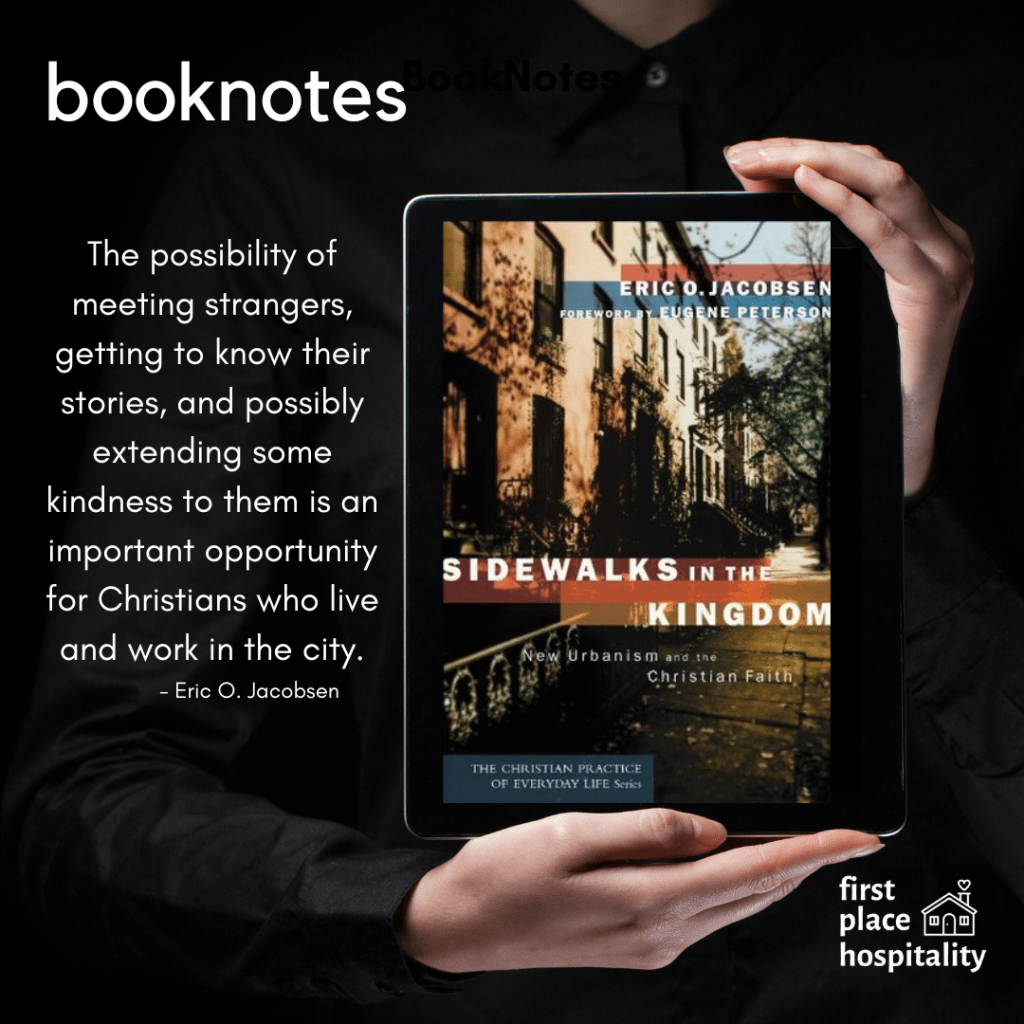
Sidewalks in the Kingdom

New Urbanism and the Christian Faith

The virtue of neighborliness is not only something I want for my neighborhood, but is something I want deeply for every residential area. I can practice neighborliness in my context while advocating for a return to neighborliness in every context.

Eric O. Jacobsen

Christians often talk about claiming our cities for Christ and the need to address urban concerns. But according to Eric Jacobsen, this discussion has remained far too abstract. Sidewalks in the Kingdom challenges Christians to gain an informed vision for the physical layout and structure of the city.

Jacobsen emphasizes the need to preserve the nourishing characteristics of traditional city life, including shared public spaces, thriving neighborhoods, and a well-supported local economy. He explains how urban settings create unexpected and natural opportunities to initiate friendship and share faith in Christ.

Helpful features include a glossary, a bibliography, and a description of New Urbanism. Pastors, city-dwellers, and those interested in urban ministry and development will be encouraged by Sidewalks in the Kingdom.

According to author Eric O. Jacobsen, the most meaningful way to define a city he has found is to say that you tend to know when you are in one. While it may sound like a cop-out, this is one area where our intuition might really be our most reliable guide.

To be more specific, there are six general features that would indicate to a visitor that he or she is in a city. These features can be understood as six distinct markers of the city.

  • Public spaces
  • Mixed-use zoning
  • Local economy
  • Beauty and quality in the built environment
  • Critical Mass
  • Presence of strangers

Jacobsen believes that a familiarity with these makers gives us handles upon which to hang our impressions of the communities in which we live, whether or not they qualify as cities. They also help focus and clarify our discussion about the merits of city life.


inspired by & adapted from Sidewalks in the Kingdom, by Eric O. Jacobsen


How Questions Lead to Understanding

The way to avoid a misunderstanding is to have an understanding.

I heard those words from my father years ago, and they have come to be an important part of an ongoing learning curve involving that most difficult of social skills – communication.

Communication between individuals or groups of people is never easy. Some people think that all we have to do is to listen. Others think we just need to hear them out. However, there is a great difference between hearing and listening. Hearing refers to the physical dimension of the sound waves striking the ear and the brain processing them into meaningful information. Listening, however, involves far more than the hearing process. It incorporates paying attention and focusing with the intention of understanding and responding appropriately.

One of the most basic of all human needs is the need to understand and to be understood. The best way to understand people is to listen to them. Not only that but when people feel that you have really listened to them, you will gain their respect and they will value and give you the credibility to speak.

Consider how you feel when you sense someone is really listening to what you have to say. You feel good, you feel understood, and more connected to the person who is listening. The fact that they are interested causes you to feel cared for.

True listening is a skill which needs to be learnt and practiced because the mind functions seven times more quickly than it is possible to speak. Therefore the mind needs to be slowed down and focused on what the person is saying, and not pay attention to other irrelevant thoughts or distractions.

One of the best ways to build up your listening skills is to ask a question, and then be quiet and listen to the answer. Questions will give you a greater understanding of the person, give them encouragement, and instill a sense of connectedness. Make sure that ask questions and listen more than you speak.

When you have the opportunity, use a question or questions and experience the power of creating understanding with others through the power of listening.

And in my experience, understanding is easier to find when you ask the right questions.

Of course, asking the right question is often a challenge. It’s easy to ask a question that triggers an argument, demands analysis, expects a defensive reply or begs for an explanation. These kinds of questions may be interesting, but they lack power.

Powerful questions are those that evoke a choice for accountability and commitment. They are questions that take us to requests, offers, declarations, forgiveness, confession, gratitude, and welcome: all of which are memorable and have a transformative power.

Questions create the space for something new to emerge.

What questions will you be asking today?


Words That Work: Unlocking the Science of Persuasion and Effective Communication

In the final post of a four-part mini-series revolving around books, there was a look at the history of the library, the role of books in both shaping conflict and being shaped by conflict, how book design impacts the reading experience, and now some closing thoughts on words themselves.

Almost everything we do involves words. Words are how we persuade, communicate, and connect. They’re how leaders lead, salespeople sell, and parents parent. They’re how teachers teach, policymakers govern, and doctors explain. Even our private thoughts rely on language.

But certain words are more impactful than others. They’re better at changing minds, engaging audiences, and driving action. What are these magic words, and how can we take advantage of their power?

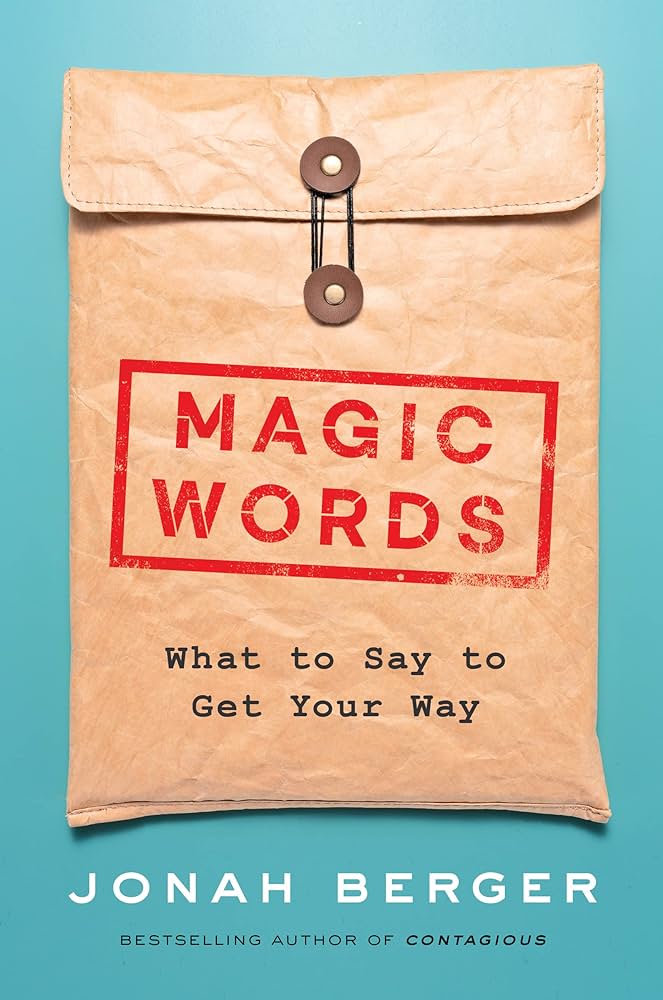
In Magic Words, internationally bestselling author Jonah Berger gives you an inside look at the new science of language and how you can use it. Technological advances in machine learning, computational linguistics, and natural language processing, combined with the digitization of everything from cover letters to conversations, have yielded unprecedented insights.

Learn how salespeople convince clients, lawyers persuade juries, and storytellers captivate audiences; how teachers get kids to help and service representatives increase customer satisfaction; how startup founders secure funding, musicians make hits, and psychologists identified a Shakespearean manuscript without ever reading a play.

This book is designed for anyone who wants to increase their impact. It provides a powerful toolkit and actionable techniques that can lead to extraordinary results. Whether you’re trying to persuade a client, motivate a team, or get a whole organization to see things differently, this book will show you how to leverage the power of magic words.

Magic Words, authored by Jonah Berger, delves into the concealed mechanisms governing language and, more significantly, delineates strategies for employing it more persuasively, nurturing relationships, and achieving success in both personal and professional realms.

The book explores six categories of influential words, devoting a chapter to each of these areas:

Activating Identity and Agency: Words that delineate authority, responsibility, and engagement in actions. This chapter delves into the profound impact subtle alterations in language can have, such as the efficacy of using nouns over verbs in persuasion, mastering the art of refusing to advance towards goals, and adopting specific interrogative phrases to enhance creativity and problem-solving. Furthermore, it discusses how speaking in the third person can mitigate anxiety and enhance communication, along with the nuanced effects of pronouns like “you” on social interactions and empathy.

Conveying Confidence: Language not only communicates information but also conveys the speaker’s confidence, thereby influencing perceptions and sway. This chapter explores how eliminating certain words transformed an underperforming salesperson into a top achiever, the significance of linguistic style in legal discourse, and linguistic cues that enhance credibility and authority. It also delves into the allure of certainty and the strategic use of uncertainty in communication to foster trust and receptivity.

Asking the Right Questions: This chapter delves into the science behind effective questioning, revealing why seeking advice enhances perceived intelligence and increases the likelihood of securing subsequent dates. It elucidates the types and timing of questions for optimal outcomes, strategies for deflecting challenging inquiries, and techniques for fostering deeper social connections through inquiry.

Leveraging Concreteness: Highlighting the potency of concrete language, this chapter reveals how specific words convey attentive listening and why emphasizing “fixing” rather than “solving” problems enhances customer satisfaction. It explores instances where abstract language may be advantageous, signaling authority and leadership, and discusses its role in fundraising for startups.

Employing Emotion: Exploring the emotive dimension of language, this chapter unveils how emotional language enhances engagement across various contexts. It narrates anecdotes, such as the success story of a young intern who built a podcasting empire by mastering storytelling principles. Additionally, it delves into the interplay between negative and positive emotions in enhancing enjoyment and boosting sales, offering insights into captivating audience attention and managing emotional responses.

Harnessing Similarity and Difference: This section explains the significance of linguistic similarity in interpersonal dynamics, explaining its impact on social connections, promotions, and friendships. It also explores scenarios where embracing difference proves advantageous, citing examples from music popularity trends and artificial intelligence research.

The book concludes by emphasizing the universal role of language in everyday communication, whether through written correspondence or oral discourse. It underscores the importance of mastering language for effective communication, persuasion, and relationship-building, positing that linguistic proficiency is a skill that can be learned and honed over time, empowering individuals to achieve their communication goals effectively.


Part of a regular series on 27gen, entitled Wednesday Weekly Reader.

During my elementary school years one of the things I looked forward to the most was the delivery of “My Weekly Reader,” a weekly educational magazine designed for children and containing news-based, current events.

It became a regular part of my love for reading, and helped develop my curiosity about the world around us.

Unlocking Understanding: The Art of Meaningful Conversation

If a person is a point of view, then to know them well you have to ask them how they see things.

David Brooks, How to Know a Person

It doesn’t work  to imagine what’s going on in people’s heads – you have to ask them.

You have to have a conversation.

A good conversation is an act of joint exploration. Somebody floats a half-formed idea. Somebody else seizes on the nub of the idea, plays with it, offers their personal perspective based on their memories, and floats it back so the other person can respond. A good conversation sparks you to have thoughts you never had before. A good conversation starts in one place and ends up in another.

Author David Brooks spent time talking with conversation experts and reading their books. He put together the following list of some of the nonobvious ways to become a better conversationalist.

  • Treat attention as an on/off switch, not a dimmer. If you’re in a conversation, you’re going to stop doing anything else and just pay attention to this.
  • Be a loud listener. When another person is talking, you want to be listening so actively that you’re practically burning calories. Active listening is an invitation to express.
  • Favor familiarity. People have trouble picturing and getting excited about the unfamiliar, but they love to talk about what they know.
  • Make them authors, not witnesses. Good conversationalists don’t only want to talk about what happened, they want to know how you experienced what happened.
  • Don’t fear the pause. Wait for the end of the other person’s comment, and then pause a few beats to consider how to respond to what’s been said.
  • Do the looping. Repeat what someone just said in order to make sure you accurately received what they were trying to project.
  • The midwife model. In conversation, a midwife is there not to lead with insights but to receive and build on the insights the other person is developing.
  • Keep the gem statement at the center. In the midst of many difficult conversations, there is a truth underneath the disagreement, something both parties can agree upon.
  • Find the disagreement under the disagreement. When you search for the disagreement under the disagreement, you are looking for the moral, philosophical roots of why you each believe what you do.
  • Don’t be a topper. When someone tells you about a situation,  don’t turn around and say, “I know exactly what you mean. Here’s what’s going on with me.”

The experience of being listened to all the way on something – until our meaning is completely clear to another human being – is extremely rare in life.

Mónica Guzmán

In the pursuit of meaningful, engaging conversations, it’s essential to develop a set of social skills and master the art of conversation. The ultimate goal is to make the experience of being actively listened to and truly understood a more common occurrence in our lives.


Inspired by, and adapted from, How to Know a Person by David Brooks


From Concept to Cover: Navigating the Design Journey of Books

This mini-series about books started off with the history of the library, then went to books at war, and now comes down to the book itself – or rather, how important the design of a book is to the reader.


Design is central to the appeal, messaging, and usefulness of books, but to most readers, it’s mysterious or even invisible. Through interiors as well as covers, designers provide structure and information that shape the meaning and experience of books. In The Design of Books, Debbie Berne shines a light on the conventions and processes of her profession, revealing both the aesthetic and market-driven decisions designers consider to make books readable and beautiful. In clear, unstuffy language, Berne reveals how books are put together, with discussions of production considerations, typography and fonts, page layouts, use of images and color, special issues for ebooks, and the very face of each book: the cover.  

The Design of Books speaks to readers and directly to books’ creators—authors, editors, and other publishing professionals—helping them to become more informed partners in the design of their projects. Berne lays out the practical steps at each stage of the design process, providing insight into who does what when and offering advice for authors on how to be effective advocates for their ideas while also letting go and trusting their manuscripts with teams of professionals. She includes guidance as well for self-publishing authors, including where to find a designer, what to expect from that relationship, and how to art direct your own book.

Throughout, Berne teaches how understanding the whats, hows, and whys of book design heightens our appreciation of these cherished objects and helps everyone involved in the process to create more functional, desirable, and wonderful books.

Berne embarked on the journey of writing this book because she sensed a gap in understanding among the authors and editors she collaborated with regarding book design. It seemed there was a lack of accessible resources for them to grasp the intricacies of design. Traditional books on design target designers themselves, while online explanations often offer fragmented and bewildering information, focusing on the “what” rather than the “why.” Berne’s aim was to equip those on the editorial side with not only the vocabulary and techniques of design but also the underlying rationale behind design decisions. This endeavor wasn’t solely for enjoyment, although design can indeed be enjoyable, but rather to facilitate more meaningful discussions, enriched experiences, and ultimately, better books.

The Design of Books provides the reader with insights into the mechanics of typography and the significance of factors like line length. It will heighten your awareness of the nuances of headings and how the choice of words influences cover design. Above all, it will enhance your perception of design and its contributions.

As a book designer turned author, Berne advocates for the importance of design in publishing and emphasizes the significance of incorporating the voice and ideas of the designer early in the process. Often, design is an afterthought, introduced late in the game, leading to a discord between the materials provided and the expectations for their presentation. Authors should consider how the design will complement the content from the outset, including collaboration with designers during the developmental stages. Effective design should intertwine seamlessly with the content; attempting to apply it as an afterthought overlooks its essence.

Design inside a book creates order and bestows authority. Reading a badly designed book is like driving over a crumbling road, potholes everywhere.

Debbie Berne

Part of a regular series on 27gen, entitled Wednesday Weekly Reader.

During my elementary school years one of the things I looked forward to the most was the delivery of “My Weekly Reader,” a weekly educational magazine designed for children and containing news-based, current events.

It became a regular part of my love for reading, and helped develop my curiosity about the world around us.

Palaces for the People

How Social Infrastructure Can Help People Fight Inequality, Polarization, and the Decline of Civic Life

The social and physical environment shapes our behavior in ways we’ve failed to recognize; it helps make us who we are and determines how we live.

Eric Klinenberg

We are living in a time of deep divisions. Americans are sorting themselves along racial, religious, and cultural lines, leading to a level of polarization that the country hasn’t seen since the Civil War. Pundits and politicians are calling for us to come together and find common purpose. But how, exactly, can this be done?

In Palaces for the People, Eric Klinenberg suggests a way forward. He believes that the future of democratic societies rests not simply on shared values but on shared spaces: the libraries, childcare centers, churches, and parks where crucial connections are formed. Interweaving his own research with examples from around the globe, Klinenberg shows how “social infrastructure” is helping to solve some of our most pressing societal challenges. Richly reported and ultimately uplifting, Palaces for the People offers a blueprint for bridging our seemingly unbridgeable divides.

According to author Eric Klinenberg, social infrastructure is not “social capital” – a concept commonly used to measure people’s relationships and interpersonal networks – but the physical conditions that determine whether social capital develops.

When social infrastructure is robust, it fosters contact, mutual support, and collaboration among friends and neighbors; when degraded, it inhibits social activity, leaving families and individuals to fend for themselves.

Social infrastructure is crucially important, because local, face-to-face interactions – at the school, the playground, and the corner diner – are the building blocks of all public life.

People forge bonds in places that have healthy social infrastructures – not because they set out to build community, but because when people engage in sustained, recurrent interaction, particularly while doing things they enjoy, relationships inevitably grow.


inspired by Palaces for the People, by Eric Klinenberg

From Aging to Sage-ing: Navigating the Journey of Becoming a Modern Elder

Many of us feel like we’re growing whole rather than growing old. What if there was a new, modern archetype of elderhood, one that was worn as a badge of honor, not cloaked in shame?

Chip Conley

On the occasion of my 65th birthday in 2023, I made public a project I had been working for some time, and one that I plan to continue the rest of my life:

Becoming a Modern Elder.

Here was my resolve: As much as it is in my health, resources, and capacity, I resolve to:

My journey to becoming a Modern Elder is all about reciprocity. 

Giving and receiving. Teaching and learning. Speaking and listening. 

Everyone gets older, but not everyone gets elder.

The first just happens (if you’re lucky and healthy). The other you have to earn.

Along this journey, I’ve been researching the topic of elderhood, and I wanted to share an important contribution to that research from Terry Jones in his book, The Elder Within:

One writer approached the idea of what he calls “elderhood” as a “state of consciousness that arises in the context of physiological aging… [where] the psyche issues a call for us to engage in life completion, a process that involves specific tasks, such as coming to terms with our mortality, healing our relationships, enjoying our achievements and leaving a legacy for the future.”

The archetypal elder has been the same force in most cultures over most all of time. An archetype is an ancient model for a role that has survived time. Some writers refer to the archetypal “elder within” when discussing the energy from the psyche that energizes those who express eldership. “Within each person awaits the figure of the elder – a promise and a challenge.” Just as the instincts seem to account for recurrent behavior patterns in man, so the archetypes seem to account for recurrent psychic patterns. 

Psychic patterns are expressions of your psyche. The psyche is all of the human being, which is not physical. The psyche includes the conscious and unconscious elements of the human personality.

When a man taps the energy of the “elder within,” the following are available to him:

  • Balance in our expression of strength, celebration, intellect, and feeling
  • Knowledge of our faults, our shadow
  • An expression of self principally from our center, our soul
  • Patience and a desire to be available to others
  • An awareness of our personal strength
  • A sage-like love for consensus and community
  • A expression of wisdom that leads to being shown extraordinary
  • Deference by the community
  • A hunger to share the world with women and children: the opposite of patriarchy
  • A drive for conservation and a passion for the Earth and its survival
  • Assertive energy that invigorates and energizes but is not dangerous to others
  • A need to nurture and guide younger people and contribute to the next generation
  • Husbandman energy: driven by a passion for the best possible life for men and the beauty of the Earth
  • Stewardship energy of the Earth, of people
  • A desire to take care of ourselves and take pride in our good health
  • Knowledge that we are caretakers whose vitality depends on a personal shift from self to community
  • A personal force that empowers others when they are in your presence
  • A hunger to introduce the meaning of life to the young

Eldership is wisdom in an active state.

Wisdom is enlightenment, insight, and a high degree of learning. The elder is aware of the need to pass on one’s knowledge and to pass on the responsibility of stewardship of man and the Earth to the young.

I would love to hear your comments:

  • What’s your reaction to the list above?
  • What would you change?
  • What would you add?
  • What would you remove?

Thanks for contributing to my ongoing research and discussion of the Modern Elder!


Turning the Pages of War and Peace

In a follow-up to last week’s look at the history of the library, a companion post: the role of books in both shaping conflict and being shaped by conflict (the very appropriate subtitle of the book).


Print, in all its rich variety, will continue to play a part in human interactions through the globe, in war as in peacetime… When books go to war, others stay behind, a reminder of the better times when conflict can be banished to the edge of our consciousness, if never wholly eradicated.

Andrew Pettegree

We tend not to talk about books and war in the same breath – one ranks among humanity’s greatest inventions, the other among its most terrible. But as esteemed literary historian Andrew Pettegree demonstrates, the two are deeply intertwined

The Book at War explores the various roles that books have played in conflicts throughout the globe. Winston Churchill used a travel guide to plan the invasion of Norway, lonely families turned to libraries while their loved ones were fighting in the trenches, and during the Cold War both sides used books to spread their visions of how the world should be run. As solace or instruction manual, as critique or propaganda, books have shaped modern military history – for both good and ill. 

With precise historical analysis and sparkling prose, The Book at War accounts for the power – and the ambivalence – of words at war.

In May 1933, news of widespread book burnings orchestrated by the Nazis in Germany triggered a swift and impassioned response in the United States. Almost 200,000 people took to the streets in cities across the country to protest this censorship. Authors, some of whose works had been burned, strongly condemned the actions. President Franklin D. Roosevelt incorporated the imagery of the smoldering pyres into his speeches, emphasizing the importance of preserving freedom and civil liberties.

Nearly a century later, book burnings during the Nazi era remain a powerful symbol, partly due to their impact at the time. Many Americans saw them as emblematic of the German regime, serving as a forewarning of future atrocities. However, Andrew Pettegree’s extensive cultural history, The Book at War: How Reading Shaped Conflict and Conflict Shaped Reading, reveals a surprising twist. Less than two decades before the Nazi book burnings, during periods of wartime chauvinism, Americans themselves fervently burned German books, with librarians leading the way.

Pettegree, a professor of modern history at Scotland’s University of St Andrews, delves into the intricate relationship between printed media, books, and war. He argues that books have played a crucial role in conditioning readers to expect and support conflicts, serving as carriers of ideology and spoils for victors. Yet, they have also provided solace and solidarity during times of combat, offering comfort to civilians in hiding and soldiers on the front lines.

While Pettegree’s depth of knowledge and skillful storytelling are evident throughout, he reaches a high-water mark when detailing the literary toll of war, providing acute actuarial insights into the destruction of books during World War II. The loss of over 500 million books in Europe, including the ransacking of Jewish libraries and the devastation in Poland, underscores the profound impact on cultural heritage.

A fascinating thread weaves through what Pettegree calls “warrior authors” – the great leaders of the world powers who found themselves in opposition not only on the battlefield, but also on the written page. Here are a few examples:

  • Winston Churchill – Writing was in his blood; his first autobiography “My Early Life” was from his adventures in India and Africa during Britain’s various wars in the region. Prior to his ascendancy to become Prime Minister, writing and journalism kept him ahead of his mounting debts. After WWII, he would win the Nobel Prize for Literature, for his oratory and historical writing.
  • Adolf Hitler – The most notorious text of the twentieth century, “Mein Kampf” laid out in remarkable detail his program for Germany and the fate that awaited its enemies. He was also a discerning reader and collector, particularly of architectural and history books, appropriated by American soldiers in 1945 and now in the Library of Congress.
  • Joseph Stalin – Belying his reputation as crude and uneducated, he was a deeply literate and thoughtful reader and lover of books. His carefully curated library of over 15,000 volumes carried over into his involvement with some of the major writing projects of the Soviet state, influencing a war of ideas in Communist countries around the world.
  • Charles de Gaulle – A lonely symbol of French defiance during most of WWII, he first came to prominence as an author of aa widely admired text on armored warfare that crossed international boundaries and was quickly translated into both German and Russian.

The Book at War not only examines the destructive power of war on literature but also highlights how books have provided comfort to individuals enduring conflict. The accounts of Allied soldiers receiving cartons of paperbacks after storming Normandy’s beaches and Anne Frank finding solace in books while hiding from the Germans in Amsterdam are particularly poignant. These stories prompt reflection on how books continue to influence those facing conflict today.

On a personal note, my father was a WWII veteran who loved to read. Much later in life – his early 80s – he shared with me both stories and a few books that he had saved from his time in service. In addition, he had a highly curated selection of books by and about some of the great leaders of that generation, particularly Dwight Eisenhower. Upon is passing, I was fortunate to bring several of those into my personal library.


Part of a regular series on 27gen, entitled Wednesday Weekly Reader.

During my elementary school years one of the things I looked forward to the most was the delivery of “My Weekly Reader,” a weekly educational magazine designed for children and containing news-based, current events.

It became a regular part of my love for reading, and helped develop my curiosity about the world around us.

How to Help You Live SENT in the Place You Call Home

Not so long ago, neighbors generally kept their doors open to one another. Smaller houses seemed less confining, because the more porous divisions between homes – separated not by doors of wood or steel but by “screen doors” – encouraged socializing with neighbors.
An essential ingredient in community formation is dying out: the strong relational ties that are built when we let our guard down with each other, when we claim common space as an appropriate forum for conversation, play, and eating.
I used to think hospitality was a lost art. Now I’m convinced it is a lost heart.

Len Sweet, From Tablet to Table

Here are some more helps in learning to build bridges with hospitalityfrom your home to your neighbors.

These bridges are the next step in the ongoing shift in thought from a facility-focused ministry (church as a place) to one based in people’s homes (church as the body of Christ BEING the church).

Think of it as shifting:

  • From a buildings to your block
  • From a campus to your cul-de-sac
  • From in-person to in-the-neighborhood

Why not BE the church in your neighborhood TODAY, instead of BRINGING your neighbors to church?

Here is a link to the webinar recording I did entitled How to Help You Live SENT in the Place You Call Home

You will learn about the spaces, places, and graces that will help you become bridge builders to your neighbors. I unpacked those three words with ideas, examples, and tools to help you BE the church where you live.

Even though recorded at the height of the pandemic in the summer of 2020, the webinar concepts are valid and needed just as much today.

Here are some next steps from the content covered in the webinar:

> Download a blank Spaces/Places/Graces Listening Guide PDF

> Download a brief synopsis of the key slides used

> Recommended Books Referenced:

   Primary

   Other Good Resources

As discussed on the webinar, the ideas and resources we talked about are just the tip of the iceberg when it comes to Building Bridges to Your Neighbors. You can find many more by searching on this site using the key words “First Place Hospitality.”

For an essential First Place Hospitality library, check out this page.


The Art of Seeing Others Deeply and Being Seen

When I was young, I wanted to be knowledgeable, but as I got older, I wanted to be wise. Wise people don’t just possess information; they possess a compassionate understanding of other people. They know about life.

David Brooks

Along the journey of becoming a Modern Elder, I want to become more present with people, have bigger conversations, and find deep pleasure in human connection.

As a textbook introvert, I struggle with the previous sentence, but there’s always hope…

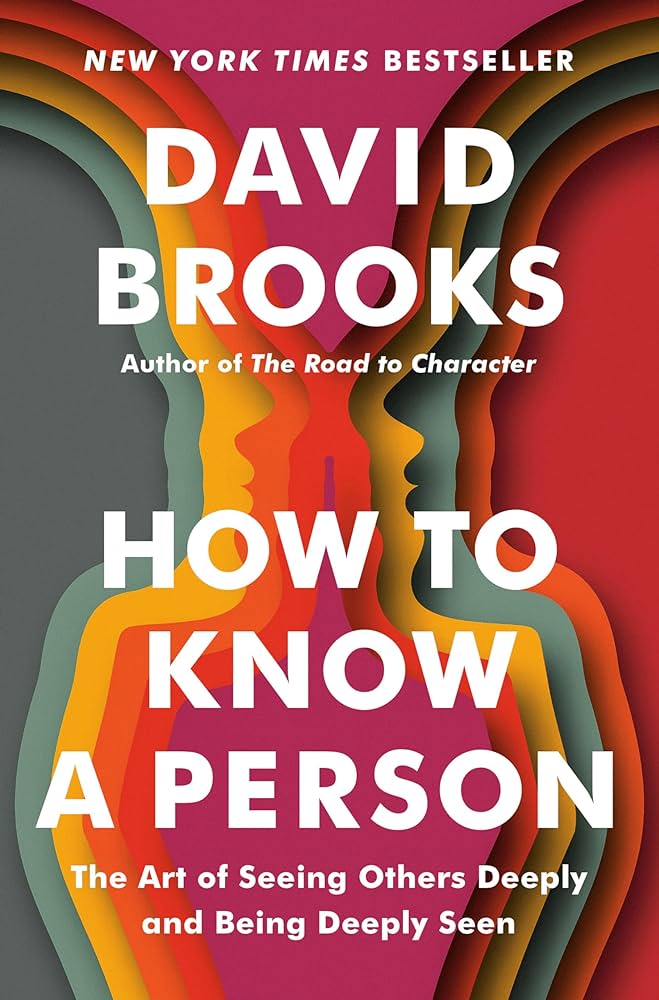
…especially when I read How to Know a Person by David Brooks.

David Brooks observes, “There is one skill that lies at the heart of any healthy person, family, school, community organization, or society: the ability to see someone else deeply and make them feel seen – to accurately know another person, to let them feel valued, heard, and understood.”

And yet we humans don’t do this well. All around us are people who feel invisible, unseen, misunderstood. In How to Know a Person, Brooks sets out to help us do better, posing questions that are essential for all of us: If you want to know a person, what kind of attention should you cast on them? What kind of conversations should you have? What parts of a person’s story should you pay attention to?

Driven by his trademark sense of curiosity and his determination to grow as a person, Brooks draws from the fields of psychology and neuroscience and from the worlds of theater, philosophy, history, and education to present a welcoming, hopeful, integrated approach to human connection. How to Know a Person helps readers become more understanding and considerate toward others, and to find the joy that comes from being seen. Along the way it offers a possible remedy for a society that is riven by fragmentation, hostility, and misperception.

The act of seeing another person, Brooks argues, is profoundly creative: How can we look somebody in the eye and see something large in them, and in turn, see something larger in ourselves? How to Know a Person is for anyone searching for connection, and yearning to be understood.

Building meaningful relationships and fostering a sense of community boils down to mastering a series of small, tangible social skills. It’s about navigating disagreements without damaging connections, gradually unveiling vulnerability, being an attentive listener, gracefully concluding conversations, seeking forgiveness when needed, gently turning down others without causing heartbreak, comforting those in distress, and hosting gatherings where everyone feels embraced. It’s also about the ability to empathize and see things from another’s perspective.

Within any group, there are two types of individuals: Diminishers and illuminators. Diminishers focus on themselves, making others feel insignificant through stereotypes and assumptions. On the flip side, illuminators exhibit a persistent curiosity about others, asking the right questions to understand different viewpoints. They shine a light on people, making them feel respected and valued.

Despite being crucial life skills, these aren’t typically taught in schools, leaving a gap in practical knowledge about offering the rich attention we all crave. At the core of a healthy person, family, school, organization, or society lies a fundamental skill: the ability to deeply see and make others feel seen, to understand and value them.

This goes beyond mastering a set of techniques; it’s a way of life. To truly know someone, you need to grasp how they perceive the world, experiencing it through their eyes. Building relationships is an ongoing effort to understand others on a profound level and let them feel heard, valued, and comprehended. It’s about knowing how they know you.

Some people are much better at seeing people than others are. In any collection of humans, there are diminishers and there are illuminators. Diminishers are so into themselves, they make others feel insignificant. They stereotype and label. If they learn one thing about you, they proceed to make a series of assumptions about who you must be.
Illuminators, on the other hand, have a persistent curiosity about other people. They have been trained or have trained themselves in the craft of understanding others. They know how to ask the right questions at the right times — so that they can see things, at least a bit, from another’s point of view. They shine the brightness of their care on people and make them feel bigger, respected, lit up.

David Brooks

Take a look at some of the following characteristics of Diminishers and Illuminators as developed by Brooks. Do you recognize yourself in any of them?

Diminisher Tactics

  • First Impressions: It’s that quick sizing-up moment when you meet someone, where you open your eyes, direct your gaze, and take them in.
  • Egotism: Some folks struggle to step outside their own viewpoints. They just aren’t curious about others.
  • Anxiety: Ever met someone drowning in the noise of their thoughts? It’s like they’ve got a whole party in their head, and they can’t quite tune into what’s happening in yours.
  • Naïve Realism: Ever thought your perspective was the one true reality, assuming everyone sees the world just as you do? That’s naive realism in action.
  • The Lesser-Minds Problem: While we’re privy to our thoughts, we only catch a snippet of what’s happening in other minds. This leads to the perception that our inner world is far more intricate than theirs.
  • Objectivism: Picture someone adopting a detached, dispassionate stance to understand entire populations but missing the individual stories.
  • Essentialism: Ever grouped people together, thinking they’re more similar than they really are? Or believed others from different groups are fundamentally different from “us”? That’s essentialism.
  • The Static Mindset: Imagine forming fixed perceptions of people, maybe based on past encounters, and not bothering to update them to reflect who they are now. That’s the static mindset in action.

The Illuminator’s Look

  • Gentleness: It’s about having a genuine emotional concern for others, recognizing the ties that bind us and the commonalities we share.
  • Openness: Pushing aside insecurities and self-absorption to fully engage in the experience of someone else.
  • Curiosity in Action: Cultivating the spirit of an explorer and honing the skill of imagining to truly see others.
  • Warmth: While some treat understanding as an intellectual exercise, for many, it’s a whole-body experience filled with emotion and affection.
  • Kindness: A generous spirit that looks for the best in people.
  • A Complete View: It’s easy to misjudge when you only see a fragment of someone rather than their whole being.

Striving to cast an illuminating gaze that is tender, generous, and open, we set ourselves on the right path. This approach helps us move beyond the clichéd character types we often lazily assign to people, ultimately enhancing how we present ourselves to the world.

The real process of, say, building a friendship or creating a community involves performing a series of small, concrete actions well: being curious about other people; disagreeing without poisoning relationships; revealing vulnerability at an appropriate pace; being a good listener; knowing how to ask for and offer forgiveness; knowing how to host a gathering where everyone feels embraced; knowing how to see things from another’s point of view.

David Brooks