Attunement in Leadership: Converting Resistance into Collective Commitment

One of the most challenging aspects of leadership isn’t dealing with external obstacles – it’s managing internal resistance from your own team. While leaders generally prepare themselves for external challenges, the emotional toll of facing opposition from within can be particularly devastating, often leaving them feeling betrayed and discouraged.

 Every leader knows the stormy seas of resistance. When faced with change, even the most dedicated teams can push back, especially when there’s something to lose. How do you guide your team through these turbulent times without losing sight of the mission? Leading Through Resistance by Tod Bolsinger is a beacon for leaders navigating the choppy waters of organizational change.

Leading Through Resistance offers more than just strategies; it delivers a mindset shift. With wisdom woven through every page, Tod Bolsinger teaches you unexpected skills to not only face resistance but to transform it into a mission-driving force.

Leading Through Resistance is a roadmap to resilient leadership. Equip yourself with the tools to lead with confidence, adapt with grace, and inspire transformation. Whether you’re a seasoned leader or just starting your leadership journey, Leading Through Resistance is your essential guide to turning resistance into resilience.


Understanding Internal Resistance

Internal resistance emerges when we introduce new ideas or attempt to implement significant organizational changes. As leaders, we often take this resistance personally, allowing our egos to become overinvolved until any disagreement feels like a direct challenge to our professional identity. This emotional response can lead to either passive avoidance or counterproductive pushback.

However, it’s crucial to understand that resistance to change isn’t malicious – it’s natural. As Edwin Friedman noted, sabotage isn’t “the bad things that evil people do,” but rather “the human things that anxious people do.” In fact, resistance is so inherently linked to the leadership process that it should be expected whenever significant change is initiated.

The Path Forward: From Pushback to Pull-Together

Instead of trying to eliminate resistance, successful leaders learn to lead through it. The key is to implement an emotionally intelligent process that transforms pushback into buy-in. Rather than meeting resistance with force, invite your team to lock arms and channel their energy toward collective progress.

Core Principles for Managing Resistance

Start with Dual Convictions

  • The Preservation Conviction: Ensure all changes protect and maintain the organization’s core purpose and values
  • The Change Conviction: Acknowledge that adaptation is necessary to preserve and advance the organization’s mission

Stay Calm, Curious, and Connected

  • Maintain emotional equilibrium without becoming detached
  • Create psychologically safe spaces for honest dialogue
  • Move closer to resistance rather than away from it
  • Transform heated emails into personal conversations
  • Convert formal complaints into opportunities for coffee meetings

Practice Attunement

Research shows that nearly 90% of what distinguishes outstanding leaders comes down to emotional intelligence rather than cognitive abilities. This emotional intelligence manifests through four core competencies:

  • Self-awareness
  • Self-management
  • Social awareness
  • Relationship management

Practical Strategies for Implementation

Slow Down the Process – While crisis often provides the urgency needed for change, resist the temptation to rush. Frenetic action rarely leads to sustainable transformation.

Give the Work Back – Engage key stakeholders early in the process. As Patrick Lencioni wisely noted, “If people don’t weigh in, they can’t buy in.” Create a guiding coalition that includes even those likely to push back— – heir perspective is valuable.

Conduct an Accusation Audit – Begin by acknowledging potential objections and fears. People are typically twice as motivated by fear of loss as they are by potential gains. Creating this psychological safety helps lower defensive barriers.

Practice Active Mirroring – Listen intently enough to repeat key phrases and emotions expressed by others. The goal isn’t to get them to say “You’re right,” but rather to hear them say “That’s right” when you reflect their concerns back to them.

Embrace the Power of “No” – Counter-intuitively, a genuine “no” is more valuable than a “counterfeit yes.” When people feel safe expressing disagreement, it builds trust and opens the door to authentic commitment later.

For those of us trained in the old “command and control” mindset,  it is natural to assume that we have to stand our ground for things to go our way. Don’t eliminate resistance – lead through it.

Tod Bolsinger

The Adaptive Reset

The traditional leadership model of meeting resistance with resistance is outdated. Today’s effective leaders understand that attunement accelerates change. When clarity and empathy combine, they become powerful tools for reducing resistance and fostering genuine buy-in.

Remember that emotional connection precedes rational agreement. In the words of moral psychologist Jonathan Haidt, “Intuitions come first, strategic reasoning second.” By focusing on building trust and lowering defensiveness through genuine connection, leaders can create the conditions for meaningful transformation.

The path forward isn’t about domination or control – it’s about the art of persuading people to work toward a common goal. When leaders make the conscious choice to resist pushing back against pushback and instead attune with those who resist, they create the possibility for collective movement forward.

This approach isn’t manipulation; it’s a process of genuine mutual transformation rooted in deep values and full engagement. By combining clear purpose with emotional intelligence, leaders can turn opponents into allies and resistance into momentum for positive change.


How Questions Lead to Understanding

The way to avoid a misunderstanding is to have an understanding.

I heard those words from my father years ago, and they have come to be an important part of an ongoing learning curve involving that most difficult of social skills – communication.

Communication between individuals or groups of people is never easy. Some people think that all we have to do is to listen. Others think we just need to hear them out. However, there is a great difference between hearing and listening. Hearing refers to the physical dimension of the sound waves striking the ear and the brain processing them into meaningful information. Listening, however, involves far more than the hearing process. It incorporates paying attention and focusing with the intention of understanding and responding appropriately.

One of the most basic of all human needs is the need to understand and to be understood. The best way to understand people is to listen to them. Not only that but when people feel that you have really listened to them, you will gain their respect and they will value and give you the credibility to speak.

Consider how you feel when you sense someone is really listening to what you have to say. You feel good, you feel understood, and more connected to the person who is listening. The fact that they are interested causes you to feel cared for.

True listening is a skill which needs to be learnt and practiced because the mind functions seven times more quickly than it is possible to speak. Therefore the mind needs to be slowed down and focused on what the person is saying, and not pay attention to other irrelevant thoughts or distractions.

One of the best ways to build up your listening skills is to ask a question, and then be quiet and listen to the answer. Questions will give you a greater understanding of the person, give them encouragement, and instill a sense of connectedness. Make sure that ask questions and listen more than you speak.

When you have the opportunity, use a question or questions and experience the power of creating understanding with others through the power of listening.

And in my experience, understanding is easier to find when you ask the right questions.

Of course, asking the right question is often a challenge. It’s easy to ask a question that triggers an argument, demands analysis, expects a defensive reply or begs for an explanation. These kinds of questions may be interesting, but they lack power.

Powerful questions are those that evoke a choice for accountability and commitment. They are questions that take us to requests, offers, declarations, forgiveness, confession, gratitude, and welcome: all of which are memorable and have a transformative power.

Questions create the space for something new to emerge.

What questions will you be asking today?


Listening for a Connection

One of the best ways to make connections with other people is by closing your mouth and opening your ears.

That’s right – Listening.

And that often starts with paying attention.

Here’s an earlier post on “paying attention” that fits right into that concept.

So, assuming you are paying attention to your surroundings, how do you enter into a conversation that will help you connect better with people around you?

Surprisingly, one of the most important tools that you need to develop in your communication skills is not your mouth. It is those two things on either side of your head.

Use your ears more than your mouth in a conversation, and become an active listener.

The most basic explanation of active listening is that is is the kind of listening that involves the use of one’s full concentration. The goal of this type of listening is to understand the person delivering the message.

Active listening is a skill which you have to develop over time, constantly practice, and fine tune along the way.

Here’s a tool developed by Dave Ping to help you listen to other people and establish a better connection with them.

Whether you’re talking with a relative, a neighbor, a friend, or a co-worker, the more you know about the person’s likes, dislikes, anxieties, and hopes, the easier it will be to connect with his or her world to establish, and then grow, a relationship.

Download the form above, and use it to listen and observe, filling in the blanks as you think the other person would.

Any answers you don’t know can serve as opportunities to listen more and to grow in your relationship.


Improve Your Ability to Connect with Others by Focusing Less on Yourself

Many, if not most, church staff leaders consider themselves good speakers. The basics are simple: leaders speak, their audience listens, and then they act on what was said.

Church leaders also know that rarely happens, and that there’s really much more to it than that. While it may be easy to speak to groups of all sizes and on many diverse topics, one critical question remains: “Are we connecting with our audience?”

To fully connect with an audience, leaders need to understand “empathy.” While you may not equate the word empathy with excellent communication skills, it actually is the secret to connecting with your audience. 

When you are able to put yourself in another person’s shoes, and try to see things from their point of view, their world, and their perspective, you will have a greater chance at both reaching and connecting with them.

THE QUICK SUMMARY – Simply Said: Communicating Better at Work and Beyond by Jay Sullivan

Simply Said is the essential handbook for business communication. Do you ever feel as though your message hasn’t gotten across? Do details get lost along the way? Have tense situations ever escalated unnecessarily? Do people buy into your ideas? It all comes down to communication. We all communicate, but few of us do it well. 

From tough presentations to everyday transactions, there is no scenario that cannot be improved with better communication skills. This book presents an all-encompassing guide to improving your communication, based on the Exec|Comm philosophy: we are all better communicators when we focus less on ourselves and more on other people. More than just a list of tips, this book connects skills with scenarios and purpose to help you hear and be heard. You’ll learn the skills to deliver great presentations and clear and persuasive messages, handle difficult conversations, effectively manage, lead with authenticity and more, as you discover the secrets of true communication.

Communication affects every interaction every day. Why not learn to do it well? This book provides comprehensive guidance toward getting your message across, and getting the results you want.

A SIMPLE SOLUTION

All leaders aspire to be better communicators. And most times, leaders feel that better communication starts with them. While not wrong, it would be a mistake to think that the focus needs to be on ourselves.

If we put the focus on what the other person is trying to gain from our exchange, we will do a better job communicating, because we will select more pertinent information, drill down to the desire level of detail, and make the information we are sharing more accessible to our audience.

If we want to improve our ability to connect with others, to understand them and to be understood more clearly, the easiest and most effective way to do so is to focus less on ourselves and more on the other person.

This is the single most significant differentiator we can apply to our communication skills to improve our effectiveness.

Your message to the world is, of necessity, your message connecting you to the world.

Your Content: the substance of what you want to convey.

Your Oral Communication Skills: the way you convey your substance.

Your Written Communication Skills: the way you represent yourself when you’re not physically present.

Your Interactions: the settings in which you engage your audience, whether it’s an audience of one or one hundred or one thousand.

Your Leadership: the way you set the tone and relate to others.

Jay Sullivan, Simply Said: Communicating Better at Work and Beyond

A NEXT STEP

Set aside some time for personal reflection on your ability to connect with others by focusing less on yourself and more on the other person.

Using the five statements above, rate yourself on a scale of one to five, where one equals “I really need help in this area” and five equals “I am consistent in this area.”

Use the following suggestions from author Jay Sullivan to improve in each of the areas above in which you scored yourself anything less than a three.

Your Content

  • Convey a clear message
  • Tell engaging stories
  • Organize your content

Your Oral Communication Skills

  • Make the most of your body language
  • Listen to understand
  • Deliver from notes and visuals
  • Respond to questions

Your Written Communication Skills

  • Edit for clarity
  • Structure your documents
  • Create reader-friendly documents
  • Write emails that resonate

Your Interactions

  • Conduct effective meetings
  • Delegate successfully
  • Share meaningful feedback

Your Leadership

  • Lead others with inspiration and influence
  • Show vulnerability

Excerpt taken from SUMS Remix 129, released October 2019.


Part of a weekly series on 27gen, entitled Wednesday Weekly Reader

Regular daily reading of books is an important part of my life. It even extends to my vocation, where as Vision Room Curator for Auxano I am responsible for publishing SUMS Remix, a biweekly book “excerpt” for church leaders. Each Wednesday on 27gen I will be taking a look back at previous issues of SUMS Remix and publishing an excerpt.

>>Purchase SUMS Remix here<<

>> Purchase prior issues of SUMS Remix here<<

How to Learn by Listening

One of the things many growing organizations have trouble with is alignment and communication – from both a cultural and “business” standpoint. This may be the result of physically distributed teams or simply rapid growth. The larger an organization grows and the more distributed it becomes, the harder it is to make sure that there is a healthy relational dimension in our communication across the organization. Even in a small organization, understanding the importance of relational connection takes communication to the next level.

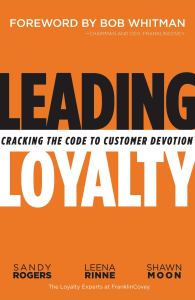
THE QUICK SUMMARY – Leading Loyalty by Sandy Rogers, Leena Rinne, and Shawn Moon

In business, if people merely like you, you’re in trouble. They need to love you! Learn how building loyalty and modeling great customer service behavior to develop frontline teams is the key to building raving fans.

To thrive in today’s economy, it’s not enough for customers to merely like you. They have to love you. Win their hearts and they will not only purchase more—they’ll talk you up to everyone they know.

But what turns casual customers into passionate promoters? What makes people stick with you for the long haul?

The industry experts at Franklin Covey set out to unlock the mysteries of gaining the customer’s loyalty. In an extensive study that involved 1,100 stores and thousands of people, they isolated examples that stood out in terms of revenues and profitability. They found that these “campfire stores” burned brighter than the rest thanks to fiercely loyal customers and the employees who delight in making their customers’ lives easier.

Now Leading Loyalty reveals the principles and practices of these everyday service heroes—the customer-facing employees who cultivate bonds and lift revenues through the roof. Full of eye-opening examples and practical tools, Leading Loyalty helps you infuse empathy, responsibility, and generosity into every interaction and:

  • Make warm, authentic connections
  • Ask the right questions
  • Listen to learn
  • Discover the real job to be done
  • Take ownership of the customer’s issue
  • Follow up and strengthen the relationship
  • Share insights openly and kindly
  • Surprise people with unexpected extras
  • Model, teach, and reinforce these essential behaviors through weekly team huddles

It’s time to invest in building loyalty. Even small improvements mean a big boost to your bottom line…and improves your business overall.

A SIMPLE SOLUTION

You would think listening would be easy. After all, we spend a good chunk of our lives doing it. We listened to our parents when we were children. We listened to our teachers in school. We listen to the radio in the car, and we listen to the TV while we are watching it.

But even though we have done it for so long, and even though we do it now, many of us don’t. Not really.

We hear sounds, but there is a difference between hearing things that happen to be around us at a given moment and actively, intentionally listening. The first happens without effort; the second comes through discipline and practice, and this is where we often fail. We find ourselves, especially when we are hearing something or someone we don’t agree with, not really listening but instead tolerating sound, just waiting for our own chance to talk.

There is a downside to efficiency when we’re working with human beings – we may neglect to take time to empathize and really listen.

The skill we are focused on here is not only listening to hear, but also listening to learn.

On a personal level, when we fail to listen, we not only miss the opportunity to show empathy and earn loyalty by connecting and learning from someone’s story, but we also fail to fulfill the greatest human need: to feel understood.

By making a genuine human connection with people and listening to learn, we uncover their story, which then allows us to feel and convey empathy.

By using the skill of listening to learn, you learn more about the other person’s story, and doing so enables you to show empathy. Listening to learn is not just a mechanical skill. It’s the result of really wanting to learn, of caring enough about another person to connect and listen for a moment.

Listening to learn comes from a heartfelt desire to truly understand other people. The more we understand, the more we can help them, the more loyal they become. The listening-to-learn behavior is rooted in the principle of empathy because it is about fully understanding and empathizing with the story of another.

Sandy Rogers, Leena Rinne, and Shawn Moon, Leading Loyalty

A NEXT STEP

Listening is important. It’s more than just a skill. In fact, it might well be worth considering, if we have trouble listening, the real reason why it’s so difficult.

A starting point? Listen to understand people without worrying or thinking about how to answer.

Who is someone on your team who excels at making genuine connection with others through listening? Ask them to share their “secrets” for listening with your whole team.

Following that, discuss the following questions:

  • What are we really trying to learn by listening?
  • Which of the following “Listen to Learn” guidelines do you need to improve on?
    • Stay silent until the person has finished talking.
    • Listen with your ears, eyes, and heart.
    • Don’t worry about how to answer – focus on understanding.
    • Rephrase what was said and check for understanding.
  • What does it mean to “listen with our ears, eyes, and heart”?
  • How do we check for understanding without solving the problem?

For a leader, listening is perhaps the most important skill of all. As a leader, we must learn to listen while navigating along with the person speaking toward a common destination – mutual understanding.

Excerpt taken from SUMS Remix 121-2, released June 2019.


Part of a weekly series on 27gen, entitled Wednesday Weekly Reader

Regular daily reading of books is an important part of my life. It even extends to my vocation, where as Vision Room Curator for Auxano I am responsible for publishing SUMS Remix, a biweekly book “excerpt” for church leaders. Each Wednesday on 27gen I will be taking a look back at previous issues of SUMS Remix and publishing an excerpt.

>>Purchase SUMS Remix here<<

>> Purchase prior issues of SUMS Remix here<<

No…or Know?

In many ways, we are all in sales. As a parent, we want our kids to follow the rules and life principles we teach them. In life, we are constantly interacting with people, many times trying to get them to “see it my way”, or to urge them to take a specific action. It may not be a product, but we all have situations in which we are “selling”.

What do you do when they say “no”?

Zig Ziglar, well-known author and inspirational speaker, had a unique idea to handle the situation:

When someone says no, the successful sales person understands that the “no” must mean the prospect doesn’t “know” enough to make the right decision.

Never argue with them. Just understand you haven’t finished your job, and accept the responsibility for going back and providing the information needed. With additional information, they will “know” enough to make a new (and favorable) decision.

Here’s Ziglar’s concept that will allow you to handle real objections in an efficient and effective way so you can deal with the “no”.

When objections occur, it’s time to get Q.U.I.E.T. Each letter stands for a word that will allow you help the individual you are talking with gather enough information to overcome their objections. When you get an objection, you pause and think Q.U.I.E.T.

Q. Begin with a question

U. You must ask questions so you can understand the objection

I. Once you understand the objection, you must identify it

E. To identify the objection and not be fooled by a false objection, you must empathize

T. If you empathize instead of sympathize with the prospect, you are ready to test the objection

If you are successful at addressing their concerns, it’s very likely that they are ready to make a new decision based on the additional information you provided.

Facing a “no” today from someone today?

 It’s time to be Q.U.I.E.T.