Using a Trimeth Lab to Boost Your Influence

The chemical and pharmaceutical industries have given us drugs for everything under the sun. You might be surprised to learn, however, that there’s a drug that could make you more persuadable if you take it and make you more persuasive if you give it to others. Perhaps even more shocking is the fact that this drug is now widely available through “trimeth labs” that are popping up in neighborhoods everywhere.

Before we explore that trimeth lab, a quick explanation: I’m wrapping up a series of posts from a great book entitled “Yes! 50 Scientifically Proven Ways to be Persuasive” by Robert Cialdini, Noah Goldstein, and Steve Martin. The information above (and expanded below) is a sample of simple but remarkably effective strategies that will make you much more persuasive at work and in your personal life.

Now – back to that trimeth lab.

The drug, known in the chemistry community as 1, 3, 7-trimethylxanthin, is more commonly known as caffeine, and these “trimeth labs” are more commonly known as coffee shops. Be it Starbucks, McCafe, or your local favorite coffee-house, the beverage you get there is a potential tool of influence and persuasion. We all know that caffeine can make us feel more alert, but can it make us more persuasive?

To test coffee’s persuasive prowess, scientist Pearl Martin and her colleagues first asked all of their participants to drink a product resembling orange juice. Half of the research subjects had their drink spiked with caffeine – the approximate amount that you might find in two cups of espresso.

Shortly after drinking the juice, all participants read a series of messages containing very good arguments advocating a certain position on a controversial issue. Those who had consumed the caffeinated beverage before reading those arguments were 35 percent more favorably disposed toward that position than were those who drank the plain juice.

The researchers also tested the effect of caffeine when participants read messages containing weak arguments. The results showed that caffeine has little persuasive power under these circumstances.

Given a choice, the studies suggest that you should make presentations when people are most alert – shortly after they’ve had their morning coffee fix, and never right after lunch. If you can’t choose the time of day, having coffee or caffeinated tea or other drinks on hand should make your audience more receptive to your message. Be aware that it usually takes about forty minutes for the full effect of caffeine to kick in, so time your presentation well!

Remember, the research suggests that this strategy is effective only if your arguments are genuine, thoughtful, and well-reasoned. So pour yourself a cup of coffee and write, edit, and rewrite your next presentation till it is absolutely on point.

Then break out the coffee for your audience.

If you have enjoyed this post as an example of increasing your persuasion, check out the others in the series from Monday and Tuesday. I highly recommend the book as well. The stories and examples contained show that persuasion is not just an art, but has many elements of science to it as well.


Jumping on the Bandwagon

When you are leading out in new directions, and want to get group buy-in, there’s nothing like using the momentum of the bandwagon.

But remember: the person who asks others to “jump on” is critical.

In a wide-ranging study based on hotel guests buying in to the reusing of towels for more than one night, social scientists were able to increase the frequency of reuse by several different methods. In addition to the standard environmental protection appeal and the social proof appeal (guests in our hotel reused towels x% of the time), the study went one step further.

Using data collected from the housekeeping staff, some guests saw a simple sign informing them that the majority of people who had previously stayed in their particular room participated in the towel reuse program at some point in their stay.

Guests who learned that the majority of the prior occupants of their particular room had participated were even more likely to reuse their towels than guests who learned the norms of the hotel in general. Compared to the standard environmental appeal, there was a 33 percent increase in the likelihood of participation.

It’s usually beneficial for us to follow the behavioral norms associated with the particular environment, situation or circumstances that most closely match our own. The results of this experiment suggest that the more similar the person giving the testimonial is to the target audience, the more persuasive the message becomes.

Here’s the application: say you’re trying to persuade your team to willingly embrace a new system. You should ask for a positive testimonial from others within your group who have already agreed to make the switch. But what if you’ve got a really stubborn team member, maybe one who has the most invested in the old way? Don’t make the mistake of choosing the most eloquent team member to try to convince the holdout. Instead, look for someone to solicit the opinions of another coworker who most closely matches the situations and circumstances of the holdout – even if that particular person happens to be less articulate or popular.

It’s all about understanding the circumstances of those who are most comparable to your target audience.

The above information came from a great book entitled “Yes! 50 Scientifically Proven Ways to be Persuasive.” Authors Robert Cialdini, Noah Goldstein, and Steve Martin reveal simple but remarkably effective strategies that will make you much more persuasive at work and in your personal life.

As I prepare for a major presentation this fall, I will be looking at some of my favorite examples of persuasion from the book; here is yesterday’s post.

When Asking a Little Goes a Long Way

Thinking big by going small is a powerful concept.

Consider the following scenario: you are asking colleagues to support a favorite charity of yours. Even though many would genuinely like to support the charity in some way they say no because they can’t afford to donate very much and they assume the small amount they can afford won’t do very much to help the cause.

Researchers put this hypothesis to the test, going door to door to ask for contributions to the American Cancer Society. After introducing themselves, they asked the residents, “Would you be willing to help by giving a donation?” For half of the residents, the request ended there. For the other half, however, the research assistants added, “Even a penny will help.”

Analysis of the results found that a penny’s worth of ask was worth a pound of persuasive gold. People in the “even a penny will help” condition were almost twice as likely as those in the other condition to donate to the cause.

There are several applications for the “even a penny will help” approach:

  • To friends and members regarding participation in a community project, “Just an hour of your time would really help.”
  • To a colleague whose handwriting is illegible, “Just a little more clarity would help.”
  • To a busy prospective client whose needs must be more fully understood “Even a brief phone call would help.”

The chances are that this little step in your direction won’t prove so little after all.

The above information came from a great book entitled “Yes! 50 Scientifically Proven Ways to be Persuasive.” Authors Robert Cialdini, Noah Goldstein, and Steve Martin reveal simple but remarkably effective strategies that will make you much more persuasive at work and in your personal life.

I’m working on a major presentation this fall entitled “Strategic Persuasion,” and this book has been a great help in my research. Look for a few more gems over the next few days.

The Motivating Process

All communication is selling. People buy on emotion and justify with fact.

– Bert Decker, You’ve Got to be Believed to be Heard

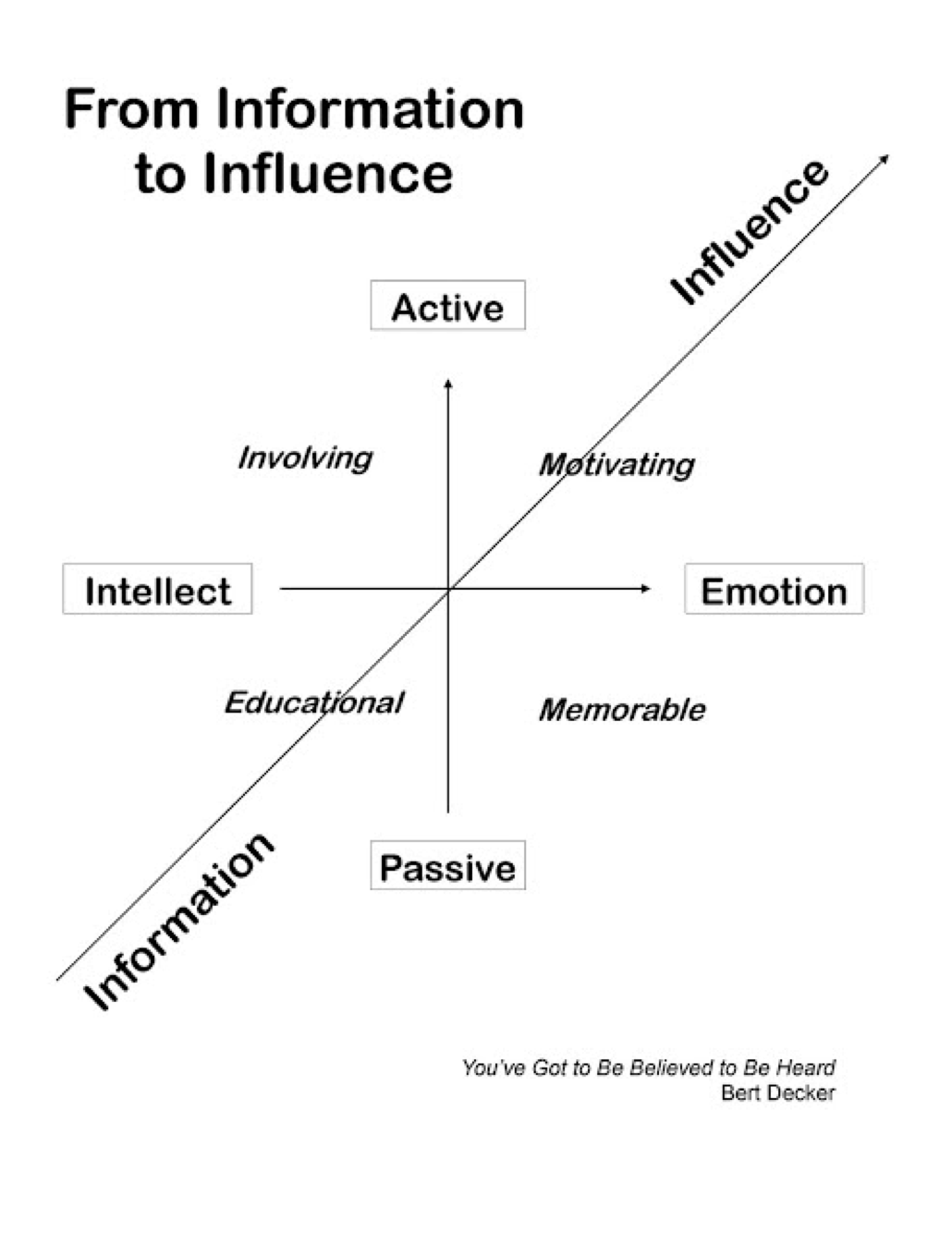
This week I’ve been recapping a section of Bert Decker’s great book on communication, “You’ve Got to Be Believed to Be Heard.” He has created the following chart that shows the path from information to influence.

The end result of the process displayed above (and described in blog posts herehere and here) is that your communication will move from information to influence. You will be able to more effectively persuade your listeners, not just by the power of your person, but by the power of your presentation as well.

As leaders, we often think that if we say words, people will get them. That is not necessarily true. They might get the words and our message if we are enthused and confident – but not if we’re nervous and we block our message by inappropriate behavioral habits.

In the matrix depicted above, your communications reach their maximum effectiveness when they are in the active and emotion quadrant. In Decker’s words, you have moved from merely providing information to a place where you are influencing the listener. You have created a climate for motivation.

John Maxwell has a famous definition of leadership: “Leadership is influence.”

If you believe that, then what are you doing today to make your communications move from information to influence?

The Involving Process, The Memorable Process

Author and communication expert Bert Decker has developed a matrix that shows how to move your communications from information to influence. A previous post was about the educational process; today  a look at the next two quadrants of his matrix: the Involving Process and the Memorable Process.

The Involving Process

To move people from passive to active, there are many options. One of the most important is to convey our energy and enthusiasm, which resonates in the listener. It’s hard to be passive when someone is excited, but it’s easy when someone is uninteresting, low on energy, and monotonous.

There are several things you can do that deal more with content and process. You can ask questions, getting people to think. You can do interactive exercises, or take people through simulated exercise or though processes. How about fill-in-the-blanks in handouts? However you can, get people involved, and move them from passive to active by interacting with them.

The Memorable Process

Moving people from the intellectual to the emotional realm is more difficult. This idea is not about ignoring the intellectual or reasoning processes in the listener, but adding the emotional dimension to your content. This is not something that is taught to us, but it is a very powerful mindset that you can learn quickly and use continuously.

Emotional perspective comes from the energy of our behavior, of course, but it can also be applied in our content. We want to become memorable by using techniques and methods that get us out of the dry and didactic world of facts and figures. We want to use our creativity, to become storytellers and interesting visualizers, to move deeper into the world of ideation and metaphor.

Decker’s book is entitled “You’ve Got to Be Believed to Be Heard.” It’s a great resource for anyone who speaks before a group of people – from 5 to 500. My focus (which ends tomorrow) has only been on one section – From Information to Influence.  There are four other sections that will help you create, organize, and then deliver – powerfully – your message.

Tomorrow: The Motivating Result

The Educational Process

Author and communicator Bert Decker developed a chart that illustrates the path from information to influence. In developing it, he starts with a typical four-quadrant diagram, and then expands it one further step, finally adding a diagonal path.

Step one of the path from information to influence starts with the educational process.

Starting in kindergarten and continuing through college into graduate school, we are mostly taught passively. Basically we sit in chairs and teachers lecture at us. They appeal to our intellect, our cognitive side.

That is our educational system, and it continues into business and into life. It is the world of information. It is on the Passive and Intellectual side of Decker’s chart, Create Your Experience.

Take a journey back to high school or college, and remember your favorite teacher. It probably wasn’t the teacher with the longest tenure, or who was most published, or who had the most degrees. It was probably the person who was the most excited about the subject – and that enthusiasm was contagious.

You caught it, and because of that they influenced you to “get” the information and knowledge.

The journey from information to influence has to start with the Educational Process, but there has to be movement: from passive to active, and from the intellectual to the emotional mental states.

Tomorrow: the Involving Process.

From Information to Influence

Jack Ryan, the historian-CIA-politician hero from author Tom Clancy’s fiction writings of the 1990s is always good for a quote:

Next time Jack, write a #@$!! memo!

He muttered this to himself as he was being lowered in a raging storm from a helicopter to a submarine, on the way to averting WWIII. His research led to an astounding discovery, but it was his willingness in presenting the information first-hand that led to the quote above. It may make for good summertime reading and an action movie, but there is actually an instructive lesson in it for anyone who seeks to become a better communicator.

The written medium is a cognitive, linear, literal, and didactic process that’s great for transferring information.

Speaking is the medium of action and influence. In speaking, we create an experience where people get us and our message together – and the two are inseparable. In speaking, we use information to influence. The power is in the presentation.

The two previous paragraphs come from Bert Decker’s book “You’ve Got to Be Believed to Be Heard.” Whenever I’m working on major presentations I always find myself coming back for a refresher course.

This week I’ll be posting excerpts from this book along with observations for ChurchWorld.

2 Questions for Your Consideration

Alan Webber, co-founder of Fast Company magazine and author of the book “Rules of Thumb“, thinks every leader needs to keep 2 lists:

  • What gets you up in the morning?
  • What keeps you up at night?

There is a lot for leaders to think about in those two sentences. Here is a summary of  Webber’s challenges:

Some people just have jobs. Others have something they really work at.

Some people are just occupied. Others have something that preoccupies them.

It makes all the difference in the world.

Consider this: you spend at least eight hours a day working, five days a week. A minimum of forty hours a week for at least forty-eight to fifty weeks a year. That’s a minimum of 1,920 hours a year. For how many years? You do the math.

What gets you up in the morning?

The level of energy put out by an organization’s people is one of the things that you are aware of as soon as you enter their space. There’s a buzz in the air (sometimes literally) created by people who are working  hard and working together. They want to be there – they came in ready to go.

What keeps you up at night?

This is a chance to be honest with yourself. Many times leaders rarely get a chance to reflect on the things that really matter to the organization’s goals. Most of the time, day-to-day urgent concerns crowd out broader issues that are the really important ones. The things that often keep leaders up are the things that never seem to find the time or place for serious engagement in the course of an ordinary workday.

We all want to do work that excites us. We want to care about things that concern us. So, about that list…

Take out a stack of three-by-five cards. Use one to write down the answer to the question “What gets you up in the morning?” Keep it to one sentence. If you don’t like your answer, throw away the card and start over – it’s only a card. Keep doing it until you’ve got an answer you can live with.

Now repeat the exercise for the question “What keeps you up at night?” Work at it until you’ve got an honest answer.

Now read your answers out loud to yourself. If you like them – if they give you a sense of purpose and direction – congratulations! Use them as a compass, checking from time to time to see if they’re still true.

If you don’t like one or both of your answers, you have a new question to consider: What are you going to do about it?

Whatever your answers are, you’re spending almost two thousand hours a year of your life doing it.

That makes it worthwhile to come up with answers you can not only live with but also live for.

Lessons in Teamwork

…courtesy of the Miami Heat

Here’s a repost from last year I thought was appropriate since the Miami Heat won the NBA Championship last night.

I’m not really a fan of pro basketball, but I must say that the free-agent talent raid pulled off by the Miami Heat has made for interesting conversations since last summer. From marketing hype at it’s most annoying (LeBron James’ announcement –“The Decision” – that he was going to the Heat) to instant pundits proclaiming them the next dynasty to a chorus of “I told you so”, it’s been more like a three-ring circus than a basketball team.

But leave it to Fast Company magazine’s Chuck Salter to find some great lessons in teambuilding from, well building a team. You need to read the whole story here, but for a quick taste read the following:

6 Steps Required to Create a Dream Team (in any setting)

  1. The Ego Equation: start with sacrifice. High-priced talent doesn’t ensure success. Think New  York Yankees – or the Knicks. Sports not your thing? Remember when Steven  Spielberg, Jeffrey Katzenberg, and David Geffen looked like a can’t-miss  team at DreamWorks? Turns out, no one bothered to account for the polarity  of their personalities. Teaming up has its trade-offs. Where once Wade had the spotlight, now he has to share it. No more entourage traveling with James. All three have seen less of the basketball. In other words, the team’s leaders have done what stars need to do when they merge: show a  willingness to sacrifice. It’s a necessary start.
  2. The Rule of Many: stars  can’t go it alone. New hires perform better when they bring a former colleague with them. Miami brought over a player who had been with James for seven seasons. The team also kept a longtime buddy of Wades who had been on the team eight years. All told, Miami added six new players in a span of 21 days: three-point specialists, guys to do the grunt work of rebounding, setting picks, and feeding the ball to the “Big 3.”
  3. The Platoon Principle: adversity is an asset. Nothing brings a team together like a common enemy. Google needs Facebook. Under Armour  needs Nike. The Heat need everybody who’s not the Heat. Coach Erik Spoelstra hoped to turn the vitriol to his advantage. The real bonding didn’t occur until the team began to lose – and badly. Said Spoelstra: “When it’s raw, when you don’t get along, that’s when there’s the most opportunity for growth.” Under duress, Miami found its identity.
  4. The Trust Theorem: when  the going gets tough, turn to one another. Watching the three  superstars at practice, it’s obvious these guys get along. But camaraderie  doesn’t necessarily translate into collaboration. When you assemble a team of experts, it’s better to have complementary, not competing, specialties.
  5. The Credibility Conundrum: manage from the inside out. Coach  Spoelstra’s position is like any manager operating between the CEO and the  in-the-trenches talent. Spoelstra needs to tread carefully, balancing his obligations to his boss and his commitments to his players, all in his  quest to build his own credibility for leadership. The coach must wrestle when to coddle and when to push, trying to master the sleight of hand that allows the young millionaires to feel they have ownership of the team even as he calls the shots.
  6. The Law of Patience: beware the blame game. Everyone remembers the six NBA titles the Chicago Bulls won with Jordan, Pippen, and a cast of specialists to support them. What we tend to forget is how long it took the Bulls to put all those pieces together. They didn’t win the first year. Or the second. Or even  the third. It took the team four years. Chemistry takes time. The playersrespect one another’s individual skills and even learn from one another. But those patterns don’t emerge right away. Chemistry isn’t something you create and then ignore. It’s a reflection of the bonds between members, and those bonds are fragile and needy – and constantly changing.

This is what any team aspires to: passion, unity, and absolute conviction that you can achieve whatever you want as a group.

What teamwork lessons can you learn from the Heat and apply to your team?

The Gospel Project

As a lifelong learner, one of the most exciting developments announced at the SBC this week was The Gospel Project, LifeWay’s first new Bible study series for adults, students, and children in more than 10 years.

The Gospel Project (TGP) is a three-year, in-depth study that launches this fall. Over 12,000 churches have already participated in a pilot project this spring, and the response has been overwhelmingly positive.

TGP draws its focus from The Baptist Faith and Message, where the last sentence of the Scripture section states: “All Scripture is a testimony to Christ who is Himself the focus of divine revelation.”

Trevin Wax, managing editor of TGP said “The main emphasis is Jesus Christ, who He is, and what He has done for us. It’s centered on how all of the Bible tells us this one over-arching story of redemption about what God has done to save us through the work of Jesus Christ.”

For more information about The Gospel Project, go to GospelProject.com.

To see the video announcing The Gospel Project, click here.