How to Invest in Your Future

One of my greatest passions is reading.

I developed this passion at an early age, and have continued to strengthen it over the years. In addition to being my passion, reading is also an important part of my role as Vision Room Curator at Auxano. In that role, I am responsible for publishing SUMS Remix every two weeks. SUMS Remix is a modified book summary in which I develop a solution to a common problem faced by church leaders from 3 different books. So, preparing SUMS Remix in 2017 alone means I have gone through dozens of leadership and organization development books to arrive at the 78 used in producing 26 issues this year.

Other parts of my role required reading current trends books, used for social media posting and content writing.

Then there’s my passion area of Guest Experience, in which I am constantly researching customer service books for application for churches. I’m building The Essential Guest Experience Library.

And, as many readers know, I am a Disney Fanatic – which extends to building a Disney library, currently 161 volumes and growing!

Finally, there’s just the pure pleasure of reading – an almost nightly hour or two in the late evening reading a wide range of books, both brand new and classics, fiction and nonfiction.

Add those 5 categories all together, and in 2017 I have “read” 186 books. 

First, a disclaimer: I did not read all 186 cover to cover. With such an immense (and pleasurable) task in front of me, and knowing there is more to my job than reading, I have to resort to some method of finding out what an author is trying to say without reading the whole book.

Here’s how I did it – and, of course it starts with a book!

How to Read a Book

Literally – that’s the name of a classic book by Mortimer Adler.  The first lesson of reading is to learn that you don’t need to “read” each book the same way. Here are Adler’s 4 levels of reading:

  • Elementary Reading – What does the book say?
  • Inspectional Reading – What is the book about?
  • Analytical Reading – What does the book mean?
  • Syntopical Reading – What does a comparison of books on the subject reveal?

Some books are only meant to be read at the first level; others are meant to be digested at some of the other levels. Know which is which!

To get the most out of a book in the least amount of time, try this strategy:

  • Read the title.
  • Read the introduction
  • Read the Table of Contents
  • Flip through the material, scanning the chapter titles and subheadings. Note the words that stand out as bold, different colors, underlined, or italicized.
  • Examine the illustrations, captions, charts and diagrams. Read the pull-quotes and sidebars.
  • Scan through the index looking for buzz words that interest you.
  • Read the first chapter.
  • Flip through the book and read the first sentence of each paragraph in each chapter. In a well written and edited book, the most important sentence containing the topic is usually the first sentence of the paragraph — but not always.
  • Read the last chapter. If there is an executive summary, read it.
  • Read any other information on the cover or dust jacket.

If the book captures your attention after doing the above tasks, then by all means dive right in!

The converse is true: if a book doesn’t capture your attention after a few attempts, stop reading it. Pick out another one on the topic – there are always more waiting for you!

With that caveat in mind, my “cover-to-cover” reading for 2017 was 117 books.

 

While the knowledge gained from reading is important, the real benefit is from the habit of reading. When you are continually reading, you condition your mind to keep taking in new knowledge. Your thinking remains fresh and sharp. Your brain is always churning on new ideas, looking for new connections it can make. Every day you pour in more ideas, which your brain must find a way to integrate into your existing knowledge base. Frequent reading fires up your neural activity, even during the periods when you aren’t reading.

Reading is a gift that you can unselfishly give yourself, one that truly keeps on giving. Why don’t you bless yourself and those around you by reading a new book in the first weeks of 2018, and sharing its wisdom with others?

Me? Well, I’m visiting a new bookstore tomorrow, I’ve got three books lined up for delivery by Amazon the first week of January, and I’m headed to the library to pick up another couple on reserve.
Plan Your Presentation with an Intentional Structure

There is really no situation much worse than finding yourself caught in a presentation or conference where the person speaking has something important to share, but remains clearly unable to share it. Those moments are a great reminder that, in order to reach someone with the message of the gospel, we first must be able to capture his or her attention.

As a church leader, you may be confident and used to speaking in front of audiences of all sizes. However, truly connecting with people requires more than confidence and experience. Great communicators have a plan for developing their message to present it in a compelling and engaging way.

THE QUICK SUMMARY – Show and Tell, by Dan Roam

For the vast majority of us, giving a presentation is an extremely difficult and nerve-racking process, whether we’re in a one-on-one meeting, a conference room with a dozen strangers, or a lecture hall in front of thousands.

But according to Dan Roam, the visual communications expert and acclaimed author of The Back of the Napkin, it doesn’t have to be so hard. We struggle when we forget the basic steps we learned in kindergarten: show and tell.

In this short but powerful book, Roam intro­duces a new set of tools for making extraordinary presentations in any setting. He also draws on ideas he’s been honing for more than two decades, as an award-winning presenter who has brought his whiteboard everywhere from Fortune 500 companies to tiny start-ups to the White House.

Even if you’re already a good speaker, you’ll learn more about understanding your audience, organizing your content, building a clear story line, creating effective visuals, and channeling your fear into fun. And you’ll master three fundamental rules:

  • When we tell the truth, we connect with our audience, we become passionate, and we find self-confidence.
  • When we tell a story, we make complex concepts clear, we make ideas unforgettable, and we include everyone.
  • When we use pictures, people see exactly what we mean, we captivate our audience’s mind, and we banish boredom.

From nailing the opening to leaving a lasting impression, you’ll soon be able to give the perfor­mance of a lifetime—time after time.

A SIMPLE SOLUTION

The foundation of every presentation is its content. Your accompanying visual imagery may be stunning, but if you say nothing, you will achieve nothing. You are standing before you audience for a reason – you are trying to communicate with them. The content of your message is what you want your audience to remember and act on.

You audience comes into the room with their own preconceived notions about your topic. They are also bringing with them any and everything that’s on their minds. Many of them are probably looking ahead to the next thing on their schedules.

How can anyone hope to grab the listener’s attention given those parameters?

It begins with the end result: “After I’ve finished presenting, how do I want my audience to be different from when I started?”

How you answer that question tells you which storyline to use.

Clear storylines are our best defense against confusion. They force complexity into submission long enough to be tamed.

Here are the four essential types of storylines.

The Report brings data to life. With a report, we change our audience’s information. A good report delivers the facts. A great report makes the facts insightful and memorable.

The Explanation shows us how. With an explanation, we change our audience’s knowledge or ability. A good explanation takes our audience to a new level. A great explanation makes it effortless.

The Pitch gets us over the hurdle. With a pitch, we change our audience’s actions. A good pitch gives our audience a solution to a problem. A great pitch makes that solution undeniable.

The Drama breaks our heart, then mends it. With a drama, we change our audience’s beliefs. A good drama makes us feel someone’s struggle. A great drama makes us feel the struggle is our own.

Every storyline is different, but they have two things in common:

  1. They have a beginning and an end. One reason many presentations fail is because they don’t go anywhere. Good presentations always move along.
  2. The end point is always higher than the beginning point. Another reason presentations fail is because they don’t trigger any change. Good presentations always move up.

In other words, an extraordinary presentation begins with knowing how far and how high we want to take our audience.

Dan Roam, Show and Tell

A NEXT STEP

Select three top ideas that your team is considering for future action – ideas that have not been done before. Together with your team, identify the most important actors or stakeholders for each idea. Think about their role and influence on the success of the idea and list your thoughts on a chart tablet.

Define the moments when each stakeholder will get to know an idea, accept it, use it, or decline it. Create a “stakeholder’s diary” for each person chosen, and write down these moments in the diary.

Example of a stakeholder – members who want to know more about discipling in everyday lives. Moment – several members have reacted positively to a recent sermon series on disciplemaking, and want to know how they can begin to practice disciplemaking in their workplace. What will you tell them? Prepare the diary according to the specific moments and give it to the stakeholder.

Build a story to support your stakeholder diary, using one of the four types of storylines outlined above. Make sure your story is descriptive and helps bring the idea to life.

Do the same with the other two ideas and reflect on the answers the stakeholders have filled in their diaries to help you choose the idea and move forward with it.

Reviewing and understanding the answers and insights into their acceptance of ideas at different moments will help you craft the stories needed to move forward with the idea.

– Adapted from “75 Tools for Creative Thinking” by Booreiland Design

Excerpt taken from SUMS Remix #52, October 2016


Part of a weekly series on 27gen, entitled Wednesday Weekly Reader

Regular daily reading of books is an important part of my life. It even extends to my vocation, where as Vision Room Curator for Auxano I am responsible for publishing SUMS Remix, a biweekly book “summary” for church leaders. Each Wednesday I will be taking a look back at previous issues of SUMS Remix and publishing an excerpt here.

How to Create a Blueprint for Ministry Model Change

Looking back, 2016 was truly a landmark year. From Olympics to Elections to Chewbacca Mom, the year contained moments worth sharing and remembering. The year contained new beginnings, new opportunities and the potential for new ministry impact.

Maybe 2016 was also supposed to be the year that you finally implemented a discipleship strategy, but there never seemed to be enough time, the right team or an applicable model. In this, the last issue of SUMS Remix for 2016, the Auxano team wants to help you jumpstart the implementation of an intentional discipleship strategy for 2017. We are proud to feature disciple-making strategy solutions from three foundational books of the Auxano Vision Framing process.

There is no time like right now to develop a discipleship strategy that engages hearts and inspires growing faith every day. Do not let 2017 slip away. Start building the disciples of tomorrow, today.

THE QUICK SUMMARY – Innovating Discipleship, by Will Mancini

Everyone is talking about discipleship, but too many churches stick to business as usual. Sunday comes and Sunday goes. The preacher preaches, the band worships, money gets put in the plate and people get back to their busy, unaffected lives. Hasn’t God called us to more?

Will Mancini thinks so, and that’s what Innovating Discipleship is all about. Innovating Discipleship is for church leaders who have growing discontent for “best practicing” and “fast following.” Is God calling you to re-dream and re-invent beyond the ministry models that were handed to you?

In this potent book, Mancini uncovers the primary obstacle in the minds of pastors that keeps discipleship stuck – revealed through thousands of hours of coaching with church leaders. He calls it the “default vision switch.”

More importantly, Innovating Discipleship gives you a simple and powerful tool to guide you, step by step, into the freedom and confidence of real discipleship, for your time and your place. In the end, there are only four paths to getting the results you have always wanted. Which path will be right for you?

A SIMPLE SOLUTION

One of the greatest challenges in helping church leaders through a vision process is quickly getting them to agree on “what is,” “what could be,” and then “what should be.” How do you start? How do you bring all of these very different perspectives together?

There are three approaches to church strategy:

  • More is more
  • Less is more
  • To be is more

Let’s ask three simple questions to identify what kind of approach represents your church.

1) Rhythm question: How many weekly engagements do we expect of people?

2) Purpose question: What are the purposes of the weekly engagements and how do they relate?

3) Environments question: Do these engagements take place in “church space” or “life space” or both?

Please don’t underestimate the simplicity and power of these questions. How a church answers these questions reveals an “operational logic” and an underlying belief system about the nature of the church.

Here is a brief description and simple diagram for these approaches.

MORE IS MORE

A “more is more” approach is seen in a church in which the basic operating assumption is that the more programs a church can offer in the “church space” the better. The hope is that more programs will attract more people and provide opportunities for spiritual growth.
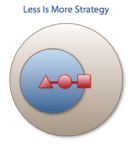
LESS IS MORE

The “less is more” approach operates with the assumption that the church should provide a few high quality offerings. Whether or not these offerings take place in church space or life space is a variable. In addition, the church attempts to design these offerings so that they have a meaningful relationship to one another. Ideally, the program offerings are designed around a unified set of output (discipleship) results.
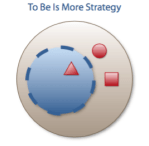
TO BE IS MORE

The “to be is more” approach operates with the assumption that the church should provide as little as needed in terms of weekly offerings in order to maximize output (discipleship) results in “life space.” With a greater focus on “life space,” each engagement is forced to have great clarity of purpose, and output (discipleship) results necessarily play a greater role in the church’s identity. This strategy requires a stronger presence of leadership and tool development.

Spiritual formation doesn’t happen in a program at the church. It happens by living your life. We really need to stay away from creating programs as our goal. Programs have their place, but they must be subordinated to the spiritual life.

– Dallas Willard

Think of your church’s ministry model as a pattern of “engagements” that are designed to produce certain outcomes. Engagements include any array of activities you offer from worship to mission trips. They are what you promote each week in your worship guide and everyday on your website. They include all of groups, classes, events, and initiatives that a church can offer. They include programs at church or anywhere away from the church, like a home-based life group or a community-based service initiative. If it’s a place I can go or something I can do in the name of your church, it’s an engagement.

Will Mancini, Innovating Discipleship

A NEXT STEP

Diagnosis – As you scan these three pictures above, which approach describes your church’s current strategy? Draw the diagram for your leadership team. Be sure to include all the various ministries you church currently offers.

Results – Looking at these three approaches to church strategy can help make connections between our ministry models and the results they are designed to produce. If you are unsatisfied with your current discipleship results, it is time to change your model.

Decision – Now you can better answer the question “Is it better to use our existing ministry model or to introduce a change?” What change would you introduce?

Every model of ministry today can be summarized by three different approaches; these approaches create a useful portal for discussing ministry model design for better results.

As you consider changing your current strategy or creating a new one, keep the following essential practices in mind.

Clarity: Innovation must be anchored in clarity first. Clarity isn’t everything but it changes everything. Clarity is the least understood innovation essential among church leaders.

Margin: If you don’t stop doing something, you’ll never start doing something better. Margin is essential. It’s the most neglected innovation essential to church staffs.

Heart: All innovation is a solution to a prior problem and people won’t care about your innovation until they emotionally connected to the problem. Heart is the most underappreciated essential for ministry leaders.

Team: Time and time again, the best ideas come from the collaborative engine of a team. For church leaders, leaning into team is the most inconvenient innovation essential.

Excerpted from SUMS Remix #56, December 2016


Part of a weekly series on 27gen, entitled Wednesday Weekly Reader

Regular daily reading of books is an important part of my life. It even extends to my vocation, where as Vision Room Curator for Auxano I am responsible for publishing SUMS Remix, a biweekly book “summary” for church leaders. Each Wednesday I will be taking a look back at previous issues of SUMS Remix and publishing an excerpt here.

Make Your 2nd Half of Marriage a Time of Incredible Fulfillment

The second half of your marriage (when the kids leave home, and/or when you are helping with your own parent’s lifestyle decisions) can be a time of incredible fulfillment, no matter what challenges you previously faced.

It can be a time of learning about each other and about God’s long-term plans for your marriage. And a time of building together – sharing dreams, making commitments, and working towards a more satisfying union.

Having just celebrated my 38th anniversary on December 8, I sought out resources to help answer this question:

How can we make the second half of our marriage even better than the first?

David and Claudia Arp’s book “The Second Half of Marriage” has provided a lot of helpful guidance in starting out on the journey of the second half of marriage. Yesterday, I posted four strategies they outline in their book. Here, in their own words, are the final four:

  1. Build a deeper friendship and enjoy your spouse. Now is a great time to deepen your friendship with each other and stretch your boundaries to prevent boredom. Think of ways to put more fun in your marriage.
  2. Renew romance and restore a pleasurable sexual relationship. Many people assume that as people grow older they lose interest in sex, but our survey results suggest otherwise. The quality of your love life is not so much a matter of performance as it is an integral part of the relationship. Take care of your health and renew romance even while acknowledging the inevitable changes that come with aging.
  3. Adjust to changing roles with aging parents and adult children. Release your children, then reconnect with them on an adult level. At the same time, your relationship with your parents may need a little altering, too. The effort you expend in forging better relationships with loved ones on both ends of the generational seesaw is well worth it.
  4. Evaluate where you are on your spiritual pilgrimage. Research indicates that most people, as they age and consider death, become more religious because they think more about what it all means. Why not consider this time of transition as an opportunity to talk more openly and regularly about your relationship with Christ: what it means, why it matters, and what it means for your marriage? Take time to serve others, too, and pass along some of the wisdom you have gained.

In addition to the wealth of material in the book, the Arps provide additional resources through their Marriage Alive website.


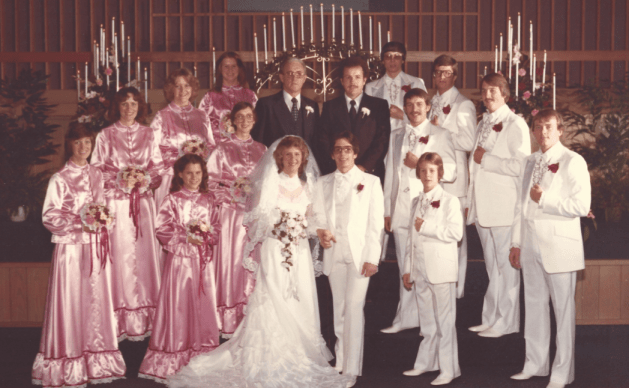
And now for the whole picture of our wedding party – December 8, 1979, at First Baptist Church, Goodlettsville, TN.

It’s day 13,882 for Anita and me – and our journey together continues!

How to Make a Great Second Half of Marriage

Happy Anniversary, Anita!

How can you make the second half of your marriage better than the first?

That question is always in the back of our mind as Anita and I celebrate our 38th anniversary today, December 8, 2017. Loosely defined, the second half of marriage comes when your kids have left home; it may also be marked by decisions a couple is making about their parent’s health and lifestyle.

We’ve got both.

I found a great resource to help begin charting this journey: David and Claudia Arp’s wonderful book The Second Half of Marriage. In their own words, here are the first four (of eight) strategies that will help every long-term couple make the most of their marriage:

  1. Let go of past marital disappointments, forgive each other and commit to making the rest of your marriage the best. Are you willing to let go of unmet expectations and unrealistic dreams? Or your mate’s little irritating habits that don’t seem to be disappearing? Giving up lost dreams and overlooking each other’s imperfections are positive steps toward forgiving past hurts and moving on in your marriage.
  2. Create a marriage that is partner-focused rather than child-focused. The tendency, once the kids leave, is to focus on new activities rather than on each other, but these activities can keep you from crafting a more intimate relationship. Try to focus more time and attention on your spouse.
  3. Maintain effective communication that allows you to express your deepest feelings, joys and concerns. Sometimes what worked when the kids were home doesn’t work as well now that the kids are gone. After all, you always had the children to talk about. Now that it’s just the two of you, you might need to upgrade your communication skills.
  4. Use anger and conflict creatively to build your relationship. With the kids gone, many couples find that issues they assumed were resolved resurface. Certain negative patterns of interaction that developed over the years can be deadly for an empty-nest marriage. Learn how to deal with issues and process anger in ways that build your relationship.

Tomorrow, the other four strategies from “The Second Half of Marriage”, as well as some other resources and ideas.

But in the meantime, I have the most beautiful bride ever:

She still is!

13,881 days and counting!!


Make the Leap to Using Visuals Evoking Emotion

Does your team seem to be using more and more words, yet communicating less and less?

Today more than ever, we live in a visual society. Especially in the online world, everyone relies on the power of photos and engagement of video.

While researching a project recently, I was struck by three surprising data points from visual communicator Dan Roam:

  • Research from IBM found that 90% of all data collected in history has been generated in the last two years.
  • Research from Cisco found that 90% of all data transmitted online today is visual.
  • Roam’s experience indicates that 90% of leaders have no idea how to effectively use visuals in their business.

90%-90%-90%. We’re generating more data than ever, that data is overwhelmingly visual, and most of us don’t know how to use images. No matter what business you’re in, the future of your business is visual.

As a church leader, it is incumbent that you get better at using visual images in your communication.

Whether drawing them, looking at them, or talking about them, visual communication adds enormously to your listener’s ability to think, to remember, and to do.

Visual imagery is, in itself, another whole language. Being fluent in that language gives us mind-boggling power to articulate thoughts, communicate those thoughts, and solve problems in ways we otherwise wouldn’t be able to.

It’s time to make the leap and use visuals to evoke emotion.

THE QUICK SUMMARY – Visual Hammer, by Laura Ries

The best way into a mind is not with words at all. The best way into a mind is with visuals.

But not any visual. You need a “visual hammer” that hammers a verbal nail. The Marlboro cowboy. Coca-Cola’s contour bottle. Corona’s lime.

The cowboy hammers “masculinity.” The contour bottle hammers “authenticity.” The lime hammers “genuine Mexican beer.”

A trademark is not a visual hammer. Almost every brand has a trademark, but fewer than one out of a hundred brands have a visual hammer. A trademark is a rebus which communicates nothing except the name of the brand.

A visual hammer, on the other hand, communicates the essence of the brand.

Visual Hammer is the first book to document the superiority of the “hammer and nail” approach to branding. Some examples.

  • The pink ribbon that made Susan G. Komen for the Cure the largest nonprofit foundation to fight breast cancer.
  • The Aflac duck that increased Aflac’s name recognition from 12 percent to 94 percent.
  • The green jacket which made the Masters the most-prestigious golf tournament.
  • The watchband which made Rolex the largest-selling luxury watch.
  • Colonel Sanders who made KFC the world’s largest chicken chain.

Why are marketing plans usually nothing but words when the best way into a mind is with the emotional power of a visual?

After reading Visual Hammer, you might want to tear up your current marketing plan and start fresh.

A SIMPLE SOLUTION

In a typical organization – and that includes churches – there is a whole gang of smart people so overwhelmed by verbal data that they’re hard pressed to know what to pay attention to.

That’s where pictures come in.

The basics of visual thinking have nothing to do with being an artist, or creating impressive designs using the latest computer application. Visual thinking is learning to think with your eyes.

Everyone already has good visual thinking skills, even if they don’t acknowledge it. Visual thinking is a very powerful way to communicate information that will help solve problems. It may appear to be something new, but the fact is, we already know how to do it.

Visual thinking starts with understanding the power of the image.

When you live in a world of word, you tend to see the visual world as secondary to verbal reality. Yet nature is visual, not verbal.

Take a walk in the park. Scuba dive in the ocean. Climb a mountain. This is reality and there are no words in nature. Words are useful devices to communicate the reality of nature.

Photographs, illustrations and drawing are artificial, but they too are a more direct representation of nature than are words.

The Coca-Cola bottle is not just a bottle. It is a visual hammer that nails in the idea that Coke is the original cola, the authentic cola, the real thing. In a Coca-Cola commercial, the visuals speak louder than the words. That’s the work of a visual hammer.

That’s the difference between designing a trademark and designing a visual hammer. Almost every brand has a trademark, but few brands have visual hammers.

A visual hammer doesn’t just repeat your brand name; it hammers a specific word into the mind. For brands that can create and dominate a new category, that word is “leadership.”

When you live in a world of words, you tend to see the visual world as secondary to verbal reality. Yet nature is visual, not verbal.

A visual hammer makes an emotional impact on the right side of the consumer’s brain which motivates the left side of the brain to verbalize the idea and then store it.

Your right brain doesn’t think in the normal sense of what we mean by “thinking.” It reacts emotionally and involuntarily.

To develop a hammer you need a narrow focus you can visualize in a dramatic way.

Don’t fret about narrow concepts not appealing to as many people as broader ones. Better to use a narrow concept to motivate a segment of the market rather than a broad concept that motivates no one.

Laura Ries, Visual Hammer

A NEXT STEP

Explore the power of visual images in solving problems with the following exercise.

Write down a list of at least four questions about a ministry situation or problem you team has recently faced.

Cluster the questions in four groups, giving each set a title.

Bring your team together around a table, and give them a large sheet of paper. Ask you team to create a quadrant by drawing two lines on their paper.

Place magazines, newspapers, precut pictures, fabrics, thread, color pencils, and glue sticks in the sender of the table. Provide plenty of materials in order for all participants to use simultaneously.

Each team member will use the materials on the table to visually answer their question. Designate a time limit for the exercise.

When completed, ask each team member to present and explain their collages. As a group, determine the single best image that represents the best answer for each question.

This exercise demonstrates the power of visual images in answering questions or problems you are encountering.


Part of a weekly series on 27gen, entitled Wednesday Weekly Reader

Regular daily reading of books is an important part of my life. It even extends to my vocation, where as Vision Room Curator for Auxano I am responsible for publishing SUMS Remix, a biweekly book “summary” for church leaders. Each Wednesday I will be taking a look back at previous issues of SUMS Remix and publishing an excerpt here.

Good Design Gets You in the Game…

…great design is the game winner.

Welcome to the world where design is king.


In the old days, designers were an afterthought, the people at the end of the production process. Engineers would hand over something that was functionally effective and have the designers make it look good. Those days are over.

Today, design is about experiences as well as products. It’s about services as much as it is hard goods.

Design is now differentiation.

Alan Webber, founder of Fast Company magazine and author of “Rules of Thumb,” puts it this way: Today companies use design to:

  • create distinctive products and services that capture their customers’ imaginations
  • restructure their corporate operations
  • unveil new logos and uniforms that express a fresh corporate identity
  • develop new communications tools that connect with customers and shareholders
  • build corporate offices that encourage and enable collaboration
  • collect and share information across a global platform

Design is a way to solve deep-seated social problems. And design is a money saver, a way to simplify products and make them easier and less expensive to manufacture and sell. Across the board designers have defines a way of seeing that adds to the delight of customers and the profitability of companies.

Application to ChurchWorld

You probably already understand this on some level. You understand that the design of your website says more about you and provides a quick glimpse of your “brand”. You know that the little – and not so little – things like the design of your logo and your letterhead, the print pieces you use, the “flow” of your worship experience all communicate instantly what your church is all about.

But if you are still a design novice, and want to learn more, here are Webber’s three ways to begin to crack the design code:

  • Reading – you may be a word person and you want to try to learn about seeing. Dan Pink’s “A Whole New Mind,” Tim Brown’s “Design Thinking,” Tom Kelley’s “The Art of Innovation” and “The Ten Faces of Innovation,” Jeanne Liedtka and Tim Ogilvie’s “Designing for Growth,” and Don Norman’s “The Design of Everyday Things” are required reading. Get one of them today; start reading it tonight, and put it into action tomorrow.
  • Viewing – You need to practice seeing. Go to an art museum; browse a furniture showroom gallery; check out the latest model cars. The more you look at objects like these, the more you appreciate great design. You’re not buying, so don’t worry about price. Look carefully at the lines, interior detailing and design, and the small things that make a big difference. “Seeing” is a critical skill for aspiring diagnosticians – like you.
  • Shopping – Go out and find an assortment of small objects that go in your home or office. Look at OXO products; visit an IKEA store. When you pick up one of these objects, you will immediately understand what “consumer-centered design” means. Go to an office supply store and sit in an Aeron chair. Look at the latest products from Apple: iPhone, iPad, the latest MacBook Air. Go to an antique store and see what great design looked like in the past. Take a virtual shopping trip to your heart’s content. When you have collected these objects (or examined them enough), what do these products have in common? Are they as good to look at as they are fun to use? Is there an emotional content to their design?

You don’t have to buy anything to get the idea. But you do have to buy into the idea:

Design is everywhere, and increasingly, design is everything.