Plan Your Discipleship Process Sequentially

Do you want to develop basic disciple-making practices, but serve in a weekend-only culture?

Every church should have a clear, simple process for making disciples. Does yours?

Almost every church engages in some form of discipleship. When a pastor uses the Bible in a sermon, or a leader opens the Scriptures to a small group, the church is providing the initial phases, but lasting discipleship must go far beyond that.

If a new Christian who attends weekend worship services only asked for help in becoming more like Christ, what would your answer be? Would everyone in leadership give the same answer? Do you share a clear, simple first step? Followed by a second step?

But this is important for more than just a “new” Christian. How are you intentionally and methodically helping other believers to deepen their walk with Christ? How can you impact a “weekend only” culture and begin to instill basic disciple-making practices into your church’s life?

Solution: Plan Your Discipleship Process Sequentially
THE QUICK SUMMARY – Simple Church, by Thom Rainer and Eric Geiger

The simple revolution is here. From the design of Apple products to Google’s uncluttered homepage, simple ideas are changing the world.

Simple Church guides Christians back to the simple gospel-sharing methods of Jesus. No bells or whistles required. With insights based on case studies of 400 American churches, Thom Rainer and Eric Geiger prove the disciple-making process is often too complex. Simple churches thrive by taking four ideas to heart:

Clarity. Movement. Alignment. Focus.

Simple Church examines each idea, clearly showing why it is time to simplify. This updated edition includes a new chapter with further insights the authors have gained through hundreds of conversations with church leaders since this landmark book’s original release.

A SIMPLE SOLUTION

Congestion on a busy highway is no picnic for commuters wanting to get to their destination. Many times it’s simply a matter of inadequate design of the highway for the number of cars currently occupying it.

Congestion in your head or chest prevents proper airflow to the lungs. Reduced airflow to the lungs means your body is not functioning as it was designed.

Congestion causes pain when traffic makes you late or shallow breaths make even simple tasks complex. Congestion in your church is painful, too. Church congestion occurs when competing programs or ministries result in lots of activity, but little or no movement in a person’s spiritual growth.

According to the Scriptures, believers should become more and more like Christ. Movement and transformation is implied, but church congestion slows or prevents growth.

One step away from a “weekend only” culture may require the decongestant of simplicity.

Simple church leaders have learned the wisdom of sequential programing. By placing the programs in sequence along the process, the programs truly become tools to facilitate the process of transformation.

As you sequentially place programs along your ministry process, here are three essentials to guide your thinking.

Order the sequence of your programs to reflect your process. In other words, the order of the programming must flow from the order of the process. If you place the programs sequentially, people will move through your process simply by moving from one program to the next. As people are progressing through the programming, they will simultaneously move through the process that God has given your church.

Designate a clear entry point to your process. The entry point is the first level of programming in your simple process. Without a clear entry point, there is no beginning to the process. When a process lacks a clear beginning, it is definitely not simple.

The entry point is the program through which people are most likely to enter your church. It is the weekly program that guests are most likely to attend. It is the program you encourage your people to invite friends to attend.

Identify the next levels of programming. Just as you have designated an entry point, identify the next levels of programming in your process. What program do you desire people to attend after they have been to your entry-point program? What is the program you want them to attend after that?

– Thom S. Rainer and Eric Geiger, Simple Church

A NEXT STEP

Does your church have a simple process designed to move people along a path to maturity in Christ?

At your next team meeting, create a fictional person named Joe Grow whose life your team will use to illustrate your process. Using a whiteboard or chart tablet, create a narrative of how Joe Grow came to Christ at your church, listing programs, activities, or processes. Continue to develop the story of Joe Grow’s faith journey toward full Christian maturity.

After completing Joe Grow’s journey, step back and look at your current church programming. Ask these refining questions:

  • What potential areas of congestion or confusion appear in the gap between what should be and what is?
  • Does Joe Grow’s faith journey follow a clearly defined process?
  • Are there currently multiple processes attempting to achieve the same result?
  • Are next steps clear in each program or process?
  • Are there multiple programs for each process, resulting in divided attention and energy?

After these careful considerations, guide your leadership team to exit the congested highway of church busyness toward a simple, yet effective, pattern of disciple-making.


The real beauty in clarifying, focusing, and strengthening the disciple-making process of your church is this: the people who are growing will, by nature, take other people along with them.

Growing people grow people. Consuming people consume programs.

Without stating and integrating a simpler, intentional disciple-making process, your church will remain stuck in a bottleneck of the status quo and “weekend only” follow-ship.

With a simple but sequential process, your church can develop an effectiveness of growing disciples.

Excerpt taken from SUMS Remix 11-2, published March 2015


Part of a weekly series on 27gen, entitled Wednesday Weekly Reader

Regular daily reading of books is an important part of my life. It even extends to my vocation, where as Vision Room Curator for Auxano I am responsible for publishing SUMS Remix, a biweekly book “summary” for church leaders. I’m going to peruse back issues of both SUMS and SUMS Remix and publish excerpts each Wednesday.

Visionary Communicators Develop an Authentic Voice

Don’t see yourself as a visionary communicator and instead prioritize the maintenance of week-to-week ministry?

Are you finding yourself on a ministry treadmill, where the busyness of ministry creates a progressively irreversible hurriedness in your life? Today’s demands can choke out needed dialogue for tomorrow. When this occurs, your multiplied activity prevents you from living with a clearer vision of what should be.

If you find yourself in this situation, it’s time to call a timeout and evaluate the obstacles that keep you from focusing on visionary communication about God’s preferred future for your church.

Solution: Develop Your Authentic Voice


THE QUICK SUMMARY – Louder Than Words by Todd Henry

There has never been a better time to build an audience for your idea or product. But with so many people clamoring for attention online and offline, it’s also more challenging than ever do work that deeply resonates and creates a true and lasting effect.

How do you set yourself apart in such a noisy, crowded world? How do you do work that is truly remarkable?

The key is to develop your authentic voice. Whether you’re an entrepreneur, a writer, a designer, or a manager building a brand, the more clear and compelling your voice, the more your message will connect with your audience. The result will be more impact and greater personal satisfaction with your work.

Louder Than Words offers a strategy for uncovering, developing, and bravely using your authentic voice to create a body of work you are proud of, that resonates deeply with others, and that ultimately impacts the world.

A SIMPLE SOLUTION

One role of today’s leaders can be seen as clarifying what is already present and helping people perceive what has gone unnoticed.

What is clarity really about? Clarity means to be free from anything that obscures, blocks, pollutes, or darkens. Being clear as a leader means being simple, understandable, and exact. The leader helps others see and understand reality better.

In order to bring clarity, a leader must first develop their authentic voice.

Your authentic voice is the expression of your compelling “why.” It defines the space that you are wired to occupy, and the unique value you are contributing, which means that if you don’t use it, then that contribution is unlikely to ever be seen.

If you set out to build a bridge between two points on a river, you’d better first determine:

  1. The purpose of the bridge and the kind of vehicles that will be crossing it
  2. Whether you have sufficient resources and materials to complete the project
  3. Whether or not a bridge is even the right solution to the problem of crossing the river

To apply this metaphor to your work, it’s important that you are able to articulate the kind of effect you wish to have, and how you want the world to be different through your efforts. You should at least have a sense of how you wish to connect with your intended audience, and how you plan to impact them. Though you don’t want to become paralyzed with inaction out of fear of getting it wrong, your vision provides you with a set of guiding principles to help you stay aligned and measure your progress.

Even though they may not have all the steps mapped out, most great leaders have some sense of where their work is leading and the ultimate impact they want to have. They have a “north pole” toward which to navigate, even if only in a general sense. This vision is what guides their efforts as they continue to refine and develop their voice.

Todd Henry, Louder Than Words

A NEXT STEP

One aspect of speaking with an authentic voice requires a precise focus on whom you are trying to reach – you have to define your intended audience.

In his book Louder Than Words, author Todd Henry advises leaders to ask the following questions when preparing to discuss vision:

  • Who is my intended audience for this?
  • What impact or outcome am I trying to achieve for them?
  • What expectations will they have of me when I talk with them, and how can I meet and surpass them?
  • How might I surprise and delight them by over-delivering in unexpected ways?

As you are preparing for your next opportunity to communicate vision in front of a team or group, walk through each of the questions above.

In advance of the talk, ask a trusted colleague to sit in on the presentation. Following the presentation, schedule a debrief time with your colleague, covering the four points listed above. Ask your colleague for candid observations on how well you covered the four points. Discuss improvements in the next opportunity you will have to talk about vision.

Repeat this exercise at least once per quarter for the next year.


When you find yourself on a ministry treadmill, constantly in motion but going nowhere, step off and learn how to connect with your team and organization with clarity by developing your authentic voice.

Excerpt taken from SUMS Remix 28-1, published November 2015


Part of a weekly series on 27gen, entitled Wednesday Weekly Reader

Regular daily reading of books is an important part of my life. It even extends to my vocation, where as Vision Room Curator for Auxano I am responsible for publishing SUMS Remix, a biweekly book “summary” for church leaders. I’m going to peruse back issues of both SUMS and SUMS Remix and publish excerpts each Wednesday.

Your Discipleship Strategy Starts with Your Definition of a Disciple

Are you looking for a discipleship strategy, but don’t know where to begin?

How do churches make disciples?

It is perhaps the central question churches face, and only some of them actually have a well-defined answer. As Mike Breen says, “The problem is that most of us have been educated and trained to build, serve, and lead the organization of the church. Most of us have actually never been trained to make disciples.”

Do we now define disciple as someone who attends worship somewhat regularly, gives to us financially, and engages in acts of evangelism and kindness every once in a while?

Solution: Define clearly and biblically what a disciple is.

THE QUICK SUMMARY – DiscipleShift by Jim Putman and Bobby Harrington

Making disciples is the church’s God-given mandate, but too often our churches fall short of their mission. We fill our pews, but fail to create committed disciples.

Discipleshift walks you through five key “shifts” that your church must make to refocus on the biblical mission of discipleship. These changes will attract the world and empower your church members to be salt and light in their communities.

A SIMPLE SOLUTION

 One of the marks of any successful team – from the sports world, business, and yes, even churches – is that all players need to be operating from the same playbook. The team must understand and operate with a basic understanding of the task set before them.

For the church, that task is making disciples. But even when churches come to some acceptance of this task, defining just exactly what “disciple” means is all together different.

Any church wanting to implement a successful discipleship strategy must first begin by defining what a disciple is.

A church must agree on the definition of its most important function, discipleship. Therefore, there must be agreement on behalf of all the church’s leaders regarding this simple, yet incredibly vital foundational question: what is a disciple?

There are two practical criteria that must guide any proposed definition of a disciple. First, the definition needs to be biblical (as Jesus defined it), and second, it needs to be clear. What we’re aiming for is a definition that every leader in your church understands and operates by.

If we dig into Matthew 4:19 as a framework and model for understanding discipleship, we find three important attributes of a disciple.

Follow Me

The first two words of Jesus are a simple invitation. This invitation indicates our acceptance of Jesus – his authority and his truth – at the head level.

 And I Will Make You

The next five words in this verse speak of a process of transformation. This tells us that discipleship involves Jesus molding our hearts to become more like his.

Fishers of Men

The final three words in this verse indicate a response of action, something that affects what we live for and do.

Putting all three attributes together, we see that a disciple is a person who:

– Is following Christ (head);

 – Is being changed by Christ (heart);

 – Is committed to the mission Christ (hands).

– Jim Putman and Bobby Harrington, Discipleshift

A NEXT STEP

At your next team meeting, ask each member to write a definition of “disciple” on a blank piece of paper and turn it in. Compile the definitions onto a single sheet of paper and distribute them to the team.

Before the next meeting, ask all of your team members to provide Scripture verses to support all of the definitions. The scriptures do not need to fully support the definition, but must speak to it in some way.

At your next team meeting, write the definitions and scripture verses that everyone brings on a white board or chart tablet. Work through the entire list, arriving at a single definition of “disciple” that is fully supported by Scripture.


The journey to a successful discipleship strategy, like all journeys, will be most successful when you know where you are starting from. Like any journey, you have to start from somewhere, and formulate a baseline definition of a disciple is the best place from which you can launch a successful discipleship strategy.

Excerpt taken from SUMS Remix Issue 10-1, published March 2015


Part of a weekly series on 27gen, entitled Wednesday Weekly Reader

Regular daily reading of books is an important part of my life. It even extends to my vocation, where as Vision Room Curator for Auxano I am responsible for publishing SUMS Remix, a biweekly book “summary” for church leaders. I’m going to peruse back issues of both SUMS and SUMS Remix and publish excerpts each Wednesday.

Be Careful Where You Aim – You Might Hit It There

a guest post by Mark Miller, bestselling author of Chess Not Checkers and The Heart of Leadership


When was the last time you took a vacation? This may seem like a random question, but it is not intended to be. One of the disciplines I have learned and had to relearn over the years is the value of getting away. Even when I’m not working, I can still learn something…

This learning experience came while playing golf. Now, let me set the record straight; I am a lousy golfer. However, for some strange reason I really enjoy the game. Although I played quite a bit years ago, these days 6 – 8 rounds a year is typical.

We were making our way around the course, and I had enjoyed my share of good shots and bad. I am always excited when I can string two or three good ones together. This greatly enhances my chance of a bogey!

We approached the 9th hole and the yardage indicated about 280 yards to carry the water or a layup with a considerably shorter shot. I should confess, for me to hit a drive 280 yards involves some roll and maybe a bounce on a cart path. To carry the lake was not a likely outcome.

I stepped up and crushed one. We watched in amazement – this was one of the best drives I had hit in years. It landed about 270 yards away… in the lake. The guys with me seemed to be impressed with how far I had hit it; little consolation knowing I would have to hit another one from the tee with the addition of a penalty stroke.

I teed up my second ball – I blasted it! Two in a row – what were the odds? Again, it landed about 270 yards away, exactly where the first one had landed. Wet!

What’s a guy to do? I reloaded and hit a third one. For this one, I really stepped on it. It went about 275 yards. Wet again.

And not to be deterred, I teed up my fourth ball and launched it – you guessed it, SPLASH!

The point of the story? There are probably several, here’s one…

I knew I couldn’t hit a golf ball 280 yards on the fly before I took my first swing. So, what happened? I wasn’t trying to. I was aiming about 20 yards LEFT of where the ball was landing. Or at least I thought I was. In reality, my alignment was off!

Many times, leaders think their organizations are aligned and the truth is they are not. The definition of insanity is doing the same things over and over and expecting a different outcome. That’s the trap I found myself in. I rationalized my poor outcome:

“I guess I’m just pushing it a little; maybe the wind is a factor; all I need to do is fire through the hitting zone; full rotation with a complete finish.”

All these thoughts ran through my head. Never did I consider, or want to admit, I might be hitting it exactly where I was aiming!

Great performance begins with great alignment.

A former golf coach taught me, “The flight of the golf ball never lies.” As it relates to organizations, my friend and colleague, Randy Gravitt, reminds me that our systems, structure, habits and behaviors are perfectly aligned to create the outcomes we are currently experiencing.

If your organization is not hitting it where you want, there could be many reasons – however, I would start by checking your alignment. Great performance begins with great alignment.

Keep swinging!

Mark Miller is the best-selling author of 6 books, an in-demand speaker and the Vice President of High-Performance Leadership at Chick-fil-A. His latest book, Leaders Made Here, describes how to nurture leaders throughout the organization, from the front lines to the executive ranks and outlines a clear and replicable approach to creating the leadership bench every organization needs.

Impact Your Community by Adopting an Incarnational Posture

Has the community around your church has changed, but you are not sure how to respond?

Some say that we live in the age of the “selfie” and are raising a generation aware of how they look, and at the same time they are growing more and more unaware of the world around them. What about your church? If you took a “congregational selfie” and then compared it to a “neighborhood selfie” of the community around your church, what would you find?

For many churches, especially established congregations with years of ministry impact, there will be a significant difference.

In the beginning, the church was a reflection of the community where it was located. There was probably significant and steady growth – as the community grew, the church naturally grew. Many churches might even have been seen as their “community center.”

However, over time, every community begins to change. It may be as simple as the community aging – or as complex as an ethnic, racial, or other socioeconomic change. Whatever the case, the community around the church probably changed…

…but the church didn’t change.

Over time, most churches resist, and even fear change.

The growing disparity between a church and its community was probably subtle – maybe even occurring over several generations. It starts with a few people beginning to move into other parts of the town and no longer making the drive back to their old community. Other events beyond the church’s control take place, like key industry moving out of town and the workforce following. Whatever the cause, the end result is that the church begins to no longer look like the community around it and many leaders are not sure how to respond.

Solution: Adopt an incarnational posture.

wwr030817fb-1

THE QUICK SUMMARY – Incarnate: The Body of Christ in an Age of Disengagement, by Michael Frost

The story of Christianity is a story of incarnation:

  • God taking on flesh and dwelling among the people He created.
  • God appointing and sending people as His body, His hands and feet.
  • Disciples of Jesus bearing the good news even as they bear the marks of His passion.

Whatever Christianity is, it is at least a matter of flesh and blood and the ends of the earth.

And yet so much of contemporary Christian culture is rooted not in incarnation but in escape―escape from the earth to heaven, escape from the suffering of this world, escape even from one another. Christianity is increasingly understood as something personal, conceptual, interior, private, and neighborless. If Jesus was God incarnate, the church is in danger of being excarnate.

In Incarnate, Michael Frost expertly and prophetically exposes the gap between the faith we profess and the faith we practice. And he offers new hope for how the church can fulfill its vocation: to be the hands and feet of Christ to one another and to our neighbors, to the ends of the earth and to the end of the age.

A SIMPLE SOLUTION

In a previous Remix, the possibility of a physical exodus of your church’s community was introduced. It may have taken place over several generations, or it could have happened almost overnight.

Even if there has been little physical “leaving” in your community, today’s technology allows anyone to disconnect from reality and be transported almost anywhere in the world, in any time frame, to escape their reality.

How can you lead your church to fight this impulse (both in reality and virtually) and be present in your community?

What are the implications of Christians wishing to countermand the excarnational impulses that pull us up and out of our neighborhoods?

Here are four suggestions for us to adopt the posture, thinking, behavior, and practices of an incarnational body and engage our communities meaningfully and for God’s glory.

Anthropologically (move in). What can we do to become more embedded in our communities, to appreciate their needs, hopes, and yearnings? Moving into the neighborhood is essential. Being able to walk to church isn’t some magical missional practice, but it does ensure that congregations will be an enfleshed presence in their immediate community.

Empathically (listen to them). The church must adopt a posture of active listening, of attentiveness to the disenchantment of our neighbors, in order to know how to offer something more than the deathly, heartless, hedonistic world of secularism.

Collaboratively (partner with them). Who else is invested in meeting the needs of the community and committed to working together in a multidisciplinary manner to meet those needs? If we truly take a kingdom approach to restoring our cities, we should be willing to partner with other churches, businesses, city officials, and social organizations to meet the needs of the city.

Sustainability (stay with them – for a long time). Many church planters or leaders are around long enough to close out their vision before moving on to the next venture. Perception is reality, until we change it. Like a marriage, church leadership should be for the longest time, wedded to a community through thick and thin, come what may.

– Michael Frost, Incarnate

A NEXT STEP

At your next staff meeting, copy and display a map of your church and its community, or draw a simple one on a chart tablet. With the church in the center, draw rings around your church at a 1, 3, and 5-mile diameter. Indicate the location of each member of your team’s house on the map.

After all house locations have been added, reflect on their location in relation to the church. What does where your leadership lives say to you regarding the concept of “move in” or being embedded in the community in which your church is located?

Do you as in individual, or on behalf of the church, participate in any practices that would be categorized as “listen to them”? If so, describe these to the rest of the team. If not, how could you begin to practice active listening in your neighborhood and in your church’s community?

Do you have personal connections with neighborhood or community leaders – do you “partner with them”? Are these connections because they are more related to you as a person or you as a leader in your church? How often do you participate in neighborhood or community gatherings in which local concerns are a topic of discussion? If you regularly participate in such meetings, what do you do with the information you heard? Does any of it filter back to team meetings, ultimately becoming a part of the discussion of fulfilling your church’s mission?

On the same map you drew earlier with staff houses, write a number next to each house indicating the number of years you have lived there. If this number is different than the number of years you have served at the church, write this number in parentheses. After looking at all the information on the map, discuss how this impacts the mission of your church. Are you prepared to “stay with them – for a long time?”

After having these incarnational discussions, create an action plan for strengthening what is working and list the possible next steps toward remedying what isn’t. Plan to revisit this discussion every three months and mark progress on incarnational impact in your community.


Vibrant churches look after the interests of others – starting with their neighbors across the street and around the block. They are involved in community concerns by supporting, if not actually leading, initiatives.

Thriving churches have open doors – open to each and every segment of their community.

If your church is going to remain a vital ministry center in your community, you need to adopt an incarnational posture.

Excerpt taken from SUMS Remix Issue 22-2, published September 2015


Part of a weekly series on 27gen, entitled Wednesday Weekly Reader

Regular daily reading of books is an important part of my life. It even extends to my vocation, where as Vision Room Curator for Auxano I am responsible for publishing SUMS Remix, a biweekly book “summary” for church leaders. I’m going to peruse back issues of both SUMS and SUMS Remix and publish excerpts each Wednesday.

You can find out more information about SUMS Remix here.

Subscribe to SUMS Remix here.

How to Read Effectively to Deliver Powerful Leadership

Leadership requires a constant flow of intelligence, ideas, and information. There is no way to gain the basics of leadership without reading.

As a boy in elementary school, I remember with fondness the Weekly Reader Club, a newspaper of sorts as well as an opportunity to buy books. My parents, especially my dad, were always happy to accommodate my asking for books to buy and bring home.

I recently gave new meaning to that idea, creating a Wednesday Weekly Reader series, in which I post a portion of the SUMS Remix book summaries I create as Vision Room Curator for Auxano.


Reading is my passion – but I don’t just read for reading’s sake.

The leader learns to invest deeply in reading as a discipline for critical thinking.

Al Mohler

leaderslibrary

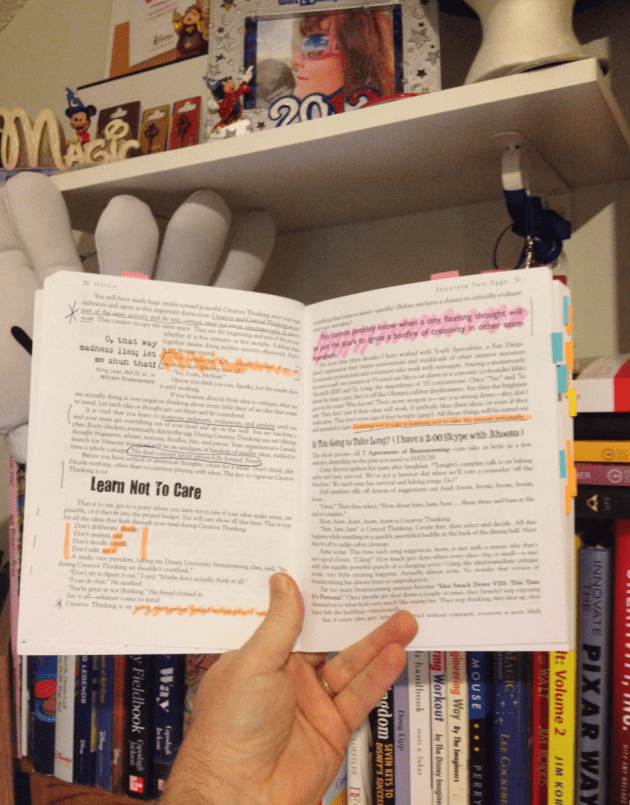
Reading, for me, is a chance to have an ongoing conversation with the author. The image above, taken from a new addition to my reading list, reflects the inside cover of almost every book in my library.

  • The large green Post-it® notes are for writing down important ideas from my reading of the book.
  • The smaller yellow Post-it® notes are for bookmarking important ideas in the pages of the book itself.
  • The four symbols are my “shorthand” for use while reading, indicating additional action needed.
  • I also usually highlight sections in various colors.
  • And on occasion, I will write longer notes in the margins.

When I’m finished with a book – particularly one that has really engaged me and caused me to think – the result looks something like this:

hatchbooknotes

I’m an active reader, working on becoming a more critical thinker, which will help me become a better leader.

What – and how – are you reading?

Protect the Past While Envisioning the Future

Does your church dream more about where you have been than where God is leading you?

Have you ever looked around to realize that your church might be living today by focusing on yesterday?

Many churches long for the past, dreaming about the “good old days.” When faced with questions that are not easily answered, or walking through times of trial and doubt, churches, like people, often want things to be the way they used to be.

The problem is, the past has gone. While we may look back and respect it, and maybe even at times revere it, we cannot live in the past, especially when circumstances demand answers for the future.

If you are interested in learning how to lead your church away from the past in order to focus on what God has ahead, protect the past while envisioning the future.

wwr030117fb-1


THE QUICK SUMMARY – Church Unique by Will Mancini

Church Unique, by Will Mancini, describes a new kind of visioning process designed to help churches develop a stunningly unique model of ministry that leads to redemptive movement. He guides churches away from an internal focus to emphasize participation in their community and surrounding culture.

Mancini offers an approach for rethinking what it means to lead with clarity as a visionary. He does this by explaining that each church has a culture that reflects its particular values, thoughts, attitudes, and actions and then shows how leaders can unlock their church’s individual DNA and unleash their congregation’s one-of-a-kind potential.

A SIMPLE SOLUTION

Bold aspirations must be rooted in the values and visions that have come before. For you to be alive and in touch with God’s work in the world, you were necessarily touched by the vision of others who came before.

Leaders should look for the artifacts of vision every day within their specific ministry contexts. An ongoing discover of uncovering and appreciating the visionary contributions of past and present help prepare your own unique vision to take shape.

Visionary leadership is the art of protecting the past as we champion the future.

We must listen carefully to the ones who have gone before us and learn about their vision. How does their vision intersect with what God is calling us to do? What artifacts of vision exist in the past that can be used to support our vision of the future?

Uncover the creation story – all vision has a creation story, the events and the passion that birth the idea of a better future. Visionary leaders uncover every creation story in the lineage of the people they are influencing.

Collect the hidden gems of vision vocabulary – in the articulation of past vision, there are key terms that live large with meaning. They are “words within the walls” that often stay undiscovered or unpolished. Consequently, they are under-noticed and under-celebrated.

Find the “Hall of Fame” memorabilia – Behind the pictures on the wall, the stained glass windows, and the sound system of your church home are the stories from the people who have forged the character of your church. These “hall of fame” memorabilia speak stories to your church’s uniqueness.

– Will Mancini, Church Unique

A NEXT STEP

Dedicate 20 minutes at the beginning of your next three team meetings to discuss the three vision artifacts listed above.

Meeting Number 1: Uncover the creation stories – the problem with most stories of the past is that they remain in rough form, half-buried in the conscious of the organization with few people who can recall a God-moment that got it started to begin with. If your church is more than five decades old, there may be few, if any, living members who were present at the birth of your church.

Create a plan to recover lost or half-buried memories of your church’s creation stories from long-term members, attic crawl spaces, newsletter archives, or historical documents in your community. The end result should be documented, sharable stories of your church’s birth and ensuing growth that serve as momentum to move forward into what God has for tomorrow. Example: Use significant historical changes like a relocation or renovation to fuel vision for significant changes that lay ahead.

Meeting Number 2: Collect the hidden gems of vision vocabulary – as your teams complete the work of uncovering the creation stories, alert them to be intentionally looking for words and phrases that are often repeated or seem to have significance attached to them. Make sure the teams collect these words and phrases for others to see and enjoy.

As you review these words and phrases, consider how they may be polished and integrated into the living language of your church today, as a way of honoring the past while honing language for the future.

Meeting Number 3: Find the “Hall of Fame” memorabilia – as your teams complete the work of uncovering the creation stories, also alert them to listen for mentions of items and objects to which others have attached importance. Most importantly, record the stories behind those objects that give them significance. Make sure the teams note these items and importance. An old window, chair, or other random object could serve as inspiration from where we have been to get where God is leading.


Not all history is bad, and not all future opportunities will be good. It takes discerning leaders to impartially and prayerfully evaluate “the way things used to be” in order to lead toward the future that God is calling you to create.

If your church is going to remain a vital outpost of Great Commission Transformation in your community, remember to protect the past while envisioning the future.

Excerpt taken from SUMS Remix Issue 22-1, published September 2015


Part of a weekly series on 27gen, entitled Wednesday Weekly Reader

Regular daily reading of books is an important part of my life. It even extends to my vocation, where as Vision Room Curator for Auxano I am responsible for publishing SUMS Remix, a biweekly book “summary” for church leaders. I’m going to peruse back issues of both SUMS and SUMS Remix and publish excerpts each Wednesday.

You can find out more information about SUMS Remix here.

Subscribe to SUMS Remix here.