Tell Your Story in Every Environment with Compelling Consistency

With so many messages competing for people’s attention, how can we most effectively tell our church’s story?

Every day, your church stewards thousands of moments of truth. Every time a member talks to a neighbor, someone drives by the church facility, a ministry email goes out, a pastor’s business card is left on a desk, some interaction on behalf of the church has transpired. Every time these events happen, the church’s vision grows brighter or dims in the tiniest little increments.

The leader’s role is to crank up the wattage.
wwr011817fb-2

THE QUICK SUMMARY – Unique, by Phil Cooke

Today’s culture is more connected than any time in history, but all of this connectivity comes with a price. We live in a world that’s become cluttered, distracted, and disrupted by social media, with the average person receiving as many as 5,000 messages a day in one form or another. If you’re a pastor, nonprofit leader, artist, filmmaker, entrepreneur, or creative professional in this hyper-connected, highly distracted world, how do you get your unique idea, project, or vision on the radar of the people who need to respond?

In Unique, Phil Cooke, a highly respected media producer and consultant, addresses both the challenges and the opportunities of branding and social media in the 21st century. If you have a vision or message to share with the world, Unique provides a blueprint to cut through the clutter, communicate your story, and impact your audience.

A SIMPLE SOLUTION

To maximize your ability to connect, you must invest time, mental energy, and resources to really discover and articulate your uniqueness — your vision, your essence, your story.

Stories inspire and capture imagination. Stories connect on personal and emotional levels. They help us develop relational connections.

That’s why it is so important for your communication toolbox to say who you uniquely are— what differentiates your church from the crowd.

The combination of the right words with powerful imagery compels engagement, insight, and memorability.

Most churches haven’t developed their story and leveraged great design to share it. Don’t miss the opportunity to tell your church’s story with design so you can really extend your reach. Shouldn’t the church connect and build relationships in every way possible?

At its core, branding is simply the art of surrounding a product, organization, or person with a powerful and compelling story. At its most basic level, branding provides answers to the simple human need to differentiate one thing from another.

The goal of branding is to win the hearts and minds of the largest audience possible and imprint an indelible story around your vision.

The power of these stories and the hold they exert over our lives is remarkable, and many would say the power of story is embedded in our genetic makeup. From the ancient days of the Israelite storytellers who recited the epic chronicles of Abraham, Isaac, and Jacob, to the writers, preachers, and filmmakers of today, we are a story-driven people, and we use stories to make sense of life.

Stories work because we want to experience the emotions, feelings, and passions of others who have encountered the challenges we face each day.

During Jesus’ short time of ministry on earth, He had to teach a message that wouldn’t simply change people during His lifetime, but transform the world for ages to come. If you had faced that challenge, what would you have done?

Jesus did what many pastors in that position would probably consider a career killer: He started telling stories. Most of Jesus’ stories were just everyday people doing everyday things. They weren’t particularly exciting, romantic, or even thrilling.

Stories drill deeply into your brain and explode later with meaning. Sometimes the meaning comes when you least expect it. Stories impact audiences because each person interprets the story in light of his or her own personal situation and experience. As a result, the impact is far greater than a simple object lesson or teaching session.

In many cases, you can interchangeably use the words “brand,” “story,” “identity,” and, sometimes, “reputation.” Branding is about building trust and loyalty and extending your relationships far beyond a single transaction.

Stories are the central focus of the art of branding.

Phil Cooke, Unique

A NEXT STEP

How well does your brand tell your story?

Here’s a question for you: What’s the Nike brand all about? If you said “Just Do It” you would be incorrect – that’s their tagline. Their brand is really their mission – “Bring inspiration and innovation to every athlete* in the world.” (By the way, the * is further explained by Nike as “If you have a body you are an athlete.”)

To help understand how your brand tells your story, watch this 5 ½ minute video from Nike with your leadership team.

After watching the video, discuss these questions with your team:

  • How much more important, and eternal, is the mandate of the church than a shoe company?
  • How well defined and well lived, and resultantly effective, is our church at telling our story?
  • Does our story create movement and reflect the heart of God for the church or is it just words on a website or worship service bulletin?

Many pastors tend to be skeptical of investing time and resources into working on statements of identity like mission or values or taglines, especially when things around church “feel” like they are going well enough.

When any organization lives their mission, the results are seen – and life change becomes possible. The marketing video from Nike sums up why, for them, people living out their mission is more important than people knowing their tagline. And shows how good they actually are at living it, better than most churches. 

What are three stories of life change that capture the essence of your church’s brand? How does your church’s mission statement move beyond generic statements to reflect these examples of your unique calling?


With the Gospel at the center of everything we do, the church, by its nature, is a message-centric organization. Jesus, the greatest story-teller of all time knew, before science showed us, that people are simply hard-wired to respond to story and images. And today’s world is becoming ever-increasingly visual, with selfies, Facebook, Twitter, and Instagram.

Consider this: there are hundreds of little moments of truth – touchpoints of connectivity – that happen each day.

Each of these are opportunities to share the message of the gospel. Are you going to make them or miss them?

Just by being more intentional with your brand, you really can capture more “makes” than “misses.”

When the communication gets cluttered, tell your story in every environment with compelling consistency.

Taken from SUMS Remix 26-2, published October 2015.


Part of a weekly series on 27gen, entitled Wednesday Weekly Reader

Regular daily reading of books is an important part of my life. It even extends to my vocation, where as Vision Room Curator for Auxano I am responsible for publishing SUMS Remix, a biweekly book “summary” for church leaders. I’m going to peruse back issues of both SUMS and SUMS Remix and publish excerpts each Wednesday.

You can find out more information about SUMS Remix here.

Subscribe to SUMS Remix here.

Understand the Four Horizons of Vision

Are you a little confused about visionary planning?

There is a difference between having a vision and having a plan. Vision is about the picture of your church’s future. A plan is about the steps to get there.

The vision answers the question, “Where is God taking us?” The plan answers the question, “What are the next best steps, and how do they relate?”

Look at vision as having four horizons.

wwr011017fb-1

THE QUICK SUMMARY – God Dreams, by Will Mancini

Is your team excited about the next big dream for your church?

You are a visionary leader and your church probably has a vision statement. Yet most churches are stuck in a trap of generic communication without a truly visionary plan. Just like a visionary restaurant needs a more specific focus than “serving food,” a visionary church needs something more than biblical generalizations like “loving God, loving people” or “making disciples and serving the world.”

When a team doesn’t share an understanding of God’s next big dream, leadership grows tired, overworked by an “all things to all people” ministry approach. Too often there’s no unified picture of what success looks like. People can feel uninspired and your church’s programming can seem more optional than ever.

Ministry without clarity is insanity. Are you ready for a better way?

In this groundbreaking work, based on Will Mancini’s 15 years and over 10,000 hours of church team facilitation, God Dreams reveals a simple and powerful planning method that will bring energy and focus to your church like never before.

First, God Dreams shows how to reclaim the role of long-range vision today by providing 12 vision templates, each with biblical, historical, and contemporary illustrations. These vision starters will dramatically accelerate your team’s ability to find complete agreement regarding your church’s future.

Second, God Dreams explains how to overcome the fruitless planning efforts that many church teams experience. With a tool called the Horizon Storyline, leaders can connect short-term action steps with the long-range dream, while leveraging the power of storytelling to make the plan “stick.” This tool will galvanize a diverse team of ministry leaders and volunteers with unprecedented enthusiasm.

Imagine leading with a refreshed sense of freedom and confidence, with a totally new way to inspire your church. Imagine the ability to harness the energy and resources of your people toward a specific dream of gospel impact, in your church and in your lifetime.

God Dreams is your passport to leading into a better future.

A SIMPLE SOLUTION

Your eyes can focus on multiple horizons. As you are reading this, look up and notice what is in your midground – a desk and chairs, other people?

Now look to the background and note what you see. A window to look through or a bookshelf?

The document itself and your arms and hands are in your foreground.

Without moving your head, experience the ability to focus in and out of these three horizons going back and forth quickly. That’s called accommodation. It’s a natural reflex that is happening subconsciously all day long. But it’s also a voluntary process. You can consciously control it whenever you want, as you probably did while trying the exercise.

What’s natural to your daily life can also be natural to your church’s organizational life. It is possible to use the three basic distances you are zooming in and out of all day long to build a visionary planning model.

In fact, the primary reason for vision in human-body functions is to guide and direct movement. The same might be said of your visionary plan: it exists to guide and direct movement for the church body as a whole.

The Horizon Storyline is a tool to develop the right amount of vision content for the right time in the future, for the entire leadership team.

The breakthrough of the Horizon Storyline is the development of a planning tool that fits human experience. It’s natural to grasp, using the way we already see, think, and communicate. What if we could forever remove the “it’s just too complicated” barrier? What if your planning tool would intuitively and immediately make sense? What if it would actually be fun to revisit over and over again?

The Horizon Storyline is defined by how we see different “horizons” in our field of vision every day. This idea is illustrated in a landscape painting, with the background far away as the eyes can see; a focal point of the piece in the midground that draws and keeps your focus; and an object in the foreground up close, right before your eyes.

To start, we just carry over the simple idea of background, midground, and foreground using those as names for three of our four planning horizons. We will simply see them as horizons, not in three-dimensional space but into the future. They are time horizons.

Here’s how it works. The near future we will define as ninety days away. That is the foreground vision. The next horizon, the midground vision, we define as one year away. And the furthest horizon we can “see” as an organization is the background vision, defined as three years away. The eyes of your church or ministry should be able to “see” this amount of time into the future.

Now that leaves one more horizon to define. This fourth horizon is just a little farther than you can clearly see. It’s just past your visible range. I call that “beyond the horizon” as a reminder that it is far away, just over the next mountain range, so to speak. I define this time frame as anywhere between five and twenty years depending on the church’s life stage and context.

Will Mancini, God Dreams

A NEXT STEP

The horizons described above are extensions of the way your eyes naturally work.

Right now think of at least one foreground, or short-term strategic horizon for your church. Something within the next 60-90 days.

Now list one big thing you hope to accomplish this year.

Finally, what is a big project, idea or task that you know will need to be tackled in the next few years of your leadership?

Rate the connectedness and continuity between these strategic initiatives. Bring the team together and ask, “What could be done to bring these three natural horizons of visionary planning into alignment?”


More energy. Greater resources. Better synergy. Would you like to have that right now at your church? Would you have guessed that the first step toward these improvements is defining your specific vision as a church?

If you don’t have a clear vision, you certainly won’t have a culture that matches. And if you don’t have a strong culture, then what are people in your church really doing?

Why are they there?

Taken from SUMS Remix 32-2, published January 2016.


Part of a weekly series on 27gen, entitled Wednesday Weekly Reader

Regular daily reading of books is an important part of my life. It even extends to my vocation, where as Vision Room Curator for Auxano I am responsible for publishing SUMS Remix, a biweekly book “summary” for church leaders. I’m going to peruse back issues of both SUMS and SUMS Remix and publish excerpts each Wednesday.

You can find out more information about SUMS Remix here.
Subscribe to SUMS Remix here.

Learn to Think Beyond “Right Now”

Imagine that the role of vision in your church is like an axe.

When skillfully used, it makes a path clear. It removes obstacles. It broadens the path for others to follow. It enable greater accomplishment.

Most pastors regularly pick up the axe of vision in their ministry. Some quickly set it back down, having never been trained in its effective use. Others swing like crazy, unaware that they wield a dull edge. Too often they become frustrated or confused by too little return for their tireless work.

One way to sharpen the axe of vision is by thinking beyond “right now.”

wwr010417fb-2


THE QUICK SUMMARY – God Dreams, by Will Mancini

Is your team excited about the next big dream for your church?

You are a visionary leader and your church probably has a vision statement. Yet most churches are stuck in a trap of generic communication without a truly visionary plan. Just like a visionary restaurant needs a more specific focus than “serving food,” a visionary church needs something more than biblical generalizations like “loving God, loving people” or “making disciples and serving the world.”

When a team doesn’t share an understanding of God’s next big dream, leadership grows tired, overworked by an “all things to all people” ministry approach. Too often there’s no unified picture of what success looks like. People can feel uninspired and your church’s programming can seem more optional than ever.

Ministry without clarity is insanity. Are you ready for a better way?

In this groundbreaking work, based on Will Mancini’s 15 years and over 10,000 hours of church team facilitation, God Dreams reveals a simple and powerful planning method that will bring energy and focus to your church like never before.

First, God Dreams shows how to reclaim the role of long-range vision today by providing 12 vision templates, each with biblical, historical, and contemporary illustrations. These vision starters will dramatically accelerate your team’s ability to find complete agreement regarding your church’s future.

Second, God Dreams explains how to overcome the fruitless planning efforts that many church teams experience. With a tool called the Horizon Storyline, leaders can connect short-term action steps with the long-range dream, while leveraging the power of storytelling to make the plan “stick.” This tool will galvanize a diverse team of ministry leaders and volunteers with unprecedented enthusiasm.

Imagine leading with a refreshed sense of freedom and confidence, with a totally new way to inspire your church. Imagine the ability to harness the energy and resources of your people toward a specific dream of gospel impact, in your church and in your lifetime.

God Dreams is your passport to leading into a better future.

A SIMPLE SOLUTION

For more than a few reasons, the practice of long-term thinking is hard to come by these days. Steward Brand, who is working on an interesting project called the 10,000-year clock project writes:

Civilization is revving itself into a pathologically short attention span. The trend might be coming from the acceleration of technology, the short horizon perspective of market-driven economics, the next election perspective of democracies or the distractions of personal multitasking. All are on the increase. Some sort of balancing corrective is needed.

This “think long” clock is consistent with God’s view of time.

God chooses to reveal Himself through redemptive history. Time is His canvas. This simple fact by itself challenges us to think about the future in epic chunks of time.

It’s time to trade an obsession with now for a mind-set that values thinking long, beginning with the discovery of twelve compelling benefits in the value of thinking long.

thinklong

Will Mancini, God Dreams

A NEXT STEP

Review the twelve compelling reasons to think long above, and note that they are grouped into three broad categories. We think long first because the Bible challenges us to do so, second because practical considerations invite us to do so, and third because it’s a key for unlocking the motivation of people.

To broaden this discussion with your team, reproduce the chart above with each of the three categories and their reasons on a single chart tablet sheet. Using these three sheets, discuss each of the 12 in terms of how you and your church can begin to think long.

Do you really want to inspire people? Don’t flood your church with more programs and events. Rather, blow their minds with new context. Give them something that blows up the smaller stories of the now. Disrupt the casual week-to-week worship routine with a real, visible, and dramatic picture of the specific difference your church will make 10 years from now. Give people something epic!

If you think long, you are more likely to dream big and attempt great.


Life is too short and ministry is too hard to swing all day with a blunt-edged vision.


Taken from SUMS Remix 31-3, published January 2016.


Part of a weekly series on 27gen, entitled Wednesday Weekly Reader

Regular daily reading of books is an important part of my life. It even extends to my vocation, where as Vision Room Curator for Auxano I am responsible for publishing SUMS Remix, a biweekly book “summary” for church leaders. I’m going to peruse back issues of both SUMS and SUMS Remix and publish excerpts each Wednesday.

You can find out more information about SUMS Remix here.

Subscribe to SUMS Remix here.

Unlock the Imagination of Your Audience by Using a Map

To help others see change, the leader must understand how to unlock the imagination.

The very act of imagination is connected to faith. The author of Hebrews writes, “Now faith is the assurance of things hoped for and the conviction of things not seen” (Hebrews 11:1). When a leader articulates, or provokes, a follower’s imagination, he or she is serving both God and the individual by exercising the muscle of faith.

Unlock the imagination of your audience by using a map.

wwr122116fb1

THE QUICK SUMMARY – Communicate to Influence by Ben Decker

Business communication is annoying. At each meeting and presentation, we are inundated with information, leaving us thirsting for inspiration. Sure, we will check off an action item because we have to . . . but what if we were actually inspired to do something? What if we were so moved that we wanted to do it?

Leaders must earn the license to lead. Not by expertise, authority, or title alone, but by influence. In Communicate to Influence, you will learn the secrets of the Decker Method―a framework that has been perfected over the past 36 years. Ben and Kelly Decker add fresh insights to these proven principles so that you can ignite change and inspire action. Discover:

  • The Five White Lies of Communicating: learn which barriers prevent you from getting better
  • The Communicator’s Roadmap: use a tool to visually chart what type of communication experience you create
  • The Behaviors of Trust: align what you say with how you say it to better connect with your audience
  • The Decker Grid: shift your message from self-centered, all about me content to relevant, audience-centered content that drives action

You are called to communicate well. Not only on the main stage, under bright lights, but every time you speak with your colleagues, your clients, and other stakeholders. It’s time to learn how. Stop informing. Start inspiring. 

A SIMPLE SOLUTION

When you inspire people, it is much easier to persuade them to buy into your vision and goals. In fact, they will move from a position of “have to” to “want to.”

How do we create an ideal communication experience for our audience? We begin by understanding what experience we are creating as communicators and by becoming focused and intentional about that experience. We need a navigational tool to help us get where we want to be. We must treat every communication situation like a new location, and input the destination of where we want to go. We need the Communicator’s Roadmap.

communicatorroadmapdecker


The vertical axis graphs our emotional connection with our audience. The emotional connections are what determine whether or not people like us, trust us, and want to follow. If there is emotional distance our audience will be disinterested or disengaged. At the opposite end of the spectrum, if you were emotionally connected to the speakers, you like them, trusted them, related to them, wanted to be around them, or at lease wanted to keep listening to them.

The horizontal axis represents our content, the actual message that we deliver. Are you distributing information, or are you driving action? The left side of the axis is reserved for information sharing. If the content is totally focused on your agenda, your ideas, and your goals, you have self-centered content.

The more you are able to focus your content and make it audience-centered, serving the wants, needs, desires, goals, and priorities of the audience, the more you shift the experience to the right side of the horizontal axis. The right side of this axis is action-oriented, and it is the part of the Communicator’s Roadmap from which influence flows.

Audience-centered content transforms the whole experience. You’ll influence the people in your audience and motivate them to action – and action is what communication is all about.

Ben Decker and Kelly Decker, Communicate to Influence

A NEXT STEP

The quadrants depicted and described above represent the types of experiences you need to create, not the type of communicator you always are. The descriptions should serve as reference points as you prepare for your next presentation.

Each key communication situation in your role as a leader needs a definition, so map it. Be intentional about the kind of experience you want to create and be intentional about where you’re going.

To help you become more comfortable with the map depicted above, practice the following exercises:

  1. A communicator’s highest goal should be to inspire (upper right quadrant). Think about a recent presentation or sermon you delivered.
    1. What quadrant did it start in (if not Inspire)?
    2. What kinds of actions could you take to move it toward the Inspire quadrant?
  2. Over the next week, observe people in various communication settings. Notice where they fall on the map. As a listener, how are you impacted by where they are on the map?
  3. The next time you dine out, don’t just focus on the food but think about the whole experience. How did the whole experience add to (or take away) from your meal? When you are preparing your next presentation, use your dining experience feelings to help you focus your total presentation experience.
  4. The next time you are at an event with multiple speakers, create a map of each of them, noting which quadrant they started in and where they finished. What stood out about the journey? Which speakers inspired you the most? What lessons can you apply to your own speaking journey?

Closing Thoughts

As leaders, we communicate in all we say and do. We may be entertaining at times, we inform much of the time, and occasionally we must be directing in what we say. But in all situations, we can inspire and connect with our audience.

It’s not what the leader thinks can be or even should be, but what must be.

Taken from SUMS Remix 29-3, published December 2015.


Part of a weekly series on 27gen, entitled Wednesday Weekly Reader

Regular daily reading of books is an important part of my life. It even extends to my vocation, where as Vision Room Curator for Auxano I am responsible for publishing SUMS Remix, a biweekly book “summary” for church leaders. I’m going to peruse back issues of both SUMS and SUMS Remix and publish excerpts each Wednesday.

You can find out more information about SUMS Remix here.
Subscribe to SUMS Remix here.

Communicate Your Vision Visually Using a Brand Toolbox

With so many messages competing for people’s attention, how can you most effectively tell your church’s story?

Every day, your church stewards thousands of moments of truth. Every time a member talks to a neighbor, someone drives by the church facility, a ministry email goes out, a pastor’s business card is left on a desk, some interaction on behalf of the church has transpired. Every time these events happen, the church’s vision grows brighter or dims in the tiniest little increments.

The leader’s role is to crank up the wattage.

wwr121416fb-1

Solution: Communicate vision visually using a brand toolbox

THE QUICK SUMMARY – What Great Brands Do, by Denise Lee Yohn

It’s tempting to believe that brands like Apple, Nike, and Zappos achieved their iconic statuses because of serendipity, an unattainable magic formula, or even the genius of a single visionary leader. However, these companies all adopted specific approaches and principles that transformed their ordinary brands into industry leaders. In other words, great brands can be built–and Denise Lee Yohn knows exactly how to do it.

Delivering a fresh perspective, Yohn’s What Great Brands Do teaches an innovative brand-as-business strategy that enhances brand identity while boosting profit margins, improving company culture, and creating stronger stakeholder relationships. Drawing from 25 years of consulting work with such top brands as Frito-Lay, Sony, Nautica, and Burger King, Yohn explains key principles of her brand-as-business strategy.

Filled with targeted guidance for CEOs, COOs, entrepreneurs, and other organization leaders, What Great Brands Do is an essential blueprint for launching any brand to meteoric heights.

A SIMPLE SOLUTION

Spotting an exceptional brand is easy, but building an exceptional brand can be one of the most challenging and elusive tasks organizations face. This task is even more difficult for churches, where “brand” is often seen as a four-letter word.

At its most simple form, though, a brand is really the personality of an organization, and it should guide every action of the organization. Your corporate culture is your brand’s foundation.

Unless and until your culture is expressed clearly through your customer experience, you have nothing worth communicating. Your brand can’t just be a promise; it must be a promise delivered. So your starting point is cultivating a strong internal corporate culture that aligns and integrates with your brand.

Great brands use culture branding to educate – to help employees understand what a brand is and why it’s important. They use it to define – to explain what the brand stands for and how it is differentiating. They use it to activate – to help people understand their own impact on brand perceptions and therefore what is expected of them.

The challenge then becomes what I often call the “head + heart + hands and feet” problem. For your employees to understand, embrace, and deliver your brand, they need to know its values in their heads, feel inspired by them in their hearts, and then put them into action with their hands and feet.

Operationalizing your brand through organizational culture requires a focus on design, empowerment, and impact. You want to design the organization and its business model so it delivers on the brand values and attributes. You want to empower your people with the tools and resources to infuse the brand into their day-to-day decisions and behaviors. Finally, you want to make such a positive impact on your employees’ lives and their careers that they support your brand’s message and mission because they know their own destinies and your brand’s destiny are intertwined.

I often work with clients to build a “Brand Toolbox” of content and decision guides to drive the approaches and behaviors needed to operationalize their brand values. The Brand Toolbox informs managers and employees by communicating what the brand platform is and by providing principles to guide brand execution. It also inspires people with images, stories, and quotes. It gets them excited about the brand and motivates them to change their behavior in support of it.

Denise Lee Yohn, What Great Brands Do

A NEXT STEP

Your brand is much more than a marketing tool. It must be a guiding compass for your organization and strategy.

We have all heard the expression that having the right tools makes the job easier. Providing your church with the right tools is no different. With a well-developed Brand Toolbox you will empower leaders, build culture, and guide daily decision-making.

Your brand is not simply a logo or a great looking brochure. Your brand is a verb. It is action; it is every experience people have with your organization – your church – every day through everything you say and do. It is your culture, your ethos. It is every touch-point. It is about building a relationship and making an emotional connection with people in your church and with people outside your church.

To build a strong brand you must first Start Inside with a clear understanding of your church’s identity and a strategy that aligns all communication. This is essential for executing your brand through a “focus on design, empowerment, and impact.”

Your Brand Toolbox is freeing and will help you simplify your communication.

How complete is your Brand Toolbox?

How far along are you in giving your team the tools necessary for building culture? Determine which number describes how complete your toolbox is:

  1. We have an empty toolbox.
  2. We have an explanation of our brand strategy along with the background and rationale so that everyone can understand why we’re doing what we’re doing, and definitions of key terms so everyone grasps the meaning behind the words.
  3. We have principles and guidelines for delivering brand values and attributes at key touchpoints between our brand and the outside world.
  4. We have sample applications for how the brand should be expressed and delivered.
  5. We have guides that walk people through important decisions, along with outlines that map processes so that people lean how to do things on brand.

If you are not satisfied with your Brand Toolbox, make an action plan for taking your toolbox to the next level of completion. Remember, Starting Inside is about execution and integrating your identity into your culture. The Toolbox must be shared and accessible as part of your leadership development at every level.

If you would like information on developing a Brand Toolbox, connect with Auxano’s design team.


Closing Thoughts

With the Gospel at the center of everything we do, the church, by its nature, is a message-centric organization. Jesus, the greatest story-teller of all time knew, before science showed us, that people are simply hard-wired to respond to story and images. And today’s world is becoming ever-increasingly visual, with selfies, Facebook, Twitter, and Instagram.

Consider this: there are hundreds of little moments of truth – touchpoints of connectivity – that happen each day.

Each of these are opportunities to share the message of the gospel. Are you going to make them or miss them?

Just by being more intentional with your brand, you really can capture more “makes” than “misses.”

Taken from SUMS Remix, Issue 26-1, October, 2015


Part of a weekly series on 27gen, entitled Wednesday Weekly Reader

Regular daily reading of books is an important part of my life. It even extends to my vocation, where as Vision Room Curator for Auxano I am responsible for publishing SUMS Remix, a biweekly book “summary” for church leaders. I’m going to peruse back issues of both SUMS and SUMS Remix and publish excerpts each Wednesday.

You can find out more information about SUMS Remix here.

Subscribe to SUMS Remix here.

Generosity Starts with the Heart, Not the Checkbook

Is your congregation stuck seeing generosity as what they cannot give rather than why or how they give?

Generosity is a way of living that involves one’s daily activities, values, and goals for life, and the use of all possessions. It begins with recognition of God as Creator of all things, and our position as steward of some things.

As stewards, we are in charge of the possessions God has given us – an authority that is real, but secondary to God’s ultimate ownership.

When we get these two ownerships mixed up, problems follow.

One solution to help you grow and develop generous givers in your church is by encouraging them to examining their heart first before you ask them to give.

wwr113016fb1

THE QUICK SUMMARY – Generosity: Moving Toward a Life that is Truly Life

How would you like to raise the tide of generosity in your life and in your church while discovering greater spiritual maturity through giving?

Generosity was designed to help you do just this. Churches are using Generosity in powerful, creative ways to change the money conversation. People give generously when they reflect on God s generosity, and this book will help you and your church do just that.

Let award-winning author Gordon MacDonald show you how in this four-week devotional, with 100,000 copies in print, that uses Scripture to demonstrate God’s desire for each of us to live a generous life. 

A SIMPLE SOLUTION

Giving is such a sacred and worshipful act that it should not be thwarted by a person’s wrong relationship to another. God so values showing mercy and achieving reconciliation that it justifies temporarily postponing the act of giving. This makes the gift and the worship more meaningful to the individual and more pleasing to God.

God seeks generous givers. But, first, He seeks generous givers whose hearts are right with Him and with others.

Jesus puts a condition on gifts in Matthew 5:23:

“Therefore, if you are offering your gift at the altar and there remember that your brother has something against you, leave your gift there in front of the altar. First go and be reconciled to your brother, then come and offer your gift.”

Here is Christ, in effect, saying that giving must be preceded by certain actions that are inherently spiritual and relational. In fact, He appears to be discouraging giving if one has not given careful attention to other issues…such as the quality of relationship between the would-be giver and his or her “brother.” You have approached the altar with your gift, He says, and suddenly you are caused to remember that there is a broken relationship out there….with your “brother.”

In this case the “brother” may be a relative, a friend, a working colleague. You’ve offended him; there is a significant breach in your relationship. Before you can give, you must repair the relational damage. Jesus’ remedy: Leave the gift in front of the altar, find your “brother,” reconcile, and then come back and complete the “transaction.”

Jesus regards giving as a whole-person event. The gift on the altar is not impressive to Him if it is not preceded by a “gift” of another kind in another part of life. In this case: the gift of reconciliation whether it means asking forgiveness or giving it. Leave your gift where it is and go to your “brother.” The temptation, of course, for the generous giver is to think that a major gift covers a lot of small issues in another part of one’s life. And that might have been true for the religious leaders of those days and, perhaps, even of today. A large gift can close a lot of eyes. But not the eyes of the Lord. God apparently would rather have the giver stay at home with his gift, if he is planning to approach the alter while there is resentment and hostility in the background.

Gordon MacDonald, Generosity: Moving Toward a Life that is Truly Life

A NEXT STEP

Personal heart change is a necessary first step toward personal life change. That principle is at the core of Jesus’ teaching.

In the Matthew 5 passage referenced above, we are called to place interpersonal reconciliation above correct ritual. While we cannot guarantee that another person will agree to be reconciled with us, we should make every effort “as far as it depends on you” (Romans 12:18).

As the leadership of your church begins with the leadership of yourself, how have you recently applied this passage to your own life? Are there un-reconciled relationships between you and a staff member or church leader?

What is the relational health of your staff? Are their offerings hindered by unhealthy relationships with one another or other church leaders?
It will take courage, but engage those closest to you in humility and a posture of grace. Begin by asking forgiveness first, then opening the door for relational repair.

As your leadership climate becomes healthier, grow a culture of generosity church-wide by creating a safe environment to talk about what matters the most. If healthy stewardship conversations cannot happen among the staff, it will never become cultural among the congregation.


Closing Thoughts

Because a giving God expects a giving people, the generous Christian should be a joyous giver. We give as an expression of our new nature and life in Christ.

Taken from SUMS Remix, Issue 30-3, December, 2015


Part of a weekly series on 27gen, entitled Wednesday Weekly Reader

Regular daily reading of books is an important part of my life. It even extends to my vocation, where as Vision Room Curator for Auxano I am responsible for publishing SUMS Remix, a biweekly book “summary” for church leaders. I’m going to peruse back issues of both SUMS and SUMS Remix and publish excerpts each Wednesday.

You can find out more information about SUMS Remix here.

Subscribe to SUMS Remix here.

How to Rewire Your Teams for Maximum Collaboration

Do key leaders in your organization only think about their ministry area and not the entire organization?

Divisions are necessary in all organizations, even churches. They provide the structure that allows your ministry to function smoothly. Every organization is divided into divisions, functions, or some type of grouping. Doing so allows each group to develop the special skill sets needed to make it function.

But when departments or functional areas become isolated from one another it causes problems. Leaders often refer to this as creating silos.

But organizational silos can also cause problems – the same structural benefits listed above also prevent the flow of information, focus, and control outward. In order for an organization to work efficiently, decisions need to be made across silos.

To break the down the barriers of silos in your organization, the goal is not to destroy the meaningful structural divisions themselves but to eliminate the problems that silos cause.

Many organizations will face the following barriers:

  • Uncoordinated decision-making
  • Competing priorities
  • Dilution of energy and effort

The following excerpt will provide your organization tools to help break down the silos in your organization.

rewireteamsfb-2

THE QUICK SUMMARYMidnight Lunch, Sarah Miller Caldicott

Thomas Edison created multi-billion dollar industries that still exist today. What many people don’t realize is that his innovations were generated through focused approaches to teamwork and collaboration.

Authored by the great grandniece of Thomas Edison, Midnight Lunch provides an intriguing look at how to use Edison’s collaboration methods to strengthen live and virtual teams today.


A SIMPLE SOLUTION

A church accomplishing its mission requires many people working on multiple teams to be successful. Often, these teams drift into a pattern of accomplishing things “their way,” erroneously thinking that what’s best for their team will be best for the organization as a whole.

This lack of coordinated decision making across the organization is the third indicator of silos in the organization.

True collaboration operates like an invisible glue that fuses learning, insight, purpose, complexity, and results together in one continuous effort.

Thomas Edison viewed true collaboration among his teams as a value creation continuum, recognizing that complexity was a norm that all team members needed to understand and address. Here is a four-phase model of the collaboration process that translates Edison’s decades of groundbreaking practices into language for the 21st Century leader. A core question serves as a launching point for the exploration of each phase.

> How do we create the foundation for true collaboration to flourish?

Phase 1 – Capacity: Select small, diverse teams of two to eight people who will thrive in an environment of discovery learning and collegiality.

> How can our collaboration team reframe the problem at hand, driving the greatest range of creativity and breakthrough solutions?

Phase 2 – Context: Focus the outlook of the team toward development of new context that broadly frames the problem or challenge under consideration. Use a combination of individual learning plus hands-on activities to drive perspectives for potential solutions.

> Can the collaboration team stay the course and continue forward despite disagreements?

Phase 3 – Coherence: Maintain collaboration momentum, creating frameworks for progress through inspiration and inspirational leadership even though disagreements may exist. Newly discover, or re-emphasize, the shared purpose that binds the team together.

> How can our collaboration team leverage internal and external networked resources nimbly and with speed?

Phase 4 – Complexity: Equip and reskill teams to implement new ideas or new solutions using internally and externally networked resources, rapidly accessing or managing complex data streams the team must navigate. Leave a footprint that contributes to a broader collective intelligence.

Sarah Miller Caldicott, Midnight Lunch

A NEXT STEP

Church leadership teams aren’t working to invent the next light bulb, but Edison’s Four Collaboration Phases can be instructive for leaders who want to break down silos on their teams

Within the four phases of capacity, context, coherence, and complexity lies the invisible glue that can help your organization develop true collaboration practices to achieve your mission.

Phase 1 – Capacity

Create your own “midnight lunch” experience by ordering pizza or other takeout food. Pick a unique place in your normal environment that is not normally associated with regular tasks, or go offsite. Use the informal atmosphere to foster conversations about interest areas of all your group members. Actively listen to the conversations, and develop a deeper level of knowledge – and connection – with your teammates.

Phase 2 – Context

As a team, take 10 minutes and create an individual list of the various sources of information you draw from each week. Does your team see a pattern in their lists? Now challenge them to create another list of five additional sources that will intentionally shift the context of their information-gathering. During weekly meetings, take five minutes to share how this new context is broadening their ministry context.

Phase 3 – Coherence

When team members begin to use self-referencing language (I, me, mine) more than team-referencing language (us, our, ours), it is an indicator that defenses are being raised and the team is in danger of losing coherence. Often, the language of the team is the first indicator of a team losing its momentum toward a shared goal. Lead your team to be constantly aware of their language, and guide them to practice inclusive language by first modeling it yourself.

Phase 4 – Complexity

Among all organizations, the church has the most potential for the existence of excessive hierarchy. To overcome this, lead your team to clear away internal roadblocks which add unnecessary time and complexity to your process. The use of the strategy map process above can be both a beginning point and continual guide to your journey toward simplification.


Closing Thoughts

Cooperation, communication, and collaboration are three keys to breaking down the organizational silos that are keeping you from achieving your mission.

Taken from SUMS Remix, Issue 9-3, March, 2015


Part of a weekly series on 27gen, entitled Wednesday Weekly Reader

Regular daily reading of books is an important part of my life. It even extends to my vocation, where as Vision Room Curator for Auxano I am responsible for publishing SUMS Remix, a biweekly book “summary” for church leaders. I’m going to peruse back issues of both SUMS and SUMS Remix and publish excerpts each Wednesday.

You can find out more information about SUMS Remix here.

Subscribe to SUMS Remix here.

How to Increase Your Team’s Productivity by Modeling Your Own

You have a pretty good sense that most of your team has too much to handle and not enough time to get it done – you may not have a sense of how much you are contributing to the problem.

In our fast-paced, get-it-done-now culture, the fact is that almost everyone on your team could use some help in increasing their personal productivity. Why not show them how by modeling effectiveness in your leadership?

By its very nature ministry makes the “I’ve gotten something done today” feeling elusive. For many church leaders, there are no edges to their work – it’s not easy to tell when the work is finished, because it really never is. Most of your team have at least half a dozen things they are trying to achieve right now – today! And a pastoral need could arise at any moment to make that to-do list completely irrelevant.

To give your team practical help for personal productivity, blaze the trail by modeling a rock-solid work routine.


www111616fb-2

THE QUICK SUMMARY

Are you over-extended, over-distracted, and overwhelmed? Do you work at a breakneck pace all day, only to find that you haven’t accomplished the most important things on your agenda when you leave the office?

The world has changed and the way we work has to change, too. With wisdom from 20 leading creative minds, Manage Your Day-to-Day will give you a toolkit for tackling the new challenges of a 24/7, always-on workplace.

Manage Your Day-to-Day shows you how to build a rock-solid daily routine field in a constant barrage of messages, find focus amid chaos, and carve out the time you need to do the work that matters

A SIMPLE SOLUTION

The biggest problem we face today is “reactionary workflow.” We live our lives pecking away at the many inboxes around us, trying to stay afloat by responding and reacting to the latest thing: emails, text messages, Tweets, Facebook, and Instagram posts, etc.

Because we are constantly connected to family, friends, and our co-workers, we have become increasingly reactive to what comes to us rather than being proactive about what matters most to us. Being informed and connected becomes a disadvantage when the deluge of information overwhelms your ability to think and act.

It’s time to consider a change in your routine – one that will maximize your creative potential by allocating your best time of the day to it, and then allowing all the other “stuff” to come later.  

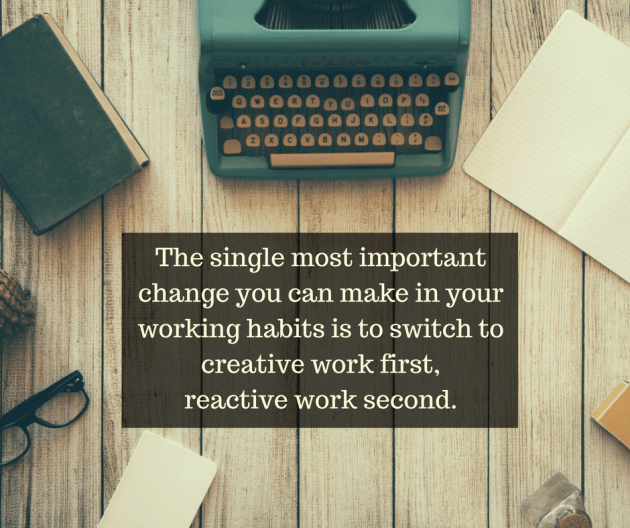
The single most important change you can make in your working habits is to switch to creative work first, reactive work second.

The Building Blocks of a Great Routine

Of course, it’s all well and good to say buckle down and ignore pesky requests, but how can you do so on a daily basis?

Start with the rhythm of your energy levels. Certain times of day are especially conducive to focused creativity, thanks to circadian rhythms of arousal and mental alertness. Notice when you seem to have the most energy during the day, and dedicate those valuable periods to your most important creative work.

Use creative triggers. Stick to the same tools, the same surroundings, even the same background music, so that they become associative triggers for you to enter the creative zone.

Manage to-do list creep. Limit your daily to-do list. A 3” by 3” Post-It© is perfect – if you can’t fit everything into that size, how will you do it all in one day? If you keep adding to your to-do list during the day, you will never finish – and your motivation will plummet. Most things can wait till tomorrow – so let them.

Capture every commitment. Train yourself to record every commitment you make (to yourself and others) somewhere that will make it impossible to forget. This will help you respond to requests more efficiently and make you a better collaborator. More importantly, it will give you peace of mind – when you are confident that everything has been captured reliably, you can focus on the task at hand.

Establish hard edges in your day. Set a start time and a finish time for your workday – even if you work alone. Dedicate different times of day to different activities: creative work, meetings, correspondence, administrative work, and so on. These hard edges keep tasks from taking longer than they need to and encroaching on your other important work. They also help you avoid workaholism, which is far less productive than it looks.

– Mark McGuinness, Manage Your Day-to-Day

A NEXT STEP

Over a period of five weeks, commit to experimenting with each of the 5 Building Blocks, one each week. As you use each building block during your work day, evaluate moments of increase or moments of distraction, and modify that particular Building Block to drive effectiveness.

After one month of using the building blocks, make an honest assessment of your work routines by asking the following questions:

  • Do you feel that your work is more productive?
  • Can you list specific ways that your work is more productive?
  • What building block was the hardest to implement? Why?
  • What building block was the easiest to implement? Why?

After you have completed your personal assessment, ask a close colleague or two the same questions. Compare their answers to yours, and make any adjustments needed.


Closing Thoughts

Becoming effective in your own work habits will serve as both an inspiration and guide for your team. By demonstrating an effective, balanced role model, you are leading your team to effectiveness of vision, not just managing their output of activity.

Taken from SUMS Remix, Issue 16-3, June, 2015


Part of a weekly series on 27gen, entitled Wednesday Weekly Reader

Regular daily reading of books is an important part of my life. It even extends to my vocation, where as Vision Room Curator for Auxano I am responsible for publishing SUMS Remix, a biweekly book “summary” for church leaders. I’m going to peruse back issues of both SUMS and SUMS Remix and publish excerpts each Wednesday.

You can find out more information about SUMS Remix here.

Subscribe to SUMS Remix here.

How to Use a Brain Trust to Spark Creativity on Your Team

In our fast-paced digital life, church leadership teams need to be creative in order to deal with the changes coming their way today – or they risk irrelevancy tomorrow.

Creativity then, becomes a constant process for every ministry area of any church rather than an occasional requirement for the worship pastor at Christmas or only limited to those “creative” churches.

Like farmers and their crops, leaders cannot dictate creativity, but they are called to cultivate creativity. Thinking and acting creatively doesn’t just happen because a leader desires it or orders it to happen. With the right environment, resources, mindset, and vision, your team will be able to develop the required motivation to be creative on their own.

How can I unleash the creativity of my team?

www110916fb1

Solution: Create a Brain Trust

THE QUICK SUMMARY

Creativity, Inc. is a book for leaders who want to lead their teams to new heights, a manual for anyone who strives for originality, and the first-ever, all-access trip into the nerve center of Pixar Animation—into the meetings, postmortems, and “Braintrust” sessions where some of the most successful films in history are made.

It is, at heart, a book about how to build a creative culture—but it is also, as Pixar co-founder and president Ed Catmull writes, “an expression of the ideas that I believe make the best in us possible.”

For nearly twenty years, Pixar has dominated the world of animation through joyousness of the storytelling, the inventive plots, and the emotional authenticity. In some ways, Pixar movies are an object lesson in what creativity really is. Here, in this book, Catmull reveals the ideals and techniques that have made Pixar so widely admired.

A SIMPLE SOLUTION

Among the many necessities for creativity is the freedom for a team to share ideas , comments, and critiques with one another. The flip side of that freedom is the danger of being too critical, or that critical comments are taken the wrong way.

How can leaders walk the fine line between encouraging open, honest dialogue among their team while at the same time avoiding negative, destructive criticism? 

Creativity has to start somewhere, and we are true believers in the power of bracing, candid feedback and the iterative process – reworking, reworking, and reworking again, until a flawed story finds its throughline or a hollow character finds a soul.

One of Pixar’s key mechanisms is the Braintrust, which we rely upon to push us toward excellence and to root out mediocrity. The Braintrust is our primary delivery system for straight talk. Its premise is simple: Put smart, passionate people in a room together, charge them with identifying and solving problems, and encourage them to be candid with one another.

It’s not foolproof – sometimes the interactions only serve to highlight the difficulties of achieving candor – but when we get it right, the results are phenomenal. The Braintrust sets the tone for everything else we do.

Participants in the Braintrust do not prescribe how to fix the problems they diagnose. They test weak points, they make suggestions, but it is up to the director to settle on a path forward.

People who take on complicated creative projects become lost at some point in the process. In order to create, you must internalize and almost become the project for a while. Soon, the details converge to obscure the whole, and that makes it difficult to move forward substantially in any one direction.

No matter what, the process of coming to clarity takes patience and candor.

The Braintrust differs from other feedback mechanisms in two ways:

  • It is made up of people with a deep understanding of the process at hand and who have been through it themselves;
  • It has no authority – the director (leader) has to figure out how to address the feedback.

We believe that ideas only become great when they are challenged and tested.

– Ed Catmull, Creativity, Inc.

A NEXT STEP

Does your leadership team debate, disagree, discuss, dump—or do you dialogue?  The group dynamics of a team can make or break your effectiveness as a leader.   Imagine what could happen in your ministry if you could lubricate your team’s communication skills.

Engaging the methods of dialogue results in two-way, open communication that generates an uninhibited flow of ideas in a “braintrust” environment.

Dialogue relates to more than communication—it involves creating an environment of trust, discipline and commitment to a common purpose where teams “think together.”

With an understanding of the basics of dialogue, the team must relentlessly:

  • Practice listening to hear, not to react
  • Practice asking to explore ideas, not to judge
  • Practice advocating an idea that focuses on the question at hand, not to defend a position

The core of dialogue is that there is understanding and discipline on the team that the question –the problem at hand—always remains the focus of the dialogue, with the church’s vision as primary filter. It works because individuals put aside egos, assumptions, emotions and agendas to focus on the question for the good of the whole–the collective vision of the church or ministry. In a true “Braintrust” dialogue, ideas get affirmed or challenged, not people.

Auxano, the consulting group I work for, has developed a hands-on tool to use in collaborative meetings that not only reinforces understanding of dialogue and team dynamics, but personally engages each individual to enter into productive, healthy collaboration and apply what they have learned.

We call it the Collaboration Cube.

Our Collaboration Cube takes these ideas to an experiential level that not only encourages team involvement in dialogue, but gives them the ability to apply it. The cube is used by the facilitator to guide the group, and by team members to communicate within the Braintrust.

Imagine creating a “Braintrust” at your church: a unified team that can work together and support decisions because they are results that people really care about and they evolved from a shared experience. What could you do with that kind of cohesive culture?  Give this method a try and watch the collective intelligence of your team and your decisions increase with results for your ministry that are unprecedented.

Read more about the Collaboration Cube, or visit our online store to purchase them


Closing Thoughts

Creativity and innovation are the life blood of a thriving ministry. But even the most creative team can become stale or fall into a rut of the same old same old. Your actions as a leader will determine if your team stays the same, or is constantly reinventing itself.

Taken from SUMS Remix, Issue 15-3, May, 2015


Part of a weekly series on 27gen, entitled Wednesday Weekly Reader

Regular daily reading of books is an important part of my life. It even extends to my vocation, where as Vision Room Curator for Auxano I am responsible for publishing SUMS Remix, a biweekly book “summary” for church leaders. I’m going to peruse back issues of both SUMS and SUMS Remix and publish excerpts each Wednesday.

You can find out more information about SUMS Remix here.
Subscribe to SUMS Remix here.

What to Do When You’re Running On Empty

More days than we would like to admit, church leaders face the necessity of leading on an empty tank. The ever present needs of the body, the ongoing call to lead our families through challenging or exciting seasons, and the every day mechanics of ministry leadership compound to drain even the healthiest leader. In fact, the question is not will you ever lead from an empty tank, but HOW will you lead from an empty tank. More importantly, what should a Pastor do when that season emerges?

A pastor’s greatest leadership tool is a healthy soul. Our concentration on skill and technique and strategy has resulted in deemphasizing the interior life. The outcome is an increasing number of men and women leading our churches who are emotionally empty and spiritually dry. – Lance Witt

It is time to face the reality that no numeric or other measurable short-term success in ministry can ever offset the long-term consequences of leading from an unhealthy spirit. What do you do when your tank runs dry?

remix-14-1fb1

Solution: Make a pit stop to replenish and recalibrate.

THE QUICK SUMMARY – Replenish, by Lance Witt

Every leader functions on two stages-the front stage or public world, and the back stage or private world. One cannot lead successfully front stage when one is completely depleted back stage. In a time when pastors are leaving the ministry in record numbers due to cynicism, disillusionment, weariness, health crises and personal scandals, there is an urgent need for soul care in the private lives of leaders.

Replenish helps leaders focus on the back stage, the interior life, in order to remain spiritually healthy. In a caring, encouraging tone, Lance Witt, former Executive Pastor at Saddleback Community Church shows pastors how to prioritize matters of the soul. Urging leaders to develop healthy spiritual practices and address problems that lead to burnout creates a healthy rhythm in their lives, improves their people skills and the spiritual climate of their team, develops better systems in their churches, and discovers how to lead an unhurried life.

For the many ministry leaders feeling alone, in over their heads, or simply worn out, this book will offer welcome relief and a healthy path forward.

A SIMPLE SOLUTION

In NASCAR, the race is won or lost in the pits. With a well-trained crew following the strategy of the crew chief (tasked with constantly adjusting to the realities of the race), a driver’s chances of being a winner are greatly enhanced.

Without a pit stop, though, it’s going to be a short race.

The same is true for leaders who think they can keep going and going, and going…

Instead of feeling constant pressure to be “on” all the time, leaders need to learn how to flow in a rhythm and pace themselves in between intensity and renewal. You really can’t balance the two, but you can work over a period of time to develop a rhythm where allowing for planned, intentional “pit stops” enables leaders to not only race strong, but finish well.

If you could plot the trajectory of your soul, where is it headed? Where you end up in ten or twenty years is largely determined by how well you manage what’s going on inside you now.

Leaders who stay spiritually healthy long term are those who learn the sacred rhythm of advance and retreat. There are times when we’re focused on the mission and taking the next hill for Christ’s kingdom. But you can’t stay on the front lines forever. You have to rest and regroup. In fact, the more fierce and intense the battle, the more you have to retreat.

Times of retreat have two powerful benefits:

Replenishing my soul. When I’m on retreat, something happens inside me that’s hard to explain. I have learned to slow my spirit, and I now realize the world can get along just fine without me for a little while. I am learning to “be” with my heavenly Father, and my soul is replenished in the process.

Recalibrating my perspective. As I ponder and pray, God regularly shifts my outlook by reminding me of what is really important. He regularly convicts me of getting so worked up over things that just aren’t that important. On retreat I have removed most of the white noise form my world, and I can be quiet enough to hear God’s voice.

– Lance Will, Replenish

A NEXT STEP

How do you know when you need a pit stop?

People who dream big and execute well run into particular hazards that most people don’t encounter.  Will Mancini has discovered that it’s not uncommon for a true ministry visionary to be tired. He has developed five causes that block the future-minded leader from feeling 100%.

At your next team meeting, write the following “formulas” on a white board or flip chart:

  • #1 God’s Vision + Man’s agendas  = Too much work
  • #2 Personal Driven-ness + God’s Vision = Too much work
  • #3 God’s Vision – God’s Timetable = Too much work
  • #4 God’s Vision – Empowering Others = Too much work
  • #5 God’s Vision – Personal Growth = Too much work

Reflect on each formula individually and discuss together as a team the extent that each formula is sapping the healthy lifestyle, mental sanity or energy-filled style that faithfulness to God and his vision deserves.

Create action steps to help each team member rewrite the formula in their own life, producing replenished leaders and a team built to finish the race.

Closing Thoughts

Godly leadership is always inside out. God has and always will choose to smile on men and women who are healthy, holy, & humble. – Lance Witt

By making a pit stop to replenish and recalibrate, leaders will help themselves and their teams keep a “full” tank and be healthy emotionally, physically, and spiritually.


Part of a weekly series on 27gen, entitled Wednesday Weekly Reader

Regular daily reading of books is an important part of my life. It even extends to my vocation, where as Vision Room Curator for Auxano I am responsible for publishing SUMS Remix, a biweekly book “summary” for church leaders. I’m going to peruse back issues of both SUMS and SUMS Remix and publish excerpts each Wednesday.

You can find out more information about SUMS Remix here. Subscribe to SUMS Remix here.