How to Be Like Walt, Part 2

Walt Disney had a burning desire for excellence in everything he did. He was always thinking, ‘We can do it better.’ That’s a common trait of all successful people.

Royal Clark, former treasurer of WED Enterprises

Walt Disney’s life provides powerful lessons that can be applied in any leadership position. Author Pat Williams recognized this, and went behind the legend to discover a man every bit as fascinating as the world he created.
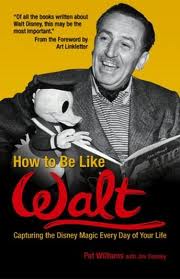
How to Be Like Walt is the result of thousands of hours of interviews of the people who knew Walt best. In addition to being a fascinating life story of one of our nation’s most creative minds, the author has distilled Walt’s life into 17 lessons – lessons that we all could learn from. I introduced the topic yesterday; here are a few more:

Plus Every Experience: Sometime during the 1940s, Walt coined the term “plussing.” Normally, the word “plus” is a conjunction, as in “two plus two equals four.” But Walt used the word as a verb – an action word. To “plus” something is to improve it. “Plussing” means giving your guests more than they paid for, more than they expect, more than you have to give them. No matter what “business” you are in, your success depends on your commitment to excellence and attention to detail. If you deliver more than people expect, you will turn people into fans. Pursue excellence in everything you do.

Be a Person of Stick-to-it-ivity: Today we look at Disneyland and say, “Of course! Just what the world needed. How could it miss?” But in 1955, Disneyland was the biggest gamble in the history of American business. The risk paid off – not because Walt was lucky or favored or a genius. It paid off because Walt wouldn’t quit. The success of Disneyland is, first and foremost, the result of sheer dogged determination and persistence in the face of obstacles and opposition. In his own words, “Get a good idea and stay with it. Dog it, and work at it until it’s done, and done right.”

Become Like a Sponge for Ideas: Walt continually fed his mind with information and ideas. He absorbed inspiration wherever he went. If you want to be like Walt – more creative, more imaginative, and more successful – then keep your eyes and ears open. Read. Watch. Travel. Talk to people wherever you go. Ask questions. Invite opinions. Become a sponge for ideas.

Ask Yourself “How About Tomorrow?”: Walt embraced the future and put the stamp of his own personality on tomorrow. If we want to help shape a better tomorrow, then we need to continually ask ourselves the same question Walt asked Ray Bradbury: “How about tomorrow?” The difference between today and tomorrow is something called change. It takes courage to embrace the future, because the future is about change, and change brings uncertainty and anxiety. We fear change; we prefer the comfort of the familiar. But change is inevitable. If we do not become future-focused, we are doomed to obsolescence when tomorrow arrives. There are so many possible futures – which one will you choose?

Here are the rest of the author’s “How to Be Like Walt” lessons:

  • Become an Animated Leader
  • Take a Risk
  • Dealing with Loss
  • Live for the Next Generation
  • Build Complementary Partnerships
  • Stay Focused
  • Accept Your Mortality
  • Make Your Family Your Top Priority
  • Be the Person God Made You to Be

Each of the 17 lessons in the book are richly illustrated with stories by and about Walt Disney. I encourage you to get a copy and prepare to be delighted – and challenged.

Walt’s life challenges us to dream bigger, reach higher, work harder, risk more, and persevere as long as it takes. That is the rich legacy Walt Disney left us. That is the supreme lesson of his endlessly instructive life. The riches of an incredible, adventure-filled life are within our grasp – if we will dare to be like Walt.

Pat Williams

If you liked these two posts, here a few more select Disney-related posts:

The Secret of Disney World

Top Ten Takeaways from Our Disney World Adventure

Understanding Guests Like Disney

Leadership = Vision Clarity

When I was in graduate school in the early 80’s, strategic planning processes included five-, ten- and sometimes even twenty-year plans. The past was relatively stable and indicated that things would continue as they were into the future. The assumption was that the near future would resemble the recent past. Rapid cultural, technological, and geopolitical change has rendered that assumption obsolete.

Will Mancini, founder of Auxano and author of the best-selling book Church Unique states it this way:

Leaders must focus more on preparation than on planning.

Mancini taps heavily into Reggie McNeal’s work here. McNeal, a consultant with The Leadership Network, has written several great books. In The Present Future he addresses 6 tough questions for the church. The one of interest here is “How do we plan for the future?” The short answer is, as both Mancini and McNeal elaborate, you don’t plan – you prepare.

Planning on past actions and assumptions will lead you to cultural irrelevance, methodological obsolescence, and missional ineffectiveness. Churches looking to planning like they always have will be left answering the wrong questions at best; at worst, they will be answering questions not asked!

Church Unique is not a road map that assumes predictability of fixed points and roads that stay unchanged over time. Instead, the tools of Church Unique are more like the compass, sextant, and chronometer of the sailor who moves across an ever-changing sea. Navigating the waters of today’s rapidly changing times requires ceaseless observation and adaptation to the surrounding environment. The better (and biblical) approach to the future involves prayer and preparation, not prediction and planning.

As a leader, are you seeking vision clarity first?

>>Download a free summary of Church Unique here.

>>Download a free summary of The Present Future here.

Got Clarity?

If you don’t know where you are going, any road will get you there. – the Cheshire Cat

Where’s your red X?
You know, the spot that says “You are here.”

Looking for the shortest distance between Point A and Point B?

The answers to the above questions aren’t in Will Mancini’s Visual Summary to his book “Church Unique,” but you will be able to grasp the process that just might answer the tough questions you’re facing today.

Take a look.

Download the free e-book.

Start out on the journey…

…today!

If you are the Exponential Conference today and would like a free copy of The Visual Summary, show this post or a Tweet related to it to the guys at the Auxano booth near the Worship Center entrance (while supplies last).

Granite Etching vs Sand Writing

This  post wraps up a quick look at a section of Will Mancini’s book “Church Unique“. I’m at the Exponential PreConference event in Orlando with part of the Auxano team, and this section has been jumping all over me!

So far, it’s been all about Soul Fast Food – but now it’s down to some “solid” stuff! The real nourishment of your people should come from the vision of your Church Unique. Only then will the enduring purpose of the church reflected locally can replace the substitutes of place, personality, programs, and people.

In his book “Built to Last“, author Jim Collins found that enduring organizations have two dominant characteristic that are complementary opposites:

  • A strong conviction about core ideals that never changes
  • A clear understanding that everything else must change in order to preserve the core

If people are nourished by unchanging vision, they are more agreeable when the rules change with tactics. It takes clarity and discipline to understand which things in the organization belong to which category. But what if our people were so captivated by the granite etching that it set us free to play with sand drawings? The leader’s role is not just to communicate in both granite and sand but to show how the two components work together. The leader should help people embrace change by nurturing an emotional connection to the unchanging core vision. The leader should preserve and champion the core vision by showing people how to constantly adapt.

Our change management problems today are vision problems first and people problems second. Many leaders want their people to run a missional marathon but unknowingly feed them junk food, leaving them malnourished and unprepared for the future. 

If you are leader in ChurchWorld, don’t be part of “feeding” your congregation junk fast food – focus on the Bread of Life, and watch your church thrive and grow! When we fail to clarify and nurture the things written in granite, our people get too attached to the things written in sand. This is how the four P’s (place, personality, programs, and people) fit in. These are sand, not granite. As the fluid and flexible stuff of the kingdom they not only should change, but must change. In the absence of vision, the stuff of sand becomes the vision. In the absence of granite, sand is all we can grasp. 

What’s on Your Menu?

The last few posts on 27gen have been a closer examination of Will Mancini’s book Church Unique. Specifically, the chapter entitled “Lost Congregations” that examines how churches adapt to a vision vacuum. Using the metaphor of Soul Fast Food, Mancini challenges the church leader to examine how their structures, programs, and ministries may have become a substitute for the real meal – what God intends for the church.

To wrap this up, I simply want to restate some of Mancini’s questions for your consideration.

  • What really happens in the soul of a congregant when left in a church’s vision vacuum over time?
  • What is left to excite the heart of church attenders?
  • What then fuels the dreams of your people?
  • What nourishes the identity of those who call your church home?

God’s people have a heart for mission; we need guidance to carry it out – vision. When a church articulates and clarifies its vision, the people of God will be released in a powerful realization of God at work in their world.

What’s on your menu?

If you are at the Exponential Conference and you resonated with the Church Unique material, I invite you to participate in the Intentional Discipleship track for your workshops. You can look at a preview here.

Dessert Time from the Soul Fast Food Menu

Today is the final day to order off the Soul Fast Food menu!

For previous orders, see these posts here and here. These thoughts are driven by my ongoing learning experience with Will Mancini’s and the Auxano presentations at Exponential 2012 Preconference.

Apple Pie “People” 

Perhaps the greatest substitute for healthy membership identity is the group of people at church – whether ten or a hundred – who “know my name.” This is not to be seen as a knock on relationships! It is identifying “community without a cause” as both unbiblical and a common source of identity for the churchgoer. Want a demonstration? Suggest a change in service times – or ask a Bible Study class or small group to multiply. People don’t want you to mess with their relationships. Our familiar friends, albeit essential to church life, have become central to the person’s identify. Relationships are critically important to community life in a church. But, like too many apple pies or anything taken to excess, they can be damaging to the overall health of the body.

Later today:  the source of real nourishment for your church – and it’s not found at your local drive-through!

More Soul Fast Food

Big Mac “Personalities”

Spiritual leaders matter to our people. But most pastors do not want their personality to be the primary umbilical cord connecting their members’ identity to the church. Charisma is not vision. It is a vehicle to deliver the vision. But for many churchgoers, connection to their church is connection to the pastor. The “person” of the pastor can easily become the primary connection point so that in the absence of vision, people cling to something – or someone – even those with little capability to lead.


Supersized “Programs”

Programs are important, and good methodologies for doing ministry should come and go. Unfortunately, most of them come and stay – like sour milk, they hang around long after their expiration date! For years, church leaders have struggled with how to dismount a dead horse. When the program exists in a vision vacuum, the how of doing the program displaces the why in the heart of the program’s leaders. Mastering the how is what makes the volunteer feel important. The problem is not the volunteer but the vision. We need the vision to raise our sight to see the why behind the program to begin with. Their hearts find more meaning in working efficiently on yesterday’s methods than in working effectively into the future.

What about your church?

Does your fast food diet include Big Mac personalities and Super Sized programs?

At the Exponential Conference this week? Check out Auxano and Will Mancini: Preconference Tuesday 4/23 beginning at 1 PM in ED 315; Intentional Leadership Track Wednesday and Thursday during the workshops (8 different sessions)

Filling the Vision Vacuum

When life around our house gets hectic, we often slip into a bad habit: fast-food for our meals. Both my wife and I enjoy cooking, especially when we can try out new recipes. But when the work day gets long, that’s one of the first things tossed aside. That usually means a quick stop at a neighborhood fast-food place for a quick meal. I’m not here to debate the health issues, but generally speaking, what we consume in a hurry is not as nutritious as what we would prepare on our own at home.

Will Mancini, author of Church Unique and founder of Auxano, makes an application to many churches by using the fast food metaphor. I’m at the Exponential Conference in Orlando this week; with Auxano being the sponsor of the Intentional Leadership Track, I thought it would be a good chance to review some of the major parts of Church Unique.

With an early start this morning, the concept of vision vacuum is fresh on my mind. Let’s take a closer look at what Mancini calls “Soul Fast Food”. To set this up, consider the following Scripture from Psalms 29:18 in The Message version:

When people can’t see what God is up to, they stumble all over themselves.

Unfortunately, most churches today are living that Scripture out. There is no clear vision of what God is up to, and the result is a vision vacuum. And when a vacuum exists, something is going to try to move in to fill it.

The Heart of the Matter – what really happens in the soul of a congregant when left in a church’s vision vacuum over time?

  • What is left to excite the heart of your church attenders?
  • What then fuels the dreams of your people?
  • What nourishes the identity of those who call your church home?

The simple answer is something does, even when vision is absent. People need vision and they need hope. If visionary leaders are not providing and nourishing it, where do people find meaning?

Soul Fast Food – According to Mancini, there are four substitutes for a well-balanced diet of vision. They fuel your most faithful people; it is how they get hope for a better future. Unfortunately, they are also four sources of a malnourished membership identity. Each of these junk food categories are not bad in and of itself. They all malnourish because they are used inappropriately as a substitute for a well-balanced vision. Here’s the first:

French Fried “Places” 

The places of our encounters with God matter – but the space itself has addictive features, just like your favorite fries. There are spots where we encounter God; they are important. But in the absence of a vision that transcends our favorite nooks and crannies, the space itself becomes the vision supplement. THe primary use of the term “church” to connote place compounds the issue. The meaning of place reflects God’s design, starting with the Garden and ending with the New Jerusalem.

But space is essential, not central in the economy of vision.

Do not underestimate the gravitational pull of the physical place on both members and leaders. Is it possible that the building itself becomes a cheap substitute for real vision? If you put too much focus on the physical place, people can be robbed of the more substantial articulation of the church’s future. The result? Anorexic vision. What about your church?

Is it time to pass the salt – or pass over french fried places all together?