
As the Declaration of Independence’s principal author, Jefferson’s inclusion in this series is essential. Jon Meacham’s biography goes beyond historical bias to examine the political genius and moral complexity of the man who gave the Declaration its enduring voice.
April and May – The Architects of Independence, Part Five
He Didn’t Want the Assignment
In the summer of 1776, as Philadelphia baked in the June heat, a thirty-three-year-old Virginia lawyer sat alone in a rented parlor on Market Street and attempted the most consequential act of writing in American history. Thomas Jefferson had not wanted the assignment. He was homesick, worried about his ailing wife Martha back in Monticello, and eager to return to Virginia, where he believed the real revolutionary work – building a new state government from scratch – was being done without him. Yet there he sat, composing a document that would not merely justify a colonial rebellion, but articulate a vision of human equality that would outlast him by centuries, that would be invoked by Frederick Douglass, echoed by Ho Chi Minh, and challenged, tested, and betrayed in ways Jefferson could never have imagined.
That tension – between the soaring idealism of Jefferson’s words and the often messy, self-interested, morally compromised reality of his life – is precisely the subject Jon Meacham sets out to illuminate in Thomas Jefferson: The Art of Power (2012). In an era when political leaders are simultaneously celebrated and diminished in real time, when the gap between rhetoric and action is a source of endless public despair, Meacham’s portrait of history’s most contradictory founding father carries an uncomfortable and urgent resonance.
The Author and His Argument
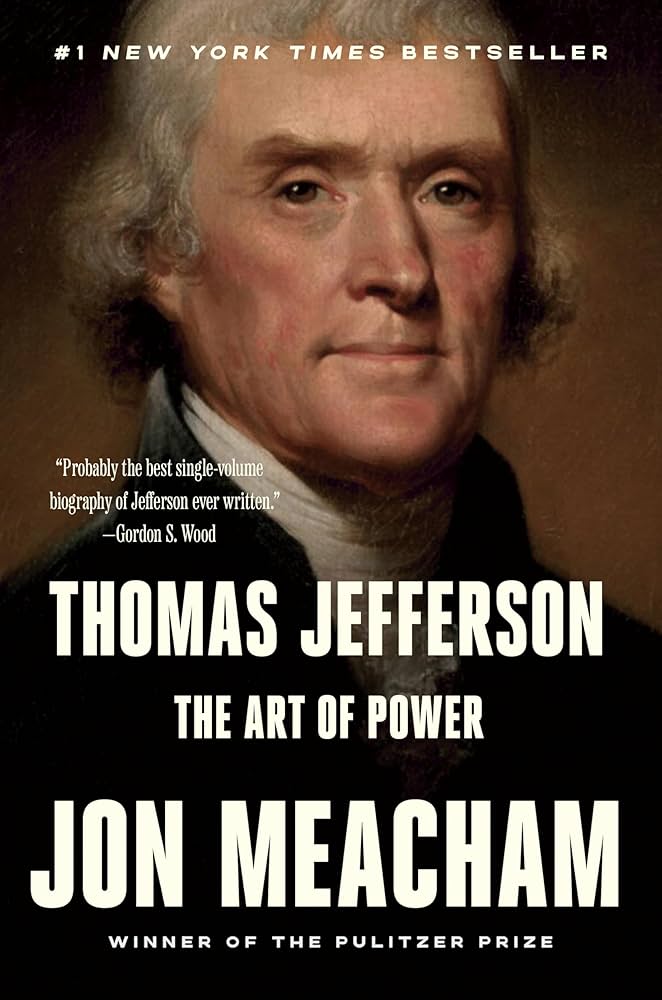
Jon Meacham is no academic provocateur. A Pulitzer Prize-winning biographer who previously chronicled Andrew Jackson and later Abraham Lincoln and George H.W. Bush, Meacham writes biography as narrative – accessible, propulsive, and attuned to the emotional texture of its subjects’ lives. His fifth book at time of publication, The Art of Power is the most widely-read Jefferson biography available today – well-written and fast-paced, entertaining and enjoyable, requiring little patience or fortitude on the part of the reader.
But Meacham’s accessibility masks a serious central thesis. His core argument is announced in his title and prosecuted on every page: that Jefferson’s genius was not merely philosophical but profoundly political. As Meacham puts it, “Philosophers think; politicians maneuver. Jefferson’s genius was that he was both and could do both, often simultaneously. Such is the art of power.” This is a Jefferson who is not the marble monument of the Jefferson Memorial, but a flesh-and-blood operator – shrewd, calculating, contradiction-tolerating, and above all, effective.
Meacham shows how Jefferson’s deft ability to compromise and improvise made him a transformational leader. We think of Jefferson as the embodiment of noble ideals, as he was, but Meacham shows that he was a practical politician more than a moral theorist. Drawing on archives in the United States, England, and France, including unpublished transcripts from Jefferson’s presidential papers, Meacham presents Jefferson as the most successful political leader of the early republic, and perhaps in all American history – a leader who found the means to endure and to win, whose story resonates today not least because he led his nation through ferocious partisanship amid economic change and external threats.
The Making of the Declaration
Meacham’s account of Jefferson’s role in drafting the Declaration of Independence cuts against two persistent myths: that Jefferson was a lone genius working in inspired isolation, and that the Congress merely rubber-stamped his prose. The truth, as Meacham renders it, was far more collaborative and politically fraught.
On June 11, 1776, the Continental Congress selected Jefferson, John Adams, Benjamin Franklin, Roger Sherman, and Robert R. Livingston to draft a declaration of independence. Knowing Jefferson’s prowess with a pen, Adams urged him to author the first draft, which was then carefully revised by Adams and Franklin before being given to Congress for review on June 28.
Jefferson drafted the document in roughly seventeen days, working from his own prior writings, George Mason’s Virginia Declaration of Rights, and a deep immersion in Enlightenment philosophy – particularly the natural-rights theories of John Locke. Drawing on documents such as the Virginia Declaration of Rights, state and local calls for independence, and his own draft of a Virginia constitution, Jefferson wrote a stunning statement of the colonists’ right to rebel against the British government, establishing their argument on the premise that all men are created equal and have the inalienable rights of life, liberty, and the pursuit of happiness.
What happened next was politically bruising. Congress stripped roughly a quarter of Jefferson’s original text, including his entire passage condemning the slave trade – a deletion that haunted Jefferson for the rest of his life and that Meacham treats as both a political necessity and a moral catastrophe. Among the rejected passages were a critical reference to the English people and, crucially, a denunciation of the slave trade and of slavery itself. Jefferson seethed at these changes but held his tongue – a display of the political discipline Meacham identifies as central to his character.
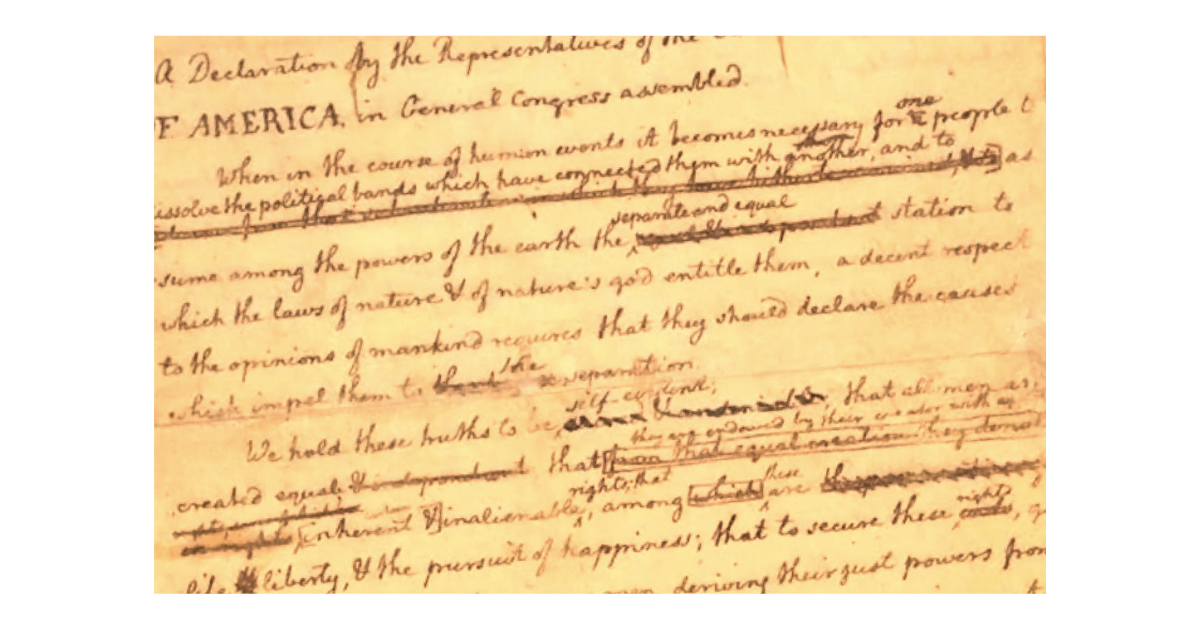
Interestingly, one of Jefferson’s most famous phrases came close to being something far less memorable. Jefferson first wrote “we hold these truths to be sacred and undeniable.” In the rough draft, the words “sacred and undeniable” were crossed out and “self-evident” written in above the line. Whether that revision was Jefferson’s own second thought or Benjamin Franklin or John Adams’s editorial hand remains a subject of scholarly debate – a small detail that opens a window onto the extraordinary collaborative pressures at work in that Philadelphia room.
Immediately Afterwards: The Revolutionary Governor
By the summer of 1776, Jefferson was seeking to be relieved from congressional service, a principal reason being his desire to be near his ailing wife. He returned to Monticello in September and plunged immediately back into Virginia politics, working closely with James Madison as a member of the new House of Delegates. Their first collaboration – to end the religious establishment in Virginia – became a legislative battle that would culminate with the passage of Jefferson’s Statute for Religious Freedom in 1786.
He was elected to the Virginia House of Delegates for Albemarle County in September 1776, when finalizing the state constitution was a priority. For nearly three years, Jefferson assisted with the constitution and was especially proud of his Bill for Establishing Religious Freedom.
Then, in the spring of 1779, came a new challenge that would test Jefferson’s limits as a leader. Jefferson was only thirty-six years old when he became governor, but he brought a diverse array of experience to the position. His two terms would prove to be the most turbulent and personally damaging years of his public life. His tenure was dominated by repeated British invasions of Virginia during the Revolution. Hampering his efforts to respond was the state constitution, which had relegated little power to the state’s chief executive. Faced with calls to provide the struggling Continental army with troops and the need to reinforce the militia against possible invasion, Jefferson presided over draft lotteries that were met with stiff resistance.
When Benedict Arnold raided Richmond in January 1781, the British forces effectively chased Jefferson from office. General Charles Cornwallis dispatched a cavalry force led by Banastre Tarleton to capture Jefferson and members of the Assembly at Monticello, but Jack Jouett of the Virginia militia thwarted the British plan, and Jefferson escaped to Poplar Forest, his plantation to the west. A subsequent legislative inquiry into his conduct as governor was embarrassing, though ultimately cleared. He retired to Monticello in 1781, shaken, and channeled his energies into writing Notes on the State of Virginia – his only book.
This period matters enormously for how we read the Declaration. Jefferson had written of freedom while enslaving hundreds; he had called for resistance to tyranny while struggling to muster an effective military response to actual invasion. The gap between his words and his governance was already apparent in the months immediately after the document he wrote became the founding creed of a new nation.
Key Passages
Meacham’s prose is at its most illuminating when he captures Jefferson’s own paradoxes in the man’s own words. Jefferson hated confrontation, and yet his understanding of power and of human nature enabled him to move men and to marshal ideas, to learn from his mistakes, and to prevail. This formulation – conflict-averse yet politically masterful – is the engine of Meacham’s entire interpretation.
Jefferson is seen as a man who, given the opportunity, would avoid confrontation, but whose profound understanding of the machinations of power and human nature made him a natural leader of men – able to motivate them to action, create ideas, correct mistakes and learn from them. Meacham repeatedly shows how Jefferson pursued his ends through proxies, through carefully cultivated networks of allies, through letters and newspaper placements and dinner-table conversations – never through direct confrontation. It is a portrait of power operating in the shadows that feels strikingly modern.
Dialogue with the Other Books in This Series
Placed within the “Architects of Independence” reading series, Meacham’s Jefferson both complements and complicates the surrounding biographies. His account aligns well with David McCullough’s John Adams on the mechanics of the drafting process – both authors confirm Adams’s central role in steering the assignment to Jefferson and his subsequent light-touch editing of the draft. Where they diverge is in temperament: McCullough’s Adams is a man of transparent moral seriousness; Meacham’s Jefferson operates through indirection and strategic ambiguity.
With Joseph Ellis’s Founding Brothers, the conversation is even richer. Ellis, who called the Declaration’s words “the most potent and consequential words in American history,” wrote extensively about the founders’ personal rivalries and ideological fault lines. Meacham largely shares Ellis’s view of Jefferson as a political genius but is arguably more sympathetic to his subject than Ellis’s often skeptical lens allows. Some critics felt that Meacham goes out of his way to portray Jefferson as a “man of his time” – and that often his excuses for Jefferson’s backtracking are so generic as to apply to any politician.
Against Pauline Maier’s American Scripture, which argues that the Declaration was ultimately the work of Congress as a collective body rather than Jefferson’s individual genius, Meacham stands in partial tension. He acknowledges Congress’s editorial role but never abandons the fundamental premise that Jefferson’s voice – his particular gift for distilling revolutionary philosophy into ringing prose – was irreplaceable. The two books are best read as complementary: Maier tells us what the document became; Meacham tells us what kind of mind conceived it.
Gordon Wood’s Revolutionary Characters, which opens this reading series, provides the essential framing for Meacham’s Jefferson – the portrait of a founding generation that believed character and public virtue were inseparable from political legitimacy. Meacham’s Jefferson is Wood’s thesis made flesh: a man whose character was simultaneously his greatest asset and his deepest liability.
Historical Reassessment: What We’ve Learned Since 2012
The Art of Power was published in the same year that Monticello opened a major joint exhibit with the Smithsonian on the enslaved community at Jefferson’s plantation – a significant cultural moment in the ongoing reassessment of Jefferson’s legacy. In June 2018, the Thomas Jefferson Foundation asserted that Jefferson’s relationship with Sally Hemings is “settled historical matter.” This is a harder line than Meacham took in 2012, and it shifts the moral weight of the biography considerably.
The scholarly consensus on the Hemings relationship has also firmed considerably in the decade since the book’s publication. Since the 1998 DNA study, several historians have concluded that Jefferson maintained a long sexual relationship with Hemings and fathered six children with her, four of whom survived to adulthood. The relationship began, historians now believe, when Hemings was between fourteen and sixteen years old and Jefferson was in his mid-forties. Meacham addresses this in the book but some readers and reviewers have felt he treats it with insufficient moral gravity – prioritizing the political Jefferson over the enslaving Jefferson.
The broader field of founding-era scholarship has also moved toward centering the enslaved and the dispossessed in ways that challenge the great-man framework Meacham employs. Annette Gordon-Reed’s work, in particular, has made it increasingly difficult to read a Jefferson biography that does not grapple systematically with the Hemings family’s experience as its own story, not merely as a complication in Jefferson’s.
Reader’s Value: Why Read This in 2026?
In an era when democratic institutions are under renewed stress, when the gap between political idealism and political reality feels especially acute, Meacham’s central argument carries fresh urgency. Jefferson was not a saint who fell short of his ideals. He was a politician who understood that ideals themselves are tools – wielded strategically, deployed selectively, powerful precisely because they transcend the compromises required to advance them. His story resonates today not least because he led his nation through ferocious partisanship amid economic uncertainty and external threat – the eternal drama of a leadership striving for greatness in a difficult and confounding world.
The Art of Power is also simply excellent narrative history – Meacham never lets the weight of scholarship bury the human drama of his subject’s life. For readers moving through this Declaration-focused series, it provides the essential bridge between the procedural history of how the document was written (Maier) and the personal dynamics among the men who wrote it (Ellis). Jefferson is the hinge on which the entire history turns, and Meacham’s biography remains the most readable and most complete account of how the man who gave the Declaration its voice actually moved through the world — with genius, with appetite, with contradiction, and with an art of power that both built a nation and left its deepest promises unfulfilled.
To read Jefferson is to read the unfinished argument of American democracy itself. Meacham makes that argument vivid and inescapable – which is exactly what the best biography does.
A Note on This Series
This journey through Revolutionary history is as much about the evolution of historical understanding as the Revolution itself. History isn’t static – each generation reinterprets the past through its own concerns, asking different questions and prioritizing different sources. By reading these books in dialogue across 250 years, we’ll witness how scholarship evolves, how narratives get challenged, and how forgotten stories resurface.
This isn’t about declaring one interpretation “right” and another “wrong,” but appreciating the richness that emerges when multiple perspectives illuminate the same transformative moment. These books won’t provide definitive answers – history rarely does – but they equip us to think more clearly about how real people facing genuine uncertainty chose independence, how ideas had consequences, and how the work of creating a more perfect union continues. As we mark this anniversary, we honor the Revolutionary generation by reading deeply, thinking critically, and engaging seriously with both the brilliance and blind spots of what they created.


