The Power of Synoptical Reading: How to Read for Mastery Across Books

In a world brimming with information, one of the most powerful yet underused reading strategies is synoptical reading. More than a technique, synoptical reading is a discipline of synthesis – of drawing together multiple perspectives on a subject to cultivate depth, clarity, and wisdom. Whether you’re a student, scholar, leader, or lifelong learner, this approach can transform the way you learn, think, and engage with complex ideas.

What Is Synoptical Reading?

Think of synoptical reading as the ultimate book conversation – it’s what happens when you gather multiple authors around the same topic and let them hash it out. Mortimer Adler and Charles Van Doren called this the highest form of reading* in their classic How to Read a Book, and for good reason. Instead of just absorbing what one author tells you, synoptical reading involves collecting different books on the same subject and playing intellectual detective, looking for patterns, contradictions, and those “aha!” moments when seemingly unrelated ideas suddenly click together. It’s like being a moderator at a debate where the participants wrote their arguments decades or even centuries apart. 

You’re not just reading – you’re orchestrating a dialogue between minds, asking tough questions, and building something new from the collision of different perspectives. 

This approach becomes incredibly powerful because it reveals how ideas evolve over time, exposes the blind spots that individual authors might miss, and often leads to insights that none of the original writers could have reached alone. In our current world of endless information streams, synoptical reading is less about consuming more content and more about becoming a thoughtful curator who can weave together the best thinking on complex topics into something genuinely illuminating.

How It Works: An Example from the Guest Experience Field

Let’s say you’re exploring the topic of guest experience – a concept that blends hospitality, emotional connection, intentional design, and cultural insight. A traditional approach might involve reading one well-known book, such as Horst Schulze’s Excellence Wins. But synoptical reading invites a broader, more layered view.
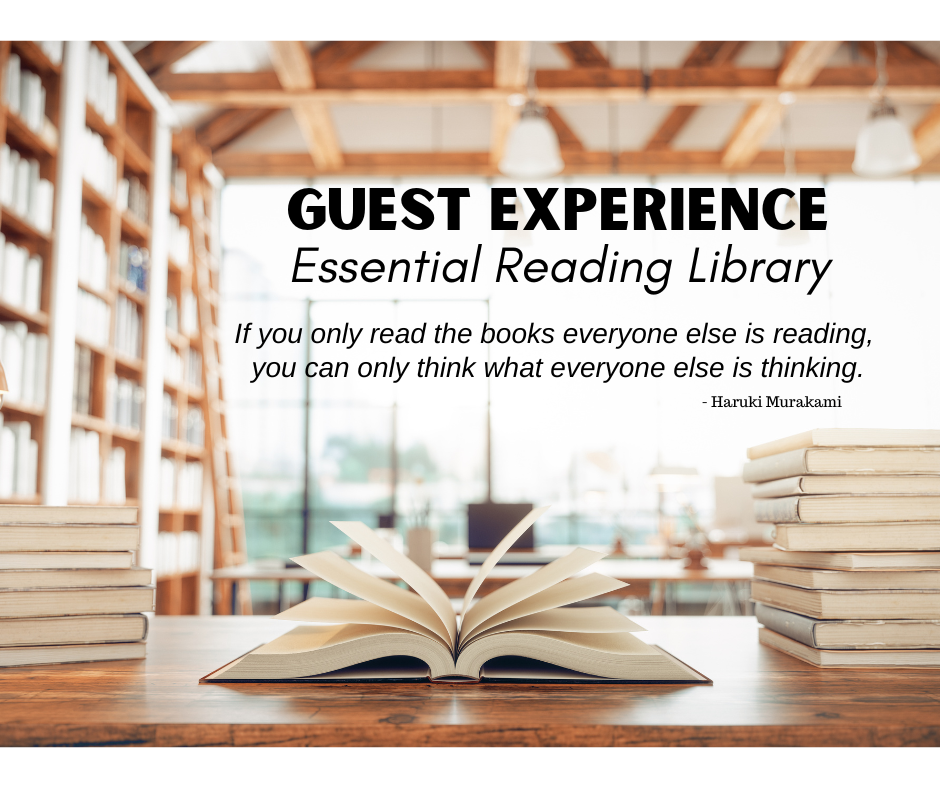
Drawing from the curated titles in The Essential Guest Experience Library, here’s how you might construct a synoptical reading list to explore guest experience from multiple vantage points:

  1. Legacy + Leadership
    Excellence Wins by Horst Schulze (co-founder of The Ritz-Carlton) offers both operational philosophy and personal leadership wisdom. His insistence that “ladies and gentlemen serve ladies and gentlemen” reframes guest experience as a matter of dignity and culture-building.
  2. Disney + Storytelling
    Be Our Guest by the Disney Institute and Theodore Kinni introduces the power of intentional systems, story-driven environments, and on-stage/off-stage discipline in delivering consistent, magical experiences. Disney’s approach models scalability without sacrificing soul.
  3. Design + Empathy
    The Power of Moments by Chip and Dan Heath provides insight into why certain interactions are remembered, shared, and treasured. Their framework – elevation, insight, pride, and connection – shifts guest experience from process to emotionally charged encounter.
  4. Culture + Soul
    Unreasonable Hospitality by Will Guidara tells the story of transforming Eleven Madison Park into the world’s best restaurant – not through food alone, but by making every guest feel seen. Guidara shows how irrational generosity creates unforgettable moments of belonging.
  5. Framework + Execution
    The Experience by Bruce Loeffler (former Disney leader) and Brian Church translates guest experience into a practical framework for leadership teams. It’s ideal for organizations that want to operationalize hospitality while keeping the heart intact.

With this synoptical approach, you start to see how different disciplines – luxury hotels, theme parks, fine dining, and organizational strategy – converge around a shared mission: to create experiences that delight, transform, and endure.

But you’ll also uncover key distinctions. Schulze emphasizes honor and systems; Guidara focuses on emotional generosity and improvisation. The Heath brothers bring psychological insight, while Loeffler provides templates for execution. Disney stands alone in institutionalizing storytelling at scale. Synthesizing these voices allows you to not only appreciate their individual brilliance but also build your own blueprint tailored to your context – whether that’s a nonprofit, church, café, or global brand.

Why Synoptical Reading Matters

In our age of information overload, it’s easy to get lost in isolated data points or become trapped in ideological echo chambers. Synoptical reading offers a structured antidote. Here’s why it’s so powerful:

  • It Develops Intellectual Humility

By reading widely and across viewpoints, you’re less likely to idolize a single author or framework. It teaches you that no one has the full picture – and that’s a good thing. True wisdom lies in nuance.

  • It Cultivates Critical Thinking

Synthesizing multiple arguments requires you to detect assumptions, biases, logical fallacies, and philosophical underpinnings. It sharpens your ability to ask, “Compared to what?” and “Why does this matter?”

  • It Deepens Retention and Understanding

Rather than passively reading and forgetting, synoptical reading demands active comparison. This act of mental wrestling increases comprehension and memory, much like cross-training enhances athletic performance.

  • It Encourages Independent Thought

By creating your own terms of discussion and evaluating authors from a higher level, you stop parroting others and begin forming your own reasoned judgments. You become not just a reader, but a thinker.

  • It Enhances Application and Problem-Solving

Most real-world challenges are not solved by one theory alone. Whether you’re addressing generational shifts in leadership, reimagining guest experiences, or tackling ethical dilemmas, synoptical readers draw from multiple wells.

How to Practice Synoptical Reading

This kind of reading is less about volume and more about intentionality. Here’s a simple framework to start:

  1. Define the Question
    What are you trying to understand? The best synoptical reading starts with a real-life tension or curiosity.
  2. Build a Bibliography
    Choose 3–5 books from different traditions, disciplines, or ideological standpoints. Don’t just read what confirms your bias – include thoughtful dissenters.
  3. Skim First, Then Dive
    Begin by skimming each book for structure, terminology, and core claims. This survey will help you create a shared vocabulary across books.
  4. Take Comparative Notes
    Use a matrix or chart to track how each author defines key terms, frames the problem, and suggests solutions. Note contradictions, insights, and shared themes.
  5. Write a Synthesis
    Summarize your findings. Where do the books align or diverge? What do they miss? What’s your take, and how has it changed?

Final Thought: Reading as Dialogue, Not Consumption

Synoptical reading reimagines books not as static containers of information but as conversation partners. Each author speaks from their vantage point, but you – the reader – host the dialogue, ask the questions, and ultimately offer the conclusion.

In a time when complexity is often flattened into soundbites and certainty is prized over curiosity, synoptical reading revives the art of intellectual hospitality. It invites divergent voices to the table, listens carefully, and offers back something wiser than any single book could contain.

If reading is a feast, synoptical reading is the banquet.


* A NOTE ABOUT WORD USEAGE: Syntopical and synoptical reading are often used interchangeably, but there’s a subtle distinction between the two, though both represent the highest and most demanding level of reading. Both methods involve reading multiple books on the same subject to gain a deep understanding of a topic. However, syntopical reading, as defined by Mortimer Adler is about creating a new perspective on a topic by putting authors in conversation with each other. While synoptical reading is also about comparing texts, it’s a broader term and not as systematic as the syntopical method described by Adler. Both approaches go beyond merely understanding a single book, pushing the reader to create new knowledge and a comprehensive understanding of a topic through rigorous comparison and analysis.

My bias has been to use the “synoptical” as that was the term I was introduced to while in graduate school (syntopical was not in the dictionary, and thus not useable in graduate work), and it has stuck with me since. That being said, the process defined by Adler is closer to what I refer to in this article.


Part of a regular series on 27gen, entitled Wednesday Weekly Reader.

During my elementary school years one of the things I looked forward to the most was the delivery of “My Weekly Reader,” a weekly educational magazine designed for children and containing news-based current events.

It became a regular part of my love for reading, and helped develop my curiosity about the world around us.

The Pages That Shaped Us: A National Book Lover’s Day Celebration

August 9th holds two profound meanings for me: it’s my father’s birthday, and it’s National Book Lover’s Day. The connection between these dates tells a story about legacy, love, and the transformative power of the written word. Each year as this day approaches I reflect on the power of reading and how my father instilled it in me.


When Words Become Memory

The last time I saw my father truly himself was during Christmas 2011. By then, several strokes had stolen his ability to read – the very thing that had defined so much of who he was. But as I wandered through our family home that quiet holiday evening, his books still lined every shelf, silent witnesses to decades of curiosity and growth.

I pulled volume after volume from their resting places, each one triggering a cascade of memories. Here was the history book that sparked our dinner conversation about World War II. There, the biography that led to his stories about perseverance. Opening each cover was like stepping into a time machine, hearing his voice again through the pages he had loved.

Two months later, on February 25, 2012, the legacy of those books became his lasting gift to me.

The Making of a Reader

My father embodied what author Jessica Hooten Wilson beautifully captures in her observation: “The manual labor of the past that allowed a human being to work in an embodied way, and to contemplate in heart and mind while working with one’s hands, encouraged the desire for reading after the physical exertions were completed.”

After twelve-hour days at his gas station, six days a week, my dad would settle into his chair with a book. Not occasionally – almost every single night. He understood something profound: that reading wasn’t just entertainment, it was essential nourishment for the soul.

This passion became the cornerstone of our family culture. As young children, every two weeks my mother would drive my brother and me to the library in the next town over. We’d return with armloads of books – I’d devour mine within days, then spend the remaining time impatiently waiting for our next literary pilgrimage.

That rhythm became my heartbeat. Elementary school, high school, college, graduate studies, decades into my professional life, and now accelerated in retirement – the weekly library visit remains sacred. Three or four books returned, three or four new adventures collected.

The Art of Deep Reading

National Book Lover’s Day isn’t just about celebrating our love of books – it’s about honoring the profound ways reading shapes us. I’ve discovered that the deepest rewards come not from reading widely, but from reading deeply.

Following Mortimer Adler’s wisdom in How to Read a Book, I practice what he calls synoptical reading – diving deep into subjects by consuming multiple perspectives on the same topic. It’s like being a detective, gathering clues from various sources to solve the mystery of understanding.

For over three decades, I’ve been conducting a synoptical investigation into Walt Disney and his revolutionary approach to creating experiences. My Disney library has grown to over 500 books, spanning from 1939 to last week’s latest releases. These aren’t just books about cartoons and theme parks – they’re masterclasses in vision, leadership, innovation, and human connection.

But Disney isn’t my only reading obsession. I maintain several “reading threads” – ongoing explorations of topics that fascinate me. Current deep dives include:

  • Charting the evolution of hospitality in American culture
  • What it means to be a “modern elder” in today’s world
  • Biblical leadership principles of “shepherding” for contemporary challenges
  • Discovering the “revolutionary” importance of Charlotte and Mecklenburg County in the 1770s

Synoptical reading often plays an important role in the Wednesday Weekly Reader, so I’m devoting an article next week – stay tuned!

Reading as Revolutionary Act

In our age of infinite scrolling and bite-sized content, choosing to read a book is almost rebellious. It’s a declaration that depth matters more than speed, that contemplation trumps consumption.

Prior to retirement, most evenings I would continue my father’s tradition – settling in with a book after the day’s work is done. As I continue to adjust to my new lifestyle, one thing is a constant – reading has expanded! I may be researching topics like those above, or working on my other major website projects – concepts of First Place Hospitality and the Modern Elder. Other times, it’s pure pleasure reading, the kind that makes you forget time.

Thomas Edison understood this hunger for knowledge and put it this way: “I didn’t read a few books, I read the library.” That’s the spirit we need to recapture – not just reading for information, but reading for transformation.

Your Book Lover’s Day Invitation

This August 9th, how will you honor the books that have shaped you? Here are some meaningful ways to celebrate:

Create New Traditions:

  • Start a synoptical reading project on a topic that fascinates you
  • Host a book swap with friends who share your interests
  • Write letters to authors whose work has impacted you
  • Create a reading nook that invites daily literary escapes

Share the Love:

  • Gift a meaningful book to someone who needs its message
  • Volunteer with literacy programs in your community
  • Share your favorite quotes using #NationalBookLoversDay
  • Mentor someone just beginning their reading journey

Go Deeper:

  • Revisit a childhood favorite with adult eyes
  • Finally tackle that classic you’ve been avoiding
  • Join or start a book club focused on challenging reads
  • Practice the four levels of reading Adler describes

The Legacy Lives On

Every August 9th, I’m reminded that the greatest gift my father gave me wasn’t his collection of books – it was his modeling of what it means to be a lifelong learner. He showed me that reading isn’t just about acquiring knowledge; it’s about remaining curious, staying humble, and never stopping our growth.

In a world that often feels chaotic and overwhelming, books offer something irreplaceable: the opportunity to slow down, think deeply, and connect with the vast tapestry of human experience. They remind us that we’re part of something larger than ourselves, contributors to an ongoing conversation that spans generations.

So today, pick up a book. Not just any book, but one that challenges you, changes you, or simply brings you joy. Turn the page with intention, knowing that somewhere, a future reader will be grateful for the path you’re helping to preserve.

After all, we’re not just book lovers – we’re the keepers of humanity’s greatest conversation.

What book will you turn to today? What conversation will you join? The pages are waiting.


Part of a regular series on 27gen, entitled Wednesday Weekly Reader.

During my elementary school years one of the things I looked forward to the most was the delivery of “My Weekly Reader,” a weekly educational magazine designed for children and containing news-based current events.

It became a regular part of my love for reading, and helped develop my curiosity about the world around us.

The Ever-Growing TBR Pile: A Bibliophile’s Beautiful Burden

In some corner or horizontal space of nearly every book lover’s home sits a tower of possibilities – a stack of unread books that grows with each passing week, defying gravity and good intentions alike. This is the TBR pile: “To Be Read,” a physical manifestation of literary ambition that stands as both promise and gentle rebuke.

Since I’m an overachiever – if only in this area – in my house, particularly my office, there are multiple TBR piles.

The Anatomy of a TBR Pile

The typical TBR pile is a fascinating ecosystem of its own. At its foundation rests the ambitious purchases – perhaps a weighty classic one has been meaning to tackle for years, or the award-winner your friends are talking about. The middle section often contains gifts from well-meaning friends and relatives who correctly identified the recipient as a reader but perhaps missed the mark on genre preferences. The middle section for me also contains my spur-of-the-moment volumes from the new section at my library. Finishing out my TBR pile are the “Top of the Stack” – either impulse buys, those books acquired during moments of weakness at bookstore sales or the latest weekly “holds” from my library searches.

What makes a TBR pile unique to each reader is not just its content but its organization – or delightful lack thereof. Some bibliophiles maintain meticulously categorized stacks sorted by genre, publication date, or reading priority. Others embrace chaos theory, allowing their collection to exist as a jumbled monument to literary possibility where the next read might be determined by whichever volume happens to be most accessible when the current book is finished.

As a firm adherent to the “both/and” philosophy, I utilize both of the above: some TBR piles have definite themes and organization; others are a haphazard collection at best.

The Weekly TBR Pilgrimage

As a dedicated reader, my local Charlotte Mecklenburg library branch serves as both sanctuary and hunting ground. Weekly visits become ritual, a sacred appointment kept regardless of weather or competing engagements. Long written in stone in my calendar is a weekly “Lunch & Learn” – an early morning library visit followed by lunch at Big Bitez Grill. These excursions follow predictable patterns: the return of last week’s borrows, the browsing of new arrivals, and finally, the inevitable checkout of more volumes than one could reasonably expect to finish before their due date. Luckily, on almost all checkouts, up to three renewals take place automatically. Best of all, there are no overdue fines!

An example would be last week’s library visit, when I picked up seven books about J.R.R. Tolkien’s works about Middle-earth. As depicted in the image below, they are this week’s “Top of the Stack” which I am reading through at the moment. Most likely, all of these books will eventually be acquired and become part of my Tolkien library.

While I have a long history of library visits going back to my childhood, library visits have evolved beyond merely walking the physical stacks. I arrive with a carefully curated hold list of titles gleaned from topic-specific searches, online reading groups, literary podcasts, and social media recommendations. The library’s computer system becomes a treasure map, leading to searching online and then reserving volumes I want to check out.

TBR and the Quest for Synoptical Reading

Among the most ambitious readers exists a practice known as synoptical reading – the art of reading multiple books on the same subject to develop a more comprehensive understanding. This approach transforms the solitary act of reading into something resembling academic research, with books in conversation with one another through the mind of their reader. Of the four types of reading, this is by far my favorite.

A TBR pile built around synoptical reading takes on a different character. Instead of random accumulation, these collections grow with purpose. One might find three biographies of the same historical figure, offering different perspectives on a single life. Or perhaps a stack of novels from the same literary movement, each illuminating different facets of a shared aesthetic. Science books examining competing theories, philosophy texts in direct dialogue with one another – the synoptical TBR pile becomes a curated symposium waiting to happen.

Library visits for the synoptical reader involve strategic searches through subject headings and cross-references. What began as interest in a single volume often expands into the exploration of an entire subject area, with each new discovery adding another title to the ever-growing list.

Truth be told, several of my TBR piles contribute to my individual libraries. Largest, of course, is my Disney library – 500+ volumes and growing. Beyond that are several that have origins and applications in my former work: Guest Experiences (315 ); First Place Hospitality (203 ); and SUMS Remix (576 ). Other examples of my smaller synoptic libraries include Bridges (14), Shepherding (17 ), author Stephen Hunter (26), and the Burger Quest (24 ). There are more, but you get the point: for me, TBR is almost equivalent to synoptical reading.

The Psychology of the Unread

There’s a particular joy in acquiring books that exists independently from the pleasure of reading them. The Japanese term tsundoku describes the habit of buying books and letting them pile up unread, and many bibliophiles recognize themselves in this gentle accusation. This has been wrongly applied to me – if I buy it, or even check it out from the library, it’s going to be read.

A healthy TBR pile serves as a buffer against the unthinkable – the prospect of having nothing new to read. It stands as a promise of adventures yet to come, of knowledge not yet acquired but tantalizingly within reach. Each unread book represents potential rather than failure, a conversation waiting to happen between author and reader.

Yet there’s also the guilt. The reproachful spines of books purchased with enthusiasm but subsequently neglected. The nagging awareness that at current reading speeds, one might need several lifetimes to complete even the existing collection, let alone new additions.

Finding Peace with the Pile

I would like to think that I am becoming a wise bibliophile, having made peace with my TBR piles, understanding that some books may remain a long-delayed read, and that’s perfectly acceptable to me. The pile serves purposes beyond mere pre-reading storage: it’s a physical manifestation of intellectual curiosity, a declaration of reading intentions, and sometimes simply office decor that accurately reflects my personality and interests.

Weekly library visits continue regardless, new books are still acquired, and synoptical reading projects are still planned with enthusiasm. The TBR pile grows and occasionally contracts, but never disappears entirely. And in this constant state of literary potential energy waits the true joy of the book lover’s life – not just in the reading, but in the anticipation of all those worlds waiting to be explored, one opened cover at a time.


Part of a regular series on 27gen, entitled Wednesday Weekly Reader.

During my elementary school years one of the things I looked forward to the most was the delivery of “My Weekly Reader,” a weekly educational magazine designed for children and containing news-based current events.

It became a regular part of my love for reading, and helped develop my curiosity about the world around us.