
Welcome back to the Wednesday Weekly Reader, where I invite you to explore books on a myriad of topics – reading that will challenge how you think and live.
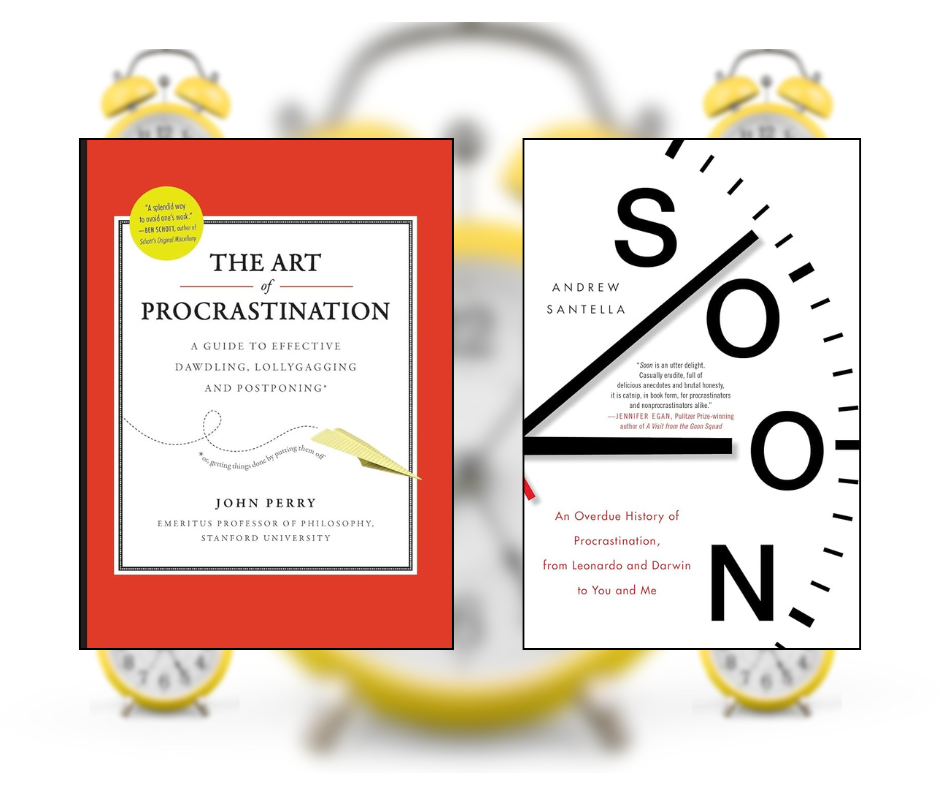
This week, as we stand at the threshold of a new year filled with resolutions and fresh starts, I’m turning to two books that will make you reconsider everything you think you know about procrastination: John Perry’s The Art of Procrastination and Andrew Santella’s Soon: An Overdue History of Procrastination. Both authors argue, from different angles, that our cultural anxiety about delay might be misplaced.
At this point I need to pause and give special thanks to my youngest son Aaron, who in his senior year in college pointed me to The Art of Procrastination. After he bought the book, read it, and wrote a paper on procrastination – all done the day it was due – he gave it to me to read.
Through it, I was introduced to the concept of horizontal organization. I enjoyed learning about, and practicing, Structured Procrastination, To-Do Lists, Procrastination as Perfectionism, and other strategies for the serial procrastinator.
Over the holidays, we were reminded of that apt demonstration of procrastination, and it inspired me to visit this timely topic.
It’s the first full week of January, that glorious window when the world feels scrubbed clean and anything seems possible. You’ve made your resolutions, bought the planner, downloaded the productivity app. This year will be different. This year, you won’t procrastinate.
But what if I told you that your procrastination isn’t the problem you think it is? What if the real issue isn’t that you delay, but that you’ve been thinking about delay all wrong?

The Paradox of the Productive Procrastinator
Stanford philosopher John Perry noticed something peculiar about himself: despite being a chronic procrastinator who avoided grading papers and other pressing tasks, he maintained a reputation as someone who got things done. This observation became the foundation for what he calls “structured procrastination” – the art of accomplishing tasks by avoiding other tasks.
The insight is both amusing and profound. Procrastinators aren’t lazy – they’re just doing the wrong things at the right time. Perry explains that procrastinators seldom do absolutely nothing; instead, they engage in marginally useful activities like organizing files or sharpening pencils, precisely because these tasks help them avoid something more important.
This month, before you beat yourself up for not immediately tackling that major project, consider this: you’re probably getting plenty done. Just not what you think you should be doing.
What History’s Greatest Delayers Teach Us
Andrew Santella’s exploration of procrastination reveals that many eminent historical figures produced great work while putting off tasks they were supposed to complete. Charles Darwin spent twenty years describing barnacles and writing about coral reefs before finally publishing his theory of natural selection. Leonardo da Vinci delayed completing commissioned paintings. These weren’t failures of character – they were human beings wrestling with complex motivations.
Santella suggests that the knottiness of human motivations means we all have lists of things we should do, yet we find reasons not to do them. This isn’t a bug in our psychology; it might be a feature. Sometimes delay allows ideas to percolate. Sometimes avoidance is our mind’s way of signaling that we need to reconsider our priorities.
Santella questions our devotion to what he calls “the cult of efficiency,” suggesting that paying attention to our procrastination means asking whether the things the world wants us to do are really worth doing.
That’s a radical thought for January, when we’re conditioned to optimize and maximize. But perhaps the most important question isn’t “How do I stop procrastinating?” but rather “What am I avoiding, and why?”

The Perfectionism Trap
Perry argues that many procrastinators are actually perfectionists – not because they do things perfectly, but because they fantasize about doing new tasks perfectly. You receive an assignment and immediately imagine producing something Hemingway could have written. You set the bar impossibly high, then look at it and think, “I’m not going to try to jump over that.”
Here’s the liberating truth: procrastination can give you permission to lower the bar. As the deadline approaches, you realize you won’t achieve perfection, so you sit down and produce something perfectly adequate instead. And here’s the secret—perfectly adequate usually does the job.
This new year, instead of vowing to do everything perfectly, try vowing to do things adequately. “Adequate” sounds uninspiring, but it’s the enemy of paralysis. An adequate workout is better than no workout. An adequate first draft is better than a blank page. An adequate conversation with a friend is better than avoiding them because you don’t have time for a “proper” visit.
Practical Strategies for Working With Your Nature
So how do we harness procrastination instead of fighting it? Here are approaches drawn from both Perry and Santella’s insights:
- Embrace Structured Procrastination. Keep a list with seemingly important tasks at the top. You probably won’t do those tasks, but you’ll accomplish the items below them while avoiding the top priorities. The trick? Put things on your list that seem urgent but aren’t actually critical. Let yourself delay those while getting real work done.
- Question the Cult of Efficiency. Not everything on your to-do list deserves to be done. Before you procrastinate, ask yourself: Is this task genuinely important, or is it something imposed by external expectations? Some procrastination is wisdom in disguise.
- Lower Your Standards (Strategically). Perfectionism paralyzes. When you notice yourself avoiding a task, ask: “What would an imperfect but acceptable version of this look like?” Then aim for that. You can always improve it later.
- Use Procrastination as Information. If you’re consistently avoiding something, investigate why. Are you scared? Uncertain? Is the task actually important to you, or are you doing it because you think you should? Your resistance might be telling you something valuable.
- Maintain Multiple Projects. Procrastinators need options. When you have several meaningful projects active simultaneously, you can productively procrastinate on one by working on another. This is far better than having only one priority that you’ll avoid by doing nothing of consequence.
- Accept Yourself. Perry’s colleague suggested that happy people often take an inventory of their flaws, adopt a code of values that treats these things as virtues, and admire themselves for living up to it. There’s wisdom in this tongue-in-cheek observation. Stop fighting your nature and start working with it.
A New Year Without Guilt
As you move through these early days of January, carrying your fresh resolutions and good intentions, I invite you to consider a different approach. Instead of declaring war on your procrastinating self, try understanding that self with compassion and curiosity.
You are not broken because you delay. You are human. And humans are complicated creatures with competing desires, protective instincts, and creative needs that don’t always align with productivity culture’s demands.
This year, when you find yourself cleaning out your inbox instead of writing that proposal, or researching new productivity systems instead of using the one you have, pause. Notice what you’re doing without judgment. Ask what you’re avoiding and why. Consider whether the thing you’re avoiding actually matters.
And then – here’s the truly revolutionary part – do something else from your list. Move. Create. Connect. Just don’t do nothing, and don’t waste your energy feeling guilty about not doing the “right” thing.

Because here’s what Perry and Santella both understood: procrastinators aren’t lazy people who need to be fixed. They’re active people who need to be understood. And sometimes the path forward isn’t through better discipline, but through better self-knowledge.
This January, instead of resolving to stop procrastinating, resolve to procrastinate with intention. Understand your delays. Use them. Learn from them. And give yourself permission to be imperfectly productive.
After all, you’ve probably been getting more done than you realize. You just need to give yourself credit for it.
Now, if you’ll excuse me, I should probably get to that other thing I’ve been putting off. Or maybe I’ll do something else first. And that’s perfectly fine.

Part of a regular series on 27gen, entitled Wednesday Weekly Reader.
During my elementary school years one of the things I looked forward to the most was the delivery of “My Weekly Reader,” a weekly educational magazine designed for children and containing news-based current events.
It became a regular part of my love for reading, and helped develop my curiosity about the world around us.



 27gen.com