The Influence of a Father: Integrity

My father had his act together.

Over the last few decades, various surveys and case studies have consistently identified honesty or integrity as the most desired characteristic in leaders. It makes sense: if people are going to follow someone, they want assurance that their leader can be trusted. They want to know that he will keep promises and follow through with commitments.

As I continue to spend this week looking back at the life of my father in his various roles of father, businessman, church leader, friend, and community leader, I have been reminded time and again that his actions matched up with his words: if he said it, it was as good as done.

My father was a product of a time and place (the Depression in the South) in which honestly was a common trait. It had to be for people to get along and survive. But I think it went beyond that: he knew and practiced the combination of ethics, morality, and integrity.

  • Ethics refers to a standard of right and wrong
  • Morality is a lived standard of right and wrong
  • Integrity means to be sound, complete, and integrated

A person can have a high or low ethic; they can also be moral or immoral. Those are choices. But if you want to have integrity, you must choose your ethics and live to match them.

My father followed the high and holy ethics of the Scriptures. By living and working by those biblical standards, he made a commitment to a certain morality. His integrity demonstrated that his actions matched his words. There is no substitute for a man of consistent Christ-like character.

Integrity doesn’t demand perfection. Even the most ethical and moral committed person can blow it. Integrity doesn’t guarantee a perfect life, but it does require an integrated life. People with integrity have a moral center that integrates their behavior. When they violate that moral center, they recognize that violation as sin and treat it as an aberration. They confess it, make restitution, seek forgiveness, and reconfirm the standard.

Where do you find yourself on the integrity scale?

Integrity is something that is earned over time. It does not come automatically with the job or the title. It begins early in our lives and careers. People tend to assume initially that someone who has risen to a certain status in life, acquired degrees, or achieved significant goals is deserving of their confidence. But complete trust is granted (or not) only after people have had the chance to get to know more about the person. The integrity foundation is built brick by brick.

The integrity of leadership is what determines whether people will want to give a little more of their time, talent, energy, experience, intelligence, creativity, and support.

High integrity earns intense commitment from others. When people perceive their leaders to have high credibility, they are significantly more likely to:

  • Be proud to tell others they are part of the organization
  • Feel a strong sense of team spirit
  • See their own personal values as consistent with those of the organization
  • Feel attached and committed to the organization
  • Have a sense of ownership for the organization

Wouldn’t you like to be the leader of an organization like that?

Get your act together.


reflections following my father’s death two years ago this week, and revisited now as my mother begins a major transition in her lifestyle

How to Be Like Walt, Part 1

Growing up in the 60’s, my earliest memories of Walt Disney came through his television shows and movies. Only decades later did I experience the magic of one of his theme parks. Looking back over all those experiences, I realize that in some sense, Walt Disney’s creative genius was equal, if not superior, to another genius of our time – Steve Jobs.

My curiosity led to ongoing research about the man called Walt Disney – and is producing some amazing lessons from his life that are powerful leadership lessons for today.

Walt Disney was more than a man. He is a symbol of the values he represents: imagination, honesty, perseverance, optimism, and vision. He was a creative genius who could visualize a future found only in his dreams – and then make those dreams come true.

Pat Williams

Walt Disney’s life provides powerful lessons that can be applied in any leadership position. Author Pat Williams recognized this, and went behind the legend to discover a man every bit as fascinating as the world he created.

How to Be Like Walt is the result of thousands of hours of interviews of the people who knew Walt best. In addition to being a fascinating life story of one of our nation’s most creative minds, the author has distilled Walt’s life into 17 lessons – lessons that we all could learn from.

Live the Adventure – Walt’s boyhood on a farm near Marceline MO inspired a sense of wonder and imagination that stayed with him throughout his life. He also experienced treatment from his father that by today’s standards would be abusive. Yet he didn’t let those memories dominate; instead, he shaped his life around the warm, nostalgic memories of his boyhood. It doesn’t matter where you came from, or who your parents are, or what happened when you were a child. All that matters is that you are willing to live the adventure and dream big dreams, them make those dreams come true.

Be a Salesman – A deeper look at Walt’s life reveals that from the beginning of his career, he was a salesman – one of the greatest salesman the world has ever known. He worked hard and sold his ideas from the earliest days of his career. Walt had the right idea and the right spirit, and he was willing to go out and sell his ideas, even when faced with huge challenges. A great salesman can’t be stopped. Be honest, enthusiastic, confident, courageous and persistent. Sell your dreams, and make them come true.

Dare to Do the Impossible – Walt returned from France after WWI and believed that anything was possible. He was audacious enough to believe that an 18-year old with one year of art school could go to a newspaper and get a job as a political cartoonist. He was brash enough to believe that he could teach animation to other artists – after learning to animate after reading two books checked out from the library. He was reckless enough that, after going bankrupt in Kansas City he went to Hollywood to start over in animated cartoons when all the animation studios were in New York City. Dare to do the impossible. Dream big dreams, and don’t be surprised when your impossible dreams come true.

Unleash Your Imagination – After losing the rights to his first cartoon creation (Oswald the Lucky Rabbit), Walt responded with imagination. In effect, he said “I’ll solve this problem by creating something new, something the world has never seen before.” So Walt created Mickey Mouse. Walt had an astounding creative awareness. He not only stored up ideas and material in his mind, but he was alert to ideas from the world around him. He had the ability to expand a good idea into a spectacular idea.

Tomorrow: How to Be Like Walt, Part 2 

My favorite post from July, 2012

Generation Flux Revisited

One of the greatest challenges of 21st century leadership is that the world we were raised and trained in no longer exists.

Robert Safian, Editor, Fast Company

Earlier this year I wrote a series of posts about a feature article in Fast Company magazine entitled Generation Flux:

Generation Flux was a term coined by Fast Company magazine Editor Robert Safian. It describes the people who will thrive best in today’s environment. It is a psychographic, not a demographic – you can be any age and be GenFlux. The characteristics of a GenFluxer are clear: an embrace of adaptability and flexibility; an openness to learning from anywhere; decisiveness tempered by the knowledge that organizational life today can shift radically in a short time period.

In the November issue, Safian has written a great follow-up feature, Secrets of the Flux Leader.

According to Safian, “we have grown up with certain assumptions about what works in an enterprise, what the metrics for success are, how we organize and deploy resources. The bulk of those resources are wrong now. The clarity of words we use to discuss business, standbys like marketplace and competitive advantage, are being redefined and rendered almost meaningless.”

It’s the same for ChurchWorld, too. 

Following a single system or outmoded model is foolhardy – churches that are successful in understanding and accomplishing their vision will be nimble and ever-changing.

Attempting to minister in today’s world is nothing if not paradoxical. Churches must be both efficient and transparent; thrifty and ambitious; nimble and stable. Churches and other organizations based on traditional stable structure and management models are not equipped for these dualities.

Generation Flux leaders are the ones who will steer their organizations toward more sophisticated models needed to survive – and thrive – in today’s world.

Are you a GenFluxer?

Of Balloons and Men…

A week ago I was at the Balloon Fiesta in Albuquerque, New Mexico. It was pretty amazing to be at the launch site and see over 200 balloons lift off in a short time. Added to that, another 100+ balloons launched away from the site and “flew” in. This was my ground view of one balloon.

While at the Balloon Fiesta, I heard about the planned “space jump” attempt that week. Weather didn’t permit it then, but it did happen.

Last Sunday, 201 miles southeast of Albuquerque and 23 miles above Roswell, New Mexico, this was the picture:

Same principle, different applications

What heights will you reach today?

It all depends on your perspective…

The Influence of a Father: Mentoring

In the days following the death of my father and his memorial services, I have been thinking a great deal about his legacy and influence on my life: past, present, and future. 

I realized that his influence has impacted not only my life, but hundreds of others as well. In his honor, I will be posting thoughts this week about that influence, and how it challenges me. Along the way, there will be applications for ChurchWorld leaders as well.

Mentoring

As we move through this thing called “life,” don’t we all wish we had a guide, a coach, a model, an advisor?

We’re looking for a mentor.

My father would not have used that word, but he did better than that: he lived and practiced being a mentor for decades.

After he was discharged from the Army Air Corps in 1946, he returned home to Mt. Juliet, TN, and began working with his brother to build and open a Gulf Service Station. After several years of work, Adams Brothers Gulf opened in 1949. 

For the next 44 years, my dad – known as “Doc” to friends and family – operated the gas station as a full service station providing not only gasoline but also preventive maintenance and tire services. He operated the station 6 days a week, 12 hours a day – and he was the only full-time employee.

Doc’s secret? He hired part-time boys in high school, with their hours being after school and Saturdays. They began working in their early teens, and could only work until they graduated – at which point they were “fired.” 

According to my dad, when you graduated from high school it was time for a “real” job or college. And so over the years, about fifteen young boys (including my brother and I) worked for my dad pumping gas, changing tires, sweeping, cleaning, painting, etc. – whatever was required. We all received a paycheck, but the life lessons we learned were far more important than the money.

At the funeral, as many of “Doc’s boys” as we could find served as pall bearers and honorary pall bearers. Some were only a few years younger than my dad; others are barely in their forties. All have gone on to lead a successful family and business life. To a man, they each expressed their heartfelt gratitude for what Doc meant to them. They wouldn’t say it, but they in turn have, and are, influencing others the same way.

If you are a leader, you should be a mentor.

How are you going to influence others today? How are you going to continue to influence others beyond today?

Here are a few other posts on mentoring you might find helpful:

 (a reposting of a previous series on Mentoring, while I am away on vacation)

Defying Gravity

The “rocket ride” comment in yesterday’s post reminded me of some remarks by Andy Stanley when he came to Elevation Church in Charlotte NC for one of our leader training sessions. They are an appropriate reminder as we consider changing change.

Recalling the dispute in Antioch and the resulting Jerusalem Council in Acts 15, Stanley developed the following thoughts about what the church should be vs. gravitational pull of culture.

1. There’s always a gravitational pull toward insiders and away from outsiders

  • You must continue to create empty seats at optimal worship times for the unchurched

People who were nothing like Jesus liked Jesus

2. There’s always a gravitational pull toward law and away from grace

  • Have as few policies as possible and as many conversations as possible

With conversations you can always extend grace

3. There’s always a gravitational pull toward complexity and away from simplicity

  • Do what you do well and do it better than anyone else

Complexity always slows things down, is expensive, and makes you lose distinctiveness in the community

4. There’s always a gravitational pull toward preserving and away from advancing

  • When you start preserving, you are building walls instead of bridges

Back when we had nothing, what would we have done?

If you want to defy gravity:

  • You must be a raving fan publicly
  • You must be an honest critic privately with the right people in the right environment for the right reason
  • You have to be extraordinarily generous

That’s how you keep the church in orbit.

What Weeding a Flower Bed Reminded Me About Leadership

I have been in Nashville TN for the last several days on a business trip. Though I wrapped up late yesterday afternoon, I planned some extra time with my mother, who lives about 20 miles from Nashville. We went out for dinner last night and I asked her what she needed doing around the house.

This is the first time I have been back “home” since my father passed away and was buried in early March. Though my mother and I talk several times each week, I knew that there were things to do for her.

Consequently, by mid-morning I found myself pulling weeds in the numerous flower gardens around the house. Both my parents liked flowers and the wildlife they attracted. My dad in particular, was what you might call a natural gardener when it came to flowers. He didn’t believe in formal landscapes and flower beds “just so.” His method was more “that looks like a good place for a few flowers.”

As I was working in around the flower beds all morning, I was reminded of the countless times I had seen my dad as he was going from one place to another in our yard just stop and pull a weed out and toss it on the ground – to be chopped up by the mower later. There wasn’t a rhyme or reason to his actions; it was just something he did.

Small consistent actions over time make a big difference.

My dad had been in declining health since late last year, and had not been able to be out in the yard, there was a lot to do. By noon I was ready for a break. Sitting and drinking several glasses of water I thought about my Dad and how his constant weeding meant that the flower gardens looked pretty good all of the time; now, they looked overgrown.

I’m certainly nowhere near the gardener my Dad was. My several hours of work will make them look good for a few weeks maybe, and then they will have to be weeded again.

But once again, my Dad is my teacher.

Leaders need to understand that consistent, small actions invested in your team will pay big dividends along the journey.

Thanks, Dad.

Smart vs. Healthy

Being smart is only half the equation in a successful organization. Yet it somehow occupies almost all the time, energy, and attention of most leaders. The other half of the equation, the one that is largely neglected, is about being healthy.

– Patrick Lencioni, The Advantage

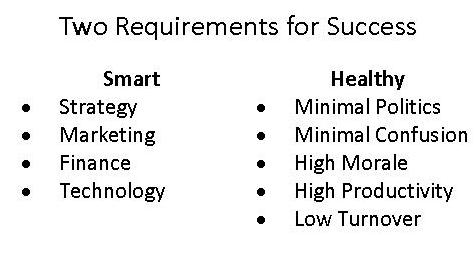
In Patrick Lencioni’s latest book The Advantage, you will find the following chart:

Lencioni comments: “Whenever I list the qualities for leaders, I usually get one of the following reactions, and sometimes both. Often they laugh quietly, in a nervous. almost guilty kind of way. Or they barely sigh, like parents do when they hear about a family where the kids do what they’re told the first time they’re asked. In either case, it’s as thought they’re thinking, ‘Wouldn’t that be nice?’ or, ‘Can you imagine?’

None of the leaders – even the most cynical ones – deny that their organizations would be transformed if they could achieve the characteristics fo a healthy organization. Yet they almost always gravitate to the left side of the chart above, retreating to the safe, measurable “smart” side of the equation.

Why?

Because it’s relatively safe and predictable, which most leaders prefer. That’s how they’ve been trained, and that’s where they’re comfortable.

It takes discipline to move beyond the safe and predictable, into the sometimes awkward and messy area of organizational health.

Tomorrow: Four Disciplines of Organizational Health

Adapted from The Advantage, by Patrick Lencioni

Level 5: Lead from the Pinnacle

Definition of a Level 5 Leader: People follow you because of who you are and what you represent

Leadership at Level 5 lifts the entire organization and creates an environment that benefits everyone in it, contributing to their success.

          John Maxwell, The 5 Levels of Leadership

Today’s post is the final in a series of five that takes a closer look at John Maxwell’s latest book, The 5 Levels of Leadership. As indicated in the introduction to this series, “5 Levels” has been five years in the making. I’ve been in leadership development in ChurchWorld for over 30 years – and I’ve been looking for a resource like this.

To whet your appetite and convince you to drop everything and get your own copy today, over this series I’m going to quote Maxwell’s top 3 points in each of five sections for each of the 5 Levels. In math shorthand, that’s 3 x 5 x 5. The product of that equation is a leadership development gold mine for you!

 Level 5– The Pinnacle

The Upside of the Pinnacle

  1. Pinnacle leadership creates a Level 5 organization
  2. Pinnacle leadership creates a legacy within the organization
  3. Pinnacle leadership provides an extended platform for leading

The Downside of the Pinnacle

  1. Being on the pinnacle can make you think you’ve arrived
  2. Being on the pinnacle can lead you to believe your own press
  3. Being on the pinnacle can make you lose focus

Best Behaviors on Level 5

  1. Make room for others at the top
  2. Continually mentor potential Level 5 leaders
  3. Create an inner circle that will keep you grounded

Help Others Move Up to Levels 4 and 5

  1. Identify and create the crucial leadership lessons they must learn
  2. Look for unexpected crucible moments they can learn from
  3. Use your own crucible moments as guidelines to teach others

Guide to Being Your Best at Level 5

  1. Remain and humble and teachable
  2. Maintain your core focus
  3. Create the right inner circle to keep you grounded

Developing leaders to the point where they are able and willing to develop other leaders is the most difficult leadership task of all. But here are the payoffs: Level 5 leaders develop Level 5 organizations. They create opportunities that other leaders don’t. They create legacy in what they do. People follow them because of who they are and what they represent. In other words, their leadership gains a positive reputation. As a result, Level 5 leaders often transcend their position, their organization, and sometimes their field.

If you are a leader in ChurchWorld asking “How can I develop leaders?”, then John Maxwell’s book The 5 Levels of Leadership will certainly provide you with proven steps to answer that question.


Level 4: Lead by People Development

Definition of a Level 4 Leader: People follow you because of what you have done for them personally

Leaders become great, not because of their power, but because of their ability to empower others.

          John Maxwell, The 5 Levels of Leadership

Today’s post is the fourth of a series of five that takes a closer look at John Maxwell’s latest book, The 5 Levels of Leadership. As indicated in the introduction to this series, “5 Levels” has been five years in the making. I’ve been in leadership development in ChurchWorld for over 30 years – and I’ve been looking for a resource like this.

To whet your appetite and convince you to drop everything and get your own copy today, over this series I’m going to quote Maxwell’s top 3 points in each of five sections for each of the 5 Levels. In math shorthand, that’s 3 x 5 x 5. The product of that equation is a leadership development gold mine for you!

 Level 4 – People Development

 The Upside of People Development

  1. People development sets you apart from most leaders
  2. People development assures that growth can be sustained
  3. People development empowers others to fulfill their leadership responsibilities

 The Downside of People Development

  1. Self-centeredness can cause leaders to neglect people development
  2. Insecurity can make leaders feel threatened by people development
  3. Shortsightedness can keep leaders from seeing the need for people development

Best Behaviors on Level 4

  1. Recruiting – find the best people possible
  2. Positioning – placing the right people in the right position
  3. Modeling – showing others how to lead

Beliefs that Help a Leader Move Up to Level 5

  1. The highest goal of leadership is to develop leaders, not gain followers or do work
  2. To develop leaders, you must create a leadership culture
  3. Developing leaders is a life commitment, not a job commitment

 Guide to Growing Through Level 4

  1. Be willing to keep growing yourself
  2. Decide that people are worth the effort
  3. Work through your insecurities

 Good leaders on Level 4 invest their time, energy, money, and thinking into growing others as leaders. They look at every person and try to gauge his or her potential to grow and lead – regardless of the individual’s title, position, age, or experience. Every person is a potential candidate for development.

Tomorrow: Level 5 – The Pinnacle