Words That Work: Unlocking the Science of Persuasion and Effective Communication

In the final post of a four-part mini-series revolving around books, there was a look at the history of the library, the role of books in both shaping conflict and being shaped by conflict, how book design impacts the reading experience, and now some closing thoughts on words themselves.
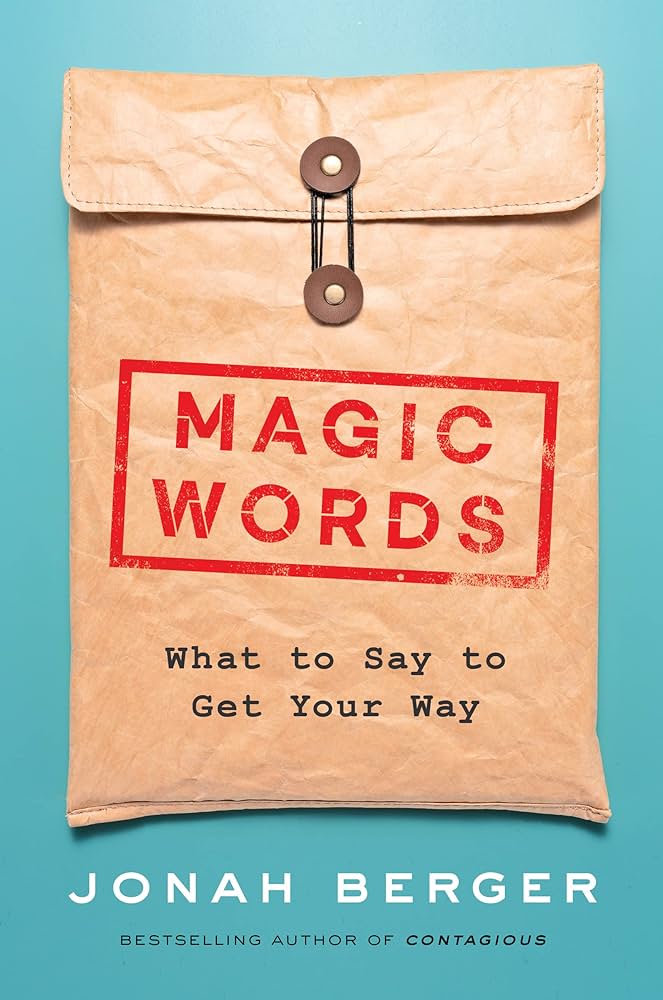
Almost everything we do involves words. Words are how we persuade, communicate, and connect. They’re how leaders lead, salespeople sell, and parents parent. They’re how teachers teach, policymakers govern, and doctors explain. Even our private thoughts rely on language.

But certain words are more impactful than others. They’re better at changing minds, engaging audiences, and driving action. What are these magic words, and how can we take advantage of their power?

In Magic Words, internationally bestselling author Jonah Berger gives you an inside look at the new science of language and how you can use it. Technological advances in machine learning, computational linguistics, and natural language processing, combined with the digitization of everything from cover letters to conversations, have yielded unprecedented insights.

Learn how salespeople convince clients, lawyers persuade juries, and storytellers captivate audiences; how teachers get kids to help and service representatives increase customer satisfaction; how startup founders secure funding, musicians make hits, and psychologists identified a Shakespearean manuscript without ever reading a play.

This book is designed for anyone who wants to increase their impact. It provides a powerful toolkit and actionable techniques that can lead to extraordinary results. Whether you’re trying to persuade a client, motivate a team, or get a whole organization to see things differently, this book will show you how to leverage the power of magic words.

Magic Words, authored by Jonah Berger, delves into the concealed mechanisms governing language and, more significantly, delineates strategies for employing it more persuasively, nurturing relationships, and achieving success in both personal and professional realms.

The book explores six categories of influential words, devoting a chapter to each of these areas:

Activating Identity and Agency: Words that delineate authority, responsibility, and engagement in actions. This chapter delves into the profound impact subtle alterations in language can have, such as the efficacy of using nouns over verbs in persuasion, mastering the art of refusing to advance towards goals, and adopting specific interrogative phrases to enhance creativity and problem-solving. Furthermore, it discusses how speaking in the third person can mitigate anxiety and enhance communication, along with the nuanced effects of pronouns like “you” on social interactions and empathy.

Conveying Confidence: Language not only communicates information but also conveys the speaker’s confidence, thereby influencing perceptions and sway. This chapter explores how eliminating certain words transformed an underperforming salesperson into a top achiever, the significance of linguistic style in legal discourse, and linguistic cues that enhance credibility and authority. It also delves into the allure of certainty and the strategic use of uncertainty in communication to foster trust and receptivity.

Asking the Right Questions: This chapter delves into the science behind effective questioning, revealing why seeking advice enhances perceived intelligence and increases the likelihood of securing subsequent dates. It elucidates the types and timing of questions for optimal outcomes, strategies for deflecting challenging inquiries, and techniques for fostering deeper social connections through inquiry.

Leveraging Concreteness: Highlighting the potency of concrete language, this chapter reveals how specific words convey attentive listening and why emphasizing “fixing” rather than “solving” problems enhances customer satisfaction. It explores instances where abstract language may be advantageous, signaling authority and leadership, and discusses its role in fundraising for startups.

Employing Emotion: Exploring the emotive dimension of language, this chapter unveils how emotional language enhances engagement across various contexts. It narrates anecdotes, such as the success story of a young intern who built a podcasting empire by mastering storytelling principles. Additionally, it delves into the interplay between negative and positive emotions in enhancing enjoyment and boosting sales, offering insights into captivating audience attention and managing emotional responses.

Harnessing Similarity and Difference: This section explains the significance of linguistic similarity in interpersonal dynamics, explaining its impact on social connections, promotions, and friendships. It also explores scenarios where embracing difference proves advantageous, citing examples from music popularity trends and artificial intelligence research.

The book concludes by emphasizing the universal role of language in everyday communication, whether through written correspondence or oral discourse. It underscores the importance of mastering language for effective communication, persuasion, and relationship-building, positing that linguistic proficiency is a skill that can be learned and honed over time, empowering individuals to achieve their communication goals effectively.


Part of a regular series on 27gen, entitled Wednesday Weekly Reader.

During my elementary school years one of the things I looked forward to the most was the delivery of “My Weekly Reader,” a weekly educational magazine designed for children and containing news-based, current events.

It became a regular part of my love for reading, and helped develop my curiosity about the world around us.

Catalyst Strategies: Transforming Challenges into Change Opportunities

Modern elders initiate something new. How do we best start something? What are the things that have traditionally held us back from new learning, new exploration, and new adventure? What can we change to make better?


We all harbor desires for change. Sales and marketing professionals aspire to reshape their prospects’ perspectives, employees yearn to influence their bosses, business leaders strive to transform their organizations, and parents seek to mold their children’s behavior. Yet, the formidable challenge of change often stems from inertia – a force that leads families to revisit the same vacation spot annually and compels companies to cling to established practices while resisting new initiatives.

Renowned author Jonah Berger, writing in The Catalyst, sheds light on our natural inclination to combat inertia aggressively. When met with resistance, individuals tend to inundate clients or superiors with facts and lengthy explanations. However, negotiators at the FBI, exemplified by figures like Greg Vecchi, adopt a more effective strategy – one that focuses on dismantling barriers rather than battling against them.

Embark on a brief journey and delve into the art of instigating change by embracing the role of a Catalyst – a superior approach inspired by the world of chemistry. Chemists employ specific substances to catalyze transformations, expediting processes that might otherwise take years. Similarly, becoming a catalyst in human interactions involves removing roadblocks and lowering barriers to initiate change.

In The Catalyst, author Jonah Berger employs the metaphor of catalysis throughout the entire book, emphasizing that the most efficient way to induce change in any scenario is by adopting the role of a catalyst. By identifying and eliminating the obstacles preventing individuals from taking action, meaningful change is achievable.

The approach begins with a fundamental question: What impediments hinder the person from changing? Understanding these barriers is key to the success of the catalyst method. For example, success in negotiating with criminals without violence hinges on this principle – sometimes, all that is needed is to locate and release the metaphorical parking brake.

Our exploration will unfold through Berger’s five strategies encapsulated in the acronym REDUCE: reduce Reactance, ease Endowment, shrink Distance, alleviate Uncertainty, and find Corroborating Evidence. These tactics serve as a guide to becoming a catalyst, facilitating positive and transformative change in various situations.

Have something you want to change? Want to change someone’s mind or how an organization works? It’s not about pushing harder, or being more persuasive, it’s about removing the barriers to change. REDUCE these five key roadblocks and you can change anything.

Reactance

When pushed, people push back. So rather than telling people what to do, or trying to persuade, catalysts allow for agency and encourage people to convince themselves. How can we allow for agency, provide a menu, or highlight a gap?

Endowment

People are wedded to what they’re already doing. The status quo. To ease endowment, we need to surface the costs of inaction, burn the ships, and frame new things as regaining a loss.

Distance

Perspectives that are too far away fall in the region of rejection and get discounted. So start by asking for less. Find an unsticking point and use it to switch the field.

Uncertainty

Change almost always involves uncertainty, and this ambiguity makes people hit the pause button, stemming action. To get people to un-pause, increase trialability. Harness freemium, reduce upfront costs, and drive discovery.

Corroborating Evidence

Sometimes one person, isn’t enough. Some things need more proof. So find reinforcement. Use multiple sources, concentrate them close in time, and figure out whether you need a firehose or a sprinkler.

Creating change is hard, but it’s possible. The key, Jonah Berger teaches us, is to become a catalyst and remove barriers to action rather than trying to create it by force.

More often than not, things don’t budge. And by focusing so much on ourselves and what we want, we forget the most important part of change: Understanding our audience.

Jonah Berger

You can do that by remembering and utilizing the five ways you can become a catalyst, forming the handy acronym REDUCE: reduce Reactance, ease Endowment, shrink Distance, alleviate Uncertainty, and find Corroborating Evidence.


How to Make Your Brand Contagious

Some church leaders consider “brand” to be a four-letter word more appropriate in the marketplace than for churches. The concept of branding has undergone changes in the last decade that demand church leaders not only accept them, but also lead forward through them.

Branding in today’s cultural context is less “this is what we can do for you” and more “this is who we are.” Here is the challenge: your brand isn’t what you say it is; it’s what your “customers” say it is. (If you want to read more about this, download SUMS Remix 81).

THE QUICK SUMMARY – Contagious: Why Things Catch On by Jonah Berger

What makes things popular? If you said advertising, think again. People don’t listen to advertisements; they listen to their peers. But why do people talk about certain products and ideas more than others? Why are some stories and rumors more infectious? And what makes online content go viral?

Wharton marketing professor Jonah Berger has spent the last decade answering these questions. He’s studied why New York Times articles make the paper’s own Most E-mailed list, why products get word of mouth, and how social influence shapes everything from the cars we buy, to the clothes we wear, to the names we give our children.

In Contagious, Berger reveals the secret science behind word-of-mouth and social transmission. Discover how six basic principles drive all sorts of things to become contagious, from consumer products and policy initiatives to workplace rumors and YouTube videos. Learn how a luxury steakhouse found popularity through the lowly cheesesteak, why anti-drug commercials might have actually increased drug use, and why more than 200 million consumers shared a video about one of the most seemingly boring products there is: a blender.

Contagious provides a set of specific, actionable techniques for helping information spread—for designing messages, advertisements, and content that people will share. Whether you’re a manager at a big company, a small business owner trying to boost awareness, a politician running for office, or a health official trying to get the word out, Contagious will show you how to make your product or idea catch on.

A SIMPLE SOLUTION

People love to be a part of stories, and to tell stories – the latest “news” on the neighborhood, a great new restaurant opening nearby, the awesome vacation they just returned from.

People also like to tell the darker side of stories – gossip, a terrible meal experience, or the lousy and expensive vacation they had.

Then there are the online stories: social proof, provided by peer-to-peer recommendations of products and services, is a powerful way to persuade your potential customers.

Take a look at these results about online reviews by BrightLocal, a social media agency:

  • 84% of people trust online reviews as much as a personal recommendation
  • 90% of consumers read less than 10 reviews before forming an opinion about a business
  • 74% of consumers say that positive reviews make them trust a local business more
  • 58% of consumers say that the star rating of a business is most important

Word of mouth – literally, in conversations face to face, or figuratively, in online conversations, is a primary factor behind many of the decisions we are making everyday.

How can your church tap into this important vehicle of conversation going on all around you? 

After analyzing hundreds of contagious messages, products, and ideas, we noticed that the same six “ingredients,” or principles, were often at work. Six key STEPPS, as I call them, that cause things to be talked about, shared, and imitated.

Principle 1: Social Currency

How does it make people look to talk about a product or idea? What we talk about influences how others see us. It’s social currency. So to get people talking we need to craft messages that help them achieve these desired impressions. We need to find our inner remarkability and make people feel like insiders.

Principle 2: Triggers

How do we remind people to talk about our ideas and products? Triggers are stimuli that prompt people to think about related things. People often talk about whatever comes to mind, so we need to design ideas that are frequently triggered by the environment and create new triggers to prevalent cues in that environment. Top of mind leads to tip of tongue.

Principle 3: Emotion

When we care, we share. So how can we craft messages and ideas that make people feel something? Emotional things often get shared. So rather than harping on function, we need to focus on feelings.

Principle 4: Public

Can people see when others are using our product or engaging in our desired behavior? Making things more observable makes them easier to imitate, which makes them more likely to become popular. So we need to make our ideas and products more public.

Principle 5: Practical Value

How can we craft content that seems useful? Given how people are inundated with information, we need to make our message stand out. We need to highlight the incredible value of what we offer, and package our knowledge and expertise so that people can easily pass it on.

Principle 6: Stories

What broader narrative can we wrap our idea in? People just don’t share information, they tell stories. We need to make our message so integral to the narrative that people can’t tell the story without it.

Jonah Berger, Contagious: Why Things Catch On

A NEXT STEP

The six principles of contagiousness listed above contain Social Currency and are Triggered, Emotional, Public, Practically Valuable, and should be wrapped in Stories. Enhancing these components in messages, products, or ideas will make them more likely to spread and become popular.

While it is convenient to imagine the six steps as the acronym STEPPS, don’t think of them as a “recipe” that has to be followed precisely. Not all six ingredients are required to make an idea contagious. View them more like toppings for a salad: choose what works for you, fits your situation, and you will still have a good result.

Write the following on the top of six chart tablets, one principle per page, allowing plenty of space for notes.

Principle 1: Social Currency

How can we talk about our church in such a way that unchurched people desire to be connected?

Principle 2: Triggers

What community triggers have we created to raise our visibility? How can we share the gospel in ways that trigger engagement?

Principle 3: Emotion

What messages are we sending that connect people emotionally?

Principle 4: Public

How can people see when others are excited about what God is doing? How are we leveraging sharable media?

Principle 5: Practical Value

What gospel content have we created that is useful to people outside of the church?

Principle 6: Stories

What larger cultural context exists in our community? How are we communicating the gospel as the solution?

Set aside a two-hour brainstorming time with your leadership team, and work through each of the questions listed.

After working through all six questions, go back and highlight the top three ideas or actions the group agrees are most important.

Create a cross-functional work group, bringing in other leaders and church members as appropriate, to take the resulting 18 ideas and actions and create an action plan with timetables and responsibilities.

As each idea or action is completed, evaluate its effectiveness and adjust as needed.

Excerpt taken from SUMS Remix 83-1, issued January 2018.


Part of a weekly series on 27gen, entitled Wednesday Weekly Reader

Regular daily reading of books is an important part of my life. It even extends to my vocation, where as Vision Room Curator for Auxano I am responsible for publishing SUMS Remix, a biweekly book “excerpt” for church leaders. Each Wednesday on 27gen I will be taking a look back at previous issues of SUMS Remix and publishing an excerpt.

>>Purchase SUMS Remix here<<