Disney at 100: Looking Back, Moving Forward

I can never stand still.
I must explore and experiment…
I resent the limitations of my own imagination.
Walt Disney

There is a blueprint to The Walt Disney Company: the primacy of story, the focus on character, the thrill of adventure, the attention to placemaking, the wonders of the world around us, the magic in beautiful music, and the excitement of experimentation and innovation.

These concepts are what made Walt Disney’s creations so unique and special, and they are still the heart and soul of the stories and experiences that The Walt Disney Company produces today.

With Walt’s shining philosophy as its guiding star, The Walt Disney Company will alway be moving forward to sharing its stories, amaze it fans, and make dreams come true. Even one hundred years is just a beginning.

In the vast landscape of entertainment and creativity, few names evoke the same sense of wonder and nostalgia as the Walt Disney Company. As we celebrate its 100th anniversary, it’s a momentous occasion that calls for reflection and celebration. For a century, Disney has been a beacon of innovation and imagination, enchanting audiences of all ages with its timeless stories, beloved characters, and groundbreaking achievements.

The journey of the Walt Disney Company is not just a corporate success story; it’s a testament to the power of dreams and the relentless pursuit of excellence. Founded in 1923 by Walt Disney and Roy O. Disney, this modest studio in Hollywood has grown into a global entertainment empire, touching the hearts of millions around the world. From the first synchronized sound cartoon, Steamboat Willie, to the much anticipated Wish coming in November, Disney’s influence on animation, film, television, and theme parks has been nothing short of remarkable.

But the significance of Disney extends beyond its business prowess. It’s a cultural touchstone, a source of inspiration, and a cherished part of countless childhoods. It’s a place where dreams come true and where imagination knows no bounds.

In this commemorative series, we embarked on a journey through time, exploring the key milestones, innovations, and moments that have defined the Walt Disney Company’s first century. From the early beginnings that saw the birth of Mickey Mouse to the digital age of streaming and global expansion, each era of Disney’s history holds its unique charm and significance.

We examined the creative genius of Walt Disney, the resilience of the company during challenging times, and the visionary leadership that has kept the magic alive for a hundred years. As we celebrate this remarkable milestone, we can’t help but ponder what the future holds for Disney and how it continues to shape the world of entertainment.

Disney at 100 Article List

As we bring our journey through the 100-year history of the Walt Disney Company to a close, we are left with a profound sense of wonder and admiration for the enduring magic that this iconic company has brought to the world. From its humble beginnings in a small office on Kingswell Avenue to its current status as a global entertainment conglomerate, Disney’s journey is nothing short of remarkable.

The Magic of Storytelling

At the heart of Disney’s success lies the magic of storytelling. It’s a magic that has transported us to enchanted forests, under the sea, to galaxies far, far away, and beyond. It’s a magic that has introduced us to unforgettable characters who have become a part of our lives. Disney’s commitment to storytelling excellence has transcended generations, proving that good stories are timeless.

Innovation and Adaptation

Disney’s ability to innovate and adapt to changing times has been a key driver of its success. From the introduction of synchronized sound in “Steamboat Willie” to the acquisition of Pixar, Marvel, and Lucasfilm, Disney has consistently pushed the boundaries of what’s possible in entertainment. The launch of Disney+ and the streaming revolution is another testament to Disney’s willingness to embrace new technologies and platforms.

The Legacy of Imagination

The legacy of Disney is not just about the past but also about the future. It’s about inspiring generations of dreamers, creators, and innovators to believe in the power of imagination. As the company celebrates its 100th anniversary, it remains committed to fostering creativity and investing in the talent of the future.

The Joy of Shared Experiences

Disney has always been about more than just entertainment; it’s about shared experiences. Whether it’s families coming together to watch a beloved Disney film, friends embarking on adventures in theme parks, or fans connecting over a shared love for iconic characters, Disney has created moments of joy and togetherness that are cherished for a lifetime.

The Promise of the Future

As we look to the future, the Walt Disney Company stands as a symbol of hope, inspiration, and endless possibilities. With plans for new theme park experiences, innovative content on Disney+, and a commitment to diversity and inclusion, Disney continues to shape the world of entertainment and storytelling.

The 100th Anniversary Celebration

As we celebrate the 100th anniversary of the Walt Disney Company, we honor a century of creativity, innovation, and magic. Disney has been a source of joy and inspiration for millions, and its impact on the world of entertainment and popular culture is immeasurable.

So, here’s to the dreamers, the believers, and the magic-makers who have brought us a century of enchantment. Remember that the magic of Disney is not bound by time or place—it’s a timeless, ever-evolving force that continues to capture the hearts of young and old alike.

What must concern us more thoughtfully is subject matter…We must appeal to a far wider range of audience interest than ever before.

Walt Disney

In bidding farewell to this journey through Disney’s history, I eagerly anticipate the stories yet to be told, the dreams yet to be realized, and the joy yet to be shared.

Happy 100th anniversary, Disney – it’s a century worth celebrating!


Walt was alway ahead of any of us, searching for new procedures, new forms of entertainment.

Frank Thomas and Ollie Johnston, Animators, Disney Legends, and coauthors of The Illusion of Life: Disney Animation

Disney at 100: Guest Experience Excellence

Do what you do so well that they will want to see it again and bring their friends.

Walt Disney

Cinderella Castle at the Magic Kingdom in Walt Disney World is beautiful from every angle…

…but the most interesting view is underneath.

Deep underneath Cinderella’s castle in the middle of the Magic Kingdom is a utility corridor running from Main Street Square to Fantasyland. There is also a circular corridor running around the circumference of the Magic Kingdom. Though it gives the appearance of a tunnel, and many Cast Members call it a tunnel, these long passageways are really corridors, built on ground level and then covered over with 5 million square yards of dirt and sand dredged to create all the beautiful water features you see around the park. The visible park you see is really the second story of the park – but that’s really another story.

In recent years I have spent over 100 days at Disney parks, museums, and a cruise. Because of proximity, most of that time was at Walt Disney World, with much of the time observing and talking with Cast Members and Guest Experience Managers of all four theme parks. In a one year stretch, I was able to be on Disney property 31 days! During my time onsite, there have been many stories but there is no better summary than this:

Imagine, if you will, that long central corridor described above where almost all Magic Kingdom Cast Members pass through in their work at the park. To one side of that corridor, beginning a long wall of photos, sayings, and displays of the history of Walt Disney World, is a very large, but simple poster with a picture of Walt Disney and these words:

Walt Disney’s vision for a great guest experience:

Safety, Courtesy, Show, Efficiency

In a line past that poster, you will see 4 more large posters, with a smiling Cast Member’s picture on each, with these words below:

  • I practice safe behaviors in everything I do
  • I am courteous and respectful to Guests of all ages
  • I stay in character and perform my role in every story
  • I use my time and resources wisely

Known by various terms but most often called the 4 Keys, they were a result of Walt Disney’s vision for Guest Experiences – first at Disneyland when it opened in 1955, then at the Magic Kingdom in 1971, and at every other theme park, cruise ship, and Disney organization since then.

In literally every conversation I had, the 4 Keys were mentioned – as a group, as individual stories, and how they are used as training tools.

That’s powerful.

These 4 keys are simple service standards, and they can be powerful tools in any organization – but especially in churches that want to provide an Exceptional Guest Experience.

There is power in establishing a framework of values from which everyone in your organization operates. Within that framework, you can empower team members in a way that gives them a sense of ownership and purpose. You create a consistent image across the entire organization.

Disney’s standards have stood the test of time for almost 70 years – shouldn’t you consider creating standards for your organization that will stand the test of time as well?

Yes, you should. And here’s the guide to help you do just that!

Whether they are called clients, customers, constituents, or, in Disney-speak, Guests, all organizations must better serve the people who purchase their products and services or risk losing them. Now, for the first time, one critical element of the methods behind the magic that is the Walt Disney World Resort – quality service – is revealed in Be Our Guest.

Even before Tom Peters and Bob Waterman profiled Walt Disney World Resort in their groundbreaking book In Search of Excellence, the most popular resort destination in the world enjoyed a reputation as a company that sets the benchmark for best business practices.

Be Our Guest outlines proven Disney principles and processes for helping your organization focus its vision and align its people and infrastructure into a cohesive strategy that delivers on the promise of exceptional customer service.

Five years after the publication of Imagineering in 1996, Walt Disney Studios CEO Michael Eisner had finally overcome the hesitations he had for years regarding Disney’s “insider’s secrets” – first with Imagineering, and now with the Guest Services found in the Parks and Resorts. It also marked the 15th anniversary of the Disney Institute – professional development programs delivered to organizations worldwide.

At the time of the publication of Be Our Guest in 2001 (and revised in 2011), the Disney Institute had established a significant presence in the training world for its ability to appeal to leaders in multiple industries, and to customize content into programs that uniquely connected participants to their own heritage, values, people, and guests.

And what better way to highlight the Disney Institute than to shine a spotlight on quality service?

Quality Service means exceeding your guests’ expectations and paying attention to detail.

Be Our Guest has been the invitation for people coming to a Disney theme park long before the song from “Beauty and the Beast” became a box office hit.

It underscores an important element in the Disney vocabulary, that customers are not referred to as such, but rather as Guests. In the Disney nomenclature, the word “Guest” is capitalized and treated as a formal noun.

What’s the difference between treating someone like a customer, and treating someone like a Guest?

The obvious analogy is that we do things differently when we bring Guests into our home. We clean up the house. We dress up. We prepare something special to eat. We host them. We take care of their real needs.

Disney Expects Guests

This principle has to be the starting point, the foundation on which all else is built. Everything – and I mean everything – is done with the Guest in mind. At Walt Disney World, exceeding Guest expectations is the standard call to duty for all cast members, both those “onstage” and “backstage”.

At Disney, everyone is a part of the Guest Experience team.

For years, Disney cast members talked of sprinkling “pixie dust”  to create magical experiences for their Guests. There really wasn’t any pixie dust – but the pixie dust was real in that it is the show that has been created from the moment a Guest arrives on the property until they leave for home.

It’s a practical magic that occurs both onstage (whenever cast members are in public areas of the parks and in front of Guests) and backstage (when they are behind the scenes where the everyday work of operating a city devoted to entertainment is conducted).

The onstage component of practical magic is the response that it produces in Guests when everything comes together in a seamless, seemingly effortless performance. The backstage component is comprised of the nuts and bolts of creating practical magic. Practical magic is whatever it takes to exceed Guest expectations.

Superlative face-to-face service is just one element in the work of exceeding Guest expectations. It means:

  • Paying attention to every aspect of the Guest experience
  • Analyzing that experience from the Guest’s perspective
  • Understanding the needs and wants of the Guest
  • Committing every element of the business – from the design of each element of the infrastructure to the interactions between Guest and cast – to the creation of an exceptional experience for each of them

Exceeding Guests’ expectations is Disney’s service strategy, and paying attention to every detail is the tactic by which it is accomplished.

  • Friendly, helpful Parking Teams
  • Getting you from the parking lot to the park entrance
  • Beautifully maintained landscaping
  • Trash – nonexistent
  • Baby strollers organized and waiting for Guests
  • Team Leaders visible everywhere – leading by example
  • Personalizing and enhancing the Guest Experience
  • Giving a “face” to the place

Disney expects Guests – and plans to exceed their Guests’ expectations every time. What about you?

The Disney organization is perhaps the greatest practitioner of Guest Experiences around today. Books have been written about what the “cast members” at Disney do to make people feel welcome (I know – I’ve read all of them, and own most of them).

As we move into the holiday season, I’m reminded of a very special visit to Walt Disney World about this time of year. My wife and I “opened and closed” the Magic Kingdom (we were there from the opening at 8 AM to closing at midnight) including Mickey’s Very Merry Christmas Party as a part of a wedding anniversary celebration.

Once again, I was amazed at the exceptional attitude of the cast members.

Observing hundreds of Cast Members, dealing with tens of thousands of Guests, there’s only one word to describe their attitude: Magical.

So I’m sure you won’t mind if we go backstage and back in time at Disney to learn about their 7 Guest Service Guidelines – a list of actions that every Disney team member learns during their orientation.

When Disneyland opened in 1955, Disney was looking for a set of generic behaviors that ensured that cast members knew how to act courteously and respect the individuality of each Guest. Over the first ten years, the four values of Safety, Courtesy, Show, and Efficiency became the foundation from which all succeeding service standards were developed.

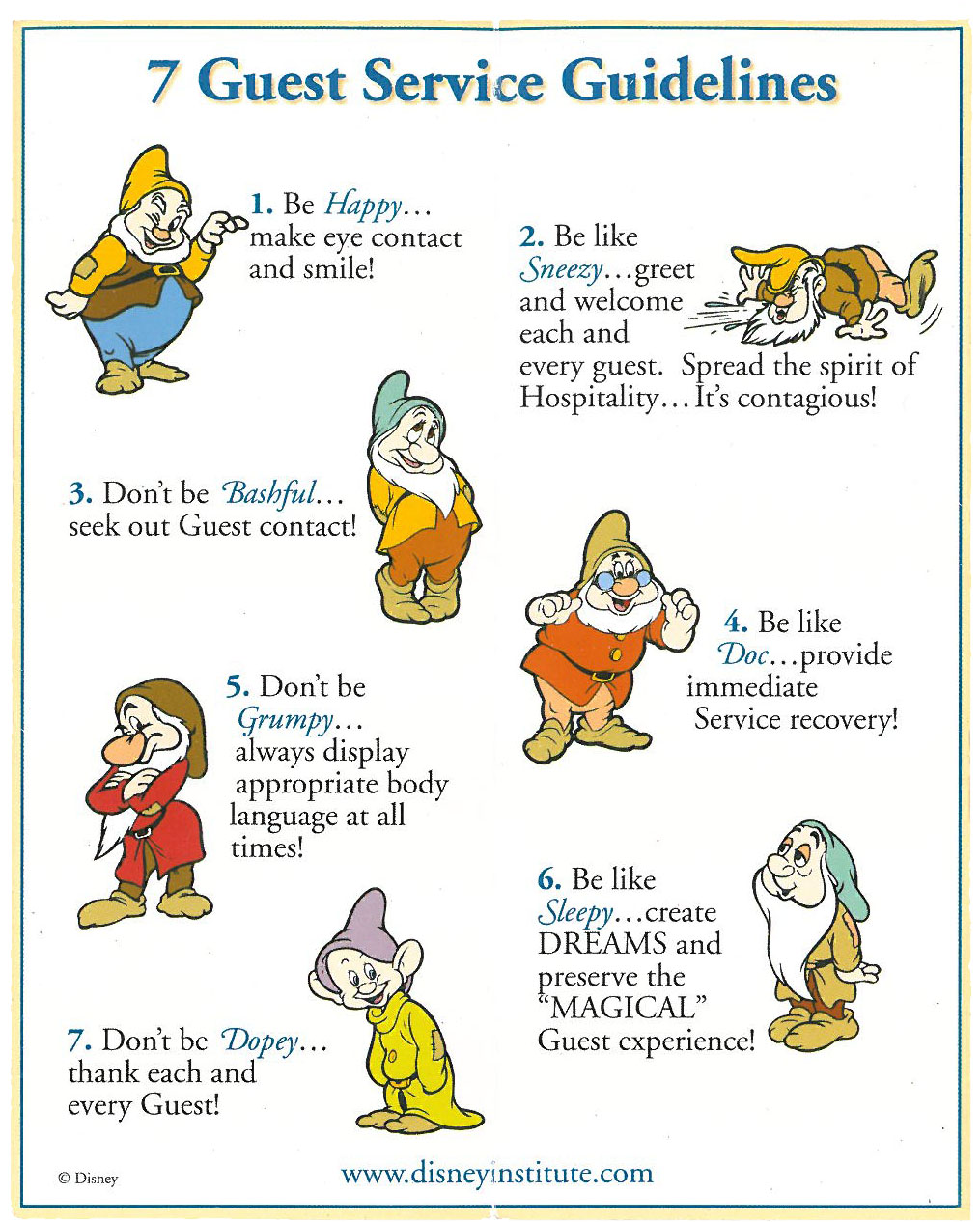
During the 1960s, these standards were translated into a set of behavioral actions called Guidelines for Guest Services, which became the centerpiece of training for all Disney cast members. Appropriately enough, the seven guidelines were personalized with the characters from the seven Dwarfs:

7 Guidelines for Guest Services

  • Make eye contact and smile
  • Greet and welcome each and every Guest
  • Seek out Guest contact
  • Provide immediate service recovery
  • Display appropriate body language at all times
  • Preserve the “magical” Guest Experience
  • Thank each and every Guest

These seven phrases serve a variety of purposes. First, they define behavior in terms of Guests. They also communicate cast member responsibilities. Finally, they showcase ways to customize service to individual Guests.

Even though these Guidelines don’t exist in this form anymore, my experiences over the years reminded me that the spirit of the Guidelines are very much in practice by cast members today.

Your organization probably won’t have tens of thousands of people coming through your doors every day – but the principles Disney uses as a baseline starting point for training its Cast Members are appropriate your use.

I don’t want the public to see the world they live in while they’re in the park. I want them to feel like they’re in another world.

Walt Disney

References

Disney at 100: How Teamwork Makes the Dream Come True

To make the dream of Disneyland come true took the combined skills and talents of hundreds of artisans, carpenters, engineers, scientists, and craftsmen. The dream they built now becomes your heritage. It is you who will make Disneyland truly a magic kingdom and a happy place for the millions of guests who will visit us now in the future.

Walt Disney, to Disneyland Cast Members in 1955

In 2017, I was able to be at Walt Disney World for 31 days – most time spent in the parks and resorts in any calendar year of my long history there.

Thanks to the unexpected generosity of two of my kids, my 2016 Annual Pass was renewed for 2017. That, coupled with a lot of client work in the Central Florida area, was all I needed to have an amazing year of yes, magical, experiences.

Let me unpack this a little: I don’t do attractions that have motion to them (vertigo). Most of those days were solo trips (though I did have some very special time with my wife in April, and my wife and daughter in November). On a few of those days I would drop in for just a few hours – maybe during the evening hours for a single show and a meal. On most of the days, it was a full day experience including a stay in one of the Resorts. On one particular day, I spent almost 20 hours at the Magic Kingdom, beginning with a 5:45 a.m. visit with the Parking Lot Cast Members, and ending at 2 a.m. the next day closing the park out.

As one of my friends put it, “Why?”

Simply put, I am always amazed by the Cast Members as they fulfill Walt Disney’s dream referenced above for Disneyland, and by extension, to all Disney endeavors the world over.

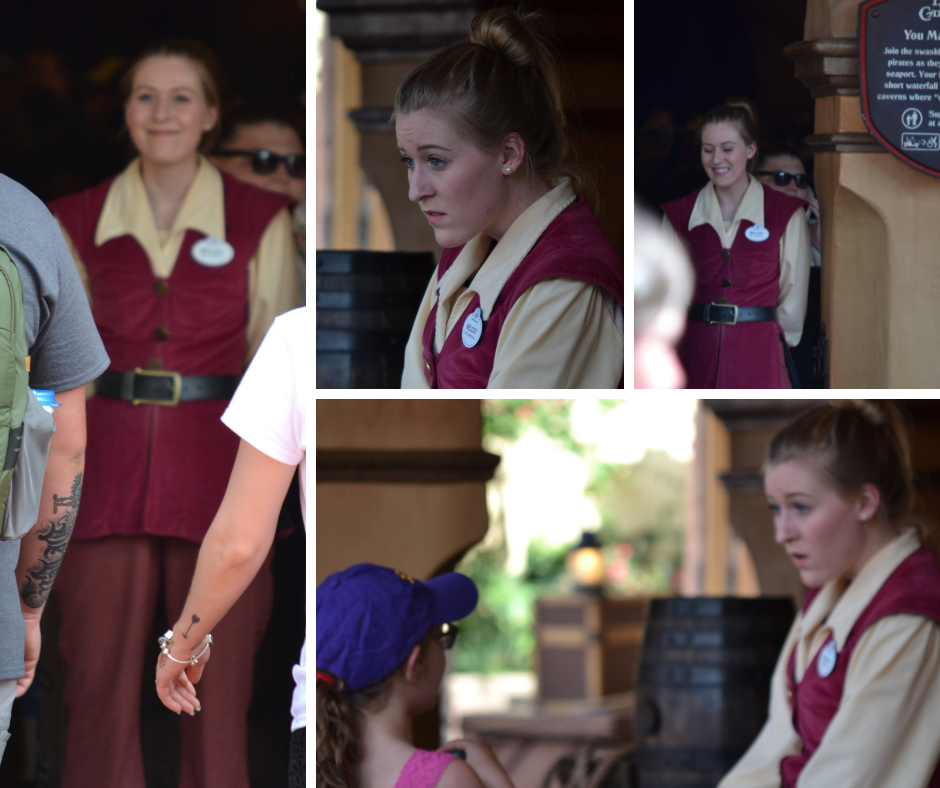
A picture is worth a thousand words:

Start with the image on the left: the Cast Member is smiling at the large crowd headed her way. But as you look at the next two images on the upper right, she is looking downward – seemingly away from the crowd approaching her. As the final image shows in the lower right, her focus all along has been on children right in front of her, but masked by the crowd from my initial viewpoint.

Boom.

The 31 days at Walt Disney World provided me with dozens of conversations with current and former Cast Members just like this. I was able to spend hours just watching interactions between Cast Members and Guests. I photographed thousands of “moments” that tell stories. Whether an hour or a day, my time at Walt Disney World provided an immersion into the excellence of Disney’s Cast Members when it comes to interactions with Guests.

Here are just a few personal stories from my Disney visits that would illustrate this takeaway:

  • The very helpful Cast Members who helped with my Backstage Magic tour arrangements
  • Cast Members at the parking lot ticket booth and in the parking lots who understood I was just being dropped off for the day
  • Bob, the Security Team member who told me I was in for a good day
  • Wayne and Ernesto, our Disney Institute tour guides, who were knowledgeable and passionate about all things Disney
  • The funny and loud Cast Members of the Whispering Canyons restaurant, who fed and entertained us at the same time
  • Cast Members who smiled and greeted us backstage and onstage all day

I could go on and on, but maybe the best story is one from the past:

courtesy Disney Imagineering

In 1978, Disney announced it was opening another part of Walt Disney World in 1982. Not just a new section – this was Epcot, one of Walt Disney’s original dreams for Disney World. And the opening was specific: October 1, 1982.

At the time, Epcot was the largest construction project in the world. Most of the people working on the project did not work for Disney; they worked for all the contractors and subcontractors all over the country.

What Disney decided to do was to make these workers feel as though they were part of the Disney family – to get them to identify with Epcot even though they weren’t actually part of the Disney organization. Here’s how they did it:

They closed down the job site one Sunday a month for over a year. Keep in mind that this was the world’s biggest construction project, moving toward a rock-solid deadline that had been announced almost four years in advance. To shut the place down one day a month was a big deal.

Disney brought in several big circus tents and set the up in what was eventually to be the Epcot parking lot. Food service went in one of the tents – hot dogs, hamburgers, and the whole works – a picnic.

In another tent, the Disney Imagineers created a miniature Epcot: the ground was sculpted to show where the land and water would be; photographs of the work were posted; artists’ renderings showed what the completed project would look like. Everything was kept up-to-date for over a year.

On that one Sunday a month, the project was shut down, and all the construction workers and their families were invited to enjoy the picnic and look around. They would enjoy the food and see what their Dad or Mom was doing.

Disney continued this for over a year so the families could watch it grow and the workers could see what they were creating – not just the big picture, but where their piece happened to fit into the big picture.

This went on all the way through the construction cycle until Epcot opened. The $1.2 billion project came in on time and on budget, with very few snags. This was in part thanks to thousands of people who were not Cast Members, and had little motivation to do so. Disney wasn’t writing their checks; they weren’t giving them benefits. They couldn’t do the traditional things that you normally do to keep employees happy.

Instead, they treated them like Cast Members. And it worked. At the grand celebration of the opening of Epcot, there was a huge celebration with thousands of people attending – most of them the construction workers and their families.

When a rough-necked iron worker is seen wearing mouse ears, you know he understands the dream.


Don’t you love the surprise of getting something extra when you least expect it?

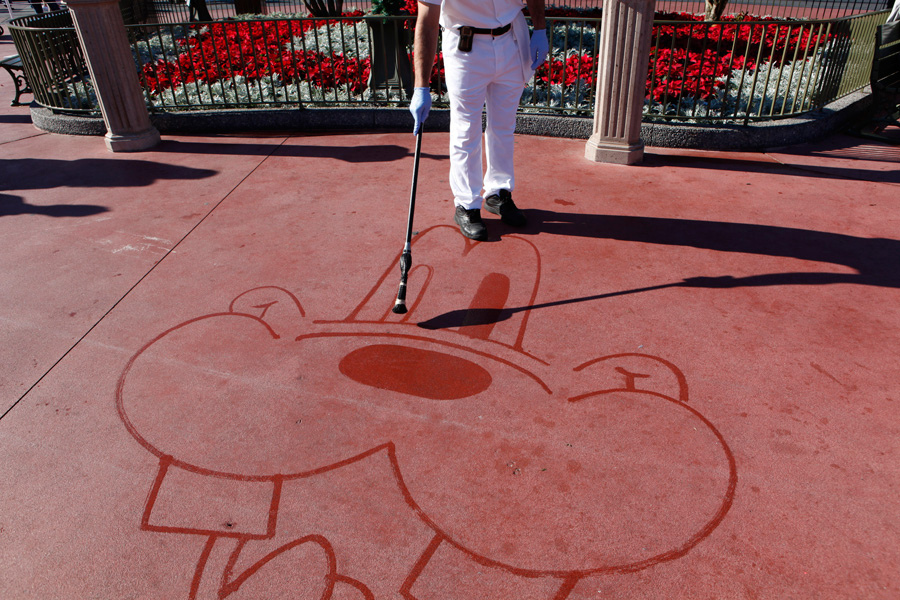
Disney’s Custodial Cast Members are some of my most favorite Cast Members to observe as they go about their role. It’s a very important role, far more than you might think. The Custodial Cast Member is much more than a “janitor” or a “street sweeper.” They are independent for the most part – meaning they have the freedom to move around in different sections of the parks because of their white costumes don’t clash with any theming. They receive extra training because of their visibility and accessibility. Their official title is Custodial Guest Services Cast Member for a reason – their very visible presence in all the parks allows them to answer guest questions, make personal connections, and create artwork…

Wait a minute – create artwork?

That’s what I said! In addition to upholding Walt Disney’s vision for keeping the parks clean for guests, members of the custodial team can also become water artists.

Custodial Cast Members can sign up for a class where they learn to draw various Disney characters with their pan, broom, and a little water.

Not to be outdone, on a recent trip to the Magic Kingdom I even saw a few regular Cast Members practicing a little art magic with masking tape.


Lee Cockerell, former executive vice president of operations at Walt Disney World Resorts, talks about this in his book The Customer Rules:

With a little bit of imagination, you too can delight customers by giving them a little extra when they least expect it. They’ll surprise you in turn by coming back early and often and by singing your praises to others.

Lee Cockerell, The Customer Rules

That’s right – some of the best comments and thanks from Guests go to the Custodial teams. That speaks so powerfully to the culture at Disney.

Now for a tough question – think of the “least desirable role” in your organization. Do those team members have the same passion and culture exhibited by the Custodial Cast Members at Disney?


We train them to be aware that they’re there mainly to help the guest.

Walt Disney

References

Disney at 100: Bringing the Story to Life

From blue sky ideation, to pencil on paper, to digital models, to plaster and paint, Imagineers build dreams. They never say “never,” and the sky is not the limit. That quest has created a new art form and a new kind of artist, one whose canvas is the world itself and whose tools are whatever it takes to turn that world into a fantastic, enveloping story.

Leslie Iwerks, “The Imagineering Story”

The books in my Disney library are a valuable resource for my ongoing quest in learning the story of Walt Disney and the “kingdoms” he created; kingdoms that continue to expand in the 57 years since his passing.

But even books have limitations…

You can dream, create, design, and build the most wonderful place in the world…but it requires people to make the dream a reality.

Walt Disney

Over the years I have been fortunate to make friends among Disney Cast Members, both current and past. A handful of those friends have been Imagineers, and as you may imagine, they are amazing storytellers, creative geniuses, and innovative to the core.

So…learning more about Imagineering? Sign me up – literally!

When the news that a new steaming service called Disney+ was coming in the fall of 2019, I was delighted – so much, that I signed up for a 3-year subscription as soon as they became available.

When the initial programming schedule was released, and included the 6-part series “The Imagineering Story,” I was ecstatic – it was among the first programs I watched on the new service.

When the book The Imagineering Story was announced, I was literally stopped what I was doing and pre-ordered the book.

There’s really no secret about our approach. We keep moving forward – opening new doors and doing new things – because we’re curious. And curiosity keeps leading us down new paths. We’re always exploring and experimenting…we call it Imagineering – the blending of creative imaginational and technical know-how.

Walt Disney

The Imagineering Story continues the behind-the-scenes journeys first revealed in the books Walt Disney Imagineering: A Behind the Dreams Look at Making the Magic Real (1995) and its sequel Walt Disney Imagineering: A Behind the Dreams Look at Making MORE Magic Real (2010).

The book goes deep into the personalities, stories, and adventures of the men and women who brought create magic around the world.

More than just the theme parks (though that would have been awesome enough), every resort hotel, shop and business setting, cruise ship, and entertainment setting exists largely through the men and women of Disney Imagineering.

The Imagineering Story greatly expands the award-winning filmmaker Leslie Iwerks’ narrative of the fascinating history of Walt Disney Imagineering.

The entire legacy of Walt Disney Imagineering is covered from day one through future projects with never-before-seen access and insights from people both on the inside and on the outside. So many stories and details were left on the cutting room floor for the series – this book allows an expanded exploration of the magic of Imagineering.

Every one of the 731 pages was filled with stories that brought the Disney Experience alive.

The experience of Disney – primarily in the theme parks, but now expanded to other resorts, retail shops, and cruise ships – can be traced back to Walt Disney. His untimely death in 1966 could have left a void in the creativity of the Disney empire.

But I believe his greatest act of genius had its origins in 1952, as he began to pull together veterans of film and animation work for a special project that came to be known as Disneyland.

That group of versatile animators and art directors was the foundation of a group that came to be called the Imagineers.

Out of this group, Disney historian Tim Hauser reflects, “came the theories, aesthetics, design, and engineering of Disneyland; the advancement of three-dimensional storytelling; the development of robotic techniques in Audio-Animatronics; and the perpetuation of an ‘architecture of reassurance’ as inspired by Walt Disney’s personal sense of optimistic futurism.”

Today Walt Disney Imagineering remains the design, development, and master-planning branch of company, with over 140 disciplines working toward the common goal of great stories and creating great places.

Walt Disney wanted Disneyland to be essentially a movie that allows you to walk in and join in the fun. Imagineers – many whom had worked with Walt Disney since the 1930s – literally brought those movies to life with their multiple disciplines. He knew from his filmmaking experience that story was everything to the audience. Disney knew he must immerse the theme park guest in living storytelling scenarios.

Designing the Guest’s experience is what Walt Disney’s Imagineers came to call “the art of the show,” a term that applies to what the Imagineers did at every level, from the broadest conceptual outlines to the smallest details, encompassing visual storytelling, characters, and the use of color.

Walt Disney realized that a visit to an amusement park could be like a theatrical experience – in a word, a show. Walt saw that the Guests’ sense of progressing through a narrative, of living out a story told visually, could link together the great variety of attractions he envisioned for his new kind of park. While traveling through their stories, Guests would encounter, and even interact with, their favorite Disney characters, and who would be transformed, as if by magic, from their two-dimensional film existence into this special three-dimensional story world.

As designers, the Imagineers create spaces – guided experiences that take place in carefully structured environments, allowing the Guests to see, hear, smell, touch, and taste in new ways. In effect, Imagineers transform a space into a story place.

Ultimately, the Imagineers gave Guests a place to play, something Walt believed that adults needed as much as children. The design of the Imagineers gives power to the Guests’ imagination, to transcend their everyday routine. Walt Disney insisted that Guests should “feel better because of” their experiences in Disney theme parks, thus establishing the art of the show.

For the Imagineers, that meant considering everything within and relating to the parks as design elements. To build effective story environments and assure Guest comfort, the designers realize that they always had to assume the Guests’ position and point of view, and just as Walt did, to take the Guests’ interests to heart and defend them when others didn’t think it mattered.

It is up to the designers to provide Guests with the appropriate sensory information that makes each story environment convincing. This means that design considerations go beyond the attractions themselves to the service and operations staff, transportation, restaurants, shops, rest rooms – even the trash cans.

Everything Begins With a Story

Storytelling has played a vital role in our survival – allowing us to share information, knowledge, and values from generation to generation. Story is the medium through which we receive our early learning as to right and wrong, good versus evil, reward and punishment, social values, etc.

We respond to storytelling. It engages our attention; no matter how old we get, who doesn’t love a good story?

Understanding this, Walt Disney utilized a technique in the early days of his cartoon films that helped illustrate the flow and continuity of stories – the storyboard.

Storyboards are tools that allowed Walt and his artists to envision a film prior to production. It allowed his team to have a shared vision of the story they were telling and how it would unfold. As a bonus to driving the creative development, it also offered a cost-effective way to experiment with a film early on, so that when production began, costs could be minimized.

Decades later, the tradition of storyboards continues on, though it has long expanded past just films. At Walt Disney Imagineering, rides, shows, and films for Disney’s theme parks around the world are the objects of regular storyboarding.

For each ride, show, or attraction, a logical story sequence is created. Almost every aspect of a project is broken sown into progressive seen sketches, called storyboard panels, that reflect the beginning, middle, and end of a Guest’s park experience.

The boards are eventually covered with every written thought, idea, and rough sketch the Imagineers can come up with.

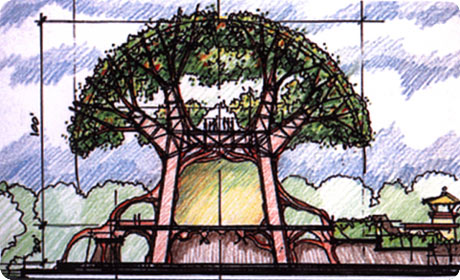
Starting with brainstorm sessions, the Imagineer’s first thoughts, ideas, images, and feelings about the story they are creating are captured on note cards and quick sketches. For example, here’s an early sketch of Animal Kingdom’s Tree of Life:

courtesy Disney Imagineering

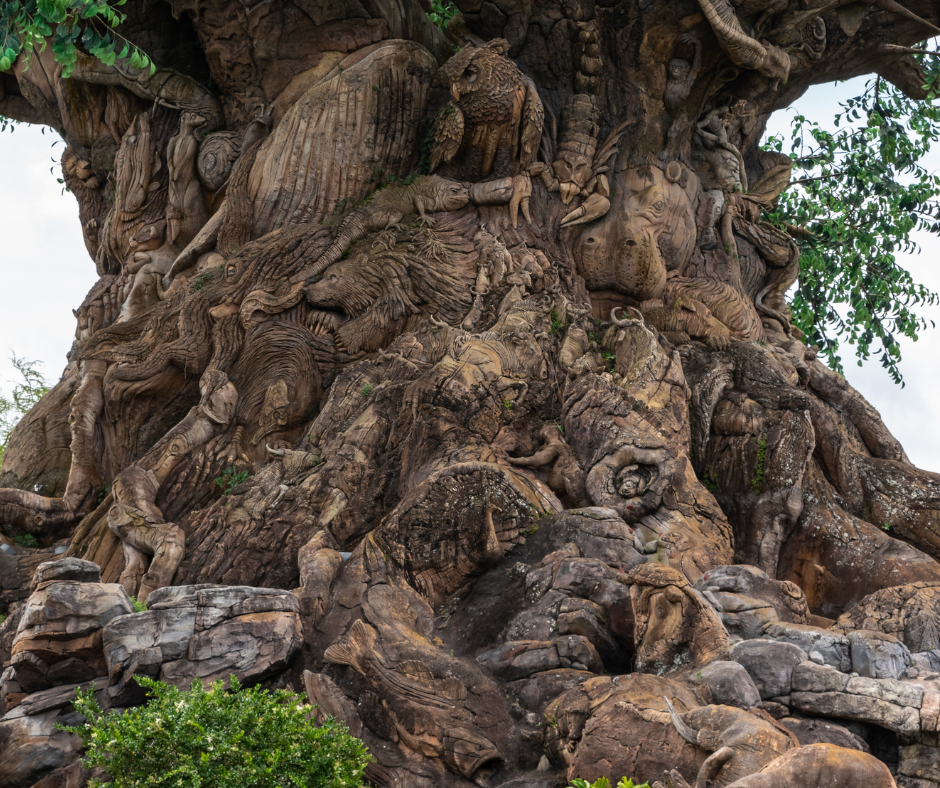
The beauty of the Tree is matched by its engineering marvels as well. It is a massive structure, towering 145 feet into the air with a full canopy of natural-looking leaves, enclosing a 420-seat theater and meeting all building codes, including withstanding 145 mph winds. The engineering feats accomplished, it was time for the  Imagineering team of sculptors to create the magnificent bark of the tree – which is actually representations of animals. That process alone took almost a full year.

courtesy Orlando Sentinel

One of the most amazing pieces of art ever created by Disney’s Imagineers, it is beautiful and meaningful, and captures the essence of Animal Kingdom at a glance. It’s a poetic statement of the majesty of nature, the stunning diversity of animals, and our respect for our place in the world. As you approach the tree and the animal forms begin to reveal themselves, it becomes clear that there is almost no tree at all. That tree is the animal kingdom.

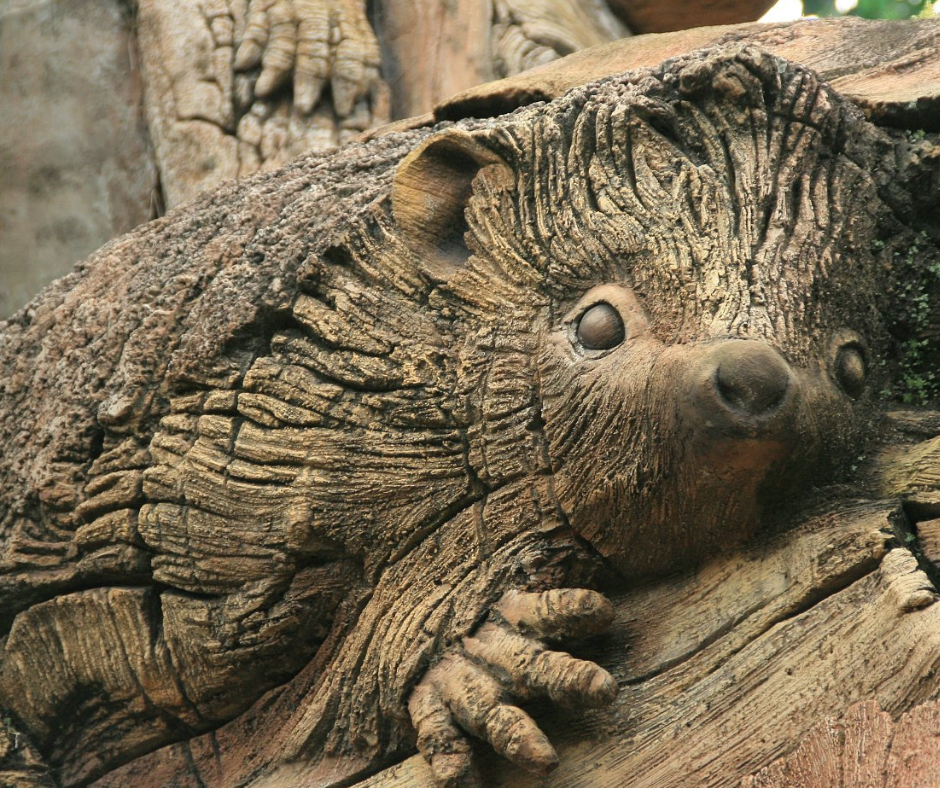
The experience of viewing the Tree of Life is like looking for animals in the clouds. The longer you look, the more you see – maybe even all 325 of them! This effect is the result of very careful planning during the design phase with the use of storyboards.

The storyboards are worked, re-worked, rearranged, and edited until the story is strong and clear. Only then will production proceed – with stunning results:

At Walt Disney Imagineering, everything they do revolves around the story – and storyboards have remained an essential tool in helping them tell the story.

That is the power of story – it is an experience that enables us to escape to another world, to be captivated and be in the moment.

The secret to Disney magic that the Imagineers bring to life is in the story!

Recently celebrating their 70th anniversary, the Imagineers have delivered – time and time again. To date, the Imagineers have built twelve theme parks; dozens of resort hotels; 5 cruise ships with two more under construction; 2 water parks; and ongoing development in existing parks and Disney properties around the world.

The Imagineers bring the Disney magic alive.

The Imagineering Story brings the Imagineers to life.

I have a hard time ranking the books in my Disney library – but The Imagineering Story is going to be in my all-time Top Ten from now on, and a highly-recommended book for anyone who wants a deeper understanding of the creative genius (and occasionally weirdness) of that special and unique blend of artists and engineers who took the dreams of one man, Walt Disney, and brought them to life. 

Walt was a storyteller above all. Walt didn’t write the stories but he envisioned them. He told stories better than anyone else around and he got the people around him to turn his stories into movies and theme park attractions.

Imagineer X. Atencio

References