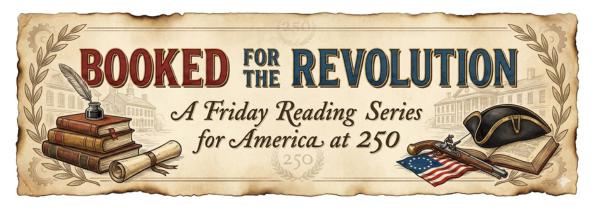
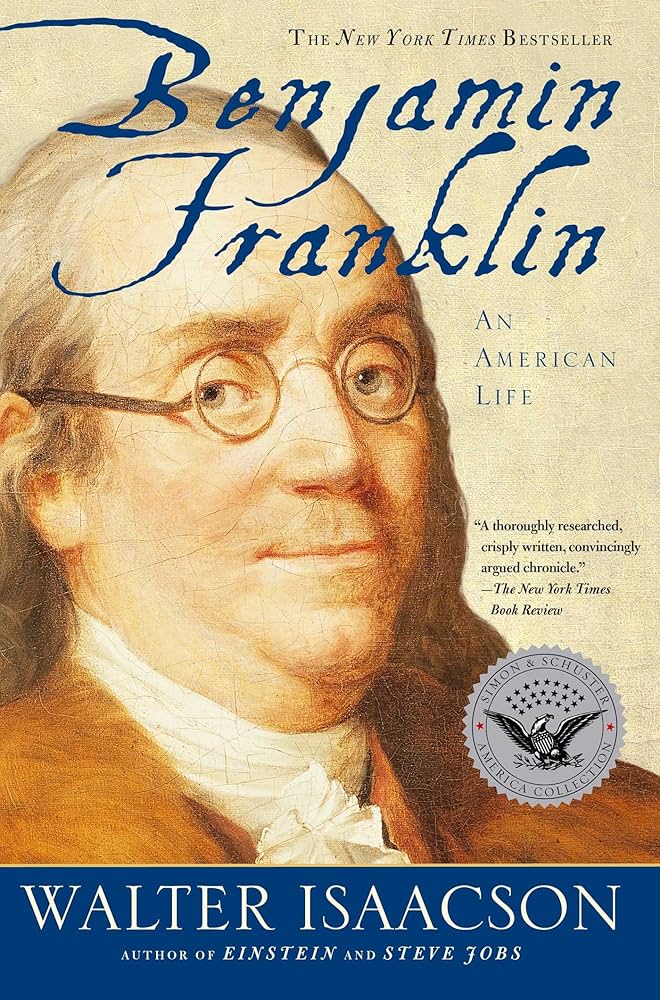
Benjamin Franklin: An American Life by Walter Isaacson. As the elder statesman of the Committee of Five, Franklin’s presence lent credibility and diplomatic weight to the Declaration. Isaacson’s definitive biography illuminates his indispensable role in the founding moment.
May and June – The Architects of Independence, Part Three
The Original American
There is a moment near the end of Benjamin Franklin’s life that captures everything essential about the man. Attending the Constitutional Convention in 1787 at age eighty-one, barely able to walk, carried into the hall by prisoners from a nearby jail because the ride in a sedan chair caused him less pain, he still managed to deliver one of the most eloquent speeches in American political history – urging delegates to sign a document he knew was imperfect, because perfection was the enemy of the possible. That disposition – pragmatic, generous, undeceived about human nature yet still hopeful about human potential – animated everything Franklin contributed to the American founding, including his indispensable presence on the Committee of Five tasked with drafting the Declaration of Independence in the summer of 1776.
In an era when Americans debate what the founding generation actually believed and intended, and when the gap between a nation’s ideals and its practice feels as precipitous as ever, Walter Isaacson’s Benjamin Franklin: An American Life (Simon & Schuster, 2003) offers something genuinely useful: a portrait of the founder who was least like an aristocrat, most like the rest of us, and perhaps most responsible for the Declaration’s survival as a serious document rather than a revolutionary pamphlet.
The Author and His Angle
Walter Isaacson came to Franklin with unusual credentials. A former chairman of CNN and managing editor of Time, he is a biographer drawn to figures who sit at the intersection of ideas and action – men and women who don’t merely think well but make things happen. His subsequent biographies of Steve Jobs and Leonardo da Vinci follow the same logic: genius expressed through craft, through persuasion, through making. Franklin, Isaacson argues, is the original American prototype of this type.
Published in 2003, the biography arrived at a moment when American confidence and American anxiety were intertwined in the aftermath of September 11, and readers were hungry to understand what, precisely, the national inheritance consisted of. Isaacson’s Franklin was timely without being polemical. He neither idolizes his subject nor performs the fashionable demolition of founders that characterized some late-twentieth-century revisionism. Instead, he presents Franklin whole – the genius and the schemer, the moralist who kept a common-law family arrangement for decades, the anti-slavery advocate who owned enslaved people in his middle years, the brilliant diplomat who was also capable of sustained personal vanity.
The Central Argument
Isaacson’s core claim is both simple and consequential: Benjamin Franklin was the most fully American of all the founders, and understanding him is understanding the nation’s practical, self-inventing, pluralist instincts at their best. Where Jefferson was an aristocratic philosopher who wrote magnificently about equality while living in profound tension with it, and Adams was a constitutionalist of great integrity and impossible temperament, Franklin was the founder who had actually been common – a runaway apprentice, a self-made printer, a man who earned his prestige rather than inheriting it.
This matters for the Declaration because Franklin’s role on the Committee of Five was not primarily literary. Jefferson was appointed primary drafter, Adams was the floor champion, and Franklin’s function was something rarer: legitimacy. He was the most famous American in the world, the man whose lightning rod and Poor Richard’s Almanack had made him a celebrity across Europe and the colonies alike. When the Committee presented its work, Franklin’s presence on it signaled to the world – and to nervous moderates in Congress – that this was not the work of hotheads. It was the considered judgment of the most respected mind America had produced.
Beyond prestige, Isaacson documents Franklin’s specific editorial contributions. The most famous is small but profound. Where Jefferson had written that men are endowed with “sacred and undeniable” truths, Franklin changed it to “self-evident.” The shift is philosophically significant: “sacred” grounds the claim in religion; “self-evident” grounds it in reason, making the Declaration’s foundational premise accessible to Enlightenment thinkers across confessional lines. It was a characteristically Franklinian edit – pragmatic, inclusive, durable.
The Months That Followed
The signing of the Declaration on August 2, 1776 did not slow Franklin. At seventy, an age at which most men of his era were already dead, he embarked almost immediately on what would become the most consequential diplomatic mission in American history.
By October 1776, Congress had appointed him minister to France, and he sailed across the Atlantic knowing that the Revolution’s survival depended almost entirely on French financial and military support. He arrived in Paris in December and was received as something between a philosopher-king and a rock star. French salons were fascinated by this American who seemed to embody Enlightenment virtue – simple dress, brilliant conversation, that famous fur cap, which the French took as the costume of a primitive, natural man and which Franklin, ever the strategist, was happy to encourage.
His work in France between 1776 and 1778 produced the Franco-American alliance, formalized in the Treaty of Amity and Commerce, which brought French money, troops, and naval power into the conflict. Without it, as most historians now concede, the Continental Army could not have sustained the war. The Declaration was words on parchment until Saratoga and the French alliance made it something more. Franklin, more than any other single individual, converted the many uncertainties from possibility into reality.
The Author’s Voice
Isaacson writes with a journalist’s instinct for the telling detail and a historian’s respect for evidence. On Franklin’s famous self-improvement regimen, his Autobiography‘s list of thirteen virtues he attempted to master one at a time, Isaacson observes that the project reveals both Franklin’s genius and his limitations:
“The virtue he found most difficult was order… and he eventually decided that a ‘speckled axe’ – one with a few imperfections – was preferable to an exhausting pursuit of perfect orderliness. It was a very American conclusion.”
That compression – biographical insight, national character, gentle irony – is characteristic of Isaacson at his best. He makes Franklin feel recognizable, someone who understood that the pursuit of perfection is often the enemy of the good, in his own life as in his politics.
Dialogue with the Reading List
Placed third in the “Architects of Independence” series, Benjamin Franklin arrives after Gordon Wood’s Revolutionary Characters and Joseph Ellis’s Founding Brothers, and before David McCullough’s John Adams. The conversation among these books is fascinating.
Where Wood situates the founders within a broader intellectual culture of republican virtue that required public men to transcend private interest, Franklin is almost a challenge to that framework: he was transparently interested in his own advancement for much of his life, and yet became genuinely devoted to public service. Ellis’s Founding Brothers gives particular attention to the tensions among the founders, and Franklin appears there as the one figure most capable of navigating those tensions through wit and strategic ambiguity.
The most pointed dialogue, however, is with McCullough’s John Adams. The two men’s relationship was one of the founding era’s great partnerships and occasional frictions. Adams admired Franklin’s genius and resented his celebrity in roughly equal measure, writing in his diary with barely concealed jealousy of the esteem the French showed his colleague. McCullough’s Adams is a man of ferocious principle; Isaacson’s Franklin is a man of flexible strategy. Both books suggest that the Revolution needed both types – and that neither man could have done the other’s job.
Pauline Maier’s American Scripture, later in the series, provides the essential corrective to any biography-centered reading of the Declaration by insisting that Congress, not any individual, made the document what it was. Isaacson’s Franklin actually prepares the reader well for Maier’s argument: he presents Franklin not as a lone genius but as a collaborator, an editor, a man who understood that collective work produces better outcomes than individual performance.
What We’ve Learned Since 2003
Isaacson’s biography predates the major scholarly work on Franklin’s relationship to slavery. More recent historians, particularly in the wake of the 1619 Project and renewed attention to the founding’s contradictions, have pressed harder on Franklin’s early slaveholding and his eventual evolution toward abolitionism – he became president of the Pennsylvania Abolition Society in 1787. While Isaacson addresses this honestly for his time, subsequent scholarship has situated it more centrally within any full account of Franklin’s moral life.
There has also been significant new work on Deborah Read Franklin, Benjamin’s common-law wife, who managed his printing business and household through his long absences and died before he returned from London. Her story, largely invisible in Isaacson’s telling, has been substantially recovered by later scholars and complicates the portrait of Franklin as the self-made man.
Why Read This in 2026?
Because the version of American identity Franklin embodied – pragmatic, pluralist, self-invented, suspicious of dogma, committed to the useful and the improvable – is precisely the version most under pressure right now. He was a founder who trusted institutions he had helped build, who believed that collective deliberation produced better outcomes than individual certainty, and who thought that a nation’s character was something made and remade over time, not fixed at a sacred origin point.
Reading Isaacson’s Benjamin Franklin in this moment is not an exercise in nostalgia. It is an encounter with a founding vision that remains genuinely contested – and, depending on your reading, genuinely available. The Declaration Franklin helped carry into the world was not, in his understanding, a completed achievement. It was, as he might have said, a useful beginning.
A Note on This Series
This journey through Revolutionary history is as much about the evolution of historical understanding as the Revolution itself. History isn’t static – each generation reinterprets the past through its own concerns, asking different questions and prioritizing different sources. By reading these books in dialogue across 250 years, we’ll witness how scholarship evolves, how narratives get challenged, and how forgotten stories resurface.
This isn’t about declaring one interpretation “right” and another “wrong,” but appreciating the richness that emerges when multiple perspectives illuminate the same transformative moment. These books won’t provide definitive answers – history rarely does – but they equip us to think more clearly about how real people facing genuine uncertainty chose independence, how ideas had consequences, and how the work of creating a more perfect union continues. As we mark this anniversary, we honor the Revolutionary generation by reading deeply, thinking critically, and engaging seriously with both the brilliance and blind spots of what they created.