
Do what you do so well that they will want to see it again and bring their friends.
Walt Disney
Cinderella Castle at the Magic Kingdom in Walt Disney World is beautiful from every angle…

…but the most interesting view is underneath.
Deep underneath Cinderella’s castle in the middle of the Magic Kingdom is a utility corridor running from Main Street Square to Fantasyland. There is also a circular corridor running around the circumference of the Magic Kingdom. Though it gives the appearance of a tunnel, and many Cast Members call it a tunnel, these long passageways are really corridors, built on ground level and then covered over with 5 million square yards of dirt and sand dredged to create all the beautiful water features you see around the park. The visible park you see is really the second story of the park – but that’s really another story.
In recent years I have spent over 100 days at Disney parks, museums, and a cruise. Because of proximity, most of that time was at Walt Disney World, with much of the time observing and talking with Cast Members and Guest Experience Managers of all four theme parks. In a one year stretch, I was able to be on Disney property 31 days! During my time onsite, there have been many stories but there is no better summary than this:
Imagine, if you will, that long central corridor described above where almost all Magic Kingdom Cast Members pass through in their work at the park. To one side of that corridor, beginning a long wall of photos, sayings, and displays of the history of Walt Disney World, is a very large, but simple poster with a picture of Walt Disney and these words:
Walt Disney’s vision for a great guest experience:
Safety, Courtesy, Show, Efficiency

In a line past that poster, you will see 4 more large posters, with a smiling Cast Member’s picture on each, with these words below:
- I practice safe behaviors in everything I do
- I am courteous and respectful to Guests of all ages
- I stay in character and perform my role in every story
- I use my time and resources wisely
Known by various terms but most often called the 4 Keys, they were a result of Walt Disney’s vision for Guest Experiences – first at Disneyland when it opened in 1955, then at the Magic Kingdom in 1971, and at every other theme park, cruise ship, and Disney organization since then.
In literally every conversation I had, the 4 Keys were mentioned – as a group, as individual stories, and how they are used as training tools.
That’s powerful.
These 4 keys are simple service standards, and they can be powerful tools in any organization – but especially in churches that want to provide an Exceptional Guest Experience.
There is power in establishing a framework of values from which everyone in your organization operates. Within that framework, you can empower team members in a way that gives them a sense of ownership and purpose. You create a consistent image across the entire organization.
Disney’s standards have stood the test of time for almost 70 years – shouldn’t you consider creating standards for your organization that will stand the test of time as well?
Yes, you should. And here’s the guide to help you do just that!

Whether they are called clients, customers, constituents, or, in Disney-speak, Guests, all organizations must better serve the people who purchase their products and services or risk losing them. Now, for the first time, one critical element of the methods behind the magic that is the Walt Disney World Resort – quality service – is revealed in Be Our Guest.
Even before Tom Peters and Bob Waterman profiled Walt Disney World Resort in their groundbreaking book In Search of Excellence, the most popular resort destination in the world enjoyed a reputation as a company that sets the benchmark for best business practices.
Be Our Guest outlines proven Disney principles and processes for helping your organization focus its vision and align its people and infrastructure into a cohesive strategy that delivers on the promise of exceptional customer service.
Five years after the publication of Imagineering in 1996, Walt Disney Studios CEO Michael Eisner had finally overcome the hesitations he had for years regarding Disney’s “insider’s secrets” – first with Imagineering, and now with the Guest Services found in the Parks and Resorts. It also marked the 15th anniversary of the Disney Institute – professional development programs delivered to organizations worldwide.
At the time of the publication of Be Our Guest in 2001 (and revised in 2011), the Disney Institute had established a significant presence in the training world for its ability to appeal to leaders in multiple industries, and to customize content into programs that uniquely connected participants to their own heritage, values, people, and guests.
And what better way to highlight the Disney Institute than to shine a spotlight on quality service?
Quality Service means exceeding your guests’ expectations and paying attention to detail.
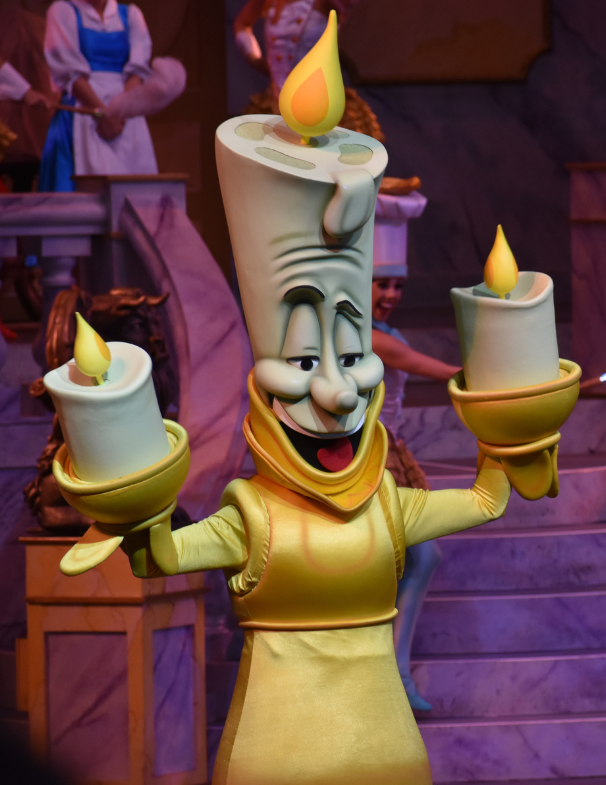
Be Our Guest has been the invitation for people coming to a Disney theme park long before the song from “Beauty and the Beast” became a box office hit.
It underscores an important element in the Disney vocabulary, that customers are not referred to as such, but rather as Guests. In the Disney nomenclature, the word “Guest” is capitalized and treated as a formal noun.
What’s the difference between treating someone like a customer, and treating someone like a Guest?
The obvious analogy is that we do things differently when we bring Guests into our home. We clean up the house. We dress up. We prepare something special to eat. We host them. We take care of their real needs.
Disney Expects Guests
This principle has to be the starting point, the foundation on which all else is built. Everything – and I mean everything – is done with the Guest in mind. At Walt Disney World, exceeding Guest expectations is the standard call to duty for all cast members, both those “onstage” and “backstage”.
At Disney, everyone is a part of the Guest Experience team.
For years, Disney cast members talked of sprinkling “pixie dust” to create magical experiences for their Guests. There really wasn’t any pixie dust – but the pixie dust was real in that it is the show that has been created from the moment a Guest arrives on the property until they leave for home.
It’s a practical magic that occurs both onstage (whenever cast members are in public areas of the parks and in front of Guests) and backstage (when they are behind the scenes where the everyday work of operating a city devoted to entertainment is conducted).
The onstage component of practical magic is the response that it produces in Guests when everything comes together in a seamless, seemingly effortless performance. The backstage component is comprised of the nuts and bolts of creating practical magic. Practical magic is whatever it takes to exceed Guest expectations.
Superlative face-to-face service is just one element in the work of exceeding Guest expectations. It means:
- Paying attention to every aspect of the Guest experience
- Analyzing that experience from the Guest’s perspective
- Understanding the needs and wants of the Guest
- Committing every element of the business – from the design of each element of the infrastructure to the interactions between Guest and cast – to the creation of an exceptional experience for each of them
Exceeding Guests’ expectations is Disney’s service strategy, and paying attention to every detail is the tactic by which it is accomplished.
- Friendly, helpful Parking Teams
- Getting you from the parking lot to the park entrance
- Beautifully maintained landscaping
- Trash – nonexistent
- Baby strollers organized and waiting for Guests
- Team Leaders visible everywhere – leading by example
- Personalizing and enhancing the Guest Experience
- Giving a “face” to the place
Disney expects Guests – and plans to exceed their Guests’ expectations every time. What about you?
The Disney organization is perhaps the greatest practitioner of Guest Experiences around today. Books have been written about what the “cast members” at Disney do to make people feel welcome (I know – I’ve read all of them, and own most of them).
As we move into the holiday season, I’m reminded of a very special visit to Walt Disney World about this time of year. My wife and I “opened and closed” the Magic Kingdom (we were there from the opening at 8 AM to closing at midnight) including Mickey’s Very Merry Christmas Party as a part of a wedding anniversary celebration.
Once again, I was amazed at the exceptional attitude of the cast members.
Observing hundreds of Cast Members, dealing with tens of thousands of Guests, there’s only one word to describe their attitude: Magical.

So I’m sure you won’t mind if we go backstage and back in time at Disney to learn about their 7 Guest Service Guidelines – a list of actions that every Disney team member learns during their orientation.
When Disneyland opened in 1955, Disney was looking for a set of generic behaviors that ensured that cast members knew how to act courteously and respect the individuality of each Guest. Over the first ten years, the four values of Safety, Courtesy, Show, and Efficiency became the foundation from which all succeeding service standards were developed.
During the 1960s, these standards were translated into a set of behavioral actions called Guidelines for Guest Services, which became the centerpiece of training for all Disney cast members. Appropriately enough, the seven guidelines were personalized with the characters from the seven Dwarfs:
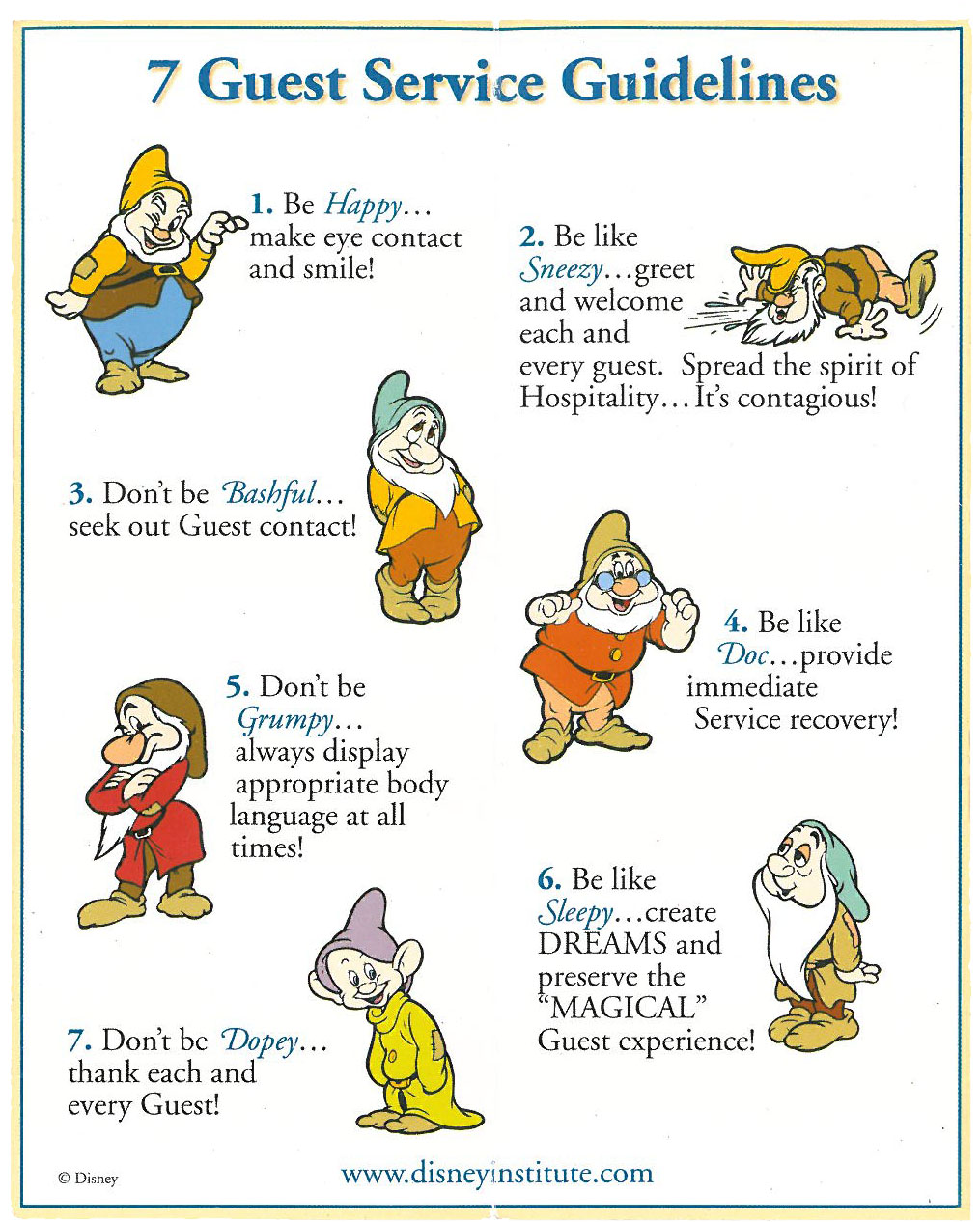
7 Guidelines for Guest Services
- Make eye contact and smile
- Greet and welcome each and every Guest
- Seek out Guest contact
- Provide immediate service recovery
- Display appropriate body language at all times
- Preserve the “magical” Guest Experience
- Thank each and every Guest
These seven phrases serve a variety of purposes. First, they define behavior in terms of Guests. They also communicate cast member responsibilities. Finally, they showcase ways to customize service to individual Guests.
Even though these Guidelines don’t exist in this form anymore, my experiences over the years reminded me that the spirit of the Guidelines are very much in practice by cast members today.
Your organization probably won’t have tens of thousands of people coming through your doors every day – but the principles Disney uses as a baseline starting point for training its Cast Members are appropriate your use.
I don’t want the public to see the world they live in while they’re in the park. I want them to feel like they’re in another world.
Walt Disney
References




 27gen.com