Visionary Leadership: Lessons from Nehemiah

I’m continuing a brief series using the biblical story of Nehemiah as an excellent role model for a Modern Elder:

Today, I wanted to take a look at Nehemiah’s skill as a Visionary Leader. Nehemiah had a clear and specific vision – to rebuild the walls of Jerusalem. This singular focus allowed him to channel his energy and resources towards achieving that goal. Effective leaders often have a well-defined vision that guides their actions and decision-making.


Nehemiah recognized a need, took initiative, conceptualized a vision, devised a strategy, and rallied others to support his cause.

In his work Visionary Leadership, Burt Nanus defines a vision as a compelling future scenario for an organization, one that is both realistic and attractive. It serves as a beacon, guiding the organization towards a destination that surpasses its current state, promising greater success or desirability.

Nanus argues that a potent vision possesses the ability to galvanize action, igniting enthusiasm and prompting the mobilization of resources and talents to bring it to fruition. Effective leaders possess the ability to perceive opportunities beyond the present reality, focusing not only on the immediate concerns but also on future possibilities. This foresight distinguishes them as leaders, enabling them to prioritize what truly matters amidst competing demands.

According to Nanus, vision occupies a central role in leadership, acting as an essential tool for success. Biblical leaders, grounded in the belief of a divine guide, approach leadership with prayerful dependence on God’s guidance. They maintain an optimistic yet pragmatic outlook, aligning their vision with God’s purposes and stewarding resources accordingly.

However, they remain mindful of the need to uphold the integrity of their vision amidst external pressures and personal agendas. They guard against self-serving motives that may distort the vision and hinder the fulfillment of God’s intentions. For them, maintaining alignment with God’s purposes is paramount, ensuring that their leadership endeavors reflect divine guidance and contribute to His ultimate plan.

Nehemiah’s Approach to Communicating the Vision

Articulating the vision with clarity

Nehemiah clearly communicated the goal of rebuilding the walls of Jerusalem to restore its security and honor. He didn’t leave room for ambiguity, ensuring that everyone understood the purpose and significance of the project.

His vision was specific and actionable, providing a clear direction for the entire community to rally behind.

Inspiring others with his passion and commitment

Nehemiah’s personal dedication to the vision was evident in his words and actions. His passion for the well-being of Jerusalem and its people inspired others to join him in the endeavor.

He led by example, demonstrating his commitment through hard work, sacrifice, and unwavering faith in God’s providence.

Addressing doubts and concerns

Nehemiah acknowledged and addressed the doubts and fears of the people, reassuring them of God’s favor and protection throughout the project.

He listened empathetically to the concerns raised by various stakeholders and provided rational responses, instilling confidence and trust in his leadership.

Involvement of key stakeholders

Nehemiah strategically engaged with influential leaders and officials to garner support for his vision. He sought the backing of King Artaxerxes of Persia, as well as local authorities, to secure resources and permissions for the project.

By enlisting the support of key stakeholders, Nehemiah gained credibility and legitimacy for his leadership, enhancing the likelihood of success.

Nehemiah actively involved the entire community in the vision, rallying people from all walks of life to participate in the rebuilding efforts. He organized the population into teams based on their skills and proximity to different sections of the wall, maximizing efficiency and collaboration.

Through effective delegation and coordination, Nehemiah ensured that everyone contributed their talents and resources towards achieving the shared goal.

Overall, Nehemiah’s approach to communicating the vision exemplifies key principles of effective leadership, including clarity, inspiration, empathy, and stakeholder engagement. By skillfully articulating his vision and rallying widespread support, Nehemiah was able to mobilize a diverse community towards the successful completion of a monumental task.

Nehemiah’s Visionary Leadership Lessons 

Focused leaders operate from clarity of vision.

Empathic leaders are characterized by their sensitivity to existing needs even before being developing a vision to address them. 

Passionate leaders operate from a profound sense of duty and accountability. 

Prepared leaders enhance motivation, making leadership tasks more manageable.

Collaborative leaders derive greater satisfaction from empowering others rather than solely focusing on executing tasks themselves.

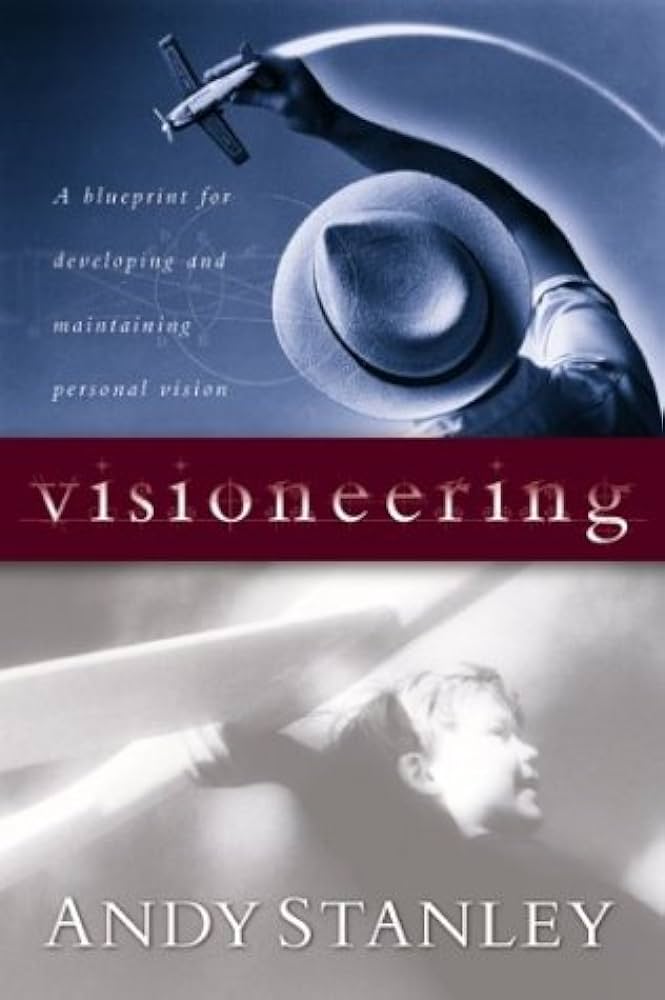
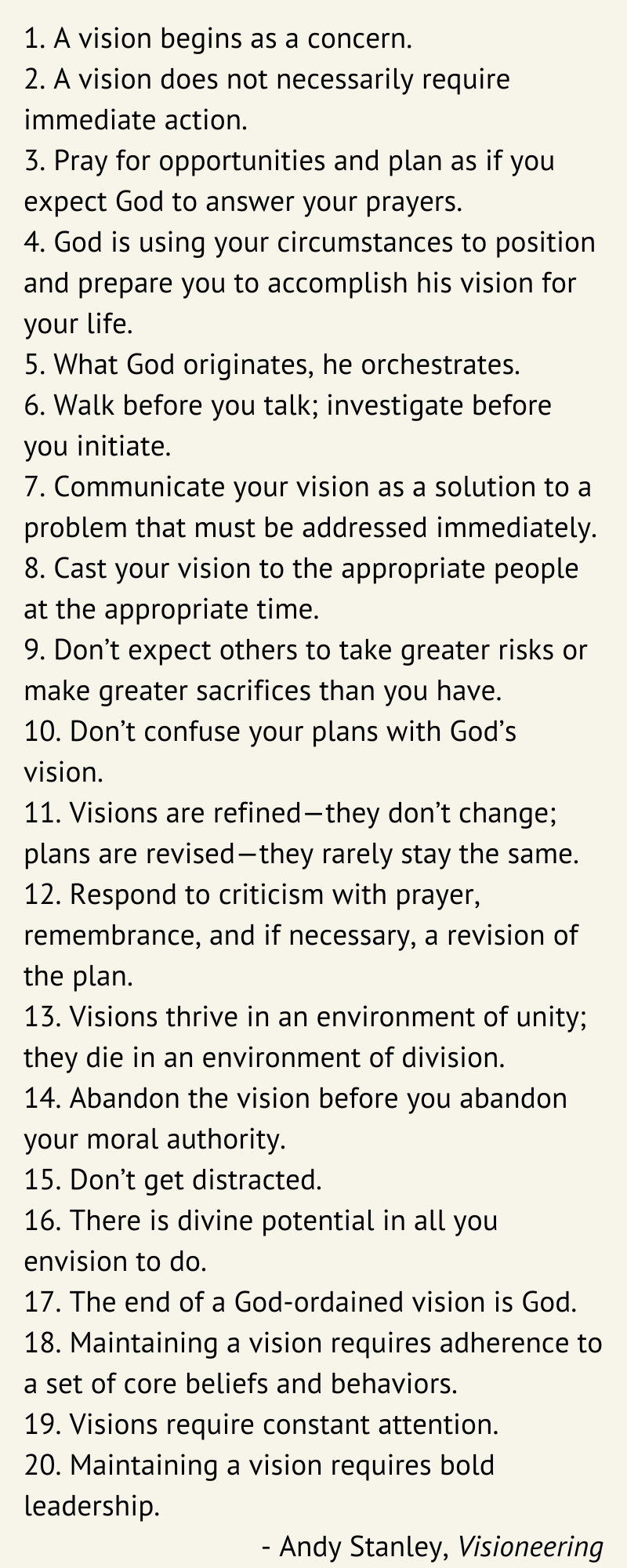
In his book Visioneering, Andy Stanley developed the following “building blocks” that leaders will find helpful as they pursue a vision for the organizations they lead.

Pursue Clarity in Your Daily Life

God crafted you with unparalleled potential and positioned you on this planet for a distinct purpose. Amidst the hustle and bustle of everyday life, you may have yet to unearth your unique calling in a manner that provides profound clarity.

This dilemma is common; akin to a faint echo, the prospect of a vision-driven existence often remains elusive, overshadowed by the demands of daily existence.

However, your divine blueprint – God’s intended plan for your life – is more accessible than you might imagine. You are a masterpiece crafted by God in Christ Jesus to undertake good deeds, which He has already laid out in advance for you to fulfill (Ephesians 2:10).

Equipped with the appropriate tools, you can uncover your life’s vision and synchronize it with your vocational path. It is both feasible and imperative to grasp your God-given identity and the dreams instilled by Him within you. Most significantly, you can discern and map out the practical steps needed to reach these aspirations.

Everybody ends up somewhere in life.

Wouldn’t you like to end up somewhere on purpose?

  • What breaks your heart?
  • What keeps you up at night?
  • What could be that should be?

Andy Stanley believes these questions are breadcrumbs that lead to the discovery of personal vision. With down-to-earth practicality, Stanley extracts principles from the story of Nehemiah to help you discover your purpose in life.

Visioneering includes helpful exercises and time-tested ideas for visionary decision-making, personal growth, and leadership at home and at work. Catch a glimpse of God’s incredible vision for your life, relationships, and business—and discover the passion to follow it.

What is clarity really about? How can pursuing clarity help us discover our purpose in life?

The concept of clarity means being free from anything that obscures, blocks, pollutes, or darkens. If you have clarity, you see things simply in an understandable and precise way.

Clarity will help you make your life direction unquestionable.

Honoring God involves discovering His picture or vision of what our lives could and should be. Glorifying God involves discovering what we could and should accomplish.

We were created and re-created with his purposes in mind. And until we discover his purpose – and follow through – there will always be a hole in our soul.

As Christians, we do not have the right to take our talents, abilities, experiences, opportunities, and education and run off in any direction we please. We lost that right at Calvary. But then, why would we dream of such a thing? God has a vision for your life. What could possibly be more fulfilling than that?

At the same time, we have no right to live visionless lives either. If God – think about it – if God has a vision for what you are to do with your allotment of years, you had better get on with it. What a tragedy to miss it. Missing out on God’s plan for our lives must be the greatest tragedy this side of eternity.

Your uniqueness and individuality will reach its pinnacle in the context of your pursuit of God’s plan for your life. Manmade visions all begin to look alike after a while. Unless you discover God’s unique vision for your future, your life may very well be a rerun.

– Andy Stanley, Visioneering

Andy Stanley, in Visioneering, says that “Vision gives significance to the otherwise meaningless details of our lives.” To further develop this thought, he wants you to realize how vision weaves four things into the fabric of our daily lives.

Reflect on each of the areas below:

Passion – vision is always accompanied by strong emotion; the clearer the vision, the stronger the emotion. How is your vision being expressed in powerful and compelling emotions?

Motivation – vision provides motivation. In what areas of your life is vision providing motivation on a regular basis?

Direction – vision sets a direction for our lives. How is your vision prioritizing your values and providing direction to your life?

Purpose – vision gives you a reason to get up and show up. How is your vision providing purpose in your daily life?

Connect with 2-3 colleagues or friends, and ask them these questions around their calling and process together how God might call you into greater collaboration together to reach your potential and impact the world.


Every Element in Your Presentation Has a Single Purpose…

…to make a change happen.

A presentation is a precious opportunity. It’s a powerful arrangement…one speaker, an attentive audience, all in their seats, all paying attention (at least at first).   – Seth Godin

Don’t waste it.

courtesy of Justin S. Campbell

courtesy of Justin S. Campbell

The purpose of a presentation is to change minds.

  • If all you’re hoping to do is survive the ordeal because of lack of preparation, you’re wasting people’s time.
  • If all you’re hoping to do is amuse and delight the crowd, you’re simply an entertainer.
  • If all you’re hoping to do is pass along information, put it in a document and email it to your audience.

But if you really want to make a change, to move from informing someone to influencing them, ask yourself these two questions:

  • Who will be changed by this presentation?
  • What is the change I seek?

The answers can range from simple to subtle to dramatic.

Once you have the answers, though, dive into it with all you’ve got.

Every element of your presentation – the room, the attendees, the length, the tone, any visual elements, the technology – exists for just one reason: to make it more likely that you will achieve the change you seek. If an element doesn’t do that, replace it with something that does, or throw it out.

If you fail to make a change, you’ve failed. If you do make change, you’ve opened the possibility you’ll be responsible for a bad decision or part of a project that doesn’t work. No wonder it’s frightening and far easier to just do a lousy presentation.   – Seth Godin

A presentation isn’t an obligation – it’s a privilege.

inspired by Seth Godin, Bert Decker, Garr Reynolds, Nancy Duarte, and Andy Stanley

12 Best Books of 2012

Making a “Best of” list is always hard – it’s a very subjective process, driven by my personal tastes, professional needs, and plain curiosity.

I’ve always been a voracious reader – a cherished habit passed down to me by my late father. In the past year, though, I’ve been able to ramp it up considerably because of my role as Vision Room Curator.

It’s not only a pleasure to read, it’s part of my job description – how cool is that?

Even so, it’s also hard to narrow it a “Best of” list down: in 2012, my reading included:

  • 127 books checked out from my local library
  • 68 print books purchased
  • 31 books received for review
  • 75 digital books on my Kindle

I also perused dozens of bookstores on my travels, writing down 63 titles for future review and/or acquisition. There are also a lot of late releases just coming out that I don’t have time to take a look at – yet. Be that as it may, here is my list of my 12 favorite books published in 2012.

Outside In

  Outside In

Guest Experiences for ChurchWorld is my passion, and this book by Harley Manning and Kerry Bodine will provide churches a “go-to” manual for years to come


Deep and Wide

Deep and Wide

Andy Stanley and Northpoint Ministries have a solid model that all churches would do well to study – not to duplicate, but to understand how to impact your community for Christ.


Center Church

Center Church

Tim Keller delivers a textbook for doing church; possibly the most important church theology/leadership/practical book in a decade


The Advantage

   The Advantage

Patrick Lencioni captures the concept of clarity (he uses the phrase “organizational health”) like no business thinker today


The Icarus Deception

   The Icarus Deception

Seth Godin’s most recent book is probably the most challenging personal one I’ve read – and that’s saying a lot!


The Lego Principle

   The LEGO Principle

Joey Bonifacio writes in a simple, profound way about the importance of “connecting” in relationships that lead to discipleship


Missional Moves

   Missional Moves

Rob Wegner and Jack Magruder in a quiet, unassuming way, illustrate how Granger Community Church is transforming into a community of believers reaching their community – and the world.


Lead with a Story

Lead with a Story

Paul Smith delivers a powerful tool to enhance the leader’s skill in storytelling.


Design Like Apple

Design Like Apple

John Edson delivers a stunningly designed book that challenges the reader to understand and utilize Apple’s principles of design


Better Together

   Better Together

Church mergers (and closings) are going to be a huge event in the next decade; Jim Tomberlin and Warren Bird give an excellent resource on how to survive and thrive throughout the process.


Quiet

   Quiet

Susan Cain writes the book I’ve been waiting for over 30 years – because I am an introvert leader.


Midnight Lunch

   Midnight Lunch

Sarah Miller Caldicott delivers a powerful primer for collaborative teamwork.


HBR Guide to Persuasive Presentations

   HBR Guide to Persuasive Presentations

Nancy Duarte is not just a great writer – she knows how to deliver a great presentation from the first idea to the final applause.


Okay, it’s not 12 – but it is a baker’s dozen!

Let’s see – there’s still over 2 weeks left in 2012 – plenty of time to find a good book – what do you recommend?

The Guest Perspective

Along with Network Navigator Jeff Harris, I am onsite this weekend in Houston, TX, conducting Guest Perspective Evaluations for two clients. Jeff and I spent time Saturday cruising the communities around the two churches, conducting a “windshield survey” of the areas.  Even though we have also spent time in the digital world of Google Maps, it’s always great to see and experience first-hand the neighborhoods of the churches we are working with.

On my flight out from Charlotte early Saturday morning, I continued reading Andy Stanley’s newest book Deep and Wide. It’s a great book for a bunch of reasons, but I’m going to pull a few quotes out here for their relevance to what Jeff and I are doing today.

Every Sunday people walk onto your campus and determine whether or not they will return the following week before your preacher opens his mouth. And that’s not fair. But it’s true. The moral of the story: Environment matters.

Environments are the messages before the message. The messages your environments communicate have the potential to trump your primary message.

By the time I (Andy Stanley) stand up to deliver what is traditionally considered the message, everybody in our audience has already received a dozen or more messages.

The quality, consistency, and personal impact of your ministry environments define your church. To put it another way, your environments determine what comes to mind when people think about your church.

I think we should determine the messages our environments communicate. We should choose the messages before the message. It’s our responsibility to shape the way people view our local churches.

The moment a church, or even a group of leaders within a church, catches a vision for capturing the hearts and imaginations of those who consider themselves unchurched or dechurched, environments take on new significance.

The longer you’ve served where you are and the longer you’ve done what you are currently doing, the more difficult it will be for you to see your environments with the objectivity needed to make the changes that need to be made. The shorter version: Time in erodes awareness of.

Every one of your ministry environments is being evaluated every week. Based on that evaluation, some people choose not to return. Additionally, every volunteer and staff member is evaluating the success of his or her particular environment against some standard. If you don’t define what excellence looks like for your staff and volunteers, they will define it for themselves. And when you don’t like what you see, you will only have yourself to blame.

Stanley’s words are a powerful reminder of just how important your Guest Experience is.

I’ve got my talking points for the Guest Perspective Evaluation with the Executive Team:

Environment matters.

Time in erodes awareness of.

Those phrases, with several hundred images and about 5-7 minutes of video, will make for a very interesting time come Monday morning.

Defying Gravity

The “rocket ride” comment in yesterday’s post reminded me of some remarks by Andy Stanley when he came to Elevation Church in Charlotte NC for one of our leader training sessions. They are an appropriate reminder as we consider changing change.

Recalling the dispute in Antioch and the resulting Jerusalem Council in Acts 15, Stanley developed the following thoughts about what the church should be vs. gravitational pull of culture.

1. There’s always a gravitational pull toward insiders and away from outsiders

  • You must continue to create empty seats at optimal worship times for the unchurched

People who were nothing like Jesus liked Jesus

2. There’s always a gravitational pull toward law and away from grace

  • Have as few policies as possible and as many conversations as possible

With conversations you can always extend grace

3. There’s always a gravitational pull toward complexity and away from simplicity

  • Do what you do well and do it better than anyone else

Complexity always slows things down, is expensive, and makes you lose distinctiveness in the community

4. There’s always a gravitational pull toward preserving and away from advancing

  • When you start preserving, you are building walls instead of bridges

Back when we had nothing, what would we have done?

If you want to defy gravity:

  • You must be a raving fan publicly
  • You must be an honest critic privately with the right people in the right environment for the right reason
  • You have to be extraordinarily generous

That’s how you keep the church in orbit.