Moving from Chief Executive Officer to Chief EXECUTION Officer

What happens when the CEO gets involved in the details of strategy execution?

The E in CEO gets changed.

It’s all too easy for a leader to delegate the actions of strategy execution to levels of management below them.

And it’s a mistake.

By retaining the execution of strategy, the Chief Execution Officer can achieve consensus and commitment across the leadership team; establish and preserve the integrity of the strategy; and engage the team. If done correctly, this approach and these achievements can greatly improve any strategy’s performance.

Randall Russell, VP at Palladium Group and founding editor of Balanced Scorecard Report, has identified the following three practices that can lead to a successful management style of a Chief Execution Officer.

Lead the Leadership Team – creating a leadership team that is unified around the strategy is the most important prerequisite for successful strategy execution. Consensus on and commitment to the strategy provides a litmus test for determining who should stay on the team – and who should go.

Share the Story of the Strategy – too many strategies never get executed because they remain the closely guarded secrets of the leadership team. To be effective, strategy should be shared with all team members. Successful organizations believe that people who perform non-strategic but vital roles should know the general outline of the strategy so that they can become more engaged and find ways to contribute.

Leverage Strategic Performance Feedback – Once the strategy is se and the extended team is engaged, a system of strategic performance feedback must be established. Alignment of performance reward and recognition systems with strategy execution must be done early in the process. Team members who see how their individual roles make a difference will be powerfully motivated.

Application for ChurchWorld Leaders

  1. Establish cross-functional integration, high-level consensus, and commitment to the strategy across your leadership team.
  2. Translate the strategy into a set of measurable objectives that guide behavior across all your teams.
  3. Integrate organization-wide measurements that enable individuals to understand their contribution to the strategy
  4. Align reward and recognitions to the overall strategy while acknowledging unique individual contributions.

Smart leaders translate strategy into execution.

For more information, see the full story here.

Summer Time is Reading Time!

What’s on your bookshelf for reading this summer?

Here’s a couple of new books for your consideration:

Who’s the Leader of the Club: Walt Disney’s Leadership Lessons, by Jim Korkis

Who's the Leader of the Club

Disney’s Hollywood Studios: From Show Biz to Your Biz, by J. Jeff Kober

DHS from Show Biz to Your Biz

Korkis and Kober are no strangers to the Disney organization – both are former Cast Members, and both have written extensively about various aspects of Disney.

Who’s the Leader of the Club is Korkis’ first venture into a business application of his vast knowledge of all things Disney, and he certainly doesn’t disappoint. He provides a section on Disney and Leadership and then follows that with seven leadership lessons as exemplified by Walt Disney. The final section is a collection of quotes, bad leadership examples, and stories by and about Walt Disney’s leadership.

Disney’s Hollywood Studios is Kober’s second Disney-specific book with a business theme, and takes the reader “behind-the-camera” to understand and apply the Disney magic to any organization. The book contains over forty chapters of park history, Disney trivia, and business best practices designed to help your organization get ready for its closeup.

Remember: Leaders are Readers!

Improvise Your Way to Clarity

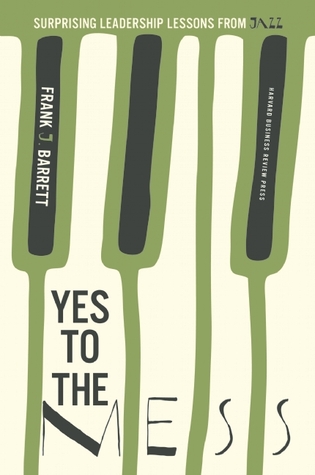
The major reason why improvisation works is that the musicians say an implicit yes to each other  – Frank J. Barrett

As with jazz soloists, so it is with organizational leaders. The competent ones hit the right notes, but the great ones are distinguished by how far ahead they are imagining and how they strategize possibilities, shape the contour of ideas, adapt and adjust in the midst of action, and resolve organizational tension.

What we need to add to our list of leadership skills is improvisation — the art of adjusting, flexibly adapting, learning through trial-and-error initiatives, inventing ad hoc responses, and discovering as you go.

Curious about the origin of “improvising,” I found the following in the dictionary:

French improviser, from Italian improvvisare, from improvviso sudden, from Latin improvisus, literally, unforeseen, from in- + provisus, past participle of providēre to see ahead

Sometimes you just have to improvise your way to clarity.

The major reason why improvisation works is that the musicians say an implicit yes to each other.

Because jazz improvisation borders on chaos and incoherence, it begs the question of how order emerges. Unlike other art forms and other forms of organized activity that attempt to rely on a pre-developed plan, improvisation is widely open to transformation, redirection, and unprecedented turns.

So it is with many jobs in organizations. They require fumbling around, experimenting, and patching together an understanding of problems from bits and pieces of experience, improvising with the materials at hand. Few problems provide their own definitive solutions.

Jazz improvisers focus on discovery in times of stress.

This is what improvisational leaders do. They come at challenges from different angles, ask more searching questions, and are born communitarians. They’re not going for easy answers or living off of old routines and stale phrases. Instead of focusing on obstacles (a form of negative self-monitoring), they create openings by asking questions that entertain possibilities.

Critically, too, improvisational leaders assume that the improv will work: that the mess is only a way station on the path to a worthwhile destination.

The message here is powerful: start by asking positive questions; foster dialogues, not monologues; and you can change the whole situation, maybe even your life.


Adapted from Say Yes to the Mess, by Frank J. Barrett

Say Yes to the Mess

Designing the DNA of the Ultimate Guest Experience for Churches

What happens when 18 of the best church Guest Experience minds in the country get together to design the DNA of the Ultimate Guest Experience for churches?


DNA1

I don’t know…

…but it’s happening over the next 4 days, so I’ll let you know next week!

Guest Experience Networking Event

Imagine a laboratory filled with 18 of the most creative church Guest Experience practitioners from around the country…


…a lab with blank walls and lots of chart tablets and markers.
…a lab surrounded by the energy and vibe of creatives at work.
…a lab stocked with snacks of every kind imaginable.
…a non-scheduled framework guided by a host but driven by participant interaction.
…a lab where Guest Experience leaders share their best practices with others.
…a collaborative learning opportunity with no limits.


GENE Therapy


The Influence of a Father: Servanthood

The true leader serves. Serves people. Serves their best interests, and in so doing will not always be popular, may not always impress. But because true leaders are motivated by loving concern rather than a desire for personal glory, they are willing to pay the price.

–  Eugene B. Habecker

 My father was born in 1927 into a rural family, the youngest of six children. It was the eve of the Great Depression, and he was helping out on the farm from an early age. As soon as he graduated from high school, he enlisted in the Army Air Corps. After his discharge, he came back to Tennessee and built a gas station, which he operated for 44 years. His life was that of hard work, long hours, and low pay.

When you think of servanthood, do you envision it as an activity performed by relatively low-skilled people at the bottom of the positional totem pole? If you do, you have a wrong impression.

Servanthood is not about position or skill – it’s about attitude.

What does it mean to embody the quality of servanthood? John Maxwell thinks a true servant leader:

  1. Puts others ahead of his own agenda
  2. Possesses the confidence to serve
  3. Initiates service to others
  4. Is not position-conscious
  5. Serves out of love

All week long I have been reflecting on the life of my father by looking at some of his character qualities including passion and integrity. This final post is a look at servanthood, and that quality, among all others, epitomized my father.

My father would not describe himself as a leader, but he was. He led quietly – to the high school boys who worked for him over the course of four decades, to the customers who came to him looking for more than just gasoline, to the church he loved and served all of his life. He was a servant leader.

Good leaders do good things. Their lives matter. Servant leaders do great things. They help others’ lives to matter by serving them. Servant leadership is great leadership.

If you want to lead on the highest level, be willing to serve on the lowest.

H. D. Adams

08/09/1927 – 02/25/2012

He made a living by what he got; he made a life by what he gave.

reflections following my father’s death two years ago, and revisited now as my mother begins a major transition in her lifestyle

The Influence of a Father: Integrity

My father had his act together.

Over the last few decades, various surveys and case studies have consistently identified honesty or integrity as the most desired characteristic in leaders. It makes sense: if people are going to follow someone, they want assurance that their leader can be trusted. They want to know that he will keep promises and follow through with commitments.

As I continue to spend this week looking back at the life of my father in his various roles of father, businessman, church leader, friend, and community leader, I have been reminded time and again that his actions matched up with his words: if he said it, it was as good as done.

My father was a product of a time and place (the Depression in the South) in which honestly was a common trait. It had to be for people to get along and survive. But I think it went beyond that: he knew and practiced the combination of ethics, morality, and integrity.

  • Ethics refers to a standard of right and wrong
  • Morality is a lived standard of right and wrong
  • Integrity means to be sound, complete, and integrated

A person can have a high or low ethic; they can also be moral or immoral. Those are choices. But if you want to have integrity, you must choose your ethics and live to match them.

My father followed the high and holy ethics of the Scriptures. By living and working by those biblical standards, he made a commitment to a certain morality. His integrity demonstrated that his actions matched his words. There is no substitute for a man of consistent Christ-like character.

Integrity doesn’t demand perfection. Even the most ethical and moral committed person can blow it. Integrity doesn’t guarantee a perfect life, but it does require an integrated life. People with integrity have a moral center that integrates their behavior. When they violate that moral center, they recognize that violation as sin and treat it as an aberration. They confess it, make restitution, seek forgiveness, and reconfirm the standard.

Where do you find yourself on the integrity scale?

Integrity is something that is earned over time. It does not come automatically with the job or the title. It begins early in our lives and careers. People tend to assume initially that someone who has risen to a certain status in life, acquired degrees, or achieved significant goals is deserving of their confidence. But complete trust is granted (or not) only after people have had the chance to get to know more about the person. The integrity foundation is built brick by brick.

The integrity of leadership is what determines whether people will want to give a little more of their time, talent, energy, experience, intelligence, creativity, and support.

High integrity earns intense commitment from others. When people perceive their leaders to have high credibility, they are significantly more likely to:

  • Be proud to tell others they are part of the organization
  • Feel a strong sense of team spirit
  • See their own personal values as consistent with those of the organization
  • Feel attached and committed to the organization
  • Have a sense of ownership for the organization

Wouldn’t you like to be the leader of an organization like that?

Get your act together.


reflections following my father’s death two years ago this week, and revisited now as my mother begins a major transition in her lifestyle

The Influence of a Father: Passion

My father never worked a day in his life.

Do not misunderstand me: my father was a hard worker. He was born on the eve of the Great Depression, the youngest of six children. He grew up on the grounds of the Hermitage, Andrew Jackson’s home, where his father was the stock keeper. He moved a couple of times before entering high school. Upon graduation, he entered the Army Air Corps and served until the fall of 1946. Upon returning home he worked in a factory for two years, when at age 22, he opened a Gulf Service Station with his brother. He continued to operate that gas station for the next 44 years, mostly by himself. The hours were long: 6 days a week, 12 hours a day.

He dealt with steaming hot cars in the summer, and worked through cold wet winters as well. His gas station opened up as a full-service station, and stayed that way for the entire 44 years. For those of you unfamiliar with the term, that means my father pumped the gas into the cars – and washed the windshields, and checked the oil in the engine, and sometimes checked the air in the tires. That’s for every car that pulled up to the gas pumps.

Looking back over my years at home, and in the years following my going off to college, starting a family, and all the way up until the close of the gas station upon his retirement in 1993, I realize now that my father never worked a day in his life.

No, he followed this advice: find something you like to do so much that you would gladly do it for nothing; then learn to do it so well that people are happy to pay you for it.

That’s what my father did: his passion for serving people by pumping their gas was his career.

Following your passion is the key to finding your potential. When a person doesn’t have passion, life can become pretty monotonous. Everything is a “have to” and nothing is a “want to.”

John Maxwell had this to say about passion:

Passion is an incredible asset for any person, but especially for leaders. It keeps us going when others quit. It becomes contagious and influences others to follow us. It pushes us through the toughest of times and gives us energy we did not know we possessed.

Passion fuels us in ways that the following assets can’t:

  • Talent…is never enough to enable us to reach our potential
  • Opportunity…will never get us to the top by itself
  • Knowledge…can be a great asset, but it won’t make us “all we can be”
  • A great team…can fall short

Passion is a real difference-maker.

For 44 years my father lived off of the energy that came from loving what he did and doing what he loved.

To most people, there is a big difference between work and play. Work is what they have to do to earn a living so that someday they can do what they want to do. Don’t live your life that way. Choose to do what you love and make the necessary adjustments to make it work in your life.

And you will never work another day in your life.

reflections following my father’s death, and revisited two years later as my mother begins a major transition in life

Leaders Should be Students of History

Usually the word “history” elicits one of two responses: a glassy-eyed stare and memories of those required classes in school that were mind-numbing, or an excited look followed by the phrase “Did you know that…”

I, proudly, am guilty of the latter.

Not content to read and study “normal” history (both my undergraduate and graduate minors are in history), I default to the obscure and strange. Who else would read books on the history of salt – or the history of dust – or the history of cod. Yes, cod. The little fish, that when salted, kept it edible for long sea voyages, allowing the “discovery” of the Americas by Europeans, among other uses (that’s a two-for-one use of history, in case you didn’t notice).

Leaders need to understand history, too.

Not just the history of books, though that’s a great start. Leaders in the local church need to know the history of the people and place they are serving. Only by understanding the past can you ever hope to lead to the future. Will Mancini, author of Church Unique and founder of Auxano, calls that “vision equity.” It’s the stories and actions over the years that have led that church to the place it is today. It’s the solid foundation that tomorrow is built on. To be ignorant of it or to ignore it is an invitation to mediocrity at best, or disaster at worst.

There is history in a place, too. Last week I was onsite for a Guest Perspective Evaluation at Cape Christian Fellowship in Cape Coral, FL. During my Saturday evening walk around of the campus, I was struck by the visual and audible impact of 3 existing water features, and 1 more in the construction phase:

IMG_5966

A simple aeration spray in the lake on the edge of the property.

IMG_5969

This beautiful waterfall is at the edge a a large grassy play area by the children’s building.

IMG_6403

This water jet fountain is the first thing you see on the path from the parking lots to the worship center.

IMG_5949

Fellowship Park, under construction. The splash fountains in the center circle will be a kids and family magnet.

These water features are part of the history – past, present, and future – of Cape Christian. They are telling a powerful story in the community.

History is a rock. Not an anchor to the past, but a bridge to the future.

Are you a student of the history of the people and place you serve? If not, there’s still time.

Class starts today.


My Favorite Books of 2013

It’s time to close out the reading year – just in time to start a new one!

A quick review of the numbers:

Purchased or review copies of books – 91

Library books checked out – 87

Kindle books downloaded – 27

That’s 205 books read in 2013, averaging almost 4 a week. I’m not a speed-reader per se, but I do read fast – and I don’t read everything in every book.

In no particular order, here are my 13 favorite books published in 2013.

Disney U: How Disney University Develops the World’s Most Engaged, Loyal, and Customer-Centric Employees, by Doug Lipp

Creative Confidence: Unleashing the Creative Potential Within Us All, by Tom and David Kelley

Red Thread Thinking: Weaving Together Connections for Brilliant Ideas and Profitable Innovation, by Debra Kaye

Shaping Our Nation: How Surges of Migration Transformed America and Its Politics, by Michael Barone

The Everything Store: Jeff Bezos and the Age of Amazon, by Brad Stone

What’s the Future of Business: Changing the Way Businesses Create Experiences, by Brian Solis

Decisive: How to Make Better Choices in Life and Work, by Chip & Dan Heath

David & Goliath: Underdogs, Misfits, and the Art of Battling Giants, by Malcolm Gladwell

Die Empty: Unleash Your Best Work Every Day, by Todd Henry

Turn This Ship Around: A True Story of Turning Followers into Leaders, by David Marquet

Leading Missional Communities, by Mike Breen

Amaze Every Customer Every Time: 52 Tools for Delivering the Most Amazing Customer Service on the Planet, by Shep Hyken

Leading the Starbucks Way: 5 Principles for Connecting with Your Customer, Your Products, and Your People, by Joseph Michelli

I realize this is a very arbitrary list, and is weighted toward the category of customer experience. No apologies there – I happen to believe that organizations of every size and type have a LOT to learn about their customers.

If you’re interested in more than just the title, read on!

Disney U, Doug Lipp

Leadership lessons from the iconic brand you can use to drive Disney-style success

In helping Walt Disney create “The Happiest Place on Earth,” Van France and his team started a business revolution in 1955 that eventually became the Disney University—the employee training and development program that powers one of the most famous brands on earth.

Disney U examines how Van France’s timeless company values and leadership expertise have turned into a training and development dynasty: the Disney U. The book reveals the heart of the Disney Culture and describes the company’s values and operational philosophies that support the world-famous Disney brand.

Creative Confidence, David & Tom Kelley

IDEO founder and Stanford d.school creator David Kelley and his brother Tom Kelley, IDEO partner and the author of the bestselling The Art of Innovation, have written a powerful and compelling book on unleashing the creativity that lies within each and every one of us.

Too often, companies and individuals assume that creativity and innovation are the domain of the “creative types.”  But two of the leading experts in innovation, design, and creativity on the planet show us that each and every one of us is creative.  In an incredibly entertaining and inspiring narrative that draws on countless stories from their work at IDEO, the Stanford d.school, and with many of the world’s top companies, David and Tom Kelley identify the principles and strategies that will allow us to tap into our creative potential in our work lives, and in our personal lives, and allow us to innovate in terms of how we approach and solve problems.  It is a book that will help each of us be more productive and successful in our lives and in our careers.

Red Thread Thinking, Debra Kaye

Success is all about connections.

Debra Kaye explodes conventional thinking about innovation and provides an approach that anyone or any business can use to expose the crucial links among observations, experiences, facts, and feelings that on the surface do not seem related–but are–to uncover fresh, brilliant insights. In Red Thread Thinking, Kaye shows you how to weave originality from disparate information and turn it into a product or service that can shake up the marketplace–and your business.

What sets Red Thread Thinking apart from other books is that it reveals exactly how to identify and understand hidden cultural codes and shifts in consumer perceptions that speak to emerging and existing markets and, as a result, catapult fresh products to iconic status.

A mold-breaking system, Red Thread Thinking sharpens your innovation skills and can assist in problem solving, whether preparing a talk, pitching a project to your colleagues and boss, managing staff in a more productive way, or taking business to a new level.

Shaping Our Nation, Michael Barone

It is often said that America has become culturally diverse only in the past quarter century. But from the country’s beginning, cultural variety and conflict have been a centrifugal force in American politics and a crucial reason for our rise to power.

The peopling of the United States is one of the most important stories of the last five hundred years, and in Shaping our Nation, bestselling author and demographics expert Michael Barone illuminates a new angle on America’s rise, using a vast array of political and social data to show America is the product of a series large, unexpected mass movements—both internal and external—which typically lasted only one or two generations but in that time reshaped the nation, and created lasting tensions that were difficult to resolve.

Sweeping, thought-provoking, and ultimately hopeful, Shaping Our Nation is an unprecedented addition to our understanding of America’s cultural past, with deep implications for the immigration, economic, and social policies of the future.

The Everything Store, Brad Stone

Amazon.com started off delivering books through the mail. But its visionary founder, Jeff Bezos, wasn’t content with being a bookseller. He wanted Amazon to become “the everything store,” offering limitless selection and seductive convenience at disruptively low prices.

To do so, he developed a corporate culture of relentless ambition and secrecy that’s never been cracked. Until now. Brad Stone enjoyed unprecedented access to current and former Amazon employees and Bezos family members, giving readers the first in-depth, fly-on-the-wall account of life at Amazon. Compared to tech’s other elite innovators–Jobs, Gates, Zuckerberg–Bezos is a private man. But he stands out for his restless pursuit of new markets, leading Amazon into risky new ventures like the Kindle and cloud computing, and transforming retail in the same way Henry Ford revolutionized manufacturing.

What’s the Future of Business, Brian Solis

Rethink your business model to incorporate the power of “user” experiences.

What’s the Future of Business? will galvanize a new movement that aligns the tenets of user experience with the vision of innovative leadership to improve business performance, engagement, and relationships for a new generation of consumerism. It provides an overview of real-world experiences versus “user” experiences in relation to products, services, mobile, social media, and commerce, among others. This book explains why experience is everything and how the future of business will come down to shared experiences.

Discover how user experience design affects your business, and how you can harness its power for meaningful revenue growth.

Decisive, Chip & Dan Heath

Chip and Dan Heath, the bestselling authors of Switch and Made to Stick, tackle one of the most critical topics in our work and personal lives: how to make better decisions.

Research in psychology has revealed that our decisions are disrupted by an array of biases and irrationalities: We’re overconfident. We seek out information that supports us and downplay information that doesn’t. We get distracted by short-term emotions. When it comes to making choices, it seems, our brains are flawed instruments. Unfortunately, merely being aware of these shortcomings doesn’t fix the problem any more than knowing that we are nearsighted helps us to see. The real question is: How can we do better?

In Decisive, the Heaths, based on an exhaustive study of the decision-making literature, introduce a four-step process designed to counteract these biases. Written in an engaging and compulsively readable style, Decisive takes readers on an unforgettable journey, from a rock star’s ingenious decision-making trick to a CEO’s disastrous acquisition, to a single question that can often resolve thorny personal decisions.

Along the way, we learn the answers to critical questions like these: How can we stop the cycle of agonizing over our decisions? How can we make group decisions without destructive politics? And how can we ensure that we don’t overlook precious opportunities to change our course? 

Decisive is the Heath brothers’ most powerful—and important—book yet, offering fresh strategies and practical tools enabling us to make better choices. Because the right decision, at the right moment, can make all the difference.

David & Goliath, Malcolm Gladwell

Three thousand years ago on a battlefield in ancient Palestine, a shepherd boy felled a mighty warrior with nothing more than a stone and a sling, and ever since then the names of David and Goliath have stood for battles between underdogs and giants. David’s victory was improbable and miraculous. He shouldn’t have won.

Or should he have?

In David and Goliath, Malcolm Gladwell challenges how we think about obstacles and disadvantages, offering a new interpretation of what it means to be discriminated against, or cope with a disability, or lose a parent, or attend a mediocre school, or suffer from any number of other apparent setbacks.

Gladwell begins with the real story of what happened between the giant and the shepherd boy those many years ago. From there, David and Goliath examines Northern Ireland’s Troubles, the minds of cancer researchers and civil rights leaders, murder and the high costs of revenge, and the dynamics of successful and unsuccessful classrooms—all to demonstrate how much of what is beautiful and important in the world arises from what looks like suffering and adversity.

Die Empty, Todd Henry

Most of us live with the stubborn idea that we’ll always have tomorrow to do our most important and valuable work. We fill our days with frantic activity, bouncing from task to task, scrambling to make deadlines and chase the next promotion. But by the end of each day we’re often left asking ourselves “did the work I do today really matter?” We feel the ticking of the clock, but we’re stuck in first gear, unsure of the path forward and without a road map to guide us.

Here’s the hard truth: sooner or later all of our tomorrows will run out, so how we choose to spend today is significant. Each day that we postpone difficult tasks and succumb to the clutter that chokes creativity, discipline, and innovation results in a net deficit to the world, our organizations, and ourselves.

Die Empty is a tool for people who aren’t willing to put off their most important work for another day. Todd Henry explains the forces that keep us in stagnation, and introduces a process for instilling consistent practices into your life that will keep you on a true and steady course.

It’s not about slaving over a project or living on a whim–it’s about embracing the idea that time is finite and making the unique contribution to the world that only you can make. Henry shows how to cultivate the mindset and the methods you need to sustain your enthusiasm, push through mental barriers, and unleash your best work each day.

Turn This Ship Around, David Marquet

David Marquet, an experienced Navy officer, was used to giving orders. As newly appointed captain of the USS Santa Fe, a nuclear-powered submarine, he was responsible for more than a hundred sailors, deep in the sea. In this high-stress environment, where there is no margin for error, it was crucial his men did their job and did it well. But the ship was dogged by poor morale, poor performance, and the worst retention in the fleet.

Marquet acted like any other captain until, one day, he unknowingly gave an impossible order, and his crew tried to follow it anyway. When he asked why the order wasn’t challenged, the answer was “Because you told me to.” Marquet realized he was leading in a culture of followers, and they were all in danger unless they fundamentally changed the way they did things.

That’s when Marquet took matters into his own hands and pushed for leadership at every level. Turn the Ship Around! is the true story of how the Santa Fe skyrocketed from worst to first in the fleet by challenging the U.S. Navy’s traditional leader-follower approach. Struggling against his own instincts to take control, he instead achieved the vastly more powerful model of giving control.

Before long, each member of Marquet’s crew became a leader and assumed responsibility for everything he did, from clerical tasks to crucial combat decisions. The crew became fully engaged, contributing their full intellectual capacity every day, and the Santa Fe started winning awards and promoting a highly disproportionate number of officers to submarine command.

No matter your business or position, you can apply Marquet’s radical guidelines to turn your own ship around. The payoff: a workplace where everyone around you is taking responsibility for their actions, where people are healthier and happier, where everyone is a leader.

Leading Missional Communities, Mike Breen

Missional Communities (MCs) are a hot topic right now in the church, and many are excited about the potential of MCs to be a vehicle that allows the church to better live out its mission in the world. But if we embrace and implement MCs merely as a new program, they won’t live up to their potential and we’ll be on to the next hot topic in a few months. MCs are helpful only if we use them as a vehicle that allows us to point ourselves towards a much deeper issue: how we can learn to live our everyday lives as extended families on mission.

Breen calls this reality oikos (“household” in Greek), and that’s actually what this book is about. Think of it like this: an MC is a great vehicle, but vehicles are supposed to take you somewhere. The destination the vehicle of MC takes us to is oikos. Breen believes oikos is something the Spirit of God is doing in this time to restore the church’s ability to function fruitfully in discipleship and mission the way the early church did, publicly living out this is the make-or-break issue for the Western church.

Breen believes we simply will not see God’s dream for the world come true unless we learn how to function as extended families on mission. And MCs are a great vehicle that helps jump-start that culture-shifting process. Breen began using MCs over 25 years ago, and has seen both breakthrough and failure.

The great thing is that it isn’t actually that complicated, and God will give us the power to do it. This isn’t a task reserved for church leaders, pastors, or experts—it’s for everyone! The goal is to learn how to function as an extended family on mission.

Amaze Every Customer Every Time, Shep Hyken

You must deliver an amazing customer experience. Why? It is the competitive edge of new-era business—in any market and any economy.

Renowned customer experience expert Shep Hyken explains how consistently amazing customers through stellar service can elevate your company from good to great. All transformations require a role model, and Shep has found the perfect role model to inspire your team: Ace Hardware. Ace was named as one of the top ten customer service brands in America by BusinessWeek and ranked highest in its industry for customer satisfaction. Through revealing stories from Ace’s over-the-top work with customers, Shep explores the five tactical areas of customer amazement: leadership, culture, one-on-one, competitive edge, and community.

Delivering amazing service requires everyone in your organization to step up and be a leader. It doesn’t take a title. It takes the right set of tools and principles. To help you empower employees at all levels, Shep brings the content to a deeply practical level. His 52 Amazement Tools—like “Ask the extra question” and “Focus on the customer, not the money”—are simple, clear, useful for almost anybody, and supported with compelling research and stories.

In Amaze Every Customer, you will find the tools and tactics you need to transform your company into a seriously customer-focused operation that will amaze every customer every time.

Leading the Starbucks Way, Joseph Michelli

One of the best-recognized and admired brands in the world, Starbucks singlehandedly transformed the ordinary delivery of coffee into a cultural phenomenon–a result of the company’s exemplary leadership practices.

Joseph Michelli, author of the bestseller The Starbucks Experience, explains that the international success of Starbucks begins with a promise: To inspire and nurture the human spirit–one person, one cup, and one neighborhood at a time. Michelli offers a perspective on the leadership principles that drove the iconic coffee company’s resurgence from serious setbacks during the economic downturn–one of the few true turnaround stories of this time. And the company continues to grow dramatically, entering new markets and channels with fresh products and technologies.

In Leading the Starbucks Way, Michelli establishes five actionable principles that fuel long-term global sustainability at Starbucks and that can be used in any company, in any industry:

  • Savor and Elevate
  • Love to Be Loved
  • Reach for Common Ground
  • Mobilize the Connection
  • Cherish and Challenge Your Legacy

Leading the Starbucks Way is a penetrating look at the inner workings of one of today’s most successful brands. The company gave Michelli one-on-one access to a variety of employees (called partners) to write this book–from baristas to senior leaders, including Howard Schultz, chairman, president, and chief executive officer.

Well, that’s it – it’s time to close out the “books” on 2013…

…I’ve got a few books ready to pick up at the library, and a couple on order scheduled to be released this week!

Think Urgency, Not Panic

Note: During the current “stay-at-home” mandates and other restrictions in place across the country, I am diving back into 11 years of posts, articles, and reviews across my different websites to bring back timely information for today.


Due to family genetics plus a serious passion for chocolate, I have to be concerned about my cholesterol. One of the first things I learned was that there was “good” and “bad” cholesterol, and that to be healthier, I needed to increase the good and decrease the bad.

According to noted leadership guru John Kotter, there are also two kinds of urgency – and like cholesterol, one is good and one is bad. The good kind is characterized by constant scrutiny of external promise and peril. It involves relentless focus on doing only those things that drive your organization forward, and doing them right now, if not sooner. The bad kind, which has been on everyone’s mind for months now, is panic-driven and characterized by frantic activity which generates a lot of heat and motion but no substance.

Interviewed in an Inc. magazine article, and recalling sections of his book A Sense of Urgency, Kotter thinks that most of what we see now is a lot of people running around trying to come up with solutions. Calling that “ineffectual at best,” he feels this type of activity is driven by a fear of losing. Want to change that? Develop a gut-level determination to win and to make absolutely sure that you and your leaders do something every single day to keep pushing your goal forward. That, Kotter says, is true urgency.

What about ChurchWorld? What do you see when you look around? Frenetic activity? Totally exhausted leaders, working long hours trying to keep ministry efforts going? Difficulty in scheduling meetings to work things out? Check this thought out: true urgency will cause people to leave plenty of white space on their calendars, because they recognize the important stuff – the stuff they need to deal with immediately – is going to happen, most times unplanned.

That’s exponentially true in the ministry world. Interruptions and people in crisis are our ministry, and only if you have margin in your life can you deal effectively and with Christ-like love.

Don’t panic – but lead with urgency.

True urgent leadership doesn’t drain people, but energizes them. It makes them feel excited to be a part of an organization that is moving forward with purpose, even audacity, in times like these. Now that’s a group I want to be a part of!

inspired by, and adapted from, A Sense of Urgency, by John Kotter

A Sense of Urgency