Bridging the Digital Divide, Part 2

The brains of those who are digitally connected are different from those who are not. Here’s how Marilee Sprenger, author of “The Leadership Brain for Dummies,” sees this divide:

courtesy facebook.com

courtesy facebook.com


Some Traditionalists (born before WW II), many Baby Boomers (born 1945-1964), and the early Gen Xers (born 1965-through the 70s) fall into the category of digital immigrants. They didn’t grow up learning the second language of the digital world and speak it with varying degrees of fluency.

Many digital immigrants:

  • Insist on paper bills even though receiving copies via email
  • Print out emails and attachments
  • Rely on printed newspapers, books, and so on
  • Are somewhat leery of paying bills online
  • Believe that methods taught years ago should work for everyone
  • Don’t understand the informal language used in emails and texts
  • Believe a social network consists of people he meets with for parties

Digital immigrants have much to offer to your organization. Wisdom derived from years of storing patterns in the brain gives them the ability to see the big picture, predict accurately, foresee future consequences, and draw on mental templates to help store new information.

Challenging tasks activate more areas in the frontal lobes of the brains of digital immigrants than in the brain of digital natives. The immigrants have little choice because their brains change as they increase their skills with technology. The natives may need to practice more skills that their brains haven’t used very much, like building rapport face to face.

How do you lead digital natives and immigrants to work together?

Next: Bridging the Digital Divide, Part 3

inspired by The Leadership Brain for Dummies, by Marilee Sprenger

Leadership Brain for Dummies

Bridging the Digital Divide

Using the Leadership Brain to Understand Generational Differences

Marilee Sprenger, author of “The Leadership Brain for Dummies,” does a good job of outlining the differences in organizations that have multiple generations involved – like the church.

This post isn’t about that – you’ll have to read her book on page 223 to understand those differences. Instead, let’s take a look at the digital divide.

courtesy resetsanfrancisco.org

courtesy resetsanfrancisco.org

The brains of those who are digitally connected are different from those who are not. Since your organization has different kinds of brains working together, maybe you should understand a little about it.

The Digital Native

Today’s world requires a new language and a new literacy – digital literacy. The late Generation X’ers (born in the late 70’s) and the generations that follow them are digital natives – they speak the language well. These people have grown up with video games, cell phones, computers, the Internet, and other techno toys. The ABCs of learning have been replaced with the XYZs of technology.

The digital natives grew up communicating in a very different and fast-paced way from their parents and older siblings. They’re proud of their ability to come up with hard data quickly and easily. It’s a wide learning gap between these generations and the prior ones.

The digital natives who believe that their world isn’t complete if they aren’t constantly connected are always trying to multitask (you can’t, but that’s another post). They’re always working hard, switching from one task to another and back again without skipping a beat.

Former Microsoft executive Linda Stone called this problem continuous partial attention.

Not truly giving anything complete attention has a number of negative effects, not the least of which is the inability to accomplish anything! Efforts to stay connected may prohibit you from bringing deep thought and closure to any one project, which may lead to stress. Elevated stress leads to distraction which starts the cycle over again.

Recognize yourself?

Next: Bridging the Digital Divide, Part 2

inspired by The Leadership Brain for Dummies, by Marilee Sprenger

Leadership Brain for Dummies

SMART or SAFE? Setting Goals and the Leadership Brain

Goal setting is vital to the success of every team – and the process also increases brain performance. According to neuroscience consultant Marilee Sprenger in ” The Leadership Brain for Dummies,” the brain sees goal-setting as an extension of itself – it takes ownership of the goal and the accomplishment.

But what do you do when your team has different kinds of “brains” trying to set goals? Could it be that you need to consider two kinds of goals?

The SMART approach to goal-setting is linear, logical, and very left-brain oriented. Those teams that think in a left-brained format appreciate this type of goal setting because it is easy to track and measure. SMART goals are:

  • Specific – each goal specifies your target exactly.
  • Measurable – each goal must be measurable so you know when you’ve reached it – or not.
  • Achievable – a goal that is within reach increases motivation and those brain chemicals that keep you motivate.
  • Realistic – a realistic goal is one your team has the resources to realize.
  • Time – specific time frames provide clear deadlines for action.

But what about teams that aren’t as left-brained? How do they set goals? Consider SAFE goals. Approaching goals in a nonlinear manner appeals more to the right hemisphere of the brain. If your team members are creative, visual, and right-brain dominant, consider SAFE goals:

  • See it – see yourself working toward the goal; then picture it already achieved.
  • Accept it – accept that you can achieve the goal, and picture what that looks like.
  • Feel it – adding emotion to your visualization is very powerful: feel good about your accomplishment; enjoy the satisfaction of a job well done.
  • Express it – visualize yourself telling others about the accomplishment of the goal; make presentations at team meetings about your contribution to the success.

The SAFE method is especially good for those brains that need to have the big picture in order to accept the fact that they can in fact accomplish their goals.

So, does your team need SMART or SAFE goals? Or a combination of both?

As leader, it’s your job to know the difference and lead accordingly!

Next: Bridging the Digital Divide


inspired by The Leadership Brain for Dummies, by Marilee Sprenger

Leadership Brain for Dummies

Brain Science and Decision-Making

Making good decisions under a variety of circumstances is a critical leadership skill. Your brain works differently to decide when you have little time than it does when you can consider your options.

courtesy tvblogs.nationalgeographic.com

courtesy tvblogs.nationalgeographic.com

Marilee Sprenger, author of “The Leadership Brain for Dummies,”, offers the following ideas to help you make the best decision when you have the time to research the situation:

  • Clearly define the problem – exactly define the challenge
  • Gather all the data related to the problem – enlist your team’s help
  • List all possible solutions – even the crazy ones
  • Consider the consequences of each solution – with a little thought, the right solution may turn out to be a disaster in waiting

When you’re making decisions with little time:

  • Consider previous situations – the decisions you made in that situation probably apply to the current one
  • Look to the future impact – even when pressed for time, considering the ramifications of your choice is critical
  • Gather as much information as you can
  • Listen to your instincts – as well as your logic

Making good choices is a matter of gathering input from all areas of your brain. Understanding how your brain processes information – even in a time crunch – will help you make better decisions.

Next: SMART or SAFE?

inspired by The Leadership Brain for Dummies, by Marilee Sprenger
Leadership Brain for Dummies

Feed Your Brain

I always thought Cherry Coke and a Hershey’s bar was brain food, but neuroscience is proving me wrong.

courtesy nu-spoon.com

courtesy nu-spoon.com

Marilee Sprenger, author of “The Leadership Brain for Dummies,” thinks that our leadership brains can be nourished so that they excel. You can provide great leadership and brain “nourishment” for your team by:

  • Providing training opportunities – on the job, onsite, offsite, virtually – you name it. Learning never stops, and the brain thrives on it.
  • Conducting personal meetings – by letting team members know you value their contributions, they are secure and will be more productive.
  • Keeping stress levels low – high stress interferes with the brain’s functions; offer coaching, mentoring, and partnering programs to help your team thrive without stressing out.
  • Celebrating successes – big or small, celebrations help teams bond. Make them regular and special; after all, humans are social animals.
  • Connecting teamwork and the organizational goals – help your team’s brains make pathways to work more efficiently.
  • Promoting life outside of work – emphasize exercise, rest, and family time; without breaks, the brain can’t work at its best.

Tomorrow: Using Your Leadership Brain in Decision-Making

 
inspired by The Leadership Brain for Dummies, by Marilee Sprenger
Leadership Brain for Dummies

I Like Dummies…

… the books, that is.

Dummies Man

courtesy thefinancialcoach.co.za

I’ve been a big fan of the “Dummies” books for a long time. I own at least 15 and have read many more – they serve as great introductions to a new topic and help chart a course for expanded learning later on.

I guess you could say they are like Cliff Notes on steroids – or is that mixing too many metaphors?

For instance, when our youngest son decided to give rugby a try after 14 years of playing soccer, it was “Rugby for Dummies” to the rescue. From a brief history of the game to key terms to strategy, after a few nights reading I felt somewhat knowledgeable about the game and could appreciate the fact that my son was a hooker. That’s another story.

A couple of years ago, I became aware of a book by John Medina entitled “Brain Rules”, a fascinating study of how the latest studies in neuroscience were helping us understand more about our brains. After reading though that book, I wanted to learn more about brain science.

Enter “The Leadership Brain for Dummies.” Author Marilee Sprenger translates the recent abundance of brain science into leadership principles which help your team keep operating at its best.

Applying Brain Science to Leadership

When you lead with the brain in mind, you address the structures of the brain and its needs. Scientists commonly consider the brain as a structure with three separate “brains” that have their own specialized jobs. Understanding how these different brains work and what they need enable you to better relate to and lead your team.

  • The survival brain wants safety and security. In a nutshell, its job is to keep you alive, and so it’s always on the lookout for changes in the environment that might put you in jeopardy. You address this brain’s needs by providing a predictable ans stable workplace – agendas, schedules, information, and procedures.
  • The emotional brain deals not just with emotion but memory. You help keep this brain moving along by being socially aware (noting your feelings but not letting them rule you), and you put it to work for you by giving your team an emotional connection to training. Any information that is connected to an emotion has a better chance of becoming a long-term memory. Also, remember that your emotions are contagious – whatever you are feeling will spread to your team.
  • The thinking brain handles the brain’s executive functions: decision-making, future planning, judgment, and emotional control. The brain learns through feedback. Change your team’s minds by providing immediate, constructive feedback.

Tomorrow: Feed Your Brain


inspired by The Leadership Brain for Dummies, by Marilee Sprenger

Leadership Brain for Dummies


Doing Daily Battle with the Curse of Knowledge

My name is Bob Adams, and I’m a knowledge addict.

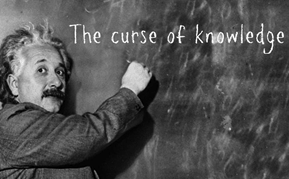
As such, I also suffer from the Curse of Knowledge. Best documented by Chip and Dan Heath in their excellent book Made to Stick, it is defined as:

Once we know something, we find it hard to imagine what it was like not to know it.

Our knowledge has  “cursed” us.
Curse of Knowledge

courtesy schneiderb.com

The Heaths recount a famous study done in 1990 by Elizabeth Newton as she earned a PhD in psychology at Stanford. She created a simple game in which she assigned people to one of two roles: “tappers” or “listeners”.

Tappers received a list of twenty-five well-known songs, such as “Happy Birthday to You” and “The Star-Spangled Banner.” Each tapper was asked to pick a song and tap put the rhythm to a listener by knocking on a table. The listener’s job was to guess the song based on the rhythm being tapped.

The listener’s job in this game is quite difficult. Over the course of Newton’s experiment, 120 songs were tapped out. Listeners guessed only 2.5% of the songs: 3 out of 120.

The real revelation came by what happened before the tapping game: When Newton asked the tappers to predict the odds that the listeners would guess correctly, they predicted the odds at 50%.

Fail.

The problem is that the tappers have been given knowledge (the song title) that makes it impossible for them to imagine what it’s like to lack that knowledge.

When they’re tapping, they can’t imagine what it’s like for the listeners to hear isolated taps rather than song.

That, my friends, is the Curse of Knowledge.

Once knowing something, it becomes difficult for us to share our knowledge with others, because we can’t readily re-create our listeners’ state of mind.

Becoming an expert in something means that we become more and more fascinated by nuance and complexity. That’s when the Curse of Knowledge kicks in, and we start to forget what it’s like not to know what we know.

Novices at anything perceive concrete details as concrete details. Experts perceive concrete details as symbols of patterns and insights that they have learned through years of experience. Because they are capable of seeing a higher level of insight, they naturally want to talk on a higher level.

That, most likely, leads to communication problems.

When you have worked for years in your particular area of specialty, it’s easy to forget that a lot of the world has never heard of your particular area of specialty, or at least at the depth you want to discuss it.

It’s easy to forget that you’re the tapper and the world is the listener.

How can you overcome the Curse of Knowledge?

The Heaths offer a couple of suggestions:

  • Giving our audience permission to ask “Why” as many times as necessary helps to remind us of the core values and principles that underlie our ideas and forces us to backtrack to the foundation of our passion.
  • Stories can almost single-handedly defeat the Curse of Knowledge. Stories have an amazing dual power to simulate and to inspire. Look for the good ones that life generates every day to get to the heart of the issue.

As for me, I will always have the Curse of Knowledge – I’m driven to learn more and more about many different topics. I don’t think there’s anything wrong with that. My passion and my vocation intersect in my job: as the Vision Room Curator for Auxano, I’m expected to dive daily into the vast and expanding knowledge pool out there…

…I’ve just got to remember that I’m a tapper, and you’re a listener. 

inspired by Made to Stick, Chip and Dan Heath

Made to Stick

Is It Time for an “Orange Revolution” in Your Organization?

If you asked who invented incandescent electric light, and you answered Thomas Edison, you’d be right – and you’d be wrong.Edison lightbulb

On October 22, 1879, the remarkable bulb dreamed up by Edison, drawn by lead experimenter Charles Batchelor, mathematically proved by Francs Upton, built by craftsmen John Kruesi and Ludwig Boehm, and tested by experimenters John Lawson, Martin Force, and Francis Jehl, burned for thirteen and a half hours.

Darkness had been illuminated forever.

The revolution that Thomas Edison wrought was the product of a team, in spite of how history books tell the story. We love the idea of a lone genius, the mastermind, the hero. We’re indoctrinated from an early age with the single-achiever ideal in school. For a fifth-grader, it’s easy to say Edison = light bulbs.

The reality is very different; geniuses build great teams.

Edison – one of the most brilliant minds in the world – accepted that he alone did not possess all the answers; but together, his team usually did.

What would you do to have a high-performing team that generates its own momentum – an engaged group of colleagues in the trenches, working passionately together to pursue a shared vision?

How about starting a revolution?

orange revolution 1For centuries the color Orange has been connected with revolutionary events. Most recent are the election events in the Ukraine, but there have also been Orange uprising in Ireland, China, England, and the Netherlands.

These revolutions signaled a transition – a spirited quest driven by people to improve the world around them.

Why shouldn’t your organization possess that same passion when it comes to creating, strengthening, and enlarging the teams that serve?

You can begin an Orange Revolution in the hearts of your team members and leaders focusing on conquering barriers, expectations, and stagnation.

Welcome to the revolution.

I will be leading The Orange Revolution at WFX in Dallas October 2-4. For an overview of WFX, go here. To learn more about the education and training available, go here.

Stay tuned for more on The Orange Revolution coming soon!

Boundaries for Leaders: Results, Relationships, and being Ridiculously in Charge

In the end, as a leader, you are always going to get a combination of two things: what you create and what you allow.  – Henry Cloud

According to clinical psychologist and leadership consultant Henry Cloud, boundaries are made up of two essential things: what you create and what you allow.

A boundary is a property line. Boundaries for LeadersIt defines where your property line begins and ends. If you think about your home, on your property, you can define what is going to happen there and what is not.

As the leader of an organization – a small group, a team, a department, maybe even the whole organization – you are responsible for the boundaries of that organization:

  • The people you invite in
  • What the goals and purposes are going to be
  • What behavior is going to be allowed – and what isn’t
  • The culture
  • The agenda
  • The rules

The leaders’ boundaries define and shape what is going to be and what isn’t.

In Boundaries for Leaders, Dr. Cloud leverages his expertise of human behavior, neuroscience, and business leadership to explain how the best leaders set boundaries within their organizations–with their teams and with themselves–to improve performance and increase employee and customer satisfaction.

In a voice that is motivating and inspiring, Dr. Cloud offers practical advice on how to manage teams, coach direct reports, and instill an organization with strong values and culture.

Boundaries for Leaders contains seven leadership boundaries that set the stage, tone, and culture for a results-driven organization, including how to:

  • Help people focus their attention on the things that matter most
  • Build the emotional climate that drives brain functioning
  • Facilitate connections that boost energy and momentum
  • Create organizational thought patterns that limit negativity and helplessness
  • Identify paths for people to take control of the activities that drive results
  • Create high-performance teams organize around the behaviors that drive results
  • Lead yourself in a manner that protects the vision

Boundaries for Leaders is essential reading for executives and aspiring leaders who want to create successful companies with satisfied employees and customers, while becoming more resilient leaders themselves.


part of the BookNotes Series – brief excerpts from books I am currently reading

What’s In Your Leadership Garden?

The planting season is in full bloom across the Carolinas.

What do you think about carrots for your garden?

In this case, it’s not the orange root vegetable long-rumored to help your eyesight. And it’s not a plot of freshly turned dirt in your backyard.

The “carrot” in this case is from the carrot and stick idiom, the origins of which involve dangling a carrot from a stick in front of a work animal to keep him moving forward.

Actually, a much nicer picture is that advanced by recognition consultants Adrian Gostick and Chester Elton in their best-selling series of Carrot books.

Carrot Principle Accelerator

How about this:

  • Seed – Set clear goals

  • Plant – Communicate openly

  • Nurture – Build trust

  • Weed – Hold everyone accountable

  • Harvest – Recognition that leads to acceleration of team performance and engagement

I don’t have a green thumb, but I do believe Gostick and Elton have hit “pay dirt” with this concept…

An ongoing series exploring the power of teamwork

Inspired by:

Midnight Lunch, written by Sarah Miller Caldicott

The Orange Revolution, written by Adrian Gostick & Chester Elton

Creating We, written by Judith Glaser