When Moses Isn’t Around, You Have to Create Your Own Miracle

According to the authors of Solving Problems with Design Thinking, most managers they meet harbor a deep, dark secret: They believe in their hearts that they are not creative.

In today’s seemingly rampant innovation mania, managers and leaders cannot appear unimaginative, let alone fail to come up with brilliant solutions to vexing problems on a whim.

For most of us there will be no Moses-like parting of the waters of the status quo that we might safely cross the Red Sea of innovation. Drowning is more likely our fate.     – from Solving Design Problems

There is hope.

Instead of trying to part the waters, leaders need to build a bridge to take us from the current reality to a new future.

In other words, we must manufacture our own miracles.

According to Liedtka et al, the technology for better bridge building already exists, right under our noses. What to call it is a matter of dispute, but they call it design thinking.

This approach to problem solving is distinguished by the following attributes:

  • It emphasizes the importance of discovery in advance of solution generation using market research approaches that are empathetic and user driven
  • It expands the boundaries of both our problem definition and our solutions
  • It is enthusiastic about engaging partners in co-creation
  • It is committed to conducting real-world experiments rather than just running analyses using historical data

And it works.

Design thinking is capable of reliably producing new and better ways of creatively solving a host of organizational problems.

inspired by and adapted from Solving Problems with Design Thinking by Jeanne Liedtka, Andrew King, and Kevin Bennett
 Solving Problems with Design Thinking

For further reading:

Why Design Thinking?

What If Leaders Thought Like Designers?

Leaders Need to Work Our of Both Sides of Their Brains

Transformation Hurts

If you are comfortable where you are, or if things are okay as they are, you wouldn’t go through transformation.

Only when the pain of changing things overcomes the pain of status quo would you ever consider transformation.

That’s where Starbucks found itself in early 2008. Chronicled in CEO Howard Schultz’s 2011 book Onward, Starbucks – at the apparent height of its success – was declining inwardly, and on the edge of declining outwardly. Onward details the transformation Starbucks went through in 2008-2010, utilizing a Transformation Agenda developed by the senior leadership team at Starbucks as the primary guide.

The Transformation Agenda featured 7 “Big Moves” – innovations and advancements designed to return Starbucks to its core practices. The Big Moves also contained one final, painful set of actions designed to reverse sales trends and bolster stock value.

600 stores closed.

12,000 partner positions eliminated in these stores.

1,000 non-store positions eliminated.

Schultz called it the most painful decision he has ever made. Only the certainty that closing the stores would keep Starbucks operational in the long run allowed him to make the decision. He understood the reasoning, but it was impossible to take the emotion out of the equation:

For all the flak about Starbucks’ ubiquity, almost every store maintained a devoted following inside and out. A soul. With each closing, we would be erasing a fingerprint, and that was a reality I could not possibly ignore.

Fast forward to the fall of 2010: Starbucks regained a healthy balance with a culture that celebrates creativity and discipline, entrepreneurship and process, as well as rigorous innovation. Their fiscal 2010 operating margin was the highest consolidated one in their 40-year history. The transformation worked.

But according to Schultz,

…perhaps the most valuable thing that came out of the two-year transformation was the confidence we gained knowing that we could preserve our values despite the hardships we faced. Holding fast to those values steadied us throughout the tumultuous journey, and the ways in which we conduct our business will continue to bring our partners pride and fuel their engagement as we continue to grow.

Success is not sustainable if it’s defined by how big you become. Large numbers are not what matter. The only number that matters is “one.”

brewed coffee in cup

One cup.

SB customer

One customer.

barista handing drink over counter

One partner.

SB interior

One experience at a time.


Question for ChurchWorld leaders:

What’s your “one”?

an updated post from a series reviewing Onward, by Howard Shultz

Onward

preparation for a new series coming soon on Leading the Starbucks Way, by Joseph Michelli

Print

Transformation Initiatives at Starbucks

A previous post was a brief look at the bold Transformation Agenda that Starbucks put into place early in 2008 to overcome their decline. The Agenda contained a mission statement and 7 Big Moves designed to return Starbucks to success.

Within a few months, at their April 2008 shareholders meeting, Starbucks rolled out the following six transformation initiatives:

  • The Mastrena – a finely crafted, Swiss made espresso machine that would provide baristas with the ability to give customers a high-quality consistent shot of espresso second to none, transforming the espresso experience in their stores. By the end of 2008 the machine was in 30% of stores, and by 2010 a majority of Starbucks had the Mastrena.
  • Conservation International – a partnership with CI, begun in 1998, was expanded so that Starbucks could buy fair-trade coffee, produced in shade-grown conditions with fair compensation and safe working conditions for coffee farm workers. By 2009, all Starbucks espresso beans and espresso-based products would qualify for a new marking designed to articulate their practices: Responsibly Grown. Ethically Traded. Proudly Served.
  • The Rewards Card – designed to recognize their most loyal customers with freebies, the Card addressed an emerging need for value. Existing Starbucks Card holders could register their cards online, instantly turning it into a Rewards Card.
  • MyStarbucksIdea.com – an interactive website designed to listen to customers suggestions, rants, and comments. Moderated by 50 veteran Starbucks employees, the website was launched live by uploading ideas submitted by shareholders that morning. Within minutes, more ideas came streaming in from people listening to the meeting’s broadcast or following rolling blog posts. In the next 24 hours, over 7,000 ideas were posted.
  • Pike Place Roast – announcing that Starbucks would once again grind whole beans in their stores, two master baristas introduced Pike Place Roast, a smooth, well-balanced, lighter blend of coffee, designed to give full flavor while not being as bold as traditional blends.
  • Clover – a commercially viable way to replicate the benefits of the French Press method of brewed coffee, Clover was a local invention acquired by Starbucks early in 2008. It created a fantastic cup of coffee at a pace designed to keep up with the demand of most Starbucks stores.

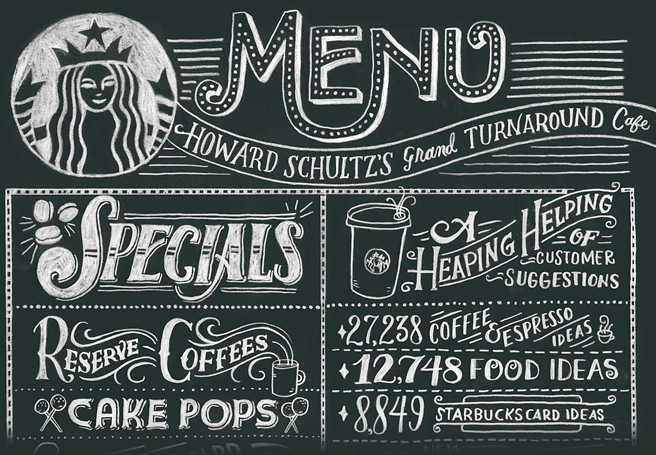
SB turnaround menu fastcompany.com

Seven Big Moves.

Six Transformation Initiatives.

All of these engaging tools that helped Starbucks navigate through a very unpredictable journey, one milestone at a time.

The initiatives introduced at that meeting each heralded a return to the core values of Starbucks – coffee, customers, innovation, and values – but they weren’t enough by themselves to bring the company back from the brink.

Painfully personal decisions were the final step in the transformation.

Lessons for ChurchWorld

  • Take a look at the initiatives above, and translate them into your world. What actions can you dream up – and then put into action – that would help you accomplish your transformation agenda?
  • Are you secure enough in your core values to put anything – and everything – on the table?
  • Transformation is not just about nuts and bolts, about systems and processes. Is your vision lived out in the lives of your people?

an updated post from a series reviewing Onward, by Howard Shultz

Onward

preparation for a new series coming soon on Leading the Starbucks Way, by Joseph Michelli

Print


Transformation Agenda

Continuing the transformation journey at Starbucks – and what it can teach your organization…

Once Starbucks Chairman Howard Schultz decided to return as CEO, he pulled together a team to began working on the process of turning the company’s performance around.

As noted in this post, one of the team’s key realizations was the need to focus on the ones: one cup of coffee, served to one customer, at one store. That thought drove the team to draft a transformation agenda that would be used company-wide to implement decisions.

The Transformation Agenda started with a compelling strategic vision, and was followed by a backbone of seven big moves, each with specific tactics. Here’s a synopsis:

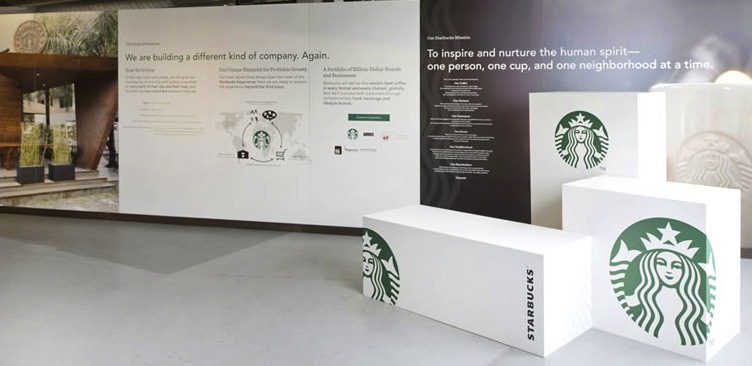
Our Aspiration – To become and enduring, great company with one of the most recognized and respected brands in the world, known for inspiring and nurturing the human spirit.

courtesy touchworldwide.com

courtesy touchworldwide.com

Seven Big Moves

  • Be the undisputed coffee authority – Starbucks could not possibly transform the company if they did not excel and lead in their core business. Focusing on their quality and passion they exhibit in sourcing, roasting, and brewing coffee, actions included improving the quality and delivery of espresso drinks, reinventing brewed coffee, delivering innovative beverages, and increase the share of the at-home market. Undergirding all these actions was the push to continue telling their story.
  • Engage and inspire their partners – Every Starbucks partner (employee) should be passionate about coffee – from soil to cup – and possess the skills, enthusiasm, and permission to share that expertise with customers. Actions included significantly improving training and career development for partners at all levels as well as developing meaningful and groundbreaking compensation, benefit, and incentive packages for partners.
  • Ignite the emotional attachment with their customers – People come to Starbucks for coffee and human connection. Their goal was to put customers back in the center of the experience by addressing their needs, providing the “value” in a manner congruent with the brand, and developing programs that recognize and reward the most loyal customers. In the stores, that meant achieving operational excellence, finding new ways to deliver world-class customer service and perfect beverages while keeping costs in line and retail partners engaged.
  • Expand their global presence-while making each store the heart of the local neighborhood – The challenge was to grow their retail presence while striving to connect with and support the neighborhoods and cultures that each store serves. Enhancing local relevancy would mean redesigning existing and new stores, offering new products that reflected the tastes of particular cultures, and reaching out by volunteering or fund-raising to support local programs and causes.
  • Be a leader in ethical sourcing and environmental impact – Starbucks has led the way in treating farmers with respect and dignity. These efforts would expand, strengthening existing partnerships and forging new ones. They also have a goal of reducing each store’s environmental footprint and sharing their initiatives with others.
  • Create innovative growth platforms worthy of their coffee – Starbucks would grow not just by adding stores and selling coffee, buy also by extending its brand and/or expertise to new product platforms expanding or complementing coffee, such as tea, cold beverages, instant coffee, food, and the booming health and wellness market. Innovation that was relevant to their core values would be the hallmark of their transformation.
  • Deliver a sustainable economic model – Without a profitable business model, Big Moves 1-6 would not be possible. It was imperative that the refocus on customers and core also be matched by an improvement on how they operated their business. Creating a culture that drove quality and speed, managing expenses on an ongoing basis, reducing costs, and building a world-class supply chain would be the primary tactics in this area. Big Move 7 would be the most painful, least sexy, and most difficult part of transforming the company.

Launched at a global summit of 200 of Starbucks’ most senior leaders from around the world, the Transformation Agenda was in Schultz’s words “to make sure that we level set the reason we exist.”

courtesy nbcnews.com

courtesy nbcnews.com

Schultz felt ultimately that the summit helped align Starbucks’ top global leaders around two very important statements: the Transformation Agenda, which outlined what everyone at Starbucks needed to do, and the mission statement, which reminded them why.

Lessons for ChurchWorld Leaders:

  • Do you know what you are doing?
  • Do you why you are doing it?
  • Do you know how you are doing it?
  • Do you know when you are successful?
  • Do you know where God is taking you?

For a better understanding of these questions in terms of your church, take a look at the Church Unique Visual Summary here, or download it here as a free e-book.

It might just be the start of your own Transformation Agenda.

an updated post from a series reviewing Onward, by Howard Shultz

Onward

preparation for a new series coming soon on Leading the Starbucks Way, by Joseph Michelli

Print

Ones Add Up

Starbucks’ CEO Howard Schultz’s 2011 book Onward details the amazing comeback story of Starbucks: after more than three decades of success, in 2008 they found themselves with sales sliding at a distressing rate, a falling stock value, and relentless competition. Compounding the problem, the world’s economy was in a tailspin.

With aggressive, sometimes painful moves and a powerful transformation agenda to guide them, they were able to reverse their decline, and by the end of 2010 were once again on top of their game.

What happened?

Here’s an excerpt from the book that gives you a big clue:

Like a doctor who measures a patient’s height and weight every year without checking blood pressure or heart rate, Starbucks was not diagnosing itself at a level of detail that would help ensure its long-term health. We predicated future success on how many stores we opened during a quarter instead of taking the time to determine whether each of those stores, would, in fact, be profitable. We though in terms of millions of customers and thousands of stores instead of one customer, one partner, and one cup of coffee at a time.

With such a mind-set, many little things dangerously slipped by unnoticed, or at least went unacknowledged. How could one imperfect cup of coffee, one unqualified manager, or one poorly located store matter when millions of cups of coffee were being served in tens of thousands of stores?

We forgot that “ones” add up.

courtesy freemarketmediagroup.com

courtesy freemarketmediagroup.com

Lessons for ChurchWorld:

  1. What “business” are you in?
  2. What are the roots of that business?
  3. It’s okay to have a 30,000 foot view, but eventually you’ve got to land the plane.
  4. You’ve got to produce results.
  5. You may see the crowds, but never forget the “ones“.

an updated post from a series reviewing Onward, by Howard Shultz

Onward

preparation for a new series coming soon on Leading the Starbucks Way, by Joseph Michelli

Print


Change Lessons from Starbucks

Readers know of my fondness of using Starbucks as a model for excellence in Guest Experiences. Over the past several years I have probably referred to them a couple of dozen times or more. One of my most requested presentations on an introduction to Guest Experiences uses Starbucks as a model. When something works well, and can serve as a model for what churches can do, why not use it?

There’s a flip side to Starbucks as well. In late 2007, the company was not doing well, and the future looked bleak. To address the emerging problems, former CEO Howard Schultz, who had stepped aside almost eight years earlier to become chairman of the board, did something unexpected: he returned as CEO to oversee day-to-day operations.

Schultz came back to Starbucks with a passion and a plan, and over the next two years, Starbucks returned to sustainable, profitable growth.

Schultz has recounted this story in Onward, released in 2011. It is a fascinating and extraordinarily intimate look at Schultz’s leadership – one that I think church leaders would find appropriate for their own journey.

Onward also serves as a great refresher and prelude to a brand new book on Starbucks: Leading the Starbucks Way, by Joseph Michelli. It was just released and I am currently working through it, preparing a new series of leadership principles demonstrated by your friendly neighborhood baristas at Starbucks.

So, for the next few days, I want to dive back into Onward and pull out some lessons for ChurchWorld leaders. What’s the best place to start?

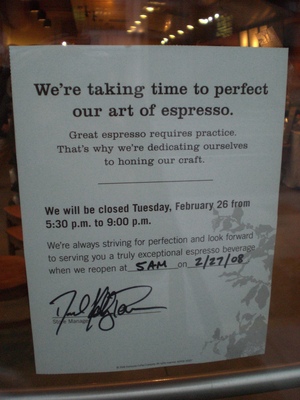
A closed sign.

On February 26, 2008 – the following sign appeared on all 7,100 Starbucks stores in the US as they closed for three hours:

SB barista training store closed

That’s right – Starbucks closed the doors early and spent three hours retraining the baristas to make sure they were doing their best. Touted by some as a marketing stunt, taken advantage of by the competitors, losing over $6 million dollars – what was up with Starbucks?

It was a symbolic act – three hours of education would not solve the huge problems Starbucks was facing.

But it worked.

Over the next year and a half, Starbucks followed a “Transformation Agenda” that provided some great leadership principles that leaders in ChurchWorld will find helpful. Here is a summary from Schultz listing those leadership lessons:

  • Grow with discipline.
  • Balance intuition with rigor.
  • Innovate around the core.
  • Don’t embrace the status quo.
  • Find new ways to see.
  • Never expect a silver bullet.
  • Get your hands dirty.
  • Listen with empathy and over communicate with transparency.
  • Tell your story, refuse to let others define you.
  • Use authentic experiences to inspire.
  • Stick to your values, they are your foundation.
  • Hold people accountable but give them the tools to succeed.
  • Make the tough choices; it’s how you execute that counts.
  • Be decisive in times of crisis.
  • Be nimble.
  • Find truth in trials and lessons in mistakes.
  • Be responsible for what you see, hear and do.
  • Believe.

Ready to learn from Starbucks’ painful journey of transformation?

an updated post from a series reviewing Onward, by Howard Shultz

Onward 

preparation for a new series coming soon on Leading the Starbucks Way, by Joseph Michelli

Print

Want a Truly Innovative Organization? Think INSIDE the Box…

Stuck in a rut? Facing a deadline to a particularly vexing problem with no solution in sight? Maybe you just want to mix things up to get some new momentum, but you don’t know where or how to start…

Are you tempted to think outside the box?

A very traditional view of innovation and creativity is that it should be unstructured and not follow any patterns or rules. Leaders everywhere are encouraged to “think outside the box.” The problem facing you should be a launching pad for brainstorming ideas, no matter how wild or far-fetched they are. The theory is that moving as far from your problem will help you come up with a breakthrough idea.

Maybe it’s time to think inside the box instead.

I first heard the term “think inside the box” when I became a part of Elevation Church in Charlotte NC over 4 years ago. Elevation’s core values are expressed in what we call The Code – here’s the definition:

We understand what God has done in and through our church is not normal. The only explanation is God’s hand of favor and mercy over a group of people willing to follow Him faithfully. To help maintain our unity, tone, and trajectory, we developed 12 core values as a church that make us unique. We call it The Code.

One of those values is “We think inside the box.”

The Code 6I’ve seen it demonstrated time and time again – from a choreographed dance step illustrating the battle of Elijah and the prophets of Baal to creative videos for worship to innovative partnerships with local groups who serve our community.

Thinking inside the box is now the norm at Elevation.

For many organizations, though, the concept is unknown. Fortunately, that’s about to change.

Authors Jacob Goldenberg and Drew Boyd recently released their new book, Inside the Box: A Proven System of Creativity for Breakthrough Results. It is the first book to detail their innovation method called Systematic Inventive Thinking – inside the box thinking.

Here’s a quick overview of five techniques Goldenberg and Boyd have discovered after studies of innovation-related phenomena in a variety of contexts.

  • Subtraction: Innovative products and services tend to have had something removed, usually something that was previously thought to be essential to use the product or service. The original Sony Walkman had the recording function subtracted, defying all logic to the idea of a “recorder.” Even Sony’s chairman and inventor of the Walkman, Akio Morita, was surprised by the market’s enthusiastic response.
  • Task Unification: Innovative products and services tend to have had certain tasks brought together and “unified” within one component of the product or service, usually a component that was previously thought to be unrelated to that task. Crowdsourcing, for example, leverages large groups of people by tasking them to generate insights or tasks, sometimes without even realizing it.
  • Multiplication: Innovative products and services tend to have had a component copied but changed in some way, usually in a way that initially seemed unnecessary or redundant. Many innovations in cameras, including the basis of photography itself, are based on copying a component and then changing it. For example, a double flash when snapping a photo reduces the likelihood of “red-eye.”
  • Division: Innovative products and services tend to have had a component divided out of the product or service and placed back somewhere into the usage situation, usually in a way that initially seemed unproductive or unworkable. Dividing out the function of a refrigerator drawer and placing it somewhere else in the kitchen creates a cooling drawer.
  • Attribute Dependency: Innovative products and services tend to have had two attributes correlated with each other, usually attributes that previously seemed unrelated. As one attribute changes, another changes. Transition sunglasses, for example, get darker as the outside light gets brighter.

The authors have found that the key to using these five techniques is the starting point. It is an idea called they call “The Closed World.”

We tend to be most surprised with those ideas “right under noses,” that are connected in some way to our current reality or view of the world. This is counterintuitive because most people think you need to get way outside their current domain to be innovative. Methods like brainstorming use random stimulus to push you “outside the box” for new and inventive ideas. Just the opposite is true. The most surprising ideas are right nearby. We have a nickname for The Closed World…we call it Inside the Box.

Are you ready to do some thinking – inside the box?

inspired by Inside the Box, by Drew Boyd and Jacob Goldenberg
Inside the Box

Stop Crying Over Spilt Milk – the Glass is Still Half Full

In addition to being a knowledge addict, I am a horizontal organizer.

This often manifests itself in a cluttered (to some) office, but in actuality it is creative genius in process…

…the problem is, the process almost never finishes.

Or, as someone once said, I would be a procrastinator if I could ever get around to it.

Which leads to “my” garage (in all honesty, my wife will not let me say “our” garage –it’s all on me).

I served for over 23 years on 3 different church staffs. During that time, I accumulated, created, and mostly saved a lot of resources including books, notebooks, workbooks, lesson plans, sermon notes, leadership training materials, etc.

Upon leaving the church staff vocation and becoming a church consultant over 9 years ago, all those resources came home to reside in our garage. They were stored in cataloged (for the most part) boxes – over 40 of them, in case you were wondering.

From time to time, I would venture out into the garage to search for a resource that would help with a consulting project. Over time, those trips became less frequent, and the resources just sat there.

For some reason, at this time and season in my life, I have begun a summer project to reduce a vast amount of the stuff in my garage, with an eventual goal of putting the family car in at night (I’ve read somewhere that’s what garages are for, but I have no actual working knowledge of that in 33+ years of marriage).

A portable storage unit sits in the driveway, and it has become my sorting/storing/waypoint for stuff on the way out of the garage to a final destination – the recycling center, Goodwill, anyone interested in church-type books, or as a last resort, the dump.

Pause that train of thought for a minute; I want to hook up another car and redirect you.

One of the new books I’m reading this week is Red Thread Thinking. As a part of my typical reading regimen, I look at the front and back covers, table of contents, and introduction before I dive into the book. Reading this book’s TOC, I came across a chapter title that stopped me in my tracks:

Don’t Cry Over Spilt Milk Because the Glass is Still Half Full.

photo courtesy ecoblog.co.za

photo courtesy ecoblog.co.za

Going straight to the chapter, the first three sentences had me hooked:

Your last failure may be part of your next success. The fastest, most profitable innovation opportunities could be right in front of you, yet unnoticed. Uncovering your hidden assets unlocks new opportunities because virtually all innovations are linked to other inventions, successful or not. 

On the next page, this:

Seeing new value in old resources just requires a little skill and motivation to gather knowledge from diverse sources, then figure out how it might be put to new uses.

And finally:

It’s time to unearth old notes from previous development projects. Are there innovations or ventures that you started to work on and then abandoned for some reason? Do an “idea audit” and see what’s in the back of your filing cabinet or closet [or garage]. It’s time to reassess – and see what you can uncover that’s worth revisiting.

Brilliant.

My summer cleaning project just took on new meaning.

inspired by Red Thread Thinking by Debra Kaye, with Karen Kelly

Red Thread Thinking

Why True Collaboration is So Crucial NOW

No organization is immune to the shifts set in motion by current global tides. Its ripple effects have shaken the very foundations of how business is being conducted today, continually reshaping our view of how leaders, teams, and customers react. Our core challenge is to acknowledge where and how to embrace true collaboration as the centerpiece of this new ecosystem.

Thomas Edison knew this in the late 1800’s.

Sarah Miller Caldicott, great grandniece of Thomas Edison and author of the book Midnight Lunch, believes that the notion of a collaboration ecosystem linking innovation, strategy, and value creation stood at the heart of Edison’s laboratories as well as his manufacturing empire.

Caldicott believes that there are three major forces to be aware of in designing an effective approach to collaboration today: complexity, metalogue, and reskilling.

The Rise in Complexity Due to Massive Generation of Data and Real-Time Synthesis: The accelerated pace of technological change has erased familiar industry boundaries, opening the way for rapid formation of new markets. A tsunami of data can now be consumed – and generated –by individuals armed with mobile phones and other smart devices.

Although operating in a different technological era, Edison embraced complexity as a fundamental component of collaboration itself. Embracing complexity rather than sidestepping it represent a hallmark of Edison’s true collaboration process.

The Rise of Metalogue as a Tool for Creating Purpose and Connection: Feelings of fragmentation yielded by economic and technological shifts have depended the need for connection and common purpose across large groups of people. Communities, organizations, and governments face an imperative to hear the opinions of diverse constituencies that now can generate influence outside of traditionally recognized channels of decision-making or authority.

Edison’s true collaboration process recognizes the central role of collegiality and team discipline as crucial components that lay the groundwork for dialogue – and ultimately, metalogue. He maintained a high level of team coherence even when pressures mounted by grounding his teams with an understanding of how debate and conflict could be constructively harnessed.

The Need for Reskilling Workers in the Innovation Age: The broad availability of smart devices paces new emphasis on what people can potentially create rather than what they already know. Skills linked to knowledge sharing, such as effective communication, adaptive thinking, and cross-generational leadership, are gaining new prominence in realms where functional expertise formerly dominated.

Edison’s four phases of collaboration offer a unique platform for embedding collaboration as a superskill in your organization using discovery learning and hands-on engagement rather than tired classroom-style approaches. Instead of pushing lectures to teach creativity and problem solving, Edison’s experiential approach engages the reskilling process by activating creative centers of the brain and thereby developing large neural networks that drive learning more deeply than task-based or fact-based approaches.

The underlying mechanisms of Edison’s true collaboration process are a crucial priority for every organization. Organizations that engage true collaboration as a backbone for their innovation, value creation, and team development will remain thriving and nimble in the face of constantly shifting economic and cultural forces.

Collaboration is not just a nostalgic look into the past or a hoped-for future aspiration – it is a necessary organizational survival skill needed now.

This has been a multi-part series being reposted in honor of Thomas Edison’s birth February 11, 1847

Edison’s Four Phases of Collaboration

As noted in yesterday’s post, I’m learning a whole new definition of “collaboration” in my role of Vision Room Curator at Auxano.

Webster’s defines collaboration as “the act or process of collaborating” – meh.

According to Sarah Miller Caldicott, great grandniece of Thomas Edison and author of the book Midnight Lunch, Edison viewed true collaboration as a value creation continuum. If one were to find a single notebook entry capturing Edison’s definition of true collaboration, Caldicott believes it would read something like this:

Applying discovery learning within a context of complexity, inspired by a common goal or a shared purpose.

True collaboration for Edison operated like an invisible glue that fused learning, insight, purpose, complexity and results together in one continuous effort.

Translating Edison’s decades of groundbreaking practices into language for the 21st Century leader, Caldicott has developed a four-phase model of the collaboration process.

 How do we create the foundation for true collaboration to flourish?

Phase 1 – Capacity: Select small, diverse teams of two to eight people who will thrive in an environment of discovery learning and collegiality.

 How can our collaboration team reframe the problem at hand, driving the greatest range of creativity and breakthrough solutions?

Phase 2 – Context: Focus the outlook of the team toward development of new context that broadly frames the problem or challenge under consideration. Use a combination of individual learning plus hands-on activities to drive perspectives for potential solutions.

 Can the collaboration team stay the course and continue forward despite disagreements?

Phase 3 – Coherence: Maintain collaboration momentum, creating frameworks for progress through inspiration, and inspirational leadership even though disagreements may exist. Newly discover, or re-emphasize, the shared purpose that binds the team together.

How can our collaboration team leverage internal and external networked resources nimbly and with speed?

Phase 4 – Complexity: Equip and reskill teams to implement new ideas or new solutions using internally and externally networked resources, rapidly accessing or managing complex data streams the team must navigate. Leave a footprint that contributes to a broader collective intelligence.

Edison leaves us a legacy we can return to over and over again as we newly shape a future that embraces the highest and best of our collaborative spirit.

If we did all the things we are capable of doing, we would literally astound ourselves.    –Thomas Edison

Go Aheadastound yourself…

A multi-part series being reposted in honor of Thomas Edison’s birth February 11, 1847