Today in the Magic Kingdom – A Field Trip for Guest Experiences

Greetings from Magic Kingdom!

courtesy John Skodak, CC 3343087934

courtesy John Skodak, CC 3343087934

When the rope drops this morning, I will already be inside the park, participating in the “Keys of the Kingdom” tour. Later in the day, I will be doing some “field work” for a Guest Experiences project – you’ll be hearing about it soon!

In the meantime, enjoy these Top Ten Takeaways from a Disney World Immersion from a previous visit.

Disney Expects Guests – What About You?

The Experience Begins in the Parking Lot

Excellence is Never Finished

Vision for the Future

Pay Attention to Details Others Ignore

Engaging All 5 Senses Creates Memory Links

Making Dreams Come True Requires Resources

Everybody Picks Up the Trash

Team Members Who Dream Together Create Fantastic Results

Everything Begins with a Story

It’s Hard to Forget the Fireworks at the End of the Day

Yes, you counted right – there were 11 Takeaways – but it’s about Disney, where they always exceed your expectations!

Follow me on Twitter, Facebook, or Instagram for live updates throughout the day. I’ll be there from before it opens, till after it closes, with the Kiss Goodnight

photo by Tom Brickman

photo by Tom Brickman


Customer Service is Never Out of Date – or Out of Place

Epiphany at the Gas Pump

Regular readers of this blog know of my borderline fanaticism in the area of Guest Services related to ChurchWorld. Some leaders cringe at those words, but the fact is people who come to church are consumers, and leaders in ChurchWorld can learn a lot from good customer service practices wherever they find them – even in a 1946 training manual for Gulf Dealers.

In a recent conversation with a friend, I was asked the question, “Where does your passion for Guest Experiences come from?”

The answer to that question became a little clearer in the last week.

My father.

My father passed away in 2012, and recent changes in my mother’s health required that she move out of the house in which she and my father had started their family in 1954. Over the last week, as my brother and I were going through the process of moving her from her home of 61 years, I took great delight in looking through some of the items my dad had saved and stored over his life. When I found this manual pictured below, I knew it would become a special part of my Guest Services resources.

After my father was discharged from the Army Air Corps following WWII, he worked at several jobs before he and his brotherGulf Service Plan 1 built a Gulf Service Station outside of Nashville TN. My father operated it for 44 years, closing it when he retired in 1993. Growing up in that gas station (literally – our house was about 100 feet away) I learned a lot about how to deal with people by watching my father interact with his “customers.” What I didn’t realize until recently was that his natural, easygoing style was augmented by customer service training materials supplied by the Gulf Oil Company.

It seems that good service is never out of date.

Notice the red dotted line around the vehicle – that’s the suggested travel path for the service man – or two – to take when a customer pulled up to the gas pumps to have gasoline put into his tank (I realize many readers have no clue nor experience of this, but it did happen!). Starting by engaging the driver, here are a few of the suggestions for engaging the customer:

  • Always be prompt – the service plan starts when you see a customer driving into your station. Whenever possible, be alert and at his side when his car stops, ready to greet him.
  • Greet the customer – your greeting is your first important step in showing courtesy to the customer, and it should be friendly, cheerful, and always in your own words.
  • Acknowledge the other customer – when a second car drives in, you should immediately recognize the other customer and saying you’ll be right with him. This kind of greeting pays off because you not only please the customer who is waiting but you also please the customer you are waiting on, who notices that you are courteous to others.
  • Improve the rear view – while you are at the rear of the vehicle putting gas in, wipe the rear window and tail lights. Should a light be out, call it to the attention to your customer at the proper time.
  • Look at those tires – while you are back there, take a look at both rear tires for cuts, blisters under inflation, etc. and make a mental note to tell your customer before he leaves your station.
  • Work to the front end – walk around the right side, cleaning the right windshield, checking the wiper blades, and inspecting the front tires.
  • Under the hood – check the oil and water levels; it’s your responsibility to protect your customer’s car. If any is needed, ask him if you may bring the levels up to the correct level.
  • Keep alert under the hood – while you have the hood open, keep alert for other service needs. Train yourself to quickly observe all needs, informing the customer as appropriate.
  • Collect for the sale – it is important to give the customer the right change, so count the change back into his hand. If he is using a credit card (yes, they had those in 1946!), learn to fill out the invoice quickly and accurately.
  • Courtesy is pleasant – before your customer leaves the station thank him and ask him to come in again. By this time you should have learned his name, so make it personal.
  • Help him safely on his way – if your station is on a busy street where it’s difficult to get into traffic, give your customer a hand. Guide him into the moving traffic safely. He may not expect this added courtesy, but he’ll be glad to get it and remember it. Every courteous act will be appreciated by your customers, and make them regular patrons of your station.

And a closing reminder:

With the Gulf Service Plan, every time you do some little service for the customer, it makes him realize that you know your business, and that you’re looking after his welfare. These services keep your customer coming back again and again. Good will – the tendency of the motorist to return to a place where he has been well-treated – is being created every time you give him not only what he wants, but what he needs. He remembers you are the man who looks after his best interests by taking good care of one of his most prized possessions – his car.

To all of us who live in 24/7, always-connected world, the actions above probably seem like a throwback or an anachronism of the good old days.

I happen to think they are a timeless reminder that service still matters – especially in ChurchWorld, where there is no “product” per se, but the outcome of the interactions with our Guests may be eternal.

Thanks Dad, for the lessons you taught me even when I didn’t realize it, and for the lessons you still teach me after you’re gone.


It All Begins with Hospitality

Church leaders need to understand the fact that our competition is not other churches; it’s places that provide WOW! Experiences and to which guests compare our churches.

While that may seem a negative, it can also be turned into a positive by LEARNING from those top-notch places and their leaders.

Take for instance Danny Meyer, the founder and co-owner of multiple top-rated New York restaurants and author of a book entitled “Setting the Table.” Subtitled “The Transforming Power of Hospitality in Business,” Meyer shares the lessons he’s learned while developing the winning recipe for doing the business he calls “enlightened hospitality.” They are lessons that the church can learn from. Here’s a sample:

Hospitality is the foundation of my business philosophy. Virtually nothing else is as important as how one is made to feel in any business transaction. Hospitality exists when you believe the other person is on your side. Hospitality is present when something happens for you. It is absent when something happens to you. Those two prepositions – for and to – express it all.

Understanding the distinction between service and hospitality has been at the foundation of our success. Service is the technical delivery of a product. Hospitality is how the delivery of that product makes it recipient feel. Service is a monologue – we decide how we wan to do thins and set our own standards for service. Hospitality, on the other hand, is a dialogue. To be on a guest’s side requires listening to that person with every sense, and following up with a thoughtful, gracious, appropriate response. It takes both great service and great hospitality to rise to the top.

People duck as a natural reflex when something is hurled at them. Similarly, the excellence reflex is a natural reaction to fix something that isn’t right, or to improve something that could be better. The excellence reflex is rooted in instinct and upbringing, and then constantly honed through awareness, caring, and practice. The overarching concern to do the right thing well is there or it isn’t.

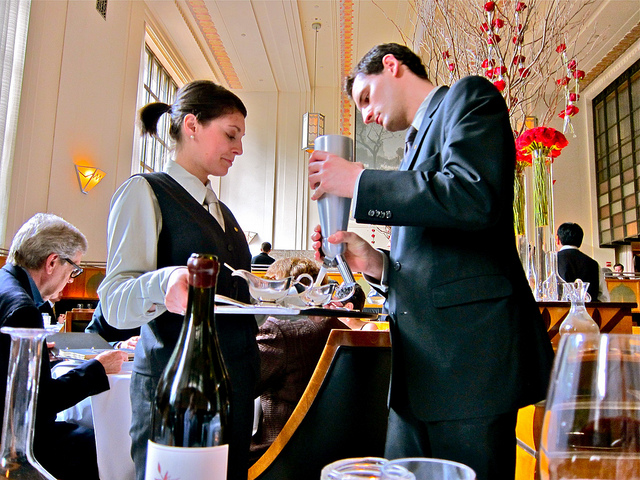
Eleven Madison Park, founded by Danny Meyer

Eleven Madison Park, founded by Danny Meyer

What a great learning environment for churches wanting to improve their Guest Services team!

Last week, I posted a series on hospitality based on Le Bernardin, the famous restaurant in NYC owned by Chef Eric Ripert. If this post resonated with you, click on the links below for more.

Creating experiences of hospitality allow for positive, uplifting outcomes for human experiences and human relationships. They will help you connect to people coming in your door week in and week out.

How will you practice hospitality in your church this weekend?


photo courtesy Julian, CC

Invisible Perfection

What the Diner (Hopefully) Doesn’t Notice

At Le Bernardin, one of New York’s premier four-star restaurants, excellence happens best when it’s not seen at all. A meal there is usually so relaxed and gracious, it’s hard to imagine the military precision with which the dining room is run.

• Before meals, the area is prepared according to checklist

• During meals, all staff adhere to strict training guidelines

• A florist makes a daily flower change on all the tables

• Silver and flatware get a weekly polish in a burnishing machine

• The concept of “mise en place” – put in place – extends to the dining room as well as kitchen

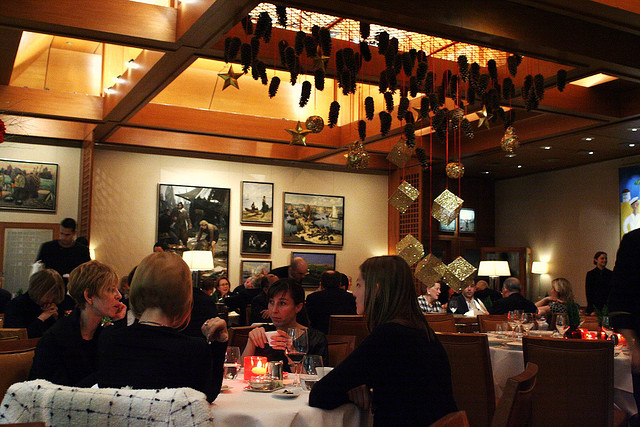
Le Bernardin

Le Bernardin

When we succeed, it looks effortless, but it’s not. It’s all codified into different organizations. It’s totally controlled – and the guest should have no idea

– Executive Chef Eric Ripert

Can you say the same about your organization and its interactions with guests?

Why not?


photo courtesy Kok Chih, CC

The Elements of Service

The center of attention in a four-star restaurant may be the food, but it’s the service before, during, and after that creates the experience.

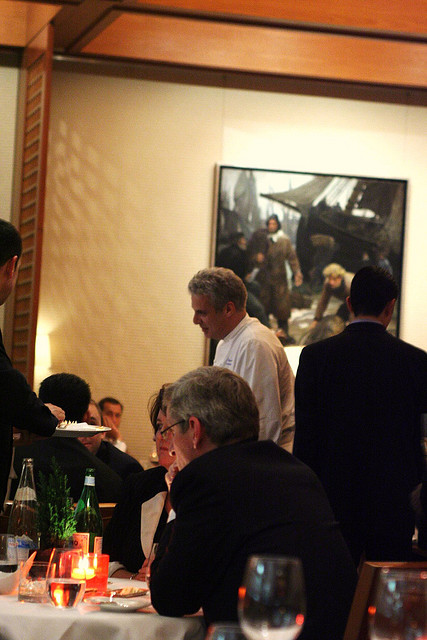
Chef Eric Ripert

Chef Eric Ripert

At Le Bernardin in New York City, the service is as much the creation of Executive Chef Eric Ripert as is his exquisite dishes. Along with the restaurant’s founder Maguy Le Coze, Ripert has created the elements of service that keep Le Bernardin at the top of its class.

Hiring – while they prefer staff with a two- or three- star background, they have been known to go with their gut instinct and hire the people they like, those that have the demeanor and willingness to please.

Training – the standard of perseverance and constant training is set at the top and carried throughout the organization. General manager David Mancini and Maitre d’ Ben Chekroun want each hire to know what goes into every other job on the floor. The constant cross-training that goes on enables the entire staff from the captains to the busboys to operate in a seamless, fluid manner.

Knowledge – The level of service expected by customers at Le Bernardin is matched and exceeded by the knowledge the staff constantly pursues. From the technical side (knowing the menu by heart, how each serving is prepared, the correct place settings, etc.) to the human aspect (learning to watch guests for clues, anticipating their needs), the staff is always learning.

Attitude – over the years the atmosphere has become less formal, but Le Bernardin’s staff will provide what you are looking for: to celebrate, to eat, to do business, to entertain the family. Their goal is for you to enjoy the experience and leave happy with a smile.

The Sixth Sense – Chekroun says that the ability to read a guest is the key to providing four-star service. “You can tell if someone is used to a four-star restaurant or it’s their first time. It’s our job to put them at ease no matter the situation. Intuition is very important on the floor – before a guest can ask “Where’s my waiter?” you must be there.”

Teamwork – At Le Bernardin, service is like the proverbial chain – a weak link will compromise the whole thing. Anyone on the chain, from the time you make a reservation till the moment you leave, can ruin the experience. It’s all about functioning as a team; even though the service is broken into sections, that’s merely strategic. The entire team is expected to understand the ebb and flow of the service and step in before needed.

Presentation – The hallmark of the food at Le Bernardin is the exquisite simplicity of the food, which calls for adding the final touch at the table. The sauces for the meal are served at the table, which provides several advantages: warmer service, better flavors, and eye-catching presentations.

Hungry yet?

Okay, let’s step away from the elegance of Le Bernardin and visit your church. Is it too big a jump to imagine that your guest services need to have the same elements of service as a four-star restaurant?

I think not.

In each of the areas above, why don’t you brainstorm how you can deliver four-star hospitality to your guests?


photo courtesy Kok Chih, CC

The Dining Experience…

…at a four-star restaurant provides excellent lessons for hospitality in the church.

With one son who is a chef and kitchen manager for a national restaurant chain and another who just finished four years of culinary school and is working as a line cook in one of Charlotte’s top-rated restaurants, I have a serious interest in all things food. My waistline also shows that, but that’s another story.

One of my favorite genres of books is that of the food industry, especially those that give a behind-the-scenes look at what goes on in the kitchen and dining room.

During a visit to my older son’s house I was perusing his bookshelf and took a look at “On the Line“, about the famous New York restaurant Le Bernardin and Executive Chef Eric Ripert. It’s a well-written and beautifully photographed look at the inner workings of the world-famous restaurant.

It’s also full of great lessons for churches that want to have world-class guest services.

Your church will not be serving exquisite meals that diners pay big bucks for – but your church can learn that the meal is only a part of the total dining experience.

The Dining Experience

One of the things that diners remark upon after eating at Le Bernardin is that the service is almost invisible. By the end of the meal, you’ve been helped by as many as seven people, but you can’t quite identify them. Although friendly and available, they work out of your field of attention so that you can focus on the food, and companions, in front of you.

While it might seem effortless, it’s a rigorous ballet that requires training and focus. The men and women juggle a plethora of details in their heads while projecting an air of gracious calm.

We have to perform to give you an illusion of effortless perfection. For you to have the right food in front of you at the right time, excellent and at the right temperature, and obviously having clean china – all those little details you’d never think of are vital

– Eric Ripert

In an earlier post, I introduced Le Bernardin’s “The List,”  as a way to think about the guest services practices at your church. I hope you’ll join in on the rest of the conversation over the next few days.

No Excuses Allowed

In Mrs. Soeesby’s Senior English class it was simply called “The List.” In letters large enough to see from anywhere in the classroom, it started above the door to the class and went all the way round the room. Each item was numbered. By the time she retired (between our second and third child’s journey through Senior English), the list was over 100 items.

The list was excuses she had heard over the years from students for not turning in their work on time.

Ever the efficient teacher, she simply required the student to write the number on a blank piece of paper and turn it in.

At Le Bernardin, one of New York’s premier four-star restaurants, co-founder Maguy Le Coze and maître d’ Ben Chekroun give new service staff a list, too – 129 details, aka “Monumentally Magnificent Trivialities” to keep in mind at all times.

Here are a few samples:

• Acknowledging guests with eye contact and smile within 30 seconds; First Impressions count!

• Not thanking guests as they leave; Last Impression!

• Not opening the front door for guests

• Being too familiar or excessively chatty

• No sense of humor

• Lack of eye contact

• Not having total focus when talking to guests

• Not really listening when spoken to

• Appearing stressed or out of control

• Not establishing rapport with the guests

• Inability to answer basic questions

• Poor personal sanitation practices

• Standing around doing nothing

• Pointing

• Walking past dropped items/trash on floor

• Excuses for anything-anytime

It’s a constant battle to keep everything consistent and up to the established standards.

Do you have a list for your Guest Services team?

You should…

9 Secret Sauces That Will Make Your Guest Experience Unique

Stock…

…the foundation for all classical French cooking.

At the CIA (that’s Culinary Institute of America), you start off a three-year education by learning how to peel vegetables and prepare a basic stock. You don’t do it once – you do it every day during the three-week rotation of the first class. Students move on after the first three weeks, but will continue to use the stock prepared by the next class of new students. Every three weeks, a new rotation of prospective chefs learn how to prepare stock.

A great stock is judged by:

  • Flavor
  • Clarity
  • Color
  • Body
  • Aroma

The perfect stock has what is referred to as a “neutral” flavor. This is a kind way of saying it doesn’t taste like anything you’re used to eating or would want to eat. But you can do a million different things with a great stock because it has the remarkable quality of taking on other flavors without imposing a flavor of its own. It offers its own richness and body anonymously. When you reduce it, it becomes its own sauce starter. You can add roux to stock and create a demi-glace, and with a demi-glace, you can make over a hundred distinct sauces that define classic French cooking.

What’s your stock?

Personally. Organizationally. However you want to define it.

 What’s that basic “thing” you are, have, or do that makes everything else come together to make things happen?

 >> Learn to make a basic stock, and the possibilities become endless.

Chip Bell knows how to make stock too – or as he calls it, the secret sauce of awesome experiences.

Bell, a well-known consultant and trainer to some of the largest countries in the world, has just released his newest book, “Sprinkles.” SprinklesSubtitled Creating Awesome Experiences Through Innovative Service, it delivers a delicious journey to innovative service.

According to Bell, there are nine “secret sauces” that form the basis for a customer experience that is served gourmet style:

  • Amazement
  • Animation
  • Abundance
  • Ambiance
  • Adoration
  • Allegiance
  • Alliance
  • Accessible
  • Adventure

Just like a chef takes a basic sauce and makes it into the foundation of an exquisite meal, your organization can take the “secret sauces” Bell writes about in Sprinkles and deliver a “value-unique” service that creates an unexpected, enchanting experience for those you serve.

Bon Appetite!

The Magic of Performance in Your Church’s Guest Experience

The empowered team member who confidently goes above and beyond for a customer is a practitioner of Performance Magic.

Service magicians use genuine rapport and personal connection with customers to create performances that are magical. Customers receive the product or service they want or need, but they also get that something extra that makes the experience unexpected, unpredictable, and memorable.

Alert to customer’s needs, service magicians read the often-subtle signals being sent. They know how to establish rapport with customers, sometimes mirroring their emotions and listening intently to ascertain the feelings behind the words – and respond in way that acknowledge those feelings.

> Tricks of the Trade

What do service magicians watch for when they aggressively, proactively observe customers?

  • Clothing – What do people’s clothes telegraph about their view of themselves and the world, and their mood and personality?
  • Eye contact – Does the customer meet your eyes? For how long and how frequently?
  • Body language – What is the customer’s body language telling that he’s not saying?
  • Voice characteristics – What can you glean – beyond the words – from this person’s manner of speaking?

The core skill for effective, active listening is getting focused and staying focused. When listening is your goal, make it the priority – do not let anything distract.

Read customers carefully – then test your assumptions before you act on them.

Service magicians take charge of customer encounters, setting the stage and the mood for the magical connection to come. They unobtrusively direct service encounters, setting the mood and making customers comfortable.

Though service magicians make connecting with customers look effortless, it doesn’t come without working at it.

> Tips for Creating Magical Dialogue

  • Establish – and publicize – a clear service philosophy
  • Build proficiency though practice
  • Develop great conversation openers that fit personality and mood
  • Listen, listen, listen
  • End with a satisfied customer wanting more

Performance magic should leave customers pleased with their experience and just a little puzzled at how you managed it. The trick is, there’s no trick at all:

Performance magic is accomplished through careful observation, fanatical listening, and genuine conversation. A disciplined practice of these actions will enable you to identify our customers’ needs before they even have a chance to voice them.

Performance Magic happens when a surprisingly positive interaction occurs between the customer and organizational personnel during the acquisition and delivery of a service or product. Magical performance is the manner that enables a service magician to take customers on an emotional journey so enchanting they cannot wait to tell their story to others.

>> Remember that as a church leader you have “customers” – they are the Guests who come to your place every weekend.

What are you waiting for? It’s time to utilize magical performances in your organization!


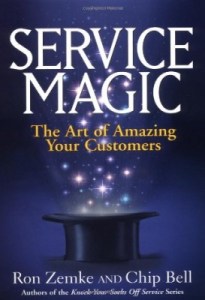
Adapted from Service Magic by Ron Zemke and Chip Bell

Service Magic

Part of an ongoing, periodic series exploring the translation of customer service in the corporate world to Guest Experiences in ChurchWorld

The Magic of Process in Your Church’s Guest Experiences

Process Magic is at work when an organization – large or small – creates a standard operating procedure that seems just the right thing to do.

Practices, policies, and procedures from initial contact to problem solving that amaze the customer with seeming ease are magical. The service magician who implements those practices with style and grace enhances the experience yet again.

Researchers repeatedly confirm that customers use “consistently good” as their gold standard for service. The customer’s sense of reliability, security, and comfort hang on service promises – real or implied – being kept with a high degree of precision and consistency. That “steadfastness” is so important that most organizations take care that their processes come with rigid standards and stern rules.

Those processes fall into one of two categories: algorithmic or heuristic.

Algorithms are step-by-step processes. Think of them as “rules of law” that focus on precision, replication, exactness, and dependability. There are “Red Rule” algorithms, designed to maximize effectiveness, safety, and predictable outcome. There are also “Blue Rule” algorithms, designed to maximize efficiency and sameness.

Heuristics are “rules of thumb” for doing work. They function more as guidelines for behavior rather than step-by-step specifics. Implicit in the guidance of heuristics is an in-context judgment call.

Using a Little Magic on Blue Rule Algorithms

Algorithmic processes are precise, lockstep means of getting the service the customer expects from the service provider to the customer. Helpful rules for adding magic to “Blue Rule” algorithms include:

  • Select a process the customer must endure and enrich it with a little magic. While some processes are crafted exclusively for the convenience of the service provider, make sure they are as customer friendly as possible by zeroing in on the feature most important to the customer.
  • Don’t alter a part of the process without examining the whole experience. If only a part of the process is enhanced, a bland or negative part left unimproved can erase or negate the enchanting memory for the customer.
  • Include props to reinforce consistency. These could include reminders, checklists, job aids, guides, cueing devices – whatever helps the service magician remain disciplined and focused.

Turning Red Rule Algorithms into Magical Memories

The more challenging arena of service processes is the unalterable algorithmic process. The service magician, unable to alter Red Rule processes, must find ways that will yield a magical experience for customers. Helpful rules for altering Red Rule processes include:

  • Alterations must be delivered in matched tones. By definition, the process can’t be changed, so alterations must be made with the experiences that surround the process. Any surrounding experience must be kept in the same tone, style, and manner of the process itself.
  • Alterations must be subtle. The key is to not tamper with anything that causes the customer to question the core values embedded in the process.
  • The magic can operate alongside the process without upsetting requirements. The “add-on” will be surprising and memorable, but it doesn’t have to interfere with the step-by-step nature of the process.
  • Value adds should be of the same nature as the core offering. Adding value works best when understated and cut from the same cloth as the core offering.

Adding Magic to Heuristic Rules of Thumb

“Rule of thumb” – or heuristic – processes are not lockstep, exact, or precise. They may be guidelines born of the folklore of an industry or conventional wisdom learned only through experience. Several universal principles are important to keep in mind before tinkering with heuristic processes. They include:

  • Never tinker with the customer’s core expectation.  The customer has very real expectations as well as a mental picture. If the magic attempted is too extreme, the customer will remember it as disruptive and artificial
  • Make sure the alteration in the process fits. Service magic enchants because it is unexpected and positive, yet it needs to be appropriate to the context and the relationship.
  • Ensure the alteration is a team effort, not an isolated gesture. The customer knows single-relationship magic when he sees it and knows it is vulnerable to turnover. It does not ensure long-term loyalty

Service processes are not naturally magic. Magic occurs when the process is transformed or contains an unanticipated dimension – the more “sparkly” the transformation, the more magical it is. Magic depends on identifying a process alteration that will be permissible by the customer, and then crafting its expression into a form unexpected by the customer.

Select the right process, alter or enhance it in the right way, and you can turn dull into delightful and mundane into magic.

You are practicing Process Magic by filling the space between “customer need” and “customer need met” with experiences of awe and memories of amazement. Magical processes are the policies, procedures, and routines that make transacting business with an organization easy, positive, and memorable.

Remember, that as a church leader you have “customers” – they are the Guests who come to your place every weekend.

What are you waiting for? It’s time to utilize magical processes in your organization!

Adapted from Service Magic by Ron Zemke and Chip Bell
Service Magic

Part of an ongoing, periodic series exploring the translation of customer service in the corporate world to Guest Experiences in ChurchWorld