Beyond Mickey’s Ten Commandments: Leadership Lessons from Disney’s Imagineers

There are two ways to look at a blank sheet of paper. It can be the most frightening thing in the world because you have to make the first mark on it. Or it can be the greatest opportunity in the world because you get to make the first mark – you can let your imagination fly in any direction, and create whole new worlds.  -Marty Sklar’s words to the Imagineers in 1966

Retired Disney Imagineer Mary Sklar had a remarkable 54-year career with the Disney organization. His work covered many areas of the organization, but focused on Imagineering, the group Walt created that blended creative imagination with technical know-how.

Sklar is best known for “Mickey’s Ten Commandments,” but in his recently published book Dream It, Do It! he revealed 3 additional lists: 2 on “The Leader’s Bible” and 1 on “Followership.”

The Leader’s Bible, Part One

  1. Create and maintain a climate of trust.
  2. Be responsive and make decisions – that’s what leader’s do!
  3. Empower your teammates – it takes many hands to bake a success.
  4. Create opportunities for new birds to fly.
  5. Remember: experience is not a negative.
  6. Make sure yours is not the only voice you are listening to.
  7. Celebrate diversity and different points of view.
  8. Never rest on your laurels – the next at-bat is your most important.
  9. Take a chance – support risk-taking.
  10. Provide plenty of blank paper.

The Leader’s Bible, Part Two

  1. Be optimistic – if you are not positive, who else will be?
  2. Courage and confidence are major cross streets on the road to success.
  3. Make curiosity your search engine.
  4. Learn to love you next assignment – be passionate about whatever you do.
  5. Provide time to explore – but deadlines are great motivation and discipline.
  6. Take time to teach – mentors are mensches.
  7. Forget the politics – it’s not an election!
  8. Traditions are important – but change is the great dynamic.
  9. Team and work are four-letter words – but together they spell “winner.”
  10. Remember: the last three letters of trend are E-N-D!

WD Quote Dream It Do It

Sklar’s ideas and principles were developed and implemented over decades of leadership with Disney’s Imagineers. They were formed by lessons learned from Sklar’s mentors, most notably Walt Disney and designer John Hench. They served the team of designers, engineers, architects, technicians, and others responsible for creating the Disney theme park experiences well…

…they will be pretty good for leaders in your organization, too!


Inspired by Dream It, Do It: My Half-Century Creating Disney’s Magic Kingdoms, by Marty Sklar Disney Legend and Imagineering Ambassador

Dream It Do It

Disney’s Imagineers: Designing the Total Guest Experience

Designing the Guest’s experience is what Walt Disney’s Imagineers came to call “the art of the show,” a term that applies to what the Imagineers did at every level, from the broadest conceptual outlines to the smallest details, encompassing visual storytelling, characters, and the use of color.

Today is eighth and concluding session of Summer Term II of the 2013 GsD program with Applied Guestology 201, a review of some of the leading organizations who deliver exemplary Guest Experiences with application to ChurchWorld.

As I conclude this brief look at Applied Guestology 201, it’s only fitting to come full circle to where we started: Walt Disney and the worlds he created.

The Imagineers design intention is always to give satisfaction to the guest.

John Hench, Imagineering genius and Disney team member for 60+ years

Walt Disney realized that a visit to an amusement park could be like a theatrical experience – in a word, a show. Walt saw that the Guests’ sense of progressing through a narrative, of living out a story told visually, could link together the great variety of attractions he envisioned for his new kind of park. While traveling through their stories, Guests would encounter, and even interact with, their favorite Disney characters, and who would be transformed, as if by magic, from their two-dimensional film existence into this special three-dimensional story world.

As designers, the Imagineers create spaces – guided experiences that take place in carefully structured environments, allowing the Guests to see, hear, smell, touch, and taste in new ways. In effect, Imagineers transform a space into a story place.

Ultimately, the Imagineers gave Guests a place to play, something Walt believed that adults needed as much as children. The design of the Imagineers gives power to the Guests’ imagination, to transcend their everyday routine. Walt Disney insisted that Guests should “feel better because of” their experiences in Disney theme parks, thus establishing the art of the show.

For the Imagineers, that meant considering everything within and relating to the parks as design elements. To build effective story environments and assure Guest comfort, the designers realize that they always had to assume the Guests’ position and point of view, and just as Walt did, to take the Guests’ interests to heart and defend them when others didn’t think it mattered.

It is up to the designers to provide Guests with the appropriate sensory information that makes each story environment convincing. This means that design considerations go beyond the attractions themselves to the service and operations staff, transportation, restaurants, shops, rest rooms – even the trash cans.

Initially, the Imagineers used the knowledge gained from their experience in films, but they soon found that their Guests themselves would teach them what they most needed to know about theme park design and operation.

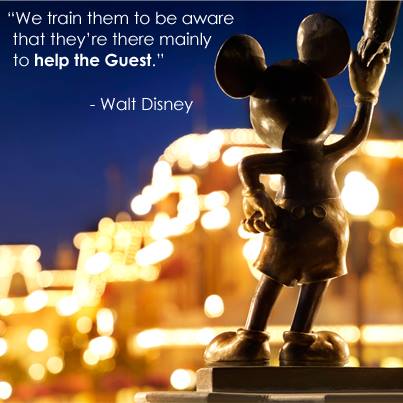
To design most effectively for Guests, the Imagineers learned that they had to observe them up close, waiting in lines with them, going on attractions with them, even eating with them. The Imagineers paid attention to Guests’ patterns of movement and the ways in which they expressed their emotions. They were able to get an idea of what was going on in their minds.

When designers see Guests in their natural states of behavior, they gain a better understanding of the space and time Guests need in a story environment.
WD Guest quote DI

Disney Imagineer Marty Sklar, who retired in 2009 as the only Disney employee to have participated in the opening of all eleven theme parks around the world, is noted for many things, but one of the most cherished has to be his creation of “Mickey’s Ten Commandments.”

During his 54-year career, Sklar was involved in all facets of the theme parks – from concepts to design to operations. Along the way, he developed, refined and practiced key principles of leadership based on what he learned from Walt Disney and other Disney Legends, especially designer John Hench. He crystalized these “learnings” into the first of what he called Mickey’s Ten Commandments:

  1. Know your audience – Identify the prime audience for your attraction or show before you begin design
  2. Wear your Guests’ shoes – Insist that your team members experience your creation just the way Guests do
  3. Organize the flow of people and ideas – Make sure there is a logic and sequence in our stories and the way Guests experience them
  4. Create a wienie (visual magnet) – Create visual “targets” that will lead Guests clearly and logically through your facility
  5. Communicate with visual literacy – Make good use of color, shape form, texture – all the nonverbal ways of communication
  6. Avoid overload – create turn-ons – Resist the temptation to overload your audience with too much information and too many objects
  7. Tell one story at a time – Stick to the story line; good stories are clear, logical, and consistent
  8. Avoid contradictions – maintain identity – Details in design or content that contradict one another confuse an audience about your story or the time period it takes place in
  9. For every once of treatment, provide a ton of treat – Walt Disney said you can educate people, but don’t tell them you’re doing it. Make it fun!
  10. Keep it up! (Maintain it) – In a Disney park or resort, everything must work. Poor maintenance is poor show!

Exceeding Guests’ expectations is Disney’s Guest Service strategy, and paying attention to every detail is the tactic by which it is accomplished.

Class dismissed.


Application for ChurchWorld

Really? If you are involved in Guest Services at your church in any capacity, and can’t see the immediate and powerful application of Mickey’s Ten Commandments to your own Guest Services process, may I kindly suggest you are serving in the wrong ministry area?

Be Our Guest” has been the invitation to Disney visitors long before the song from Beauty and the Beast became a box office hit.

It underscores an important element in the Disney vocabulary, that customers are not referred to as such, but rather as Guests. In the Disney nomenclature, the word “Guest” is capitalized and treated as a formal noun.

What’s the difference between treating someone like a visitor, and treating someone like a Guest?

The obvious analogy is that we do things differently when we bring Guests into our home. We clean up the house. We dress up. We prepare something special to eat. We host them. We take care of their real needs.

Disney expects Guests

At Disney theme parks around the world, they expect Guests – and plan to exceed their Guests’ expectations every time. What about you?

Are you expecting Guests?

Recommended Reading for this session:

Designing Disney: Imagineering and the Art of the Show, John Hench

Dream It, Do It: My Half-Century Creating Disney’s Magic Kingdoms, Marty Sklar

(for a complete reading list, see The Essential Guest Experience Library)

Guestology – the art and science of knowing and understanding your guests – is a term originated by Bruce Laval of the Walt Disney Company. The use of GsD is a tongue-in-cheek acknowledgment that organizations that really want to understand and deliver a WOW Guest Experience need to study the best practices and principles in use today, and then adapt them to the context of their own environment.

the GsD (Doctor of Guestology) journey: 2nd Term Summer 2013


Walt Disney – the Father of Guestology

Walt Disney was the originator of the practices that came to be called Guestology. The Disney organization remains the world’s foremost practitioner of the Art & Science of serving their Guests.

Because of that, I’m starting Summer Term II of the 2013 GsD program with Applied Guestology 201, a quick review of some of the leading organizations who deliver exemplary Guest Experiences with application to ChurchWorld. We begin with Walt Disney and move from there to several well-known organizations, wrapping this course up by returning back to the Magic Kingdom.

Walt Disney – the Father of Guestology

courtesy 9hdw.com

courtesy 9hdw.com

In order to understand the magic of Disney’s Guestology, you need to know a little about Walt Disney, and why he cared so much about customer service. When he threw his energies into the creation of Disneyland in the early 1950s, he was totally concentrated on the guest experience. The very idea for Disneyland was born in Saturday trips to amusement parks that Walt Disney made with his two daughters. In those days, amusement parks were disreputable, dirty, and often in poor condition. While watching and waiting on his daughters to finish their rides, he began to watch the other customers and how they reacted to the parks.

A single question drove Disney: How could this experience be improved for the entire family?

Walt’s answer was to create a new kind of amusement park, a “theme” park with an intense focus on the guest experience. With his successful background in animation and movies, and with a studio of brilliant, creative minds to work with, Disney created a “living show.”

With a little bit of the same magic, your organization can do the same.

Be Our Guest” has been the invitation to Disney visitors long before the song from Beauty and the Beast became a box office hit. It underscores an important element in the Disney vocabulary, that customers are not referred to as such, but rather as Guests. In the Disney nomenclature, the word “Guest” is capitalized and treated as a formal noun.

What’s the difference between treating someone like a customer, and treating someone like a Guest?

The obvious analogy is that we do things differently when we bring Guests into our home. We clean up the house. We dress up. We prepare something special to eat. We host them. We take care of their real needs.

Disney expects Guests

This principle has to be the starting point, the foundation on which all else is built. Everything – and I mean everything – is done with the Guest in mind. At Walt Disney World, exceeding Guest expectations is the standard call to duty for all cast members, both those “onstage” and “backstage”.

Quality Service is Disney’s behind-the-scenes name for its customer service processes, and is simply defined as follows:

Quality Service means exceeding your Guests’ expectations by paying attention to every detail of the delivery of your products and services.

That’s it. The magic of Disney’s customer service is paying attention to details. But as you might expect, the simplicity of those few words is lived out daily by tens of thousands of Cast Members performing and interacting with hundreds of thousands of Guests, all delivered with a magical smile.

The WOW! Factor of Exceeding Guest Expectations

  • Superlative face-to-face service
  • Paying close attention to every aspect of the Guest Experience
  • Analyzing that experience from the Guest’s perspective
  • Understanding the needs and wants of the Guest
  • Committing every element of the organization – from the design of the infrastructure to the interaction between Guest and Cast – to the creation of an exceptional experience

Be Our Guest, The Disney Institute

Exceeding Guests’ expectations is Disney’s service strategy, and paying attention to every detail is the tactic by which it is accomplished.

That’s how Disney does customer service. A common purpose generates quality standards. The standards are defined and delivered using three basic systems that every organization shares: its people, its physical assets, and its processes. All three are integrated and aligned to produce the Disney brand of magic.

At Walt Disney World, they expect Guests – and plan to exceed their Guests’ expectations every time. What about you?

Are you expecting Guests?

Application to ChurchWorld

When it comes to ChurchWorld, more often than not we have visitors.

It may be a little thing to you, just a word, but I think it’s actually a powerful first impression that needs to change.

Do you have Visitor parking? Visitor packets? A Visitor’s Center? Do you welcome your visitors during the worship experience? And on and on…

The first step in creating a WOW! Guest experience is to remove the word visitor from your vocabulary, never to be used again.

It’s a little thing to be sure. But it’s a mindset change that will really impact how you create the rest of the experience at your church.

You are expecting Guests this weekend.

Guests come to your place, looking for a warm greeting, a smiling face, and an experience designed to make them feel like, well, Guests. Nothing phony, manipulative, or in-your-face; just welcome them as guests with the most sincere, energizing, and loving experiences you can.

Start with this simple change that conveys a powerful image, one that will be reflected through your church – and you have taken a HUGE step in understanding what Guestology is all about.

Recommended Reading:

(For a complete reading list, see The Essential Guest Experience Library)

Guestology – the art and science of knowing and understanding your guests – is a term originated by Bruce Laval of the Walt Disney Company. The use of GsD is a tongue-in-cheek acknowledgment that organizations that really want to understand and deliver a WOW Guest Experience need to study the best practices and principles in use today, and then adapt them to the context of their own environment.

the GsD (Doctor of Guestology) journey: 2013 Summer Term II


Start with a Question, Then Challenge Your Assumptions

Start with a question to discover if there is an opportunity for creativity.

Questions start the creative process by asking how, why, and in what other way can something be done. The answers you get will explore options that kick off creativity.

The most unrealistic options inspire tangent ideas that take you to new places you would never have considered.

Once you have the basic questions to ask, it’s time to add questions that are specific to your challenge. Review your list of questions with others and ask them to help develop additional questions.

Now for a critical step in the creative process:

Challenge your assumptions.

As you continue to develop your ideas, you need to constantly question and challenge your assumptions.

As you answer the questions and narrow down your assumptions, it’s most likely that you are ready to solve the problem.


part of a series of ideas to shape and tone your creative muscles

Inspired and adapted from The Imagineering Workout

The Disney Imagineers

Imagineering logo

Walt Disney’s Vision for Guest Experience

Cinderella’s Castle is beautiful from every angle…

Cinderella Castle2013

…but the most interesting view is underneath.

Deep underneath Cinderella’s castle in the middle of the Magic Kingdom is a utility corridor running from Main Street Square to Fantasyland. There is also a circular corridor running around the circumference of the Magic Kingdom. Though it gives the appearance of a tunnel, and many Cast Members call it a tunnel, these long passageways are really corridors, built on ground level and then covered over with 5 million square yards of dirt and sand dredged to create all the beautiful water features you see around the park. The visible park you see is really the second story of the park – but that’s really another story.

I recently spent 2 days in Walt Disney World, one of them being part of a Backstage Magic tour – behind the scenes, if you will, of all four theme parks in Walt Disney World. I will be recounting many stories from my time there in the days ahead, but there is no better way to start them than this:

Imagine, if you will, a long central corridor where almost all Magic Kingdom Cast Members pass through in their work at the park. To one side of that corridor, beginning a long wall of photos, sayings, and displays of the history of Walt Disney World, is a simple poster with a picture of Walt Disney and these words:

Walt Disney’s vision for a great guest experience:

Safety, Courtesy, Show, Efficiency

In a line past that poster, you will see 4 more large posters, with a smiling Cast Member’s picture on each, with these words below:

  • I practice safe behaviors in everything I do
  • I am courteous and respectful to Guests of all ages
  • I stay in character and perform my role in every story
  • I use my time and resources wisely

Known by various terms but most often called the 4 Keys, they were literally Walt Disney’s vision for Guest Experiences – first at Disneyland when it opened in 1955, then at the Magic Kingdom in 1971, and at every other theme park, cruise ship, and Disney organization since then.

These 4 keys are simple service standards, and they can be powerful tools in any organization – but especially ChurchWorld.

There is power in establishing a framework of values from which everyone in your organization operates. Within that framework, you can empower team members in a way that gives them a sense of ownership and purpose. You create a consistent image across the entire organization.

Disney’s standards have stood the test of time for over 50 years – shouldn’t you consider creating standards for your organization that will stand the test of time as well?

Today begins a 14-part series on Guest Experience applications from my recent 2-day immersion at Disney World. It’s time for Disney Lab!


2013 GsD (Doctor of Guestology) journey

Spring Semester in the GsD Program: It’s All Disney All the Time!

In my continuing pursuit of a GsD (Doctor of Guestology), I’m really excited about the next month:

Reading Perquisite

Disney UA long-anticipated book just arrived yesterday –


Look for details on the thirteen powerful lessons Lipp delivers in Disney U coming soon.

Learning Lab

Backstage Magic bookshelfIn late April, I will be headed to Disney World for a 2-day learning lab. The first day, I will be spending the whole day in the Magic Kingdom with my wife. We’ll be focusing on the newest attractions and restaurants that have recently opened up in Fantasyland.

The second day, I will be spending about 7 hours behind-the-scenes on the “Backstage Magic” tour. It’s a tour of all 4 parks plus a few extras.

During the ‘semester” look for regular updates on how ChurchWorld leaders can translate the magic of Disney into WOW! Guest Experiences for your church.

the GsD (Doctor of Guestology) journey: Spring 2013

Talent is All About the Possible

Everyone is talented – it’s natural to us.

Watching my 2 ½ year old granddaughter over the course of the last week has reminded me of that. I’ll see another expression of it this weekend at my grandson’s 5th birthday party – all about dragons! And even in the curious eyes of his 4 month old sister – her expressions are just waiting to blossom.

As the parent of 4 children, I think I knew that at one time – but the youngest is now 20, and those kinds of memories tend to fade…

It took the exuberance of my granddaughter and a special focus on children at my church last Sunday to remind me of the truth in the title above.

The reality is that everyone is talented. It’s very evident in watching and listening as a young child learns to talk.  Language is a creative tool from the first words we speak to mastering the art of storytelling.

Then there’s the fridge art, the bathtub crayons, and the sidewalk chalk masterpieces – all reminding us of the evidence of emerging ability.

Talent isn’t just the ability to paint a portrait, compose a symphony, or sculpt a statue – it’ about the possible.

A creative mind is always working.

Where and how it gets expressed is your choice.

A new world is waiting for your creative mind and talent, so make a choice: Focus on the abilities that come naturally to you and make things possible.

No excuses!

part of a series of ideas to shape and tone your creative muscles

Inspired and adapted from The Imagineering Workout

The Disney Imagineers

Imagineering logo

How to Be Like Walt, Part 1

Growing up in the 60’s, my earliest memories of Walt Disney came through his television shows and movies. Only decades later did I experience the magic of one of his theme parks. Looking back over all those experiences, I realize that in some sense, Walt Disney’s creative genius was equal, if not superior, to another genius of our time – Steve Jobs.

My curiosity led to ongoing research about the man called Walt Disney – and is producing some amazing lessons from his life that are powerful leadership lessons for today.

Walt Disney was more than a man. He is a symbol of the values he represents: imagination, honesty, perseverance, optimism, and vision. He was a creative genius who could visualize a future found only in his dreams – and then make those dreams come true.

Pat Williams

Walt Disney’s life provides powerful lessons that can be applied in any leadership position. Author Pat Williams recognized this, and went behind the legend to discover a man every bit as fascinating as the world he created.

How to Be Like Walt is the result of thousands of hours of interviews of the people who knew Walt best. In addition to being a fascinating life story of one of our nation’s most creative minds, the author has distilled Walt’s life into 17 lessons – lessons that we all could learn from.

Live the Adventure – Walt’s boyhood on a farm near Marceline MO inspired a sense of wonder and imagination that stayed with him throughout his life. He also experienced treatment from his father that by today’s standards would be abusive. Yet he didn’t let those memories dominate; instead, he shaped his life around the warm, nostalgic memories of his boyhood. It doesn’t matter where you came from, or who your parents are, or what happened when you were a child. All that matters is that you are willing to live the adventure and dream big dreams, them make those dreams come true.

Be a Salesman – A deeper look at Walt’s life reveals that from the beginning of his career, he was a salesman – one of the greatest salesman the world has ever known. He worked hard and sold his ideas from the earliest days of his career. Walt had the right idea and the right spirit, and he was willing to go out and sell his ideas, even when faced with huge challenges. A great salesman can’t be stopped. Be honest, enthusiastic, confident, courageous and persistent. Sell your dreams, and make them come true.

Dare to Do the Impossible – Walt returned from France after WWI and believed that anything was possible. He was audacious enough to believe that an 18-year old with one year of art school could go to a newspaper and get a job as a political cartoonist. He was brash enough to believe that he could teach animation to other artists – after learning to animate after reading two books checked out from the library. He was reckless enough that, after going bankrupt in Kansas City he went to Hollywood to start over in animated cartoons when all the animation studios were in New York City. Dare to do the impossible. Dream big dreams, and don’t be surprised when your impossible dreams come true.

Unleash Your Imagination – After losing the rights to his first cartoon creation (Oswald the Lucky Rabbit), Walt responded with imagination. In effect, he said “I’ll solve this problem by creating something new, something the world has never seen before.” So Walt created Mickey Mouse. Walt had an astounding creative awareness. He not only stored up ideas and material in his mind, but he was alert to ideas from the world around him. He had the ability to expand a good idea into a spectacular idea.

Tomorrow: How to Be Like Walt, Part 2 

My favorite post from July, 2012

Mickey’s Ten Command-ments for the Setting

In yesterday’s post the concept of the “setting” at Disney was introduced. Going a little deeper, from the excellent guest services book Be Our Guest, Disney vice chairman Marty Sklar gave the following list of setting design principles:

  • Know your audience – before creating a setting, obtain a firm understanding of who will be using it
  • Wear your guest’s shoes – never forget the human factor; evaluate your setting from the guest’s perspective by experiencing it as a guest
  • Organize the flow of people and ideas – think of your setting as a story; tell that story in an organized, sequenced way
  • Create a visual magnet – a landmark used to orient and attract guests
  • Communicate with visual literacy – use the common languages of color, shape, and form to communicate through setting
  • Avoid overload – do not bombard guests with information; let them chose the information they want when they want it
  • Tell one story at a time – mixing multiple stories in a singe setting is confusing; create one setting for each big idea
  • Avoid contradictions – every detail and every setting should support and further your organizational identity and mission
  • For every ounce of treatment provide a ton of treat – give your guests the highest value by building an interactive setting that gives them the opportunity to exercise all of their senses
  • Keep it up – never get complacent and always maintain your setting

Around the Disney organization, these principles were known as “Mickey’s Ten Commandments for the Setting.” Whether it was a movie, a book, or a theme park, the Imagineers at Disney know the importance of setting as they told their stories.

What stories are your settings telling?

From Be Our Guest, by The Disney Institute

Everything Matters

All organizations, knowingly or unknowingly, build messages to their customers (Guests) into the settings in which they operate.

Consider these pairs:

  • A luxury car dealership and a used car lot
  • A theme park and a traveling carnival
  • A designer clothing retailer and an outlet store

In each pair, people are buying a similar product – cars, entertainment, and apparel. But in each case, the setting in which they buy these products is communicating a great deal about the quality of the products and services customers can expect, not to mention the price they are willing to pay.

The simple fact is that everything, animate and inanimate, speaks to customers.

The above words come from “Be Our Guest,” the fantastic customer service book published by The Disney Institute. Talk to me very long about Guest Services, and you will hear me talk about Disney – probably several times!

Yesterday it was about Process; today, it’s all about Place.  When you think about a physical setting, it’s appropriate to start at Disney and understand what they call “the magic of setting.”

Setting is the environment in which service is delivered to customers, all of the objects within that environment, and the procedures used to enhance and maintain the service environment and objects.

Components include:

  • Architectural design
  • Landscaping
  • Lighting
  • Color
  • Signage
  • Directional designs on flooring and wall coverings
  • Texture of floor surfaces
  • Focal points and directional signs
  • Internal and external detail
  • Music and ambient noise
  • Smell
  • Touch and tactile experiences
  • Taste

Quite a list, right? Remember that when considering Guest Services…

Everything matters.

From Be Our Guest, by the Disney Institute