Understanding and Using a Journey Map

Journey maps are documents that visually illustrate the particular range of activities of a Guest over time. Many journey maps plot the entire course of a Guest’s relationship with an organization – all of the steps that Guests take as they discover, evaluate, attend, access, use, get support, and leave – or re-engage – the church. Others zoom in to just one particular part of the journey.

The scope of the journey map, the exact visualization, and the degree of detail it contains vary based on how the organization wants to use it.

Jonathan Browne, Forrester Research

At Auxano, our version of a simple journey map is called “The Seven Checkpoints.” We believe the first place to start is to imagine seven checkpoints for your guest. Think of the checkpoints as “gates” or even “hurdles” that any first time Guest must navigate to get from their comfy family room to your worship service.

Auxano7Checkpoints

With every gate comes a simple question: Has the church removed the inherent difficulty of navigating the gate for the first time? 

More specifically we look for every opportunity to make each gate simple, easy and obvious to navigate.

The Seven Checkpoints

#1 Before Departure: Are directions and service times immediately accessible to Guests from your church website, phone recording and yellow pages (yes – they’re still around!)?

#2 Travel to Location: Do Guests know where to turn into your church location?

#3 Parking Lot: Do Guests know where to park?

#4 Building Entrance: Do Guests know which door to enter?

#5 Children’s Ministry: Do Guests know where to take their kids?

#6 Welcome Center: Do Guests know where to go for more information?

#7 Worship: Do Guests know which door to enter?

These seven checkpoints can be plotted on a graph that illustrates how your Guest ministry is doing: is it simple, easy and obvious where your hospitality creates a WOW! or is it complex, confusing, and frustrating where your Guests cry out “Someone help me now?”

Any particular difficulties created by your location or facility should be viewed as hospitality opportunities. By providing a great solution to an obvious barrier, you enhance the wow-factor of the hospitality.

Have you ever considered creating a journey map for Guests coming to your church?

Part 3 of a multi-part series based on the book Outside In

Outside In

These posts “translate” the world of customer experience to the language and setting of Guest Experiences in the church.


>> Read Part 2

The Value of Guest Experiences

You Are in The Guest Experience Business – Whether You Know It or Not

Guest Experiences should be fundamental to the success of your church.

For many churches, Guest experiences are the single greatest predictor of whether Guests will return – or go somewhere else.

A Guest Experience goes to the heart of everything you do – how you conduct your weekend services, the way your teams behave when they interact with Guests and each other, the sense of welcome you provide. You literally can’t afford to ignore it, because your Guests take it personally each and every time they touch your organization – be it services, people, or places.

If the above is true, why are so many church leaders seemingly blind to the importance of Guest experiences? Primarily, it’s because they don’t know what they don’t know – starting with what a Guest Experience actually means. While most church leaders have at least heard the term Guest Experience, they often believe it’s just another way welcoming “visitors” (more on this dreaded word here).

That misunderstanding is a disaster in the making. If you don’t understand what the Guest Experience is and why it’s important, you risk losing your Guests to organizations that do – and I don’t mean other churches.

Your church has competition…and it’s not the church down the street.

Like it or not, we live in a consumer-driven society, and the people who come to our church – you and me – and the people we are trying to reach are consumers.

With consumers comes competition.

If your church is going to be effective in its mission, you must beat the competition.

Mark Waltz, Granger Community Church

Pretty strong words…

But dead-on accurate.

The good news is that our “competition” is not the other churches in your town. As a matter of fact, most of them are on your team.

So who is your competition? Here is how Waltz sees it:

Your competition, the rival that will keep people away from your church, is any business, services, or experience your Guests have encountered in the past few weeks.

That competition includes restaurants, malls, golf courses, amusement parks, movie theaters, sporting events, and so on.

Bottom line: the competition for your Guests began when they were wowed in another environment. Your Guests have high expectations that are formed every day from new encounters with excellence and conscientious care.

Although too much of their world is merely adequate, they know excellence, and they return to place where they experience it.

Bottom bottom line: Will your Guests’ experience in your church be worth getting out of bed?

To appreciate what Guest Experience really means, let’s start by clearing up a few misconceptions about it. Here are a few things that the Guest Experience is not.

  • It’s not soft and fluffy – you love your Guests because you think your church offers them something they can’t get anywhere else. But loving your Guests won’t help you succeed unless you do something about it; like making it easy to find your building and then get inside; finding the right place for your family; providing opportunities for them to engage with others; encouraging them to take the next step – whatever that might be. All of these (and more, as you will see) are critical aspects of Guest experiences.
  • It’s not Guest Services – This is a subtle concept, but Guest Services is more of a reactionary term. People come to Guest Services when they have a problem or need help. It’s like saying that a safety net is a trapeze act. The net is important to the act, but if the performer has to use the net something has gone wrong with the show.
  • It’s not welcoming visitors – Do you have Visitor parking? Visitor packets? A Visitor’s Center? Do you welcome your visitors during the worship experience? And on and on…The first step in creating a WOW! Guest Experience is to remove the word visitor from your vocabulary, never to be used again.

If these are some of the things that the Guest Experience is not – what, then, is it?

Here’s the beginning of definition, which I hope you will customize to your own setting:

The Guest Experience is all the connections and services your organization offers to someone who comes to your campus, how they interact with the people and processes there, what your brand stands for. It’s what your Guests think happened when they tried to learn about you online or in person, or maybe over the phone. What’s more, it’s about how they felt about those interactions: excited, happy, and reassured, or nervous, disappointed, and frustrated.

Guest Experiences are how your Guests perceive their interactions with your organization.

Once you understand this, you can lead your organization from the outside in, bringing the perspective of your Guests to every decision you make.


Part 2 of a multi-part series based on the book Outside In

Outside In

These posts “translate” the world of customer service to the language and setting of Guest Experiences in the church.

>> Read Part 1

Translating Customer Experience for ChurchWorld Leaders

Customer service is, quite simply, how customers perceive their every interaction with an organization. This may come as a shock to you, but churches should have customers, too. 

We just call them Guests.

Just over two years ago, Harley Manning and Kerry Bodine, customer experience analysts at Forrester Research, released a book entitled “Outside In.” Subtitled The Power of Putting Customers at the Center of Your Business, Outside In offers a complete road map to attaining the experience advantage.

When I read the book, it created a whole new awareness of how “customer service” in the corporate environment could be “translated” into the Guest Experience at churches.

If you are a ChurchWorld leader, you need to understand the powerful truths contained in this book. Today I will begin a series of updated posts from two years ago about the book Outside In. This will help introduce a new season of personal emphasis on Guest Experiences for churches, and some exciting news!

Outside In certainly stands on its own, but over the next few days I’m going to be translating the content into the language of ChurchWorld Guest Services, and making applications to how you can take advantage of the Guest Experience in your church. Go ahead and order a copy from Amazon now. It’ll be here in a couple of days. You’ll be referring to it frequently. In the meantime, here’s an outline for your consideration.

The Value of Guest Experience

  • You need your Guests more than they need you
  • You are in the Guest experience business – whether you know it or not

The Guest Journey

  • Discover
  • Evaluate
  • Attend
  • Access
  • Use
  •  Get support
  • Leave
  • Re-engage

The Three Levels of Guest Experience

  • Meets needs – I accomplished my goal
  • Easy – I didn’t have too work hard
  • Enjoyable – I felt good about that

The Guest Experience Ecosystem

  • Deconstructed
  • Visible to customers
  • How to create a Guest experience ecosystem

The Six Disciplines of Guest Experience

  • Strategy
  • Guest Understanding
  • Design
  • Measurement
  • Governance
  • Culture

The Path to Guest Experience Maturity

  • Improve
  • Transform
  • Sustain

The Four Adoption Levels of Guest Experience

  • Missing
  • Ad Hoc
  • Repeatable
  • Systematic

Transformation Priorities

  • Build on strengths
  • Shore up weaknesses

The Rise of the Guest Experience Team

Part 1 of a multi-part series based on the book Outside In 

Outside In

These posts “translate” the world of customer service to the language and setting of Guest Experiences in the church.

NEXT: The Value of Guest Experiences

It’s Better to be a Pirate than Join the Navy

With all the hullabaloo about the sales numbers for Apple’s iPhone 6 over the weekend (10 million phones!), here’s a reminder of what’s behind Apple’s success:

Leading Apple with Steve Jobs details the management principles Jay Elliot learned from Jobs – and what every manager can learn about motivating people to do the best work of their lives.

Elliot was personally hired by Jobs just in time to accompany him on the last of his historic visits to Xerox’s Palo Alto Research Center – visits that changed the course of computing (the graphic user interface and the mouse, among others). Elliot was Senior VP of Apple, overseeing all company procedures and strategic planning, as well as software development and HR.

First, an image:

Recognize it? This is the flag designed by a couple of the original Macintosh team and flown over the building that housed the small but outspoken crew that was responsible for bringing Jobs’ vision of the personal computer to the masses. It reflected a phrase that Jobs used at a team retreat:

It’s better to be a pirate than join the navy

Those with a cursory knowledge of the Apple story might think that this is a reference to Apple against the rest of the computer world – which it has been for all of its existence. But the real origin of this phrase and the accompanying image comes from Jobs’ insistence of creating a visionary team within Apple – a team that would band together and fight against the corporate bureaucracy that Apple had become in just a few short years.

To protect innovation, Jobs created a company within a company, gave them their own identity, and turned them loose. He didn’t want the Macintosh group to be dragged into the same mess (Jobs used a more earthy term) and lose their entrepreneurial focus – the ability to see and be motivated by an inspiring vision of the future. Jobs’ achieved this by

…building an environment that makes people feel they are surrounded by equally talented people and their work is bigger than they are. The feeling that the work will have tremendous influence and is part of a strong, clear vision.

The rest is history…

Application for ChurchWorld:

Churches don’t have a product like Apple, but then again Apple has always been more than just a product. It’s about creativity and innovation and experience and passion and people – terms which certainly have application to the church – or should. One thing that the church (no matter what its size) has in common with Apple or any large business is a tendency to gravitate toward institutionalism and bureaucracy. Leaders need to resist this, and one way to do this is to create a “pirate” crew that has the qualities of entrepreneurship, risk-taking, and an absolute passion and commitment to the vision of the church.

Choose your crew wisely, and they will challenge your thinking, fuel your ideas, pump up your momentum, sharpen your creative edge, and accomplish great things.

Commander’s Intent: Living Out the Most Important Part of Life

I’m in the middle of a vacation where I’m spending most of the time on an Air Force base, visiting with my son and his family. Although my head knowledge of military life is substantial, nothing can substitute for actually seeing and living in the experience.

CannonAFB

During my observations this week I was reminded of a phrase from Chip and Dan Heath’s first book, Made to Stick: Commander’s Intent. Here are a few excerpts that explain the concept:

Commander’s Intent (CI) is a crisp, plain-talk statement that appears at the top of every order, specifying the plan’s goal, the desired end-state of an operation.

The CI never specifies so much detail that it risks being rendered obsolete by unpredictable events.

Commander’s Intent manages to align the behavior of soldiers at all levels without requiring play-by-play instructions from their leaders. When people know the desired intention, they’re free to improvise, as needed, in arriving there.

A commander could spend a lot of time enumerating every specific task, but as soon as people know what the intent is they begin generating their own solutions.

According to the Heaths, the Combat Maneuver Training Center, the unit in charge of military simulations, recommends that officers arrive at the Commander’s Intent by asking themselves two questions:

If we do nothing else during tomorrow’s mission, we must ___________________________.

The single, most important thing that we must do tomorrow is ______________________.

When an officer understands this, and is able to communicate this core idea to his troops, the probability of success increases.

When an officer is vague about this, or fails to communicate the core idea to his troops, failure is inevitable.

Unlike the officers and airmen I’m observing this week, most of our daily lives don’t have national security ramifications.

It doesn’t mean that our core ideas have any less significance for our lives.

What Commander’s Intent are you following?

Create a Culture of Extreme Guest Experience Focus

Here is a short checklist for how to create a culture of extreme Guest Experience focus.

1.    Create a Guest Experience vision. Much like creating a vision statement to direct the organization, you should also create a clear and compelling “Guest Experience vision” that describes the level of service your organization aspires to deliver.

2.    Infuse your entire organization with the Guest Experience journey. Create strong, trusting relationships with your Guests. Solicit feedback, communicate that feedback throughout the entire organization, and then be sure to take action on the feedback your Guests have given you.

3.    Become an expert on delivering superior Guest Experiences. Find out everything you can about how to deliver a great Guest Experience. Steal the best ideas, benchmark against the top performers, share that information across your organization and make learning about and working on improving Guest Experience a core competency of your organization.

4.    Turn every team member into a Guest Experience champion. Make serving the Guest the number one job of every team member in your organization.  Help them with the tools, training, equipment and support they must have to deliver excellence consistently.  Reward and praise those who deliver above and beyond the call of duty, deal quickly and effectively with anyone who does not embrace the Guest Experience values.

5.    Remove any barrier that stands in the way of delivering superior Guest Experiences. Look at all systems, policies, procedures, reports and rules. Wipe out anything that creates roadblocks or frustrations in the effort to delight and amaze the Guest.  Stupid rules that make it hard for team members to serve superbly impact your organization negatively.

6.    Measure, measure, measure, measure, measure & communicate. Create a clear, specific and extremely well thought out and over-communicated program for systematically collecting and quickly communicating the most important Guest Experience delivery measurements to the people who can then act on them.  Make it easy for your people to win.

7.    Walk the talk. Every level of the organization, starting at the very top, MUST be a living example of your Guest Experience strategy.  If the senior leadership team in your organization does not support and demonstrate the critical importance of Guest Experiences, there is absolutely no hope that your front-line people will deliver great Guest Experiences. All team members must demonstrate an obsession for delivering consistently Guest Experiences.

What would have to change in your organization to create a culture of extreme Guest Experience focus?

What are you waiting for?

AwesomelySimple

Adapted from Awesomely Simple by John Spence

Summer Time is Reading Time!

What’s on your bookshelf for reading this summer?

Here’s a couple of new books for your consideration:

Who’s the Leader of the Club: Walt Disney’s Leadership Lessons, by Jim Korkis

Who's the Leader of the Club

Disney’s Hollywood Studios: From Show Biz to Your Biz, by J. Jeff Kober

DHS from Show Biz to Your Biz

Korkis and Kober are no strangers to the Disney organization – both are former Cast Members, and both have written extensively about various aspects of Disney.

Who’s the Leader of the Club is Korkis’ first venture into a business application of his vast knowledge of all things Disney, and he certainly doesn’t disappoint. He provides a section on Disney and Leadership and then follows that with seven leadership lessons as exemplified by Walt Disney. The final section is a collection of quotes, bad leadership examples, and stories by and about Walt Disney’s leadership.

Disney’s Hollywood Studios is Kober’s second Disney-specific book with a business theme, and takes the reader “behind-the-camera” to understand and apply the Disney magic to any organization. The book contains over forty chapters of park history, Disney trivia, and business best practices designed to help your organization get ready for its closeup.

Remember: Leaders are Readers!

Improvise Your Way to Clarity

The major reason why improvisation works is that the musicians say an implicit yes to each other  – Frank J. Barrett

As with jazz soloists, so it is with organizational leaders. The competent ones hit the right notes, but the great ones are distinguished by how far ahead they are imagining and how they strategize possibilities, shape the contour of ideas, adapt and adjust in the midst of action, and resolve organizational tension.

What we need to add to our list of leadership skills is improvisation — the art of adjusting, flexibly adapting, learning through trial-and-error initiatives, inventing ad hoc responses, and discovering as you go.

Curious about the origin of “improvising,” I found the following in the dictionary:

French improviser, from Italian improvvisare, from improvviso sudden, from Latin improvisus, literally, unforeseen, from in- + provisus, past participle of providēre to see ahead

Sometimes you just have to improvise your way to clarity.

The major reason why improvisation works is that the musicians say an implicit yes to each other.

Because jazz improvisation borders on chaos and incoherence, it begs the question of how order emerges. Unlike other art forms and other forms of organized activity that attempt to rely on a pre-developed plan, improvisation is widely open to transformation, redirection, and unprecedented turns.

So it is with many jobs in organizations. They require fumbling around, experimenting, and patching together an understanding of problems from bits and pieces of experience, improvising with the materials at hand. Few problems provide their own definitive solutions.

Jazz improvisers focus on discovery in times of stress.

This is what improvisational leaders do. They come at challenges from different angles, ask more searching questions, and are born communitarians. They’re not going for easy answers or living off of old routines and stale phrases. Instead of focusing on obstacles (a form of negative self-monitoring), they create openings by asking questions that entertain possibilities.

Critically, too, improvisational leaders assume that the improv will work: that the mess is only a way station on the path to a worthwhile destination.

The message here is powerful: start by asking positive questions; foster dialogues, not monologues; and you can change the whole situation, maybe even your life.


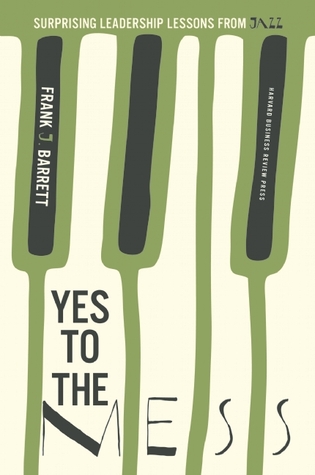
Adapted from Say Yes to the Mess, by Frank J. Barrett

Say Yes to the Mess

The Language of Success: Creating a Culture of Happiness

Throughout my career, I had found that most people want to be involved in something greater than just being paid for a job. My basic story is about the two men laying bricks. When asked what he is doing, one man says, ‘I’m laying bricks.’ The other man performing the same task says, ‘I’m building a cathedral.’ – Van France, Disney University founder

Beginning with the original orientation at Disneyland in 1955, Van’s goal always remained the same: instill a sense of pride among cast members about where they work and the jobs they perform. Van was determined to make Disneyland a place where customers and cast members experienced second-to-none service.

photo by glassslipperconcierge.com

photo by glassslipperconcierge.com

One of his strategies involved creating a whole new language that would reinforce the dignity of every job in the park.

What’s the difference between treating someone like a customer, and treating someone like a Guest?

The obvious analogy is that we do things differently when we bring Guests into our home. We spruce up the house. We dress up. We prepare something special to eat. We host them. We take care of their real needs.

Disneyland is a huge stage, so Van leveraged this by introducing show-business term. He reasoned that a new vocabulary, coupled with strong organizational values, could bring pride and energy to the job.

  • Employees became cast members, hosts, and hostesses
  • Customers became Guests
  • Good show was a job well-done
  • Uniforms were costumes
  • On-stage are actions visible to Guests
  • Backstage are the actions taken out of sight of the Guests.

However, merely changing nouns or verbs won’t ensure world-class customer service or create a motivated and engaged workforce – in any organization. Catchy words for Guests and team members have no value without leadership support.

The values instilled by Walt Disney and perpetuated by Van France at the Disney University are reflected in the daily actions of cast members at every organizational level.

What you do here and how you act is very important to our entire organization. We have a worldwide reputation for family entertainment. Here at Disneyland, we meet our world public on a person-to-person basis for the first time. Your every action (and mine also) is a direct reflection of our entire organization. – Walt Disney

Applying Van France’s Four Circumstances to ChurchWorld Guest Experience Teams

Innovate – Support – Educate – Entertain

 Putting People First

  • What is the culture of your organization?
  • How is respect conveyed to team members?
  • Do they know they are valued?
  • How are Van’s Four Circumstances (Innovate, Support, Educate, Entertain) used to communicate your culture?

Words Reflect Culture

  • Does your organization use unique words to identify team members and Guests?
  • Does the culture of your organization support those words?
  • How are organizational values reflected in words and actions?

Inspired by and adapted from Disney U by Doug Lipp

Disney U

Get the book TODAY to learn invaluable lessons for your Guest Experience Teams

Book     Kindle

Disney U is one of the most significant resources related to the Disney organization, leadership, team development, and Guest Experiences available. In honor of the one year anniversary of the release of Disney U, this is a look back at a series from the book that originally ran last year.

Beyond Orientation: Executive Team Development – Moving from Silos to Synergy

Walt was very firm in stating that Disneyland – the dream – was the star. It was his way of controlling the people with their outsized egos who thought that they or their divisions, departments, or functions were responsible for our success – Van France

The entrepreneurial and highly innovative culture created by the Disney organization had an unintended consequence: divisional and communication silos.

People were so focused on their areas of responsibility that they didn’t consider their impact on other divisions and departments.  Executives lost sight of the big picture, and as a result, lost some opportunities for synergy.

To counter that, the Disney University team created an experience for the executives that borrowed from Van France’s timeless model for any training program:

  • Make it simple, not simplistic
  • Make it enjoyable
  • Design experiential activities that make it memorable

The result: Disney Dimensions, a training program for 25 senior leaders throughout Disney. It was designed to give them a full-immersion, 7-day experience of the California and Florida theme parks, as well as Disney Studios and Imagineering (the design geniuses behind the parks).

Essentially, the executives were exposed to every business unit in the company and had them solving each other’s problems.

Disney Dimensions captured the essence of a Van-France inspired educational event. It informed. It engaged. It was fun. It accomplished its business goals. The leadership program also enjoyed each of the Four Circumstances Van identified as crucial to the success of the Disney University:

  • Innovate – the multiday, multivenue design exposed the participants to every area of the company. Until then, most executives hadn’t ventured beyond their own area of expertise.
  • Support – Disney Dimensions received the overt, enthusiastic support of top management, who had a hand in choosing the participants and didn’t hesitate to sing its praises.
  • Educate – combining executive-level attendees from each operating division in the unique and interactive environment created a forum in which participants educated one another.
  • Entertain – every training event is an opportunity to be creative and interesting rather than the opposite: dull and academic.

The living laboratory experiential activities that led to advanced levels of cross-functional collaboration and creative problem solving are worthwhile goals for any organization.

Applying Van France’s Four Circumstances to ChurchWorld Guest Experience Teams

Innovate – Support – Educate – Entertain

 How is executive development handled in your organization?

  • What is being done to fully engage executives in organizational collaboration? Who does it and how frequently?
  • How could this strategy improve?
  • How are real-time ministry issues used in training and development programs?
  • Are there examples of ministry hits and misses that can be transformed into case studies for senior leadership team development?
  • Does the senior leadership team in our organization openly assess ministry successes and failures?
  • How can leaders in your organization lend their support to training initiatives?
  • In your organization, what needs to be done to promote and perpetuate senior leadership team development?

Inspired by and adapted from Disney U by Doug Lipp

Disney U

Get the book TODAY to learn invaluable lessons for your Guest Experience Teams

Book     Kindle

Conclude the Disney U experience on 4/24/14 with The Language of Success

Disney U is one of the most significant resources related to the Disney organization, leadership, team development, and Guest Experiences available. In honor of the one year anniversary of the release of Disney U, this is a look back at a series from the book that originally ran last year.