Leaders Get Calendared

Do you find yourself constantly running from one issue to the next without any margin in your life?

Do you feel like you are over-committed to such a degree that the truly important things have been slipping a little?

Do you wish for a reset button and dream of starting over someplace new, just like you did last time? (How did that work out for you?)

Many times we neglect the lasting work of ministry for the instant gratification of solving a problem or being the hero. The thing is, nobody wins when church activity replaces people development. Pastors, more than anyone, must learn to be disciplined to focus, and do only what only they can do.

THE QUICK SUMMARY – Kevin Kruse, 15 Secrets Successful People Know About Time Management

What if a few new habits could dramatically increase your productivity, and even 5x or 10x in key areas? What if you could get an hour a day to read, exercise, or to spend with your family?

New York Times bestselling author, Kevin Kruse, presents the remarkable findings of his study of ultra-productive people. Based on survey research and interviews with billionaires, Olympic athletes, straight-A students, and over 200 entrepreneurs—-including Mark Cuban, Kevin Harrington, James Altucher, John Lee Dumas, Pat Flynn, Grant Cardone, and Lewis Howes – Kruse answers the question: “What are the secrets to extreme productivity?”

A SIMPLE SOLUTION

Faced with a mountain of tasks to do and things to accomplish, most of us feel immediately better when we’ve put all of these things on a “to-do list.” And, there is some value in putting things to be done on paper (or digitally stored).

But that value is practically nothing unless you find a way to act upon that thing.

Highly successful people dont have a to-do list, but they do have a very well-kept calendar.

One of the most consistent actions you can take to get things done is to schedule time for them.

The simple act of scheduling tasks on your calendar – instead of writing them on a to-do list – will free your mind, reduce stress, and increase cognitive performance. There are several key concepts to managing your life using your calendar instead of a to-do list.

First, schedule a chunk of time for everything that is important to you; this is called “time blocking” or “time boxing.” Focus on those things that bring you closer to your goals each and every day.

Second, important items should be scheduled as early in the day as possible. As the day progresses, all kinds of things will come up, and you will find it hard to keep focused on the important things.

Third, dont cancel goals; reschedule them if necessary. When circumstances prevent keeping an important time-block, reschedule it, keeping it as a priority.

Fourth, treat your time-blocked calendar entries as if they were appointments with your doctor; they are that important. Don’t cave in on your self-scheduled appointments; they really are important!

When you master the practice of time-blocking – using your calendar instead of your to-do list – you can literally see your life’s priorities by looking at your weekly calendar.

Kevin Kruse, 15 Secrets Successful People Know About Time Management

A NEXT STEP

Utilizing a calendar is probably second nature to you, whether a digital calendar or a print calendar, or a combination of both. Even so, review the four concepts listed above and choose to implement them as a part of a two-week experiment.

Putting these concepts into use can transform your calendar into a powerful life-guiding tool.

Using the concepts above, make an effort over the next two weeks to put them into practice in your daily calendaring. By utilizing these concepts, you are in effect designing your ideal week with your priorities.

At the end of the two-week experiment, what changes have you noticed? What changes have those closest to you noticed?

Now challenge your team toward this same effort. Begin to celebrate calendaring success and measure the increased output and impact of your efforts.

Excerpt taken from SUMS Remix 68-2, issued June 2017.


Part of a weekly series on 27gen, entitled Wednesday Weekly Reader

Regular daily reading of books is an important part of my life. It even extends to my vocation, where as Vision Room Curator for Auxano I am responsible for publishing SUMS Remix, a biweekly book “summary” for church leaders. Each Wednesday I will be taking a look back at previous issues of SUMS Remix and publishing an excerpt here.


>> Purchase SUMS Remix here<<

Grow Your Leadership Skills – Lead with Influence

Do you know you are a leader, but need help growing your leadership skills?

While the phrase “natural born leader” is often used, there’s really not scientific support for this phenomenon. In reality anyone could become a leader and everyone should grow as a leader.

To become a leader is to become a learner. Leadership is not a natural gifting but a set of abilities, and like any other skill set it is to be learned and improved.

Those who have chosen to take on or accept a leadership role must own their personal responsibility for developing their leadership ability.

THE QUICK SUMMARY – Joseph Grenny, Kerry Patterson, et al, Influencer

Whether you’re a CEO, a parent, or merely a person who wants to make a difference, you probably wish you had more influence with the people in your life. But most of us stop trying to make change happen because we believe it is too difficult, if not impossible. We learn to cope rather than learning to influence.

From the bestselling authors who taught the world how to have Crucial Conversations comes the new edition of Influencer, a thought-provoking book that combines the remarkable insights of behavioral scientists and business leaders with the astonishing stories of high-powered influencers from all walks of life. You’ll be taught each and every step of the influence process–including robust strategies for making change inevitable in your personal life, your business, and your world. You’ll learn how to:

  • Identify high-leverage behaviors that lead to rapid and profound change
  • Apply strategies for changing both thoughts and actions
  • Marshal six sources of influence to make change inevitable

Influencer takes you on a fascinating journey from San Francisco to Thailand to South Africa, where you’ll see how seemingly “insignificant” people are making incredibly significant improvements in solving problems others would think impossible. You’ll learn how savvy folks make change not only achievable and sustainable, but inevitable. You’ll discover breakthrough ways of changing the key behaviors that lead to greater safety, productivity, quality, and customer service.

No matter who you are or what you do, you’ll never learn a more valuable or important set of principles and skills. Once you tap into the power of influence, you can reach out and help others work smarter, grow faster, live, look, and feel better–and even save lives. The sky is the limit . . . for an Influencer.

A SIMPLE SOLUTION

John Maxwell, arguably one of the most respected authorities on leadership, is well known for his definition of leadership as being influence – nothing more, nothing less.

It is a good start, but it is not adequate by itself.

David Burkas, executive coach, modifies Maxwell’s definition:

Leadership is the process of influencing others to work toward a mutually desired vision.

Leaders, then, recruit and influence followers to work together to make a shared vision reality.

At the end of the day, what qualifies people to be called “leaders” is their capacity to influence others to change their behavior in order to achieve important results.

Influencers are successful because they think intentionally about their ability to help others act in unprecedentedly effective ways. They think about influencing behavior, talk about it, and practice it.

Three keys that all influencers adhere to and that you can use to your own benefit:

Focus and measure. Influencers are crystal clear about the result they are trying to achieve and are zealous about measuring it.

Find vital behaviors. Influencers focus on high-leverage behaviors that drive results. More specifically, they focus on the two or three vital actions that produce the greatest amount of change.

Engage all six sources of influence. Influencers break from the pack by overdetermining change. Where most of us apply a favorite influence tool or two to our important challenges, influencers identify all of the varied forces that are shaping the behavior they want to change and then get them working for rather than against them. And now for the really good news. According to research, by getting six different sources of influence to work in their favor, influencers increase their odds of success tenfold. The six sources are:

  • Personal motivation – help them love what they hate

  • Personal ability – help them do what they can’t

  • Social motivation – provide encouragement

  • Social ability – provide assistance

  • Structural motivation – change their economy

  • Structural ability – change their space

Joseph Grenny, Kerry Patterson, et al, Influencer

A NEXT STEP

Review each of the three keys above by considering the following questions.

Influence begins when you focus and measure

  • Identify what you are really trying to accomplish
  • Create measures that focus your attention on this goal
  • Takes these measures frequently

Next, find vital behaviors

  • Identify two or three behaviors that will drive the majority of your change
  • Concentrate all your change efforts on these behaviors

Finally, engage all six sources of influence

  • Review the six sources of influence listed above
  • Which of these six sources are working against you?
  • How can you turn it from a negative into a positive source of influence?

Excerpt taken from SUMS Remix 69-1, issued June 2017


Part of a weekly series on 27gen, entitled Wednesday Weekly Reader

Regular daily reading of books is an important part of my life. It even extends to my vocation, where as Vision Room Curator for Auxano I am responsible for publishing SUMS Remix, a biweekly book “summary” for church leaders. Each Wednesday I will be taking a look back at previous issues of SUMS Remix and publishing an excerpt here.

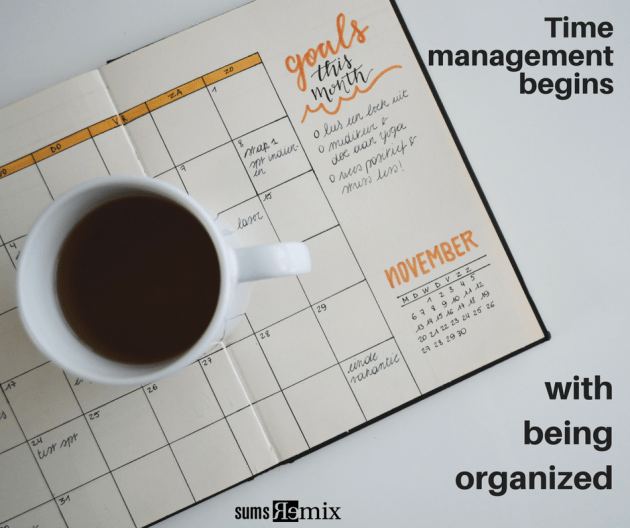
Time Management Begins with Being Organized

Do you spend more time fighting fires than making disciples?

Do you find yourself constantly running from one issue to the next without any margin in your life?

Do you feel like you are over-committed to such a degree that the truly important things have been slipping a little?

Do you wish for a reset button and dream of starting over someplace new, just like you did last time? (How did that work out for you?)

Many times we neglect the lasting work of ministry for the instant gratification of solving a problem or being the hero. The thing is, nobody wins when church activity replaces people development. Pastors, more than anyone, must learn to be disciplined to focus, and do only what only they can do.

THE QUICK SUMMARY – Time Management Magic, by Lee Cockerell

During Lee Cockerell’s career at Disney as the Senior Operating Executive of Walt Disney World Resort, he led a team of 40,000 Cast Members (employees) and was responsible for the operations of 20 resort hotels, four theme parks, two water parks and the ESPN Sports Complex.

As you can imagine, Lee had to become a time management expert, first as a means of survival and then as a way to help others make the best use of their time. The time management secrets he developed have become one of his most requested corporate training lectures and are now available to you in this tell–all book.

A SIMPLE SOLUTION

Almost everyone you encounter feels that he or she has too much to handle and not enough time to get it all done. We may have a “better” life than earlier generations, but at what price? Increased stress levels? Growing frustration?

Our lives no longer have clear boundaries. Not only does it seem that our work and personal lives are always open-ended, the two are usually intertwined.

If our lives have changed, then it stands to reason that the old models and habits used to deal with life are insufficient, and need to change as well.

Most people are not overworkedthey are under-organized.

We need to figure out how to be more organized, so we can get all the urgent, vital, and important things done before it’s too late. I believe the average person can do 50 percent more than they are doing now, including all the right things, if they have an effective system for keeping their lives under control.

The number one excuse people use for not getting done what should be done is, “I did not have enough time.” It’s really nothing more than an excuse, since we all have exactly the same amount of time.

Time management is the act of controlling the events in your life.

A lot of people would reject that definition because they believe we can’t control the events in our lives, because so much of what we deal with every day springs up unexpectedly, seemingly out of nowhere.

Here are some practical tips that will give you a high level of control:

Surround yourself with great people – hire skilled people with passion for their work and a can-do attitude.

Train and educate – train your team thoroughly and educate them about every aspect of your operation, including values, philosophy, priorities, and mission.

Be crystal clear about your expectations – communicate your expectations with unambiguous clarity.

Anticipate and practice – think through all the things that can happen and practice how you will handle them.

Leave spaces in your calendar – pencil in free, uncommitted periods in your day, every day.

Do it now! – when something comes up that must be done, do it; don’t procrastinate.

Lee Cockerell, Time Management Magic

A NEXT STEP

Review Lee’s list of six practical tips listed above, and rank them from what you do best to what you do worst.

Starting at the bottom (the action that you are the worst at), make a specific effort for the next week to put that tip into practice. For example, if you don’t leave spaces in your calendar, take the time to create space each day in your calendar for the next week.

At the end of the week, take time to review the past week, and note how taking that action changed your daily routine. Was it for the better? How? Was it about the same? Did it make it worse? Ask yourself, “Is this something I need to make a regular part of my routine?”

After completing the “worst” of the six tips, go to the next one, and repeat the actions above for the next week. Repeat each one until you have completed all six.

At the end of six weeks, and having experimented with all six of the tips above, take time to review the process.

  • How has your daily routine improved?
  • Have others on your team noticed?
  • Which of the six tips are you planning to keep and make a part of your regular routine?
  • Which of the six didn’t work for you? Why?

Now repeat this exercise every six months as a reminder on the importance of organization.

Excerpt taken from SUMS Remix 68-1, released June 2017.


Part of a weekly series on 27gen, entitled Wednesday Weekly Reader

Regular daily reading of books is an important part of my life. It even extends to my vocation, where as Vision Room Curator for Auxano I am responsible for publishing SUMS Remix, a biweekly book “summary” for church leaders. Each Wednesday I will be taking a look back at previous issues of SUMS Remix and publishing an excerpt here.

Engage Your Audience With a Visual Alphabet

Do you seem to be using more and more words, yet communicating less and less?

Today more than ever, we live in a visual society. Especially in the online world, everyone relies on the power of photos and engagement of video.

While researching a project recently, I was struck by three surprising data points from visual communicator Dan Roam:

  • Research from IBM found that 90% of all data collected in history has been generated in the last two years.
  • Research from Cisco found that 90% of all data transmitted online today is visual.
  • Roam’s experience indicates that 90% of leaders have no idea how to effectively use visuals in their business.

90%-90%-90%. We’re generating more data than ever, that data is overwhelmingly visual, and most of us don’t know how to use images. No matter what business you’re in, the future of your business is visual.

As a church leader, it is incumbent that you get better at using visual images in your communication.

Whether drawing them, looking at them, or talking about them, visual communication adds enormously to your listener’s ability to think, to remember, and to do.

Visual imagery is, in itself, another whole language. Being fluent in that language gives us mind-boggling power to articulate thoughts, communicate those thoughts, and solve problems in ways we otherwise wouldn’t be able to.

THE QUICK SUMMARY – Sunni Brown, The Doodle Revolution

There is NO SUCH THING as a mindless doodle!

What did Einstein, JFK, Edison, Marie Curie, and Henry Ford have in common? They were all inveterate doodlers. These powerhouse minds knew instinctively that doodling is deep thinking in disguise-a simple, accessible, and dynamite tool for innovating and solving even the stickiest problems.

Sunni Brown’s mission is to bring the power of the Doodle to the rest of us. She leads the Revolution defying all those parents, teachers, and bosses who say “Stop doodling! Get serious! Grow up!”

She overturns misinformation about doodling, demystifies visual thinking, and shows us the power of applying our innate visual literacy. She’ll teach you how to doodle any object, concept, or system imaginable, shift habitual thinking patterns, and transform boring text into displays that can engage any audience.

A SIMPLE SOLUTION

“Doodling” in meetings can help you think. The downside is that it can make it appear that you’re not paying attention, but the upside is that those “barely fit for the wall of a cave” drawings can help clarify complexity, defog obscurity, uncover opportunities, and even share ideas.

You may be equally bad at art with both hands, but there is something personal, emotional, and contagious about a hand-drawn sketch that simply conveys a problem or solution.

The goal of the Doodle Revolution is to get people to lean how to think better  using visual language.

The Visual Alphabet is a twelve-letter alphabet that would allow even the most hopeless of artists to be able to visualize anything with minimal practice.

As you can see, the Visual Alphabet is composed of twelve “letters.” We call them letters because they’re the visual equivalent of alphabetic letters. Six of the letters are what we call “forms,” meaning that they are visual marks that, without purposeful manipulation, do not close in on themselves.

The remaining six are called “fields,” meaning that they fold back in on themselves, forming a closed visual field.

The Visual Alphabet is almost as valuable as the alphabet. When we dust it off and use it, we suddenly have an enormous range of communication possibilities at our disposal. Any object, form, or figure can be deconstructed using the letters of the Visual Alphabet.

Sunni Brown, The Doodle Revolution

A NEXT STEP

Draw a box like the one below, and recreate the Visual Alphabet. After completing the images, write the words corresponding to each image.


Draw another box like the one below, and using the Visual Alphabet, “reverse engineer” one object you see around you – anything in your line of sight: chairs, tables, laptops, people.

Now pull out your last sermon or communication piece. Look back at your main point or call to action. Now try and recreate that using the visual alphabet using a box like the one below.

What did you struggle with in doing this? Was your central theme too complex? What did you learn about those words as you described them with visual “letters?”

How can your next communication be clearer using this technique?

If you feel uncomfortable, remember this is an alphabet. You learned to read and write by practicing. The Visual Alphabet is like a starter kit for learning to express ideas as images.


We are living and leading in the most visual age known to man. You can become a powerful visual communicator using the ideas above.

Being a visual leader means that you and your fellow leaders are the buoys and beacons that point out direction and highlight what is “right” to focus on. In times as dynamic and uncertain as ours are now, your willingness to show up as a learning leader – someone who can listen as well as direct, who can explore and question as well as declare – is at a premium.

– David Sibbet


When something is unclear, start drawing. It will unleash the problem-solving power of your visual mind.

– Dan Roam

Excerpt taken from SUMS Remix 55-3, December 2016


Part of a weekly series on 27gen, entitled Wednesday Weekly Reader

Regular daily reading of books is an important part of my life. It even extends to my vocation, where as Vision Room Curator for Auxano I am responsible for publishing SUMS Remix, a biweekly book “summary” for church leaders. Each Wednesday I will be taking a look back at previous issues of SUMS Remix and publishing an excerpt here.

How to Transform Conflict Through Communication

No matter how you define it, conflict is a serious issue that all church leaders face – all too often. You would think that a church “family” should be able to avoid conflict. But how often does your own biological family go through conflict of various intensities?

Your church family consists of hundreds or thousands of complex human relationships, all brought together under the banner of worshipping and serving God in this particular place and time.

You’ve invested yourself heavily in these relationships – as has everyone else to varying degrees. We all have expectations of each other – and when those are not met, the seeds of conflict are planted. Left unaddressed these small seeds can grow into a garden of weeds that choke out the healthy dialog needed to restore the relationship. The longer the situation goes untended, the greater the issue(s) magnify – until the weeds have taken over the garden and any hope of bearing fruit has been squeezed out entirely.

Is it possible to avoid conflict entirely? In a word, no. We’re too “human” to hope for that.

Can we transform and redeem conflict from a destructive force to one in which all parties come through the other side, better for the experience? In a word, yes. We’re children of a loving Father, and His love can see us through any level of conflict.

THE QUICK SUMMARY – Transforming Church Conflict by Deborah Van Deusen Hunsinger and Theresa F. Latini

With many pastors facing burnout and congregations suffering from internal divisions, there is a need for Christian resources that present concrete problem-solving techniques for handling conflict in the church.

This book offers practical skills and strategies that the authors have learned through years of studying nonviolent communication (NVC) as described in Marshall Rosenberg’s book, Nonviolent Communication: A Language of Life, and as developed by numerous NVC trainers all over the world.

Using real-world case studies and examples, Hunsinger and Latini helpfully guide pastors and lay leaders through effective and compassionate ways to deal with discord. These strategies include differentiating observations from evaluations, experiencing and expressing feelings, identifying and connecting with needs, and making requests rather than demands. By learning the basic skills of compassionate communication, church leaders can be empowered to transform, rather than merely manage, church conflict

A SIMPLE SOLUTION

One of the problems surrounding conflict in the church occurs when you look at the church as a singular organization. While it does exist that way in several aspects (legal entity, location, etc.) it really is made up of several different groups.

For example, many churches have the following three groups within the church:

  • The congregation
  • The governing board
  • The staff

Dealing with conflict the same way with all these groups is really an invitation to extend or worsen the conflict. For example, you could have a disaster simmering on the board and have a happy congregation and staff. It only takes a few dissatisfied staff members to disrupt the work of the board and congregation. Finally, it is all-too-possible to have congregational unrest even when the staff and board are working well together.

What’s the single similarity in all the situations described above?

Communication.

When we value the needs of others as well as our own, we can use the four basic skills of compassionate communication to gain mutual understanding and to fulfill as many core needs as possible within our human limits.

The four basic skills of non-violent communication template are: Observation, Feeling, Need, and Request. The OFNR template for learning compassionate communication is a useful tool for guiding our conversation, but it is not a formula for a particular way of speaking.

Observations describe what is available to our senses: what we can see, hear, touch, taste, or smell. They are specific to time and context. In making an observation, the aim is to describe what you have seen or heard as if a video camera were recording the incident.

We continually assess what is happening around us through our emotional capacities. Besides acting as a kind of radar for danger, our emotions are also closely tied to our thought.

We are motivated to act, speak, keep silent, and move toward or away from someone on the basis of our needs. Virtually everything we do (or chose not to do) is an attempt to meet a need. Thus, our needs are the source of our underlying motivation.

Once we have clarity about what we need, we can make a request that we believe will contribute to its being met. Requests are understood as gifts, not demands. They give us the opportunity to contribute to one another’s life.

Deborah Van Deusen Hunsinger and Theresa F. Latini, Transforming Church Conflict

A NEXT STEP

To understand and practice better communication among the three groups listed above, set aside time in a future leadership team meeting and work through the following exercise.

Using a current example of an ongoing situation in your church, create a separate chart tablet for the congregation, the governing board, and the staff.

Along the left margin, write the words Observation, Feeling, Need, and Request.

For each of the three groups, and using the descriptions of the OFNR communication skills above, discuss the situation from the vantage point of the particular group.

After you have completed all three charts, look for areas of similarity and difference.

Use the areas of similarity to promote unity, and use the areas of difference to work to an agreeable resolution.

Conflict may be inevitable, for after all we are all human. However, conflict can be preempted and lessened in both intensity and frequency.

Excerpt taken from SUMS Remix 66-3, issued May 2017


Part of a weekly series on 27gen, entitled Wednesday Weekly Reader

Regular daily reading of books is an important part of my life. It even extends to my vocation, where as Vision Room Curator for Auxano I am responsible for publishing SUMS Remix, a biweekly book “summary” for church leaders. Each Wednesday I will be taking a look back at previous issues of SUMS Remix and publishing an excerpt here.

Escape the 9 to 5 Rut With a Virtual Office

If you ask people where they go when they really need to get work done, very few will respond “the office.” If they do say the office, they’ll include a qualifier such as “super early in the morning before anyone gets in” or “I stay late at night after everyone’s left” or “I sneak in on the weekend.”

What they’re trying to tell you is that it is hard to actually get work done at the office. The average office has become the last place people want to be when they really want to get work done during the day. How many Pastors actually study for Sunday in their office? Most have a home-office or office-within-the-office they retreat into.

That’s because offices have become disruption factories.

Meaningful work, creative work, thoughtful work, and important work – this type of effort takes stretches of uninterrupted time to get into the zone. But in most offices, such long stretches just can’t be found. Instead, it’s just one appointment or distraction after another.

Millions of workers and thousands of companies have already discovered the joys and benefits of working remotely.

Is it time your church considered current remote working options?


THE QUICK SUMMARY – Remote by Jason Fried and Davis Heinemeier Hansson

The “work from home” phenomenon is thoroughly explored in this illuminating new book from bestselling 37signals founders Fried and Hansson, who point to the surging trend of employees working from home (and anywhere else) and explain the challenges and unexpected benefits. Most important, they show why – with a few controversial exceptions such as Yahoo — more businesses will want to promote this new model of getting things done.

The Industrial Revolution’s “under one roof” model of conducting work is steadily declining owing to technology that is rapidly creating virtual workspaces and allowing workers to provide their vital contribution without physically clustering together. Today, the new paradigm is “move work to the workers, rather than workers to the workplace.” According to Reuters, one in five global workers telecommute frequently and nearly 10 percent work from home every day. Moms in particular will welcome this trend. A full 60% wish they had a flexible work option. But companies see advantages too in the way remote work increases their talent pool, reduces turnover, lessens their real estate footprint, and improves the ability to conduct business across multiple time zones, to name just a few advantages. In Remote, iconoclastic authors Fried and Hansson will convince readers that letting all or part of work teams function remotely is a great idea–and they’re going to show precisely how a remote work setup can be accomplished.

A SIMPLE SOLUTION

9 to 5 is not just the name of a cheesy but funny 1980 movie; it’s also a practice engrained into our psyche which would have us believe that only during those hours at an office can real work take place.

It’s just not true anymore.

Think about it – if any of your work requires a computer, a few files, and your brainpower, do you really need to be in an office? Could you not just as easily do the work from a coffee shop, your kitchen table, or outside on a beautiful spring day?

Taking that thought further, do you even need to be doing that work in a specified time frame?

If the results of your work are the goal, then it’s time to consider remote work.

Remote work is about setting your team to be free to be the best it can be, whenever and wherever that might be.

Embracing remote work doesn’t mean you can’t have an office; just that it’s not required. It doesn’t mean all your employees can’t live in the same city, just that they don’t have to.

Your organization is probably already working remotely without you even knowing it. When you have legal issues, you probably don’t have lawyers on staff – you outsource the work to a lawyer or a law firm. Unless your organization is large enough for a full accounting staff, you probably outsource some or all of your financial work to a CPA or accounting firm. Human resources? Marketing? Lawn Care? Custodial Services? These are just a few examples of essential business activities being performed by outside people.

Every day this kind of remote work works, and no one considers it risk, reckless, or irresponsible. So why do so many of these same organizations that trust “outsiders” to do their critical work have such a hard time trusting “insiders” to work from home?

Look around inside your organization and notice what work already happens on the outside, or with minimal face-to-face interaction. You may be surprised to discover that your company is more remote than you think.

Jason Fried and Davis Heinemeier Hansson, Remote

A NEXT STEP

Conduct an “audit” of all the different types of work that goes on within your organization using the following process.

On a chart tablet, list all the work that is performed for your organization by an outside individual or group. Beside each item, write the frequency with which it is performed – daily, weekly, monthly, quarterly, or annually. Beside the frequency, list the primary leader in your organization responsible for overseeing that work.

On a second chart tablet, list all the remaining work that is performed in your organization. As before, list both frequency and primary leader by the item.

As a team, review the work done inside your organization, and list up to 10 items that could conceivably be done remotely or outsourced. At this point, you are simply capturing ideas, not working out all the details.

Discuss the list of 10, and come to a consensus of which is most important by ranking them from 1 to 10.

Continuing that discussion, take the top three and list what it would take for that item to be moved from being accomplished onsite during specific hours to offsite or outsourced. Take the necessary steps to make it happen.

After three months, evaluate those three items; adjust as needed. Chose the next three times on the original list of 10, and repeat the process.

Excerpt taken from SUMS Remix 67-2, issued May 2017


Part of a weekly series on 27gen, entitled Wednesday Weekly Reader

Regular daily reading of books is an important part of my life. It even extends to my vocation, where as Vision Room Curator for Auxano I am responsible for publishing SUMS Remix, a biweekly book “summary” for church leaders. Each Wednesday I will be taking a look back at previous issues of SUMS Remix and publishing an excerpt here.

Do You Understand Your Conflict Management Style?

How do you handle church conflict?

No matter how you define it, conflict is a serious issue that all church leaders face – all too often. You would think that a church “family” should be able to avoid conflict. But how often does your own biological family go through conflict of various intensities?

Your church family consists of hundreds or thousands of complex human relationships, all brought together under the banner of worshipping and serving God in this particular place and time.

You’ve invested yourself heavily in these relationships – as has everyone else to varying degrees. We all have expectations of each other – and when those are not met, the seeds of conflict are planted. Left unaddressed these small seeds can grow into a garden of weeds that choke out the healthy dialog needed to restore the relationship. The longer the situation goes untended, the greater the issue(s) magnify – until the weeds have taken over the garden and any hope of bearing fruit has been squeezed out entirely.

Is it possible to avoid conflict entirely? In a word, no. We’re too “human” to hope for that.

Can we transform and redeem conflict from a destructive force to one in which all parties come through the other side, better for the experience? In a word, yes. We’re children of a loving Father, and His love can see us through any level of conflict.

THE QUICK SUMMARY – Discover Your Conflict Management Style, by Speed B. Leas

Speed B. Leas helps readers to assess their conflict response and discover options appropriate to different levels of conflict.

He draws on years of experience helping conflicted congregations to provide valuable insights on the nature of conflict and its resolution, making this an excellent tool for raising self-awareness and a practical introduction to conflict management.

This new edition contains an improved Conflict Strategy Instrument, revised to reflect new learnings and more accurately describe your conflict management style.

A SIMPLE SOLUTION

When faced with almost any situation in life, most of us will respond on the basis of how we have handled similar encounters. Our response pattern is also influenced by the issue at hand or the individuals involved. For example, an individual may find controlling the conversation during an argument works best with his spouse. That same pattern will usually be taken in similar conflicts with others.

This “conflict management style” may be intentionally or unintentionally selected. It may also change depending on the specific circumstances surrounding the conflict.

If you accept the principle that conflict is a part of life, and that, over time, we adopt specific conflict management styles, then the natural progression delivers this: Identifying and understanding our conflict management styles will usually help us work through conflicts in a quicker and more satisfactory conclusion for all parties involved.

Understanding your conflict management style will help you become more comfortable with differences and encourage open and confident sharing of differences and concerns with one another.

This instrument identifies six different styles for managing differences: Persuading, Compelling, Avoiding/Accommodating, Collaborating, Negotiating, and Supporting.

Each can be an appropriate style, and none should be thought of as “bad” or inferior. A certain style can cause a problem when it is used inappropriately, but one should not assume that Avoiding is always wrong or that all conflicts must be confronted.

Persuasion strategies are those where a person or group attempts to change another’s point of view, way of thinking, feelings, or ideas. One attempting to persuade another uses rational approaches, deductive and inductive argument, and any other verbal means she thinks will work to convince the other that her opinion is the one that should prevail.

Most of the Compelling we experience in our day-to-day lives is not through the use of physical force but that which comes through the use of authority. Authority is the right we give to a person or group to make certain decisions for us – because it is expedient or because we can’t agree. Authority comes through a tacit or explicit contract we make with others.

When one Avoids a conflict, one evades or stays away from it, attempting to skirt it or keep it from happening. Ignoring a conflict is acting as if it weren’t going on. Fleeing is actively removing yourself from the arena in which conflict might take place. When you accommodate, you go along with the other, with the opposition. Procrastination is a common strategy used to avoid, ignore, or accommodate. Putting off dealing with the conflict may be the most common way that this set of strategies is used.

Collaborative conflict strategies are frequently touted as the best or only strategy to use when dealing with conflict. When one collaborates, one co-labors, works together, with others on the resolution of the difficulties that are being experienced.

Negotiating refers to a strategy that is very similar to Collaboration, except that the expectations of the parties are lower as they enter the conflict arena. People who use Negotiation are trying to get as much as they can, assuming that they will not get everything they want.

Often called communication skills or active listening, Support strategies assume that the other is the one with the problem. It is your task NOT to take responsibility for dealing with it, but to help the other deal with the problem.

Speed B. Leas, Discover Your Conflict Management Style

A NEXT STEP

Use the following team exercise to help everyone understand the different types of conflict management styles.

Create a fictional congregational situation that has the potential for being divisive. Develop a back-story and supporting characters.

Ask each member of your team to undertake one of the six types of conflict management styles listed above. If you have more than six on your team, partner up with others so there are six groups.

With the fictional situation in mind, allow 15 minutes for each group to develop a brief presentation for the rest of their group, based on their assigned conflict management style. The presentation should include highlights or bullet points written on a chart tablet.

When everyone has completed their work, have each group present their work to the entire team.

After each team has made their presentation, enter into a team discussion, working through each of the six conflict management styles. Ask individual team members to share which of the six they are most comfortable using, and which is most uncomfortable.

In closing, challenge the team to review and keep in mind these six conflict management styles as they lead their individual teams.

Excerpt taken from SUMS Remix Issue 66-2, issued May 2017


Part of a weekly series on 27gen, entitled Wednesday Weekly Reader

Regular daily reading of books is an important part of my life. It even extends to my vocation, where as Vision Room Curator for Auxano I am responsible for publishing SUMS Remix, a biweekly book “summary” for church leaders. Each Wednesday I will be taking a look back at previous issues of SUMS Remix and publishing an excerpt here.

Working Remotely Starts With Your Culture

How can we maximize team effectiveness, as well as better steward Church resources, by leveraging cultural shifts in the workplace?

If you ask people where they go when they really need to get work done, very few will respond “the office.” If they do say the office, they’ll include a qualifier such as “super early in the morning before anyone gets in” or “I stay late at night after everyone’s left” or “I sneak in on the weekend.”

What they’re trying to tell you is that it is hard to actually get work done at the office. The average office has become the last place people want to be when they really want to get work done during the day. How many Pastors actually study for Sunday in their office? Most have a home-office or office-within-the-office they retreat into.

That’s because offices have become disruption factories.

Meaningful work, creative work, thoughtful work, and important work – this type of effort takes stretches of uninterrupted time to get into the zone. But in most offices, such long stretches just can’t be found. Instead, it’s just one appointment or distraction after another.

Millions of workers and thousands of companies have already discovered the joys and benefits of working remotely.

Is it time your church considered current remote working options?

THE QUICK SUMMARY – The Year Without Pants, by Scott Berkun

Fifty million websites, or 20 percent of the entire web, use WordPress software. The force behind WordPress.com is a convention-defying company called Automattic, Inc., whose 120 employees work from anywhere in the world they wish, barely use email, and launch improvements to their products dozens of times a day. With a fraction of the resources of Google, Amazon, or Facebook, they have a similar impact on the future of the Internet. How is this possible? What’s different about how they work, and what can other companies learn from their methods?

To find out, former Microsoft veteran Scott Berkun worked as a manager at WordPress.com, leading a team of young programmers developing new ideas. The Year Without Pants shares the secrets of WordPress.com’s phenomenal success from the inside. Berkun’s story reveals insights on creativity, productivity, and leadership from the kind of workplace that might be in everyone’s future.

  • Offers a fast-paced and entertaining insider’s account of how an amazing, powerful organization achieves impressive results
  • Includes vital lessons about work culture and managing creativity

The Year Without Pants shares what every organization can learn from the world-changing ideas for the future of work at the heart of Automattic’s success.

A SIMPLE SOLUTION

Culture is incredibly important when it comes to considering moving into the possibility of remote work. The stronger your culture, the less specific training and oversight is needed.

You don’t need everyone to be physically together to create a strong culture. After all, culture really isn’t found in a handbook or in a poster on a wall. Culture is about the actions and values being lived out day by day in your organization.

If your culture is strong, and is centered on your vision, then physical location of work being done toward those ends is – or should be – a minor concern. As a practical matter, most organizations today have blown past the work/personal life boundaries of prior generations.

Isn’t it time to recognize that, and bring a little common sense back into the equation?

Many people assume working remotely is a sham. It violates the bright yellow line that we pretend exists between work and home, a line shattered by laptops and movie e-mail years ago.

The very idea of working remotely seems strange to most people until they consider how much time at traditional workplaces is spent working purely through computers. If 50 percent of your interacting with coworkers is online, perhaps through e-mail and web browsers, you’re practically working remotely.

If remote work allows location to become irrelevant, you can hire the best talent in the world, wherever they are.

Remote work will succeed or fail because of company culture, not because of the feature itself.

Self-motivated people thrive when granted independence

Managers who want better performance must provide what their staff need

Remote work is a kind of trust, and trust works two ways. If someone who works for you wants to work remotely or use a new e-mail tool or brainstorming method, little is lost in letting him or her try it out. If his or her performance stays the same or improves, you win. If it goes poorly, you still win, as you’ve demonstrated your willingness to experiment, encouraging everyone who works for you to continue looking for ways to improve their performance.

Most people doubt online meetings can work, but they somehow overlook that most in-person meetings don’t work either. Being online does mean everyone might be distracted, but plenty of meetings today are filled with people with their laptops open, messaging each other about how bored they are.

Scott Berkun, The Year Without Pants

A NEXT STEP

When considering the move to having remote work as a regular part of your organizational routine, the strength of your present culture is a huge first step. Even with a strong culture, though, you as a leader need to be prepared for comments and criticism from within your organization, from the stakeholders outside the organization, and from the people your organization serves.

To prepare for dealing with these criticisms, write potential excuses for why remote work won’t work for you. Use the ideas below as starters, and add your own unique ones.

  • We can really only work when we’re all in a room
  • If I can’t see my team, how do I know they’re working?
  • Homes, coffee shops, etc. are full of distractions
  • Sensitive information won’t be secure offsite
  • What about when someone needs something NOW?
  • I’ll lose control of my team
  • We have a lot of resources (read, money) tied up in physical spaces

After you have completed the list, review it, and counter as many of the criticisms as possible. Don’t make this a solo exercise; involve your whole team in this process.

Working remotely isn’t without complication or occasional sacrifice. It’s about making things better for more people more of the time.

Excerpt taken from SUMS Remix 67-1, issued May 2017


Part of a weekly series on 27gen, entitled Wednesday Weekly Reader

Regular daily reading of books is an important part of my life. It even extends to my vocation, where as Vision Room Curator for Auxano I am responsible for publishing SUMS Remix, a biweekly book “summary” for church leaders. Each Wednesday I will be taking a look back at previous issues of SUMS Remix and publishing an excerpt here.

Leaders Forecast the Future

Do you feel like most days you are running on a ministry treadmill? You know the feeling – it’s when the busyness of ministry creates a progressively irreversible hurriedness in your life as a leader. The sheer immediacy of each next event or ministry demand prevents you from taking the time to look to the future horizon – and sometimes even today’s calendar – until it crashes in on you.

All too often, today’s demands can choke out the needed dialogue for tomorrow. When this occurs, your multiplied activity accomplishes little of value and prevents you from ministry with a clear sense of what God has called you to do.

THE QUICK SUMMARY – The Signals Are Talking, by Amy Webb

Amy Webb is a noted futurist who combines curiosity, skepticism, colorful storytelling, and deeply reported, real-world analysis in this essential book for understanding the future. The Signals Are Talking reveals a systemic way of evaluating new ideas bubbling up on the horizon – distinguishing what is a real trend from the merely trendy. This book helps us hear which signals are talking sense, and which are simply nonsense, so that we might know today what developments-especially those seemingly random ideas at the fringe as they converge and begin to move toward the mainstream-that have long-term consequence for tomorrow.

With the methodology developed in The Signals Are Talking, we learn how to think like a futurist and answer vitally important questions: How will a technology-like artificial intelligence, machine learning, self-driving cars, bio hacking, bots, and the Internet of Things – affect us personally? How will it impact our businesses and workplaces? How will it eventually change the way we live, work, play, and think-and how should we prepare for it now?

Most importantly, Webb persuasively shows that the future isn’t something that happens to us passively. Instead, she allows us to see ahead so that we may forecast what’s to come – challenging us to create our own preferred futures.

A SIMPLE SOLUTION – Forecast the Future

Though it may often seem like it, tomorrow doesn’t arrive fully formed, but develops in measured steps. The tomorrow in question is not a calendar day, but the whole spectrum of actions, activities, and personalities that together make up your future.

No, your tomorrow begins taking shape with seemingly disparate events from all directions around you. They may seem random, but in the right context these points will be discerned first as a fuzzy pattern before developing into a meaningful whole. Before you know it, your future has arrived.

Are you ready for the future? Maybe the bigger question should be, did you see it coming? 

No one should plan for a future she cannot see.

Futurists are skilled at listening to and interpreting the signals talking. It’s a learnable skill, and a process anyone can master. Futurists look for early patterns – pre-trends, if you will – as the scattered points on the fringe converge and begin moving toward the mainstream. They know most patterns will come to nothing, and so they watch and wait and test the patterns to find those few that will evolve into genuine trends.

Each trend is a looking glass into the future, a way to see over time’s horizon. The advantage of forecasting the future win this way is obvious. Organizations that can see trends early enough to take action have first-mover influence. But they can also help to inform and shape the broader context, conversing and collaborating with those in other fields to plan ahead.

One of the reasons you don’t recognize this moment in time as an era of great transformation is because it’s hard to recognize change. The pace of change has accelerated, as we are exposed to and adopt new technologies with greater enthusiasm and voracity each year.

Forecasting the future requires a certain amount of mental ambidexterity. Just as a piano player must control her left and right hands as she glides around the keyboard playing, you need to learn how to think in two ways at once – both monitoring what’s happening in the present and thinking how the present relates to the future.

Amy Webb, The Signals Are Talking

A NEXT STEP

Mapping the future for your church begins with identifying early signposts as you look out on the horizon. In order to chart the best way forward, you must understand emerging trends: what they are, what they aren’t, and how they operate.

Amy Webb has developed a six-part process that can help you forecast the future. These six steps were developed during a decade of research at the Future Today Institute.

  1. Find the Fringe – Make observations and harness information from the fringes of society or a particular area. What can you observe about the groups of people in your church that might look or act different from the majority? What motivates or demotivates them?
  2. Use CIPER – Uncover hidden patterns by searching for Contradictions, Inflections, Practices, Hacks, Extremes, and Rarities. Are there any “unwritten” rules at your church in parking, arrival time, or ministry patterns that tell a story?
  3. Ask the Right Questions – Determine if whether a pattern is really a trend.
  4. Calculate the ETA – Ensure that the timing is right for the trend and for your organization.
  5. Write Scenarios – Scenarios inform the strategy you will create to take the necessary action on a trend. Talk through any changes that you might make as a result of the discoveries above. What complications and opportunities emerge as you think through the impact on the congregation.
  6. Pressure-Test the Future – Are your scenarios comprehensive enough? Is the strategy you’re taking the right one for the future?

Write each one of the six steps above on a separate chart tablet. Set aside three hours with your team to work through the six steps above, answering the question “What is the future of X?” where X is a proposed new ministry initiative.

Excerpt taken from SUMS Remix 64-1, April 2017


Part of a weekly series on 27gen, entitled Wednesday Weekly Reader

Regular daily reading of books is an important part of my life. It even extends to my vocation, where as Vision Room Curator for Auxano I am responsible for publishing SUMS Remix, a biweekly book “summary” for church leaders. Each Wednesday I will be taking a look back at previous issues of SUMS Remix and publishing an excerpt here.

Developing a Generous Life: Downsize to Maximize

How can you experience the transforming power of a generous life? 

Generosity is a testimony of God’s grace in your life. It affirms your faith and it is how God desires to work around the world. You are declaring your faith again and again every time you give. When you then give extravagantly, you are truly participating at a high level in the advancement of the gospel mission. You perceive in an increasing way, what is important to God, how He works in the world, and desires to partner with you.

But where do you start in developing a generous life?

THE QUICK SUMMARY – The More of Less, by Joshua Becker

Most of us know we own too much stuff. We feel the weight and burden of our clutter, and we tire of cleaning and managing and organizing.

While excess consumption leads to bigger houses, faster cars, fancier technology, and cluttered homes, it never brings happiness. Rather, it results in a desire for more. It redirects our greatest passions to things that can never fulfill. And it distracts us from the very life we wish we were living. In The More of Less, Joshua Becker, helps you….

  • recognize the life-giving benefits of owning less
  • realize how all the stuff you own is keeping you from pursuing your dreams
  • craft a personal, practical approach to decluttering your home and life
  • experience the joys of generosity
  • learn why the best part of minimalism isn’t a clean house, it’s a full life

The beauty of minimalism isn’t in what it takes away. It’s in what it gives.

A SIMPLE SOLUTION – Downsize to Maximize

Contentment is a lifelong pursuit. It truly is hard to be content. As a matter of fact, you have to learn how to be content. Here are two words that can help: process and perspective. Contentment is not an event or experience, it is a trained discipline of the soul. Perspective is the active ingredient that enables contentment in many different trying situations. 

Once we let go of the things that dont matter, we are free to pursue all the things that really do matter.

There is more joy to be found in owning less than can ever be found in pursuing more. In a world that constantly tells us to buy more and more, we often lose sight of that. But consider the life-giving benefits. You can expect a payoff in every one of the following areas if you practice the principles of minimalism taught in The More of Less.

More time and energy – the fewer things we have, the more of our time and energy we’ll have left to devote to other pursuits that matter more to us.

More money – by buying fewer things, we spend less money.

More generosity – there are countless opportunities worth vastly more than material accumulation.

More freedom – every time we remove an unnecessary item, we gain back a little freedom.

Less stress – every added possession increases the worry in our lives.

Less distraction – everything around us competes for our attention.

Less environmental impact – overconsumption accelerates the destruction of natural resources.

Higher-quality belongings – owning more stuff is not better; owning better stuff is better.

A better example for our kids – give your children a framework to counteract the out-of-control lifestyle marketed to them.

Less comparison – purposefully owning less begins to take us out of the unwinnable game of comparison.

More contentment – material possessions will never fully satisfy the desires of our hearts.

Joshua Becker, The More of Less

A NEXT STEP

If we were to be honest with ourselves, many of us could identify with a five-year old when it comes to buying and owning things. We’re captivated by the glamour of things – and we want them now!

Which over time means we end up with a home full of clutter.

So where do you actually start trying to clear out all that stuff you own?

You’ve probably heard of the 80/20 principle. It’s a generality, but it has proven true in many areas of life. How about trying it in the area of your possessions?

It means that you use 20 percent of your stuff 80 percent of the time, and you use the other 80 percent of your stuff only 20 percent of the time. Within that 80 percent of your stuff that mostly just lies around, there should be plenty of choices to start trimming down clutter.

Start with the areas of your home that you use frequently. Living rooms, bedrooms, and bathrooms are a great place to start because you will quickly see the benefits of getting rid of stuff.

As you move from room to room, just put things in a box for later sorting. The idea is to start simplifying your life so you will see the benefits. Now it’s time for the fun.
Have a personal garage sale and give your profit back to the church or specific missionary. Alternately, you could donate to a local organization that can resell for ministry funds. Bottom line, keep the big-picture in mind.

Now step back and take a look at the results, and start the peace that comes from living in a home that has enough – but not too much. And the joy of leveraging your excess for Kingdom access.

Even if the benefits in the list above and the short exercise above were the only reasons for practicing contentment and minimalism, they would be enough. But there’s more. There’s also the personalized benefit each of us can get from minimalism. Getting rid of what you don’t need is the first step toward crafting the life you want.

Giving joyfully then regretting painfully is no fun. Giving should be 100% rewarding all the time. How can we discover this? Can we move to an incredible lifestyle of consistency, dependability, and the rewarding life of generosity? A place where the front side and back side of giving are equally meaningful?

Excerpt taken from SUMS Remix 65-1, issued April 2017


Part of a weekly series on 27gen, entitled Wednesday Weekly Reader

Regular daily reading of books is an important part of my life. It even extends to my vocation, where as Vision Room Curator for Auxano I am responsible for publishing SUMS Remix, a biweekly book “summary” for church leaders. Each Wednesday I will be taking a look back at previous issues of SUMS Remix and publishing an excerpt here.