Getting Your Ideas Off the Ground: 7 Lessons from the Wright Brothers

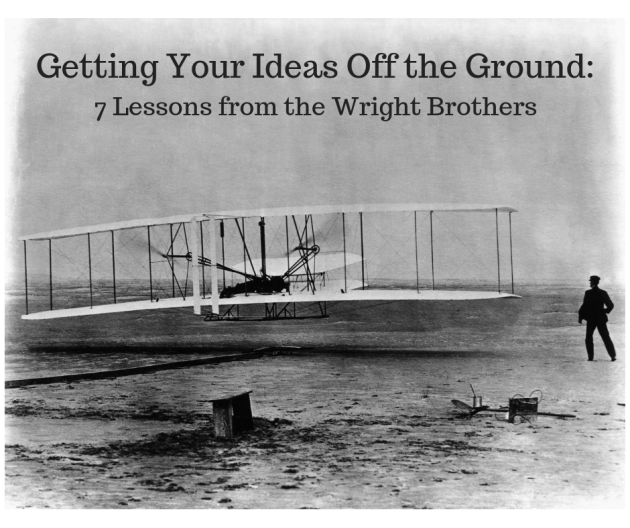
On December 17, 1903, near Kitty Hawk, North Carolina, the Wright Flyer became generally accepted as the first powered, heavier-than-air machine to achieve controlled, sustained flight with a pilot aboard. 

Looking back over these 115 years from a personal viewpoint:

  • In 1903, my grandmother was 5 years old.
  • In 1953, my parents were married.
  • In 2003, the second of my four children began college.
  • Today, in 2018, all 14 of my immediate family have traveled by airplane. My Air Force grandkids, even at 5 and 8, have more frequent flyer miles than I do.

In the lifetime of my extended family, “flying” has come from non-existent to a routine afterthought.

The principles of flying even extend beyond our earth, to travel in space.

How did two men, in 1903, working essentially alone and with little formal scientific training, solve a problem so complex and demanding as heavier-than-air flight, which had defied better-known experimenters for centuries?

Certainly the brothers were talented, but the true answer also lies in their background and early experiences.

With no education beyond public schools, how did the the Wright brothers get past numerous obstacles the world’s other scientists hadn’t even begun to tackle?

In 2003, on the 100th anniversary of the first flight, Mark Eppler published The Wright Way, defining seven essential problem-solving principles the brothers used in accomplishing this enormous feat.

  • A passion for knowledge and information
  • An ability to argue through tough issues in search of truth
  • An ability to identify the hardest part of a problem, and the discipline to begin there
  • A talent for tactile and conceptual tinkering
  • An ability to conceptualize new (often radical) ideas, and the courage to consider them
  • A penchant for method and meticulous attention to detail
  • An ability to create infinitely more together than they could by themselves

On today’s 115th anniversary of the flight at Kitty Hawk, leaders should look at the above list and apply them to problems they are facing.

Applying these principles might just help you get your ideas “off the ground.”

For additional information about the fascinating story of the Wright Brothers, here are four great books I recommend:


How to Communicate with Intentionality by Clarifying Your Message

“Scrambling to keep up and looking for ways to get their message heard, churches are creating more videos, designing more logos, printing more inserts, sending more emails, launching new apps and websites, posting more social media updates, and trying to write lots of captivating content.”

“Here’s what happens. The people they are trying to reach move further away just to survive the onslaught.”

The above paragraphs resonate from the introductory pages of Kem Meyer’s book “Less Chaos. Less Noise.” These words become a powerful reminder that today’s church faces a culture in which the difficulty of connecting with people has become an ever-changing proposition.

Every day, your church stewards thousands of moments of truth. Every time a member talks to a neighbor, someone drives by the church facility, a ministry e-mail goes out, a pastor’s business card is left on a desk, some interaction on behalf of the church has transpired. Every time these events happen, the church’s vision glows brighter or dims in the tiniest little increments.

The visionary leader cares too much about the message to let it just blow in the wind, unattended. Church leaders must be bold and relevant as they integrate vision into the all aspects of church communication. This can happen only with a tremendous amount of intentionality in the complex discipline of church communications.


THE QUICK SUMMARY – Building a StoryBrand by Donald Miller

Donald Miller’s StoryBrand process is a proven solution to the struggle business leaders face when talking about their businesses. This revolutionary method for connecting with customers provides readers with the ultimate competitive advantage, revealing the secret for helping their customers understand the compelling benefits of using their products, ideas, or services.

Building a StoryBrand does this by teaching readers the seven universal story points all humans respond to; the real reason customers make purchases; how to simplify a brand message so people understand it; and how to create the most effective messaging for websites, brochures, and social media.

Whether you are the marketing director of a multibillion dollar company, the owner of a small business, a politician running for office, or the lead singer of a rock band, Building a StoryBrand will forever transform the way you talk about who you are, what you do, and the unique value you bring to your customers.

A SIMPLE SOLUTION – Clarify your message

What is clarity really about? A synthesis of definitions brings clarity to the concept of clarity: it means being free from anything that obscures, blocks, pollutes, or darkens.

Being clear as a leader means being simple, understandable, and exact.

The leader helps others see and understand reality better. Leaders constantly bring the most important things to light: current reality and future possibility, what God says about it, and what we need to do about it.

Unfortunately, there is often a gap between the leader’s words and how followers receive the leader’s words. Like a dropped cell call, this is caused by various sources of disconnection and static between people, even if the leader is communicating clearly.

Like the bars that indicate signal strength on a cell phone, every leader has signal strength levels that distinguish perceiving, thinking, and communicating with others.

The effective leader must spend extra time bridging the gaps by practicing clarity with words.

Words sell things. And if we haven’t clarified our message, our customers won’t listen.

Nobody will listen to you if your message isn’t clear, no matter how expensive your marketing material may be.

Your customers have questions burning inside them, and if we aren’t answering those questions, they’ll move on to another brand. If we haven’t identified what our customer wants, what problem we are helping them solve, and what life will look like after they engage our products and services, we can forget about thriving.

What we think we are saying to our customers and what our customers actually hear are two different things. And customers make buying decisions not based on what we say but on what they hear.

We need a filter to minimize the noise. The essence of branding is to create simple, relevant messages we can repeat over and over so that we “brand” ourselves into the public consciousness.

Donald Miller, Building a StoryBrand

A NEXT STEP

Stories move us. They engage us. They inspire us. Stories give us examples of how to act – and how not to act. The best ones stay with us forever.

To clarify your message using stories, it will be helpful to follow the formula that author Donald Miller uses in his book Building a StoryBrand. Purchasers of the book will receive free access to an online tool, the StoryBrand BrandScript.

While you will not be able to use the powerful techniques in this brief overview, you can at least get an idea of how those techniques might be used in your setting.

Here is an overview:

Nearly every story you see or hear can be outlined as: A CHARACTER who wants something encounters a PROBLEM before they can get it. At the peak of their despair, a GUIDE steps into their lives, gives them a PLAN, and CALLS THEM TO ACTION. That action helps them avoid FAILURE and ends in SUCCESS.

In a team discussion, write the key words from the above statement down the left side of a chart tablet.

  • Character
  • Problem
  • Guide
  • Plan
  • Calls them to action
  • Failure
  • Success

Brainstorm the successful transformation you’re helping the average church member achieve by writing out ideas for each of the categories listed.

Discuss among your team how you can use the StoryBrand principles to clarify your church’s message through the telling of stories.

Every human being is already speaking the language of story, so when you begin using a story framework, you’ll finally be speaking their language.

Excerpt taken from SUMS Remix 81-1, issued December 2017.


Part of a weekly series on 27gen, entitled Wednesday Weekly Reader

Regular daily reading of books is an important part of my life. It even extends to my vocation, where as Vision Room Curator for Auxano I am responsible for publishing SUMS Remix, a biweekly book “excerpt” for church leaders. Each Wednesday on 27gen I will be taking a look back at previous issues of SUMS Remix and publishing an excerpt.


> >Purchase SUMS Remix here<<

Discover Your Own Giftedness and Its Potential to Change Your Life

Your divine design, as expressed in Ephesians 2:10, is more knowable than you realize. You are God’s workmanship created in Christ Jesus to do good works, which He has prepared in advance, that you should walk in them.

With the right tools, courageous dialogue, and an experienced guide, you can accelerate progress in articulating your life vision and aligning your life vocation.

Auxano Founder Will Mancini and pastor Dave Rhodes have developed those tools.

The books referenced in this SUMS Remix are just a taste of what possibilities exist as you explore what you were created for.

Once you read through this “appetizer,” read more about how you can and should know your Life Younique: your God-given identity and your God inspired dreams. Then, you can discern and design the practical next steps to get there.

THE QUICK SUMMARY – The Person Called You by Bill Hendricks

“I can’t stand my job anymore.”
“I feel like I have no direction.”
“What should I do with my life?”

Sound familiar? If so, you’re not alone. Barna Group finds that 75% of Americans are seeking ways to live more meaningful lives. And among practicing Christians, only 40% have a clear sense of their calling.

But there is a way to find and follow your purpose.

For over twenty years, Bill Hendricks has been helping people of all ages and stages find meaning and direction for their work and for their lives. The key is harnessing the power of human giftedness. Every person has their own unique giftedness—including you! And the best way to discover it is not through a test or gift assessment exercise, but from your own life story. Through this book, find out what you were born to do and the profound difference that insight makes for every area—your work, your relationships, even your spirituality.

The Person Called You is a celebration, exploration, and explanation of human giftedness. Bill describes what it is (and isn’t), where it comes from, how you can discover your own giftedness, and, most importantly, its potential to transform your life.

A SIMPLE SOLUTION – Determine your giftedness

When we hear someone speak of another as “gifted,” we often conclude that giftedness is an uncommon thing, reflected in a few superstar athletes or maybe in the brilliant thinking of Nobel Prize winners. While such people are amazing, giftedness is not for a fortunate few. It is part of the human condition.

Giftedness is not just what you can do, but what you are born to do,  enjoy doing, and do well.

Giftedness is the unique way in which you function. It’s a set of inborn core strengths and natural motivation you instinctively and consistently use to do things that you find satisfying and productive.

Giftedness is not about what you can do but what you were born to do, enjoy doing, and do well. People can do all kinds of things. But they only enjoy doing certain things. Everyone has something they gain energy from doing. The giftedness is not in the activity itself, it’s in the person, in their sense of joy or fulfillment or accomplishment.

Giftedness is fundamentally about your behavior. It is found in what you do and how you do it. Not so much why you do it. Giftedness is a phenomenon; it just is. Your behavior – the consistent pattern of what you actually do and how you do it – tells me what your giftedness is.

Giftedness is about behavior, but not just any behavior. You many do any number of things, but certain activities have a way of focusing your energy in a highly engaging way. If you examine those moments carefully, you’ll discover a consistent intertwining of strengths and motivation in your behavior.

If giftedness is about motivation combined with ability, it follows that it is also about satisfaction combined with productivity. When you get to do what you’re motivated to do, you feel satisfaction. And if you do what you’re actually able to do, you tend to be productive. You actually accomplish something.

Your giftedness never fundamentally changes, but that doesn’t mean you can’t develop as a person. Your giftedness is your most powerful tool for personal and professional growth in two ways: 1) you can develop your gift yourself; and 2) you can use your gift to acquire skills and cultivate competencies that you did not come by naturally.

Bill Hendricks, The Person Called You

A NEXT STEP

Find time in your schedule to spend a few hours disconnected from your job and other responsibilities. Turn off your mobile phone, and any other distraction.

Think back over you life to a time when there were certain moments or activities that captured your interest in some compelling way. Perhaps you found yourself lost in the activity you were so involved in it.

You accomplished something – maybe not anything impressive to others, but something significant to you. When you think back to that activity, you recall it as an energizing and satisfying event. You might even want to do it again.

That activity had two important criteria: 1) you were actually doing something; and 2) you took satisfaction from the activity.

The satisfying activities of your life described above hold valuable clues as to what your giftedness is all about.

To more fully understand what you are doing when you’re in the sweet spot of your giftedness, complete the online version of the author’s “Discovering Your Giftedness: A Step-by-Step guide found here.

Excerpt taken from SUMS Remix 80-2, released November 2017.


Part of a weekly series on 27gen, entitled Wednesday Weekly Reader

Regular daily reading of books is an important part of my life. It even extends to my vocation, where as Vision Room Curator for Auxano I am responsible for publishing SUMS Remix, a biweekly book “excerpt” for church leaders. Each Wednesday on 27gen I will be taking a look back at previous issues of SUMS Remix and publishing an excerpt.

> >Purchase SUMS Remix here<<


The Story of Disney’s Magical Connection to the Christmas Season

Disney magic is alway special, but at Christmas time, it seems to soar to even greater heights.

A new book by Jim Korkis, Disney Historian and an internationally acknowledged authority on Walt Disney, delivers over 30 stories about Disney’s connection to Christmas over the years. Each meticulously gives the background details and sources that bring the story to life.

The Vault of Walt: Christmas Edition is divided into four sections:

  • Walt Disney Stories
  • Animation and Television Stories
  • Disney Park Stories
  • Mouse-ce-llaneous Stories

Here is one paragraph of one story that perfectly captures the delightful depth and breadth of the book:

“It was that Christmas gift of a pair of boots that gave the world the Walt Disney we know today. It was that gift that helped a thirteen-year-old focus on what his future would be as a cartoonist and to work to make that dream come true. The right Christmas gift can transform a young person’s future as it did Walt Disney’s life.”

This absolutely fascinating teaser is just one example from an excellent book. If you are looking for the perfect gift for the Disney fan in your life, look no further than The Vault of Walt Christmas Edition by Jim Korkis.

Are You Living in the Leadership Loop?

Leaders, by definition (if not practice) have followers. Leaders find, recruit, and train followers for specific tasks. While this is an important task in any organization, a leader who can only lead followers is limited. To make it to the next level of leadership, a leader must be able to lead other leaders – those alongside them.

Leading peers is a unique challenge, no matter what organization a leader is part of. A highly competent leader who is seen – rightly or wrongly – to have considerable influence with his boss is often at a disadvantage when it comes to peer-to-peer relationships.

To succeed at leading alongside your peers, you must work at giving your colleagues reasons to respect and follow you. You do that by helping them win, and in doing so, you will not only help your organization but you will also help yourself.

THE QUICK SUMMARY – The 360° Leader, John Maxwell

Don’t wait for that promotion! Start leading NOW…right where you are!

What’s the number one question leadership expert John C. Maxwell is asked while conducting his leadership conferences? “How can I implement what you teach when I’m not the top leader?” Is it possible to lead well when you’re not the top dog? How about if the person you work for is a bad leader? The answer is a resounding yes!

Welcome to The 360° Leader. People who desire to lead from the middle of organizations face unique challenges. And they are often held back by myths that prevent them from developing their influence. Dr. Maxwell, one of the globe’s most trusted leadership mentors, debunks the myths, shows you how to overcome the challenges, and teaches you the skills you need to become a 360° leader.

If you have found yourself trying to lead from the middle of the organization, as the vast majority of professionals do, then you need Maxwell’s insights. You have a unique opportunity to exercise influence in all directions—up (to the boss), across (among your peers), and down (to those you lead). The good news is that your influence is greater than you know.

Practice the disciplines of 360° leadership and the opportunities will be endless . . . for your organization, for your career, and for your life.

A SIMPLE SOLUTION

The middle of an organization is a great place to practice and build your skills while at the same time extending your influence in all directions. Leaders above you recognize your contributions to the greater organization. Followers below you are grateful for your leadership and influence in developing them.

However, people who find it difficult to lead alongside their peers are often individuals who don’t excel at building relationships. More so than leading up or down, developing and deepening relationships with your peers is critical to your success in leading alongside them.

If you want to gain influence and credibility with people working alongside you, then don’t try to take a shortcut or cheat the process. Instead, learn to understand, practice, and complete the leadership loop with them.

Take a look at the following graphic, which will give you an idea of what the leadership loop looks like:

You can see that it’s a cycle that starts with caring and ends with succeeding.

  1. Caring – Taking an Interest in People

You have to show people that you care about them by taking an interest in them. People always move toward someone who increases them and away from anyone who decreased them.

  1. Learning – Get to Know People

Take time to talk to your peers in the organization. Ask to hear their stories. Try to discover their best skills. Ask for their opinions on work-related issues. And as much as you can, try to put yourself in their shoes.

  1. Appreciating – Respect People

We should strive to see others’ unique experiences and skills as a resource and try to learn from them. If you treat your peers with this kind of respect, appreciating them for who they are, then they will be more likely to respect and listen to you in return.

  1. Contributing – Add Value to People

Few things increase the credibility of leader ore than adding value to the people around them. When you go out of your way to add value to your peers, they understand that you really want them to when with no hidden agenda of your own.

  1. Verbalizing – Affirm People

Few things build people up like affirmation. When you affirm people, you make firm within them the things you see about them. If you want to influence your peers, become their best cheerleader.

  1. Leading – Influence People

The things you’ve done up to know have served to build your relationship with them, give you credibility, and display that your motives are good. With that kind of history, you will have earned the opportunity to influence them.

  1. Succeeding – Win With People

Great leaders don’t use people so that they can win. They lead people so that they all can win together. The wonderful thing about helping others succeed is that it earns you more opportunities to help an even greater number of people.

If you help others succeed, additional people will come into your life whom you will have an opportunity to help succeed, and the cycle will start over again.

John C. Maxwell, The 360° Leader

A NEXT STEP

Draw the leadership loop pictured above, and post it in a visible, but out-of-the-way place in your office or work area as a reminder.

Create a matrix on a spreadsheet listing your peer’s names in a horizontal column, and the seven leadership loop actions in a horizontal row across the top.

Over the next month, review the seven actions above on a daily basis, and intentionally schedule and follow through on these actions each day with your peers. At the end of each day, make a brief note in the respective place what action you have taken with each of your peers.

At the end of the week, review your progress, and consider how you will continue and improve in the next week.

At the end of the month, call your team together and debrief your experiment with them.

  • Ask them at what point they realized you were doing something differently.
  • Ask them what they thought about your actions.
  • Encourage them to express what it felt to them as an individual.
  • Ask them if they, in turn, began to do some of the same things with others.
  • Discuss with the group how the actions you took increased the relationships of the team.
  • Challenge your peers to work through the leadership loop in a similar manner.

Excerpt taken from SUMS Remix 79-2, issued November 2017.


Part of a weekly series on 27gen, entitled Wednesday Weekly Reader

Regular daily reading of books is an important part of my life. It even extends to my vocation, where as Vision Room Curator for Auxano I am responsible for publishing SUMS Remix, a biweekly book “excerpt” for church leaders. Each Wednesday on 27gen I will be taking a look back at previous issues of SUMS Remix and publishing an excerpt.

>>Purchase SUMS Remix here<<


5 Simple Things You Can Do to Help Design Your Life

Your divine design, as expressed in Ephesians 2:10, is more knowable than you realize. You are God’s workmanship created in Christ Jesus to do good works, which He has prepared in advance, that you should walk in them.

With the right tools, courageous dialogue, and an experienced guide, you can accelerate progress in articulating your life vision and aligning your life vocation.

Auxano Founder Will Mancini and pastor Dave Rhodes have developed those tools: Younique, a life-long process of discovering and living out your unique life call.

Once you read through this “appetizer,” read more about how you can and should know your Life Younique: your God-given identity and your God inspired dreams. Then, you can discern and design the practical next steps to get there.

THE QUICK SUMMARY – Designing Your Life by Bill Burnett and Dave Evans

At last, a book that shows you how to build – design – a life you can thrive in, at any age or stage.

Designers create worlds and solve problems using design thinking.

In Designing Your Life, Bill Burnett and Dave Evans show us how design thinking can help us create a life that is both meaningful and fulfilling, regardless of who or where we are, what we do or have done for a living, or how young or old we are. The same design thinking responsible for amazing technology, products, and spaces can be used to design and build your career and your life, a life of fulfillment and joy, constantly creative and productive, one that always holds the possibility of surprise.

A SIMPLE SOLUTION

As you look around your office, home, or the coffee shop where you are reading this, you will realize that everything surrounding you was designed by someone. And every design started with a problem.

The same process that created the things around you can be applied to designing something far more important – your life.

Like the unique lamps or furniture, a well-designed life will have a look and feel all of its own. You can use design thinking to create a life that is meaningful, joyful, and fulfilling.

You never finish designing your life – life is a joyous and never-ending design project of building your way forward.

A well-designed life is a life that makes sense. It’s a life in which who you are, what you believe, and wheat you do all line up together.

A well-designed life is a marvelous portfolio of experiences, of adventures, of failures that taught you important lessons, of hardships that made you stronger and helped you know your self better, and of achievements and satisfactions.

A well-designed life isn’t a noun – it’s a verb. Just keep building your way forward. Design isn’t just a technique to address problems and projects – it’s a way of living.

Good design always releases the best of what was already there and waiting to be found and revealed.

Life design revolves around five simple things you need to do:

  1. Be curious – there’s something interesting about everything. Endless curiosity is the key to a well-designed life. Nothing is boring to everyone.
  2. Try stuff – With a bias to action, there is no more being stuck – no more worrying, analyzing, pondering, or solving your way through life.
  3. Reframe problems – Reframing is a change in perspective, and almost any design problem can use a perspective switch.
  4. Know it’s a process – Awareness of the process means you don’t get frustrated or lost, and you don’t ever give up.
  5. Ask for help – Radical collaboration means that you aren’t alone in the process.

You can apply some of the five mindsets virtually anywhere, on any given day. The opportunities to live into being curious or to try stuff are endless.

Bill Burnett and Dave Evans, Designing Your Life

A NEXT STEP

Write the five mindset phrases above, each to a single journal page. On a weekly basis, work through the following steps.

Be Curious – choose a new or new-to-you topic which you have just heard about in terms of your ministry area. Reflect on the following questions:

  • What would someone who is interested in this want to know?
  • How does it work?
  • How did it used to be done?
  • What is the most interesting thing about it?
  • What do I need to learn more about?

Try Stuff – choose a new ministry topic or event in the near future. Reflect on the following questions:

  • How can we try this – even on a small scale – this week?
  • What would we like to know more about?
  • How do I go about finding out?
  • What will we learn when we expand the scale?

Reframe problems – choose a recent ministry event that has concluded. Reflect on the following questions:

  • What perspective am I viewing the event from?
  • How can I change to a completely different perspective and view the event?
  • What other perspectives could other people have about the event?
  • In describing the event from other perspectives, what new information did I learn that will be helpful the next time?

Know it’s a process – choose a ministry idea that someone on your team has talked about but not yet implemented. Reflect on the following questions:

  • List all the steps leading up to, and following after, the idea.
  • What would happen if you didn’t think more than one step ahead?
  • What’s the worst thing that can happen? What would you do?
  • What’s the best thing that can happen? What will you do?

Ask for help – identify a ministry action or event that you have been thinking about, but is not yet public. Find a peer you can talk to about your ideas, using these questions:

  • Describe the idea in five minutes, then ask for five minutes of feedback.
  • List the individuals and/or groups that would be involved in launching this idea. Are you connected to, and in conversation with, all of them?
  • Keep an “ask-for-help” journal, and right down questions you want help on. Each week, identify people who can help you, and ask them for help.

By keeping the mindsets as an active orientation in your daily life, you will soon see how they can help you continually design your life.

Excerpt taken from SUMS Remix 80-1, issued November 2017.


Part of a weekly series on 27gen, entitled Wednesday Weekly Reader

Regular daily reading of books is an important part of my life. It even extends to my vocation, where as Vision Room Curator for Auxano I am responsible for publishing SUMS Remix, a biweekly book “excerpt” for church leaders. Each Wednesday on 27gen I will be taking a look back at previous issues of SUMS Remix and publishing an excerpt.
> >Purchase SUMS Remix here<<

Exploring the Continuing Leadership Influence of Walt Disney

J. Jeff Kober’s latest book, “Disney, Leadership, and You” is an excellent work that more than delivers on its title.

Drawing from an inquisitive mind and keen insight, Kober has nearly five decades experience with Walt Disney – from both within and without the company – which provide a very readable, practical, and thoroughly enjoyable leadership book that you will find yourself returning to time and again for just the right nugget to use.

I have “known” Jeff for years through his writing, and earlier this year was grateful to meet him and engage his services for an immersive park experience with a group I was leading. The warmth, wit, and sheer knowledge of Disney, coupled with his ability to instantly link it to practical applications of my group, was one of the highlights of our experience. That same experience has been translated into this book.

If you are a leader in any size or type of organization, the stories Jeff Kober has captured in “Disney, Leadership, and You” should be a valuable addition to your library, a source of personal encouragement, and a wealth of practical training for both you and your team.

The book is divided into four sections:

  1. Defining Leadership
  2. Leaders Attain Results
  3. Leaders Build Relationships
  4. Putting It All Together

In those four sections you will find 18 themed chapters, each chock full of leadership principles illustrated with stories of Disney leaders from all ranks. The principles are solid in themselves, but what makes them memorable is the stories of the Cast Members.

The stories and principles perfectly describe how Disney Cast Members create magic each day through their hard work and respect for Walt Disney’s original vision.

You organization is not Disney, but you can learn from their excellence. “Disney, Leadership, and You” is an extraordinary source of lessons and learning to help you make a dramatic impact on why you do, what you do, and how you do it.

Effective Leaders Know How to Make the Shift from Critic to Critical Thinker

Leaders, by definition (if not practice) have followers. Leaders find, recruit, and train followers for specific tasks. While this is an important task in any organization, a leader who can only lead followers is limited. To make it to the next level of leadership, a leader must be able to lead other leaders – those alongside them.

Leading peers is a unique challenge, no matter what organization a leader is part of. A highly competent leader who is seen – rightly or wrongly – to have considerable influence with his boss is often at a disadvantage when it comes to peer-to-peer relationships.

To succeed at leading alongside your peers, you must work at giving your colleagues reasons to respect and follow you. You do that by helping them win, and in doing so, you will not only help your organization but you will also help yourself.

SOLUTION #1: Shift from critic to critical thinker

THE QUICK SUMMARY – How to Lead When You’re Not in Charge by Clay Scroggins

Are you letting your lack of authority paralyze you?

One of the greatest myths of leadership is that you must be in charge in order to lead. Great leaders don’t buy it. Great leaders lead with or without the authority and learn to unleash their influence wherever they are.

With practical wisdom and humor, Clay Scroggins will help you nurture your vision and cultivate influence, even when you lack authority in your organization. And he will free you to become the great leader you want to be so you can make a difference right where you are. Even when you’re not in charge.

A SIMPLE SOLUTION

As a leader, you have undoubtedly been told “no” at some point in your life. When that happens, what is your typical reaction? Do you become cynical and defensive, or do you redirect that energy into a more positive direction?

Leaders who want to become a positive influence with their peers must learn how to overcome the tendency to be critical and become a critical thinker.

Great leaders know how to listen, watch, connect the dots, and fix problems because they’re able to think critically.

If you are seeking to develop the skills of a critical thinker, there are four subtle shifts you must make.

Shift #1 – Stop thinking as an employee.

Start thinking as an owner.

Owners see things others don’t see.

Owners have more buy-in than others do.

Owners care more deeply because their future depends on it.

If there is trash in the hallway or in the parking lot, employees may decide to walk past it. Or worse, they call someone in facilities to pick up the trash. Owners pick up the trash because it’s their reputation on the line.

Shift #2 – Stop stacking your meetings.

Start scheduling thinking meetings.

As a staff member, you often get sucked into a multitude of meetings. It’s the natural gravitational pull of any organization. The worst is having a stack of meetings, back to back. While this may seem efficient, it can also be an enemy of critical thinking. You get to the end of the day and realize you’ve generated no new thoughts or new ideas.

Schedule space to think critically, marking it down like a meeting, at points throughout the day. The greatest enemy of thinking critically is an overcrowded schedule.

Shift #3 – Stop being critical.

Start thinking critically.

If thinking critically is a skill, being critical is a snare. Many leaders don’t want to be critical. They don’t sit around planning to be cynics, but they still get caught in the trap.

The key difference between someone who is critical and someone who is a critical thinker is motive. People who are critical want you to lose. They’re bringing problems, not solutions.

People who are great critical thinkers want you to win. They’re motivated to make something better.

Shift #4 – Stop giving others a grade.

Start lending them a hand.

No one likes the feeling of being constantly measured and monitored. If you’re not careful, your critical thinking will make others feel like you’re giving them grades.

This is not about whether you should convey the thoughts that could better those around you. It’s about how you pass on those thoughts. When you communicate critical thoughts to others, you need to do so with a helping hand, not a grading tone.

Clay Scroggins, How to Lead When You’re Not in Charge

A NEXT STEP

On a chart tablet, write each of the shifts, leaving space below each one to add comments.

Set aside time to review your actions in the last week, focusing on activities in which you were involved with one or more of your peers.

Write down, under each shift, the actions that fit the first part of the shifts – the “negatives.” For each one, write out how you can make the shift as described in the second part of the phrase.

Take the initiative to review these actions with your peers, and ask them to comment on the shift you would like to enact.

Excerpt taken from SUMS Remix 79-1, issued November 2017.


Part of a weekly series on 27gen, entitled Wednesday Weekly Reader

Regular daily reading of books is an important part of my life. It even extends to my vocation, where as Vision Room Curator for Auxano I am responsible for publishing SUMS Remix, a biweekly book “excerpt” for church leaders. Each Wednesday on 27gen I will be taking a look back at previous issues of SUMS Remix and publishing an excerpt.

>>Purchase SUMS Remix here<<

How to Use Social Media Platforms to Create a Lasting Experience

Communication today is real time, all the time. Thanks to the continuing innovations in technology and the rapid rate of adaption, events that occur around the world – or across the street – are now capable of being seen by millions of individuals. And it’s not just the “viewing” that is important – it’s what effect those views have on the individual watching them.

The social media platforms that exist today, as well as those which are being developed and will be the next big thing, can have a far-reaching impact on the ministries of your church.

Are you taking advantage of them? Or, do you feel like they take advantage of you? Is social media creating communication traction? Or is it becoming a constant distraction?

THE QUICK SUMMARY – The Art of Social Media, by Guy Kawasaki and Peg Fitzpatrick

By now it’s clear that whether you’re promoting a business, a product, or yourself, social media is near the top of what determines your success or failure. And there are countless pundits, authors, and consultants eager to advise you.

But there’s no one quite like Guy Kawasaki, the legendary former chief evangelist for Apple and one of the pioneers of business blogging, tweeting, Facebooking, Tumbling, and much, much more. Now Guy has teamed up with Peg Fitzpatrick, who he says is the best social-media person he’s ever met, to offer The Art of Social Media—the one essential guide you need to get the most bang for your time, effort, and money.

With over one hundred practical tips, tricks, and insights, Guy and Peg present a bottom-up strategy to produce a focused, thorough, and compelling presence on the most popular social-media platforms. They guide you through steps to build your foundation, amass your digital assets, optimize your profile, attract more followers, and effectively integrate social media and blogging.

For beginners overwhelmed by too many choices as well as seasoned professionals eager to improve their game, The Art of Social Media is full of tactics that have been proven to work in the real world. Or as Guy puts it, “great stuff, no fluff.”

A SIMPLE SOLUTION

In the not-too-distant past, promotion of an upcoming event focused primarily on print media – think newspaper ads, or poster, or the like. If you were lucky enough to have the resources, you might have even ventured into radio or television advertising.

Why those methods are still in use – and might be very beneficial for some of your activities – there is another, more powerful, and certainly more timely method – social media platforms.

You have something critically important to your ministry happening every weekend – your worship experiences. Maybe you have an annual event that attracts thousands of people to your campus.

How are you taking advantage of social media platforms to not just promote the event prior to its actual happening, but connect real-time with participants in the room – or “participants” around the world?

Most organizations do not use social media to increase the visibility and value of events. Instead, they focus on pre-event promotions and do little, if anything, with social media at the event itself. 

Here are several ways you can rock an event with social media.

Pick a short, evergreen hashtag – the goal is to choose a hashtag that’s trending and constantly in people’s faces.

Integrate the hashtag into everything – use the hashtag the moment you start promoting the event. That means it’s on your website, in all your advertising, and in your e-mail signature. All print materials and video slides should include the hashtag. Every team member, speaker, vendor, and guest should know what the hashtag is.

Ask everyone to use it – it’s not enough to tell people the hashtag; you also need to ask them to use it.

Reach beyond the event – the audience for an event is anyone in the world who’s interested in your organization, not only the people at the event.

Dedicate a person – to truly socialize an event, at least one person should focus exclusively on social media activities. The person will have plenty to do:

  • Before: share promotional posts to drive awareness and attendance.
  • During: Tweet what’s happening and take pictures of speakers and guests. Upload these pictures during breaks and reshare other people’s posts.
  • After: Share articles about the event, as well as more pictures and videos. Encourage attendees to share their pictures.

Stream live coverage – don’t obsess about the possibility of reducing event attendance.

Provide real-time updates – If you can’t do live streaming video, use Twitter and Instagram to provide in-the-moment updates.

Put your leaders to work – make sure your leaders are available for and encouraging to pose for photos with attendees. Encourage them to post photos with the hashtag.

Guy Kawasaki and Peg Fitzpatrick, The Art of Social Media

A NEXT STEP

Pick a future event that you want to raise the quality of experience around – before, during, and after – via social media platforms. With your leadership team, brainstorm what kinds of actions need to take place to make that happen.

Pull together an action team composed of individuals representing the event and individuals responsible for social media. Outline to the team what your leadership team has discussed, and ask them to review the initial brainstorm list, add to and/or revise, and then implement. Work with the team to create an evergreen hashtag, as the authors above describe.

Ask this team to also develop sharing measures for each of the three stages – before, during, and after – so that you will be able to gauge the effectiveness of sharing. Provide resources to this team so they will be able to carry through with their plans.

At the conclusion of the event, ask this team to report to your leadership team the results of the experiment. Decide what was effective, and plan to implement with future events. If something worked but needs revision, ask the team to develop plans for that. If something clearly didn’t work, and can’t be revised, scrap it.

After you have used the sharing plan for four events, make additional revisions as needed, and then implement for all events as needed.

Excerpt taken from SUMS Remix 78-3, released October 2017.


Part of a weekly series on 27gen, entitled Wednesday Weekly Reader

Regular daily reading of books is an important part of my life. It even extends to my vocation, where as Vision Room Curator for Auxano I am responsible for publishing SUMS Remix, a biweekly book “excerpt” for church leaders. Each Wednesday on 27gen I will be taking a look back at previous issues of SUMS Remix and publishing an excerpt.

>>Purchase SUMS Remix here<<

Understanding the Seven Elements of a Discipleship Lifestyle

Discipleship is a process that begins after conversion and continues throughout a believer’s life. Discipleship calls for our undivided attention and commitment to follow the commands of our Lord. Discipleship is not an option for any church or believer. Christ mandated it in the Great Commission. To disciple others is to obey our Lord’s command; to do otherwise is to disobey Him.

It becomes easy for every church’s disciple-making mission to get cluttered with lots of things to do. And most church leaders are very good at doing things. As a result, administration of programs replaces actual disciple making practices. As you look ahead to the next year, slow down and refresh your conviction for disciplemaking by looking to the Master himself.

How does a Jesus-centric disciplemaking conviction rescue you from a “program management” culture? Have you resigned to herding people through classes and events? Are you relying too much on better preaching? Or do you have a robust, disciple-making strategy built around life-on-life investment, like Jesus?

THE QUICK SUMMARY – The Disciplemaker’s Handbook, by Bobby Harrington and Josh Patrick

Many people believe that discipleship is important, but they need help. In fact, the vast majority of Christians report that they have never been personally discipled by a more mature follower of Jesus. Is it any wonder that they have a difficult time knowing how to disciple others?

If making disciples of Jesus is the greatest cause on earth, how should we equip people to do it? This handbook is a practical guide for how to embrace the discipleship lifestyle – being a disciple of Jesus and how to make other disciples of Jesus.

Whether you are a parent who wants to disciple your children, a small group leader who wants to disciple those in your group, or a church leader who wants to disciple future leaders, the seven key elements in this handbook form a framework for understanding discipleship that can be applied in countless situations. In addition, there are questions provided in each section to help you think through how to apply the material to your disciple making efforts.

A SIMPLE SOLUTION

Auxano Founder Will Mancini recently recalled a conversation with Robert Coleman, author of “The Master Plan of Evangelism.” Coleman’s comment was “ The disciples were not surprised by the Great Commission.” He was clarifying that the mission to make disciples was not a new idea of a novel thought. It was what the twelve had seen modeled in every nook and cranny of life. Furthermore, every act, every event, every word of our Savior had a multiplication intent. And as a ministry leader you are reading this today, called by God and leading ministry, because his intent translated to impact.

So stop your “doing” that just “does.” Focus, prioritize and practice-until-you-master the kind of “doing” that multiplies

These seven elements are simply a framework we’ve found helpful in summarizing Jesus’ disciplemaking method, helpful for personal discipleship and teaching in a local church context.

Relationships – The central impulse for explaining Jesus’ mission to others and to make disciples is love. As John 3:16 says, “For God so loved the world that he have his one and only Son.” By his example, Jesus showed us that disciple making is the development of genuine life-on-life relationships motivated by Jesus-style love.

Jesus – Jesus drew people to himself. He was unabashed and clear in speaking the truth. He is the centerpiece and the focus of all discipleship. We are not discipling people into a program; we are introducing them to a person. The mission of Jesus was to give himself in love for the sake of others so that people would know him, reassure him, and promote him and his message to others.

Intentionality – Jesus had a strategy. He had a plan, a road map for making disciples, what Dr. Robert Coleman calls The Master Plan. Jesus guided, coached, and developed his disciples into disciple makers and released them, commissioning them to disciple others as Jesus had discipled them. Their disciple-making work changed the world.

Bible – The Word of God is the training manual that Jesus relied upon in his ministry and provided for all discipleship and teaching. As the author of the Scriptures, Jesus has provided its contents, in both the Old and New Testaments, to give us his teaching, his correction, and his training on the important matters of life and godliness.

Spirit – Jesus’ life and ministry were fueled by the Holy Spirit. After living for thirty years in obscurity, Jesus began formally making disciples after the Spirit descended upon him when he was baptized. From that point forward, he remained in a constant state of openness to the Spirit.

Journey – Jesus led his disciples on a journey, inviting them to learn by walking with him and watching him. Though it is a disjointed growth story, it begins with his invitation to come and see and culminates with the Great Commission, where they are sent to go and multiply.

Multiply – Jesus’ master plan was to make disciples who were like him in their message and their methods, and then to multiply them by sending them out to disciple others as they had been discipled by him. Jesus teaches us to make disciples who make disciples until the end of time.

Bobby Harrington and Josh Patrick, The Disciplemaker’s Handbook

A NEXT STEP

Set aside one morning or afternoon for a personal retreat. Go someplace that is out of the office and life giving. Allow yourself time to unplug and reflect on the questions around each of the seven elements of discipleship. Journal your responses to each question below.

Relationships

  • Why is a commitment to relationships so important in disciple making? Are you willing to make the relationship with the person(s) you are discipline a priority?
  • Why is a church community important in discipling relationships?

Jesus

  • In what ways does a person’s understanding of Jesus and his gospel impact the kind of disciple they become?

Intentionality

  • What is intentionality and why is it important in discipleship?
  • For the discipling relationship you want, what special knowledge and skills do you need?

Bible

  • In what way is Jesus central to personally knowing the Bible?

Spirit

  • How do we stifle or work against the Spirit?
  • How do we encourage the work of the Spirit?

Journey

  • Why is it important to know and understand the basic discipleship journey?

Multiply

  • In what way is discipleship the ongoing need of all Christians and the core mission of the church?

After this time of reflection and prayer, what would God have you to do as a result? Identify one to two next steps in your personal disciple-making journey to act on in the next seven days. After walking this road for a season, lead others from your team to do the same.

Excerpt taken from SUMS Remix 77-1, released October 2017.


Part of a weekly series on 27gen, entitled Wednesday Weekly Reader

Regular daily reading of books is an important part of my life. It even extends to my vocation, where as Vision Room Curator for Auxano I am responsible for publishing SUMS Remix, a biweekly book “excerpt” for church leaders. Each Wednesday on 27gen I will be taking a look back at previous issues of SUMS Remix and publishing an excerpt.

>>Purchase SUMS Remix here<<