Encourage All Generations on Your Team to Connect Through Real Conversations

In 2020, 25 percent of the labor force will be over the age of 55 – and they’re not retiring anytime soon. These projections from the Bureau of Labor Statistics at the US Department of Labor indicate that not only will Baby Boomers continue to work alongside their current Generation X and Millennial colleagues, but that they will still be around when Generation Z joins the workforce.

The result? A clash of cultures that will require a new management approach.

Gone are the days when people entered the workforce as young adults, worked until their late 50s, and then moved off into retirement while younger generations took their place. Instead, the average retirement age has steadily been creeping up in recent decades as older employees – in particular, the Baby Boomers – stay in the workforce either by choice or by necessity.

Of course, the implications of the COVID-19 pandemic are still reverberating across home, work, and church settings, so everything is up for grabs!

Before we dive into the discussion, here’s a brief recap of just who comprises the generational cohorts mentioned above. While there’s no set standard, the following descriptions are generally accepted:

  • Baby Boomers – born in the years 1946-1964, numbering about 76 million people
  • Generation Xers – born in the years 1965-1980, numbering about 66 million people
  • Millennials – born in the years 1981-1997, numbering just over 83 million people
  • Generation Zers – born in the years 1998-present, numbering over 80 million and still growing

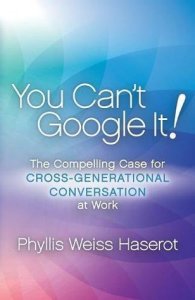
THE QUICK SUMMARY – You Can’t Google It! The Compelling Case for Cross-Generational Conversation at Work by Phyllis Weiss Haserot

Much of the learning, skills and perspective people of all ages need to succeed long-term in their careers is not found in data on the Internet, but rather in conversations and personal relationships with the people they work with.

Tech tools have trained us to search the Internet for answers to everything, but we can’t find most of the non-technical or non-data-based answers we seek there. Learning about perspectives, relationships and experiences comes best from conversations.

In most organizations there are three, four, or even five generations working together with differing expectations about how things are done and by whom. People of different generations are increasingly isolated physically, functionally, or emotionally from each other both by communication styles and media and lack of the perspective that would help them understand why people think and act as they do. You Can’t Google It! facilitates action to promote and foster cross-generational conversation in organizations on both the parts of management and the multi-generational teams that are increasingly the key to productivity, profitability and sustainability.

You Can’t Google It! is a tool to help organizations and individuals remove the stress, frustration, and negative energy that often arises from working with people of different generations, so they understand and are able to accomplish their common goals―faster and profitably. It is about the implications of different generations, and how to move towards closing that gap.

A SIMPLE SOLUTION

Author Phyllis Weiss Haserot pulls no punches in establishing the issue of cross-generational conversations:

  • As an established professional, do you question the work ethics of young employees and co-workers?
  • As a young professional, how do you deal with resistance to your ideas from Baby Boomers who think their experience and seniority mean they know it all?
  • Will your organization be threatened because key personnel will soon reach traditional retirement age?
  • Are you wondering how to transform intergenerational challenges into an asset for your organization?

Much of the learnings, skills, and perspectives that people of all ages need to succeed – especially in working with each other – are not found in data on the Internet but rather in conversations and personal relationships with the people they work with. The new multigenerational paradigm is meaningful cross-generational conversation.

GENgagementTM can be defined as the state of achieving harmony, mutual involvement and cooperation, flow, and ongoing absorption in work with people of different generations.

GENgagement means getting all of the generations to understand each other, their influences, and their worldview so they can work collaboratively, loyally, and productively.

It is integral to the mission of transforming workplaces into engaged and productive environments for solving problems and being great places to work. Equally important, it helps individuals and organizations develop closer rapport and loyalty bonds with clients and other external stakeholders – the bedrock of any mission-driven organization.

A satisfying and perennial recipe for GENgagement contains these ingredients as integral to the experience for all personnel:

Defining the big picture for everyone

Having a clear purpose and mission

Visioning – what achieving the mission and purpose will look like

Communicating the importance of each person’s role

Living a culture that respects the values of and promises to employees, clients, donors, alumni, etc. every day

Enabling multigenerational input to organization and and market strategy and service delivery

A sense of joy and continuing curiosity at work

Phyllis Weiss Haserot, You Can’t Google It! The Compelling Case for Cross-Generational Conversation at Work

A NEXT STEP

Distribute the following questions from author Phyllis Haserot to your team in advance. After they have had time to read through them, gather the team for an extended conversation about each question.

  1. Help me understand your perspective on work and the marketplace outside of our organization. What factors influence your worldview, the attitude you bring to your work, and your interactions with colleagues?
  2. What would you like to see changed about how our work is done, and how can you help make it more effective? How important is hierarch to you? When is years of experience very important in your role, and when are other factors equally or more important?
  3. What is getting in the way of a more productive and satisfying working relationship? How can I as your teammate help you learn how best to work with me?
  4. What would you say are your core values? Do you think they are significantly different from my generation’s core values? How can we jointly overcome intergenerational tensions?
  5. What strategies for impact and influence at work can we learn from each other?

Use these conversations as a springboard to ongoing cross-generational conversations as a regular part of the leadership development process in your organization.

Excerpt taken from SUMS Remix 127-3, released September 2019.


Part of a weekly series on 27gen, entitled Wednesday Weekly Reader

Regular daily reading of books is an important part of my life. It even extends to my vocation, where as Vision Room Curator for Auxano I am responsible for publishing SUMS Remix, a biweekly book “excerpt” for church leaders. Each Wednesday on 27gen I will be taking a look back at previous issues of SUMS Remix and publishing an excerpt.
>>Purchase SUMS Remix here<<

>> Purchase prior issues of SUMS Remix here<<

Act Now – It’s Time to Put Yourself in Your Own Story

Information overload.

You live it every day – Facebook, Twitter, LinkedIn, and Instagram. You’re more informed and connected than ever.

Yet, if you’re honest, you’re probably feeling more distracted than ever.

More lonely. More restless.

According to studies done by Barna Research:

  • 71% of people feel overwhelmed by the amount of information they need to stay up to date.
  • 36% of adults stop what they’re doing to check a text or message when it comes in.
  • 35% of adults think their personal electronics sometimes separate them from other people.

Being hyperlinked changes every aspect of our lives – and often, not for the better.

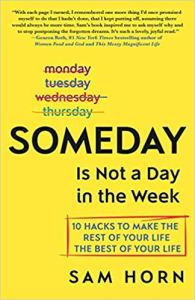
THE QUICK SUMMARY – Someday is Not a Day in the Week by Sam Horn

Are you:
• Working, working, working?
• Busy taking care of everyone but yourself?
• Wondering what to do with the rest of your life?
• Planning to do what makes you happy someday when you have more time, money, or freedom?

What if someday never happens? As the Buddha said, “The thing is, we think we have time.”

Sam Horn is a woman on a mission about not waiting for SOMEDAY … and this is her manifesto. Her dad’s dream was to visit all the National Parks when he retired. He worked six to seven days a week for decades. A week into his long-delayed dream, he had a stroke. Sam doesn’t want that to happen to you. She took her business on the road for a Year by the Water. During her travels, she asked people, “Do you like your life? Your job? If so, why? If not, why not?”

The surprising insights about what makes people happy or unhappy, what they’re doing about it (or not), and why…will inspire you to carve out time for what truly matters now, not later.

Life is much too precious to postpone. It’s time to put yourself in your own story. The good news is, there are “hacks” you can do right now to make your life more of what you want it to be. And you don’t have to be selfish, quit your job, or win the lottery to do them. Sam Horn offers actionable, practical advice in short, snappy chapters to show you how to get started on your best life ― now.

A SIMPLE SOLUTION

According to author Sam Horn, you don’t need to quit your job, win the lottery, or walk away from your responsibilities to make your life more of what you want it to be.

There are things you can do right here, right now, to be happier, healthier, and more fulfilled.

There are steps you can take to make your life more fulfilling.

It’s time to hack your life by tapping into proven best practices, expedite results and discover a shortcut to success.

Make your “one day” Day One.

The Ten Life Hacks are actions you can take to create a more fulfilling life, sooner, not later. Please note: These hacks are a framework, not a formula. 

LIFE HACK 1:  Evaluate Your Happiness History

LIFE HACK 2:  Generate a Today, Not Someday Dream

LIFE HACK 3:   Abdicate Outdated Beliefs and Behaviors

LIFE HACK 4:   Initiate Daily Actions that Move Your Life Forward

LIFE HACK 5:   Celebrate What’s Right with Life, Right Here, Right Now

LIFE HACK 6:   Affiliate with People Who Have Your Back and Front

LIFE HACK 7:   Integrate Your Passion and Profession

LIFE HACK 8:   Negotiate for What You Want, Need, and Deserve

LIFE HACK 9:    Innovate a Fresh Start

LIFE HACK 10: Relocate to Greener Pastures

Sam Horn, Someday is Not a Day in the Week

A NEXT STEP

According to author Sam Horn, the best way to make progress in making your “Someday” is to ask probing questions that prompt you to change – for good.

Listed below are sample questions for each of the ten Life Hacks listed above. Schedule at least thirty minutes a day for the next ten days, and reflect on the questions listed.

LIFE HACK 1: Evaluate Your Happiness History

Play hooky for a day.

  1. How would you spend your free day or afternoon? What would you do if the people you’re responsible for would be taken care of, and there would be no repercussions?
  2. What are three things you would not do on your day of hooky? Why?   

LIFE HACK 2: Generate a Today, Not Someday Dream

Put a date on the calendar.

  1. What would you like to experience or achieve by the end of this year? What is your Today, Not Someday dream? When will you launch it? What “do-date” did you put on your calendar?
  2. Now, start filling in the W’s … where, when, who, what, and why. Who will you discuss this with so they can help you fill in the blanks so your dream goes from vague to vividly clear?
  3. Where will you post your dream so it stays “in sight, in mind,” and you are constantly re-inspired to do what you said you wanted to do?

LIFE HACK 3: Abdicate Outdated Beliefs and Behaviors

Let it go, let it go, let it go.

  1. How do you feel when you walk into your home? Where would your home rate on the “Clutter (1) to Clean (10) Scale”? How does that affect you? Do you feel guilty, stressed, or frustrated with how things have piled up? Or do you feel proud and at peace with how well-designed, organized, and beautiful your space is?
  2. How much time do you spend cleaning, repairing, buying, renovating your stuff? Is that a source of enjoyment, a burden and chore, or something in between? Explain.
  3. Are you ready to downsize your home and/or release some belongings? How will you do that? Who else does this have an impact on? How will you negotiate this with them? What could you do with the resources that would be freed up when you have less to take care of?

LIFE HACK 4: Initiate Daily Actions that Move Your Life Forward

Honor the nudges, and connect the dots.

  1. Do you make room for whims? Why or why not? When was a time you honored a nudge and acted on your intuition? What happened as a result?
  2. Do you think this is a lot of hooey? Does your intellect override your instincts? Or, do you agree that if we have a sixth sense that alerts us to what’s wrong, we also have a sixth sense that alerts us to what’s right? What are your beliefs about this?
  3. How will you honor the instincts that have your best interests at heart? How will you connect the dots, act on “coincidences” that beat the odds, and align with congruent individuals and opportunities that “feel right”?

LIFE HACK 5: Celebrate What’s Right with Life, Right Here, Right Now

Get out of your head and come to your senses.

  1. When was the last time you saw something as if for the first or last time? Describe what happened and what it felt like.
  2. Do you have a busy, stressful life? What is the ongoing impact of rushing, rushing, rushing— and always feeling “an hour late and a dollar short”?
  3. Would you say you have “juice” in your camera? Do you look at the world with fresh eyes? When, where, and how will you get out of your head and come to your senses?

LIFE HACK 6: Affiliate with People Who Have Your Back and Front

Launch your ship in public.

  1. So, what is that venture you want to launch? Who has supported you, cheered you on? What have they done to help you achieve your goal and do what’s important to you?
  2. Who has cautioned you, told you (“ for your own good”) that what you want to do won’t work or isn’t a good idea? What impact has that had on you?
  3. How will you take your dream public and give others a chance to jump on your bandwagon? Will you create a vision board and/or host a Today, Not Someday party? Where did you post your vision so it stays “in sight, in mind”?

LIFE HACK 7: Integrate Your Passion and Profession

Don’t wait for work you love – create work you love.

  1. Do you love your job? Do you feel you’re adding value and contributing? How so?
  2. If you don’t find your work satisfying, why not? What talents or skills are you not having an opportunity to use or get credit for?
  3. What are your Four I’s? How could you leverage them into a paying career where you get paid to do what you’re good at? What is your next step? Will you visit crafts fairs to see how other people have turned a passion into a profession? Elaborate.

LIFE HACK 8: Negotiate for What You Want, Need, and Deserve

If you don’t ask, the answer’s always “No.”

  1. When is a time you asked for something you wanted – whether it was a promotion, project lead, or pay raise? How did you prepare? What was the result?
  2. When is a time you waited for someone to “do the right thing,” act on your behalf, or give you what you deserved? As Dr. Phil would say, “How’d that work for you?”
  3. What is a situation you’re unhappy with right now? Which of the Four A’s have you used? How will you alter the situation by using the Five P’s of Persuasion to increase the likelihood of improving this situation?   

LIFE HACK 9: Innovate a Fresh Start

Quit watering dead plants.

  1. Is the majority of your life out of your control and not to your liking? How so? Does this challenging time have a timeline? Can you “make your mind a deal it can’t refuse” so you are able to keep things in perspective?
  2. What do you currently do to maintain a positive perspective, to have something to look forward to in bleak times? How do you stay focused on what you can control?
  3. Are there dead plants you can stop watering? What can you quit that is compromising your quality of life? How can you innovate a fresh start if you are going through dark times to keep the light on in your eyes?   

LIFE HACK 10: Relocate to Greener Pastures

Come full circle.

  1. When was the last time you were in your hometown? What memories did it bring back? Did you reconnect with people that influenced you? Did it catalyze a new creative direction that could be a satisfying full-circle way to come home to who you truly are?
  2. What used to light you up but now feels like it might be a retreat or regression to “go back there”? Do you worry it’s thinking small instead of thinking big? Could it actually be you’re going “home” to who you are at your core, your best self?
  3. Do you agree that we can be “at home” wherever we are and that “home” is a mindset, not a location? Where do you feel most at home? 

Excerpt taken from SUMS Remix 126, released August 2019


Part of a weekly series on 27gen, entitled Wednesday Weekly Reader

Regular daily reading of books is an important part of my life. It even extends to my vocation, where as Vision Room Curator for Auxano I am responsible for publishing SUMS Remix, a biweekly book “excerpt” for church leaders. Each Wednesday on 27gen I will be taking a look back at previous issues of SUMS Remix and publishing an excerpt.
>>Purchase SUMS Remix here<<

>> Purchase prior issues of SUMS Remix here<<

Manage Yourself to Achieve True and Lasting Excellence

Tom Paterson, brilliant consultant for decades and creator of the StratOp strategic system for operating and growing your organization, passed away on September 3, 2019.

As a non-profit group, Auxano has the largest team of theologically trained, pastor-experienced facilitators in the country in the process developed by Paterson. Each of our Navigators feels the impact of the tools developed by Tom Paterson in their daily work with churches across the country.

To honor the legacy of Tom Paterson on the anniversary of his passing, this excerpt from SUMS Remix 128 is based on one of Paterson’s friend and collaborator Peter Drucker’s books.

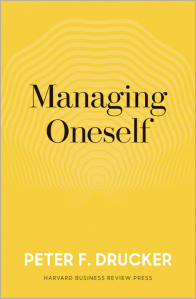
THE QUICK SUMMARY – Managing Oneself by Peter Drucker

Peter Drucker is widely regarded as the father of modern management, offering penetrating insights into business that still resonate today. But Drucker also offers deep wisdom on how to manage our personal lives and how to become more effective leaders.

In these two classic articles from Harvard Business Review, Drucker reveals the keys to becoming your own chief executive officer as well as a better leader of others. “Managing Oneself” identifies the probing questions you need to ask to gain the insights essential for taking charge of your career, while “What Makes an Effective Executive” outlines the key behaviors you must adopt in order to lead. Together, they chart a powerful course to help you carve out your place in the world.


A SIMPLE SOLUTION

Tom Paterson was a long-time friend of Peter Drucker. Drucker often referred to Paterson as the “Process Practitioner.” In turn, Drucker was known as the “father of modern management.” Because of their friendship, the third excerpt of this SUMS Remix comes from Drucker’s thoughts on “Managing Oneself.”

According to Drucker, the concept of managing oneself is increasingly important as each one of us becomes solely responsible for the trajectory of our ever-longer careers.

He believed that only when you operate with a combination of your strengths and a disciplined self-knowledge could you achieve true and lasting excellence.

Most people think they know what they are good at. They are usually wrong. More often, people know what they are not good at – and even then more people are wrong than right. And yet, a person can perform only from strength. One cannot build performance on weaknesses, let alone on something one cannot do at all.

The only way to discover your strength is through feedback analysis. Whenever you make a key decision or take a key action, write down what you expect will happen. Nine or twelve months later, compare the actual results with your expectations. I have been practicing this method for 15 to 20 years now, and every time I do it, am surprised.

Practiced consistently, this simple method will show you within a fairly short period of time, maybe two or three years, where your strengths lie – and this is the most important thing to know. The method will show you what you are doing or failing to do that deprives you of the full benefits of your strengths. It will show you where you have no strengths and cannot perform.

Several implications for action follow from feedback analysis. First and foremost, concentrate on your strengths. Put yourself where your strengths can produce results.

Second, work on improving your strengths. Analysis will rapidly show where you need to improve skills or acquire new ones. It will also sow the gaps in your knowledge – and those can usually be filled.

Third, discover where your intellectual arrogance is causing disabling ignorance and overcome it. Far too many people – especially people with great expertise in one area – are contemptuous of knowledge in other areas or believe that being bright is a substitute for knowledge.

Peter Drucker, Managing Oneself

A NEXT STEP

Work through the following blind spot exercise to discover potential blind spots in your understanding of your strengths.

  1. On a chart tablet, write a list of your strengths (up to ten), and arrange them in order of your certainty of that strength. In other words, the strength you feel best reflects you should be number one, and so on.
  2. For each strength, write down and number elements that are assumptions or uncertainties.
  3. Think about what would happen (consequences or risks) if the assumptions for each strength were wrong or untrue. Write down and number the consequences and mark their impact as high, medium, or low.
  4. Count the number of assumptions/impact per strength. Select both the strength with the lowest score (least assumptions/impact) and the one with the highest score (most assumptions/impact).
  5. Select the three strengths with the highest score, and develop ideas on how you might reduce the assumptions and impact, and therefore make them stronger.

The above exercise adapted from “75 tools for Creative Thinking.”

Excerpt taken from SUMS Remix 128, released September, 2019.


Part of a weekly series on 27gen, entitled Wednesday Weekly Reader

Regular daily reading of books is an important part of my life. It even extends to my vocation, where as Vision Room Curator for Auxano I am responsible for publishing SUMS Remix, a biweekly book “excerpt” for church leaders. Each Wednesday on 27gen I will be taking a look back at previous issues of SUMS Remix and publishing an excerpt.

>>Purchase SUMS Remix here<<

>> Purchase prior issues of SUMS Remix here<<

Look Back and Learn: Investing in Wisdom Equity

In researching and working on some leadership development material for an ongoing writing project, I came across the following:

Christianity is a religion of change. Jesus’ call in Mark 1:15 (the kingdom of God is at hand) was a call to change – change of mind and heart, of conduct and character, of self and society. By its very nature Christianity is a religion for a changing world and has always had its greatest opportunity during times of upheaval.

The Christian leader has no option; he must face a changing world. If the leader is to render maximum service, he must both adjust himself to the phenomena of change and address himself passionately to the business of producing and guiding change. Here are some elements that constitute the changed world in which the Christian leader today is called to fulfill his ministry.

Changed world outlook

Changed economic philosophy

Changed social consciousness

Changed family life

Changed community conditions

Changed moral standards

Changed religious viewpoints

Changed conceptions of the church

Changed media for molding public opinion

Changed demands made upon the leader

Pretty good list, right? Dead on. Taken from today’s headlines.

Nope.

courtesy the Southern Baptist Theological Seminary

courtesy the Southern Baptist Theological Seminary

The author was Gaines S. Dobbins, distinguished professor of Religious Education at my alma mater, The Southern Baptist Theological Seminary, in Louisville KY.

Written in 1947.

As the introduction to the book “Building Better Churches: A Guide to Pastoral Ministry.”

Dr. Dobbins retired before I was born, but while in seminary in the early eighties I had the privilege of sitting under a couple of professors who were students of Dr. Dobbins and spoke of his great influence on their development and career. There is a chair named for him at SBTS, and of course I recognized his name and influence. When I came across this book in a used bookstore, I bought it on impulse. After flipping through it, I realized it was a treasure of leadership wisdom.

At Auxano, we talk about a concept called “vision equity.” It’s realizing that the history of a church is a rich resource for helping rediscover what kinds of vision language past generations have used. That language is very useful for anticipating and illustrating God’s better intermediate future.

As I read Dr. Dobbin’s book, I think there is also a concept called “wisdom equity.” It’s realizing that there have been some great leaders and deep thinkers over the past decades and centuries whose collective wisdom would be a great place to start as we struggle with the new realities that face us every day.

It’s why I love history – I see it not as an anchor that holds us to the past, but as a foundation to build a bridge to the future.

History is not just books and information stored about the past. It can also be found in living beings – those around us, family and friends, who have lived through events and learned lessons my generation – and the ones following me – need so desperately to learn.

Go ahead – look back and learn.

Guiding Your Multigenerational Workplace Through Five Growth Precepts

In 2020, 25 percent of the labor force is projected to be over the age of 55 – and they’re not retiring anytime soon. These projections from the Bureau of Labor Statistics at the US Department of Labor indicate that not only will Baby Boomers continue to work alongside their current Generation X and Millennial colleagues, but that they will still be around when Generation Z joins the workforce.

The result? A clash of cultures that will require a new management approach.

Gone are the days when people entered the workforce as young adults, worked until their late 50s, and then moved off into retirement while younger generations took their place. Instead, the average retirement age has steadily been creeping up in recent decades as older employees – in particular, the Baby Boomers – stay in the workforce either by choice or by necessity.

Before we dive into the discussion, here’s a brief recap of just who comprises the generational cohorts mentioned above. While there’s no set standard, the following descriptions are generally accepted:

  • Baby Boomers – born in the years 1946-1964, numbering about 76 million people
  • Generation Xers – born in the years 1965-1980, numbering about 66 million people
  • Millennials – born in the years 1981-1997, numbering just over 83 million people
  • Generation Zers – born in the years 1998-present, numbering over 80 million and still growing

How do you manage the workplace reality of having three or four different generations on your team?

THE QUICK SUMMARYGenerations at Work: Managing the Clash of Boomers, GenXers, and GenYers in the Workplace by Ron Zemke, Claire Raines, and Bob Filipczak

Written for all who are struggling to manage a workforce with often incompatible ethics, values, and working styles, Generations at Work looks afresh at the root causes of professional conflict and offers practical guidelines for navigating multigenerational differences.

By laying bare the most common causes of conflict – including the Me Generation’s frustration with GenYers’ constant desire for feedback and the challenges facing GenXers sandwiched between these polarities – the book offers practical, spot-on guidance for managing the differences with consideration to each generation’s unique needs.

Along with the authors’ insights for managing a workforce with different ways of working, communicating, and thinking, the book offers in-depth interviews with members of each generation, tips on best practices from companies successfully bridging the generation gap, and a mentorship field guide to help you support the youngest members of your team–tools, which are the key to helping your workforce interact more positively with one another and thrive in today’s wildly divergent workplace culture.

A SIMPLE SOLUTION

According to the authors of Generations at Work, today’s workplace contains the conflicting voices and views of the most age- and value-diverse workplace the world has known since our great-great-great-grandparents abandoned field and farm for factory and office. At no time in our history have so many and such different generations with such diversity been asked to work together shoulder to shoulder, side by side, and cubicle to cubicle.

While there have certainly been multiple generations employed in the same organization before, they were mainly separated from each other by the hierarchy of a manufacturing-oriented economy. Senior (older) employees – mostly white and male – worked in the head office or were top management positions in key parts of the company. Middle-aged employees tended to be in middle management or high-skill, seniority-protected trade jobs. The youngest, newest, and physically strongest were on the factory floor or endured time in specific trainee slots that would lead, over time, to middle management – at best.

Among all the groups mentioned above, contact was primarily horizontal; with people like themselves, or at best, one level up or down the chain of command. Mingling among the generations, if and when it happened at all, was significantly influenced by formality and protocol.

Today’s workplace is totally different. The old pecking order, hierarchy, and shorter work life spans that kept a given generational cohort isolated from others no longer exist or they exist in a more permeable manner.

An unfortunate outcome of this shift is the likelihood of intergenerational conflict: differences in values, views, and ways of working, talking, and thinking that set people in opposition to one another, and challenge organizational best practices.

While generational differences have existed for, well, generations, what’s different is that this new generation gap is a four-way divide. The once “natural” flow of resources, power, and responsibilities from older to younger has been dislocated by changes in life expectancy, increases in longevity and health, as well as changes in lifestyle, technology, and knowledge.

Life for every generation has become increasingly nonlinear, unpredictable, and uncharitable.

Generational differences can be a source of creative strength and a source of opportunity, or a source of stifling stress and unrelenting conflict. Understanding generational differences is critical to making them work for the organization and not against it.

Accommodate employee differences

With employee retention at or near the top of the list of organizational “must meet” measures, the most generationally friendly organizations treat their employees as they do their customers. They learn all they can about them, work to meet their specific needs, and serve them according to their unique preferences. Each generation’s icons, language, and precepts are acknowledged, and language is used that reflects generations other than those “at the top.”

Create choices

Generationally friendly companies allow the workplace to shape itself around the work being done, the customers being served, and the people who work there.  They recognize that people from a mix of generations have differing needs and preferences, and they design their human resources strategies to meet varied employee needs. “Change” is not so much the name of a training seminar or a core value listed somewhere in their mission statement as it is an assumed way of living and working.

Operate from a sophisticated management style

Generationally friendly managers don’t have time for BS, although they are tactful. They give those who report to them the big picture, with specific goals and measures, and then they turn their people loose – giving them feedback, rewards, and recognition as appropriate.

Respect competence and initiative

Generationally friendly organizations assume the best of people. They treat everyone, from the newest recruit to the most seasoned employee, as if they have great things to offer and are motivated to do their best. It is an attitude that can become a self-fulfilling prophecy.

Nourish initiative

Generationally friendly organizations are concerned and focused, on a daily basis, with making their workplaces magnets for excellence. They know that keeping their people is every bit as important in today’s economy as finding and retaining customers. Therefore, they offer lots of training, from one-on-one coaching opportunities to interactive online training to an extensive and varied menu of classroom courses. They encourage lateral movement within the organization and have broadened assignments.

Ron Zemke, Claire Raines, and Bob Filipczak, Generations at Work: Managing the Clash of Boomers, GenXers, and GenYers in the Workplace

A NEXT STEP

Set aside time at a future leadership team meeting to review your organizational structure in terms of the five initiatives listed above.

On five separate chart tablets, write one phrase each as listed above across the top. Draw a vertical line down the center of each chart tablet, and write the words, “Positive” and “Negative” on either side of the line.

Discuss with your team how each one of the five initiatives are demonstrated in your organization in both positive and negative terms.

After your discussion is concluded, decide how you will celebrate the positive actions and correct the negative actions.

Excerpt taken from SUMS Remix 127-1, released September 2019.


Part of a weekly series on 27gen, entitled Wednesday Weekly Reader

Regular daily reading of books is an important part of my life. It even extends to my vocation, where as Vision Room Curator for Auxano I am responsible for publishing SUMS Remix, a biweekly book “excerpt” for church leaders. Each Wednesday on 27gen I will be taking a look back at previous issues of SUMS Remix and publishing an excerpt.

>>Purchase SUMS Remix here<<

>> Purchase prior issues of SUMS Remix here<<

Fight Information Overload by Going Minimal

Information overload.

You live it every day – Facebook, Twitter, LinkedIn, and Instagram. You’re more informed and connected than ever.

Yet, if you’re honest, you’re probably feeling more distracted than ever.

More lonely. More restless.

According to studies done by Barna Research:

  • 71% of people feel overwhelmed by the amount of information they need to stay up to date.
  • 36% of adults stop what they’re doing to check a text or message when it comes in.
  • 35% of adults think their personal electronics sometimes separate them from other people.

Being hyperlinked changes every aspect of our lives – and often, not for the better.

THE QUICK SUMMARY – Digital Minimalism: Choosing a Focused Life in a Noisy World by Cal Newport

Minimalism is the art of knowing how much is just enough. Digital minimalism applies this idea to our personal technology. It’s the key to living a focused life in an increasingly noisy world.

In this timely and enlightening book, the bestselling author of Deep Work introduces a philosophy for technology use that has already improved countless lives.

Digital minimalists are all around us. They’re the calm, happy people who can hold long conversations without furtive glances at their phones. They can get lost in a good book, a woodworking project, or a leisurely morning run. They can have fun with friends and family without the obsessive urge to document the experience. They stay informed about the news of the day, but don’t feel overwhelmed by it. They don’t experience “fear of missing out” because they already know which activities provide them meaning and satisfaction.

Now, Newport gives us a name for this quiet movement, and makes a persuasive case for its urgency in our tech-saturated world. Common sense tips, like turning off notifications, or occasional rituals like observing a digital Sabbath, don’t go far enough in helping us take back control of our technological lives, and attempts to unplug completely are complicated by the demands of family, friends and work. What we need instead is a thoughtful method to decide what tools to use, for what purposes, and under what conditions.

Drawing on a diverse array of real-life examples, from Amish farmers to harried parents to Silicon Valley programmers, Newport identifies the common practices of digital minimalists and the ideas that underpin them. He shows how digital minimalists are rethinking their relationship to social media, rediscovering the pleasures of the offline world, and reconnecting with their inner selves through regular periods of solitude. He then shares strategies for integrating these practices into your life, starting with a thirty-day “digital declutter” process that has already helped thousands feel less overwhelmed and more in control.

Technology is intrinsically neither good nor bad. The key is using it to support your goals and values, rather than letting it use you. This book shows the way.

A SIMPLE SOLUTION

While many leaders believe in the power of digital platforms, and recognize the importance of various specific applications, a growing number of those same leaders feel as though their current relationship with technology is unsustainable – to the point that if something doesn’t change soon, they will reach a breaking point.

According to author Cal Newport, people don’t succumb to screens because they’re lazy, but instead billions of dollars have been invested to make this outcome inevitable.

It seems we have stumbled backward into a digital life we didn’t sign up for.

My research on digital minimalism has revealed the existence of a loosely organized “attention resistance movement,” made up of individuals who combine high-tech tools with disciplined operating procedures to conduct surgical strikes on popular attention economy services – dropping in to extract value, and then slipping away before the attention traps set by those companies can spring shut.

The tactics below have proved successful in shunting aside relentless efforts to capture your attention.

Delete Social Media from Your Phone

The smartphone versions of social media sites are much more adept at hijacking your attention than the versions accessed through a web browser on your laptop or desktop computer. Because you always have your phone with you, every occasion becomes an opportunity to check your feeds. If you’re going to use social media, stay far away from the mobile versions of these services, as they pose a significantly bigger risk to our time and attention. This practice suggests you remove all social media apps from your phone. You don’t have to quit these services, you just have to quit accessing them on the go.

Turn Your Devices Into Single-Purpose Computers

The sentiment that temporarily blocking features of a general-purpose computer reduces its potential is common for tools that do just that. It’s also flawed: it represents a misunderstanding of computation and productivity that benefits the large digital attention economy conglomerates much more than the individual users that they exploit. As many have discovered, the rapid switching between different applications tends to make the human’s interaction with the computer less productive in terms of the quality and quantity of what is produced. This practice of blocking might at first seem overly aggressive, but what it’s actually doing is bringing you back closer to the ideal of sing-purpose computing that’s much more compatible with our human attention systems.

Use Social Media Like a Professional

Social media professionals approach these tools differently than the average user. They seek to extract large amounts of value for their professional and (to a lesser degree) personal lives, while avoiding much of the low-value distortion these services deploy to lure users into compulsive behavior. Their disciplined professionalism, in other words, provides a great example for any digital minimalist looking to join the attention resistance. To a social media pro, the idea of endlessly surfing your feed in search of entertainment is a trap (these platforms have been designed to take more and more of your attention) – an act of being used by these services instead of using them to your own advantage.

Embrace Slow Media

To embrace news media from a mind-set of slowness requires first and foremost that you focus only on the highest-quality sources. Breaking news, for example, is almost always much lower quality than the reporting that’s possible once an event has occurred and journalists have had time to process it. Similarly, consider limiting yourself to the best of the best when it comes to selecting individual writers you follow. Another important aspect of slow news is the decisions you make regarding how and when this consumption occurs. The key to embracing Slow Media is the general commitment to maximizing the quality of what you consume and the conditions under which you consume it.

Dumb Down Your Smartphone

Declaring your freedom from you smartphone is probably the most serious step you can take toward embracing the attention resistance. Dumbing down your phone, of course, is a big decision. Convincing yourself that a dumb phone can satisfy your need so that its benefits outweigh its costs is not necessarily easy. Indeed, it might require a leap of faith – a commitment to test life without a smartphone to see what it’s really like.

Cal Newport, Digital Minimalism: Choosing a Focused Life in a Noisy World

A NEXT STEP

According to author Cal Newport, if you are exhausted by your “digital device addiction,” it’s not only possible to say, “No More,” it’s actually not that hard.

Set aside some time (without your phone!) to review the following five suggestions listed above. For each, make a Pro/Con list for what it would mean to your life if you took that action.

Review the list, and make a decision to embrace at least one of the actions for the next week.

After the week has passed, reflect on what taking that action meant to you, in terms of time gained, relationships grown, etc.

Consider another action to undertake, and follow the same suggestions.

At the end of one month’s experiments, talk with your spouse or a close colleague who would have noticed the changes in your routine and its results. What do they have to say?

Excerpt taken from SUMS Remix 126-1, released September 2019.


Part of a weekly series on 27gen, entitled Wednesday Weekly Reader

Regular daily reading of books is an important part of my life. It even extends to my vocation, where as Vision Room Curator for Auxano I am responsible for publishing SUMS Remix, a biweekly book “excerpt” for church leaders. Each Wednesday on 27gen I will be taking a look back at previous issues of SUMS Remix and publishing an excerpt.

>>Purchase SUMS Remix here<<

>> Purchase prior issues of SUMS Remix here<<

How to Learn by Listening

One of the things many growing organizations have trouble with is alignment and communication – from both a cultural and “business” standpoint. This may be the result of physically distributed teams or simply rapid growth. The larger an organization grows and the more distributed it becomes, the harder it is to make sure that there is a healthy relational dimension in our communication across the organization. Even in a small organization, understanding the importance of relational connection takes communication to the next level.

THE QUICK SUMMARY – Leading Loyalty by Sandy Rogers, Leena Rinne, and Shawn Moon

In business, if people merely like you, you’re in trouble. They need to love you! Learn how building loyalty and modeling great customer service behavior to develop frontline teams is the key to building raving fans.

To thrive in today’s economy, it’s not enough for customers to merely like you. They have to love you. Win their hearts and they will not only purchase more—they’ll talk you up to everyone they know.

But what turns casual customers into passionate promoters? What makes people stick with you for the long haul?

The industry experts at Franklin Covey set out to unlock the mysteries of gaining the customer’s loyalty. In an extensive study that involved 1,100 stores and thousands of people, they isolated examples that stood out in terms of revenues and profitability. They found that these “campfire stores” burned brighter than the rest thanks to fiercely loyal customers and the employees who delight in making their customers’ lives easier.

Now Leading Loyalty reveals the principles and practices of these everyday service heroes—the customer-facing employees who cultivate bonds and lift revenues through the roof. Full of eye-opening examples and practical tools, Leading Loyalty helps you infuse empathy, responsibility, and generosity into every interaction and:

  • Make warm, authentic connections
  • Ask the right questions
  • Listen to learn
  • Discover the real job to be done
  • Take ownership of the customer’s issue
  • Follow up and strengthen the relationship
  • Share insights openly and kindly
  • Surprise people with unexpected extras
  • Model, teach, and reinforce these essential behaviors through weekly team huddles

It’s time to invest in building loyalty. Even small improvements mean a big boost to your bottom line…and improves your business overall.

A SIMPLE SOLUTION

You would think listening would be easy. After all, we spend a good chunk of our lives doing it. We listened to our parents when we were children. We listened to our teachers in school. We listen to the radio in the car, and we listen to the TV while we are watching it.

But even though we have done it for so long, and even though we do it now, many of us don’t. Not really.

We hear sounds, but there is a difference between hearing things that happen to be around us at a given moment and actively, intentionally listening. The first happens without effort; the second comes through discipline and practice, and this is where we often fail. We find ourselves, especially when we are hearing something or someone we don’t agree with, not really listening but instead tolerating sound, just waiting for our own chance to talk.

There is a downside to efficiency when we’re working with human beings – we may neglect to take time to empathize and really listen.

The skill we are focused on here is not only listening to hear, but also listening to learn.

On a personal level, when we fail to listen, we not only miss the opportunity to show empathy and earn loyalty by connecting and learning from someone’s story, but we also fail to fulfill the greatest human need: to feel understood.

By making a genuine human connection with people and listening to learn, we uncover their story, which then allows us to feel and convey empathy.

By using the skill of listening to learn, you learn more about the other person’s story, and doing so enables you to show empathy. Listening to learn is not just a mechanical skill. It’s the result of really wanting to learn, of caring enough about another person to connect and listen for a moment.

Listening to learn comes from a heartfelt desire to truly understand other people. The more we understand, the more we can help them, the more loyal they become. The listening-to-learn behavior is rooted in the principle of empathy because it is about fully understanding and empathizing with the story of another.

Sandy Rogers, Leena Rinne, and Shawn Moon, Leading Loyalty

A NEXT STEP

Listening is important. It’s more than just a skill. In fact, it might well be worth considering, if we have trouble listening, the real reason why it’s so difficult.

A starting point? Listen to understand people without worrying or thinking about how to answer.

Who is someone on your team who excels at making genuine connection with others through listening? Ask them to share their “secrets” for listening with your whole team.

Following that, discuss the following questions:

  • What are we really trying to learn by listening?
  • Which of the following “Listen to Learn” guidelines do you need to improve on?
    • Stay silent until the person has finished talking.
    • Listen with your ears, eyes, and heart.
    • Don’t worry about how to answer – focus on understanding.
    • Rephrase what was said and check for understanding.
  • What does it mean to “listen with our ears, eyes, and heart”?
  • How do we check for understanding without solving the problem?

For a leader, listening is perhaps the most important skill of all. As a leader, we must learn to listen while navigating along with the person speaking toward a common destination – mutual understanding.

Excerpt taken from SUMS Remix 121-2, released June 2019.


Part of a weekly series on 27gen, entitled Wednesday Weekly Reader

Regular daily reading of books is an important part of my life. It even extends to my vocation, where as Vision Room Curator for Auxano I am responsible for publishing SUMS Remix, a biweekly book “excerpt” for church leaders. Each Wednesday on 27gen I will be taking a look back at previous issues of SUMS Remix and publishing an excerpt.

>>Purchase SUMS Remix here<<

>> Purchase prior issues of SUMS Remix here<<

Seven Trends of the New Retirement Mindset

Many leaders view retirement – whether a few years or a few decades away – as a finish line.

But increasingly these leaders, especially for those who are closer to retirement, are finding that being too young to retire but too old to find a job has become a critical issue.

Will Heath, Succession Specialist, writes in his upcoming book, “There comes a point in every ministry leader’s life when their greatest contribution and source of influence shifts from the performance of tasks to protection and mentoring.”

In other words, retirement isn’t the last great thing a leader does. It is the gateway to a leader’s greatest season of influence.

We may live ten years longer than our parents and may even work twenty years longer, yet power is moving to those ten years younger.

Are leaders in this age group facing a decades long “irrelevancy gap”?

THE QUICK SUMMARYI’m Not Done, by Patti Temple Rocks

When it comes to discrimination in the workplace, we’ve come a long way as a society. But there’s still one systemically ignored form of discrimination that happens all the time, and it affects everyone: ageism. 

Ageism is real. It’s widespread, insidious, and up until now, it’s been largely hidden, due to the low rate of reporting from those who are pushed out of their jobs when they reach a certain age. With the largest demographic America has ever seen–baby boomers–now experiencing age discrimination at work, it’s time to talk about this deeply hurtful and bad-for-business practice.

In I’m Not Done, Patti Temple Rocks takes a deep dive into ageism in the workplace–what it looks like, how it harms people and businesses alike, and how business leaders can get on the right side of the issue. Patti’s story, and the stories of those like her, creates a powerful declaration and a movement to stop this last remnant of workplace discrimination in its tracks: #I’mNotDone!

A SIMPLE SOLUTION

Imagine a world where there is no longer a preconceived notion about what age someone becomes irrelevant or undervalued. What if, like every other form of inclusion, you were valued just because you were valuable?

Imagine a world where nobody feels the pressure to leave an organization before they are ready to leave, and age is taken off the table as a marker for retirement.

Older employees offer a wealth of value. They are, quite literally, a treasure to any organization. They have life experiences and work experiences that can absolutely meld with youth and new ideas and technologies. Imagine an organization that leveraged this experience and wisdom, that blended its workforce into a truly diverse, agile, intelligent, cohesive and kind organization.

What if you put as much thought into the end of your career as you did in the beginning, and it didn’t have to be kept a secret until the day you gave notice?

There are more older Americans in the workplace than ever before. And they’re accomplishing more than any generation before them. Because older workers are staying in their careers longer, a new paradigm is emerging. Here are seven key trends I see in the new Baby Boomer mindset.

The Wise Boomer

Boomers don’t see themselves as old, in either mind or body. They want to be appreciated for the knowledge and skills they’ve gained over a lifetime, and want to contribute in meaningful ways, including the ability to pass along their wisdom and life experience.

Sixty is (Really) the New Fifty

Boomers are intent on re-inventing aging in their own fun-loving image, going back to school, launching businesses, and running marathons. They don’t know the concept of “age-appropriate,” and they still feel great.

The “I Got This” Attitude

Long defined by their independent, trailblazing approach to life, Boomers are resistant to receiving support that threatens their autonomy. Their Millennial children don’t always understand this.

What Retirement?

Boomers look at retirement completely differently from previous generations. Boomers like having an impact in every way they can, and will be as creative as they need to be in finding opportunities.

No Moving Truck Required

Many Boomers are choosing to stay closer to home to remain connected to others – particularly their children and grandchildren, so they can stay active in their lives. They are also totally comfortable jumping on a plane and finding an Airbnb when they crave a little sunshine.

Constantly Connected

Boomers are readily adapting technology and using social media just as much as younger generations do. In fact, they are much more likely to share, advocate, and influence others online.

Proud…Just Not Always Out Loud

While Boomers are often justifiably proud of how young they look, feel, and act, sometimes that results in an effort, conscious or otherwise, to disguise their actual age.

Patti Temple Rocks, I’m Not Done

A NEXT STEP

Almost all ambitious young people spend a lot of time thinking and talking about the early stages of their career. Most don’t give a single thought to managing the tail end of their career. That’s a shame, because navigating the last ten years of a career can be even more difficult than the first ten.

It doesn’t matter what your age is now – the fact is, at some point you will “retire” from working. The seven trends above are both instructive for Baby Boomers rapidly approaching retirement – and younger leaders whose retirement may be years away.

Real magic happens when organizations make a concerted effort to incorporate age into their diversity initiatives. When a team is made up of younger “digital natives” who grew up on the Internet and social media, along with more senior employees who have decades of industry experience, there is a synergy of talents and abilities. Everyone learns from one another. That combination of wisdom, experience, and youth is powerful.

If you are lucky to serve on an age-diverse team, set aside some time in a future team meeting to discuss the seven trends listed above, both as a present reality and a future event.

Excerpt taken from SUMS Remix 122-1, released July 2019


Part of a weekly series on 27gen, entitled Wednesday Weekly Reader

Regular daily reading of books is an important part of my life. It even extends to my vocation, where as Vision Room Curator for Auxano I am responsible for publishing SUMS Remix, a biweekly book “excerpt” for church leaders. Each Wednesday on 27gen I will be taking a look back at previous issues of SUMS Remix and publishing an excerpt.

>>Purchase SUMS Remix here<<

>> Purchase prior issues of SUMS Remix here<<

Become a Better Leader Through Balancing Differences

Leadership training and development in our military takes place on two fronts. First, officers identify, build, and utilize the skills that will allow individuals and teams to effectively and efficiently achieve their goal. Second, officers focus on training methods and techniques that will allow those same individuals and teams to practice effective combat and leadership skills in the fields.

The same types of leadership training and development can also serve leaders in your organization – beginning with you.

THE QUICK SUMMARY – The Dichotomy of Leadership by Jocko Willink and Leif Babin

With their first book, Extreme Ownership, Jocko Willink and Leif Babin set a new standard for leadership, challenging readers to become better leaders, better followers, and better people, in both their professional and personal lives.

Now, in The Dichotomy of LeadershipJocko and Leif dive even deeper into the unchartered and complex waters of a concept first introduced in Extreme Ownership: finding balance between the opposing forces that pull every leader in different directions. Here, Willink and Babin get granular into the nuances that every successful leader must navigate.

Mastering the Dichotomy of Leadership requires understanding when to lead and when to follow; when to aggressively maneuver and when to pause and let things develop; when to detach and let the team run and when to dive into the details and micromanage. In addition, every leader must:

  • Take Extreme Ownership of everything that impacts their mission; yet utilize Decentralize Command by giving ownership to their team. 
  • Care deeply about their people and their individual success and livelihoods, yet look out for the good of the overall team and above all accomplish the strategic mission. 
  • Exhibit the most important quality in a leader―humility, but also be willing to speak up and push back against questionable decisions that could hurt the team and the mission.

With examples from the authors’ combat and training experiences in the SEAL teams, and then a demonstration of how each lesson applies to the business world, Willink and Babin clearly explain THE DICHOTOMY OF LEADERSHIPskills that are mission-critical for any leader and any team to achieve their ultimate goal: VICTORY.

A SIMPLE SOLUTION

The most difficult – and essential – element of leadership requires finding the balance between opposing forces that exist for every leader.

The list of dichotomies is infinite. Because for every positive behavior a leader should have, it is possible to take that behavior to the extreme, where it becomes a negative. Often a leader’s greatest strength can also be his or her greatest weakness. But knowing and understanding that these dichotomies exist is the first part of keeping them from becoming a problem.

A good leader builds powerful, strong relationships with his or her subordinates. But while that leader would do anything for those team members, the leader must recognize there is a job to do. And that job might put the very people the leader cares so much about at risk.

The key is balance, maintaining an equilibrium where your team have the guidance to execute but at the same time freedom to make decisions and lead.

There are limitless dichotomies in leadership, and a leader must carefully balance between these opposite forces. But none are as difficult as this: to care deeply for each individual member of the team, while at the same time accepting the risks necessary to accomplish the mission.

This dichotomy reveals itself in the civilian sector as well as the military. This is one of the most difficult dichotomies to balance, and it can be easy to go too far in either direction. If leaders develop overly close relationships with their people, they may not be willing to make those people do what is necessary to compete a project or a task. They may not have the wherewithal to lay off individuals with who they have relationship even if it is the right move for the good of the company. And some leaders get so close to their people that they don’t want to have hard conversations with them – they don’t want to tell them that they need to improve.

On the other hand, if a leader is too detached from the team, he or she may overwork, overexpose, or otherwise harm its members while achieving no significant value from that sacrifice. The leader may be too quick to fire people to save a buck, thereby developing the reputation of not caring about the team beyond its ability to support the strategic goals.

So leaders must find the balance. They must push hard without pushing too hard. They must drive their team to accomplish the mission without driving them off a cliff.

Jocko Willink and Leif Babin, The Dichotomy of Leadership

A NEXT STEP

In order for leaders to find the balance described above, authors Jocko Willink and Leif Babin had developed two checklists: one with common symptoms resulting from a leader being too close to a team, and the other which indicates a leader might be too hands-off with his team.

Reproduce each of the two lists below on separate chart tablets, and review them first by yourself. Add to the lists as needed.

Then, bring the sheets into your next team meeting for a general team discussion about this dichotomy of leadership.

Too Close to Your Team

  1. Bold and aggressive action becomes rare.
  2. Creativity grinds to a halt.
  3. Even in an emergency, the team will not mobilize and take action.
  4. The team shows a lack of initiative; members will not take action unless directed.
  5. An overall sense of passivity and failure to react.

Too Far Away from Your Team

  1. Lack of vision in what the team is trying to do and how to do it.
  2. Lack of coordination between individuals on the team and efforts that often compete or interfere with each other.
  3. Initiative oversteps the bounds of authority; individuals and teams carry out actions beyond what they have authorization to do.
  4. The team is focused on the wrong priority mission or pursuit of solutions that are not in keeping with the strategic direction of the team.
  5. There are too many people trying to lead.

Excerpt taken from SUMS Remix 119-2, released May 2019


Part of a weekly series on 27gen, entitled Wednesday Weekly Reader

Regular daily reading of books is an important part of my life. It even extends to my vocation, where as Vision Room Curator for Auxano I am responsible for publishing SUMS Remix, a biweekly book “excerpt” for church leaders. Each Wednesday on 27gen I will be taking a look back at previous issues of SUMS Remix and publishing an excerpt.

>>Purchase SUMS Remix here<<

>> Purchase prior issues of SUMS Remix here<<

How to Engage Your Team Through Affirmation

One of the things many growing organizations have trouble with is alignment and communication – from both a cultural and “business” standpoint. This may be the result of physically distributed teams or simply rapid growth. The larger an organization grows and the more distributed it becomes, the harder it is to make sure that there is a healthy relational dimension in our communication across the organization. Even in a small organization, understanding the importance of relational connection takes communication to the next level.

THE QUICK SUMMARY – Win the Heart by Mark Miller

Employee engagement is shockingly low–but it’s not an employee problem; it’s a leadership problem. Bestselling author Mark Miller says it’s up to leaders to create a workplace where their employees truly want to be – and he reveals four keys to doing it.

Every great company has an engaged workforce, and nurturing a culture of engagement is at the heart of great leadership – employees who really care about their work, their coworkers, and the organization can supercharge a company’s success. But for many years, engagement has been suffering. Gallop reports that 70 percent of employees are not fully engaged on the job. Mark Miller draws on more than forty years of leadership experience to show leaders at all levels how to change the conversation and create real competitive advantage in the process.

In the fourth book in Miller’s High Performance Series, CEO Blake Brown sets out to discover how to create the kind of workplace where everyone feels excited to come to work, passionate about what he or she brings to the company, and energized at the end of the day. It’s a journey that takes him literally all over the world–from Italy to Greece to Green Bay and more. What he discovers from the pages of history is as relevant as the evening news. 

Engagement unleashes untapped potential buried deep within the hearts of your people. An engaged workforce is more creative, more driven, and more enthusiastic about reaching company goals. If you put the lessons in this book to work, your people will never look at work, or their leaders, the same way again.

A SIMPLE SOLUTION

When your team members are made to feel that they matter, they develop self-confidence and self-esteem, and that translates to positive results. Team members who are not treated as if they mattered perform as if their jobs don’t matter either.

When you recognize, appreciate, and encourage your team members, they will in turn share those affirmations with others, resulting in a better team and organization culture.

Genuine affirmation, from the heart, tends to connect with the heart.

We actually do a lot of things behind the scenes so you can have a consistently amazing experience.

  • It starts with leadership – no organization drifts to greatness.
  • We have to select the right people and be sure they are aligned on what matters most – this is a never-ending challenge, but without it, everything is so much harder. Some things even become impossible without everyone pulling in the same direction.
  • We have to be sure people are fully engaged and focused on execution. If they aren’t engaged, there’s no way we’ll deliver consistently. We want excellence to be the norm, not a random occurrence.

The two-word secret to engagement: “Thank you.” We want every employee to know how much we value his or her energy and effort, so we thank you a lot.

We say thank you when we see an employee doing their work with excellence; we say thank you when we observe someone going above and beyond our already high standards; we say thank you when we see our people living out our core values; we even say thank you for a team member’s contributions at the end of every shift.

Mark Miller, Win the Heart

A NEXT STEP

Do you say “thank you” to your team members often enough – or at all?

Here’s a starter list of 10 ideas to say “thank you” to team members. Use this list as a starter to complete a chart tablet of at least 30 ways to say thank you – and use at least one every day for the next month.

Wall of fame – Create a wall of fame featuring images of team members; be sure to include what they did that you are recognizing them for.

Praise often – Praise your team members quickly – as soon as you notice an action that is praiseworthy.

Give the gift of wellness – Give out passes to a yoga studio or gym. Healthy team members feel better about themselves and add value to the team.

Have fun – Reward your team after the conclusion of a special season or event with a fun outing. It not only says thanks but encourages team participation and bonding.

Sticky notes – The adult version of the affirming lunch note to your child! Leave notes on their desks or work areas, saying thanks and explaining why.

Random gifts – Who doesn’t like surprises? Give team members small gifts with a note saying thanks.

Acknowledge team members in meetings – When team members have a great idea, perform above and beyond the expectations, or something worthy of mentioning – be sure to acknowledge them in front of their peers.

Appreciate personal wins – When a team member achieves a personal milestone in their lives, celebrate with them in your work environment.

Celebrate birthdays – Make their birthday a special day in some way.

Write a note – A personal, handwritten note is always a special gesture. Mail it to your team member’s home, so their family can see it and celebrate too.

It’s your turn!


Part of a weekly series on 27gen, entitled Wednesday Weekly Reader

Regular daily reading of books is an important part of my life. It even extends to my vocation, where as Vision Room Curator for Auxano I am responsible for publishing SUMS Remix, a biweekly book “excerpt” for church leaders. Each Wednesday on 27gen I will be taking a look back at previous issues of SUMS Remix and publishing an excerpt.

>>Purchase SUMS Remix here<<

>> Purchase prior issues of SUMS Remix here<<