(Brain) Death by Meeting

Participants in organizations around the world have long suspected it, but now there is some evidence to back it up:

Meetings may make you “brain dead.”

“You may joke about how committee meetings make you feel brain-dead, but our findings suggest that they may make you act brain-dead as well,” Read Montague, the study leader, wrote in the Carilion, a Virginia Tech Research Institute publication.

Somewhere, Patrick Lencioni is smiling.

Lencioni, a noted author, speaker, and consultant on leadership and organizational principles, wrote a book in 2004 entitled “Death by Meeting.”

Even though It’s been around awhile, it’s worth taking a look at – and one of the best ways to do that is by taking a quiz.

Here’s the quiz; go ahead and take it – I’ll wait. 

Back already? You must have a meeting to go to! Or else you figured out that his suggested answers are on the next page of the quiz.

Lencioni believes that there are four basic types of meetings:

  • Daily Check-in, lasting 5-10 minutes
  • Weekly Tactical, lasting 45-90 minutes
  • Monthly Strategic, lasting 2-4 hours
  • Quarterly Off-Site Review, lasting 1-2 days

Check here for a complete description. Looking for quick tips for effective meetings? Check out these 5 great ideas.

Remember – as a leader, the meetings you run are a direct reflection on your leadership skills, preparation, and effectiveness.

And you don’t want any brain-dead team members around the table.

Long Lists Don’t Get Done

Start making smaller to-do lists. Long lists collect dust.

When’s the last time you finished a long list of things? You might have knocked off the first few, but chances are you eventually abandoned it (or blindly checked off items that weren’t really done properly).

Long lists are guilt trips. The longer the list of unfinished items, the worse you feel about it. And at a certain point, you just stop looking at it because it makes you feel bad. Then you stress out and the whole thing turns into a big mess.

There’s a better way. Break that long list down into a bunch of smaller lists. For example, break a single list of a hundred items into ten lists of ten items. That means when you finish an item on a list, you’ve completed 10 percent of that list, instead of 1 percent.

Yes, you still have the same amount of stuff left to do. But know you can look at the small picture and find satisfactions, motivation, and progress. That’s a lot better than staring at the huge picture and being terrified and demoralized.

Whenever you can, divide problems into smaller and smaller pieces until you’re able to deal with them completely and quickly. Simply rearranging your tasks this way can have an amazing impact on your productivity and motivation.

And a quick suggestion about prioritization: Don’t prioritize with numbers or labels. Avoid saying, “This is high priority, this is low priority.” Likewise, don’t say, “This is a three, this is a two, this is a one, this is a three,” etc. Do that and you’ll almost always end up with a ton of really high-priority things. That’s not really prioritizing.

Instead, prioritize visually. Put the most important thing at the top. When you’re done with that, the next thing on the list becomes the next most important thing. That way you’ll only have a single next most important thing to do at one time.

And that’s enough.


The inspirational words above come from the book “Rework,” by Jason Fried and David Heinemeier Hansson, the founders of 37signals.

                           If you don’t own it, you should. 

The artwork is by illustrator Mike Rohde.

Emulate Chefs

With the culinary art/leadership connection going on, and the fact that I’ve been rereading Jason Fried and David Heinemeier Hansson’s great book “Rework“, I thought the following post from last year would be appropriate again.

You’ve probably heard of Emeril Lagasse, Mario Batali, Rachel Ray, Paula Deen, Bobby Flay, Jacque Pepin, or Julia Child. They’re great chefs, but there are a lot of great chefs out there. So why do you know these few better than others?

Because they share everything they know.

They put their recipes in cookbooks and show their techniques on cooking shows. They want you to take what they have developed and make it your own.

Great organizations should share everything they know, too. Don’t be paranoid and secretive, but be open and generous.

A recipe is much easier to copy than a business idea. Shouldn’t that scare someone like Mario Batali? Why would he go on TV and show you how he does what he does? Why would he put all his recipes in cookbooks where anyone can buy and replicate them? Because he knows those recipes and techniques aren’t enough to beat him at his own game. No one’s going to buy his cookbook, open a restaurant next door, and put him out of business. It doesn’t work like that, but many organizations think that’s what will happen if others learn how they do things.

Emulate famous chefs. They cook, so they write cookbooks.

What do you do? What are your “recipes”? What’s your “cookbook”? What can you tell the world about how you operate that’s informative, educational, and promotional?

What’s cooking in your “kitchen” that you should share?


Pursuing Excellence…

Always.

From an instructor at the Culinary Institute of America:

Cooking is an inexact science, and this is where the art comes in. You’ve got standard ratios that work up to a point. There are always variables, as far as: Did you cook all the roux out? How high was your cooking temperature? How much evaporation did you have? How much did it reduce? You have to take all those things into account, and see what your final product is, and figure out how to fix it. You have to be not so stressed out or under pressure that you can say “I know it’s not right and I need to fix it.”

“You can’t ever send a product out if it’s not right,” he continued. It doesn’t matter how busy you are – your reputation is on the line every time you put a plate out. If you send it out hoping they won’t notice, then that’s the kind of chef you will be all your life.

“So. Start. Good habits. Early! Do it right. Take your time.”

As Tom Peters would say:

EXCELLENCE.

Always.

If not EXCELLENCE, what?

If not EXCELLENCE now, when?

Excellence is not a goal – it’s the way we live, who we are.

What’s up at your place, excellence-wise? Are you content with the same old, same old? Is is good enough? Or are you pursuing excellence?

Strive for excellence – ignore success.

What’s Your Stock?

Stock…

…the foundation for all classical French cooking.

At the CIA (that’s Culinary Institute of America), you start off your three-year education by learning how to peel vegetables and prepare a basic stock. You don’t do it once – you do it every day during the three-week rotation of the first class. Students move on after the first three weeks, but will continue to use the stock prepared by the next class of new students. Every three weeks, a new rotation of prospective chefs learn how to prepare stock.

A great stock is judged by:

  • Flavor
  • Clarity
  • Color
  • Body
  • Aroma

The perfect stock has what is referred to as a “neutral” flavor. This is a kind way of saying it doesn’t taste like anything you’re used to eating or would want to eat. But you can do a million different things with a great stock because it has the remarkable quality of taking on other flavors without imposing a flavor of its own. It offers its own richness and body anonymously. When you reduce it, it becomes its own sauce starter. You can add roux to stock and create a demi-glace, and with a demi-glace, you can make over a hundred distinct sauces that define classic French cooking.

What’s your stock?

Personally. Organizationally. However you want to define it.

What’s that basic “thing” you are, have, or do that makes everything else come together to make things happen?

Learn to make a basic stock, and the possibilities become endless.

Making a Leadership Emulsion

Some of the most flavorful, satisfying, and versatile sauces in the culinary world are an emulsion – but you’ve got to work to make one.

This is an emulsion: an agreement between two unlike elements (butter and water), achieved by heat and motion. If you get it slightly wrong – as when the sauce starts to dry out, destroying the balance between the fat and the liquid – the unlike elements pull apart and break up. When that happens, it takes more work to get the emulsion back to where you want it than it did to get it in the first place.

As a ChurchWorld leader, you are, in effect, an emulsion.

Both leadership and management are necessary skills to bring your organization forward. While many people separate “leadership” and “management,” they are both necessary.

Leadership involves inspiring, motivating, crafting a vision, setting direction, strategic thinking, and bringing out the best in your people.

Management involves planning, tracking, and measuring – in short, handling all the nuts-and-bolts of day-to-day business operations.

People in positions of responsibility and leadership – like you – need to do both well in order to be successful. This need dramatically intensifies during times of economic uncertainty, shifting internal and external forces, and the constant need to do more with less – like now.

You need to be an “emulsified leader:” building solid skills in both leadership and management AND the ability to switch gracefully between the two.

I’m Hungry

I love food. This love of food runs in, and through, my family. It began with my mother, a transplanted Midwesterner who adapted to Southern cooking in the mid 1950s and honed the craft with family and church for almost 60 years. It continues with two of my sons: the oldest, a restaurant chef and regional trainer with Outback; and the youngest, a first year student in Johnson and Wales University’s Culinary Arts/Food Service Management program.

And of course, I practice cooking when I can: old standby recipes that have become family favorites, new ones pulled from magazines or off the Web.  One look at me and you see I don’t miss too many meals!

Then there is the learning part: I read food magazines, culinary books, first person narratives about life in the industry, and so on. When I eat out, I focus on the food – and the people preparing and delivering it. It’s always instructive.

Beyond the simple love of food, I think that the food and culinary industry can be a great teacher as well. For instance, ChurchWorld leaders would be well advised to emulate chefs. They also would benefit from having a great “stock.” And of course leaders should use all their senses – just like a good chef does.

Over the next few days, I want to invite you on a food journey that focuses on leadership. I hope to uncover some new dishes, revisit some old classics, and hopefully give you some ideas that will help you create just the “menu” you need in your organization.

I suppose Bon Appetite! is too corny – but it rolls off the tongue, doesn’t it?

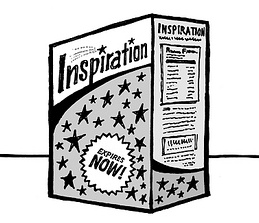
Inspiration is perishable

We all have ideas. Ideas are immortal. They last forever.

What doesn’t last forever is inspiration. Inspiration is like fresh fruit or milk: it has an expiration date.

If you want to do something, you’ve got to do it now. You can’t put it on a shelf and wait two months to get around to it. You can’t just say you’ll do it later. Later, you won’t be pumped up about it anymore.

If you’re inspired on a Friday, swear off the weekend and dive into the project. When you’re high on inspiration, you can get two weeks of work done in twenty-four hours. Inspiration is a time machine in that way.


Inspiration is a magical thing, a productivity multiplier, a motivator. But it won’t wait for you. inspiration is a now thing. If it grabs you, grab it right back and put it to work.

The inspirational words above come from the book Rework by Jason Fried and David Heinemeier, the founders of 37signals.

If you don’t own it, you should.

The artwork is by illustrator Mike Rohde.

Introducing the Scrum to ChurchWorld

During the course of the past week’s posts I have journeyed from Generation Flux to Adaptability to Nostalgia to Agile Development to a new destination: the Scrum.

It’s actually all part of the same journey: 1) realizing tomorrow is not going to be like yesterday, and 2) What am I as a leader going to do about it?

Back to the Scrum. As a parent of four children, I have been involved in many sports, some for fun, more that were in a league setting. About three years ago, my youngest son-at that time a junior in high school-came home and said he had signed up for the rugby team at school.


Okay. New experience, new opportunity for learning.


In rugby, a scrum is a formalized contest for possession of the ball during a rugby game between the two sets of forwards who each assemble in a tight-knit formation with bodies bent and arms clasped around each other and push forward together against their opponents.

Hold that thought.

Yesterday I suggested that an Agile Manifesto for ChurchWorld needs to be developed. In my research to do just that, what do I encounter but a Scrum – but with a new definition:

In the agile world a scrum is a process framework within which people can address complex adaptive problems, while productively and creatively delivering products of the highest possible value.

I think it’s time to go back to the drawing board.

Learning from the World of Business Bankruptcy and Software Development

Kodak, the iconic company that was synonymous with pictures, has declared bankruptcy.

When that news came out last week, I knew I would be getting around to connecting it to ChurchWorld. James Emery White, pastor of Mecklenburg Community Church in Charlotte, NC, already has: What Business Are You In? is a great post that every ChurchWorld leader needs to read.

As soon as I had finished reading it, my thoughts went back to the Generation Flux cover story from Fast Company that I posted here, here, and here last week. There were several topics that I had marked in it for future research, and one of them ties in nicely to the bankruptcy announcement by Kodak and White’s post.

It’s about being agile.

I’m not talking exclusively about physical agility, the ability to move quickly and with suppleness, skill, and control; I’m not talking only about mental agility, the ability to be able to think quickly and intelligently. It’s really a combination of the two, and more.

Software development used to be developed by what chaos expert DJ Patil called the “waterfall” process:

One group develops the product, another builds visual mockups…and finally a set of engineers builds it to some specification document.

Think Microsoft and their practice of having a designated schedule of issuing large, finished releases of their products (Windows 95, Windows 2000, etc.). Today that process has given way to “agile” development, what Patil calls “the ability to adapt and iterate quickly throughout the product life cycle.” In today’s software world, that concept follows the precepts of “The Agile Manifesto,” a 2001 document written by a group of developers who stated a preference for:

  • individuals and interactions over processes and tools
  • working software over comprehensive documentation
  • responding to change over following a plan

Maybe it’s time for an Agile Manifesto for ChurchWorld.