Filling the Vision Vacuum

When life around our house gets hectic, we often slip into a bad habit: fast-food for our meals. Both my wife and I enjoy cooking, especially when we can try out new recipes. But when the work day gets long, that’s one of the first things tossed aside. That usually means a quick stop at a neighborhood fast-food place for a quick meal. I’m not here to debate the health issues, but generally speaking, what we consume in a hurry is not as nutritious as what we would prepare on our own at home.

Will Mancini, author of Church Unique and founder of Auxano, makes an application to many churches by using the fast food metaphor. I’m at the Exponential Conference in Orlando this week; with Auxano being the sponsor of the Intentional Leadership Track, I thought it would be a good chance to review some of the major parts of Church Unique.

With an early start this morning, the concept of vision vacuum is fresh on my mind. Let’s take a closer look at what Mancini calls “Soul Fast Food”. To set this up, consider the following Scripture from Psalms 29:18 in The Message version:

When people can’t see what God is up to, they stumble all over themselves.

Unfortunately, most churches today are living that Scripture out. There is no clear vision of what God is up to, and the result is a vision vacuum. And when a vacuum exists, something is going to try to move in to fill it.

The Heart of the Matter – what really happens in the soul of a congregant when left in a church’s vision vacuum over time?

  • What is left to excite the heart of your church attenders?
  • What then fuels the dreams of your people?
  • What nourishes the identity of those who call your church home?

The simple answer is something does, even when vision is absent. People need vision and they need hope. If visionary leaders are not providing and nourishing it, where do people find meaning?

Soul Fast Food – According to Mancini, there are four substitutes for a well-balanced diet of vision. They fuel your most faithful people; it is how they get hope for a better future. Unfortunately, they are also four sources of a malnourished membership identity. Each of these junk food categories are not bad in and of itself. They all malnourish because they are used inappropriately as a substitute for a well-balanced vision. Here’s the first:

French Fried “Places” 

The places of our encounters with God matter – but the space itself has addictive features, just like your favorite fries. There are spots where we encounter God; they are important. But in the absence of a vision that transcends our favorite nooks and crannies, the space itself becomes the vision supplement. THe primary use of the term “church” to connote place compounds the issue. The meaning of place reflects God’s design, starting with the Garden and ending with the New Jerusalem.

But space is essential, not central in the economy of vision.

Do not underestimate the gravitational pull of the physical place on both members and leaders. Is it possible that the building itself becomes a cheap substitute for real vision? If you put too much focus on the physical place, people can be robbed of the more substantial articulation of the church’s future. The result? Anorexic vision. What about your church?

Is it time to pass the salt – or pass over french fried places all together?


Curating the Exponential Conference

Yesterday, the ever-churning machine that is the Internet pumped out more unfiltered digital data.

Yesterday, 250 million photos were uploaded to Facebook, 864,000 hours of video were uploaded to YouTube, and 294 BILLION emails were sent. And that’s not counting all the check-ins, friend requests, Yelp reviews and Amazon posts, and pins on Pintrest.

The volume of information being created is growing faster than your software is able to sort it out. As a result, you’re often unable to determine the difference between a fake LinkedIn friend request, and a picture from your best friend in college of his new baby. Even with good metadata, it’s still all “data”–whether raw unfiltered, or tagged and sourced, it’s all treated like another input to your digital inbox.

What’s happened is the web has gotten better at making data. Way better, as it turns out. And while algorithms have gotten better at detecting spam, they aren’t keeping up with the massive tide of real-time data.

While devices struggle to separate spam from friends, critical information from nonsense, and signal from noise, the amount of data coming at us is increasingly mind-boggling.

In 2010 we frolicked, Googled, waded, and drowned in 1.2 zettabytes of digital bits and bytes. A year later volume was on an exponential growth curve toward 1.8 zettabytes. (A zettabyte is a trillion gigabytes; that’s a 1 with 21 zeros trailing behind it.)

Which means it’s time to enlist the web’s secret power–humans.

– from a Fast Company online article

That’s why Auxano created the role of Vision Room Curator, and that’s my new job.

Today I dive headlong into that role, leaving for Orlando and the Exponential Conference – a gathering of 5,000 church planters from around the world. If you’re attending the event, I hope you will check out Auxano. If you’re not attending, but would be interested in a live simulcast of the event, get more information here.

Auxano has a key role in the conference: founder and Clarity Evangelist Will Mancini is hosting the Intentional Leadership Track; along with Will, Navigators Jeff Harris, Jim Randall, Dave Saathoff, and Bryan Rose are leading breakout sessions.

My role? Curating learning opportunities for ChurchWorld leaders…

Join the party! Follow all the Auxano team activity here.


Four Disciplines of Organizational Health

An organization doesn’t become healthy in a linear, tidy fashion.

– Patrick Lencioni, The Advantage

Patrick Lencioni’s latest book The Advantage is a comprehensive, practical guide, covering many of the topics introduced in one of his eight business fable books. But don’t make the mistake of thinking that this is just a repackaging – The Advantage goes far beyond that. In it you will find some very practical, hands-on tools to help your organization become healthy.

Previous posts here and here introduced the book. The central theme of the book is today’s topic: The Four Disciplines Model. Here is Lencioni’s overview of the Four Disciplines.

Discipline 1: Build a Cohesive Leadership Team

An organization simply cannot be healthy if the people who are chartered with running it are not behaviorally cohesive in five fundamental ways. In any kind of organization, from a corporation to a department within that corporation, from a small, entrepreneurial company to a church or a school, dysfunction and lack of cohesion at the top inevitably lead to a lack of health throughout.

Discipline 2: Create Clarity

In addition to being behaviorlly cohesive, the leadership team of a healthy organization must be intellectually aligned and committed to the same answers to six simple but critical questions. There can be no daylight between leaders around these fundamental issues.

Discipline 3: Overcommunicate Clarity

Once a leadership team has established behavioral cohesion and created clarity around the answers to those questions, it must then communicate those answers to the rest of the organization clearly, repeatedly, enthusiastically, and repeatedly (that’s no typo). When it comes to reinforcing clarity, there is no such thing as too much communication.

Discipline 4: Reinforce Clarity

Finally, in order for an organization to remain healthy over time, its leaders must establish a few critical, non-bureaucratic systems to reinforce clarity in every process that involves people. Every policy, every program, every activity should be designed to remind your team what is really most important.

I hope today’s post and the previous two have enticed you to get The Advantage. The book certainly stands alone, but there is also a great deal of web content available on organizational health.

What are you waiting on?

The health of your organization is at stake!

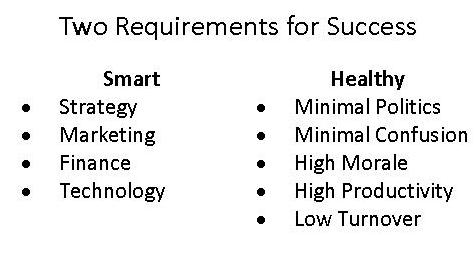
Smart vs. Healthy

Being smart is only half the equation in a successful organization. Yet it somehow occupies almost all the time, energy, and attention of most leaders. The other half of the equation, the one that is largely neglected, is about being healthy.

– Patrick Lencioni, The Advantage

In Patrick Lencioni’s latest book The Advantage, you will find the following chart:

Lencioni comments: “Whenever I list the qualities for leaders, I usually get one of the following reactions, and sometimes both. Often they laugh quietly, in a nervous. almost guilty kind of way. Or they barely sigh, like parents do when they hear about a family where the kids do what they’re told the first time they’re asked. In either case, it’s as thought they’re thinking, ‘Wouldn’t that be nice?’ or, ‘Can you imagine?’

None of the leaders – even the most cynical ones – deny that their organizations would be transformed if they could achieve the characteristics fo a healthy organization. Yet they almost always gravitate to the left side of the chart above, retreating to the safe, measurable “smart” side of the equation.

Why?

Because it’s relatively safe and predictable, which most leaders prefer. That’s how they’ve been trained, and that’s where they’re comfortable.

It takes discipline to move beyond the safe and predictable, into the sometimes awkward and messy area of organizational health.

Tomorrow: Four Disciplines of Organizational Health

Adapted from The Advantage, by Patrick Lencioni

The Case for Organizational Health

The single greatest advantage any company can achieve is organizational health. Yet it is ignored by most leaders even though it is simple, free, and available to anyone who wants it.

– Patrick Lencioni, The Advantage

With that bold statement, Patrick Lencioni delivers perhaps his finest work to date – no mean feat considering that his eight business fables remain required reading for leaders in any organization – especially ChurchWorld.

Instead of trying to become smarter, Lencioni asserts that leaders and organizations need to shift their focus to becoming healthier, allowing them to tap into the more-than-sufficient intelligence and expertise they  already have.

What’s the secret to discovering organizational health? Or to put it more bluntly, why do leaders struggle to embrace it?

According to Lencioni, it’s because too many leaders quietly believe they are too sophisticated, too busy, or too analytical to bother with it. In other words, they think it’s beneath them. Before leaders can tap into the power of organizational health, they must humble themselves enough to overcome the three biases that prevent them from embracing it:

  • The Sophistication Bias: organization health is so simple and accessible that many leaders have a hard time seeing it as a real opportunity for meaningful advantage. It doesn’t require great intelligence or sophistication – just uncommon levels of discipline, courage, persistence, and common sense.
  • The Adrenaline Bias: becoming a healthy organization takes a little time; unfortunately, too many leaders suffer from adrenaline addiction, hooked on the daily rush of activity and firefighting within their own organizations.
  • The Quantification Bias: the benefits of becoming a healthy organization are difficult to accurately quantify. It requires a level of conviction and intuition that many overly analytical leaders have a hard time accepting.

To close this post, possibly one of the boldest, most audacious quotes you will ever hear or read:

Once organizational health is properly understood and placed into the right context, it will surpass all other disciplines in business as the greatest opportunity for improvement and competitive advantage. Really.

Tomorrow: Would you rather be smart or healthy?

New Beginnings

Today I begin a new chapter in my life – as Curator of the Vision Room at Auxano.

Yeah.

No – YEAH!

To find out the scoop, take a look at the tabs above for full information.

For a trip back to the day it started, I’ve reprinted a post from November 10, 2008: reflections on the day I first met Will Mancini.

School’s Out – on Strategic Planning

As I’ve posted many times on this blog, Catalyst 2008 totally rocked my boat on a personal and business level – to the point of tipping it over! I’m still processing and talking about Catalyst, and probably will be till next year’s Catalyst (yeah – I’ve already registered for it, along with the rest of my family – but that’s another post).

My boat just turned over again.

Will Mancini, author of Church Unique and founder and Clarity Evangelist at Auxano, was kind enough to meet with me and the editor of Church Solutions magazine, Karen Butler, on the last day of WFX in Houston last week. Will was joined by Cheryl Marting, Chief Connections Officer at Auxano (already they win the award for coolest job titles). Since Will lives in Houston, the original intent was just to get to know him a little better in advance of next February’s Church Solutions Conference and Expo. Karen set the lunch up, and was very kind to include me in. As soon as the conversation started, it was obvious to me that God had set this up all along to continue the “mind expansion” He set in place at Catalyst.

Church Unique was published earlier this year by Leadership Network. I’m a huge fan of Leadership Network – I attended a Leadership Gathering in 1995 and have participated in several national training events since then (thank you Sue Mallory for all you have done for equipping ministries in the church). Anyway, when LN publishes a book, I’m all over it. So when Church Unique came out, I picked it up – and it mesmerized me from the opening pages.

My experience with strategic planning matters goes back to seminary in the early 80’s: Lyle Schaller, Aubrey Malphurs, Bobb Biehl, Kennon Callahan, Peter Drucker – these were the leaders in the field that we followed. Others have joined them in the years since, but all of these – and especially Malphurs – have influenced my own views of strategic planning in the churches I served and in the churches I work with now as a development consultant.

I had not gotten further than the introduction of Church Unique and a table contrasting strategic planning and Mancini’s Vision Pathway than I knew my views of strategic planning and its place in the church world had changed – forever.

His approach centers on the powerfully simple concept that God has created all churches as unique. While we understand that God created His world with uniqueness (think snowflakes), and His children (DNA, environment, and culture) the same way, we think that churches are mostly alike.

Do you think He would act any differently with His church?

Over the next few days, I will be posting a few of the nuggets of Church Unique. But don’t take my word for it – get a copy immediately, block out some time to dive into it, and prepare to put on a life-preserver – your boat is going to be rocked!

Here are those posts if you are interested:

Over the past four years I’ve written dozens of posts about Will, Auxano, and Church Unique.

Now I get to live it out!

That’s a God thing…

Level 5: Lead from the Pinnacle

Definition of a Level 5 Leader: People follow you because of who you are and what you represent

Leadership at Level 5 lifts the entire organization and creates an environment that benefits everyone in it, contributing to their success.

          John Maxwell, The 5 Levels of Leadership

Today’s post is the final in a series of five that takes a closer look at John Maxwell’s latest book, The 5 Levels of Leadership. As indicated in the introduction to this series, “5 Levels” has been five years in the making. I’ve been in leadership development in ChurchWorld for over 30 years – and I’ve been looking for a resource like this.

To whet your appetite and convince you to drop everything and get your own copy today, over this series I’m going to quote Maxwell’s top 3 points in each of five sections for each of the 5 Levels. In math shorthand, that’s 3 x 5 x 5. The product of that equation is a leadership development gold mine for you!

 Level 5– The Pinnacle

The Upside of the Pinnacle

  1. Pinnacle leadership creates a Level 5 organization
  2. Pinnacle leadership creates a legacy within the organization
  3. Pinnacle leadership provides an extended platform for leading

The Downside of the Pinnacle

  1. Being on the pinnacle can make you think you’ve arrived
  2. Being on the pinnacle can lead you to believe your own press
  3. Being on the pinnacle can make you lose focus

Best Behaviors on Level 5

  1. Make room for others at the top
  2. Continually mentor potential Level 5 leaders
  3. Create an inner circle that will keep you grounded

Help Others Move Up to Levels 4 and 5

  1. Identify and create the crucial leadership lessons they must learn
  2. Look for unexpected crucible moments they can learn from
  3. Use your own crucible moments as guidelines to teach others

Guide to Being Your Best at Level 5

  1. Remain and humble and teachable
  2. Maintain your core focus
  3. Create the right inner circle to keep you grounded

Developing leaders to the point where they are able and willing to develop other leaders is the most difficult leadership task of all. But here are the payoffs: Level 5 leaders develop Level 5 organizations. They create opportunities that other leaders don’t. They create legacy in what they do. People follow them because of who they are and what they represent. In other words, their leadership gains a positive reputation. As a result, Level 5 leaders often transcend their position, their organization, and sometimes their field.

If you are a leader in ChurchWorld asking “How can I develop leaders?”, then John Maxwell’s book The 5 Levels of Leadership will certainly provide you with proven steps to answer that question.


Level 4: Lead by People Development

Definition of a Level 4 Leader: People follow you because of what you have done for them personally

Leaders become great, not because of their power, but because of their ability to empower others.

          John Maxwell, The 5 Levels of Leadership

Today’s post is the fourth of a series of five that takes a closer look at John Maxwell’s latest book, The 5 Levels of Leadership. As indicated in the introduction to this series, “5 Levels” has been five years in the making. I’ve been in leadership development in ChurchWorld for over 30 years – and I’ve been looking for a resource like this.

To whet your appetite and convince you to drop everything and get your own copy today, over this series I’m going to quote Maxwell’s top 3 points in each of five sections for each of the 5 Levels. In math shorthand, that’s 3 x 5 x 5. The product of that equation is a leadership development gold mine for you!

 Level 4 – People Development

 The Upside of People Development

  1. People development sets you apart from most leaders
  2. People development assures that growth can be sustained
  3. People development empowers others to fulfill their leadership responsibilities

 The Downside of People Development

  1. Self-centeredness can cause leaders to neglect people development
  2. Insecurity can make leaders feel threatened by people development
  3. Shortsightedness can keep leaders from seeing the need for people development

Best Behaviors on Level 4

  1. Recruiting – find the best people possible
  2. Positioning – placing the right people in the right position
  3. Modeling – showing others how to lead

Beliefs that Help a Leader Move Up to Level 5

  1. The highest goal of leadership is to develop leaders, not gain followers or do work
  2. To develop leaders, you must create a leadership culture
  3. Developing leaders is a life commitment, not a job commitment

 Guide to Growing Through Level 4

  1. Be willing to keep growing yourself
  2. Decide that people are worth the effort
  3. Work through your insecurities

 Good leaders on Level 4 invest their time, energy, money, and thinking into growing others as leaders. They look at every person and try to gauge his or her potential to grow and lead – regardless of the individual’s title, position, age, or experience. Every person is a potential candidate for development.

Tomorrow: Level 5 – The Pinnacle


Level 3: Lead by Production

Definition of a Level 3 Leader: People follow you because of what you have done for the organization

…good leaders don’t just create a pleasant working environment. They get things done! That’s why they must move up to Level 3, which is based on results.

          John Maxwell, The 5 Levels of Leadership

Today’s post is the third of a series of five that takes a closer look at John Maxwell’s latest book, The 5 Levels of Leadership. As indicated in the introduction to this series, “5 Levels” has been five years in the making. I’ve been in leadership development in ChurchWorld for over 30 years – and I’ve been looking for a resource like this. 

To whet your appetite and convince you to drop everything and get your own copy today, over this series I’m going to quote Maxwell’s top 3 points in each of five sections for each of the 5 Levels. In math shorthand, that’s 3 x 5 x 5. The product of that equation is a leadership development gold mine for you!

 Level 3 – Production

 The Upside of Production

  1. Leadership production gives credibility to the leader
  2. Leadership production models and sets the standard for others visually
  3. Leadership production brings clarity and reality to vision

 The Downside of Production

  1. Being productive can make you think you’re a leader when you’re not
  2. Productive leaders feel a heavy weight of responsibility for results
  3. Production leadership requires making difficult decisions

 Best Behaviors on Level 3

  1. Understand how our personal giftedness contributes to the vision
  2. Cast vision for what needs to be accomplished
  3. Begin to develop your people into a team

 Beliefs That Help a Leader Move Up to Level 4

  1. Production is not enough
  2. People are an organization’s most appreciable asset
  3. Growing leaders is the most effective way to accomplish the vision

 Guide to Growing Though Level 3

  1. Be the team member you want on your team
  2. Translate personal productivity into leadership
  3. Understand everyone productivity niche

Leading and influencing others becomes fun on this level. Success and productivity have been known to solve a lot of problems. On Level 3, leaders can become change agents. They can tackle tough problems and face thorny issues. They can make difficult decisions that will make a difference. They can take their people to another level of effectiveness. 

Tomorrow: Level 4 – People Development

Level 2: Lead by Permission

Definition of a Level 2 Leader: People follow you because they want to

The agenda for leaders on Level 2 isn’t preserving their position. It’s getting to know their people and figuring out how to get along with them. You can like people without leading them, but you cannot lead people well without liking them.

          John Maxwell, The 5 Levels of Leadership

Today’s post is the second of a series of five that takes a closer look at John Maxwell’s latest book, The 5 Levels of Leadership. As indicated in the introduction to this series, “5 Levels” has been five years in the making. I’ve been in leadership development in ChurchWorld for over 30 years – and I’ve been looking for a resource like this.

To whet your appetite and convince you to drop everything and get your own copy today, over this series I’m going to quote Maxwell’s top 3 points in each of five sections for each of the 5 Levels. In math shorthand, that’s 3 x 5 x 5. The product of that equation is a leadership development gold mine for you! 

Level 2 – Permission

The Upside of Permission

  1. Leadership permission makes work more enjoyable
  2. Leadership permission increases the energy level
  3. Leadership permission opens up channels of communication

The Downside of Permission

  1. Permission leadership appears too soft for some people
  2. Leading by permission can be frustrating for achievers
  3. Permissional leaders can be taken advantage of

Best Behaviors on Level 2

  1. Connect with yourself before trying to connect with others
  2. Develop a people-oriented leadership style
  3. Practice the golden rule

Beliefs That Help a Leader Move Up to Level 3

  1. Relationships alone are not enough
  2. Building relationships requires twofold growth
  3. Achieving the vision as a team is worth risking the relationship

Guide to Growing Through Level 2

  1. Be sure you have the right attitude toward people
  2. Connect with yourself
  3. Understand where you’re coming from

Moving up to Level 2 is an important development in leadership because that is where the followers give their supervisors permission to lead them. People change from being subordinates to followers for the first time, and that means there is movement. Leadership always means that people are going somewhere. They aren’t static. No journey, no leadership.

Tomorrow: Level 3 – Production