As told here, the exceptional guest services I recently encountered in a hospital Emergency Department at 1 AM in the morning were not normal…
…and here’s the reason why.
In 2004 Vanderbilt University Medical Center launched Elevate, a medical center-wide effort to improve the environment for patients, physicians, employees, trainees and students. Vanderbilt was already nationally recognized for excellence in many areas. But Dr. Harry Jacobson, at the time the Vice Chancellor for Health Affairs, had ambitious goals, including that Vanderbilt become one of the nation’s top 10 academic medical centers and a Fortune 100 employer – something that an academic medical center has never achieved. Elevate was designed to help achieve these and other goals by focusing on three important areas: Service, People and Quality.
Elevate was seen as a journey to establish a new culture of service – to patients, to colleagues and to the team members themselves.
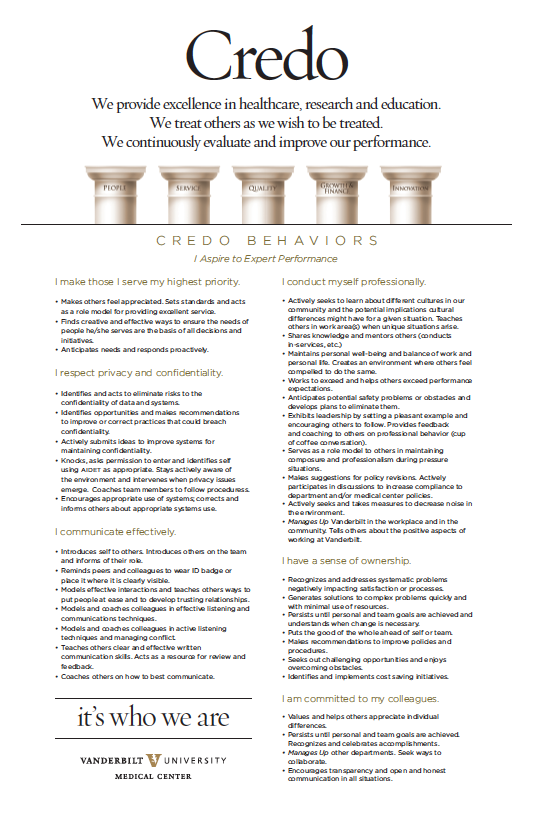
Vision: Elevate builds a common culture based upon service excellence and credo behavior across Vanderbilt University Medical Center.
Mission: Establish a culture of excellence based on service to our patients, our colleagues and to each other. Strengthen VUMC leadership practices to recruit, retain and develop an engaged and committed workforce – the foundation for service excellence.
The leadership of VUMC saw Elevate as a marathon, not a sprint. It was a journey that will continue as they set new goals for excellence.
The results of that journey?

In order to help the VUMC team fulfill the Credo, a “Tackle Box” was created – but there’s nothing fishy about this tackle box.
The Tackle Box is an online team resource, comprised of ideas to help leaders and their teams “catch” the spirit of the VUMC Credo in some fun and engaging ways and “tackle” a shared understanding and use of core values in everyday work. It consists of a collection of activities, discussion starters and agendas to use with teams.
The Credo, as part of VUMC culture, is best taught by observation, by raising awareness through discussion, by example and with honest feedback. Leaders of Elevate feel that the Tackle Box and the experiences arising from it will help the VUMC team re-focus and re-energize around the basics of the Credo and the spirit of It’s Who We Are.
In addition to The Tackle Box, the following tactics were introduced by the Studer Group and are key to the Elevate journey towards excellence.
- Rounding for Outcomes – The consistent practice of asking specific questions of key stakeholders—leaders, employees, physicians and patients—to obtain actionable information.
- Recognition – Affirming words, hand written thank you notes and or other methods used to recognize, reward and reinforce good performance and behavior.
- Employee Selection and the First 90 Days – A retention tool as well as a way of building individual accountability within employees. Hire your co-workers, train your co-workers, orient your co-workers and be a role model for your co-workers.
- Discharge Phone Calls – A way for staff to reconnect with patient after their visit to our medical center.
- Key Words at Key Times – Using specific words to use with patients, staff and physicians to let them know what we are doing and why we are doing it.
The Credo is an inward-focusing framework supporting the VUMC culture of service excellence. But what does the patient see?
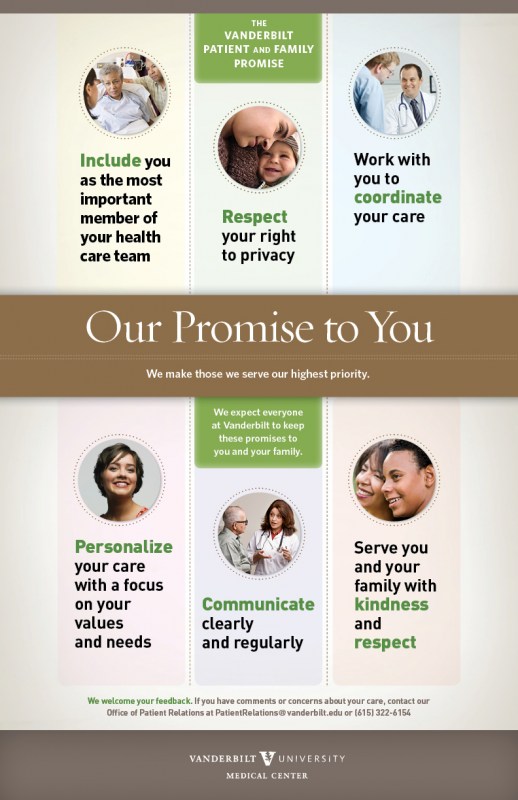
The Vanderbilt Patient and Family Promise is the outward expression of the Credo and describes what patients and family should expect from VUMC.
Elevate 10 Years Later
Affirming that its people are Vanderbilt University Medical Center’s most important asset, 2015 will bring a renewed focus to Elevate. The Studer Group, a partner in the original cultural engagement and leadership development journey begun in 2004, will help facilitate this process.
“The purpose of renewing our commitment to the core principles of Elevate is to make the Medical Center a better place for all employees to work, for physicians to practice medicine and for our patients to receive care. Our goal is to have a workforce that feels more valued and satisfied, enjoys coming to work each day and believes they are making a difference,” said C. Wright Pinson, MBA, M.D., deputy vice-chancellor for Health Affairs.
“The Medical Center and the work we do to improve the lives of others is something we all care about deeply. Many of us have spent the majority of our careers here,” said Pinson.
“The best way to move forward in the current climate of change is to articulate our future vision and re-engage and recommit to our culture of service, to our patients and to each other.”
An essential ingredient for sustained success within leading organizations is maintaining a culture of high performance.
This year, the emphasis will be on reinforcing the Medical Center’s culture in ways that better equip all faculty and staff to thrive amidst the constant pace of change that is now part of the U.S. health care system.
“As we move into a new fiscal year, VUMC continues to excel by virtually every measure as a very high-performing organization, even after having faced unprecedented challenges,” said Jeff Balser, M.D., Ph.D., vice-chancellor for Health Affairs and dean of the School of Medicine. “Nevertheless, to maintain this trajectory after such a difficult year, it’s important to acknowledge what we’ve experienced and focus on our people.”
“The foundation for excellence is an engaged and committed workforce, not only in service to our patients but also demonstrating commitment to our colleagues and to professionalism,” said Pinson.
Through Elevate, teams will be working to implement greater alignment of the Medical Center’s Pillar goals to achieve improved service, quality, safety, innovation and financial performance through increased employee engagement.
“We are taking these steps to reinforce passion for the important work that we do. Every day that you take steps to improve yourself and to help those who surround you reach greater heights is a great day,” said Pinson.
Having been born and raised in the Nashville area, the excellent level of medical care provided by VUMC to my mother was no surprise to me.
What was surprising, however, was the systematic cultural emphasis on the total patient experience.
Elevate works.
It works when the Emergency Department admissions staff and nurses work quickly and efficiently, while at the same time have all the time in the world to talk with my mother.
It works when the Chief Resident, Dr. Oliver, exhibits the best bedside manner I have ever experienced, explaining what is going on, and what may have to happen.
It works when the nurses of the Critical Care unit immediately adopt an 86-year old as their favorite patient because of the stories she tells – and come by to see her even when she moves to another unit.
It works when Yana, a nurse on the 9th floor Step Down Unit, personalizes patient care in the most tender caring manner possible – consistently, efficiently, lovingly – throughout 3-day, 12-hour shifts with many other patients to care for. I have no doubt each patient thought they were her only patient.
It works in the late night and early morning hours as the always-cheerful housekeeping staff brings by new linens, cleans the room – and takes time to talk about family and life events.
It works when the nutrition staff drops off meals only to hear the patient complain about them – even when it’s what the doctor ordered – and before they leave, the patient agrees it’s best for her.
It works when Dr. Putnam, Chairman of the Department of Thoracic Surgery and the Attending Physician, makes his daily rounds – taking time to talk with the patient in a genuine, caring attitude – not just someone “making the rounds.”
For the dozens of other individuals whose demonstrated exceptional patient care in my recent experience at Vanderbilt University Medical Center – Elevate works.
Information for this article came from personal observations, the VUMC Elevate website, and conversations with VUMC staff