Disney at 100: Bringing the Story to Life

From blue sky ideation, to pencil on paper, to digital models, to plaster and paint, Imagineers build dreams. They never say “never,” and the sky is not the limit. That quest has created a new art form and a new kind of artist, one whose canvas is the world itself and whose tools are whatever it takes to turn that world into a fantastic, enveloping story.

Leslie Iwerks, “The Imagineering Story”

The books in my Disney library are a valuable resource for my ongoing quest in learning the story of Walt Disney and the “kingdoms” he created; kingdoms that continue to expand in the 57 years since his passing.

But even books have limitations…

You can dream, create, design, and build the most wonderful place in the world…but it requires people to make the dream a reality.

Walt Disney

Over the years I have been fortunate to make friends among Disney Cast Members, both current and past. A handful of those friends have been Imagineers, and as you may imagine, they are amazing storytellers, creative geniuses, and innovative to the core.

So…learning more about Imagineering? Sign me up – literally!

When the news that a new steaming service called Disney+ was coming in the fall of 2019, I was delighted – so much, that I signed up for a 3-year subscription as soon as they became available.

When the initial programming schedule was released, and included the 6-part series “The Imagineering Story,” I was ecstatic – it was among the first programs I watched on the new service.

When the book The Imagineering Story was announced, I was literally stopped what I was doing and pre-ordered the book.

There’s really no secret about our approach. We keep moving forward – opening new doors and doing new things – because we’re curious. And curiosity keeps leading us down new paths. We’re always exploring and experimenting…we call it Imagineering – the blending of creative imaginational and technical know-how.

Walt Disney

The Imagineering Story continues the behind-the-scenes journeys first revealed in the books Walt Disney Imagineering: A Behind the Dreams Look at Making the Magic Real (1995) and its sequel Walt Disney Imagineering: A Behind the Dreams Look at Making MORE Magic Real (2010).

The book goes deep into the personalities, stories, and adventures of the men and women who brought create magic around the world.

More than just the theme parks (though that would have been awesome enough), every resort hotel, shop and business setting, cruise ship, and entertainment setting exists largely through the men and women of Disney Imagineering.

The Imagineering Story greatly expands the award-winning filmmaker Leslie Iwerks’ narrative of the fascinating history of Walt Disney Imagineering.

The entire legacy of Walt Disney Imagineering is covered from day one through future projects with never-before-seen access and insights from people both on the inside and on the outside. So many stories and details were left on the cutting room floor for the series – this book allows an expanded exploration of the magic of Imagineering.

Every one of the 731 pages was filled with stories that brought the Disney Experience alive.

The experience of Disney – primarily in the theme parks, but now expanded to other resorts, retail shops, and cruise ships – can be traced back to Walt Disney. His untimely death in 1966 could have left a void in the creativity of the Disney empire.

But I believe his greatest act of genius had its origins in 1952, as he began to pull together veterans of film and animation work for a special project that came to be known as Disneyland.

That group of versatile animators and art directors was the foundation of a group that came to be called the Imagineers.

Out of this group, Disney historian Tim Hauser reflects, “came the theories, aesthetics, design, and engineering of Disneyland; the advancement of three-dimensional storytelling; the development of robotic techniques in Audio-Animatronics; and the perpetuation of an ‘architecture of reassurance’ as inspired by Walt Disney’s personal sense of optimistic futurism.”

Today Walt Disney Imagineering remains the design, development, and master-planning branch of company, with over 140 disciplines working toward the common goal of great stories and creating great places.

Walt Disney wanted Disneyland to be essentially a movie that allows you to walk in and join in the fun. Imagineers – many whom had worked with Walt Disney since the 1930s – literally brought those movies to life with their multiple disciplines. He knew from his filmmaking experience that story was everything to the audience. Disney knew he must immerse the theme park guest in living storytelling scenarios.

Designing the Guest’s experience is what Walt Disney’s Imagineers came to call “the art of the show,” a term that applies to what the Imagineers did at every level, from the broadest conceptual outlines to the smallest details, encompassing visual storytelling, characters, and the use of color.

Walt Disney realized that a visit to an amusement park could be like a theatrical experience – in a word, a show. Walt saw that the Guests’ sense of progressing through a narrative, of living out a story told visually, could link together the great variety of attractions he envisioned for his new kind of park. While traveling through their stories, Guests would encounter, and even interact with, their favorite Disney characters, and who would be transformed, as if by magic, from their two-dimensional film existence into this special three-dimensional story world.

As designers, the Imagineers create spaces – guided experiences that take place in carefully structured environments, allowing the Guests to see, hear, smell, touch, and taste in new ways. In effect, Imagineers transform a space into a story place.

Ultimately, the Imagineers gave Guests a place to play, something Walt believed that adults needed as much as children. The design of the Imagineers gives power to the Guests’ imagination, to transcend their everyday routine. Walt Disney insisted that Guests should “feel better because of” their experiences in Disney theme parks, thus establishing the art of the show.

For the Imagineers, that meant considering everything within and relating to the parks as design elements. To build effective story environments and assure Guest comfort, the designers realize that they always had to assume the Guests’ position and point of view, and just as Walt did, to take the Guests’ interests to heart and defend them when others didn’t think it mattered.

It is up to the designers to provide Guests with the appropriate sensory information that makes each story environment convincing. This means that design considerations go beyond the attractions themselves to the service and operations staff, transportation, restaurants, shops, rest rooms – even the trash cans.

Everything Begins With a Story

Storytelling has played a vital role in our survival – allowing us to share information, knowledge, and values from generation to generation. Story is the medium through which we receive our early learning as to right and wrong, good versus evil, reward and punishment, social values, etc.

We respond to storytelling. It engages our attention; no matter how old we get, who doesn’t love a good story?

Understanding this, Walt Disney utilized a technique in the early days of his cartoon films that helped illustrate the flow and continuity of stories – the storyboard.

Storyboards are tools that allowed Walt and his artists to envision a film prior to production. It allowed his team to have a shared vision of the story they were telling and how it would unfold. As a bonus to driving the creative development, it also offered a cost-effective way to experiment with a film early on, so that when production began, costs could be minimized.

Decades later, the tradition of storyboards continues on, though it has long expanded past just films. At Walt Disney Imagineering, rides, shows, and films for Disney’s theme parks around the world are the objects of regular storyboarding.

For each ride, show, or attraction, a logical story sequence is created. Almost every aspect of a project is broken sown into progressive seen sketches, called storyboard panels, that reflect the beginning, middle, and end of a Guest’s park experience.

The boards are eventually covered with every written thought, idea, and rough sketch the Imagineers can come up with.

Starting with brainstorm sessions, the Imagineer’s first thoughts, ideas, images, and feelings about the story they are creating are captured on note cards and quick sketches. For example, here’s an early sketch of Animal Kingdom’s Tree of Life:
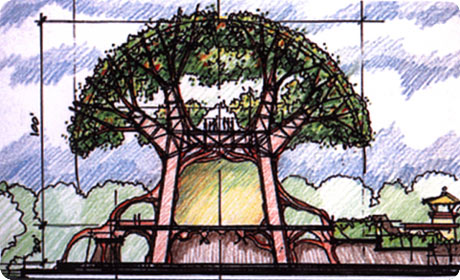
courtesy Disney Imagineering

The beauty of the Tree is matched by its engineering marvels as well. It is a massive structure, towering 145 feet into the air with a full canopy of natural-looking leaves, enclosing a 420-seat theater and meeting all building codes, including withstanding 145 mph winds. The engineering feats accomplished, it was time for the  Imagineering team of sculptors to create the magnificent bark of the tree – which is actually representations of animals. That process alone took almost a full year.

courtesy Orlando Sentinel

One of the most amazing pieces of art ever created by Disney’s Imagineers, it is beautiful and meaningful, and captures the essence of Animal Kingdom at a glance. It’s a poetic statement of the majesty of nature, the stunning diversity of animals, and our respect for our place in the world. As you approach the tree and the animal forms begin to reveal themselves, it becomes clear that there is almost no tree at all. That tree is the animal kingdom.

The experience of viewing the Tree of Life is like looking for animals in the clouds. The longer you look, the more you see – maybe even all 325 of them! This effect is the result of very careful planning during the design phase with the use of storyboards.

The storyboards are worked, re-worked, rearranged, and edited until the story is strong and clear. Only then will production proceed – with stunning results:

At Walt Disney Imagineering, everything they do revolves around the story – and storyboards have remained an essential tool in helping them tell the story.

That is the power of story – it is an experience that enables us to escape to another world, to be captivated and be in the moment.

The secret to Disney magic that the Imagineers bring to life is in the story!

Recently celebrating their 70th anniversary, the Imagineers have delivered – time and time again. To date, the Imagineers have built twelve theme parks; dozens of resort hotels; 5 cruise ships with two more under construction; 2 water parks; and ongoing development in existing parks and Disney properties around the world.

The Imagineers bring the Disney magic alive.

The Imagineering Story brings the Imagineers to life.

I have a hard time ranking the books in my Disney library – but The Imagineering Story is going to be in my all-time Top Ten from now on, and a highly-recommended book for anyone who wants a deeper understanding of the creative genius (and occasionally weirdness) of that special and unique blend of artists and engineers who took the dreams of one man, Walt Disney, and brought them to life. 

Walt was a storyteller above all. Walt didn’t write the stories but he envisioned them. He told stories better than anyone else around and he got the people around him to turn his stories into movies and theme park attractions.

Imagineer X. Atencio

References

Disney at 100: The Lifelong Partnership of Walt and Roy Disney

My brother Walt and I first went into business together almost a half-century ago. And he was really, in my opinion, truly a genius – creative, with great determination, singleness of purpose and drive; and through his entire life he was never pushed off his course or diverted to other things.

Roy Disney, at the Dedication of Walt Disney World, October, 1971

The year 2023 marks a momentous occasion for Disney enthusiasts and fans of the magical world of animation and entertainment. It’s the 100th anniversary of the Disney Company, a celebration that invites us to take a journey through time and rediscover the remarkable story of two brothers who forever changed the landscape of the entertainment industry: Walt Disney and Roy Disney.

As we explore the extraordinary partnership of Walt and Roy Disney, we’ll look at highlights of their shared vision, unwavering dedication, and the remarkable accomplishments that define their legacy.

From the earliest days of their lives in the bustling city of Chicago, Illinois, to the groundbreaking achievements that revolutionized animation and theme parks, the story of Walt and Roy Disney is a tale of creativity, innovation, and the power of collaboration. Together, they laid the foundation for a global entertainment empire that continues to enchant and inspire generations of dreamers and believers.

Join me on this journey as we unravel the tale of the Disney brothers whose partnership laid the foundation for a magical world where dreams come true. Through the highs and lows, triumphs and challenges, their story is a testament to the enduring spirit of innovation and the belief that anything is possible when you have a dream and someone to share it with.

Childhood and Early Years

In the heart of the bustling city of Chicago, Illinois, in the early years of the 20th century, two brothers were born who would go on to change the face of entertainment forever. Walter Elias Disney, known to the world as Walt, and his younger sibling Roy Oliver Disney, came into the world with an innate curiosity and a shared passion for art and animation.

Shared Upbringing

The Disney brothers grew up in a modest household, where their father, Elias Disney, worked as a carpenter, and their mother, Flora Disney, nurtured their creative spirits. It was within the confines of this supportive and nurturing family that the seeds of their future dreams were sown. 

From an early age, it was clear that Walt and Roy possessed a unique bond. Being eight years older, he would often push the infant Walt in a carriage along the streets of their home. Even after a move from Chicago to a farm in Marceline, MO in 1906, the brothers remained close. Having three older brothers, Walt was mature for a seven-year old, and Roy treated him as an equal, rather than a pesky little brother. 

When the two older brothers left the family farm to strike out on their own, and with their father Elias weakened by illness, the responsibility of keeping up the farm fell to Roy. It was too much for a boy who was also attending high school, so the Disney family sold the farm and moved into a small house in Marceline, primarily so the three children (Roy, Walt, and sister Ruth) could finish school.

In 1910, the family moved to Kansas City, with Elias becoming a newspaper distributor – and drafting his sons Roy and Walt to make deliveries in the early hours before school began and late afternoon, after school had been dismissed. These long hours of shared work were an foreshadowing of the partnership that continued throughout the remainder of their lives.

Separate Paths

After graduation from high school and working a few odd jobs, Roy settled into the world of banking as a teller. Walt’s love of drawing since boyhood deepened throughout his school years. Walt often came to see Roy because he wanted a quarter or half-dollar for paper to draw on. That pattern became the story of their lives: Roy providing the money for Walt’s artistic endeavors.

As the U.S. began its involvement in WWI, Roy enlisted in the Navy, serving for two years. Back in Kansas City, Elias Disney grew dissatisfied with the newspaper business, and moved his family back to Chicago. Walt finished high school in Kansas City, then moved to Chicago for a brief time, before convincing his reluctant parents to allow him to volunteer for the Red Cross and go the the battlegrounds of Europe. 

When the war ended in 1919, Roy returned to Kansas City and his job as a bank teller. Walt, drawn innately by the bond he had with Roy, also settled in Kansas City. He announced he had decided to make a career out of his passion: he would become an artist.

The Birth of the Disney Brothers’ Animation Ventures

In the years that followed, the Walt began to experiment with animation techniques, driven by his insatiable curiosity and an eagerness to bring drawings to life. He embarked on a series of jobs that helped him hone his craft. After a few setbacks, he borrowed money from friends and family and launched “Laugh-O-Gram Films.” After some initial success, Walt had overextended Laugh-O-Gram, and it went bankrupt. Desperate, he reached out to his older brother for advice through a series of letters and telegrams.

Roy had not been well since his return from the Navy; he was diagnosed with tuberculosis, and sent to a series of veterans’ hospitals in New Mexico and Arizona to recuperate. After some recovery, he moved to California and began a hunt for a job. After a few small jobs, he suffered a relapse from TB and entered the VA hospital in Los Angeles. Receiving disability payments, he would often reply to Walt’s letters with a $20 bill enclosed – because he knew Walt needed the money.

Upon the failure of Laugh-O-Gram, Walt received a letter from Roy encouraging Walt to leave Kansas City. The next day, Walt boarded a train to join his older brother Roy in California.

Founding of Disney Brothers Studio

In the early 1920s, as the world was on the brink of a new era, Walt and Roy Disney were about to embark on an adventure that would forever change the course of entertainment history. It was a time of boundless creativity and innovation, and the Disney brothers were poised to be at the forefront of it all.

From Humble Beginnings to Ambitious Dreams

The Disney brothers had come a long way from their modest upbringing in Chicago. In 1923, with a few sketches from the Kansas City days, an old camera, and an unyielding determination to succeed, they founded Disney Brothers Studio in Hollywood, California. Staring in their uncle’s garage, they soon moved to rented rooms behind an realtor.

The inception of Disney Brothers Studio marked the birth of what would eventually become The Walt Disney Company. At this early stage, the company was a small animation studio with big dreams. Walt Disney, the visionary and creative force behind the operation, had a clear vision for what he wanted to achieve: to create innovative and captivating animated content that would transport audiences to magical worlds.

The Complementary Roles of Walt and Roy

One of the hallmarks of the Disney brothers’ partnership was the way in which they complemented each other’s strengths. Walt was the dreamer, the artist, and the storyteller. He had a knack for creating beloved characters like Mickey Mouse and crafting unforgettable narratives. Meanwhile, Roy was the pragmatist, the financial wizard, and the one who kept the studio afloat during challenging times.

Roy’s role in the early days of Disney Brothers Studio cannot be overstated. While Walt poured his heart and soul into the creative process, Roy handled the business side of things. He secured contracts, managed budgets, and ensured that the studio had the financial stability to continue its groundbreaking work. Roy forsook banking work and a hospital bed, where he was recuperating from tuberculosis contracted during wartime, to start as the cameraman, bookkeeper, and even cel washer for a time at the little animation studio. Without Roy’s steady hand guiding the company, Walt’s creative visions might never have seen the light of day.

Alice Comedies

Walt’s experimentation of putting a live person into an animated cartoon was a success, and soon the brothers had a contract to move forward. Eventually, they produces a series of 56 Alice shorts over the next three and a half years, each one becoming more popular than the previous one. With the success of the Alice comedies, the brothers moved into an all new and larger studio in 1926.

Oswald

In 1927, the debut of Walt and Roy’s first true cartoon star, Oswald the Lucky Rabbit, furthered their creative accolades and reputation. Oswald appeared in a series of 26 silent cartoons, but the Disney Brothers Studio lost the rights to Oswald through a contract dispute with the distributor.

The Debut of Mickey Mouse and a Turning Point

In 1928, Disney Brothers Studio faced a critical turning point. The studio had experienced some success with its Oswald series, but in the same dispute in which they lost Oswald, they lost almost all their animators. Returning to California from New York City with the bitter news, Walt telegraphed Roy:

LEAVING TONIGHT STOPPING OVER KC ARRIVE HOME SUNDAY MORNING SEVEN THIRTY DON’T WORRY EVERYTHING OK WILL GIVE DETAILS WHEN ARRIVE—WALT

Walt later told the story of coming up with the character of Mickey Mouse on that long and painful ride from NYC. It was the creation of Mickey Mouse in the groundbreaking short film Steamboat Willie that catapulted them to fame. There were actually two earlier Mickey Mouse cartoons – Plane Crazy and The Gallopin’ Gaucho – but Steamboat Willie was the first cartoon with sound. Mickey Mouse quickly became a cultural phenomenon, capturing the hearts of audiences around the world.

Steamboat Willie was not only the first synchronized sound cartoon but also the birth of a global icon. It showcased Walt’s innovative spirit and Roy’s ability to navigate the evolving landscape of the film industry. Together, they had struck gold.

A World of Imagination Unveiled

By the late 1920s into the 1930s, Disney Brothers Studio had firmly established itself as a leader in animation. With beloved characters like Mickey Mouse capturing the hearts of audiences, the studio was poised for growth. Walt Disney’s unceasing creativity gave birth to a world of imagination, as he introduced a cavalcade of new characters and storytelling techniques.

The Silly Symphonies series allowed for experimentation in animation, paving the way for innovations like the multiplane camera, which added depth and dimension to their films. Each new release was a testament to Walt’s artistic vision, while Roy, always the financial steward, ensured the studio’s continued financial success.

Snow White

Buoyed by the success of his animation projects, Walt brought to life a dream he had held onto since 1917 – a full-length animated feature film, Snow White. Taking three years to produce, requiring great financial sacrifice, and despite the derision of Hollywood, it opened to tremendous acclaim on December 21, 1937. 

Because of the long development process, there was time to contract licensees during production (Roy’s idea) and Snow White marked the first time a complete licensed merchandise campaign was in place upon a film’s release. Additionally, a 3-record set of recordings from the film became the first feature-film soundtrack release – before the word “soundtrack” was used.

The success of Snow White provided resources for the construction of a new, state-of-the art studio in Burbank, and by October 1940 the Disneys’s new studio was ready to usher in a new generation of filmmaking advancements.

The Disney Magic Expands to Television

In 1950 the Disney brothers expanded their reach into television. While other Hollywood studios ignored the rise of television, Walt and Roy embraced it. They saw the medium as a new platform for storytelling – one which allowed him to communicate directly to audiences. 

Over the years, shows like The Mickey Mouse Club and Walt Disney’s Wonderful World of Color brought Disney’s magic into living rooms across America. Once again, Walt’s storytelling prowess and Roy’s financial management were the perfect recipe for success.

These television programs not only showcased beloved Disney characters but also provided a platform for Walt to share his insatiable curiosity and passion for education and innovation. This commitment to learning and growth would become a cornerstone of the Disney legacy.

In addition, it was the partnership with the fledgling ABC network that allowed the seed money and loan backing for a project that had been on Walt Disney’s heart since boyhood – an amusement park.

Challenges and the Birth of Disneyland

As the Disney brothers reached the 1950s, they faced a monumental challenge that would test their partnership like never before: the construction of Disneyland. The idea of a theme park where families could step into the enchanting world of Disney was a bold one, but it also came with enormous financial risk.

Walt’s boundless creativity and Roy’s financial acumen were never more critical. Roy’s relentless pursuit of funding secured the necessary resources for Disneyland to become a reality. On July 17, 1955, Disneyland opened its gates, and the world was forever changed. The Disney brothers had created a place where dreams came true, and it was an immediate success.

Walt Disney World

By the mid-1960s, with the critical and commercial success of Disneyland, and bolstered by Disney’s expanding innovation in attractions, Walt and Roy know that the Disney entertainment empire was ready to leave the comfort of sunny California and head east. Beginning with secret research and land acquisition, their eventual target was central Florida near Orlando, and the “Florida Project” was formally announced in 1965.

The Disney brothers’ decision to begin on an entertainment destination the likes of which the world had never seen would change the faces of themed entertainment and international tourism forever.

With a blank canvas of over 27,000 acres, by 1971 Walt Disney World had become the largest private construction project in U.S. history, with more than 8,000 workers onsite at the peak of activity.

But first it had to cross a tragic hurdle: the death of Walt Disney in December 1966. This would be the ultimate – and final – test of the siblings’ bond, and Rory charged on in deference to his late brother’s wishes. Adhering to Walt’s guiding principles, Roy postponed his own retirement and devoted all his energy to what he insisted should be call Walt Disney World.

The Lasting Legacy of Walt and Roy Disney

The story of Walt and Roy Disney is a tale of two brothers whose dreams transcended generations. As we venture into the final chapter of our exploration, we pay homage to their enduring legacy—a legacy that continues to enchant, inspire, and unite people from all corners of the globe.

The End of an Era and the Beginning of a New Chapter

The passing of Walt Disney in 1966 marked the end of an era. Walt’s creative genius had been the driving force behind Disney Brothers Studio, and his absence left a void that seemed impossible to fill. However, Roy Disney, ever the steadfast partner, stepped into the spotlight once more to ensure that Walt’s vision would live on.

Roy took on the role of CEO of The Walt Disney Company, guiding it through the completion of projects Walt had initiated, including the opening of Walt Disney World in Florida in October 1971. His dedication to his brother’s dreams never wavered, and his leadership was instrumental in preserving Walt’s legacy.

Roy’s Final Act

In December 1971, just months after Walt Disney World opened its gates in Florida, Roy Disney passed away. His departure marked the end of an era for Disney, but it also signaled the beginning of a new chapter. The magic that Walt and Roy had conjured together continued to shine brightly, enchanting visitors and fans alike.

Walt Disney World, with its vast array of attractions and immersive experiences, became a testament to the enduring spirit of the Disney brothers. It was a place where dreams could come true, where imagination had no limits, and where the legacy of Walt and Roy Disney thrived.

A World of Imagination Lives On

In the grand tapestry of entertainment history, the names Walt and Roy Disney occupy a place of honor and reverence. Their extraordinary partnership leaves a legacy that  spans a century of creativity and innovation and has shaped the way we experience and imagine the world. As we conclude the journey through their remarkable story, we celebrate the enduring influence of the Disney brothers.

The Boundless Creativity of Walt Disney

Walt Disney, the visionary, was a relentless dreamer. His imagination knew no limits, and he had the remarkable ability to turn the ordinary into the extraordinary. From the creation of Mickey Mouse to the development of groundbreaking animation techniques, Walt was a true pioneer.

His passion for storytelling, artistry, and innovation not only defined Disney’s early years but also set a standard that continues to drive the company’s creative endeavors. Walt’s words, “It’s kind of fun to do the impossible,” still resonate as a call to dream big and never give up on the pursuit of one’s vision.

The Stewardship of Roy Disney

Roy Disney, the steady hand, was the unsung hero behind the scenes. His financial acumen and unwavering support allowed Walt’s dreams to become a reality. Time and again, Roy ensured that the company had the resources it needed to grow and flourish.

Roy’s commitment to preserving his brother’s vision, even after Walt’s passing, exemplifies the strength of their partnership. His leadership and dedication during challenging times underscore the importance of resilience and the power of believing in a shared dream.

A Century of Dreams Realized

In commemorating the 100th anniversary of the Disney Company, we pay tribute to the Disney brothers’ everlasting influence. Their legacy continues to inspire generations, ignite the flames of creativity, and remind us that, with courage and imagination, all our dreams can come true.

The Disney brothers’ story is a testament to the power of dreams, the magic of storytelling, and the enduring spirit of partnership. It is a legacy that will continue to enchant, inspire, and unite people around the world for generations to come.

From the early days of animation to the creation of theme parks and a global brand that bears their name, their story is a example of the enduring magic of imagination and the belief that, in the words of Walt Disney himself, “All our dreams can come true if we have the courage to pursue them.”


Walt used to say that Disneyland would never be finished, and it never will. I like to think, too, that Walt Disney’s influence will never be finished; that through his creations, future generations will continue to celebrate what he once described as “that precious, ageless something to every human being which makes us play with children’s toys and laugh at silly things and sing in the bathtub and dream.”

Roy Disney

I always go and check with my brother. Always. But I don’t always agree with him. Roy had faith in me. I think that Roy has done a lot of things against his better judgment because he felt that I wanted to do it. Most of our arguments and disagreements I think have been because Roy has felt that he had to protect me.

Walt Disney

References

Disney at 100: How Passion Launched a Dream

On October 16, 2023, the Walt Disney Company will celebrate its 100th Anniversary. Today kicks off a series in recognition of this event – a series looking into the characteristics that have made the Walt Disney Company a beacon of innovation and imagination, enchanting audiences of all ages with its timeless stories, beloved characters, and groundbreaking achievements.

Some of the articles have existed before and been refreshed for this series; others are brand new. In either case, I hope you will enjoy reading about the dreamers, the believers, and the magic-makers who have brought us a century of enchantment.


To say that Walt Disney was merely a train enthusiast understates the extent to which his life was intertwined with railroading. In Walt’s case, his small-scale fascination led to a full-scale kingdom.

Michael Broggie, Walt Disney’s Railroad Story

With love of Disney history, I’m always grateful to visit Disney properties and immerse myself in the stories and culture of Walt Disney and the “kingdoms” he began. During one multi-day visit to California, I had the opportunity to visit Disneyland several days, experiencing both the familiar and new perspectives.

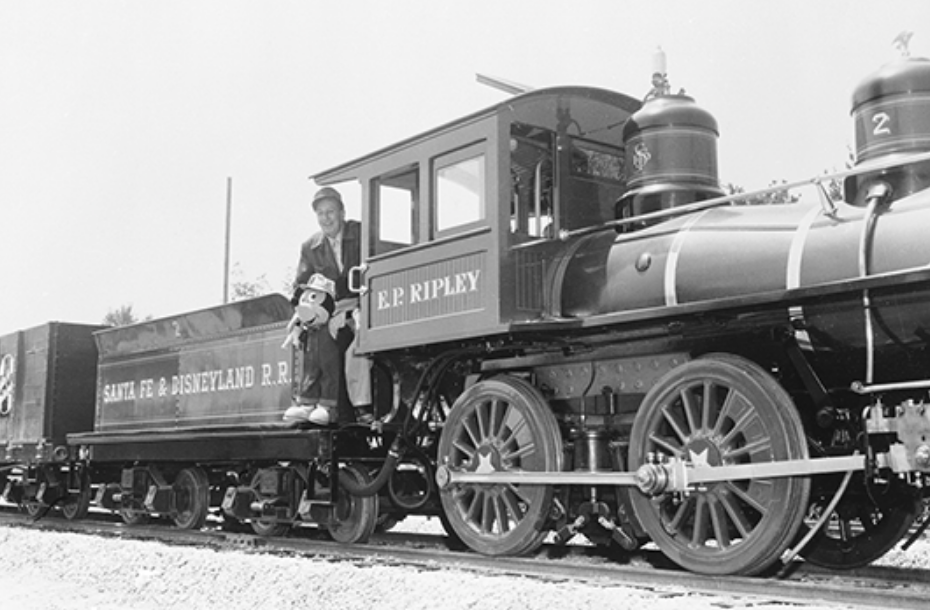
Take this image, for example:

In talking with current Cast Members, Tour Guides, and former Imagineers, various stories were given as to the origin of Disneyland:

  1. It was Walt Disney’s fascination with trains, beginning as a boy, that led him to first create a scale model railroad in his backyard. Not satisfied, he begin to develop an ever-growing park that would include a railroad. When Disneyland opened in 1955, the first object you saw approaching the park was a train station, and a 5/8 scale railroad encircled the park.
  2. Saturday’s were “Daddy’s Day,” and Walt often took his daughters to play in nearby parks. While sitting on a bench in Griffith Park, Walt imagined what a park would look like that would allow both parents and children to be immersed in a story-rich, safe, clean park.
  3. Fascinated by miniatures, Walt began a hobby of crafting extremely detailed miniature items, building entire rooms filled with objects that were not only beautiful to look at, but fully functional. He envisioned a place to display these miniatures so that people from all over the country could enjoy them.
  4. By the late 1940’s-early 1950’s, Walt had grown tired of making animated pictures, and even his recent venture into live-action motion pictures left him dissatisfied. He imagined a place were people could actually be a part of a story, immersed in all the rich details that a “theme park” could provide.

What is the true origin of Disneyland?

I believe that all of the above contributed to the creation of Disneyland. And the common denominator of all of them?

Passion.

I want it to look like nothing else in the world. And it should be surrounded by a train.

Walt Disney

The creation story of Disneyland, the first “theme” park in the world and the model for all Disney parks to follow, is somewhat clouded.

Depending on who is telling it, or even when it is told, the origins of Disneyland can start with a park bench, model making, boredom, or a boyhood fascination with trains.

There is a measure of truth to all of them. It is certain is that all of these influences in the life of Walt Disney contributed to the resulting creation.

Personally, I lean toward Walt’s love of trains as the primary inspiration for Disneyland.

As a bona fide Disney fan, focusing on the history of the man and the company that bears his name (especially from the late 1920s to the mid-1960s), I can trace “railroad” stories from Walt (and about Walt) that reinforce this.

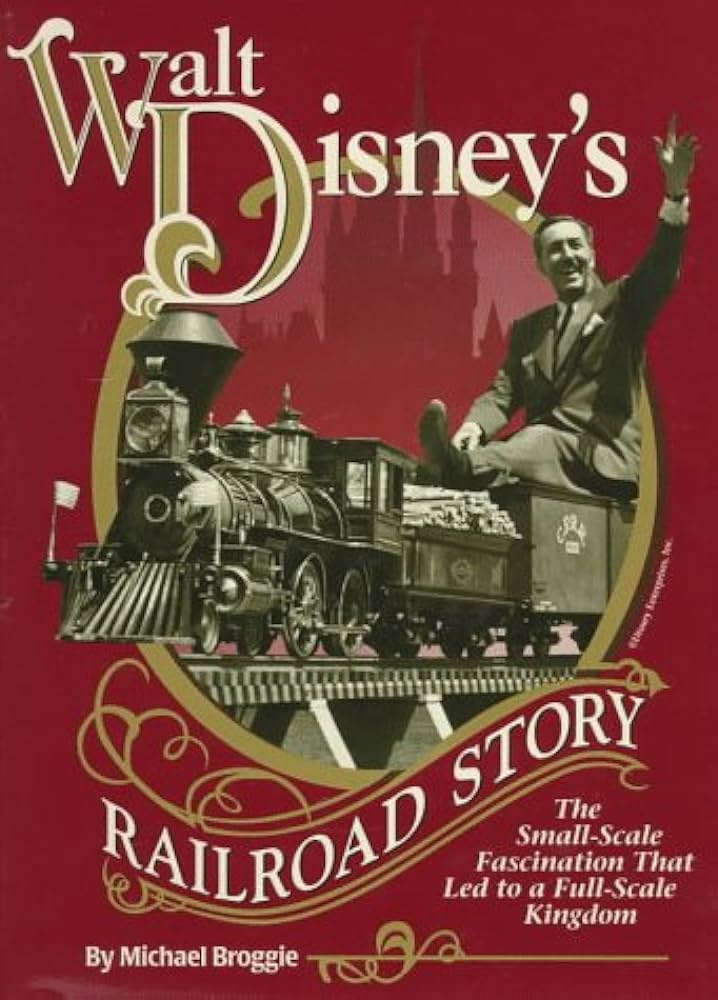
Those railroad stories could (and do) fill several books – the best of which is Walt Disney’s Railroad Story, by Michael Broggie.

It’s a fascinating book, and when the author knew of Walt Disney as “Uncle Walt,” and had the enviable role as a teenager to assist Walt in the operation of the Carolwood Pacific Railroad (Disney’s personal, rideable miniature railroad in the backyard of his home), you know the stories are going to be memorable, filled with detail, and a fascinating read.

You see, Michael Broggie’s father Roger E. Broggie was a precision machinist who joined the Disney Studios in 1939. Broggie’s accomplishments at the studio were wide-ranging, but in the early 1950s he was promoted to the head of the Disney Studios’ Machine Shop, where he became a transportation specialist. 

And where did he fine-tune the skills needed to create all the unique transportation vehicles found at Disneyland and later at Walt Disney World?

In building Walt Disney’s backyard railroad…

On the Carolwood Pacific Railroad.

The Carolwood Pacific Railroad (CPRR) was a 7 1/4-inch gauge ridable miniature railroad run by Walt Disney in the backyard of his home in the Holmby Hills neighborhood of Los Angeles, California. 

It featured the Lilly Belle, a 1:8-scale live steam locomotive named after Disney’s wife, Lillian Disney, and built by the Walt Disney Studios’ machine shop. The locomotive made its first test run on December 24, 1949. It pulled a set of freight cars, as well as a caboose that was almost entirely built by Disney himself. 

It was Disney’s lifelong fascination with trains, as well as his interest in miniature models, that led to the creation of the CPRR. The railroad, which became operational in 1950, was a half-mile long and encircled his house. The backyard railroad attracted visitors to Disney’s home; he invited them to ride and occasionally drive his miniature train.

With the creation of a personal railroad, Disney’s next step could only be designing and building the real thing.

Research into the earliest development of Disney’s “park” reveals a constant: the presence of a railroad with a steam engine pulling cars that people could ride in.

So, any visit to a Disney theme park for me must include a ride on the Disney Railroad.

Unfortunately, on my last visit to Walt Disney World on the occasion of its 50th anniversary on October 1, 2021, the railroad had been out of commission since 2018 for the pandemic-delayed construction of the TRON Lightcycle Run, a new attraction coming to the Magic Kingdom. The train tracks have been rerouted through the Lightcycle attraction inside a tunnel as shown in this concept art.

I knew any surprise announcement that the train would be running on October 1 was unlikely, but it wasn’t until I rode the People Mover early that morning and saw the view of the dismantled train tracks, plainly visible where they would run through the future Lightcycle Run attraction, that the disappointment set in.

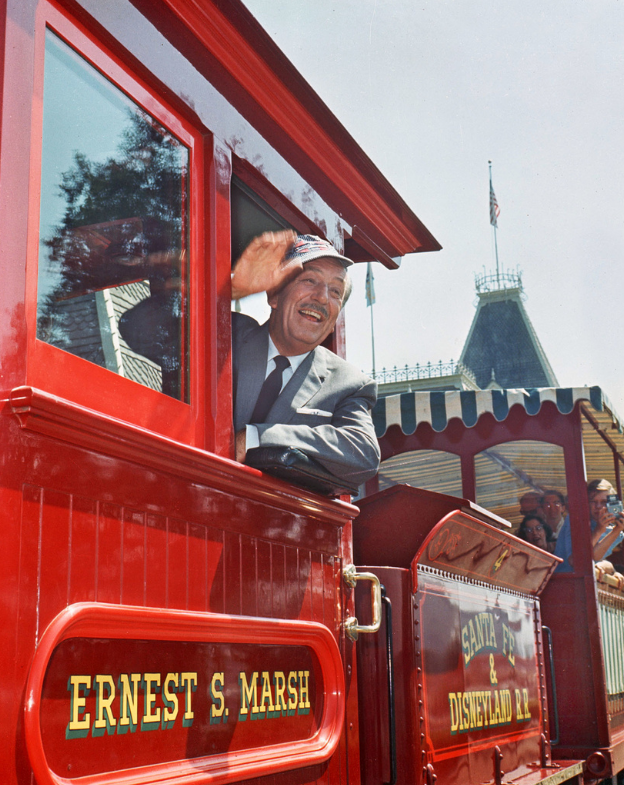
In the meantime, the train was available as the perfect backdrop for a memorable photo at different places in the park. Just before Christmas 2022, it began to run again.

For me, “the perfect backdrop” of a static display is a far cry from the swaying motion of the train as it leaves the station and begins to circle the park…

..the way Walt Disney dreamed about it from the time he was a young boy…

…until he made it happen.


It all begins with dreams.

Walt Disney

References

The Modern Elder’s Dilemma: Balancing Lifelong Learning and Mentoring the Next Generation

My journey to becoming a modern elder is a fascinating one, characterized by a profound commitment to both personal growth and guiding the generations that follow. There is a delicate balance between being a lifelong learner and a mentor – let’s shed some light on why this equilibrium is vital in today’s rapidly evolving world.

The Lifelong Learner’s Quest – and a Current Example

Imagine history as an endless library, with each book representing a treasure trove of knowledge. As someone with an insatiable curiosity, you’ve made it your mission to explore these volumes continuously. The principle of being a lifelong learner is rooted in the idea that the pursuit of knowledge knows no age limit. 

I’ve always been an avid reader, and my passion for history knows no bounds. It’s a passion that takes me on fascinating journeys through time. I’m on one such journey now: revisiting the history of the U.S. during the Gilded Age (1877-1900) – a period roughly sandwiched between the Reconstruction Era following the Civil War and the Progressive era (1896-1917) – a period of widespread social activism and political reform across the U.S. focused on defeating corruption, monopoly waste, and inefficiency. 

I am discovering that this time period serves as both a mirror and a cautionary tale for our contemporary society. As we confront modern economic disparities, we must draw upon the lessons of history. The echoes of the past remind us that the pursuit of wealth must be tempered with compassion and a commitment to the well-being of all. In the subsequent articles, we will delve deeper into the Gilded Age’s legacy, exploring how it reverberates in today’s world of technological advancement and economic complexity.

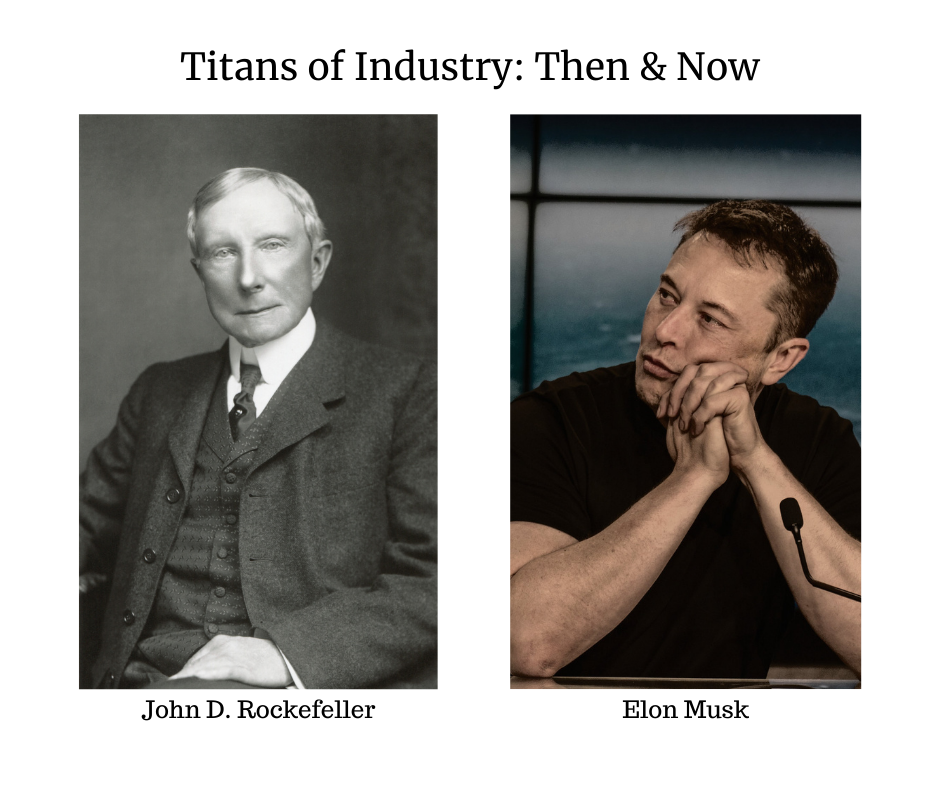
In the heart of this tumultuous era stood titans of industry like Andrew Carnegie, whose steel empire forged the very skeleton of the modern age, and John D. Rockefeller, whose Standard Oil Company oiled the wheels of progress. Their fortunes grew at a staggering pace, giving rise to the notion that the age was “gilded” in a veneer of gold.

Yet, as skyscrapers pierced the heavens and railroads stitched the nation together, countless workers toiled in oppressive conditions, their sweat and blood sustaining the grandeur above. They faced grueling hours, meager wages, and perilous workplaces. Their lives stood in stark contrast to the opulence of the industrial barons. Poverty festered in the shadows, casting a pall over the grandeur. The “gilded” surface of society hid the harsh reality of life for the many.

As we look back upon this tumultuous epoch, it’s essential to recognize the striking parallels that echo through the corridors of history and into our present day. Income inequality, which simmered beneath the surface in the Gilded Age, remains a pressing issue today. The struggle for workers’ rights and the fight against social injustices continue to shape our society, echoing the challenges of yesteryears.

The allure and paradox of the Gilded Age serve as a poignant reminder that, despite the passage of time, certain themes persist. The titans of industry today are in the information business, represented by Elon Musk. This period invites us to reflect on our own age – a time of remarkable technological advancements, where the glimmer of prosperity coexists with the shadows of inequality.

As a lifelong learner, I thrive on these sensory descriptions. They remind me that history is not just about facts and dates; it’s about stories and emotions. It’s about stepping into the shoes of those who came before us and understanding their world. The pursuit of knowledge keeps my mind sharp and open to new ideas.

Here are some key aspects of a lifelong learner to consider:

Embracing Change

Lifelong learning keeps your mind agile and adaptable. In a world where new technologies and ideas constantly emerge, being open to change is crucial.

Staying Relevant

By actively seeking new information and skills, you ensure that you remain relevant in your field and continue to contribute to your organization and society.

Personal Fulfillment

Learning is not just a means to an end but a source of personal fulfillment. It enriches your life, broadens your perspective, and keeps your passion for knowledge burning brightly.

Guiding the Next Generation

While your personal growth is paramount, you also recognize the importance of mentoring and investing in younger generations – while at the same time learning from them! This role as a guide carries immense responsibility and rewards:

Passing the Torch

By sharing your experiences, knowledge, and insights, you help prepare the next generation for the challenges they will face. You become a bridge between the past and the future.

Nurturing Talent

Guiding young individuals allows you to identify and nurture their talents, helping them unlock their full potential.

Legacy Building

Mentoring is a way to leave a lasting legacy. The impact you have on the lives of those you mentor can ripple through time, shaping the future in profound ways.

The Art of Balancing

Balancing lifelong learning with mentoring can be challenging, but it’s a dance worth mastering. Here’s how you can achieve this equilibrium:

Structured Learning

Allocate dedicated time for your own learning endeavors. Consider it an investment in your ability to mentor effectively.

Integration

Find ways to weave your newfound knowledge into your mentoring relationships. This integration makes your guidance more relevant and powerful.

Adaptive Mentorship

Recognize that the needs of the next generation are ever-evolving. Be willing to adapt your mentoring style and content to meet these changing needs.

The Ripple Effect

As a modern elder, the commitment to both learning and mentoring creates a positive ripple effect. I hope to inspire those around me to embrace lifelong learning as a path to personal growth. Simultaneously, I want to empower younger generations to navigate their journeys with wisdom and confidence. Along that journey, I plan to learn from them.

The modern elder’s journey is a testament to the beauty of balance. By relentlessly pursuing knowledge while guiding the next generation, I don’t want to be just an individual; I want to be a beacon of inspiration and wisdom. This delicate dance between personal growth and mentorship can result in the crucial role in shaping a brighter, more informed, and empowered future for all.


Embracing Yesterday to Shape Tomorrow: The Importance of Studying History

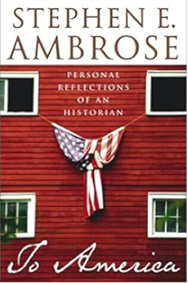
It is through history that we learn who we are and how we got that way, why and how we changed, why the good sometimes prevailed and sometimes did not.

Stephen Ambrose, “To America”

Usually the word “history” elicits one of two responses: a glassy-eyed stare and memories of those required classes in school that were mind-numbing, or an excited look followed by the phrase “Did you know that…”

I, proudly, am guilty of the latter.

Not content to read and study “normal” history (both my undergraduate and graduate minors are in history), I also default to the obscure and strange. Who else would read books on the history of salt – or the history of dust – or the history of cod. Yes, cod. The little fish, that when salted, kept it edible for long sea voyages, allowing the “discovery” of the Americas by Europeans, among other uses (that’s a two-for-one use of history, in case you didn’t notice).

Leaders need to understand history, too.

In the bustling world of today, where we are constantly moving forward, it’s easy to overlook the treasure trove that lies behind us – our history. As a modern elder with a passion for learning and an insatiable curiosity, I firmly believe that history is not a dry, irrelevant subject but a vibrant tapestry of human experiences waiting to be explored. A journey through time into the immersive world of history AND understanding how it is crucial for our personal growth, societal development, and the generations that follow.

A Symphony of Senses

Say you wanted to learn about how bakers sold bread in the early development of the bakery as we know it today. You could discover the “facts” about it… But imagine standing on the cobbled streets of a medieval town, the scent of freshly baked bread wafting from the nearby bakery. The clatter of horse-drawn carriages and the chatter of townsfolk fill the air. This bakery did more than sold bread – it was the earliest “community center” in the town. This sensory immersion is what history can provide. It allows us to step into the shoes of our ancestors, experiencing their world through vivid descriptions and narratives. By understanding history, we awaken our senses to a world long gone, enriching our own lives in the process.

Emotional Time Travel

History is not just a collection of dates and events; it’s a window into the human experience. It lets us feel the triumphs and tribulations, the joys and sorrows of those who came before us. When we learn about the struggles of past generations, we gain perspective on our own challenges. It fosters empathy, connecting us on a deep emotional level with people who lived in vastly different times and circumstances.

Learning from Mistakes

One of the most valuable lessons history teaches us is that mistakes are part of the human experience. History is replete with errors in judgment and their consequences. As a modern elder, I understand the importance of learning from these mistakes. By studying history, we can avoid repeating the blunders of the past and pave the way for a brighter future.

Continuing to Learn While Guiding the Next Generation

My mission as a modern elder is to invest in other leaders, especially those younger than me, while at the same time continuing, even accelerating, my lifelong learning journey. I’ll be speaking more to this paradox in the next post. Understanding history equips us with the knowledge and wisdom to mentor and guide others. When we share the lessons of history with them, we empower them to make informed decisions and shape a better world.

The Power of Contrarian Ideas

History is a playground of diverse ideas, where conventional wisdom often gets challenged. As someone who values contrarian ideas, I appreciate the wealth of innovation and progress that emerges from questioning the status quo. History is a testament to the power of thinking differently and challenging established norms.

Embracing Technology

In today’s fast-paced world, technology plays a vital role in preserving and sharing history. Digital archives, virtual reality experiences, and interactive websites transport us back in time like never before. Embracing these technologies allows us to make history even more accessible and engaging for future generations.

Only by understanding the past can you ever hope to lead to the future.

History is a rock. Not an anchor to the past, but a bridge to the future.

In the journey of life, history is our compass, guiding us through the vast sea of human experiences. It engages our senses, deepens our emotions, and teaches us invaluable lessons. I implore you to embrace the beauty of history, for it is not a relic of the past but a beacon for the future. Let us pass down the torch of knowledge and understanding to the generations that follow, ensuring that the tapestry of history continues to enrich our lives. Together, we can unlock the boundless treasures of our past.


As a modern elder with an insatiable curiosity and a passion for history, I’ve had the pleasure of delving into countless books that illuminate the tapestry of our past. Among these volumes, To America by Stephen E. Ambrose is a very personal look at our nation’s history through the eyes of one of the twentieth century’s most influential historians. Here are some insights into this recommended work, highlighting its significance and the enduring lessons it imparts.

The Essence of To America

Stephen E. Ambrose, who was known for his narratives of American history, once again demonstrates this mastery in To America. This book serves as a testament to the author’s deep reverence for the United States and its rich history. Ambrose’s writing resonates with a sense of awe and admiration for the nation’s journey from its inception to modern times.

Historical Perspective

Ambrose’s storytelling prowess shines brightly as he takes readers on a chronological journey through pivotal moments in American history. His vivid descriptions and diligent research breathe life into the past, making history feel tangible. As a student of history, I appreciate his commitment to accuracy and detail, which brings authenticity to each page.

Themes of Resilience and Triumph

Throughout To America, Ambrose underscores the resilience of the American spirit. He skillfully narrates tales of triumph over adversity, from the struggles of the early colonists to the challenges faced by the nation during its formative years. Ambrose’s portrayal of historical figures and events is both insightful and inspiring, reminding readers of the enduring values that have shaped America.

Character Portraits

One of the book’s strengths is Ambrose’s ability to paint vivid portraits of key figures in American history. From George Washington’s steadfast leadership to the audacity of the Wright brothers, each character comes to life with their unique attributes and contributions to the American story. My personal favorite was his section on Theodore Roosevelt, one of America’s greatest presidents (and one whom I will be writing about in the future). Ambrose’s portrayal of these individuals humanizes history, making it relatable to readers of all backgrounds.

Relevance to Modern Times

As a modern elder, I believe that understanding history is essential for navigating the complexities of today’s world. Ambrose’s To America not only provides historical insights but also offers a lens through which we can better comprehend contemporary challenges and triumphs. It encourages readers to reflect on how the past continues to shape our present.

Conclusion

In To America, Stephen E. Ambrose weaves a masterful tapestry of American history that resonates deeply with those who, like me, are passionate about the past. This book is a testament to the enduring spirit of a nation built on resilience, innovation, and the pursuit of freedom. Ambrose’s meticulous research, evocative storytelling, and reverence for history make To America an essential read for anyone seeking a richer understanding of the United States and its remarkable journey.


Part of a regular series on 27gen, entitled Wednesday Weekly Reader

During my elementary school years one of the things I looked forward to the most was the delivery of “My Weekly Reader,” a weekly educational magazine designed for children and containing news-based, current events.

It became a regular part of my love for reading, and helped develop my curiosity about the world around us.


Lead a Church that Knows, and Loves, Its Neighbors

Let’s play a word game – read the word at the end of this sentence, then jot down the first three things that come to your mind in the space below: Neighbor.

What was on your list? Was it Mr. Rogers, or the latest mobile game “Hello Neighbor,” or maybe a generic group of people?

What about a specific person or family? Someone whom you know more than just a first name – someone whom you have established some sort of relationship that goes beyond the surface.

“Neighbor” is one of those words that can encompass dozens of meanings, good and bad experiences, and warm memories or frightful nightmares.

Neighbor certainly has connotations beyond someone who lives near or next door to you – and rightfully so. But let’s start there – the person who lives in close proximity to you.

Do you understand who your neighbor is? Even better are you leading a church full of people who understand who their neighbors are?

This SUMS Remix will help you answer these two vital questions, for the health of your church, and your ministry. The solutions include: 


The Condiment Conundrum: Finding the Perfect Toppings to Elevate Your Burger Experience

In the grand gastronomic symphony that is the hamburger, the role of condiments is nothing short of a crescendo. These seemingly humble additions have the power to transform a mere patty and bun into a sensory masterpiece. Whether you are a burger connoisseur or just love reading about them, it’s time to delve into the condiment conundrum, unraveling the art and science of finding the perfect toppings that take your hamburger experience to unprecedented heights.

The Symphony of Flavor Enhancement

Condiments are the conductor’s baton in the burger orchestra, enhancing flavors with every brushstroke. From the zing of ketchup to the creamy elegance of mayo, each condiment plays a unique note, harmonizing with the meat’s taste and texture. They’re not mere accompaniments; they’re the catalysts that awaken dormant taste buds and elevate the burger from a meal to a multi-sensory experience.

Unleashing Creativity: Innovative Topping Combinations

Imagine the burger as a blank canvas, awaiting a creative touch to bring it to life. This is where innovative topping combinations emerge as the artist’s palette. From the tangy intrigue of pickled red onions to the smoky allure of chipotle aioli, the possibilities are as boundless as imagination itself. Culinary trailblazers are known to fuse ingredients like fig jam, blue cheese, and arugula to create a symphony of sweet, salty, and peppery notes – all in a single bite.

The Balancing Act: A Dance of Flavors

The artistry of burger toppings lies in their ability to strike the perfect balance of flavors. Each element should complement the others, creating a harmonious medley rather than a cacophony. It’s the marriage of opposing forces – the richness of a fried egg offsetting the acidity of a tomato slice, the crunch of lettuce contrasting the tender juiciness of the patty. The condiments’ role isn’t just to shine on their own but to collaborate, ensuring that each bite is a harmonious journey through taste dimensions.

In the culinary world of hamburgers, every element, from the bun to the patty, plays a vital role in crafting the perfect burger. Yet, it’s the toppings that often steal the show, adding layers of flavor, texture, and complexity to this beloved American classic. In our exploration of the condiment conundrum, let’s dive into the art and science of finding the perfect toppings that take your hamburger experience to unprecedented heights. Here are the condiment basics:

Cheese: The Creamy Embrace

Let’s begin with cheese – the crown jewel of burger toppings. Whether it’s the creamy melt of American cheese, the sharp bite of cheddar, or the luxurious indulgence of brie, cheese adds a rich and savory dimension to your burger. It provides a silky texture as it melds with the patty’s heat, creating a luscious contrast to the meat’s juiciness. The condiment connoisseur knows that cheese isn’t just an optional extra; it’s a fundamental component of a truly outstanding burger.

Bacon: The Smoky Savior

Bacon, with its tantalizing smokiness and crispy texture, is a quintessential burger topping. It’s the culinary phoenix that rises above mere condiment status, adding a layer of umami richness that harmonizes with the meat’s flavors. Whether it’s woven into a lattice or stacked in generous strips, bacon provides a smoky, salty contrast that elevates the entire burger experience.

Lettuce and Tomatoes: The Fresh Crispness

Lettuce and tomatoes bring a refreshing crunch and a burst of freshness to each bite. The cool, crisp lettuce leaves provide a textural contrast to the warm, juicy patty, while the vibrant, ripe tomato slices introduce a hint of acidity that cuts through the burger’s richness. Together, they create a symphony of sensations, ensuring that every mouthful is a harmonious blend of flavors and textures.

Onion: The Allium Alchemy

Onions, whether caramelized, raw, or pickled, add a touch of allium magic to your burger. Caramelized onions bring sweetness and depth, creating a luxurious and savory profile. Raw onions offer a sharp, zesty bite that awakens the palate. Pickled onions introduce a tangy twist, balancing the burger’s flavors with their briny notes. In any form, onions are a condiment conundrum essential, enhancing the overall taste experience.

Pickles: The Tangy Counterpoint

Pickles, with their bracing acidity and satisfying crunch, are the unsung heroes of burger toppings. They provide a burst of contrasting flavor that cuts through the burger’s richness, revitalizing the palate with their tanginess. Whether they’re dill or bread-and-butter, pickles add a zesty counterpoint that elevates every bite.

Ketchup and Mustard: The Classic Duo

Ketchup and mustard are the classic condiments that have stood the test of time. Ketchup, with its sweet and slightly tangy profile, adds a luscious, tomatoey richness. Mustard, on the other hand, introduces a sharp, zesty kick that complements the burger’s flavors. Together, they form a timeless duo that evokes a sense of nostalgia and familiarity, reminding us of the classic American burger experience.

Other Burger Condiments: A World of Possibilities

Beyond the classic toppings above, the world of burger condiments is vast and diverse. These days, the proliferation of options has taken the burger into wild and exciting new areas and flavor combinations. Along with the mainstays listed above, here are just a few other popular condiments that can elevate your burger game:

  • Mayonnaise: Creamy and indulgent, mayonnaise adds a silky texture and a subtle richness to your burger.
  • Sauces: Explore a world of sauces, from barbecue and aioli to tzatziki and sriracha, each offering its unique flavor profile.
  • Hot Peppers: Whether it’s jalapeños, banana peppers, or pepperoncini, hot peppers provide a spicy kick that can electrify your burger.
  • Avocado: Creamy, buttery avocado slices bring a dose of healthy freshness to your burger.
  • Barbecue Sauce: Sweet and smoky barbecue sauce can transform a burger into a barbecue-inspired delight.
  • Sriracha: For those who love heat, sriracha provides a spicy and garlicky kick to burgers.
  • Aioli: This garlic-infused mayonnaise-based sauce adds a gourmet touch with its creamy and aromatic profile.
  • Salsa: Salsa, whether mild or hot, adds a burst of flavor and a touch of Mexican flair to burgers.

These condiments can be mixed and matched to create a wide range of burger experiences, from classic and simple to gourmet and adventurous. The choice of condiments allows for a highly customizable culinary journey, making burgers a versatile and beloved meal choice.

Customization: Crafting Your Culinary Tale

One of the greatest pleasures of burger creation is the act of customization. Much like an author weaving characters into a narrative, burger enthusiasts craft their own culinary tales through condiment choices. A dollop of tangy barbecue sauce transforms the burger into a rustic barbecue feast, while a smattering of sautéed mushrooms and Swiss cheese conjures images of Alpine landscapes. Customization allows you to narrate your burger story, expressing your tastes, moods, and cravings.

In the condiment conundrum, there’s no one-size-fits-all solution. It’s a dynamic interplay of personal preferences, flavor profiles, and the adventurous spirit of culinary exploration. As you stand before the canvas of your burger, consider each condiment as a brushstroke – a deliberate choice that adds depth, character, and layers of taste. So, whether you opt for a classic ensemble or venture into avant-garde territory, remember that the condiments are your culinary companions, transforming each bite into a harmonious, flavorful adventure.


Still hungry?

The Whataburger Story: A Tale of Flavor and Family

From Drive-Thru to Cultural Icon: The Story Behind In-N-Out Burger

Burgerology: The Art and Science of the Perfect Patty

Flipping History: How McDonald’s Shaped the Hamburger’s Popularity

Indulging in Burger Bliss: A Quest for Culinary Perfection

White Castle: The Trailblazing Pioneer of Fast Food

Bite Into Tradition: The Best Loved Regional Burger Chains in the Country

Burger Beast Unleashed: The Ultimate Tribute to Burgers in Sef Gonzalez’ Book

Sink Your Teeth into “The Hamburger”: A Culinary Journey by Josh Ozersky

Burger Magic: Exploring the Universal Fascination Behind America’s Favorite Dish

My Quest for the Perfect Hamburger: A Literary, Culinary, and Arbitrary Journey in Pursuit of America’s Iconic Delight

A Tantalizing Top of the Stack, Made to Order

Before Burger Quest


The Whataburger Story: A Tale of Flavor and Family

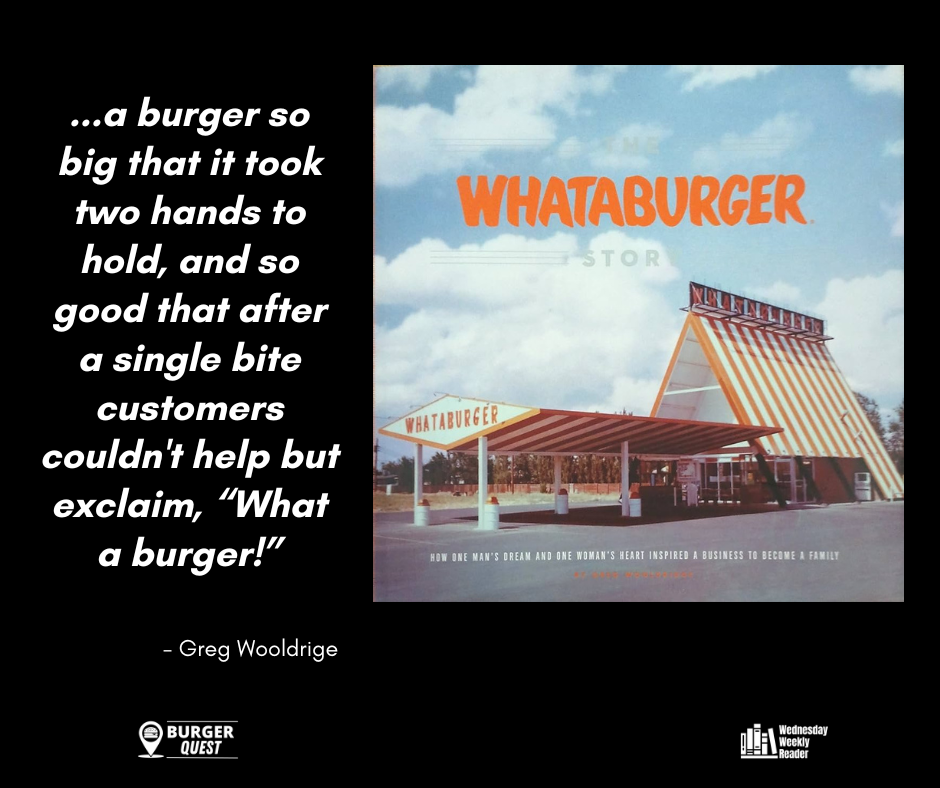
In 1950, an adventurous and determined entrepreneur named Harmon Dobson had a bold idea: to serve a burger so big that it took two hands to hold, and so good that after a single bite customers couldn’t help but exclaim, “What a burger!” He named his humble burger stand, located on Ayers Street in Corpus Christi, Texas, “Whataburger.”

The golden age of drive-ins and American automobiles was just getting started back on August 8, 1950, when Harmon Dobson opened Whataburger #1. This tiny burger stand offered something people had never seen: a burger that was so big, they had to hold its five-inch bun with two hands. It was an instant success, and Harmon began to expand the business to other markets. In 1955, Harmon married Grace Williamson and became Whataburger’s “First Couple.” Together, they raised three children: Hugh, Lynne and Tom. By the end of the decade, Harmon would open Whataburger #21 in Pensacola, Florida. It was the first Whataburger restaurant outside the state of Texas.

During the next 50+ years, over 800 Whataburger restaurants were opened, spanning every state from Arizona to Florida, but the most by far in it’s home state of Texas. Ask any Texan – born or transplanted – and they will all have a Whataburger story, recalled with fondness and good enough to make your mouth water.

The Whataburger Story by Greg Wooldridge is a gastronomic adventure that chronicles the journey of a beloved Texas-based fast-food chain that transcended regional boundaries to become a national icon. The book takes readers on a savory exploration, delving into the origins, growth, and enduring success of Whataburger. Wooldridge intertwines the story of this iconic burger joint with the family values and entrepreneurial spirit that shaped its foundation.

The narrative opens with a vivid glimpse into the early days of Whataburger, where the aroma of freshly grilled beef patties permeated the air. Readers are transported to the small, humble Corpus Christi location, where Harmon Dobson’s vision came to life. With colorful anecdotes and historic photographs, Wooldridge paints a portrait of a man with a passion for burgers and an unwavering commitment to quality.

As the book unfolds, readers witness the expansion of Whataburger’s distinctive orange and white-striped A-frame buildings, which became synonymous with the brand. The story unfolds like a well-seasoned recipe, blending entrepreneurial perseverance, community engagement, and a dash of Texan hospitality that sets Whataburger apart.

The Whataburger Story is a delightful journey through time and taste, a must-read for fans of good food and American entrepreneurship. Greg Wooldridge brings to life the legacy of Harmon Dobson and the enduring success of Whataburger with a captivating narrative that leaves readers craving not just the famous burgers but also the heartwarming culture that the brand embodies.

Wooldridge’s storytelling is akin to the sizzle of a Whataburger patty on the grill, evoking the essence of a bustling 1950s diner. The narrative seamlessly weaves together the history, the people, and the flavors that have made Whataburger an integral part of American fast-food culture.

One of the book’s triumphs is its ability to delve beyond the burger and give readers a glimpse into the values that have driven Whataburger’s growth. The focus on family, community involvement, and employee care adds layers of depth to the story, making “The Whataburger Story” not just a culinary history but a heartwarming tale of the American dream.

Wooldridge captures the essence of Whataburger’s appeal, from its distinctive architecture to its timeless menu offerings. The narrative invites readers to taste the love and care that has gone into every Whataburger creation, leaving a lingering aroma of nostalgia and Texas pride.

In conclusion, The Whataburger Story is a literary feast that serves up a generous helping of history, culture, and delectable burgers. For anyone with a fondness for Whataburger or a craving for a well-told entrepreneurial tale, this book is a fulfilling treat. It’s a reminder that behind every iconic fast-food brand is a story, and in Whataburger’s case, it’s a story seasoned to perfection with the flavors of family, perseverance, and great taste.


Still hungry?

Bun Brilliance: Unveiling the Essence of the Ultimate Burger Bun

From Drive-Thru to Cultural Icon: The Story Behind In-N-Out Burger

Burgerology: The Art and Science of the Perfect Patty

Flipping History: How McDonald’s Shaped the Hamburger’s Popularity

Indulging in Burger Bliss: A Quest for Culinary Perfection

White Castle: The Trailblazing Pioneer of Fast Food

Bite Into Tradition: The Best Loved Regional Burger Chains in the Country

Burger Beast Unleashed: The Ultimate Tribute to Burgers in Sef Gonzalez’ Book

Sink Your Teeth into “The Hamburger”: A Culinary Journey by Josh Ozersky

Burger Magic: Exploring the Universal Fascination Behind America’s Favorite Dish

My Quest for the Perfect Hamburger: A Literary, Culinary, and Arbitrary Journey in Pursuit of America’s Iconic Delight

A Tantalizing Top of the Stack, Made to Order

Before Burger Quest


5 Everyday Ways to Love Your Neighbor and Change the World

What would you call someone who listens without judgment, offers you wise counsel but helps you make your own decision, and loves you no matter what?

That’s a friend!

Jesus had a nickname given to him by the religious leaders of His day – Friend of Sinners (Matthew 11:16-19).

Jesus’ simple strategy to reach the world was friendship and blessing.

There is no better model for what it looks like to “go and bless” than Jesus. His entire life was a blessing. The Gospels give us numerous examples of how Jesus blessed the people He encountered.

Dave Ferguson and Jon Ferguson

B.L.E.S.S. authors Dave Ferguson and Jon Ferguson made a list of all the ways Jesus practiced being a blessing to people, and narrowed it down to the top five. The resulting B.L.E.S.S. practices are five everyday ways that Jesus loved his neighbors.

B: Begin with prayer

When Jesus started His earthly mission, Luke 6 tells us that He went out on a mountain and prayed. Prayer is both how you discover your mission and how you live out your mission.

L: Listen

Asking questions and then listening was central to Jesus’ life and teachings. Any relationship starts with listening to someone’s words and life. True listening may be the kindest and most loving gift you can give someone.

E: Eat

Jesus liked to eat! Over and over, as in Matthew 9, we find Jesus with tax collectors and sinners…doing what? Eating! There is something about sharing a meal together that moves any relationship past acquaintance toward friendship.

S: Serve

Jesus told us straight up, “The Son of Man did not come to be served, but to serve…” (Matthew 20:28). He modeled for us that once you begin with prayer, listen, and eat with someone, there is a good chance that you’ll discover how you can best serve the person God is asking you to bless.

S: Story

When people were ready to listen, Jesus would share his story, as in John 14 with Thomas. When you befriend and bless people, they feel relationally safe and want to know your story. Then, and only then, can you tell them how the love of God and Jesus’ life, death, and resurrection have changed you.

Using the brief descriptions above, and downloading the PDF tool below, write out practices in each of the five B.L.E.S.S. categories.

How will you use one of these practices each day?

Remember, though: B.L.E.S.S. is not a checklist.

Many well-intentioned people have taken these missional rhythms and turned them into a set of linear steps to be performed one at a time. The B.L.E.S.S. practices are NOT a checklist or another church program you graduate from. They are simple, everyday ways to bless the people around you. Never focus more on the practices than on the people you are seeking to bless!


inspired by B.L.E.S.S. by Dave Ferguson and Jon Ferguson

Winning with Insight: Game Film’s Dual Impact on Sports and Organizational Excellence

When the calendar rolls around to September, it means cool weather is not far behind, school has started, pumpkin spice is everywhere, and football – at the high school, college, and professional levels – takes center stage in the world of athletics.

Being a small “f” fan of pro football, my wife and I recently spent some time watching “Quarterback,” the Netflix series documenting the 2022 seasons of pro football quarterbacks Marcus Mariota, Kirk Cousins, and Patrick Mahomes. It was fascinating to watch on many levels, showing glimpses of both the personal and private lives of the three as well as their professional side

What I found most fascinating was the quarterback’s attention to the art and science of watching “film” of both their own performances and those of upcoming opponents. I use “film” as most players and coaches still call it film (from the days when it really was film in a projector) though today it is all video-based.

In the realm of professional sports, victory isn’t just a result of brute strength or natural talent. It’s a product of meticulous preparation, strategic analysis, and continuous adaptation. At the heart of this winning formula lies the practice of game film analysis. By studying past games, athletes and coaches dissect every play, every movement, and every decision to gain a competitive edge. Remarkably, these principles extend beyond the confines of the sports arena and offer invaluable insights for organizations striving for success in the business world.

Game Film in Professional Sports: A Deeper Dive

Breaking Down Game Footage

Game film analysis isn’t a casual viewing of highlights; it’s a comprehensive study of every nuance that unfolds on the field. Coaches and players immerse themselves in the footage, dissecting player positioning, execution of plays, and opponents’ strategies. Just as a chess player analyzes each move to anticipate their opponent’s next steps, teams scrutinize game film to uncover patterns and vulnerabilities.

This process mirrors the world of business, where keen observation is pivotal. Organizations must carefully dissect their operations, team dynamics, and market trends to identify strengths, weaknesses, and opportunities. Just as a coach studies an opponent’s tactics, businesses need to analyze their competitors’ moves to stay ahead.

Strategy Development and Adaptation

Game film isn’t just about looking backward; it’s about using insights to forge ahead strategically. Coaches derive game plans from their analysis, exploiting opponents’ weaknesses and capitalizing on their own strengths. Similarly, halftime adjustments are informed by a thorough review of the first half’s game film, allowing teams to adapt and recalibrate.

In the corporate realm, strategic decision-making is equally crucial. Organizations can develop strategies based on data-driven insights, aligning them with market trends and staying ahead of the curve. The agility to adapt strategies in real-time, as exemplified by halftime adjustments in sports, is essential for businesses facing a dynamic landscape.

Leveraging Advanced Analytics

Modern sports have embraced advanced analytics, ushering in a new era of understanding player performance and team dynamics. Metrics like player tracking data provide granular insights that shape coaching strategies. Similarly, organizations can harness the power of AI, big data, and performance analytics to make informed decisions and gain a competitive edge.

Translating Game Film Principles to Organizational Success

Observation and Analysis in Business

Just as coaches dissect game footage, organizations must keenly observe their internal processes and external environment. Identifying patterns, strengths, and weaknesses allows for more targeted strategies and effective decision-making.

Strategic Decision-Making

The correlation between game plans in sports and business strategies is undeniable. Data-driven decisions, informed by careful analysis, are the cornerstone of success. Adapting strategies based on real-time insights, as done in sports during halftime, is paramount in the corporate world.

Technology’s Role in Organizational Analysis

The integration of technology and data analytics has revolutionized sports, providing insights that were once unimaginable. In the same vein, businesses can leverage AI, big data, and advanced analytics to gain deeper insights into their operations, customers, and market trends.

Fostering a Culture of Continuous Improvement

Sports teams embrace the concept of continuous improvement, learning from both victories and losses. This approach is equally vital in business, where organizations must embrace feedback, learn from setbacks, and cultivate a culture that thrives on growth.

Winning Beyond the Scoreboard

Game film analysis is more than a practice; it’s a mindset that leads to victory. The principles of dissecting game footage, developing strategies, leveraging technology, and fostering a culture of improvement are transferable to organizations seeking success. As businesses adopt the “game film” approach, they can unlock the potential to observe, strategize, adapt, and learn – propelling themselves toward victory on and off the field.


Watching the pros watching game film reminded me of a great article by Dan and Chip Heath (authors of Made to Stick, Switch, and Decisive). Published in Fast Company magazine, it’s entitled “Watch the Game Film.” You really need to check out the whole article, but here’s a quick summary:

  • Football coaches use game film to spot things they’d never see in real time. They have an entire week to review a 60-minute game.
  • In the business world, every day is game day, and leaders don’t take the time to “study the film” of their activities. It’s unfortunate, because studying game film can yield unexpected results.
  • Doug Lemov, a consultant to school districts, utilized film of top-tier teachers in the classroom to train other teachers – resulting in raising students a grade level and a half in one year.
  • It doesn’t have to be film – Jump Associates, a strategy consulting firm, uses trained observers to record client meetings. After the meeting, the Jump staff holds a debriefing, modeled on the Army’s after-action reviews.

In the grand theater of football, game film isn’t just about reliving past moments; it’s a strategic treasure trove. The principles of observation, analysis, adaptation, and technology utilization that are at play in dissecting game film can be seamlessly applied to organizational consulting. The organizational consultant, akin to a coach, guides teams towards excellence by leveraging insights and strategies gleaned from the “game film” of business operations.

Just as a football team’s commitment to reviewing game film elevates their performance, organizations that integrate these principles into their approach can unlock the strategic power needed for sustained success. By embracing the wisdom of the gridiron, the path to peak organizational performance becomes clearer and more achievable than ever before.

What insights might your team be overlooking because no one is observing carefully enough?

Maybe it’s time to press the PAUSE button and start screening some game film.

There are some things you’ll never see unless you look.