Innovation’s Seven Deadly Sins

Innovation – something different that has impact – is both more important and more accessible than ever before

          Scott D. Anthony, The Little Black Book of Innovation

Something different that has impact.

This simple definition of innovation by author Scott Anthony belies the deep and resonating ideas in The Little Black Book of Innovation. From this simple definition, Anthony breaks down the essential differences between various types of innovation and illuminates its vital role in organizational success and personal growth.

What better way to introduce the topic to ChurchWorld leaders than start off with a list of Innovation’s Seven Deadly Sins:

  • Pride – forcing your view of quality onto your audience; often results in overshooting
  • Sloth – having innovation efforts slow to a crawl
  • Gluttony – suffering from the curse of abundance; leads to overly lows, overly linear innovation efforts
  • Lust – getting distracted by pursuing too many “Bright, shiny objects”
  • Envy – creating an us-versus-them relationship between the core and new growth efforts
  • Wrath – punishing risk takers severely
  • Greed – impatience for growth; leads to prioritizing low-potential markets

Tomorrow: How to Avoid the Seven Deadly Sins

What Color is Your Pen?

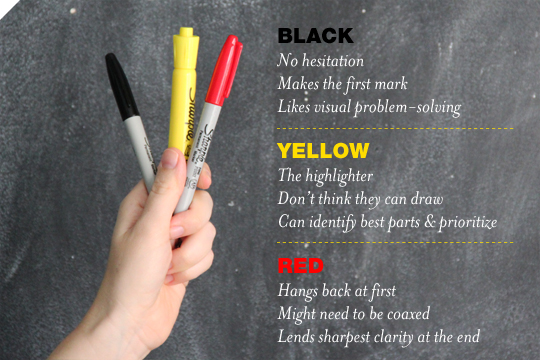
According to author Dan Roam (The Napkin Academy) there are three kinds of visual thinkers:

  • people who can’t wait to start drawing (the Black Pen people)
  • those who are happy to add to someone else’s work (the Yellow Pen people)
  • those who question it all – right up to the moment they pick up the Red Pen and redraw it all.

Which are you?

Hand me the pen! Black pen people show no hesitation in putting the first marks on an empty page. They come across as immediate believers in the power of pictures as a problem-solving tool, and have little concern about their drawing skills – regardless of how primitive their illustrations may turn out to be. They jump at the chance to approach the whiteboard and draw images to describe what they’re thinking. They enjoy visual metaphors and analogies for their ideas, and show great confidence in drawing simple images, both to summarize their ideas and then help work through those ideas.

I can’t draw, but… Yellow Pen people (or highlighters) are often very good at identifying the most important or interesting aspects of what someone else has drawn. These are the people who are happy to watch someone else working at the whiteboard – and after a few minutes will begin to make insightful comments – but who need to be gently prodded to stand and approach the board in order to add to it. Once at the board and with pen tentatively in hand, they always begin by saying “I can’t draw, but…” and then proceed to create conceptual masterworks. These people tend to be more verbal, usually incorporate more words and labels into their sketches, and are more likely to make comparisons to ideas that require supporting verbal descriptions.

I’m not visual Red Pen people are those least comfortable with the use of pictures in a problem-solving context – at least at first. They tend to be quiet while others are sketching away, and when they can be coaxed to comment, most often initially suggest a minor corrections of something already there. Quite often, the Red Pens have the most detailed grasp of the problem at hand – they just need to be coaxed into sharing it. When many images and ideas have been captured on the whiteboard, the Red Pen people will finally take a deep breath, reluctantly pick up the pen, and move to the board – where they redraw everything, often coming up with the clearest picture of them all.

Roam’s conclusion of these different types of people?

Regardless of visual thinking confidence or pen-color preference, everybody already has good visual thinking skills, and everybody can easily improve those skills. Visual thinking is an extraordinarily powerful way to solve problems, and though it may appear to be something new, the fact is that we already know how to do it.

What color is your pen?

There’s Nothing Wrong with Words…

…what’s wrong is that they’re not enough.

I’m currently enrolled in, and taking online, The Napkin Academy from visual communicator Dan Roam.

Why?

  1. There is no more powerful way to discover a new idea than to draw a simple picture
  2. There is no faster way to develop and test an idea than to draw a simple picture
  3. There is no more effective way to share an idea with other people than to draw a simple picture

In a typical organization – including ChurchWorld – there is a whole gang of smart people so overwhelmed by verbal data that they’re hard pressed to know what to pay attention to.

The words and data are overwhelming.

That’s where pictures come in. Whether drawing them, looking at them, or talking about them, pictures add enormously to our ability to think, to remember, and most importantly, to do.

I’m really benefitting from being a part of The Napkin Academy – and you can too.

It’s time to put down the mouse and pick up a pen…

Your Visual Thinking Toolkit

Any problem can be made clearer with a picture, and any picture can be made using the same simple set of tools and rules.

–       Dan Roam, The Back of the Napkin

Author, consultant, and visual thinker Dan Roam (The Back of the Napkin, Unfolding the Napkin, and Blah, Blah, Blah) argues that everyone is born with a talent for visual thinking, even those who swear they can’t draw.

Here are the main concepts as covered in his first book The Back of the Napkin and expanded on in the next two books. Using these simply powerful tools, he shows anyone how to clarify a problem or sell an idea by visually breaking it down using a simple set of visual thinking tools.

3 Basic Visual Thinking Tools

  • Our eyes
  • Our mind’s eye
  • Our hand-eye coordination

4 Steps of the Visual Thinking Process

  • Look
  • See
  • Imagine
  • Show

5 Questions to Help Open Your Mind’s Eye

  • Simple or Elaborate
  • Qualitative or quantitative
  • Vision or execution
  • Individual or comparison
  • Change or status quo

6 Ways We See and Show

  • Who/what – portrait
  • How much – chart
  • Where – map
  • When – timeline
  • How – flowchart
  • Why – plot

The Back of the Napkin proves that thinking with pictures can help you discover and develop new ideas, solve problems in unexpected ways, and dramatically improve your ability to share your insights. You will literally begin to see the world in a new way. Ven though the book has been available for several years, if you haven’t got one I encourage you to pick up a copy as soon as possible to fully understand, and implement, these powerful communication tools.

These tools have a new meaning to me as Vision Room Curator at Auxano. To help me better prepare for my new role, I’m starting school today: Dan Roam’s Napkin Academy, the first online school for visual thinking. I’ll be posting more about it later this week.

You should pick up a pen and join me!

Leadership = Vision Clarity

When I was in graduate school in the early 80’s, strategic planning processes included five-, ten- and sometimes even twenty-year plans. The past was relatively stable and indicated that things would continue as they were into the future. The assumption was that the near future would resemble the recent past. Rapid cultural, technological, and geopolitical change has rendered that assumption obsolete.

Will Mancini, founder of Auxano and author of the best-selling book Church Unique states it this way:

Leaders must focus more on preparation than on planning.

Mancini taps heavily into Reggie McNeal’s work here. McNeal, a consultant with The Leadership Network, has written several great books. In The Present Future he addresses 6 tough questions for the church. The one of interest here is “How do we plan for the future?” The short answer is, as both Mancini and McNeal elaborate, you don’t plan – you prepare.

Planning on past actions and assumptions will lead you to cultural irrelevance, methodological obsolescence, and missional ineffectiveness. Churches looking to planning like they always have will be left answering the wrong questions at best; at worst, they will be answering questions not asked!

Church Unique is not a road map that assumes predictability of fixed points and roads that stay unchanged over time. Instead, the tools of Church Unique are more like the compass, sextant, and chronometer of the sailor who moves across an ever-changing sea. Navigating the waters of today’s rapidly changing times requires ceaseless observation and adaptation to the surrounding environment. The better (and biblical) approach to the future involves prayer and preparation, not prediction and planning.

As a leader, are you seeking vision clarity first?

>>Download a free summary of Church Unique here.

>>Download a free summary of The Present Future here.

Got Clarity?

If you don’t know where you are going, any road will get you there. – the Cheshire Cat

Where’s your red X?
You know, the spot that says “You are here.”

Looking for the shortest distance between Point A and Point B?

The answers to the above questions aren’t in Will Mancini’s Visual Summary to his book “Church Unique,” but you will be able to grasp the process that just might answer the tough questions you’re facing today.

Take a look.

Download the free e-book.

Start out on the journey…

…today!

If you are the Exponential Conference today and would like a free copy of The Visual Summary, show this post or a Tweet related to it to the guys at the Auxano booth near the Worship Center entrance (while supplies last).

Granite Etching vs Sand Writing

This  post wraps up a quick look at a section of Will Mancini’s book “Church Unique“. I’m at the Exponential PreConference event in Orlando with part of the Auxano team, and this section has been jumping all over me!

So far, it’s been all about Soul Fast Food – but now it’s down to some “solid” stuff! The real nourishment of your people should come from the vision of your Church Unique. Only then will the enduring purpose of the church reflected locally can replace the substitutes of place, personality, programs, and people.

In his book “Built to Last“, author Jim Collins found that enduring organizations have two dominant characteristic that are complementary opposites:

  • A strong conviction about core ideals that never changes
  • A clear understanding that everything else must change in order to preserve the core

If people are nourished by unchanging vision, they are more agreeable when the rules change with tactics. It takes clarity and discipline to understand which things in the organization belong to which category. But what if our people were so captivated by the granite etching that it set us free to play with sand drawings? The leader’s role is not just to communicate in both granite and sand but to show how the two components work together. The leader should help people embrace change by nurturing an emotional connection to the unchanging core vision. The leader should preserve and champion the core vision by showing people how to constantly adapt.

Our change management problems today are vision problems first and people problems second. Many leaders want their people to run a missional marathon but unknowingly feed them junk food, leaving them malnourished and unprepared for the future. 

If you are leader in ChurchWorld, don’t be part of “feeding” your congregation junk fast food – focus on the Bread of Life, and watch your church thrive and grow! When we fail to clarify and nurture the things written in granite, our people get too attached to the things written in sand. This is how the four P’s (place, personality, programs, and people) fit in. These are sand, not granite. As the fluid and flexible stuff of the kingdom they not only should change, but must change. In the absence of vision, the stuff of sand becomes the vision. In the absence of granite, sand is all we can grasp. 

What’s on Your Menu?

The last few posts on 27gen have been a closer examination of Will Mancini’s book Church Unique. Specifically, the chapter entitled “Lost Congregations” that examines how churches adapt to a vision vacuum. Using the metaphor of Soul Fast Food, Mancini challenges the church leader to examine how their structures, programs, and ministries may have become a substitute for the real meal – what God intends for the church.

To wrap this up, I simply want to restate some of Mancini’s questions for your consideration.

  • What really happens in the soul of a congregant when left in a church’s vision vacuum over time?
  • What is left to excite the heart of church attenders?
  • What then fuels the dreams of your people?
  • What nourishes the identity of those who call your church home?

God’s people have a heart for mission; we need guidance to carry it out – vision. When a church articulates and clarifies its vision, the people of God will be released in a powerful realization of God at work in their world.

What’s on your menu?

If you are at the Exponential Conference and you resonated with the Church Unique material, I invite you to participate in the Intentional Discipleship track for your workshops. You can look at a preview here.

Dessert Time from the Soul Fast Food Menu

Today is the final day to order off the Soul Fast Food menu!

For previous orders, see these posts here and here. These thoughts are driven by my ongoing learning experience with Will Mancini’s and the Auxano presentations at Exponential 2012 Preconference.

Apple Pie “People” 

Perhaps the greatest substitute for healthy membership identity is the group of people at church – whether ten or a hundred – who “know my name.” This is not to be seen as a knock on relationships! It is identifying “community without a cause” as both unbiblical and a common source of identity for the churchgoer. Want a demonstration? Suggest a change in service times – or ask a Bible Study class or small group to multiply. People don’t want you to mess with their relationships. Our familiar friends, albeit essential to church life, have become central to the person’s identify. Relationships are critically important to community life in a church. But, like too many apple pies or anything taken to excess, they can be damaging to the overall health of the body.

Later today:  the source of real nourishment for your church – and it’s not found at your local drive-through!

More Soul Fast Food

Big Mac “Personalities”

Spiritual leaders matter to our people. But most pastors do not want their personality to be the primary umbilical cord connecting their members’ identity to the church. Charisma is not vision. It is a vehicle to deliver the vision. But for many churchgoers, connection to their church is connection to the pastor. The “person” of the pastor can easily become the primary connection point so that in the absence of vision, people cling to something – or someone – even those with little capability to lead.


Supersized “Programs”

Programs are important, and good methodologies for doing ministry should come and go. Unfortunately, most of them come and stay – like sour milk, they hang around long after their expiration date! For years, church leaders have struggled with how to dismount a dead horse. When the program exists in a vision vacuum, the how of doing the program displaces the why in the heart of the program’s leaders. Mastering the how is what makes the volunteer feel important. The problem is not the volunteer but the vision. We need the vision to raise our sight to see the why behind the program to begin with. Their hearts find more meaning in working efficiently on yesterday’s methods than in working effectively into the future.

What about your church?

Does your fast food diet include Big Mac personalities and Super Sized programs?

At the Exponential Conference this week? Check out Auxano and Will Mancini: Preconference Tuesday 4/23 beginning at 1 PM in ED 315; Intentional Leadership Track Wednesday and Thursday during the workshops (8 different sessions)

Filling the Vision Vacuum

When life around our house gets hectic, we often slip into a bad habit: fast-food for our meals. Both my wife and I enjoy cooking, especially when we can try out new recipes. But when the work day gets long, that’s one of the first things tossed aside. That usually means a quick stop at a neighborhood fast-food place for a quick meal. I’m not here to debate the health issues, but generally speaking, what we consume in a hurry is not as nutritious as what we would prepare on our own at home.

Will Mancini, author of Church Unique and founder of Auxano, makes an application to many churches by using the fast food metaphor. I’m at the Exponential Conference in Orlando this week; with Auxano being the sponsor of the Intentional Leadership Track, I thought it would be a good chance to review some of the major parts of Church Unique.

With an early start this morning, the concept of vision vacuum is fresh on my mind. Let’s take a closer look at what Mancini calls “Soul Fast Food”. To set this up, consider the following Scripture from Psalms 29:18 in The Message version:

When people can’t see what God is up to, they stumble all over themselves.

Unfortunately, most churches today are living that Scripture out. There is no clear vision of what God is up to, and the result is a vision vacuum. And when a vacuum exists, something is going to try to move in to fill it.

The Heart of the Matter – what really happens in the soul of a congregant when left in a church’s vision vacuum over time?

  • What is left to excite the heart of your church attenders?
  • What then fuels the dreams of your people?
  • What nourishes the identity of those who call your church home?

The simple answer is something does, even when vision is absent. People need vision and they need hope. If visionary leaders are not providing and nourishing it, where do people find meaning?

Soul Fast Food – According to Mancini, there are four substitutes for a well-balanced diet of vision. They fuel your most faithful people; it is how they get hope for a better future. Unfortunately, they are also four sources of a malnourished membership identity. Each of these junk food categories are not bad in and of itself. They all malnourish because they are used inappropriately as a substitute for a well-balanced vision. Here’s the first:

French Fried “Places” 

The places of our encounters with God matter – but the space itself has addictive features, just like your favorite fries. There are spots where we encounter God; they are important. But in the absence of a vision that transcends our favorite nooks and crannies, the space itself becomes the vision supplement. THe primary use of the term “church” to connote place compounds the issue. The meaning of place reflects God’s design, starting with the Garden and ending with the New Jerusalem.

But space is essential, not central in the economy of vision.

Do not underestimate the gravitational pull of the physical place on both members and leaders. Is it possible that the building itself becomes a cheap substitute for real vision? If you put too much focus on the physical place, people can be robbed of the more substantial articulation of the church’s future. The result? Anorexic vision. What about your church?

Is it time to pass the salt – or pass over french fried places all together?