How to Adjust Your Management Style

Managing a team is a job with a perpetual preoccupation: the manager can never be free to forget the work, never has the pleasure of knowing, even temporarily, that there is nothing left to do.

– Henry Mintzberg

To serve as a church staff member, be it a single-staff position in a small church or a role in a multi-staffed megachurch means you are a manager.

Not a leader, though that is true as well.

You are a manager, and there is a difference. As author Henry Mintzberg writes, “By the excessive promotion of leadership, we demote everyone else. We create clusters of followers who have to be driven to perform, instead of leveraging the natural propensity of people to cooperate in communities.”

Becoming a manager of effective ministry teams is as simple as A, B, C, and A is for “Adjust your management style.”

THE QUICK SUMMARY – High Output Management by Andrew Grove

The essential skill of creating and maintaining new businesses—the art of the entrepreneur—can be summed up in a single word: managing. 

Born of Grove’s experiences at one of America’s leading technology companies, High Output Management is equally appropriate for sales managers, accountants, consultants, and teachers, as well as CEOs and startup founders. Grove covers techniques for creating highly productive teams, demonstrating methods of motivation that lead to peak performance—throughout, High Output Management is a practical handbook for navigating real-life business scenarios and a powerful management manifesto with the ability to revolutionize the way we work.

A SIMPLE SOLUTION

As the leader of a team, or the leader of leaders of teams, it is only natural that you want to lead them in a way that delivers the best output possible. On the other hand, you have many other tasks at hand as a leader.

If you want to approach this particular task in the most efficient manner possible, is there a single best management style, one approach that will work better than all the others?

Like the pursuit of almost any discipline, the answer is “no.” There simply is no one style of leadership that is better than another.

The secret is you must learn to adjust your management style, not just manage the same way for everyone.

The output of a manager is the output of the organizational units under his or her supervision or influence.

The question then becomes, “What can managers do to increase the output of their teams?” Put another way, what specifically should they be doing during the day when a virtually limitless number of possible tasks calls for their attention?

To give you a way to answer that question, I would like to introduce the concept of the task-relevant maturity (TRM) of your subordinates. The TRM is a combination of the degree of their achievement orientation and readiness to take responsibility, as well as their education, training, and experience.

The conclusion is that varying management styles are needed as task-relevant maturity varies. Specifically, when the TRM is low, the most effective approach is one that offers very precise and detailed instructions, wherein the supervisor tells the subordinate what needs to be done, when, and how: in other words, a highly structured approach. As the TRM of the subordinate grows, the most effective style moves from the structured to one more given to communication, emotional support, and encouragements, in which the manager pays more attention to the subordinate as an individual than to the task at hand. As the TRM becomes even greater, the effective management style changes again. Here the manager’s involvement should be kept to a minimum, and should primarily consist of making sure that the objectives toward which the subordinate is working are mutually agreed upon.

Here’s a summary:

Task Relevant Maturity of Subordinate Characteristics of the

Effective Management Style

Low Structured; task-oriented; tell “what,” “when,” and “how”

Medium Individual-oriented; emphasis on two-way communication, support, and mutual reasoning

High Involvement by manager minimal; establishing objectives and monitoring

Managers must regard any management mode not as either good or bad but rather as effective or ineffective, given the TRM of our subordinates within a specific working environment. This is why researchers cannot find the single best way for a manager to work. It changes day-by-day and sometimes hour-by-hour.

Andrew Grove, High Output Management

A NEXT STEP

Because a person’s TRM depends on a specific working environment, when the environment changes, so will his TRM as will his supervisor’s most effective management style.

In order for you to learn to understand and adapt the concept of TRM to your team, you need to fully understand and apply these concepts on a regular basis.

Block off two hours in your schedule to begin working on TRM concepts for your team. First, reproduce the summary table listed above on a chart tablet.

Next, for the most common environments of your team, write in their names alongside one of the three designations of “low,” “medium,” or “high.” Remember, you are not labeling their TRM as either good or bad, but rather as effective or ineffective.

Transfer the designations and names to another chart tablet, writing them along the left side. For each person, write at least two actions you will take to help move from their current state to the next level. If they are at the “high” designation already, write actions that will help them move to the next level beyond their current assignment.

Schedule this activity into your calendar once per quarter.

Excerpt taken from SUMS Remix 120-1, released June 2019.


Part of a weekly series on 27gen, entitled Wednesday Weekly Reader

Regular daily reading of books is an important part of my life. It even extends to my vocation, where as Vision Room Curator for Auxano I am responsible for publishing SUMS Remix, a biweekly book “excerpt” for church leaders. Each Wednesday on 27gen I will be taking a look back at previous issues of SUMS Remix and publishing an excerpt.

>>Purchase SUMS Remix here<<

>> Purchase prior issues of SUMS Remix here<<

Follow These Rules in Order to Raise Your Personal Leadership Lid

Leadership training and development in our military takes place on two fronts. First, officers identify, build, and utilize the skills that will allow individuals and teams to effectively and efficiently achieve their goal. Second, officers focus on training methods and techniques that will allow those same individuals and teams to practice effective combat and leadership skills in the fields.

In this issue, we will have a chance to hear from leaders in the Army, Navy, and Air Force as they discuss various aspects of leadership training and development that have served them well during their careers.

The same types of leadership training and development can also serve leaders in your organization – beginning with you.

THE QUICK SUMMARY – It Worked for Me by Colin Powell

Colin Powell, one of America’s most admired public figures, reveals the principles that have shaped his life and career in this inspiring and engrossing memoir.

A beautiful companion to his previous memoir, the #1 New York Times bestseller My American Journey, Powell’s It Worked for Me: In Life and Leadership is a trove of wisdom for anyone hoping to achieve their goals and turn their dreams into reality.

A message of strength and endurance from a man who has dedicated his life to public service, It Worked for Me is a book with the power to show readers everywhere how to achieve a more fulfilling life and career.

A SIMPLE SOLUTION

Short, pithy sayings have played an important role in the life and legendary career of Army four-star general and former Secretary of State Colin Powell. And the heart of these are his “Thirteen Rules.”

Stories don’t just make pleasant reading.

They speak to a journey of learning about life and leadership.

  1. It ain’t as bad as you think. It will look better in the morning. This rule reflects an attitude and not a prediction. A good night’s rest and the passage of just eight hours will usually reduce the infection.

  2. Get mad, and then get over it. Everyone gets mad; it is a natural and healthy emotion. Staying mad isn’t useful.

  3. Avoid having your ego so close to your position that when your position falls, your ego goes with it. Accept that your position is faulty, not your ego. Loyalty is disagreeing strongly, and loyalty is executing faithfully.

  4. It can be done. This is more about attitude than reality. Maybe it can’t be done, but always start out believing you can get it done until facts and analysis pile up against it.

  5. Be careful what you chose: you may get it. Don’t rush into things. Usually there is time to examine the choices, turn them over, and think through the consequences. Some bad choices can be corrected; others you will have to live with.

  6. Don’t let adverse facts stand in the way of a good decision.  Superior leadership is often a matter of superb instinct. When faced with a tough decision, use the time available to gather information that will inform your instinct. Often, factual analysis alone will indicate the right choice. More often, your judgment will be needed to select from the best course of action.

  7. You shouldn’t make someone else’s choices. You shouldn’t let someone else make yours. Ultimate responsibility for a team or an organization falls on the leader, but leaders need to make sure the choices they make are theirs and they are not responding to the pressure and desire of others.

  8. Check small things. Success ultimately rests on small things, lots of small things. Leaders have to have a feel for small things – a feel for what is going on in the depths of an organization where small things reside. The followers live in a world of small things. Leaders must find ways, formal and informal, to get visibility into that world.

  9. Share credit. When something goes well, make sure you share credit down and around the whole organization. It is the way you appeal to the dreams, aspirations, anxieties, and fears of your followers. They want to be the best they can be; a good leader lets them know when they are.

  10. Remain calm. Be kind. Calmness protects order, ensures that we consider all the possibilities, restores order when it breaks down, and keeps people fro shouting over each other. Kindness, too, reassures followers and holds their confidence.

  11. Have a vision. Be demanding. Followers need to know where their leaders are taking them and for what purpose. Great leaders inspire every follower at every level to internalize their purpose, and to understand that their purpose goes far beyond the mere details of their job.

  12. Don’t take counsel of your fears or naysayers. We can learn to be aware when fear grips us, and can train to operate through and in spite of or fear. In the same way, naysayers may be right in their negativity, and reality may be on their side. Listen to everyone you need to, and go with your fearless instinct.

  13. Perpetual optimism is a force multiplier. If you believe and have prepared your followers, the followers will believe.

Colin Powell, It Worked for Me

A NEXT STEP

Use Colin Powell’s “Thirteen Rules” as a 90-day team learning exercise as follows.

In the room used for your team meetings, put up 13 chart tablets, and on each, write one of the rules listed above.

Each week challenge your team to drop by and write examples, illustrations, and brief notes about something that occurred to or with them in the past week that reflects the rule.

In the next team meeting, briefly review that sheet, and discuss how the team can learn from it. Then, point out the next week’s rule and encourage the team to repeat the process.

Follow these actions for an entire quarter, until you have been through all 13 rules.


Part of a weekly series on 27gen, entitled Wednesday Weekly Reader

Regular daily reading of books is an important part of my life. It even extends to my vocation, where as Vision Room Curator for Auxano I am responsible for publishing SUMS Remix, a biweekly book “excerpt” for church leaders. Each Wednesday on 27gen I will be taking a look back at previous issues of SUMS Remix and publishing an excerpt.

>>Purchase SUMS Remix here<<

>> Purchase prior issues of SUMS Remix here<<

Broadcast Attention by Knowing Your Thread

When Thomas Davenport and John Beck wrote the book The Attention Economy, they brought a very important message to church leaders. The book argues that information and talent are no longer your most important resource but rather attention itself. People cannot hear the vision unless we cut through the clutter.

The principle of attention requires church leaders to be bold and relevant as they integrate vision into the internal communication of the church. According to Davenport and Beck, these are the most important characteristics to get attention:

  • The communication is personalized.
  • The communication comes from a trustworthy source.
  • The communication is brief.
  • The communication is emotional.

In other words, your communication should be telling stories.

And your stories start with knowing your thread.

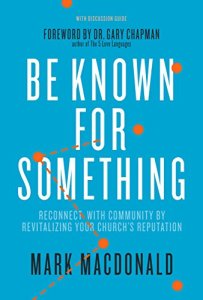
THE QUICK SUMMARY – Be Known for Something by Mark MacDonald

Pastor, communicator, ministry leader… listen to your community!

— 80% of evangelical churches are in decline or stagnation.

— A third of our communities have no perceived need for a local church.

— Many churches aren’t known for anything relevant in their communities.

The solution: Be known for something that will reconnect you to your community. Embark on an eye-opening journey to revitalize your church’s reputation, control your message, and create a communication strategy for reaching the lost for Jesus Christ.

Your church needs to reconnect with community. This book will help you to discover how.

Mark MacDonald, a leading voice in effective church communication, shares fascinating stories to help you discover your unique thread that will…

  • Revitalize your church’s reputation
  • Simplify your church’s messaging
  • Tear down your ministry silos
  • Attract people to your church

Be Known For Something is the answer to engaging your congregation while encouraging church growth from your community.

Discover your thread in this easy-to-read and easy-to-lead book. Learn how to control it, communicate it, and live it.

A SIMPLE SOLUTION

The sitcom “Cheers,” a hit for 11 seasons, may be best remembered for the refrain of its theme song: “where everybody knows your name.”

What about your church? Does your community “know your name?” Not the literal name of your church, but the “who” and “what” and “why” of your church.

Maybe that question needs to be preceded with another, more telling one: Do your members “know your name?”

According to “Be Known for Something” author Mark MacDonald, if your members and regular attenders don’t know what their church was known for, the community certainly won’t hear about it.

And if your community doesn’t hear about you, or “know your name,” are you really being effective in reaching them?

Why do thousands of churches fail annually while our communities have lost interest in our ministries? Perhaps, there’s a thread we can discover so that we can reconnect with our local community where God planted us…a thread that God will use to grow His Church and your ministry.

Do you know what your thread is? Here are the criteria to weigh your ideas and create a successful communication thread:

It needs to be simple.

This short statement (1-5 words) needs to be a simple concept that people will embrace and remember.

It needs to be somewhat “open” in thought.

The more specific the statement is, the harder it will be to “roll it out” across your ministry.

It needs to be emotionally charged.

Consider the emotion someone will have when he or she experiences the benefit. Make sure this emotion is the feeling you or your church exudes.

It needs to be benefit-driven.

The statement should refer to a solution and, therefore, a prominent pain or a path to a goal.

It needs to feel like your congregation.

Be biblical, genuine, authentic, and real.

It needs to be unique.

The more unique you are in the communication thread, the easier it will be for you to break through with it.

Your DNA scarlet thread is woven within everything you’re doing. Get your thread embedded into people’s long-term memory.

Mark MacDonald, Be Known for Something

A NEXT STEP

Use the following discussion questions by author Mark MacDonald in your next leadership team meeting to focus on discovering your church’s “thread.”

  • If our people were to go and live our mission statement, how would their lives attract non-churched people in our community?
  • If we are “being” our mission statement, what benefit would speak directly to someone in our community?
  • What’s the biggest benefit for attending our church? What would the average regular attender say it is?
  • If there’s more than one thing, do we think we could decide on the thing? The answer we want to hear regularly to this question, “so why do you attend this church?”. Would the answer encourage someone else who doesn’t attend a church now to attend?

Excerpt taken from SUMS Remix 118-2, released May 2019.


Part of a weekly series on 27gen, entitled Wednesday Weekly Reader

Regular daily reading of books is an important part of my life. It even extends to my vocation, where as Vision Room Curator for Auxano I am responsible for publishing SUMS Remix, a biweekly book “excerpt” for church leaders. Each Wednesday on 27gen I will be taking a look back at previous issues of SUMS Remix and publishing an excerpt.

>>Purchase SUMS Remix here<<

>> Purchase prior issues of SUMS Remix here<<