Conduct a Community Analysis

Has the community around your church changed, and you are not sure how to respond?

Some say that we live in the age of the “selfie” – a generation focusing more and more on how they look, and at the same time  growing more and more unaware of the world around them. What about your church? If you took a “congregational selfie” and then compared it to a “neighborhood selfie” of the community around your church, what would you find?

For many churches, especially established congregations with years of ministry impact, there will be a significant difference.

In the beginning, the church was a reflection of the community where it was located. There was probably significant and steady growth – as the community grew, the church naturally grew. Many churches might even have been seen as their “community center.”

However, over time, every community begins to change. It may be as simple as the community aging – or as complex as an ethnic, racial, or other socioeconomic change. Whatever the case, the community around the church probably changed…

…but the church didn’t change.

Over time, most churches resist, and even fear change.

The growing disparity between a church and its community was probably subtle – maybe even occurring over several generations. It starts with a few people beginning to move into other parts of the town and no longer making the drive back to their old community. Other events beyond the church’s control take place, like key industry moving out of town and the workforce following. Whatever the cause, the end result is that the church begins to no longer look like the community around it and many leaders are not sure how to respond.

It’s time to do a community analysis.

 wwr012517fb-1

THE QUICK SUMMARY – Neighborhood Mapping, by John Fuder.

In addition to understanding the Word of God, it is necessary to understand the people we serve. Once we make sense of our neighborhoods and communities, we can begin to “diagnose” needs and apply the proper “dose” of the gospel to meet those opportunities.

Neighborhood Mapping awakens the neighborhood explorer to consider effective methodology of understanding their neighborhood. Dr. Fuder calls believers to shift the focus from inside the church building to those who live in the community.

Best practices and sample surveys will be available in this resource as explorers will look through the lens of Scripture to give practical steps to exegete the community and consider best practices of:

  • What is a neighborhood map/Community Analysis?
  • When should this map/analysis be created?
  • Why should we map our neighborhood?
  • Who is on the map and who is a part of this analysis?
  • Where are the borders of this map/analysis?
  • How does one conduct a community analysis?

A SIMPLE SOLUTION

It’s no secret that our world is changing rapidly around us. We often are more accepting of societal change around the world than across the street. Yet God has placed your church in a specific location so that you might impact your community with cosmic significant and locally specific actions.

If your church is going to be an active presence in your community, you can’t sit behind closed doors, waiting for the neighborhood to come to you. You must step out, engaging those around you and seeking to understand their hopes, dreams, and needs.

In order to minister to your community, you need to not only know how to interpret the Bible, but also how to engage with and adapt to those for whom the gospel message is addressed.

When we exegete a community, we draw meaning from it. We discover the underlying history, context, and culture of that place and its people. 

Analyzing our communities enables us to explore and rediscover our surroundings. Once we make sense of our context, we can begin to “diagnose” needs and apply the proper “dose” of the gospel to meet those opportunities. Community analysis is the methodology and vehicle to rediscover our missional mandate in the church: to proclaim and demonstrate the gospel. The focus shifts from those inside the building to those outside – it is about the people we seek to reach. We must help our people see that “neighbor love” is an important part of following Jesus, and that moves us to find ways to know our neighbors in order to minister to and serve them well.

Community analysis is a four-step process; it’s what I call the 4Ss: supplication, stakeholders, surveys, and stories.

Supplication – before we do anything else in our communities, we seek, individually and corporately, God’s direction and leading.

Stakeholders – focus on people within the community with whom we can partner or network, such as neighborhood leaders, social services, schools, or businesses.

Surveys – through questionnaires and gathering focus groups, we get a stronger idea of our neighbor’s felt needs, worldviews, and attitudes toward church and faith in general.

Stories – gather the stories we hear through those questionnaires and interviews and put them into case studies to get a fuller picture of our neighbors so that we can better minister and reach out to them.

– John Fuder, Neighborhood Mapping

A NEXT STEP

Prior to your next leadership team meeting, distribute this SUMS Remix to members of your team and ask them to read through it and be prepared to work on this solution using the 4S guide as outlined above. Spend 15 minutes in each of the following sections, using the listed questions as a springboard for great discussion. Before moving on to the next section, identify one team action or next step, and one individual next step. Also be sure someone is documenting the conversation and key ideas that emerge.

Supplication – seeking God’s direction and leading

  • In your personal prayer life, are you specifically naming individuals and needs of your community?
  • In your leadership team’s prayer life, are you specifically naming individuals and needs of your community?
  • In your corporate prayer life, are you specifically naming individuals and needs of your community?
  • Commit to one specific action both individually and corporately that you will undertake in the area of Supplication in the next week.

Stakeholders – seeking community and neighborhood partners

  • Do you have individual or a network of community leaders with whom you maintain a regular connection?
  • If not, do you know where or how to obtain names of such individuals?
  • Do you have a local governmental connection that you maintain regular contact with?
  • Assuming you have connections described above, how often do you connect with them? Do you seek information from them or primarily use the connection as an information flow from you to them?
  • In connections with the individuals listed above, do you have a mechanism in place to regularly listen to and develop a deeper understanding of their concerns?
  • Assuming you have such a mechanism, how do you take action on their concerns?
  • Commit to one specific action both individually and corporately that you will undertake in the area of Stakeholders in the next week.

Surveys – seeking information that helps reveal our communities understanding of our church specifically and faith generally

  • Has your church ever conducted a community survey of any type? If so, when was it done? How was the information used?
  • Do you have knowledge of the resources needed to conduct a community survey? If not, do you know where to get the resources?
  • If you were to look at the community around you, can you identify specific segments that might need different types of surveys? If so, what are they?
  • Commit to one specific action both individually and corporately that you will undertake in the area of Surveys in the next week.

Stories – collecting the stories arising out of the actions listed above

  • Do you know where to go and who to listen to in order to hear the stories of your community?
  • Have you really listened to the stories of the community around you from people actually involved in them? How did that make you feel?
  • Compare those stories to any stories that make up part of your church’s history and heritage. Do they coincide, or are they vastly different?
  • Consider specific ways you will gather stories from your community through active listening, surveys, or guided conversations.
  • Commit to one specific action both individually and corporately that you will undertake in the area of Stories in the next week.

Your community is not frozen in time; it is constantly changing. Your work of community analysis must also be done over and over again. It is never a “one and done” thing. To learn more about congregational and community survey resources, start a conversation with the Auxano team today.


Vibrant churches look after the interests of others – starting with their neighbors across the street and around the block. They are involved in community concerns by supporting, if not actually leading, initiatives.

Thriving churches have open doors – open to each and every segment of their community.

Taken from SUMS Remix 21-1, published August 2015.


Part of a weekly series on 27gen, entitled Wednesday Weekly Reader

Regular daily reading of books is an important part of my life. It even extends to my vocation, where as Vision Room Curator for Auxano I am responsible for publishing SUMS Remix, a biweekly book “summary” for church leaders. I’m going to peruse back issues of both SUMS and SUMS Remix and publish excerpts each Wednesday.

You can find out more information about SUMS Remix here.
Cooperation Rather Than Confrontation

Following the Civil War, economic recovery and expansion in the United States was to a large part driven by the expansion of the railroad system.

From its infancy in the 1830s through the 1870s, railroad systems developed piecemeal within the borders of each state. Everything from locomotive size to railcar layout to schedules to fares was developed only with a mind to serve a limited scope – usually measured in tens of miles, occasionally getting up into the hundreds of miles. Nowhere was this more glaring than the rail gauge, or distance between rails.

Facing a tremendous rebuilding effort, with grand schemes of expansion beyond that, the independent railroad systems of the mid-1880s realized that it would be better to serve national, rather than local, interests. The idea that it was better for a railroad to have a separate gauge from its local rivals had become redundant.

Cooperation rather than confrontation was now the watchword.

After decades of incessant fighting, railroad companies realized that railroads work best as an integrated system; the longer that passengers and freight can travel without changing trains, the better the service.

In the South, the five-foot gauge was changed to standard (4 feet, 8 ½ inches) over two days in the summer of 1886.

Two days.

27gen012017fb-1


Large gangs of track workers moved one of the rails on 13,000 miles of track. The operation – staggering in its scope – also required converting 1,800 locomotives and 40,000 coaches. Up until this time, trains heading in and out of the South had been subject of delays as their cars were lifted by hoists and attached to wheel sets of the right gauge.

The efforts of tens of thousands of workers over a momentous thirty-six-hour period on May 31-June 1, 1886 created – at last – a unified railroad for almost the whole United States.

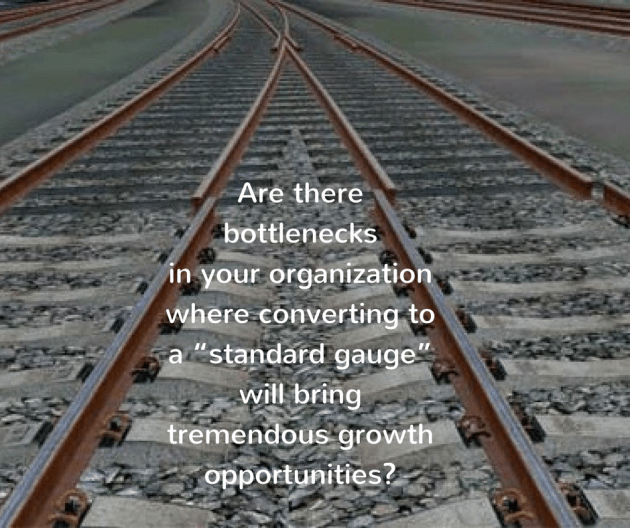
Are there bottlenecks in your organization where converting to a “standard gauge” will bring tremendous growth opportunities?

Background material from The Great Railroad Revolution by Christian Wolmar

Tell Your Story in Every Environment with Compelling Consistency

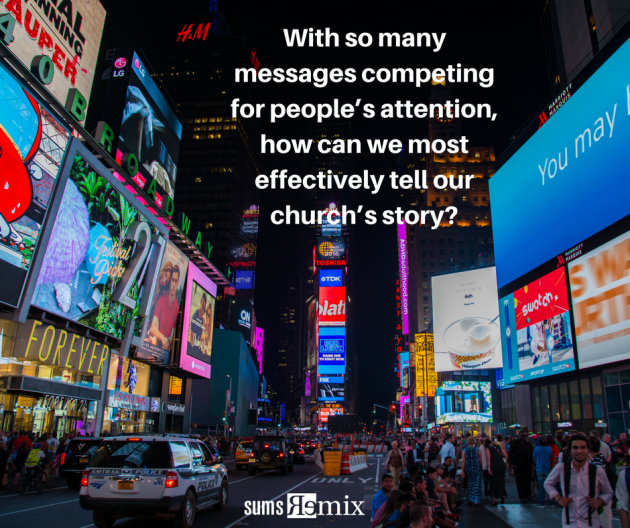
With so many messages competing for people’s attention, how can we most effectively tell our church’s story?

Every day, your church stewards thousands of moments of truth. Every time a member talks to a neighbor, someone drives by the church facility, a ministry email goes out, a pastor’s business card is left on a desk, some interaction on behalf of the church has transpired. Every time these events happen, the church’s vision grows brighter or dims in the tiniest little increments.

The leader’s role is to crank up the wattage.

wwr011817fb-2

THE QUICK SUMMARY – Unique, by Phil Cooke

Today’s culture is more connected than any time in history, but all of this connectivity comes with a price. We live in a world that’s become cluttered, distracted, and disrupted by social media, with the average person receiving as many as 5,000 messages a day in one form or another. If you’re a pastor, nonprofit leader, artist, filmmaker, entrepreneur, or creative professional in this hyper-connected, highly distracted world, how do you get your unique idea, project, or vision on the radar of the people who need to respond?

In Unique, Phil Cooke, a highly respected media producer and consultant, addresses both the challenges and the opportunities of branding and social media in the 21st century. If you have a vision or message to share with the world, Unique provides a blueprint to cut through the clutter, communicate your story, and impact your audience.

A SIMPLE SOLUTION

To maximize your ability to connect, you must invest time, mental energy, and resources to really discover and articulate your uniqueness — your vision, your essence, your story.

Stories inspire and capture imagination. Stories connect on personal and emotional levels. They help us develop relational connections.

That’s why it is so important for your communication toolbox to say who you uniquely are— what differentiates your church from the crowd.

The combination of the right words with powerful imagery compels engagement, insight, and memorability.

Most churches haven’t developed their story and leveraged great design to share it. Don’t miss the opportunity to tell your church’s story with design so you can really extend your reach. Shouldn’t the church connect and build relationships in every way possible?

At its core, branding is simply the art of surrounding a product, organization, or person with a powerful and compelling story. At its most basic level, branding provides answers to the simple human need to differentiate one thing from another.

The goal of branding is to win the hearts and minds of the largest audience possible and imprint an indelible story around your vision.

The power of these stories and the hold they exert over our lives is remarkable, and many would say the power of story is embedded in our genetic makeup. From the ancient days of the Israelite storytellers who recited the epic chronicles of Abraham, Isaac, and Jacob, to the writers, preachers, and filmmakers of today, we are a story-driven people, and we use stories to make sense of life.

Stories work because we want to experience the emotions, feelings, and passions of others who have encountered the challenges we face each day.

During Jesus’ short time of ministry on earth, He had to teach a message that wouldn’t simply change people during His lifetime, but transform the world for ages to come. If you had faced that challenge, what would you have done?

Jesus did what many pastors in that position would probably consider a career killer: He started telling stories. Most of Jesus’ stories were just everyday people doing everyday things. They weren’t particularly exciting, romantic, or even thrilling.

Stories drill deeply into your brain and explode later with meaning. Sometimes the meaning comes when you least expect it. Stories impact audiences because each person interprets the story in light of his or her own personal situation and experience. As a result, the impact is far greater than a simple object lesson or teaching session.

In many cases, you can interchangeably use the words “brand,” “story,” “identity,” and, sometimes, “reputation.” Branding is about building trust and loyalty and extending your relationships far beyond a single transaction.

Stories are the central focus of the art of branding.

Phil Cooke, Unique

A NEXT STEP

How well does your brand tell your story?

Here’s a question for you: What’s the Nike brand all about? If you said “Just Do It” you would be incorrect – that’s their tagline. Their brand is really their mission – “Bring inspiration and innovation to every athlete* in the world.” (By the way, the * is further explained by Nike as “If you have a body you are an athlete.”)

To help understand how your brand tells your story, watch this 5 ½ minute video from Nike with your leadership team.

After watching the video, discuss these questions with your team:

  • How much more important, and eternal, is the mandate of the church than a shoe company?
  • How well defined and well lived, and resultantly effective, is our church at telling our story?
  • Does our story create movement and reflect the heart of God for the church or is it just words on a website or worship service bulletin?

Many pastors tend to be skeptical of investing time and resources into working on statements of identity like mission or values or taglines, especially when things around church “feel” like they are going well enough.

When any organization lives their mission, the results are seen – and life change becomes possible. The marketing video from Nike sums up why, for them, people living out their mission is more important than people knowing their tagline. And shows how good they actually are at living it, better than most churches. 

What are three stories of life change that capture the essence of your church’s brand? How does your church’s mission statement move beyond generic statements to reflect these examples of your unique calling?


With the Gospel at the center of everything we do, the church, by its nature, is a message-centric organization. Jesus, the greatest story-teller of all time knew, before science showed us, that people are simply hard-wired to respond to story and images. And today’s world is becoming ever-increasingly visual, with selfies, Facebook, Twitter, and Instagram.

Consider this: there are hundreds of little moments of truth – touchpoints of connectivity – that happen each day.

Each of these are opportunities to share the message of the gospel. Are you going to make them or miss them?

Just by being more intentional with your brand, you really can capture more “makes” than “misses.”

When the communication gets cluttered, tell your story in every environment with compelling consistency.

Taken from SUMS Remix 26-2, published October 2015.


Part of a weekly series on 27gen, entitled Wednesday Weekly Reader

Regular daily reading of books is an important part of my life. It even extends to my vocation, where as Vision Room Curator for Auxano I am responsible for publishing SUMS Remix, a biweekly book “summary” for church leaders. I’m going to peruse back issues of both SUMS and SUMS Remix and publish excerpts each Wednesday.

You can find out more information about SUMS Remix here.
Subscribe to SUMS Remix here.

Understand the Four Horizons of Vision

Are you a little confused about visionary planning?

There is a difference between having a vision and having a plan. Vision is about the picture of your church’s future. A plan is about the steps to get there.

The vision answers the question, “Where is God taking us?” The plan answers the question, “What are the next best steps, and how do they relate?”

Look at vision as having four horizons.

wwr011017fb-1

THE QUICK SUMMARY – God Dreams, by Will Mancini

Is your team excited about the next big dream for your church?

You are a visionary leader and your church probably has a vision statement. Yet most churches are stuck in a trap of generic communication without a truly visionary plan. Just like a visionary restaurant needs a more specific focus than “serving food,” a visionary church needs something more than biblical generalizations like “loving God, loving people” or “making disciples and serving the world.”

When a team doesn’t share an understanding of God’s next big dream, leadership grows tired, overworked by an “all things to all people” ministry approach. Too often there’s no unified picture of what success looks like. People can feel uninspired and your church’s programming can seem more optional than ever.

Ministry without clarity is insanity. Are you ready for a better way?

In this groundbreaking work, based on Will Mancini’s 15 years and over 10,000 hours of church team facilitation, God Dreams reveals a simple and powerful planning method that will bring energy and focus to your church like never before.

First, God Dreams shows how to reclaim the role of long-range vision today by providing 12 vision templates, each with biblical, historical, and contemporary illustrations. These vision starters will dramatically accelerate your team’s ability to find complete agreement regarding your church’s future.

Second, God Dreams explains how to overcome the fruitless planning efforts that many church teams experience. With a tool called the Horizon Storyline, leaders can connect short-term action steps with the long-range dream, while leveraging the power of storytelling to make the plan “stick.” This tool will galvanize a diverse team of ministry leaders and volunteers with unprecedented enthusiasm.

Imagine leading with a refreshed sense of freedom and confidence, with a totally new way to inspire your church. Imagine the ability to harness the energy and resources of your people toward a specific dream of gospel impact, in your church and in your lifetime.

God Dreams is your passport to leading into a better future.

A SIMPLE SOLUTION

Your eyes can focus on multiple horizons. As you are reading this, look up and notice what is in your midground – a desk and chairs, other people?

Now look to the background and note what you see. A window to look through or a bookshelf?

The document itself and your arms and hands are in your foreground.

Without moving your head, experience the ability to focus in and out of these three horizons going back and forth quickly. That’s called accommodation. It’s a natural reflex that is happening subconsciously all day long. But it’s also a voluntary process. You can consciously control it whenever you want, as you probably did while trying the exercise.

What’s natural to your daily life can also be natural to your church’s organizational life. It is possible to use the three basic distances you are zooming in and out of all day long to build a visionary planning model.

In fact, the primary reason for vision in human-body functions is to guide and direct movement. The same might be said of your visionary plan: it exists to guide and direct movement for the church body as a whole.

The Horizon Storyline is a tool to develop the right amount of vision content for the right time in the future, for the entire leadership team.

The breakthrough of the Horizon Storyline is the development of a planning tool that fits human experience. It’s natural to grasp, using the way we already see, think, and communicate. What if we could forever remove the “it’s just too complicated” barrier? What if your planning tool would intuitively and immediately make sense? What if it would actually be fun to revisit over and over again?

The Horizon Storyline is defined by how we see different “horizons” in our field of vision every day. This idea is illustrated in a landscape painting, with the background far away as the eyes can see; a focal point of the piece in the midground that draws and keeps your focus; and an object in the foreground up close, right before your eyes.

To start, we just carry over the simple idea of background, midground, and foreground using those as names for three of our four planning horizons. We will simply see them as horizons, not in three-dimensional space but into the future. They are time horizons.

Here’s how it works. The near future we will define as ninety days away. That is the foreground vision. The next horizon, the midground vision, we define as one year away. And the furthest horizon we can “see” as an organization is the background vision, defined as three years away. The eyes of your church or ministry should be able to “see” this amount of time into the future.

Now that leaves one more horizon to define. This fourth horizon is just a little farther than you can clearly see. It’s just past your visible range. I call that “beyond the horizon” as a reminder that it is far away, just over the next mountain range, so to speak. I define this time frame as anywhere between five and twenty years depending on the church’s life stage and context.

Will Mancini, God Dreams

A NEXT STEP

The horizons described above are extensions of the way your eyes naturally work.

Right now think of at least one foreground, or short-term strategic horizon for your church. Something within the next 60-90 days.

Now list one big thing you hope to accomplish this year.

Finally, what is a big project, idea or task that you know will need to be tackled in the next few years of your leadership?

Rate the connectedness and continuity between these strategic initiatives. Bring the team together and ask, “What could be done to bring these three natural horizons of visionary planning into alignment?”


More energy. Greater resources. Better synergy. Would you like to have that right now at your church? Would you have guessed that the first step toward these improvements is defining your specific vision as a church?

If you don’t have a clear vision, you certainly won’t have a culture that matches. And if you don’t have a strong culture, then what are people in your church really doing?

Why are they there?

Taken from SUMS Remix 32-2, published January 2016.


Part of a weekly series on 27gen, entitled Wednesday Weekly Reader

Regular daily reading of books is an important part of my life. It even extends to my vocation, where as Vision Room Curator for Auxano I am responsible for publishing SUMS Remix, a biweekly book “summary” for church leaders. I’m going to peruse back issues of both SUMS and SUMS Remix and publish excerpts each Wednesday.

You can find out more information about SUMS Remix here.

Subscribe to SUMS Remix here.

It’s Up to You to Make the Brick Click

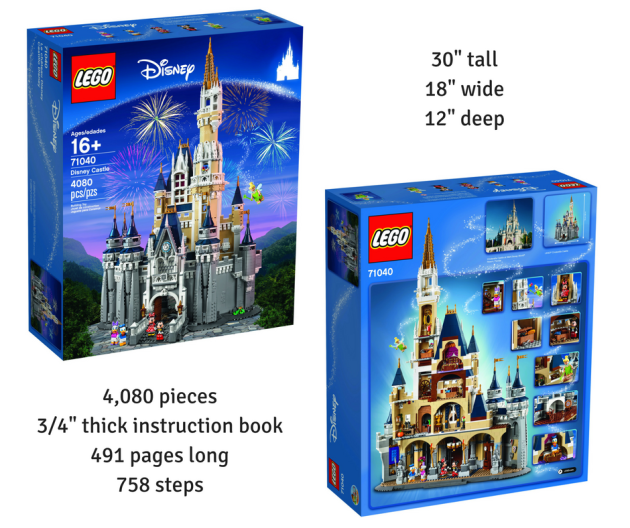
Christmas morning found the following under our tree:

legocastlefb-1


The story of our family fun putting it together is recounted elsewhere, but our week-long adventure reminded me of a great book on a recent success story of LEGO – and the lessons we can learn from it.

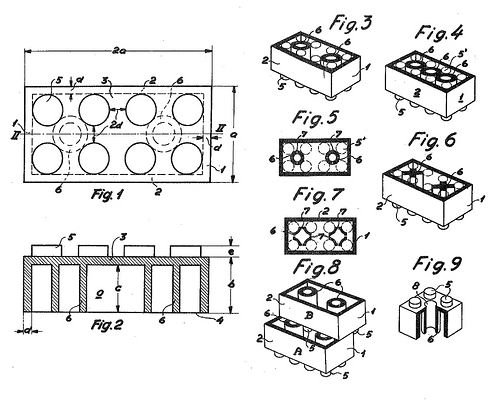
The LEGO brick is deceptively simple. By itself, it has almost no value and worse, no use. Only an engineer can appreciate the creative value of those knobs on top and the hollow tubes underneath.

LEGO brick patent drawing

Snap two or more of them together, and you’ve suddenly opened up a world of almost infinite possibilities. Google LEGO creations and be prepared to be amazed:

  • A functioning supercomputer (1,000 bricks plus electronic parts)
  • A full-size Rolls-Royce aircraft engine (152,000 bricks)
  • A detailed recreation of the 2012 London Olympics (over 250,000 bricks)
  • A life-size two-story house with working toilet and shower (3.3 million bricks)
  • A full-scale replica of the Star Wars X-Wing fighter (over 5 million bricks)

In the fifty-five years since it was patented, the LEGO brick has ignited the imaginations of millions of children and adults – and become a universal building block for catalyzing creativity.

What was the secret behind LEGO’s decades of success?

LEGO owes much of its enduring performance to a core set of founding principles that have guided the company for over eighty years:

  • Values are Priceless
  • Relentless Experimentation Begets Breakthrough Innovation
  • Not a Product but a System
  • Tighter Focus Leads to More Profitable Innovation
  • Make It Authentic
  • First the Stores, Then the Kids

Even so, at the height of its success toward the end of the 1990s, LEGO stumbled and almost became a statistic – another failed company. They began to confuse growth with success, literally selling their LEGO systems around the world. Unfortunately, the company’s rapid globalization was not accompanied by sufficient innovation. Technological advances also began to change the nature of play – VCRs, video games, cable TV, computers, the Internet, which claimed an increasingly larger share of the core market of LEGO – children.

Determined to rebound from successive years of loss, the executive team embarked on an ambitious initiative for reigniting growth. The effort was oriented around some of the world’s most popular strategies for developing new products and services.

Seven Innovation Strategies

  • Hire diverse and creative people
  • Head for blue ocean markets
  • Be customer driven
  • Practice disruptive innovation
  • Foster open innovation – heed the wisdom of the crowd
  • Explore the full spectrum of innovation
  • Build an innovation culture

LEGO heeded the proclamations of management strategists and adopted the seven truths of innovation – all of them. For a time, the strategy worked. For a company that was struggling to catch up with a world that was passing it by, there was in inherent logic in the LEGO Group’s pursuit of the seven truths.

But LEGO had placed a lot of big bets in just a few short years. The company was trying to expand on so many fronts it was in danger of losing its focus and discipline. Individually, the seven truths have worked for other companies. Collectively, they almost pushed LEGO into bankruptcy.

The most difficult challenge in business is not to invent an innovative product; it’s to build an organization that can continually create innovative products. It took LEGO seven years and played out in five stages.

The result? LEGO emerged from its near-death experience as the world’s most profitable and fastest-growing company. From 2007 to 2011 through the worst of the global recession, LEGO profits quadrupled, far exceeding the giants of the toy industry, Mattel and Hasbro. From 2008 to 2010, LEGO profits grew faster than Apple, despite competing in an industry with few entry barriers aggressive competition, fickle customers and no patent protection on its core product – the LEGO brick.

LEGO achieved those results not by breaking with business convention but by building within it.

They operated “inside the box”.

Excerpted and adapted from Brick by Brick, by David Robertson with Bill Breen

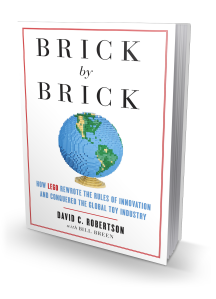
Brick by Brick

Brick by Brick is the story behind that seven year journey to success. Sometimes radical, but always applicable, Brick by Brick contains real-world lessons for unleashing breakthrough innovation in your organization.

The excerpts above have barely scratched the surface of the wisdom contained in Brick by Brick. Leaders in organizations of all sizes, profit or non-profit, will benefit from the lessons it contains. It digs into the LEGO Group’s practical approach to everyday innovation and shows how your organization can do the same.

It’s about LEGO’s reinvention of innovation – making continuous innovation less of an abnormality and more of the new normal.

A warning – like every LEGO set, Brick by Brick‘s principles require you to bring your own imagination and experience to the game to figure out what’s best for you and your organization.

It’s up to you to make the bricks click.

Learn to Think Beyond “Right Now”

Imagine that the role of vision in your church is like an axe.

When skillfully used, it makes a path clear. It removes obstacles. It broadens the path for others to follow. It enable greater accomplishment.

Most pastors regularly pick up the axe of vision in their ministry. Some quickly set it back down, having never been trained in its effective use. Others swing like crazy, unaware that they wield a dull edge. Too often they become frustrated or confused by too little return for their tireless work.

One way to sharpen the axe of vision is by thinking beyond “right now.”

wwr010417fb-2


THE QUICK SUMMARY – God Dreams, by Will Mancini

Is your team excited about the next big dream for your church?

You are a visionary leader and your church probably has a vision statement. Yet most churches are stuck in a trap of generic communication without a truly visionary plan. Just like a visionary restaurant needs a more specific focus than “serving food,” a visionary church needs something more than biblical generalizations like “loving God, loving people” or “making disciples and serving the world.”

When a team doesn’t share an understanding of God’s next big dream, leadership grows tired, overworked by an “all things to all people” ministry approach. Too often there’s no unified picture of what success looks like. People can feel uninspired and your church’s programming can seem more optional than ever.

Ministry without clarity is insanity. Are you ready for a better way?

In this groundbreaking work, based on Will Mancini’s 15 years and over 10,000 hours of church team facilitation, God Dreams reveals a simple and powerful planning method that will bring energy and focus to your church like never before.

First, God Dreams shows how to reclaim the role of long-range vision today by providing 12 vision templates, each with biblical, historical, and contemporary illustrations. These vision starters will dramatically accelerate your team’s ability to find complete agreement regarding your church’s future.

Second, God Dreams explains how to overcome the fruitless planning efforts that many church teams experience. With a tool called the Horizon Storyline, leaders can connect short-term action steps with the long-range dream, while leveraging the power of storytelling to make the plan “stick.” This tool will galvanize a diverse team of ministry leaders and volunteers with unprecedented enthusiasm.

Imagine leading with a refreshed sense of freedom and confidence, with a totally new way to inspire your church. Imagine the ability to harness the energy and resources of your people toward a specific dream of gospel impact, in your church and in your lifetime.

God Dreams is your passport to leading into a better future.

A SIMPLE SOLUTION

For more than a few reasons, the practice of long-term thinking is hard to come by these days. Steward Brand, who is working on an interesting project called the 10,000-year clock project writes:

Civilization is revving itself into a pathologically short attention span. The trend might be coming from the acceleration of technology, the short horizon perspective of market-driven economics, the next election perspective of democracies or the distractions of personal multitasking. All are on the increase. Some sort of balancing corrective is needed.

This “think long” clock is consistent with God’s view of time.

God chooses to reveal Himself through redemptive history. Time is His canvas. This simple fact by itself challenges us to think about the future in epic chunks of time.

It’s time to trade an obsession with now for a mind-set that values thinking long, beginning with the discovery of twelve compelling benefits in the value of thinking long.

thinklong

Will Mancini, God Dreams

A NEXT STEP

Review the twelve compelling reasons to think long above, and note that they are grouped into three broad categories. We think long first because the Bible challenges us to do so, second because practical considerations invite us to do so, and third because it’s a key for unlocking the motivation of people.

To broaden this discussion with your team, reproduce the chart above with each of the three categories and their reasons on a single chart tablet sheet. Using these three sheets, discuss each of the 12 in terms of how you and your church can begin to think long.

Do you really want to inspire people? Don’t flood your church with more programs and events. Rather, blow their minds with new context. Give them something that blows up the smaller stories of the now. Disrupt the casual week-to-week worship routine with a real, visible, and dramatic picture of the specific difference your church will make 10 years from now. Give people something epic!

If you think long, you are more likely to dream big and attempt great.


Life is too short and ministry is too hard to swing all day with a blunt-edged vision.


Taken from SUMS Remix 31-3, published January 2016.


Part of a weekly series on 27gen, entitled Wednesday Weekly Reader

Regular daily reading of books is an important part of my life. It even extends to my vocation, where as Vision Room Curator for Auxano I am responsible for publishing SUMS Remix, a biweekly book “summary” for church leaders. I’m going to peruse back issues of both SUMS and SUMS Remix and publish excerpts each Wednesday.

You can find out more information about SUMS Remix here.
Subscribe to SUMS Remix here.