
In our physical world, a bridge is a marvel of engineering – a structure of steel, concrete, or stone designed to span a gap that would otherwise be impassable. But as we explored in a previous discussion on the literal and metaphorical power of bridges, these structures do more than just facilitate travel; they symbolize the human desire to connect. While physical bridges conquer geographic divides, there is a much more complex and invisible chasm currently widening in our social fabric: the divide of “Othering.”
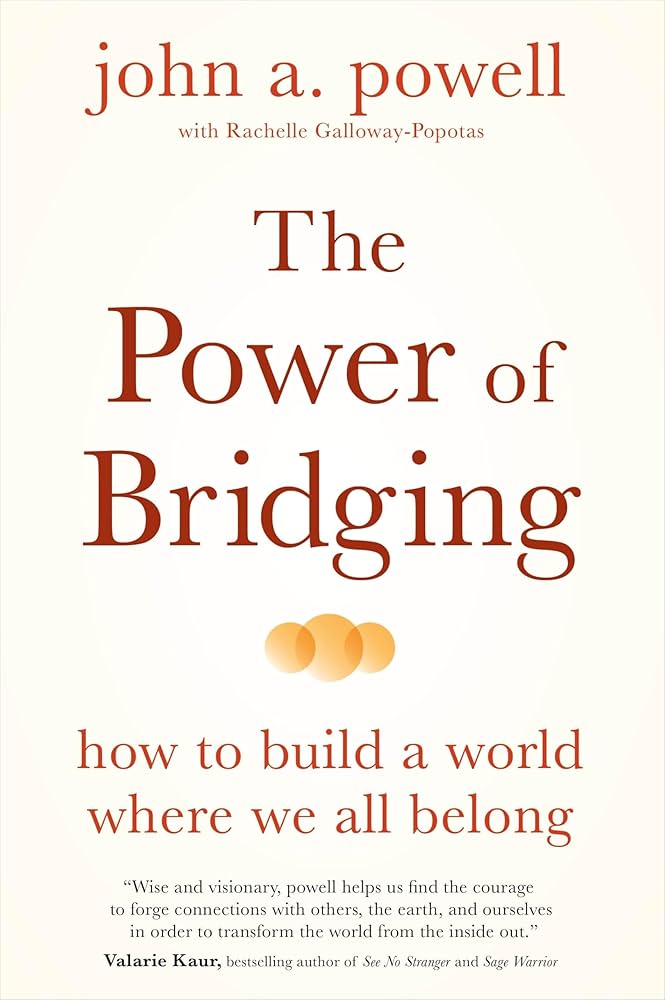
We don’t want to live in a society in turmoil. In fact, 93 percent of people in the U.S. want to reduce divisiveness, and 86 percent believe it’s possible to disagree in a healthy way. Yet with increasing political and social fragmentation, many of us don’t know how to move past our differences. Civil rights scholar john a. powell presents an actionable path through “bridging” that helps us communicate, coexist, and imagine a new story for our shared future where we all belong.
To navigate this, we turn to the powell’s profound insights in his latest work, The Power of Bridging: How to Build a World Where We All Belong. If our earlier exploration of bridges focused on the beauty of the connection itself, powell’s work provides the blueprint for the internal and systemic engineering required to build those connections in a fractured society. He moves us from seeing bridges as static objects to understanding “bridging” as a dynamic, life-saving practice.
The Three States of Human Connection: Breaking, Othering, and Bridging
To understand why we need to bridge, we must first understand the forces that pull us apart. Powell identifies two primary states that define our current social crises: Othering and Breaking.
Othering is the starting point. It is a psychological and sociological process where we perceive certain individuals or groups as fundamentally different from us. It isn’t just noticing a difference; it is the act of attaching a value judgment to that difference – viewing the “other” as a threat, as “less than,” or as someone who does not belong in our circle of concern.
When Othering is left unchecked, it evolves into Breaking. Breaking occurs when we turn inward to our own “in-group” (a process known as bonding) but do so by explicitly pushing away or demonizing the “out-group.” In a state of breaking, we stop seeing the full story of the other person. We see a flat caricature – a stereotype that justifies our fear or exclusion. Breaking is the collapse of the bridge; it is the moment we decide that the gap is too wide to cross and that the person on the other side is an enemy.
Bridging, then, is the intentional antidote. It is the practice of reaching across these divides to connect with people who are unlike us. Crucially, powell emphasizes that bridging is not “same-ing.” It does not require us to erase our differences or abandon our deeply held values. Instead, it asks us to acknowledge those differences and find a shared humanity beneath them.

The Blueprint: Why We Bridge
Why should we take the risk of building a bridge when it feels safer to stay behind our walls? Powell argues that our very survival – socially, politically, and even ecologically – depends on it. We live in a world of “accelerated change.” Technological shifts, climate crises, and shifting demographics create a profound sense of anxiety. When we are anxious, our natural instinct is to “break” – to find a small group where we feel safe and exclude everyone else.
However, breaking is a “false safety.” It narrows our world and prevents us from solving the very problems that cause our anxiety. Bridging, on the other hand, expands the “circle of human concern.” It allows us to co-create a larger “we” – a society where belonging isn’t a zero-sum game. In powell’s vision, my belonging cannot be predicated on your exclusion. If the bridge only supports people who look and think like me, it isn’t a bridge; it’s just an extension of my own island.
The Practice: How to Become a Bridger
Bridging is not a passive state of mind; it is a skill that must be practiced. Drawing from The Power of Bridging, we can identify four pillars of the “bridger’s” craft:
1. Empathetic Listening (The “Sawubona” Approach)
Powell references the South African greeting Sawubona, which means “I see you.” Bridging begins with the radical act of truly seeing another person’s humanity. This requires empathetic listening – listening not to find a flaw in someone’s argument, but to understand their story. When we listen to a story, we move away from the “flat” representation of the other and begin to see their complexities, their fears, and their dreams.
2. Holding Stories Loosely
One of the greatest obstacles to bridging is the “single story.” When we hold our own identity or our group’s narrative too rigidly, any alternative story feels like an existential threat. Powell suggests we should “hold our stories loosely.” This doesn’t mean giving up our identity; it means leaving enough room in our hearts to realize that our story is one of many. By doing so, we create space to co-author a new story together.
3. Navigating the Tension of “Short” and “Long” Bridges
Not all gaps are the same size. A “short bridge” might be connecting with a neighbor who has a different political sign in their yard but shares your love for the local park. A “long bridge” involves reaching across deep historical traumas or systemic injustices. Powell is realistic: long bridges are difficult. They require more vulnerability, more time, and more emotional labor. We cannot bridge all the time, especially when we are too hurt or too angry. But we can maintain bridging as our orientation – the direction in which we are trying to move.
4. Bridging with the Self
Perhaps the most surprising insight in powell’s work is that bridging must also happen internally. We often “other” parts of ourselves – our past mistakes, our vulnerabilities, or aspects of our identity that we’ve been told are “wrong.” To be an effective bridger in the world, we must first bridge the fractures within our own souls, accepting our own complexities so we can better accept them in others.
The “Wildcard” of Co-Creation
The ultimate goal of bridging is not just “getting along.” It is co-creation. When we bridge, we aren’t just crossing over to the other side to visit; we are building a new space in the middle. This is the “Learning Zone.”
In our comfort zone, everything is familiar, but nothing grows. In the “breaking” zone, everything is fear and conflict. But in the bridging zone – the Learning Zone – we experiment. We stretch our abilities. We find that by connecting with someone different, we are actually transformed. We don’t come out the same person we were when we started across the bridge.
A Call to Engineering the Future
In this 27gen article, we saw how bridges are the physical manifestation of our desire to connect. john a. powell takes that metaphor and gives it a moral heartbeat. He reminds us that while the world may feel like it is “breaking,” that breaking is a choice – and bridging is a choice, too.
To be a “bridger” in today’s world is an act of courage. It means being willing to be the structure that others walk on. It means risking the discomfort of the unknown for the possibility of a world where everyone belongs.
As we look at the landscapes of our lives – our families, our workplaces, and our communities – we must ask ourselves: Where are the gaps? Where have I allowed “Othering” to take root? And what is the first small stone I can lay today to begin building a bridge?
The architecture of belonging is not built by geniuses in ivory towers; it is built by ordinary people who decide that the person on the other side of the divide is worth knowing. It is built one story, one heartbeat, and one bridge at a time.

Part of a regular series on 27gen, entitled Wednesday Weekly Reader.
During my elementary school years one of the things I looked forward to the most was the delivery of “My Weekly Reader,” a weekly educational magazine designed for children and containing news-based current events.
It became a regular part of my love for reading, and helped develop my curiosity about the world around us.
 27gen.com