How to Overcome an Overloaded Life by Creating Margin

We’re all busy in the same sorts of ways. Our lives are consumed with the crushing weight of family, work, and church activities. Our lives are bombarded with requests, demands, and desires. Individual situations may be quantitatively less busy than others, and some more so, but as a society we are living a shared experience of an overwhelmed life.

Where does it all stop? When will things slow down? How can we recapture time lost?

Technology has delivered time-saving devices that actually consume more time. Progress moves our lives faster and faster, yet we seem incapable of enjoying little if any benefit. We desire and often achieve more. We have bought into a full-life timeshare to only find ourselves bankrupt in emptiness.

Are you asking this question?

I don’t have enough time to do the things I need to do, let alone the things I want to do.

THE QUICK SUMMARY – Margin, by Richard A. Swenson

Margin is the space that once existed between ourselves and our limits. Today we use margin just to get by. This book is for anyone who yearns for relief from the pressure of overload. Reevaluate your priorities, determine the value of rest and simplicity in your life, and see where your identity really comes from. The benefits can be good health, financial stability, fulfilling relationships, and availability for God’s purpose.

A SIMPLE SOLUTION

Life in much of the world today is essentially devoid of time and space. The time and space that once existed in the lives of family and friends who regularly lingered after dinner, visited with the neighbors, sat on the front porch, went for long walks, planted flowers or a garden, and always had a full night’s sleep.

People are exhausted from trying to live life in a 24/7 world. People are stressed trying to keep the good things going and the bad things at bay. People are overloaded with things that (maybe) were once good but now are burdens.

We need more time. We need more space. We need more reserves. We need more buffer.

We need margin.

Margin is the space between our load and our limits. It is the amount allowed beyond that which is needed. It is something held in reserve for contingencies or unanticipated situations. Margin is the gap between rest and exhaustion, the space between breathing and suffocating. 

To be healthy, we require margin in at least four areas: emotional energy, physical energy, time, and finances. Conditions of modern living, however, have drained these margins rather than sustaining them.

Restoring Margin in Emotional Energy

  1. Cultivate social supports – The existence of intact, functioning, healthy, nurturing systems of social support are as good a resource for replenishing depleted energy reserves as can be found.
  2. Reconcile relationships – True reconciliation is one of the most powerful of all human interactions.
  3. Serve one another – One of the best ways to heal your own pain is to focus instead on meeting the needs of others.
  4. Rest – Be with people and serve them. But be sure to get away occasionally. Escape. Relax. Sleep in. Rest restores.

Restoring Margin in Physical Energy

  1. Take personal responsibility – Until we accept personal responsibility for our own health, the road to the future will remain paved with aches.
  2. Change your habits – Changing habit disorders often requires changing lifestyles.
  3. Decrease intake of fat, sugars, and total calories – There are healthier foods that also taste good, we can change our bad habits, and we can’t afford not to.
  4. Exercise for the body, mind, and spirit – One hundred percent of people who exercise to the point of cardiorespiratory fitness will experience an increased sense of well-being.

Restoring Time Margin

  1. Expect the unexpected – To plan for the unexpected is not an invitation to sloppiness or mediocrity but instead a concession to reality.
  2. Learn to say “No” – Saying No is not just a good idea, it has now become a mathematical necessity.
  3. Get less done but do the right things – Busyness is not a synonym for kingdom work – it is only busyness.
  4. Prune the activity branches – Even though it is much harder to stop something than start it, periodically, get out the clippers and prune away.

Restoring Financial Margin

  1. Live within your harvest – Not only should you make do with what you have but accept what you have.
  2. Discipline desires and redefine needs – Clarify the distinction between needs and desires and be honest about it before God.
  3. Fast – The world does not stop nor the family fall apart when we unplug from the treadmill of consumerism for a period.
  4. Counter culture – Willingly and knowingly wrestle control from a culture wanting to tell us what we must buy and own.

Richard A. Swenson, Margin

A NEXT STEP

Review the above four areas of margin needed in your life, and choose the one that you personally most need at this time.

Block off a two-hour minimum time where you will not be disturbed. Turn off your mobile phone and ask not to be disturbed.

On a chart tablet, list the margin area you chose at the top, and then divide the chart tablet into four quadrants. In each quadrant, list one of the four actions that accompany the margin area above.

Taking at least 20 minutes for each, list actions or thoughts that come to mind in each of the four areas. List everything that comes to mind, even if it doesn’t seem practical at first.

When you have completed all four quadrants, review the tablet and connect any similar actions with a line. Now, force rank at least three actions in each of the quadrants.

List the top three from each quadrant on a new chart tablet entitled, “My Prescriptions for Restoring Margin.” For each, write out a brief description and date as to when you will begin taking this action.

Repeat the above steps once per week until you have covered all four areas of margin in your life. Calendar time one month from the start your work in each of the four areas to revisit your progress, making changes as needed.

Bonus: Walk your leadership team through this exercise. The greatest gift you may give your staff is the ability to create margin.

Excerpt taken from SUMS Remix 87-1, released February 2018.


Part of a weekly series on 27gen, entitled Wednesday Weekly Reader

Regular daily reading of books is an important part of my life. It even extends to my vocation, where as Vision Room Curator for Auxano I am responsible for publishing SUMS Remix, a biweekly book “excerpt” for church leaders. Each Wednesday on 27gen I will be taking a look back at previous issues of SUMS Remix and publishing an excerpt.


>>Purchase SUMS Remix here<<


How to Make Your Brand Contagious

Some church leaders consider “brand” to be a four-letter word more appropriate in the marketplace than for churches. The concept of branding has undergone changes in the last decade that demand church leaders not only accept them, but also lead forward through them.

Branding in today’s cultural context is less “this is what we can do for you” and more “this is who we are.” Here is the challenge: your brand isn’t what you say it is; it’s what your “customers” say it is. (If you want to read more about this, download SUMS Remix 81).

THE QUICK SUMMARY – Contagious: Why Things Catch On by Jonah Berger

What makes things popular? If you said advertising, think again. People don’t listen to advertisements; they listen to their peers. But why do people talk about certain products and ideas more than others? Why are some stories and rumors more infectious? And what makes online content go viral?

Wharton marketing professor Jonah Berger has spent the last decade answering these questions. He’s studied why New York Times articles make the paper’s own Most E-mailed list, why products get word of mouth, and how social influence shapes everything from the cars we buy, to the clothes we wear, to the names we give our children.

In Contagious, Berger reveals the secret science behind word-of-mouth and social transmission. Discover how six basic principles drive all sorts of things to become contagious, from consumer products and policy initiatives to workplace rumors and YouTube videos. Learn how a luxury steakhouse found popularity through the lowly cheesesteak, why anti-drug commercials might have actually increased drug use, and why more than 200 million consumers shared a video about one of the most seemingly boring products there is: a blender.

Contagious provides a set of specific, actionable techniques for helping information spread—for designing messages, advertisements, and content that people will share. Whether you’re a manager at a big company, a small business owner trying to boost awareness, a politician running for office, or a health official trying to get the word out, Contagious will show you how to make your product or idea catch on.

A SIMPLE SOLUTION

People love to be a part of stories, and to tell stories – the latest “news” on the neighborhood, a great new restaurant opening nearby, the awesome vacation they just returned from.

People also like to tell the darker side of stories – gossip, a terrible meal experience, or the lousy and expensive vacation they had.

Then there are the online stories: social proof, provided by peer-to-peer recommendations of products and services, is a powerful way to persuade your potential customers.

Take a look at these results about online reviews by BrightLocal, a social media agency:

  • 84% of people trust online reviews as much as a personal recommendation
  • 90% of consumers read less than 10 reviews before forming an opinion about a business
  • 74% of consumers say that positive reviews make them trust a local business more
  • 58% of consumers say that the star rating of a business is most important

Word of mouth – literally, in conversations face to face, or figuratively, in online conversations, is a primary factor behind many of the decisions we are making everyday.

How can your church tap into this important vehicle of conversation going on all around you? 

After analyzing hundreds of contagious messages, products, and ideas, we noticed that the same six “ingredients,” or principles, were often at work. Six key STEPPS, as I call them, that cause things to be talked about, shared, and imitated.

Principle 1: Social Currency

How does it make people look to talk about a product or idea? What we talk about influences how others see us. It’s social currency. So to get people talking we need to craft messages that help them achieve these desired impressions. We need to find our inner remarkability and make people feel like insiders.

Principle 2: Triggers

How do we remind people to talk about our ideas and products? Triggers are stimuli that prompt people to think about related things. People often talk about whatever comes to mind, so we need to design ideas that are frequently triggered by the environment and create new triggers to prevalent cues in that environment. Top of mind leads to tip of tongue.

Principle 3: Emotion

When we care, we share. So how can we craft messages and ideas that make people feel something? Emotional things often get shared. So rather than harping on function, we need to focus on feelings.

Principle 4: Public

Can people see when others are using our product or engaging in our desired behavior? Making things more observable makes them easier to imitate, which makes them more likely to become popular. So we need to make our ideas and products more public.

Principle 5: Practical Value

How can we craft content that seems useful? Given how people are inundated with information, we need to make our message stand out. We need to highlight the incredible value of what we offer, and package our knowledge and expertise so that people can easily pass it on.

Principle 6: Stories

What broader narrative can we wrap our idea in? People just don’t share information, they tell stories. We need to make our message so integral to the narrative that people can’t tell the story without it.

Jonah Berger, Contagious: Why Things Catch On

A NEXT STEP

The six principles of contagiousness listed above contain Social Currency and are Triggered, Emotional, Public, Practically Valuable, and should be wrapped in Stories. Enhancing these components in messages, products, or ideas will make them more likely to spread and become popular.

While it is convenient to imagine the six steps as the acronym STEPPS, don’t think of them as a “recipe” that has to be followed precisely. Not all six ingredients are required to make an idea contagious. View them more like toppings for a salad: choose what works for you, fits your situation, and you will still have a good result.

Write the following on the top of six chart tablets, one principle per page, allowing plenty of space for notes.

Principle 1: Social Currency

How can we talk about our church in such a way that unchurched people desire to be connected?

Principle 2: Triggers

What community triggers have we created to raise our visibility? How can we share the gospel in ways that trigger engagement?

Principle 3: Emotion

What messages are we sending that connect people emotionally?

Principle 4: Public

How can people see when others are excited about what God is doing? How are we leveraging sharable media?

Principle 5: Practical Value

What gospel content have we created that is useful to people outside of the church?

Principle 6: Stories

What larger cultural context exists in our community? How are we communicating the gospel as the solution?

Set aside a two-hour brainstorming time with your leadership team, and work through each of the questions listed.

After working through all six questions, go back and highlight the top three ideas or actions the group agrees are most important.

Create a cross-functional work group, bringing in other leaders and church members as appropriate, to take the resulting 18 ideas and actions and create an action plan with timetables and responsibilities.

As each idea or action is completed, evaluate its effectiveness and adjust as needed.

Excerpt taken from SUMS Remix 83-1, issued January 2018.


Part of a weekly series on 27gen, entitled Wednesday Weekly Reader

Regular daily reading of books is an important part of my life. It even extends to my vocation, where as Vision Room Curator for Auxano I am responsible for publishing SUMS Remix, a biweekly book “excerpt” for church leaders. Each Wednesday on 27gen I will be taking a look back at previous issues of SUMS Remix and publishing an excerpt.
>>Purchase SUMS Remix here<<


Share Your Vision by Leading Down the Inspiration Pathway

Never static, vision is always evolving. Like a sequence of smaller mountains that give view to larger mountains on reaching the summit, today’s new accomplishments give view to tomorrow’s possibilities.

Vision is a living language: a treasure chest of phrases, ideas, metaphors, and stories. The beauty of a treasure chest like this is that your whole team can put words and dreams into it, and the entire leadership can pick ideas and stories out of it.

What does your vision treasure chest contain? Does it need some more loot inside in order for you to articulate your vision in powerful and captivating ways?

THE QUICK SUMMARY – The Inspiration Code by Kristi Hedges

Great leaders inspire action with their words. They spark enthusiasm and commitment. With a single conversation, they can change the direction of someone’s life.

Everyone wants to be the kind of leader who energizes and mobilizes others yet too few are. Why is it so challenging to crack the code?

Executive coach Kristi Hedges spent years studying exactly what inspiring leaders do differently. Informed by quantitative research and thousands of responses from leaders at all levels, she reveals that inspiring communication isn’t about grand gestures. Instead, those who motivate us most do a few things routinely, consistently, and intentionally.

Eye opening and accessible, The Inspiration Code dispels common myths about how leaders communicate and guides them in cultivating qualities that authentically excite.

Inspired companies need inspirational leaders. Learn to unlock motivation, lift people’s’ sights, and lead them into the future.

A SIMPLE SOLUTION – Lead Down the Inspiration Pathway

A vision should never be designed to be read. What would have happened to Martin Luther King Jr.’s “I Have a Dream” speech if he made it a PowerPoint presentation, or decided to just send out flyers?

People do not follow words – they follow you!

The vision cannot be separated from the vision caster, and the vision caster cannot separate his message from his life as a model.

Communicating your vision with clarity and inspiration can be accomplished, but you’ve got to move – you need to lead others down the inspiration pathway.

Inspiration Pathway conversations happen when we communicate in a way that is present, personal, passionate, and purposeful. These four factors greatly enhance our inspirational effect.

I call this model a “path” because it’s a passage with movement, both for the one inspiring and the one being inspired.

When we are inspiring, we are:

Present: We’re focused on the person in front of us, not distracted by the swirl of day, visibly stressed, or beholden to our agenda. We keep an open mind and let conversations flow. People who inspire us are both physically and mentally available to us. They focus on us. They give us the gift of time, and just as important, the gift of their attention.

Personal: We’re authentic and real, and listen generously. We notice what’s true about others and help them find their potential. Authenticity seems to fly in the face of the impassiveness we’ve been trained to adopt at work. But people look to you to see how much you care, and this shapes how much they will care.

Passionate: We infuse energy, and manage this as one of our greatest tools. We blend logic and emotion, and show conviction through our presence. People who are passionate enthusiasts for what they do create passion in others.

Purposeful: We are intentional. We are willing to serve as role models and engage in courageous discussions about purpose. A purpose that ignites us is personal. It’s less about a vision outside of us, and more about the vision we possess inside. Helping someone find that internal spark of purpose, or reignite it, is a transformational act.

Kristi Hedges, The Inspiration Code

A NEXT STEP

In order to lead others down the inspiration pathway, you will need to prepare yourself first. Calendar your next visionary presentation; it could even be your message this Sunday! Set aside two-three hours in an off-site location, get comfortable, and work through the author’s four elements of inspiration by thinking through and implementing the following:

Present

  • When we give another person our full attention versus our divided attention, the conversation changes. To be fully present to the conversation, eliminate distractions, use a reflective pause, get curious, and show receptive body language.
  • When we’re in a state of overwhelm, we’re not inspiring anyone. People’s natural instinct is to distance themselves from someone who seems frenetic. Challenge your current assumptions before jumping to try new strategies.
  • We can’t open someone else’s mind if ours is closed. When you cultivate an open mind, we create a learning space that allows others to expand their own thinking.

Personal

  • Though counterintuitive, showing authenticity is something we can work on. We’re adaptively authentic, where we learn new behaviors and integrate them into our own way of being.
  • Inspiring corporate visions are conversations about potential on a large scale. They tell the organization that it can achieve more because it’s capable of being more.
  • Deep, focused listening is a key inspirational skill, but it’s harder than it looks. Most people focus on hearing rather than on understanding. It takes effort, but you can become a better listener by understanding the listening environment.

Passionate

  • Energy is a primary way that we convey passion. Energy is a tool we can harness and cultivate to great effect. To do so, first know what gives you energy about your message, sync that up with your audience, and display your passion verbally and nonverbally.
  • There is no passion without emotion, and any attempt to convey such comes across unconvincing or deceptive. Being strategic and authentic with our emotions in our communication helps us to inspire others.
  • To show conviction, focus on aligning your nonverbal behaviors with your words, and both with your intent. This helps your body and mind to work together to show up with clarity.

Purposeful

  • Having a purpose is linked to inspiration and intrinsic motivation. People are inspired by something, and when you engage others in purpose, you create the impetus.
  • To continually refresh your sense of purpose, inspire yourself by surrounding yourself with a personal board of advisors as role models, and by taking risks toward your purpose.
  • Courageous leadership requires clear choices, saying no to some opportunities to be able to say yes to others.

Excerpt taken from SUMS Remix 85-2, released January 2018.


Part of a weekly series on 27gen, entitled Wednesday Weekly Reader

Regular daily reading of books is an important part of my life. It even extends to my vocation, where as Vision Room Curator for Auxano I am responsible for publishing SUMS Remix, a biweekly book “excerpt” for church leaders. Each Wednesday on 27gen I will be taking a look back at previous issues of SUMS Remix and publishing an excerpt.
>>Purchase SUMS Remix here<<


How to Communicate Your Vision: Create Stories that Reflect Experience

There is no more powerful engine driving an organization toward excellence and long-range success than an attractive, worthwhile, and achievable vision of the future, widely shared.

– Burt Nanus

The right vision for the future of an organization moves people to action, and because of their action, the organization evolves and makes process. Like a bicycle, an organization must continually move forward, or fall over. The role of vision in driving the organization forward is indispensable.

The vision’s power lies in its ability to grab the attention of those both inside and outside the organization and to focus that attention on a common dream – a sense of direction that both makes sense and provides direction.

To that end, your church’s vision cannot exist merely as words on a page or website, or in an impressive visual display in your church foyer.

Articulating your vision through consistent and powerful ideas is one of the toughest tasks of leadership.

THE QUICK SUMMARY – Whoever Tells the Best Story Wins, by Annette Simmons

Stories have tremendous power. They can persuade, promote empathy, and provoke action. Better than any other communication tool, stories explain who you are, what you want…and why it matters. In presentations, department meetings, over lunch any place you make a case for new customers, more business, or your next big idea you’ll have greater impact if you have a compelling story to relate.

Whoever Tells the Best Story Wins will teach you to narrate personal experiences as well as borrowed stories in a way that demonstrates authenticity, builds emotional connections, inspires perseverance, and stimulates the imagination. Fully updated and more practical than ever, the second edition reveals how to use storytelling to:

  • Capture attention
  • Motivate listeners
  • Gain trust
  • Strengthen your argument
  • Sway decisions
  • Demonstrate authenticity and encourage transparency
  • Spark innovation
  • Manage uncertainty

Complete with examples, a proven storytelling process and techniques, innovative applications, and a new appendix on teaching storytelling, Whoever Tells the Best Story Wins hands you the tools you need to get your message across and connect successfully with any audience.

A SIMPLE SOLUTION

Organizations run on numbers, facts, forecasts, and processes. If that sounds dull and unengaging, it’s because those factors are not what really drive our passion and desire to excel, to lead, or to sink our hearts and souls into the work we do. Ultimately, the kind of transformative results that can come only from enriched, passionate people depend on a distinctly human element – storytelling.

The power of even a simple story to affirm someone’s connection to your organization’s people, values, and vision can mean the difference between simple competence and fully realized ownership. Your stories help people feel more engaged and alive.

Story can be defined as a reimagined experience narrated with enough detail and feeling to cause your listener’s imaginations to experience it as real.

You are already telling stories about who you are, why you are here, and what you envision, value, teach, and think about. The problem is, you haven’t realized how much your stories matter. To help us pay attention, let’s look at the six kinds of stories we tell that lead to influence, imagination, and innovation.

Who-I-Am Stories

What qualities earn you the right to influence a particular person? Tell of a time, place, or event that provides evidence you have these qualities.

Why-I-Am-Here Stories

When someone assumes you are there to sell an idea that will cost him or her money, time, or resources, it immediately discredits your “facts” as biased.

Teaching Stories

Certain lessons are best learned from experience, and some lessons are learned over and over again. It’s better to tell a story that creates a shared experience.

Vision Stories

A worthy, exciting future story reframes present difficulties as “worth it.”

Value-in-Action Stories

Values are subjective. Hypothetical situations sound hypocritical.

I-Know-What-You-Are Thinking Stories

People like to stay safe. It is a trust-building surprise for you to share their secret suspicions in a story that first validates then dispels these objections without sounding defenseless.

When you turn your attention to the six kinds of stories, you will be more intentional in creating the kind of perceptions that achieve goals rather than reinforce problems.

Annette Simmons, Whoever Tells the Best Story Wins

A NEXT STEP

People are starving for meaningful stories, while we are surrounded by impersonal messages dressed in bells and whistles that are story-ish but are not effective. People want to feel a human presence in your messages, to taste a trace of humanity that proves there is a “you” as sender. Learning how to tell personal stories teaches you how to deliver the sense of humanity in the messages you send.

Schedule some time where you can be alone to complete the following exercise.

Imagine you are stranded alone on a desert island. You have six slips of paper, a pencil, and six bottles. If you could communicate one thing by using each of the six story types listed above that would inspire your church for the future, what would it be and how would you say it?

Write each of the six “messages” on a separate sheet of paper, then roll them up to create scrolls. Insert each message in a separate bottle.

At your next team meeting, read each message aloud, and discuss it as a group.

Ask each team member to repeat the process on his or her own over the next month.

Excerpt taken from SUMS Remix 84-1, issued January 2018.


Part of a weekly series on 27gen, entitled Wednesday Weekly Reader

Regular daily reading of books is an important part of my life. It even extends to my vocation, where as Vision Room Curator for Auxano I am responsible for publishing SUMS Remix, a biweekly book “excerpt” for church leaders. Each Wednesday on 27gen I will be taking a look back at previous issues of SUMS Remix and publishing an excerpt.

> >Purchase SUMS Remix here<<

How to Communicate with Intentionality by Clarifying Your Message

“Scrambling to keep up and looking for ways to get their message heard, churches are creating more videos, designing more logos, printing more inserts, sending more emails, launching new apps and websites, posting more social media updates, and trying to write lots of captivating content.”

“Here’s what happens. The people they are trying to reach move further away just to survive the onslaught.”

The above paragraphs resonate from the introductory pages of Kem Meyer’s book “Less Chaos. Less Noise.” These words become a powerful reminder that today’s church faces a culture in which the difficulty of connecting with people has become an ever-changing proposition.

Every day, your church stewards thousands of moments of truth. Every time a member talks to a neighbor, someone drives by the church facility, a ministry e-mail goes out, a pastor’s business card is left on a desk, some interaction on behalf of the church has transpired. Every time these events happen, the church’s vision glows brighter or dims in the tiniest little increments.

The visionary leader cares too much about the message to let it just blow in the wind, unattended. Church leaders must be bold and relevant as they integrate vision into the all aspects of church communication. This can happen only with a tremendous amount of intentionality in the complex discipline of church communications.


THE QUICK SUMMARY – Building a StoryBrand by Donald Miller

Donald Miller’s StoryBrand process is a proven solution to the struggle business leaders face when talking about their businesses. This revolutionary method for connecting with customers provides readers with the ultimate competitive advantage, revealing the secret for helping their customers understand the compelling benefits of using their products, ideas, or services.

Building a StoryBrand does this by teaching readers the seven universal story points all humans respond to; the real reason customers make purchases; how to simplify a brand message so people understand it; and how to create the most effective messaging for websites, brochures, and social media.

Whether you are the marketing director of a multibillion dollar company, the owner of a small business, a politician running for office, or the lead singer of a rock band, Building a StoryBrand will forever transform the way you talk about who you are, what you do, and the unique value you bring to your customers.

A SIMPLE SOLUTION – Clarify your message

What is clarity really about? A synthesis of definitions brings clarity to the concept of clarity: it means being free from anything that obscures, blocks, pollutes, or darkens.

Being clear as a leader means being simple, understandable, and exact.

The leader helps others see and understand reality better. Leaders constantly bring the most important things to light: current reality and future possibility, what God says about it, and what we need to do about it.

Unfortunately, there is often a gap between the leader’s words and how followers receive the leader’s words. Like a dropped cell call, this is caused by various sources of disconnection and static between people, even if the leader is communicating clearly.

Like the bars that indicate signal strength on a cell phone, every leader has signal strength levels that distinguish perceiving, thinking, and communicating with others.

The effective leader must spend extra time bridging the gaps by practicing clarity with words.

Words sell things. And if we haven’t clarified our message, our customers won’t listen.

Nobody will listen to you if your message isn’t clear, no matter how expensive your marketing material may be.

Your customers have questions burning inside them, and if we aren’t answering those questions, they’ll move on to another brand. If we haven’t identified what our customer wants, what problem we are helping them solve, and what life will look like after they engage our products and services, we can forget about thriving.

What we think we are saying to our customers and what our customers actually hear are two different things. And customers make buying decisions not based on what we say but on what they hear.

We need a filter to minimize the noise. The essence of branding is to create simple, relevant messages we can repeat over and over so that we “brand” ourselves into the public consciousness.

Donald Miller, Building a StoryBrand

A NEXT STEP

Stories move us. They engage us. They inspire us. Stories give us examples of how to act – and how not to act. The best ones stay with us forever.

To clarify your message using stories, it will be helpful to follow the formula that author Donald Miller uses in his book Building a StoryBrand. Purchasers of the book will receive free access to an online tool, the StoryBrand BrandScript.

While you will not be able to use the powerful techniques in this brief overview, you can at least get an idea of how those techniques might be used in your setting.

Here is an overview:

Nearly every story you see or hear can be outlined as: A CHARACTER who wants something encounters a PROBLEM before they can get it. At the peak of their despair, a GUIDE steps into their lives, gives them a PLAN, and CALLS THEM TO ACTION. That action helps them avoid FAILURE and ends in SUCCESS.

In a team discussion, write the key words from the above statement down the left side of a chart tablet.

  • Character
  • Problem
  • Guide
  • Plan
  • Calls them to action
  • Failure
  • Success

Brainstorm the successful transformation you’re helping the average church member achieve by writing out ideas for each of the categories listed.

Discuss among your team how you can use the StoryBrand principles to clarify your church’s message through the telling of stories.

Every human being is already speaking the language of story, so when you begin using a story framework, you’ll finally be speaking their language.

Excerpt taken from SUMS Remix 81-1, issued December 2017.


Part of a weekly series on 27gen, entitled Wednesday Weekly Reader

Regular daily reading of books is an important part of my life. It even extends to my vocation, where as Vision Room Curator for Auxano I am responsible for publishing SUMS Remix, a biweekly book “excerpt” for church leaders. Each Wednesday on 27gen I will be taking a look back at previous issues of SUMS Remix and publishing an excerpt.

> >Purchase SUMS Remix here<<

Discover Your Own Giftedness and Its Potential to Change Your Life

Your divine design, as expressed in Ephesians 2:10, is more knowable than you realize. You are God’s workmanship created in Christ Jesus to do good works, which He has prepared in advance, that you should walk in them.

With the right tools, courageous dialogue, and an experienced guide, you can accelerate progress in articulating your life vision and aligning your life vocation.

Auxano Founder Will Mancini and pastor Dave Rhodes have developed those tools.

The books referenced in this SUMS Remix are just a taste of what possibilities exist as you explore what you were created for.

Once you read through this “appetizer,” read more about how you can and should know your Life Younique: your God-given identity and your God inspired dreams. Then, you can discern and design the practical next steps to get there.

THE QUICK SUMMARY – The Person Called You by Bill Hendricks

“I can’t stand my job anymore.”
“I feel like I have no direction.”
“What should I do with my life?”

Sound familiar? If so, you’re not alone. Barna Group finds that 75% of Americans are seeking ways to live more meaningful lives. And among practicing Christians, only 40% have a clear sense of their calling.

But there is a way to find and follow your purpose.

For over twenty years, Bill Hendricks has been helping people of all ages and stages find meaning and direction for their work and for their lives. The key is harnessing the power of human giftedness. Every person has their own unique giftedness—including you! And the best way to discover it is not through a test or gift assessment exercise, but from your own life story. Through this book, find out what you were born to do and the profound difference that insight makes for every area—your work, your relationships, even your spirituality.

The Person Called You is a celebration, exploration, and explanation of human giftedness. Bill describes what it is (and isn’t), where it comes from, how you can discover your own giftedness, and, most importantly, its potential to transform your life.

A SIMPLE SOLUTION – Determine your giftedness

When we hear someone speak of another as “gifted,” we often conclude that giftedness is an uncommon thing, reflected in a few superstar athletes or maybe in the brilliant thinking of Nobel Prize winners. While such people are amazing, giftedness is not for a fortunate few. It is part of the human condition.

Giftedness is not just what you can do, but what you are born to do,  enjoy doing, and do well.

Giftedness is the unique way in which you function. It’s a set of inborn core strengths and natural motivation you instinctively and consistently use to do things that you find satisfying and productive.

Giftedness is not about what you can do but what you were born to do, enjoy doing, and do well. People can do all kinds of things. But they only enjoy doing certain things. Everyone has something they gain energy from doing. The giftedness is not in the activity itself, it’s in the person, in their sense of joy or fulfillment or accomplishment.

Giftedness is fundamentally about your behavior. It is found in what you do and how you do it. Not so much why you do it. Giftedness is a phenomenon; it just is. Your behavior – the consistent pattern of what you actually do and how you do it – tells me what your giftedness is.

Giftedness is about behavior, but not just any behavior. You many do any number of things, but certain activities have a way of focusing your energy in a highly engaging way. If you examine those moments carefully, you’ll discover a consistent intertwining of strengths and motivation in your behavior.

If giftedness is about motivation combined with ability, it follows that it is also about satisfaction combined with productivity. When you get to do what you’re motivated to do, you feel satisfaction. And if you do what you’re actually able to do, you tend to be productive. You actually accomplish something.

Your giftedness never fundamentally changes, but that doesn’t mean you can’t develop as a person. Your giftedness is your most powerful tool for personal and professional growth in two ways: 1) you can develop your gift yourself; and 2) you can use your gift to acquire skills and cultivate competencies that you did not come by naturally.

Bill Hendricks, The Person Called You

A NEXT STEP

Find time in your schedule to spend a few hours disconnected from your job and other responsibilities. Turn off your mobile phone, and any other distraction.

Think back over you life to a time when there were certain moments or activities that captured your interest in some compelling way. Perhaps you found yourself lost in the activity you were so involved in it.

You accomplished something – maybe not anything impressive to others, but something significant to you. When you think back to that activity, you recall it as an energizing and satisfying event. You might even want to do it again.

That activity had two important criteria: 1) you were actually doing something; and 2) you took satisfaction from the activity.

The satisfying activities of your life described above hold valuable clues as to what your giftedness is all about.

To more fully understand what you are doing when you’re in the sweet spot of your giftedness, complete the online version of the author’s “Discovering Your Giftedness: A Step-by-Step guide found here.

Excerpt taken from SUMS Remix 80-2, released November 2017.


Part of a weekly series on 27gen, entitled Wednesday Weekly Reader

Regular daily reading of books is an important part of my life. It even extends to my vocation, where as Vision Room Curator for Auxano I am responsible for publishing SUMS Remix, a biweekly book “excerpt” for church leaders. Each Wednesday on 27gen I will be taking a look back at previous issues of SUMS Remix and publishing an excerpt.
> >Purchase SUMS Remix here<<


Are You Living in the Leadership Loop?

Leaders, by definition (if not practice) have followers. Leaders find, recruit, and train followers for specific tasks. While this is an important task in any organization, a leader who can only lead followers is limited. To make it to the next level of leadership, a leader must be able to lead other leaders – those alongside them.

Leading peers is a unique challenge, no matter what organization a leader is part of. A highly competent leader who is seen – rightly or wrongly – to have considerable influence with his boss is often at a disadvantage when it comes to peer-to-peer relationships.

To succeed at leading alongside your peers, you must work at giving your colleagues reasons to respect and follow you. You do that by helping them win, and in doing so, you will not only help your organization but you will also help yourself.

THE QUICK SUMMARY – The 360° Leader, John Maxwell

Don’t wait for that promotion! Start leading NOW…right where you are!

What’s the number one question leadership expert John C. Maxwell is asked while conducting his leadership conferences? “How can I implement what you teach when I’m not the top leader?” Is it possible to lead well when you’re not the top dog? How about if the person you work for is a bad leader? The answer is a resounding yes!

Welcome to The 360° Leader. People who desire to lead from the middle of organizations face unique challenges. And they are often held back by myths that prevent them from developing their influence. Dr. Maxwell, one of the globe’s most trusted leadership mentors, debunks the myths, shows you how to overcome the challenges, and teaches you the skills you need to become a 360° leader.

If you have found yourself trying to lead from the middle of the organization, as the vast majority of professionals do, then you need Maxwell’s insights. You have a unique opportunity to exercise influence in all directions—up (to the boss), across (among your peers), and down (to those you lead). The good news is that your influence is greater than you know.

Practice the disciplines of 360° leadership and the opportunities will be endless . . . for your organization, for your career, and for your life.

A SIMPLE SOLUTION

The middle of an organization is a great place to practice and build your skills while at the same time extending your influence in all directions. Leaders above you recognize your contributions to the greater organization. Followers below you are grateful for your leadership and influence in developing them.

However, people who find it difficult to lead alongside their peers are often individuals who don’t excel at building relationships. More so than leading up or down, developing and deepening relationships with your peers is critical to your success in leading alongside them.

If you want to gain influence and credibility with people working alongside you, then don’t try to take a shortcut or cheat the process. Instead, learn to understand, practice, and complete the leadership loop with them.

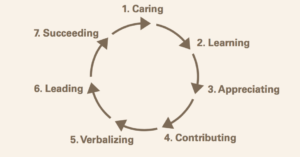
Take a look at the following graphic, which will give you an idea of what the leadership loop looks like:

You can see that it’s a cycle that starts with caring and ends with succeeding.

  1. Caring – Taking an Interest in People

You have to show people that you care about them by taking an interest in them. People always move toward someone who increases them and away from anyone who decreased them.

  1. Learning – Get to Know People

Take time to talk to your peers in the organization. Ask to hear their stories. Try to discover their best skills. Ask for their opinions on work-related issues. And as much as you can, try to put yourself in their shoes.

  1. Appreciating – Respect People

We should strive to see others’ unique experiences and skills as a resource and try to learn from them. If you treat your peers with this kind of respect, appreciating them for who they are, then they will be more likely to respect and listen to you in return.

  1. Contributing – Add Value to People

Few things increase the credibility of leader ore than adding value to the people around them. When you go out of your way to add value to your peers, they understand that you really want them to when with no hidden agenda of your own.

  1. Verbalizing – Affirm People

Few things build people up like affirmation. When you affirm people, you make firm within them the things you see about them. If you want to influence your peers, become their best cheerleader.

  1. Leading – Influence People

The things you’ve done up to know have served to build your relationship with them, give you credibility, and display that your motives are good. With that kind of history, you will have earned the opportunity to influence them.

  1. Succeeding – Win With People

Great leaders don’t use people so that they can win. They lead people so that they all can win together. The wonderful thing about helping others succeed is that it earns you more opportunities to help an even greater number of people.

If you help others succeed, additional people will come into your life whom you will have an opportunity to help succeed, and the cycle will start over again.

John C. Maxwell, The 360° Leader

A NEXT STEP

Draw the leadership loop pictured above, and post it in a visible, but out-of-the-way place in your office or work area as a reminder.

Create a matrix on a spreadsheet listing your peer’s names in a horizontal column, and the seven leadership loop actions in a horizontal row across the top.

Over the next month, review the seven actions above on a daily basis, and intentionally schedule and follow through on these actions each day with your peers. At the end of each day, make a brief note in the respective place what action you have taken with each of your peers.

At the end of the week, review your progress, and consider how you will continue and improve in the next week.

At the end of the month, call your team together and debrief your experiment with them.

  • Ask them at what point they realized you were doing something differently.
  • Ask them what they thought about your actions.
  • Encourage them to express what it felt to them as an individual.
  • Ask them if they, in turn, began to do some of the same things with others.
  • Discuss with the group how the actions you took increased the relationships of the team.
  • Challenge your peers to work through the leadership loop in a similar manner.

Excerpt taken from SUMS Remix 79-2, issued November 2017.


Part of a weekly series on 27gen, entitled Wednesday Weekly Reader

Regular daily reading of books is an important part of my life. It even extends to my vocation, where as Vision Room Curator for Auxano I am responsible for publishing SUMS Remix, a biweekly book “excerpt” for church leaders. Each Wednesday on 27gen I will be taking a look back at previous issues of SUMS Remix and publishing an excerpt.

>>Purchase SUMS Remix here<<


5 Simple Things You Can Do to Help Design Your Life

Your divine design, as expressed in Ephesians 2:10, is more knowable than you realize. You are God’s workmanship created in Christ Jesus to do good works, which He has prepared in advance, that you should walk in them.

With the right tools, courageous dialogue, and an experienced guide, you can accelerate progress in articulating your life vision and aligning your life vocation.

Auxano Founder Will Mancini and pastor Dave Rhodes have developed those tools: Younique, a life-long process of discovering and living out your unique life call.

Once you read through this “appetizer,” read more about how you can and should know your Life Younique: your God-given identity and your God inspired dreams. Then, you can discern and design the practical next steps to get there.

THE QUICK SUMMARY – Designing Your Life by Bill Burnett and Dave Evans

At last, a book that shows you how to build – design – a life you can thrive in, at any age or stage.

Designers create worlds and solve problems using design thinking.

In Designing Your Life, Bill Burnett and Dave Evans show us how design thinking can help us create a life that is both meaningful and fulfilling, regardless of who or where we are, what we do or have done for a living, or how young or old we are. The same design thinking responsible for amazing technology, products, and spaces can be used to design and build your career and your life, a life of fulfillment and joy, constantly creative and productive, one that always holds the possibility of surprise.

A SIMPLE SOLUTION

As you look around your office, home, or the coffee shop where you are reading this, you will realize that everything surrounding you was designed by someone. And every design started with a problem.

The same process that created the things around you can be applied to designing something far more important – your life.

Like the unique lamps or furniture, a well-designed life will have a look and feel all of its own. You can use design thinking to create a life that is meaningful, joyful, and fulfilling.

You never finish designing your life – life is a joyous and never-ending design project of building your way forward.

A well-designed life is a life that makes sense. It’s a life in which who you are, what you believe, and wheat you do all line up together.

A well-designed life is a marvelous portfolio of experiences, of adventures, of failures that taught you important lessons, of hardships that made you stronger and helped you know your self better, and of achievements and satisfactions.

A well-designed life isn’t a noun – it’s a verb. Just keep building your way forward. Design isn’t just a technique to address problems and projects – it’s a way of living.

Good design always releases the best of what was already there and waiting to be found and revealed.

Life design revolves around five simple things you need to do:

  1. Be curious – there’s something interesting about everything. Endless curiosity is the key to a well-designed life. Nothing is boring to everyone.
  2. Try stuff – With a bias to action, there is no more being stuck – no more worrying, analyzing, pondering, or solving your way through life.
  3. Reframe problems – Reframing is a change in perspective, and almost any design problem can use a perspective switch.
  4. Know it’s a process – Awareness of the process means you don’t get frustrated or lost, and you don’t ever give up.
  5. Ask for help – Radical collaboration means that you aren’t alone in the process.

You can apply some of the five mindsets virtually anywhere, on any given day. The opportunities to live into being curious or to try stuff are endless.

Bill Burnett and Dave Evans, Designing Your Life

A NEXT STEP

Write the five mindset phrases above, each to a single journal page. On a weekly basis, work through the following steps.

Be Curious – choose a new or new-to-you topic which you have just heard about in terms of your ministry area. Reflect on the following questions:

  • What would someone who is interested in this want to know?
  • How does it work?
  • How did it used to be done?
  • What is the most interesting thing about it?
  • What do I need to learn more about?

Try Stuff – choose a new ministry topic or event in the near future. Reflect on the following questions:

  • How can we try this – even on a small scale – this week?
  • What would we like to know more about?
  • How do I go about finding out?
  • What will we learn when we expand the scale?

Reframe problems – choose a recent ministry event that has concluded. Reflect on the following questions:

  • What perspective am I viewing the event from?
  • How can I change to a completely different perspective and view the event?
  • What other perspectives could other people have about the event?
  • In describing the event from other perspectives, what new information did I learn that will be helpful the next time?

Know it’s a process – choose a ministry idea that someone on your team has talked about but not yet implemented. Reflect on the following questions:

  • List all the steps leading up to, and following after, the idea.
  • What would happen if you didn’t think more than one step ahead?
  • What’s the worst thing that can happen? What would you do?
  • What’s the best thing that can happen? What will you do?

Ask for help – identify a ministry action or event that you have been thinking about, but is not yet public. Find a peer you can talk to about your ideas, using these questions:

  • Describe the idea in five minutes, then ask for five minutes of feedback.
  • List the individuals and/or groups that would be involved in launching this idea. Are you connected to, and in conversation with, all of them?
  • Keep an “ask-for-help” journal, and right down questions you want help on. Each week, identify people who can help you, and ask them for help.

By keeping the mindsets as an active orientation in your daily life, you will soon see how they can help you continually design your life.

Excerpt taken from SUMS Remix 80-1, issued November 2017.


Part of a weekly series on 27gen, entitled Wednesday Weekly Reader

Regular daily reading of books is an important part of my life. It even extends to my vocation, where as Vision Room Curator for Auxano I am responsible for publishing SUMS Remix, a biweekly book “excerpt” for church leaders. Each Wednesday on 27gen I will be taking a look back at previous issues of SUMS Remix and publishing an excerpt.

> >Purchase SUMS Remix here<<

Understanding the Seven Elements of a Discipleship Lifestyle

Discipleship is a process that begins after conversion and continues throughout a believer’s life. Discipleship calls for our undivided attention and commitment to follow the commands of our Lord. Discipleship is not an option for any church or believer. Christ mandated it in the Great Commission. To disciple others is to obey our Lord’s command; to do otherwise is to disobey Him.

It becomes easy for every church’s disciple-making mission to get cluttered with lots of things to do. And most church leaders are very good at doing things. As a result, administration of programs replaces actual disciple making practices. As you look ahead to the next year, slow down and refresh your conviction for disciplemaking by looking to the Master himself.

How does a Jesus-centric disciplemaking conviction rescue you from a “program management” culture? Have you resigned to herding people through classes and events? Are you relying too much on better preaching? Or do you have a robust, disciple-making strategy built around life-on-life investment, like Jesus?

THE QUICK SUMMARY – The Disciplemaker’s Handbook, by Bobby Harrington and Josh Patrick

Many people believe that discipleship is important, but they need help. In fact, the vast majority of Christians report that they have never been personally discipled by a more mature follower of Jesus. Is it any wonder that they have a difficult time knowing how to disciple others?

If making disciples of Jesus is the greatest cause on earth, how should we equip people to do it? This handbook is a practical guide for how to embrace the discipleship lifestyle – being a disciple of Jesus and how to make other disciples of Jesus.

Whether you are a parent who wants to disciple your children, a small group leader who wants to disciple those in your group, or a church leader who wants to disciple future leaders, the seven key elements in this handbook form a framework for understanding discipleship that can be applied in countless situations. In addition, there are questions provided in each section to help you think through how to apply the material to your disciple making efforts.

A SIMPLE SOLUTION

Auxano Founder Will Mancini recently recalled a conversation with Robert Coleman, author of “The Master Plan of Evangelism.” Coleman’s comment was “ The disciples were not surprised by the Great Commission.” He was clarifying that the mission to make disciples was not a new idea of a novel thought. It was what the twelve had seen modeled in every nook and cranny of life. Furthermore, every act, every event, every word of our Savior had a multiplication intent. And as a ministry leader you are reading this today, called by God and leading ministry, because his intent translated to impact.

So stop your “doing” that just “does.” Focus, prioritize and practice-until-you-master the kind of “doing” that multiplies

These seven elements are simply a framework we’ve found helpful in summarizing Jesus’ disciplemaking method, helpful for personal discipleship and teaching in a local church context.

Relationships – The central impulse for explaining Jesus’ mission to others and to make disciples is love. As John 3:16 says, “For God so loved the world that he have his one and only Son.” By his example, Jesus showed us that disciple making is the development of genuine life-on-life relationships motivated by Jesus-style love.

Jesus – Jesus drew people to himself. He was unabashed and clear in speaking the truth. He is the centerpiece and the focus of all discipleship. We are not discipling people into a program; we are introducing them to a person. The mission of Jesus was to give himself in love for the sake of others so that people would know him, reassure him, and promote him and his message to others.

Intentionality – Jesus had a strategy. He had a plan, a road map for making disciples, what Dr. Robert Coleman calls The Master Plan. Jesus guided, coached, and developed his disciples into disciple makers and released them, commissioning them to disciple others as Jesus had discipled them. Their disciple-making work changed the world.

Bible – The Word of God is the training manual that Jesus relied upon in his ministry and provided for all discipleship and teaching. As the author of the Scriptures, Jesus has provided its contents, in both the Old and New Testaments, to give us his teaching, his correction, and his training on the important matters of life and godliness.

Spirit – Jesus’ life and ministry were fueled by the Holy Spirit. After living for thirty years in obscurity, Jesus began formally making disciples after the Spirit descended upon him when he was baptized. From that point forward, he remained in a constant state of openness to the Spirit.

Journey – Jesus led his disciples on a journey, inviting them to learn by walking with him and watching him. Though it is a disjointed growth story, it begins with his invitation to come and see and culminates with the Great Commission, where they are sent to go and multiply.

Multiply – Jesus’ master plan was to make disciples who were like him in their message and their methods, and then to multiply them by sending them out to disciple others as they had been discipled by him. Jesus teaches us to make disciples who make disciples until the end of time.

Bobby Harrington and Josh Patrick, The Disciplemaker’s Handbook

A NEXT STEP

Set aside one morning or afternoon for a personal retreat. Go someplace that is out of the office and life giving. Allow yourself time to unplug and reflect on the questions around each of the seven elements of discipleship. Journal your responses to each question below.

Relationships

  • Why is a commitment to relationships so important in disciple making? Are you willing to make the relationship with the person(s) you are discipline a priority?
  • Why is a church community important in discipling relationships?

Jesus

  • In what ways does a person’s understanding of Jesus and his gospel impact the kind of disciple they become?

Intentionality

  • What is intentionality and why is it important in discipleship?
  • For the discipling relationship you want, what special knowledge and skills do you need?

Bible

  • In what way is Jesus central to personally knowing the Bible?

Spirit

  • How do we stifle or work against the Spirit?
  • How do we encourage the work of the Spirit?

Journey

  • Why is it important to know and understand the basic discipleship journey?

Multiply

  • In what way is discipleship the ongoing need of all Christians and the core mission of the church?

After this time of reflection and prayer, what would God have you to do as a result? Identify one to two next steps in your personal disciple-making journey to act on in the next seven days. After walking this road for a season, lead others from your team to do the same.

Excerpt taken from SUMS Remix 77-1, released October 2017.


Part of a weekly series on 27gen, entitled Wednesday Weekly Reader

Regular daily reading of books is an important part of my life. It even extends to my vocation, where as Vision Room Curator for Auxano I am responsible for publishing SUMS Remix, a biweekly book “excerpt” for church leaders. Each Wednesday on 27gen I will be taking a look back at previous issues of SUMS Remix and publishing an excerpt.

>>Purchase SUMS Remix here<<


How Are You Using Social Media to Tell a Bigger Story?

Communication today is real-time, all the time. Thanks to the continuing innovations in technology and the rapid rate of adaption, events that occur around the world – or across the street – are now capable of being seen by millions of individuals. And it’s not just the “viewing” that is important – it’s what effect those views have on the individual watching them.

The social media platforms that exist today, as well as those which are being developed and will be the next big thing, can have a far-reaching impact on the ministries of your church.

Are you taking advantage of them? Or, do you feel like they take advantage of you? Is social media creating communication traction? Or is it becoming a constant distraction?

THE QUICK SUMMARY – Trending Up, edited by Mark Forrester

Every church has a story that can change the course of people’s lives but how do you share that story beyond your four walls?

Throughout these pages, you’ll find simple strategies for creating powerful content that can connect your church to the people who need the life-changing story of Christ. Leading church communications specialists break down complex social media themes, providing accessible, practical answers to questions that all churches face, such as:

  • What should I be posting based on my goals?
  • How do I use social media as a tool to foster community?
  • How do I get the people I’m trying to reach with social media?

With this book, your church will be ready to reach one of the biggest missions fields today: the billions of active users on social media. Topics include:

  • Why Social Media?
  • Content Strategy
  • Story: Your Church’s Story & God’s Story
  • Connecting with Your Church
  • Reaching Your Community

The book includes recommended books, websites, blogs, and other tools to help you develop your social media presence.

A SIMPLE SOLUTION

The power of story to captivate people and move them to action has been used by leaders for thousands of years. From the earliest oral traditions passed from generation to generation to cat memes that have a lifespan only as long as it takes to view them, stories can be a powerful communication tool.

The platform of social media can take the power of story and communicate it instantly to hundreds or thousands of people. With it, you can connect with people at work, at home, in the car, at the store – literally almost anywhere.

However, that same platform can turn off hundreds or thousands of people if it is not used in a way that aligns with the rest of your church’s story.

Your social media strategy should fit into everything your church communicates, which means it must fit into a bigger story.

The best way to bring social media into a bigger story is to use it to help tell the three bigger stories already happening around you: your church’s bigger story, your community’s bigger story, and God’s bigger story. Identifying each one is the first step in understanding how social media can complement – and not compete with – everything you do.

Connect to Your Church’s Bigger Story

There’s a good chance your church has boiled down its work into one simple mission statement. Everything you do as an organization – from program and marketing to human resources – should fit into this concise statement. That includes social media.

Every picture and video, post, and reply is aimed at furthering your mission,

Connect to Your Community’s Bigger Story

If you look long and hard at the community you live in, there’s a good chance you’ll see groups of people gathered around certain ideas. Your community is crawling with bigger stories.

Knowing your city’s DNA can help you use your social media efforts to tell your community’s bigger story. Find one or two of those stories and engage your social media efforts to tell it.

Connect to God’s Bigger Story

If your church incorporates Christian doctrine into everything you do, why shouldn’t you include social media? If we meet, pray, and serve because the Bible tells us to, may Scripture offers direction can be guided as well.

It might seem a bit trite, but the more you can connect your social media strategy to the words God has given us through Scripture, the better. Simply put, obeying God’s bigger story can help your social media to tell a bigger story.

Mark Forrester, Editor, Trending Up

A NEXT STEP

Make a chart tablet sheet for each of the three “bigger stories” listed above. Draw a vertical line down the middle of each chart tablet under the title.

In a team meeting, ask your team to review each of the three chart tablets and list social media actions that you are currently doing for that topic. Complete each of the three chart tablets in a similar manner.

Next, evaluate the lists. Are these actions effective? How do you know? How are you measuring effectiveness? Is there something you could be doing, but are not, to make the action more effective? If so, assign responsibility for someone on the team to ensure that is done.

Next, ask your team to review each of the three chart tablets and list social media actions that you should be doing for that topic. Complete each of the three chart tablets in a similar manner.

On another chart tablet, pull out the actions you should be doing, and group them under similar headings. For example, all actions under “Instagram” will be written under that heading. After you have grouped the actions by category, discuss as a team which are the most important for you to accomplish first.

Pull out the top three items, and assign responsibility, a timeline, and checkpoints for each. At a future meeting, discuss the status of each.

After the top three have been accomplished, measure their effectiveness, and review with the team how they need to be revised, left as is, or scrapped.

Follow the same process with all items on the list, three at a time, until all have been implemented.

Excerpt taken from SUMS Remix 78-1, issued October 2017.


Part of a weekly series on 27gen, entitled Wednesday Weekly Reader

Regular daily reading of books is an important part of my life. It even extends to my vocation, where as Vision Room Curator for Auxano I am responsible for publishing SUMS Remix, a biweekly book “excerpt” for church leaders. Each Wednesday on 27gen I will be taking a look back at previous issues of SUMS Remix and publishing an excerpt.

> >Purchase SUMS Remix here<<