
In the final post of a four-part mini-series revolving around books, there was a look at the history of the library, the role of books in both shaping conflict and being shaped by conflict, how book design impacts the reading experience, and now some closing thoughts on words themselves.
Almost everything we do involves words. Words are how we persuade, communicate, and connect. They’re how leaders lead, salespeople sell, and parents parent. They’re how teachers teach, policymakers govern, and doctors explain. Even our private thoughts rely on language.
But certain words are more impactful than others. They’re better at changing minds, engaging audiences, and driving action. What are these magic words, and how can we take advantage of their power?
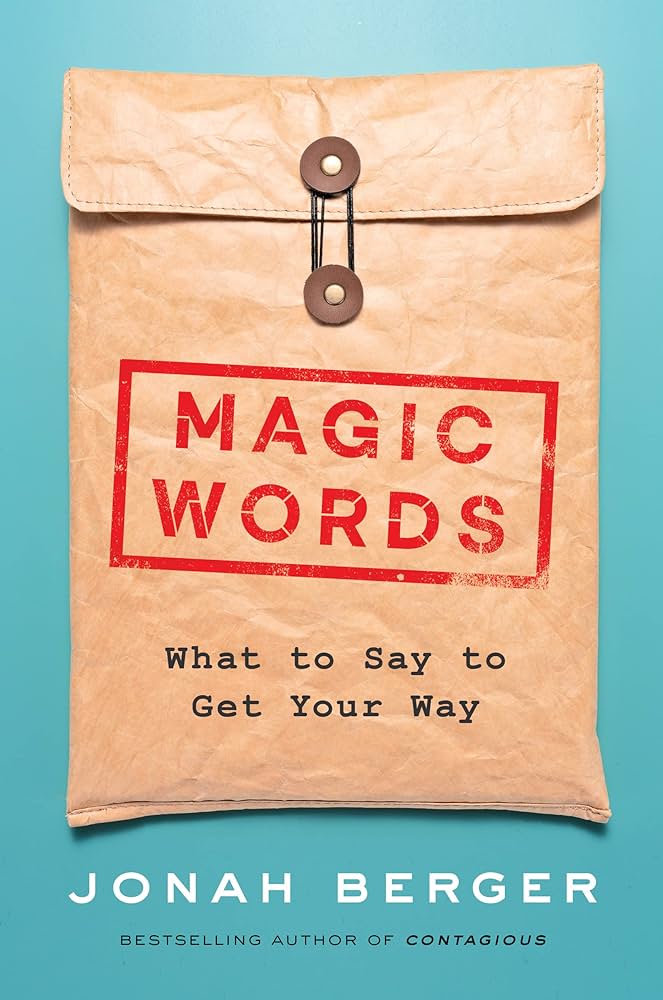
In Magic Words, internationally bestselling author Jonah Berger gives you an inside look at the new science of language and how you can use it. Technological advances in machine learning, computational linguistics, and natural language processing, combined with the digitization of everything from cover letters to conversations, have yielded unprecedented insights.
Learn how salespeople convince clients, lawyers persuade juries, and storytellers captivate audiences; how teachers get kids to help and service representatives increase customer satisfaction; how startup founders secure funding, musicians make hits, and psychologists identified a Shakespearean manuscript without ever reading a play.
This book is designed for anyone who wants to increase their impact. It provides a powerful toolkit and actionable techniques that can lead to extraordinary results. Whether you’re trying to persuade a client, motivate a team, or get a whole organization to see things differently, this book will show you how to leverage the power of magic words.

Magic Words, authored by Jonah Berger, delves into the concealed mechanisms governing language and, more significantly, delineates strategies for employing it more persuasively, nurturing relationships, and achieving success in both personal and professional realms.
The book explores six categories of influential words, devoting a chapter to each of these areas:
Activating Identity and Agency: Words that delineate authority, responsibility, and engagement in actions. This chapter delves into the profound impact subtle alterations in language can have, such as the efficacy of using nouns over verbs in persuasion, mastering the art of refusing to advance towards goals, and adopting specific interrogative phrases to enhance creativity and problem-solving. Furthermore, it discusses how speaking in the third person can mitigate anxiety and enhance communication, along with the nuanced effects of pronouns like “you” on social interactions and empathy.
Conveying Confidence: Language not only communicates information but also conveys the speaker’s confidence, thereby influencing perceptions and sway. This chapter explores how eliminating certain words transformed an underperforming salesperson into a top achiever, the significance of linguistic style in legal discourse, and linguistic cues that enhance credibility and authority. It also delves into the allure of certainty and the strategic use of uncertainty in communication to foster trust and receptivity.
Asking the Right Questions: This chapter delves into the science behind effective questioning, revealing why seeking advice enhances perceived intelligence and increases the likelihood of securing subsequent dates. It elucidates the types and timing of questions for optimal outcomes, strategies for deflecting challenging inquiries, and techniques for fostering deeper social connections through inquiry.
Leveraging Concreteness: Highlighting the potency of concrete language, this chapter reveals how specific words convey attentive listening and why emphasizing “fixing” rather than “solving” problems enhances customer satisfaction. It explores instances where abstract language may be advantageous, signaling authority and leadership, and discusses its role in fundraising for startups.
Employing Emotion: Exploring the emotive dimension of language, this chapter unveils how emotional language enhances engagement across various contexts. It narrates anecdotes, such as the success story of a young intern who built a podcasting empire by mastering storytelling principles. Additionally, it delves into the interplay between negative and positive emotions in enhancing enjoyment and boosting sales, offering insights into captivating audience attention and managing emotional responses.
Harnessing Similarity and Difference: This section explains the significance of linguistic similarity in interpersonal dynamics, explaining its impact on social connections, promotions, and friendships. It also explores scenarios where embracing difference proves advantageous, citing examples from music popularity trends and artificial intelligence research.
The book concludes by emphasizing the universal role of language in everyday communication, whether through written correspondence or oral discourse. It underscores the importance of mastering language for effective communication, persuasion, and relationship-building, positing that linguistic proficiency is a skill that can be learned and honed over time, empowering individuals to achieve their communication goals effectively.

Part of a regular series on 27gen, entitled Wednesday Weekly Reader.
During my elementary school years one of the things I looked forward to the most was the delivery of “My Weekly Reader,” a weekly educational magazine designed for children and containing news-based, current events.
It became a regular part of my love for reading, and helped develop my curiosity about the world around us.
 27gen.com