Making a Leadership Emulsion

Some of the most flavorful, satisfying, and versatile sauces in the culinary world are an emulsion – but you’ve got to work to make one.

This is an emulsion: an agreement between two unlike elements (butter and water), achieved by heat and motion. If you get it slightly wrong – as when the sauce starts to dry out, destroying the balance between the fat and the liquid – the unlike elements pull apart and break up. When that happens, it takes more work to get the emulsion back to where you want it than it did to get it in the first place.

As a ChurchWorld leader, you are, in effect, an emulsion.

Both leadership and management are necessary skills to bring your organization forward. While many people separate “leadership” and “management,” they are both necessary.

Leadership involves inspiring, motivating, crafting a vision, setting direction, strategic thinking, and bringing out the best in your people.

Management involves planning, tracking, and measuring – in short, handling all the nuts-and-bolts of day-to-day business operations.

People in positions of responsibility and leadership – like you – need to do both well in order to be successful. This need dramatically intensifies during times of economic uncertainty, shifting internal and external forces, and the constant need to do more with less – like now.

You need to be an “emulsified leader:” building solid skills in both leadership and management AND the ability to switch gracefully between the two.

Establishing a Culture of Service

Yesterday’s post introduced what I have found to be the number one question I encounter in talking with leaders in ChurchWorld:

How do we discover/train/keep more volunteers in our church?

I have dozens of conversations with church leaders every week. In almost every conversation – no matter what the original topic – the question above comes up. Large or small, rural or urban or suburban, traditional or contemporary, denominational or non-denominational, the question is always being asked.

Yesterday I began a series of posts on the concept of volunteers in ChurchWorld. I introduced the topic with the first of two  articles written in 2009 for Church Solutions magazine. They were based on a unique experience I had at my church that summer – one that changed my perspective and trajectory. You can read the first one here. And here’s the second… 

Establishing a Culture of Service (originally written for Church Solutions magazine in August 2009)

If you took a poll of church leaders about some of their biggest problem areas in churches today, you are sure to find some variation of “we need more workers” in the top three. I grew up in the home of two very committed parents who served in a lot of different church positions over the years. As a young teenage believer, I helped out where I could. As a young married adult, my wife and I volunteered for numerous positions in our college and seminary churches. While serving in church staff positions for over 23 years, I also served in different volunteer capacities. When I transitioned into the role of a church consultant, I continued in volunteer roles in my church. As I look back over these decades of experiences, the need for more workers is a prominent and consistent memory.

What if it didn’t have to be that way?

A few weeks ago I wrote about Elevation Church in Charlotte NC and their efforts in enlisting volunteers for their kick-off Sunday in the fall. In that post, I noted the events of the day and posed a question: Where do I sign up? It wasn’t a rhetorical question, because my wife and I had already made the decision to serve on the volunteer staff at Elevation. Here is the rest of the story.

On that “No Show Sunday” Elevation had an additional 560 volunteers sign up. That was critical because on 8/23/09, the church opened their first permanent campus, added three new worship services at two campus locations, and upgraded the facilities at their third location, thus requiring the additional volunteers. In the two weeks before the opening and expansion, each of the campus locations had volunteer recognition and training events on-site. Each of the 4 areas of volunteering had a session with the team leader going over the responsibilities of that area. Volunteers were given the task of “shadowing” a position to see if that was indeed where they wanted to serve. Our team leaders emailed and called us before our first Sunday of service. A volunteer leader packet came in the mail. So it was no surprise that a whole new cadre of volunteer leaders were eagerly in place on the first day!

Some observations of my recent experiences at Elevation:

  • Does your church have a culture of service? Do you expect that everyone will serve somewhere, doing something? If not, why not?
  • Many times, all you have to do is ask. People want to serve; they just need permission from you!
  • Make sure you are ready for the response. If you asked for volunteers and got 50 or 100 or more, would you be ready for them?
  • Establish a training/shadowing process. Volunteers don’t need 4 weeks of intensive training before they serve; most can begin right away with a minimum amount of training, continuing to learn as they serve.
  • Do you have a process to keep up with volunteers, seeing how they are doing and challenging them to strive for more?
  • Do you celebrate the volunteers who serve in your church? You couldn’t pay them to do what they do, but it is nice to recognize their gifts of time and service throughout the year.
  • Is volunteering a high value for your church? Do your full-time staff positions recognize the crucial role volunteers serve and respond appropriately?

I have been fortunate to serve in dozens of volunteer leadership capacities over the past four decades, but I’m very grateful to be a part of a church that knows the value of volunteers, challenges us to go beyond ourselves, and do it all while serving our Lord.

What’s the culture of service like in your organization?


Church Leaders Are Always Asking This Question…

How do we discover/train/keep more volunteers in our church?

I have dozens of conversations with church leaders every week. In almost every conversation – no matter what the original topic – the question above comes up. Large or small, rural or urban or suburban, traditional or contemporary, denominational or non-denominational, the question is always being asked.

With that in mind, I wanted to visit the concept of volunteers in ChurchWorld. I’ll introduce the topic today and tomorrow with a couple of articles written in 2009 for Church Solutions magazine. They were based on a unique experience I had at my church that summer – one that changed my perspective and trajectory.

Volunteers-The Lifeblood of Your Church (originally published 8/9/2009 in Church Solutions magazine)

 What do you do when a church experience built on volunteers throws a “No Show Sunday”? That was the experience at all of Elevation Church’s (Charlotte NC) multiple campuses this weekend as the staff designed a unique service both to honor current volunteers and encourage new volunteers as Elevation (3 campus locations, 8 services) prepares to add their first permanent site this fall and increase the number of services at each location.

Initially crafted as a response to being “a one-man show”, the weekend services began with no greeters, no parking crew, or no signs all over the place – typical Elevation features. As a matter of fact, one of Elevation’s core values is honoring guests. Not this weekend! Participants walked in to the campus locations with only a single sign at the entrance: “Elevation Church worship today”. No welcome team of any kind. Only a couple of staff members checking in kids at the different children’s areas. No resource booth. No energetic music or hosts outside the worship center: just a single sign pointing out the printed lyric sheets. A bare stage with a couple of portable speakers and a single mic stand. At each location, a single worship leader came out and led the crowd in music printed on the sheets. 

When it was time for the sermon, Pastor Steven Furtick was onscreen as usual, with a simple greeting: “Welcome to the worst Sunday ever at Elevation Church!” What followed was a powerful message for the church today, based on Jesus’ first public miracle as recounted in John 2:1-11.

  • The wedding scene in John 2 reflected a time when guests received honor; today at many churches, guests show up and we have nothing prepared.
  • Jesus disassociated himself, deferring to another time. He owed nothing at the event, but gave everything. We, who owe everything, give nothing.
  • Mary’s “do whatever He tells you” gave us instructions for obedience.

I was reminded of a comment by Uptown campus pastor Larry Hubatka several weeks before: “You never get the full experience at Elevation until you volunteer.” I wrote it down, and it came back full force today in the absence of all volunteers.

Elevation Church is driven by volunteers: 1,860 volunteers are in the database. Each weekend over 860 volunteers work over 3,295 hour per week in the four broad areas of Family Services, Guest Services, Production, and Administration. 

The powerful close came when Furtick reminded the audience that when Jesus turned the water into wine, the only ones who witnessed the miracle were the servants. When you serve, you get to witness the power of God.

Where do I sign up?

(the numbers at Elevation have changed now – we have 7 campuses, twice as many volunteers, and are continually expanding – but the principle is the same)

Tomorrow: Establishing A Culture of Service


The Window and the Mirror

Yesterday our campus pastor was talking with our leaders about being a Level 5 Leader as developed in Jim Collins’ book “From Good to Great.”
 
The conversation triggered a quick revisit to the book, and to this little gem by Collins:

Level 5 leaders look out the window to apportion credit to factors outside themselves when things go well (and if they cannot find a specific person or event to give credit to, they credit good luck).


At the same time, they look in the mirror to apportion responsibility, never blaming bad luck when things go poorly.

 
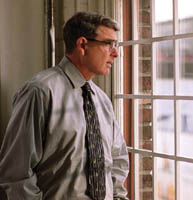
Every leader looks out the window and in the mirror.

What do you see today?

Leadership is an Art: Tapestry

If leadership is an art, then one of its most amazing forms has to be the tapestry.

Tapestry is a form of textile art, woven by hand on a loom. The vertical threads are hidden in the completed work; they are flexible in order to be drawn over and under the horizontal threads. The horizontal threads are visible, and thus have a finer quality. Because they are spun with a twist in opposite directions, they exist in tension. Together, the two types of threads create a beautiful image. Intricate, detailed images were created by artists which were then given to craftsmen to produce the finished artwork. Tapestries often contain symbolic emblems, mottoes, or a coat of arms. They were used by kings as a symbol of authority, able to be rolled up and carried to wherever the king was to be. The church used tapestries for displays on special occasions. They also served as a functional item, useful for insulation in drafty castles.

History lesson aside, a tapestry is a perfect metaphor for leaders God uses in His work:

  • God is the master Artist, creating the design of our lives; we are craftsmen who weave individual threads following His pattern
  • Leaders should not have a one-dimensional outlook on life; they need to be vertically connected to God while horizontally connected to people
  • Our connection to God should be constant, weaving over and under throughout life
  • Our connections with people are highly visible even though under some tension
  • Our leadership qualities should represent something; they are a symbol that others see and recognize what they stand for
  • As leaders, we represent authority – the question is how will you represent it?
  • Leaders are certainly visible for all to see, but they must always remember that leadership is not an end unto itself, but a function of “leading” others
  • Leadership is not fixed to a place; true leaders cannot help but lead, whether in the corporate office, the church meeting room, or the family kitchen table.

How are you weaving the threads of life into the beautiful masterpiece God has created for you?