How Can We Serve Our Neighbors If We Haven’t Paid Attention to Them?

Welcome to the age of white noise.

We live our lives in a constant tether to phones, to apps, and to social media – mostly acquiescing to FOMO.

In this age of distraction, the ability to experience and be present is often lost, as is our capacity to think and to see and to listen.

Rob Walker, The Art of Noticing

At a basic level, paying attention is simply making a selection among all the stimuli bombarding you at any moment.

Even if we ignore most of what is going on around us, we can only take in so much of the world at a time. Our sensory system has a limited capacity, both in range and in speed of processing.

I was paying so little attention to most of what was right before me that I had become a sleepwalker on the sidewalk. What I saw and attended to was exactly what I expected to see. That attention invited attention’s companion: inattention to everything else.

Alexandra Horowitz, On Looking

Questions to Ponder

  • How do you observe the all-too-familiar in order to discover new meaning and discern the activity of God that others miss?
  • What do you look for?
  • How can you learn to scrutinize the obvious?
  • What does it mean to look for the extraordinary in the ordinary?

I would like to suggest the answer to these questions begins with seeing through the lens of love.

Download the tool below to begin a ten-day journey in looking at your neighbors through the lens of love, specifically with the Fruit of the Spirit in mind.


The fruit of the Spirit are not merely characteristics that we aspire to own. They are glorious graces that characterize all those who pursue a Christlike character.

In order to “pay attention” by following the Holy Spirit, use the nine fruit of the spirit as described by pastor, professor, and storyteller, Calvin Miller as a framework for incorporating them into your life.

How to Help Your Church See Biblical Hospitality – Specifically the “Table” – as a Way of Life

In December 2019, the motion picture, “A Beautiful Day in the Neighborhood,” staring Tom Hanks as beloved television icon Fred Rogers made its debut. Rogers was the creator, showrunner, and host of the preschool television series Mister Rogers’ Neighborhood, which ran from 1968-2001.

As a musician, puppeteer, writer, and producer, Fred Rogers’ gentle demeanor brought beautiful simplicity through nurturing interactions with young children to over 30 years of viewers. His enigmatic theme song, from which the motion picture takes its title, includes the following lines, which many adults can recall:

It’s a beautiful day in this neighborhood, 

A beautiful day for a neighbor,

Would you be mine?

Could you be mine?

Fred Rogers was also a Presbyterian minister, and it’s likely those lines were inspired by another story of a neighbor.

In the Parable of the Good Samaritan (Luke 10:25-37), Jesus asked the expert in law, in effect, “Who is your neighbor?”

It’s almost 2020, and the question remains, “Who is our neighbor?”

From the television neighborhoods of Beaver Cleaver and Andy Taylor, to Mr. Rogers, to Sam and Diane, to Jerry and Kramer, to Rachel and Monica and Phoebe and Chandler and Joey, to Phil and Claire, to Jack and Rebecca and Randall and Kate, it’s a question that mainly depicts an unfulfilled longing for a neighborhood that actually works.

It occurs to me that this is not a neighborhood;

It is only a collection of unconnected individuals.

Philip Langdon, A Better Place to Live

Long gone are the days where kids played in the yards and streets all day “till the street lights came on” and where neighbors talked across fences or on front porches.

It seems as if the people we live closest to appear only briefly when the car leaves the garage in the morning and comes back in the evening. 

It seems as if the idea of “neighborhood” has disappeared in reality if not actuality, and with it the idea of knowing for, and caring for, neighbors.

As Lance Ford and Brad Brisco write in Next Door as in Heaven:

What does all this neighborhood business have to do with the gospel? As Jesus followers – people of the Good News – we follow the one who said the most important commandment is to love God with all our heart, soul, and strength, and to love our neighbors as ourselves. We have a tremendous opportunity before us: to take notice and help resurrect rich relationship in our neighborhoods.

If anyone should “neighbor” differently, it should be us.

According to Leonard Sweet, if we really want to learn someone’s story, sitting down at the table and breaking bread together is the best way to start.

This issue of SUMS Remix looks at solutions that will help you see the importance of your “table” as a place of disciplemaking. The solutions include: 

A closing quote, by Rosaria Butterfield, author of The Gospel Comes with a House Key, seems most appropriate:

Radical, ordinary hospitality brings the gospel to our lost friends and neighbors. Such hospitality sees our homes as not our own, but as God’s tools for the furtherance of his kingdom as we welcome those who look, think believe, and act differently from us into our everyday, sometimes messy lives – helping them see what true Christian faith really looks like.  

SUMS Remix 134, released December 2019


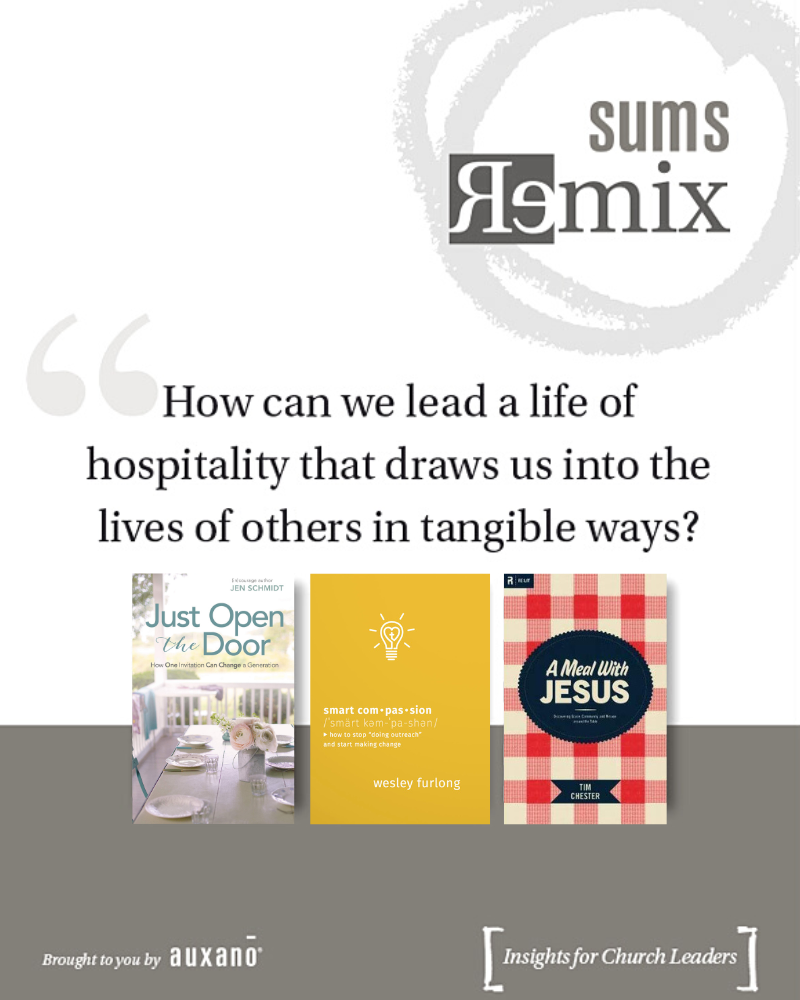
How to Lead a Life of Hospitality that Draws You into the Lives of Others in Tangible Ways

The heart of God’s purpose for humankind is relationships – first, with God Himself; then, with one another. Arguably, there is no better place to build relationships than at the table with good food and great conversation.

Len Sweet, in his book From Tablet to Table states it eloquently:

Remember God’s first command in the Bible? Eat.

Remember God’s last command in the Bible? Drink.

And everything in between is a table – a life-course meal on which is served the very bread of life and cup of salvation.

It’s time to bring back the table to our homes, to our churches, and to our neighborhoods and the world.

The table is a recurring biblical theme, one that our fast-paced, drive-through, Instant Pot culture finds unfamiliar.

What would happen if we brought back the table as a sacred object of furniture in every home, church, and community?

Are we truly hungry to accept Jesus’ invitation –  “Come and follow” – and to go wherever He leads, even if it means next door?

Especially if it means following Him next door!

What would it take for the table to return to the center of our family lives – and by extension, to those God has placed in our circle and situations?

This issue of SUMS Remix looks at solutions that will help you learn how to engage with your neighbors, establishing and deepening your relationships through hospitality. The solutions include: 

SUMS Remix 103, released October 2018


No More Front Porches

Rebuilding Community in Our Isolated Worlds

Being a part of God’s kingdom is not just having a private relationship with God but also having a communal relationship with His other children.

Linda Wilcox, No More Front Porches

Front Porches. Once they were a vital part of American society. Whether you had a large verandah that circled the house, or little more than a front stoop, you adorned it with comfortable chairs and spent hours there, talking with friends and relatives, watching what was going on in the neighborhood, looking out for others, and keeping in touch with your world. Front porches symbolized relationships and being involved with life beyond your front door.

Today, life has changed.

Few new homes offer a place to nestle as twilight sets in and few people have the leisure time for this lifestyle, or even for the relationships that it represents. We’ve moved ahead and left front porch attitudes behind as quaint relics.

But in recent decades, as the nation has reeled from tragedies such as the September 11 terrorist attacks, countless shootings, and the pandemic, Americans are again scurrying to regain that closeness, care, and compassion we found in communities that sat on front porches. Perhaps, we’re finding, we need the stability of those front porch attitudes in our lives.

In No More Front Porches, sociologist Linda Wilcox looks at how and why communities, churches, and lifestyles have changed. She evaluates the nostalgia for the ’good old days,’ and explores the offerings of today. Though we can never regain the idealized past, she gives us help and hope for building emotional and community ’front porches’ in the frantic society we now zoom through. She helps us learn how to avoid isolation and refocus our methods for building those close, front porch relationships.

Let No More Front Porches help you discover a little bit more about this society in which we live. And in the process, you’re bound to learn how to better enjoy people in your home, neighborhood, church and world.

According to author Linda Wilcox, it’s not uncommon for us, thanks to 24-hour news availability, to know more about what’s happening on the other side of the planet than what’s happening on the other side of the fence.

Written in 2002, that truism is all the more prevalent today. It’s too easy to become trapped in the digital world of 24/7, feeling always on, FOMO, and living life in the hyperspeed lane.

Only in the last decade, the author writes, have we come to “need” this much immediate contact with each other. Now, it seems, we can’t live without our devices right beside us, if not in our hands most of our waking hours.

At the same time, we desire a personal space that allows us to escape the demands of our public (and digital) lives and a place we can call our own.

And so we retreat into our closed garage doors and empty front porches, emerging in our vehicles off on an errand, returning to the same garage door, closing it before we exit the vehicle.

A pointed, and poignant, quote from the author sums it up: Let’s be realistic. Perhaps we can’t save the world [by being on the front porch], but surely we can do a better job than we have in the past.

Americans are hungry to regain the closeness, care, and compassion we used to find right outside our front doors.

inspired and adapted from No More Front Porches


Welcome home! Exploring First Place Hospitality

Recently I celebrated my 65th birthday! But it’s also the re-birth of an endeavor I’ve been working on over the past few years…

For many years, I’ve been passionate about Guest Experiences – particularly those in a church setting. While I consider that to be a critical part of welcoming people into a church setting, I’ve felt unsettled – like there was “more to the story” of hospitality.

For the last few years, a growing place in my heart has been thinking about Guest Experiences in the setting of the home.

A part of 27gen is going to explore First Place Hospitality – and it just what it sounds like.

Hospitality in your home, your “first place.”

Come on in!

If we take the Great Commandment literally, we must open our eyes and our hearts to love the people on the street where we live. The act of loving our actual neighbors is one of the simplest and yet most powerful things that we can do to make an impact in our world. 

The solutions to the problems in our neighborhoods can’t be found in governmental programs or getting more people to come to your church.

The solution is with people just like you in your neighborhood.

The solution is to get back to the basics of what Jesus commanded: Love God and love your neighbors.

Think of it as First Place Hospitality – building bridges to your neighbors in your “First Place,” your home.

Look for the most recent posts for BookNotes, Deeper Dives, Tools, or Home Hospitality Network features – new every Monday!

How Environmental Immersion Leads to Creative Inspiration

One can be inspired by research as well as immersed in it for inspiration.  Rhonda Counts, Show Producer, Walt Disney Imagineering Florida

How you do research is dependent upon where you are in the process. Disney’s Imagineers value the story’s intent and the importance of being surrounded with or immersed in the story’s environment.

Here’s an example of creative immersion from one of my past projects:

As you can see, there was a definite pirate’s theme going on in part of my office. It’s both from previous work and new work in process at the time. I’ve used the theme of the “Pirates of the Caribbean” storyline – both the attraction and the movies – to develop training resources and presentations in the area of Guest Experiences.

Specifically, I created a tool – the Guest Experience Compass. And how better to demonstrate it, than using Jack Sparrow’s compass? I also created the Guest Experience Code – and based it on the storyline of the Pirates Code. Of course, both of these tools had to be introduced and used by a pirate – the Navigator – in a fully immersive learning environment. The result?

As a result of my pirate “adventure,” I created a series of Guest Experience learning activities lasting from a half day to two days.

And it doesn’t stop with pirates.

There’s the fact that my office is, in fact, a Disney museum (a title given by my granddaughter).

rva-office-db-3

It’s continually changing as I acquire new books and other “resources” that help my inspiration.

DisneyVerticalTowers091922

It’s no secret that I am a Disney fanatic of the first degree! I had an early start in the 60s, both from watching “The Wonderful World of Disney” and benefiting from my father, who as a Gulf gasoline dealer received many promotional tie-ins from Disney movies.

My first actual in-person experience took place as a rising senior in high school during the summer of 1975, when my high school band was privileged to march in America on Parade, one of Disney’s salutes to America’s Bicentennial. I didn’t know it at the time, but looking back with minors in history at both the undergraduate and graduate level, that was an important event.

You must also add to that mix over 100 days of staying in Disney properties (both land and sea) in the last 12 years. Friends know that I can’t go long in almost any conversation without weaving in a personal Disney experience to illustrate a point.

Finally, it’s anchored by the Disney library of over 450 books (and growing!) noted above: I am literally immersed in all things Disney. As I research and work on various projects – especially Hospitality – I find great inspiration through the many resources at hand. My immersion is not limited to the visual and tactile – at any given time, the soundtrack of a Disney movie, or the background music from one of Disney’s theme parks is playing in the background.

Here’s how Disney Imagineers recommend immersion into an environment:

Select a project that you want to immerse yourself in. Make a list of all the elements of the project and find samples (the larger the better) that represent these elements. Find a place in your surroundings to display the samples so you can immerse yourself in them.

For example, if you wanted to fix up a vintage car, surround yourself with large detailed pictures of its original interior and exterior, very large color samples for its seat cushions, dashboard, etc., and exterior paint job, pictures of various locations you would drive to, and of course, spray the space with new car scent.

Research leads to inspiration.

And now, to visually introduce (and tease a new project in the works):

CreativeHospitalityWorkshop

More to come!


part of a series of ideas to help shape and tone your creative muscles

Inspired and adapted from The Imagineering Workout

written by The Disney Imagineers

Is Your Church Practicing the 4 Habits Behind a Successful Guest Experience?

I have no talents. I am only passionately curious.   – Albert Einstein

One of the joys of my work at Auxano is that I get to serve in multiple roles. My primary role of Vision Room Curator allows me to thrive in my giftedness of research and curiosity, as I am constantly looking for content that creates break-thru clarity with church teams to realize their vision.

In addition, our value of Carnivorous Learning is demonstrated daily in my research, reading, and curation of the cloud of information available for church leaders.

But when my primary role of Vision Room Curator intersects with my secondary role of Guest Experience Navigator, it’s a really good day.

Today’s Vision Room post “4 Habits Behind a Successful Guest Experience” is a great example of the mashup of my two roles. The post speaks to the idea that a primary factor in creating a great Guest Experience comes down to having great people on your front line teams and training them well.

7-Guest Experience

The post itself stands alone, but I was also able to connect it to our most recent SUMSa free book summary – on Judgment on the Front Line by Chris DeRose and Noel Tichy. The book is essential reading for any church leader whose role involves leading Guest Services, Hospitality, or First Impressions teams. The SUMS is a good introduction, but I encourage you to pick up the book as well.

What makes it a great day is that I get to live out the ideas and thoughts above in a couple of ways: this weekend, I will be conducting a Guest Perspective Evaluation for one of our client churches. Front line interaction is a key indicator of the success of a church’s Guest services. During my evaluation, I will take over 400 images and 3-7 minutes of video, which will be edited into a 2-hour presentation for the senior leadership team the following Monday.

In that presentation, I don’t really have to say much – if “a picture is worth a thousand words,” the several hundred images and a few minutes of video have to be worth a book!

On any given weekend, Auxano Navigators are at a church somewhere across the country making the same kind of evaluations for our clients. It’s a powerful service that we love providing.

Beyond the occasional onsite consultation, I also get to live out my role mashup by serving on a Guest Services team at my church, Elevation Church’s Lake Norman campus. After 4 years as a Guest Services Coordinator at our Uptown campus, I stepped over to the launch of our newest campus in the Lake Norman area to serve on the parking team. (I serve an additional role on the Leadership Development team for the church as a whole, but that’s a story for another day).

My Team Coordinator Skyler and Team Leader Jason have demonstrated an excellent grasp of the 4 activities mentioned in the Vision Room post above:

  1. In spite of intentional preplanning for the launch, they listened to our team’s suggestions each of the following 3 weekends to improve traffic flow, increase pedestrian safety, and make sure our Guests felt welcome at all times.
  2. As Coordinator, Skyler is working with our Boot Camp Team (Elevation’s volunteer enlistment strategy) to make sure Parking Team members have a great attitude.
  3. Our Parking Team – like all Elevation teams – is crystal clear on our purpose, because it’s the same as our church purpose: To reach people far from God so that they might be raised to life in Christ.
  4. Our Team Leader Jason encourages creativity and autonomy – from Ryan who “hooks and lands” VIP (first-time Guests) cars into special parking to Christiana who leads the Lake Norman Taxi Team (golf carts to get our Volunteers from their designated lot 1/3 mile away from the church) to Lindsay whose smile contest makes us all laugh – and smile even bigger.

If you lead or serve on a Guest Services, Hospitality, First Impressions or similarly functioning team, I hope you will click on the links above to read more.

Want to know more? Leave a comment below or use the contact tab above to get in touch with me.

Remember…

How your front line teams represent themselves – what they do (or don’t do), what they say (or don’t say) – that’s the powerful human “first impression” your Guest is experiencing – and will remember.

What Retailers Don’t Know – But Churches Can Learn

For the final post on my return review of Paco Underhill’s classic book Why We Buy, it’s time to dive into the brains of retailers and take a look at what they don’t know – and what churches can learn from them.

  • How many of the people who walk into stores buy something? The quick, and wrong, answer is almost 100%. The conversion, or closure rate – the percentage of shoppers who become buyers – is almost always thought to be much higher than it actually is. Conversion rates measure what you make of what you have – it shows how well (or how poorly) the entire enterprise is functioning where it counts the most: in the store. It’s all about what happens within the four walls of the store.

ChurchWorld Lesson: How effective are you with what you’ve got in terms of ministry? Marketing, advertising, promotion and a great location can help bring guests to your church – but it’s the job of your leadership team, the ministries you’re attempting, and the entire church body to make sure the Guests not only leave fulfilled, but return. Maybe as second timers, maybe eventually as participants and then members. The lesson: How are your assimilation systems working? Sure, you’ve got a great front door, and maybe even a few effective side doors – but how big is your back door?

  • How long does a shopper spend in the store? Assuming that he or she is shopping and not standing in line, this may be perhaps the single most important factor in determining how much she or he will buy. Studies have shown a direct relationship between the amount of time in a store and the resulting sales volume; usually a buyer spends almost 50% more time than a non-buyer.

ChurchWorld Lesson: There are certainly differences of opinion in the church world as to how long you want Guests and members to linger before or after worship services. Churches with multiple services often need to have a smooth transition from one service to another. This is an area where design or renovation can play a critical role: make adequate space for a foyer, café, other gathering place so that those who choose to do so can fellowship with others. Another opportunity for evaluation in this area might be the pace of services – does the timing/scheduling need to be altered?

  • What is the store’s interception rate? Interception rate is the percentage of customers who have some contact with an employee. This is an especially important measurement in a time when stores use fewer full-time employees and more minimum-wage employees. Research has established a direct relationship: the more shopper-employee contacts that take place, the greater the average sale. Talking with an employee has a way of drawing a customer in closer.’

ChurchWorld Lesson: This is a critical factor in making Guests feel welcome to your church. Well-trained and observant Guest Experience teams should make all people feel welcome to your church by extending a verbal welcome and offering a handshake or other appropriate physical touch. Guests especially need to have a verbal interaction with someone beyond a cursory “Good Morning”. The key is to engage the Guest as you are attending to their needs.

  • How long does the store make customer’s wait? Studies have shown this is the single most important factor in customer satisfaction. Few retailers realize that when shoppers are made to wait in line (or anywhere else) their impression of overall service plunges.

ChurchWorld Lesson: While church participants aren’t likely to leave like a shopper might in a long checkout line, it can happen. Most often you will find this expressed in the parking lot – in church consultations observing traffic patterns I have seen cars pull in, find no parking spots, and pull right back out onto the street. Examine all your areas where waiting might occur – can you reduce, or eliminate, wait time?

  • Who are the shoppers in the store? Take the retail store who stocks pet treats on upper shelves, unaware that the main buyers of this product were senior adults and young children. Or the family style restaurant who had too many tables for two and not enough for four or more, which caused headaches during busy times. Or the Florida-based drugstore chain’s Minneapolis branch, where a full assortment of suntan lotions was on prominent display – in October.

ChurchWorld Lesson: This is probably one of the most important areas church leaders can discover – and one that many church leaders get wrong over half of the time. Who is in your target area of ministry? Who is coming to your church? Who is not coming to your church? Grouped under the broad area of demographics, this type of information is invaluable to help you understand who your neighbors are and how they may be changing. Once you understand the who, it is much easier to begin to answer the how, where, and why questions of ministry.

As I close this brief foray into the science of shopping, I need to remind you of a couple of things: First, there is a whole lot more about this area that I think could be very beneficial to churches who want to make sure they are doing all they can to attract and retain Guests who come to their churches. My focus has been on the front end of that – hospitality – and there is a lot more. Interested? Contact me for a conversation.

Also, there are probably many who would say all this focus on the church guest and member in a consumer mindset is wrong. Certainly, everyone is entitled to their opinion. Mine is that we live in a very consumer-driven, consumer-oriented society. The competition for churches seeking to reach new people is not other churches – it’s any place and any experience that these people will compare your church to.

Shouldn’t we be doing the very best we can to reach them?

Read Part 1 of this series here.

Read Part 2 of this series here.

Shopping and the Church

This post by my boss Will Mancini on how churches can leverage trends in retail brought to mind some research I had done a couple of years ago about the connection between retail stores and the church.

What? You don’t think there are some similarities between the two? Read on, and then let me know what you think…

Paco Underhill, the founder and CEO of Envirosell, Inc. wrote the book on the science of shopping – literally. Why We Buy, originally written in 1999 and updated in 2009, is a witty and pragmatic report from the retail trenches on consumers’ tastes and habits — what makes them tick, what happens to people in stores, how to influence or change customers, and how and why customers change stores. Envirosell is a research and consulting firm that advises a blue-chip collection of Fortune 100 companies seeking to understand the behavior and motivation of the contemporary consumer. Envirosell films, records, and follows 50,000 to 70,000 shoppers through their retail experiences in stores, banks, and public spaces. Underhill uses video, trained “trackers” (researchers who discreetly cruise the aisles tracking shoppers and making notes on their activities), and photo analysis to help retailers understand why consumers buy – or don’t. Here’s a quick story that shows how Underhill and the Envirosell team’s research documented, then changed, the way many stores market a common item today.

A large company owned a chain of drugstores throughout the country. In efforts to understand buying patterns, they had Underhill study a typical store near their headquarters. It was located in an enclosed regional mall in the Northeast. The store’s sales were good overall, but in one category – analgesics – it was underperforming. Video study showed that the closure rate – the percentage of shoppers who bought – was below expectations. Plenty of customers picked up the packages, read the labels, but didn’t complete the purchase. The company’s previous studies had shown that the conversion rate was high, so there was another factor at work.

store aisle

Over the course of three days, a pattern emerged. The aspirin was displayed on a main aisle, on the path to some refrigerated cases of soft drinks, which tended to draw many customers to that section of the store. The main customers for the cold drinks were teenagers, many of them mall employees on a quick break. They would rush down the aisle, grab a drink, and hurry back to the front to checkout. Along the way, they would have to brush by customers – often median and senior adults in the aspirin aisle. The video studies showed that many times the aspirin shoppers would simply stop their browsing and walk away empty-handed.

The primary learning was that a store has more than one constituency, and it must therefore perform several functions, all from the same premises. Sometimes those functions coexist in perfect harmony, but other times they clash.

Hello? Does this sound like your church? Do you not have various constituencies “competing” for the same space and resources? Does it often seem like a tug-of-war with no winners?

The solution for the drugstore chain? They moved the aspirin to a quieter section of the store, where sales rose 15% immediately. They also located a selection of cold drinks and snacks close to the front of the store – a move that has now become industry standard.

That’s what the science of shopping can teach the church. People have habits on how they move in spaces, interact with others, and make decisions.

Why not study the retail world and apply those principles to the design and operations of our churches?

What are some retail lessons you have observed and have implemented at your church?

Read Part 2 in this series here.

Senses and Sensibility – Getting Back to Basics

Do you long for the “good old days” when the pace of our lives was simpler and life was slower? As comedian Will Rogers once said,

Things ain’t what they used to be – and probably never was.

There’s no use longing for the good old days. In a world that is:

  • Increasingly hurried
  • Painfully insecure
  • Physically and mentally exhausting
  • Socially and economically fragmented, and
  • Psychologically and emotionally demanding

Millions of people are desperately in need of opportunities to feel:

  • Free from time pressure
  • Safe and secure in their surroundings
  • Pleasantly stimulated, physically and mentally
  • At peace with themselves and others, and
  • Ready to be open-minded, creative, and productive

Organizations that can provide such opportunities by re-imagining the Guest experience will attract an enormous number of Guests in the years ahead and keep them coming back.

Guest experience – in a church? Here’s where the “common sense” comes into play. Just like the business you frequent often, churches delivering experiences that exceed Guest’s expectations are those to which people return, again and again, until they’re no longer Guests but full-fledged members of the church community. When a Guest thinks “Wow!” it is because he or she feels affirmed or valued. The church has said, “You matter.” While you may not be trying to sell a product, your Guest (and potential member) is very much “shopping” for a church. More important, they are shopping for a spiritual experience that addresses their personal needs. Why not make sure you do all in your power to make it happen?

A Potpourri of Guest Improvement Ideas

Visit your church …again – How familiar are you with your own church building and campus? We all tend to get comfortable with our own surroundings and overlook what our Guests see. Try to see your facilities through a fresh set of eyes – your guest’s eyes.

  • How easy is it to drive onto your campus and find convenient parking close to your buildings?
  • What’s the condition of the parking lots, sidewalks, and landscaping?
  • Are there greeters and parking lot helpers to guide you into the building?
  • Are the buildings and rooms identified?
  • Is there a welcome area that is warm and inviting and that has smiling helpful people staffing it?
  • Do you have a café or refreshment area nearby for guests and members?
  • If you have children, it is easy to find the right place for them? Do the security measures in place give you a sense of peace as you leave your child?

Visit another church in your community – What can you learn from visiting another church?

  •  How do they handle parking and greeting?
  • What kinds of signage do they use?
  • How are the people greeting one another? Do feel like they’re invading your “space”, or are you comfortable?
  • When you first walk inside the building, what do you smell?
  • Is the area visually cluttered, or pleasing?
  • What’s the noise level like?
  • Is there a café area? Is it clean?

Overall, does the facility make you feel welcome? How does the personal impact of the people fit in to the surroundings?

Visit other types of places and engage all your senses – The next time you dine out, take on the role of a critic. Not just of the food, but of the total experience.

  •  What are your impressions of the parking area, the restaurant, host/hostess, wait time, staff – and don’t forget the food!
  •  How was the experience?
  • What wowed you?

You’re not trying to find something wrong – you’re trying to train yourself to use all your senses to imagine what Guests are experiencing when they come to your church.

Identify potential distractions – and work to remove them – If your Guests become distracted because they can’t find a place to park, or their children’s room has an odor in it, or whatever, you will have a difficult time re-engaging them for the real experience you’re trying to establish: a personal encounter with Jesus. When you eliminate potential or obvious distractions, you are one step closer to satisfying your Guests.

Company’s coming – are you ready to “WOW” them? Use your common sense to engage all of your Guest’s senses and their first impression will be a positive and lasting one.

Want to know more? Expand your “sensory knowledge” by reading:

  • First Impressions: Creating Wow Experiences in Your Church, Mark L. Waltz
  • The Experience Economy, Updated Edition, Joseph Pine and James Gilmore
  • How to Think Like Leonardo da Vinci, Michael J. Gelb
  • The Starbucks Experience, Joseph Michelli
  • The Apple Experience, Carmine Gallo
  • Setting the Table, Danny Meyer
  • Chocolates on the Pillow Aren’t Enough, Jonathan M. Tisch
  • Brand Sense, Martin Lindstrom
  • Moments of Truth, Jan Carlzon
  • Why We Buy, Paco Underhill