It’s Good to Be Home: Creating First Place Hospitality

In what may seem to be direct opposition to my thoughts about front porches here and here, my wife and I have just completed a series of home renovations over the last three years that did not change our somewhat smallish front porch, but nevertheless, have increased our neighborhood connections.

It’s all about loving where you live!

Here’s the story…

My wife Anita and I have been married for 44+ years. We have three sons, (with three amazing daughters-in-law) and a daughter (married to a great son-in-law). These amazing kids and their spouses have been blessed with eleven children!

The image below represents the last time we were all together: Thanksgiving 2021 in Greenwich, NY. Since then we’ve added three little ones – all this year! Collectively, we are the #AdamsFamilyExperience!
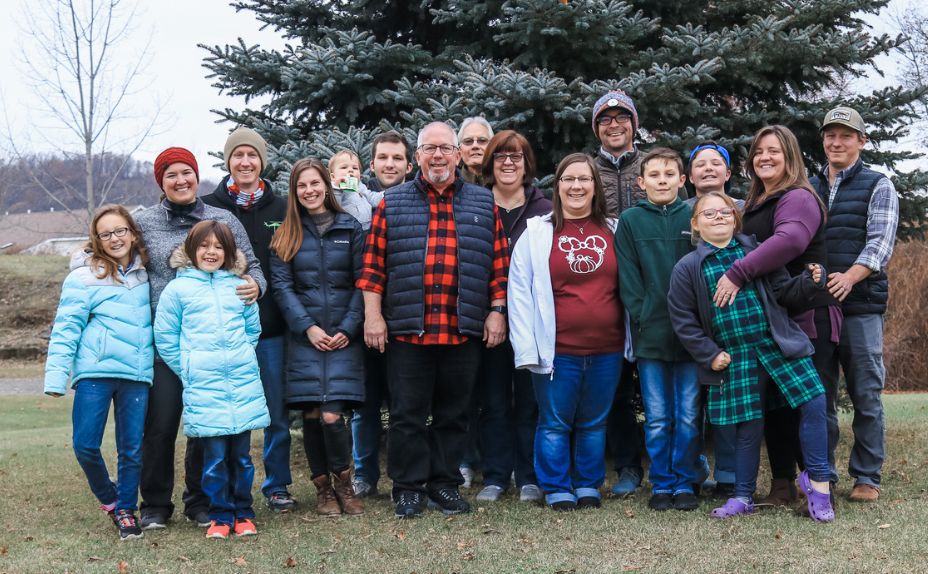
About three years ago my wife and I, as empty nesters, made the decision to stay in our long-time home (29+ years) where our kids grew up – even as they moved away to establish homes of their own from one end of the country (New Mexico) to the other (New York, then Virginia), along with two who have settled in opposite ends of North Carolina. With one family in the military and moving about every three years, we decided to stay put.

With eleven grandchildren grouped into 2 ages (five age 3 and under, and six ages 10-16), we knew we needed space for lots of different activities.

What that means IRL:

  • With 11 grandchildren, our family numbers 21 when we all gather together (plus up to four dogs). We don’t get to do that as often as we would like, but we want to be prepared when we do! Thus…
  • Our renovations, although with different purposes, were all guided by the primary intention of creating more gathering space. Functionally, that meant keeping all four bedrooms useable, but with a different purpose: each of three bedrooms formerly used by our kids became (respectively) an office for my wife, an office for myself, and a Disney room for the grandchildren. Each of those rooms can sleep two or more.
  • With three bathrooms, we had no reservations about removing the garden tub in the master bath, and creating a walk-in shower. Need to bathe infants? No problem; we’ve still got two tubs.
  • In our family room, we were satisfied with the layout, but decided to mount a large screen TV on the wall to free up space below for additional seating. The fireplace, though adequate, seemed a little lonely on the tallest wall in the house, so Anita and I designed a feature wall that our contractor built to perfection.
  • Our biggest renovation, aka “The Project” was just completed and involved adding square footage to our house footprint, totally renovating the kitchen, removing a wall between the kitchen and dining room, and adding a full-width deck across the back of our house.
  • With the interior complete, up next is the final exterior project: some work on our backyard, freshening up outdoor play space for the younger four of our grandkids who are 3 and younger; correcting drainage flow due to the new roof and deck; and adding cafe lights to a portion of our deck.

Even when our family can’t visit as often as we would love to have them, our home is dedicated to hospitality for friends, neighbors, and those we haven’t met yet. In just the first month, we:

  • Kicked off the newest space with a Mexican fiesta luncheon for our church community group
  • Invited our neighbors on one side to a impromptu family dinner as a treat for all the hard work they’ve been doing on a pool install this summer
  • Hosted two of our kids’ families for the long Independence Day weekend: four extra adults, three grandchildren, and one large dog
  • Planned a neighborhood event that had to be postponed (but will be rescheduled)
  • Made our deck and kitchen available for our neighbor’s 12-year old daughter’s birthday party – even when we weren’t at home for the weekend.

In August, our NM kids and grandkids (two adults, three children) will be staying for five days as part of a two-week vacation.

…and we’ve got lots more planned for the late summer and fall!

My wife and I share a passion: creating hospitality culture lifestyles where ordinary people demonstrate extraordinary love.

In order to help make that possible in a physical space, here’s the dedication pledge my wife and I made over our renovations:

When we understand God’s welcome to us, we can better pass it on to someone else.

When we use our lives exactly as they are, desiring only to create a sacred space for our guests, we turn entertaining upside down and it becomes radical hospitality.

We don’t need to be who we used to be; God sees who we’re becoming – and we’re becoming love.

We can’t love people we don’t know. Saying we love our neighbors is simple. But guess what? Doing it is too. We think Jesus’ command to “love your neighbor” means we’re actually supposed to love our neighbors. Engage them. Delight in them. Throw a party for them.

Jesus wants us to show people who He is by what we do, not just tell them what we think.

It’s time to bring back the table to our homes.

If we really want to learn someone’s story, sitting down at the table and breaking bread together is the best way to start. The table is the place where our identity is born – the place were the story of our lives is retold, reminded, and relived.

(Special thanks to the writings of Bob Goff and Len Sweet)

The solution is to get back to the basics of what Jesus commanded:

Love God and love your neighbors.

Think of it as First Place Hospitality – building bridges to your neighbors in your “First Place,” your home.


Next Time: Images and Acknowledgments for The Project

How to Measure the Power of Place Attachment

To be rooted is perhaps the most important and least recognized need of the human soul

Simone Weil

What if a place becomes the right place only by our choosing to love it?

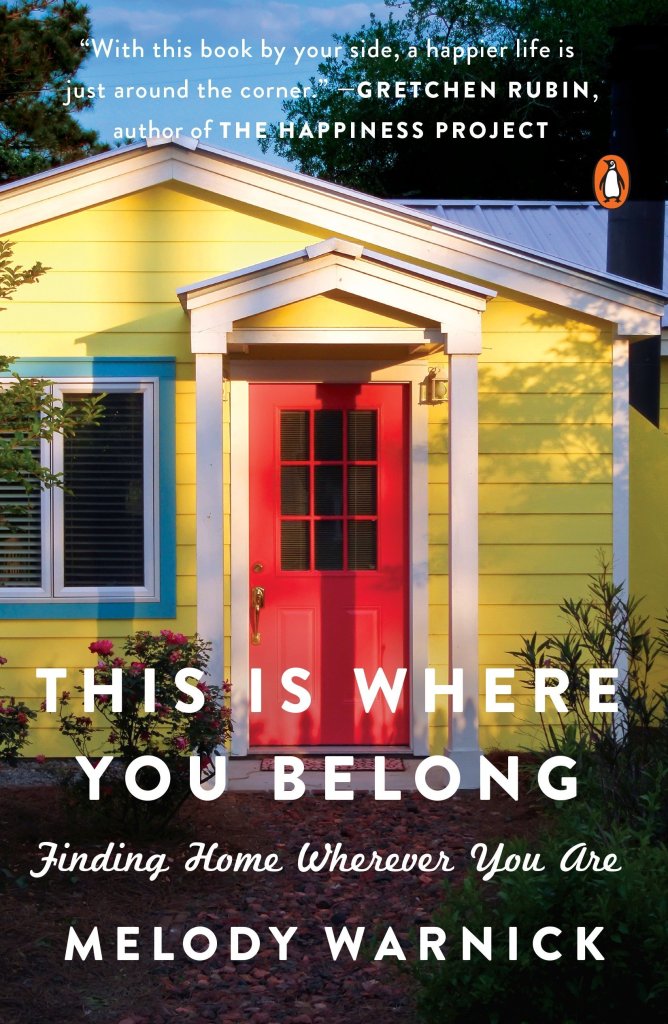
Melody Warnick, author of the fabulous book This Is Where You Belong, sets the whole tone of her book in the first chapter talking about “Place Attachment.”

Humans are instinctively driven to form connection with places. 

The most common term for this is “place attachment,” because it suggests the affectionate, almost familial connection that can form between us and where we live. You mostly know it when you feel it, which you probably have. When you roll into your town after being away for awhile and say, “It’s good to be home,” that’s a product of place attachment. So is feeling drawn as if by magic to a particular city, never wanting to leave the place where you grew up, or never wanting to leave the place you live right now.

If all this sounds a bit touch-feely, it is. Like happiness, place attachment exists partly as emotion and partly as a pattern of thought, which makes it difficult to quantify.

Over the years researchers have developed a “place attachment scale” of statements they use to gauge the sensation. Study participants are usually asked to rank their agreement on a scale of 1 to 5, but for the sake of simplicity, you can assess your own place attachment by answering each of the questions below “true” or “false” about the town or city where you live. Click here or on the image below for a PDF.

The more times you answer “true,” the more likely you are to be attached to your town. Making nineteen or more “true” answers, which puts you in the top quartile, indicates that you probably feel strongly connected to where you live. Six or fewer, on the other hand, suggests that you live somewhere unfamiliar or in a town you’re not particularly over the moon about. And if you’re not very place attached you may be saying to yourself, “Clearly place attachment feels nice. But why should I care? Will it actually make my life feel better?”

According to place attachment research, the answer is a resounding yes. Studies show that when you pit “Stayers” – long-term residents of a place – against “Movers,” the Stayers are generally far more social.

Where we live matters, and staying where we live matters. When it comes to place attachment, our towns are what we think they are.

No matter what anyone else thinks, your town just has to make you happy.

And being a good neighbor starts with you.


I can’t emphasize this enough: If you like the idea of loving where you live, of being a better neighbor, or anything remotely connected, you MUST check out the work of Melody Warnick. Follow her on social media. Buy the book (below). Sign up for her newsletter on her website. Peruse the website for other articles she has written. It’s all PURE GOLD.

Inspired and adapted from

This is Where You Belong, Melody Warnick

No More Front Porches

Rebuilding Community in Our Isolated Worlds

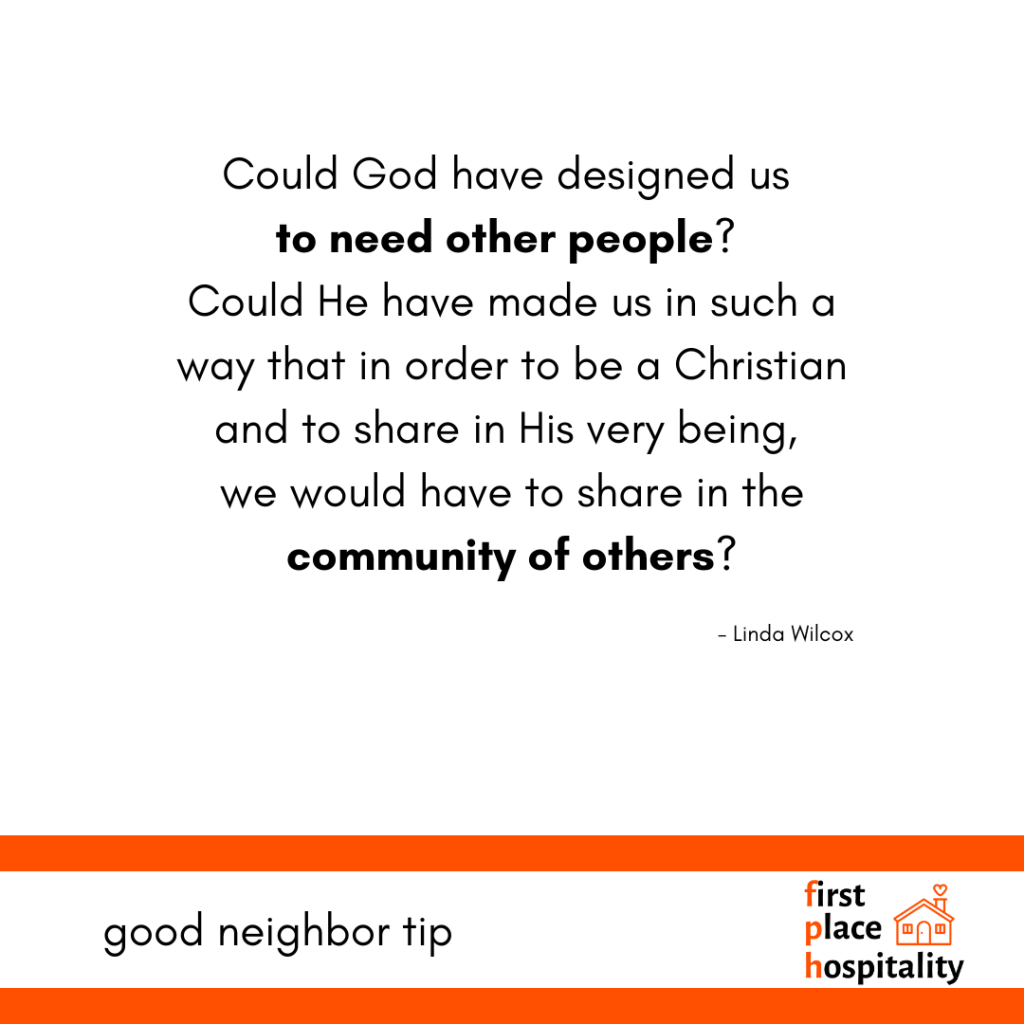
Being a part of God’s kingdom is not just having a private relationship with God but also having a communal relationship with His other children.

Linda Wilcox, No More Front Porches

Front Porches. Once they were a vital part of American society. Whether you had a large verandah that circled the house, or little more than a front stoop, you adorned it with comfortable chairs and spent hours there, talking with friends and relatives, watching what was going on in the neighborhood, looking out for others, and keeping in touch with your world. Front porches symbolized relationships and being involved with life beyond your front door.

Today, life has changed.

Few new homes offer a place to nestle as twilight sets in and few people have the leisure time for this lifestyle, or even for the relationships that it represents. We’ve moved ahead and left front porch attitudes behind as quaint relics.

But in recent decades, as the nation has reeled from tragedies such as the September 11 terrorist attacks, countless shootings, and the pandemic, Americans are again scurrying to regain that closeness, care, and compassion we found in communities that sat on front porches. Perhaps, we’re finding, we need the stability of those front porch attitudes in our lives.

In No More Front Porches, sociologist Linda Wilcox looks at how and why communities, churches, and lifestyles have changed. She evaluates the nostalgia for the ’good old days,’ and explores the offerings of today. Though we can never regain the idealized past, she gives us help and hope for building emotional and community ’front porches’ in the frantic society we now zoom through. She helps us learn how to avoid isolation and refocus our methods for building those close, front porch relationships.

Let No More Front Porches help you discover a little bit more about this society in which we live. And in the process, you’re bound to learn how to better enjoy people in your home, neighborhood, church and world.

According to author Linda Wilcox, it’s not uncommon for us, thanks to 24-hour news availability, to know more about what’s happening on the other side of the planet than what’s happening on the other side of the fence.

Written in 2002, that truism is all the more prevalent today. It’s too easy to become trapped in the digital world of 24/7, feeling always on, FOMO, and living life in the hyperspeed lane.

Only in the last decade, the author writes, have we come to “need” this much immediate contact with each other. Now, it seems, we can’t live without our devices right beside us, if not in our hands most of our waking hours.

At the same time, we desire a personal space that allows us to escape the demands of our public (and digital) lives and a place we can call our own.

And so we retreat into our closed garage doors and empty front porches, emerging in our vehicles off on an errand, returning to the same garage door, closing it before we exit the vehicle.

A pointed, and poignant, quote from the author sums it up: Let’s be realistic. Perhaps we can’t save the world [by being on the front porch], but surely we can do a better job than we have in the past.

Americans are hungry to regain the closeness, care, and compassion we used to find right outside our front doors.

inspired and adapted from No More Front Porches


How to Lead Your Church to Leverage the Everyday Moments of Their Life to Share the Gospel

Just for fun, ask this question to a group of church leaders: Is an attractional model of ministry or incarnational emphasis more effective? Then sit back, as a vigorous discussion is sure to follow.

Attractional ministry implies that the church’s basic strategy for reaching the lost revolves around getting “seekers” or the “unchurched” into the church building. Once inside, the opportunity to present the gospel defines the primary opportunity for evangelism. This is often known as an “invest and invite” approach.

In contrast, the incarnational emphasis of a missional mindset focuses on living and sharing the gospel “where life happens.” The emphasis is placed on the church “disassembling” itself for the primary work of evangelism in the nooks and crannies of everyday life.

In the attractional mode, big church buildings are important, and the church gathered is the consummation of evangelism. In the incarnational mode, fluid and flexible communities of faith are important; the church scattered is the consummation of evangelism. A common rally-cry against the attractional model is that the church should be measured by its sending capacity, not its seating capacity.

The missional reorientation described above represents an important shift in focus from methodology to identity.

This issue of SUMS Remix looks at solutions that will help you understand that distinction, and equip the church to leverage everyday moments in their lives to share the gospel: 

Sending is not something you do, but being sent is something you are.

SUMS Remix 82, released December 2017


Listening for a Connection

One of the best ways to make connections with other people is by closing your mouth and opening your ears.

That’s right – Listening.

And that often starts with paying attention.

Here’s an earlier post on “paying attention” that fits right into that concept.

So, assuming you are paying attention to your surroundings, how do you enter into a conversation that will help you connect better with people around you?

Surprisingly, one of the most important tools that you need to develop in your communication skills is not your mouth. It is those two things on either side of your head.

Use your ears more than your mouth in a conversation, and become an active listener.

The most basic explanation of active listening is that is is the kind of listening that involves the use of one’s full concentration. The goal of this type of listening is to understand the person delivering the message.

Active listening is a skill which you have to develop over time, constantly practice, and fine tune along the way.

Here’s a tool developed by Dave Ping to help you listen to other people and establish a better connection with them.

Whether you’re talking with a relative, a neighbor, a friend, or a co-worker, the more you know about the person’s likes, dislikes, anxieties, and hopes, the easier it will be to connect with his or her world to establish, and then grow, a relationship.

Download the form above, and use it to listen and observe, filling in the blanks as you think the other person would.

Any answers you don’t know can serve as opportunities to listen more and to grow in your relationship.


Welcome home! Exploring First Place Hospitality

Recently I celebrated my 65th birthday! But it’s also the re-birth of an endeavor I’ve been working on over the past few years…

For many years, I’ve been passionate about Guest Experiences – particularly those in a church setting. While I consider that to be a critical part of welcoming people into a church setting, I’ve felt unsettled – like there was “more to the story” of hospitality.

For the last few years, a growing place in my heart has been thinking about Guest Experiences in the setting of the home.

A part of 27gen is going to explore First Place Hospitality – and it just what it sounds like.

Hospitality in your home, your “first place.”

Come on in!

If we take the Great Commandment literally, we must open our eyes and our hearts to love the people on the street where we live. The act of loving our actual neighbors is one of the simplest and yet most powerful things that we can do to make an impact in our world. 

The solutions to the problems in our neighborhoods can’t be found in governmental programs or getting more people to come to your church.

The solution is with people just like you in your neighborhood.

The solution is to get back to the basics of what Jesus commanded: Love God and love your neighbors.

Think of it as First Place Hospitality – building bridges to your neighbors in your “First Place,” your home.

Look for the most recent posts for BookNotes, Deeper Dives, Tools, or Home Hospitality Network features – new every Monday!

Love Where You Live by Getting More Political

Today’s post is the eighth in a series of ten posts over the next few weeks, taking a “deeper dive” into the concepts at the heart of Melody Warnick’s book, This is Where You Belong

Here is Warnick’s list of ten placement behaviors that she developed on the journey to “Love where you live.”

  1. Walk more
  2. Buy local
  3. Get to know your neighbors
  4. Do fun stuff
  5. Explore nature
  6. Volunteer
  7. Eat local
  8. Become more political
  9. Create something new
  10. Stay loyal through hard times

If some small part of me might have once been reluctant about the wonkiness of a nine-week civics class, it had been overshadowed by the recognition that the Citizens Institute was exactly what you would do if you cared about your city.

Melody Warnick

As author Melody Warnick went through a nine-week Citizens Institute in her hometown, she came to two realizations:

  1. Good towns just don’t happen. They are planned into existence.
  2. Making decisions that keep all kinds of residents satisfied is incredibly difficult.

In her research she found support for this line of thought from various sources. “I think town employees are the unsung heroes,” says Rick Morse, an associate professor of public administration and government at the University of North Carolina at Chapel Hill, who studies citizens academies. “They’re always in the background working, and people don’t realize that all in their life is convenient and good because of what these other people do. For citizens, it’s kind of this aha moment: ‘Oh wow, these are good people, and they’re doing good things.'”

According to Warnick, the majority of Americans are crap at civic engagement, the process by which we citizen participate in the running of our town in an effort to make things better – happier – where we live. Very few of us get involved in local politics.

When you live in a town where people are not like you, politically or otherwise, you can feel isolated and alienated. The antidote, and the way to experience more place attachment where you live, is twofold.

First, learn to appreciate other residents for who they are and what they do for you – like Warnick did at the Citizens Institute.

Second, work with other to make good things happen in your town despite your differences.

Here are a few of the author’s ideas for Getting More Political:

  • Follow your mayor and city councilors on social media.
  • Join a local citizen’s academy (they go by many names).
  • Read a local news source online or in print to keep up with what’s happening in your town.
  • Download and use civic apps for your town.
  • Attend a city council meeting.

I can’t emphasize this enough: If you like the idea of loving where you live, of being a better neighbor, or anything remotely connected, you MUST check out the work of Melody Warnick. Follow her on social media. Buy the book. Sign up for the newsletter on her website. Peruse the website for other articles she has written. It’s all PURE GOLD.

Love Where You Live by Eating Local

Today’s post is the seventh in a series of ten posts over the next few weeks, taking a “deeper dive” into the concepts at the heart of Melody Warnick’s book, This is Where You Belong.

Here is Warnick’s list of ten placement behaviors that she developed on the journey to “Love where you live.”

  1. Walk more
  2. Buy local
  3. Get to know your neighbors
  4. Do fun stuff
  5. Explore nature
  6. Volunteer
  7. Eat local
  8. Become more political
  9. Create something new
  10. Stay loyal through hard times

Good food makes cities wealthier and more compelling, but there’s another reason why what we eat makes us love where we live. Food has an inimitable sensory power to connect us to a place.

Melody Warnick

And a starting point for eating local, according to author Warnick, is you local farmers’ market:

  1. The kinds of small, slow transactions that farmers’ markets represent the slow, “French-village” way to shop, filling your arms with the food you will eat for dinner tonight.
  2. Buying your groceries at the farmers’ market returns more money to the town you live in.
  3. The farmers’ market is decidedly social. Some studies show that at community farmers’ markets, people had ten times as many conversations than they did in supermarkets.

If not buying local, what about growing your own food? Studies that people who garden or farm have higher levels of neighborhood attachment; the act of literally putting down plant roots extends metaphorical ones as well.

Then there’s the path of becoming a “regular” at a local restaurant. My regular Tuesday or Wednesday lunch takes place at Big Bite’Z Grill in Cornelius, NC – here’s the story.

In Warnick’s story of choosing a restaurant to eat local, the most telling comment is this:

Perhaps, I thought, being recognized didn’t matter as much as doing the recognizing. So what if I ordered the same chicken cashew sandwich five times in a row and an employee didn’t congratulate me on my steadfastness? I could still enjoy feeling like it was my sandwich, the same way I could still feel this was my restaurant, even if no one who worked there cared.

Here are a few of the author’s ideas for Eating Local:

  • Find a place in your hometown to become a regular.
  • Shop regularly at your farmers’ market.
  • Plant a garden, big or small.
  • Follow local restaurants on social media, and support them there.

All over this country are would-be “third places” – not just coffee shops and diners but potlucks, church dinners, and chili cookoffs – that can make us feel like we belong where we live.

Make them your own.


I can’t emphasize this enough: If you like the idea of loving where you live, of being a better neighbor, or anything remotely connected, you MUST check out the work of Melody Warnick. Follow her on social media. Buy the book. Sign up for the newsletter on her website. Peruse the website for other articles she has written. It’s all PURE GOLD.

Love Where You Live by Volunteering

Today’s post is the sixth in a series of ten posts over the next few weeks, taking a “deeper dive” into the concepts at the heart of Melody Warnick’s book, This is Where You Belong.

Here is Warnick’s list of ten placement behaviors that she developed on the journey to “Love where you live.”

  1. Walk more
  2. Buy local
  3. Get to know your neighbors
  4. Do fun stuff
  5. Explore nature
  6. Volunteer
  7. Eat local
  8. Become more political
  9. Create something new
  10. Stay loyal through hard times

There are a million good reasons to volunteer, one of them being that “you don’t have to move out of your neighborhood to live in a better one,” as urban activist Majora Carter has said. Falling in love with where you live is simply a side benefit.

Melody Warnick

According to author Melody Warnick, volunteering in your hometown gives you a double-whammy benefit: Helping out makes you feel better while simultaneously making your city a better place to live. What’s good for your community is good for you.

One of the by-products of volunteering in and for your city can be a sense of “place identity.” The idea is that, in the same way you might self-identify as a parent or a lawyer or a dog lover, volunteering helps you see yourself as a valuable part of your town. You join the collective “we” of your place, a sentiment that’s summed up tidily in this statement from the place attachment scale: “Where I live tells you a lot about who I am as a person.”

Here are a few of the many ideas in her book:

  • Consider the things about your area that break your heart, like the homeless guy on the ben or the packs of teenagers you see shuffling around at loose ends.
  • Find a place to volunteer. Big cities have lots of opportunities. Small towns often have their own volunteer centers. Check out the local branch of the United Way.
  • Perform random acts of kindness, either on a special day like your birthday or a day you’re bored.
  • Donate to a cause, and make it a family project by saving change in a jar. Let the family decide where the donation will go.

I can’t emphasize this enough: If you like the idea of loving where you live, of being a better neighbor, or anything remotely connected, you MUST check out the work of Melody Warnick. Follow her on social media. Buy the book. Sign up for the newsletter on her website. Peruse the website for other articles she has written. It’s all PURE GOLD.

How to Love Where You Live: Do Fun Things

Today’s post is the fourth in a series over the next few weeks, taking a “deeper dive” into the concepts at the heart of Melody Warnick’s book, This is Where You Belong.

Here is Warnick’s list of ten placement behaviors that she developed on the journey to “Love where you live.”

  1. Walk more
  2. Buy local
  3. Get to know your neighbors
  4. Do fun stuff
  5. Explore nature
  6. Volunteer
  7. Eat local
  8. Become more political
  9. Create something new
  10. Stay loyal through hard times

Learning my town’s history hadn’t made it to my “Love Where You Live” To-Do list.

Maybe it should have.

Melody Warnick

According to author Melody Warnick, it can take time and effort for your town’s things to become your things. Realistically, determining beforehand how well a city’s social offerings match your interests will increase your chance of loving it there. After all, these are social offerings, and social connectedness is at the heart of place attachment.

In some ways, developing place satisfaction is really a matter of creating a repository of happy memories where you live. Here’s where we toured the historic home. Here’s where we went on the bike ride. Here’s where we spent the day at the museum/football game/park/nature center.

Each shining moment gets pinned to your mental map of your city, and soon it’s entirely overlaid with pleasures big and small.

Here are a few of the many ideas found in her book:

  • Develop your out-of-towner list using the Power of 10+ framework developed by Project by Public Spaces. What ten local sites, historic landmarks, tourist attractions, parks, museums, statues, or events can you show off to visitors? Take people to the places that have meaning to you.
  • Find out what’s going on in your hometown. Most large cities and many smaller ones have websites, magazines, or newspapers with event calendars.
  • Do the stuff your town is good at. Learn to like them. You’ll feel happier faster.
  • Annual festivals are often a focal point of local pride, and they tell you a lot about what your place values and what residents consider themselves good at. Plus, research shows that such community rituals can increase place attachments.
  • Show up. Make a goal to show up to one community social offering a month, even if it’s not what you’d normally do for fun.
  • Create fun for yourself. A shortcut to place attachment is to do the things that make you happy where you live. Pinpoint the ways you like to spend your time, then search out the right kinds of activities in your town – or make them happen yourself.

I can’t emphasize this enough: If you like the idea of loving where you live, of being a better neighbor, or anything remotely connected, you MUST check out the work of Melody Warnick. Follow her on social media. Buy the book. Sign up for the newsletter on her website. Peruse the website for other articles she has written. It’s all PURE GOLD.