
There are few certainties in ministry today. Unfortunately, one of them is the inevitability of a potential crisis occurring in our country, your community or even your church that could have a major effect on your congregation and even your reputation.
A crisis is an event, precipitated by a specific incident, natural or man-made, that attracts critical media attention and lasts for a definite period of time. Certainly, the COVID-19 pandemic qualifies.
But life is full of other types of disruptions, some seemingly minor in nature and others truly of a global scale. In between those two bookends are countless events that require leaders to be at the forefront in communicating to their organizations, the community, and the greater public.
When your church finds itself in the midst of a crisis, the ripple effects can disrupt lives and operations for the foreseeable future if public opinion is not properly addressed and stewarded.
Skillfully managing the perception of the crisis can determine the difference between an organization’s life or death. In the pitched battle between perception and reality, perception always wins.
There is a solution – you can prepare for the inevitable crisis by proactive actions that will help in preempting potential crises or help make them shorter in duration. Finding yourself in a crisis situation is bad; not being prepared when a crisis occurs is devastatingly worse.
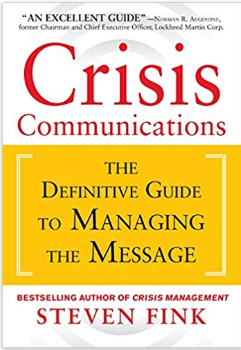
THE QUICK SUMMARY – Crisis Communications: The Definitive Guide to Managing the Message by Steven Fink
Skillfully managing the perception of the crisis determines the difference between a company’s life or death. Because in the pitched battle between perception and reality, perception always wins.
The inevitability of a crisis having a potentially major effect on your business and your reputation – at some point – is almost a guarantee. When your company finds itself in the midst of a crisis, the ripple effects can disrupt lives and business for the foreseeable future if public opinion is not properly shaped and managed.
Fortunately, there is a solution. Crisis communications and crisis management legend Steven Fink gives you everything you need to prepare for the inevitable—whether it’s in the form of human error, industrial accidents, criminal behavior, or natural disasters.
In this groundbreaking guide, Fink provides a complete toolkit for ensuring smooth communications and lasting business success through any crisis. Crisis Communications offers proactive and preventive methods for preempting potential crises. The book reveals proven strategies for recognizing and averting damaging crisis communications issues before it’s too late. The book also offers ways to deal with mainstream and social media, use them to your advantage, and neutralize and turn around a hostile media environment.
A SIMPLE SOLUTION
According to author Steven Fink, a good working definition of a crisis is any situation, that if left unattended, has the potential to:
- Escalate the intensity
- Damage the reputation or positive public opinion of the organization or its leadership
- Interfere with the normal operations
- Fall under close government or media scrutiny
- Impact the organization’s financial well-being
Using the five-step list above as a pragmatic guide, the responsible leader will realize that what may not qualify as a minor crisis in one situation may actually threaten the existence of the organization in another.
So the question becomes, do you know what YOUR crisis is?
Before you can even begin to think about communicating during a crisis, there are three absolute imperatives that must be undertaken in any crisis situation.
Steven Fink
Identify your crisis
Isolate your crisis
Manage your crisis
IDENTIFY
How hard can it be to identify a crisis when it’s happening to your organization? Actually, it’s harder than you might think. Focus on identifying your crisis – the one with which you have to deal, the one over which you have some measure of control. Try to avoid distracting scenarios, of which there will be many.
In a crisis, especially a crisis with competing interests, the only person who is looking out for your organization’s reputation is you.
ISOLATE
Isolation might very well mean designating a crisis management team to deal exclusively with the crisis, with its members temporarily delegating their normal duties and responsibilities to others for the duration of the crisis. Ideally, this team would be isolated from the rest of the company, and hopefully, keep quiet about its progress until the appropriate time.
MANAGE
If you have properly identified and then successfully isolated the crisis, the actual management of the crisis is the easiest part (assuming you are a good manager to begin with). That’s because you will now be laser-focused on the specific task at hand, and once you’ve cleared away the distracting brush, your mission becomes crystal clear. When that occurs, making vigilant decisions – the epitome of good crisis management – is well within your grasp.
Steven Fink, Crisis Communications: The Definitive Guide to Managing the Message

A NEXT STEP
While the COVID-19 crisis is certainly on everyone’s mind, it is truly a once-in-a-lifetime event, and “understanding” it in terms of the discussion above is beyond the scope of this exercise.
However, your organization likely has faced a crisis within the last year – a physical event, a natural disaster, or a personnel issue. No matter what the crisis, it was a disruption to your normal activities.
Using a past crisis, have your team walk through the three steps listed above. You are actually doing a post-mortem or after-action report: using a past event, evaluated through a new lens (the three steps above) to help prepare you for the next time you have a crisis.
Taking note of any actions you should have done, but didn’t, develop an action plan to make sure you do it the next time.

Part of a regular series on 27gen, entitled Wednesday Weekly Reader
During my elementary school years one of the things I looked forward to the most was the delivery of “My Weekly Reader,” a weekly educational magazine designed for children and containing news-based, current events.
It became a regular part of my love for reading, and helped develop my curiosity about the world around us.
Along with early and ongoing encouragement from my parents – especially my father – reading was established as a passion in my life that I was happy to continually learn from, share with my children, and watch them share with their children.
Reading keeps our minds alive and growing.
 27gen.com