How to See the Spectacle of the Ordinary

Recently my wife and I had the great privilege to host the 2023 version of Nina and GrandBob’s Summer Camp – that time when we are able to host our grandchildren at our house or keep grandkids at their parent’s house for an extended time.
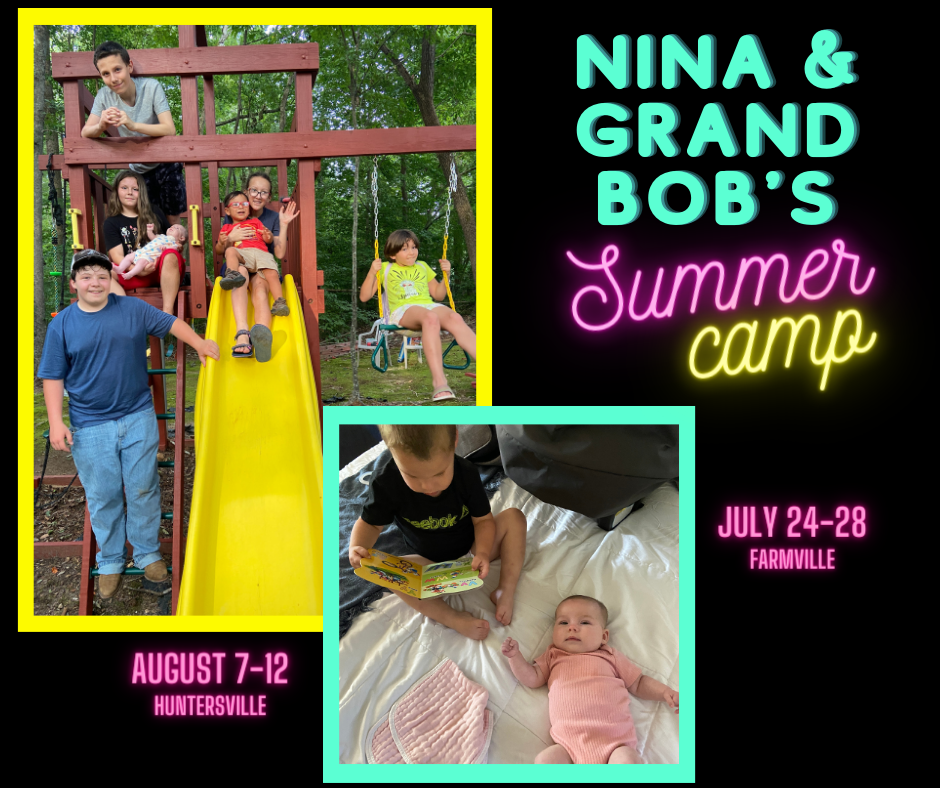
For a period of two weeks, we had an amazing time with our nine grandchildren, in two groups as noted in the image above. We laughed, ate ice cream, played games, took walks, and much more. We’re already looking ahead to repeating the camps in 2024!

In reflecting back on those two weeks, I was reminded of the first time we attempted such a thing. It wasn’t hosting our grandkids, their parents were with us, and it wasn’t at our house. But it remains a powerful lesson years later.


A few years ago, my wife and I had the wonderful opportunity to plan and deliver The Adams Family Adventure – a week-long trip to Walt Disney World for our immediate family of fifteen at the time: six children and nine adults.

All week long I had the most fun watching the rest of the family as they experienced Walt Disney World, most for the first time. We captured that trip in over 3,000 images, to bring up stories in the future from our memory from those images.

As we departed from four different cities on the first day of our trip, we were texting and FaceTiming about our various experiences. It was the first airplane flight for four of the grandchildren (they did great). They left their homes early in the morning, took long flights, got on a big “magical” bus, and arrived at our resort.

To our grandchildren, it must have been a little strange. From the time they came running off the bus, throughout all of the fun adventures of the week, to the goodbyes at the end of the week, they were a little overwhelmed, maybe even overstimulated about the whole process – and I began to see all over again what it means to be curious.

You can, and must, regain your lost curiosity. Learn to see again with eyes undimmed by precedent.   – Gary Hamel

My grandchildren’s curiosity was brought sharply into focus when I recently read the following:

In childhood, then, attention is brightened by two features: children’s neophilia (love of new things) and the fact that, as young people, they simply haven’t seen it all before.   – Alexandra Horowitz

Alexandra Horowitz’s brilliant On Looking: Eleven Walks with Expert Eyes shows us how to see the spectacle of the ordinary – to practice, as Sir Arthur Conan Doyle puts it, “the observation of trifles.”

On Looking is structured around a series of eleven walks the author takes, mostly in her Manhattan neighborhood, with experts on a diverse range of subjects, including an urban sociologist, a geologist, a physician, and a sound designer. She also walks with a child and a dog to see the world as they perceive it. What they see, how they see it, and why most of us do not see the same things reveal the startling power of human attention and the cognitive aspects of what it means to be an expert observer.

Here’s an illustrative example as Horowitz walks around the block with a naturalist who informs her she has missed seeing three different groups of birds in the last few minutes of their walk:

How had I missed these birds? It had to do with how I was looking. Part of what restricts us seeing things is that we have an expectation about what we will see, and we are actually perceptually restricted by that perception. In a sense, perception is a lost cousin of attention: both serve to reduce what we need to process of the world “out there.” Attention is the more charismatic member, packaged and sold more effectively, but expectation is also a crucial part of what we see. Together they allow us to be functional, reducing the sensory chaos of the world into unbothersome and understandable units.

Attention and expectation also work together to oblige our missing things right in front of our noses. There is a term for this: inattentional blindness. It is the missing of the literal elephant in the room, despite the overturned armchairs and plate-sized footprints. 

Horowitz’s On Looking should be required reading for those wanting to become modern elders. How often do we fly past the fascinating world around us? A world, mind you, that we have been called to serve.

How can we serve others if we aren’t paying attention to the world around us?

To a surprising extent, time spent going to and fro – walking down the street, traveling to work, heading to the store or a child’s school – is unremembered. It is forgotten not because nothing of interest happens. It is forgotten because we failed to pay attention to the journey to begin with.

On Looking, Alexandra Horowitz

The consulting firm I work for uses a thought process called “The Kingdom Concept,” with references to artist Andrew Wyeth:

 Most artists look for something fresh to paint; frankly, I find that quite boring. For me it is much more exciting to find fresh meaning in something familiar.   – Andrew Wyeth

This reminds me of the concept of vujá dé.

No, that’s not a misspelling – it really is vujá déVujá Dé implies seeing everything as if for the first time or better still, seeing everything everyone else sees, but understanding it differently. (Simon T. Bailey)

You might even say the journey to being a modern elder starts with paying attention – with a healthy dose of vujá dé.

Questions to Ponder

  • How do you observe the all-too-familiar in order to discover new meaning and discern the activity of God that others miss?
  • What do you look for?
  • How can you learn to scrutinize the obvious?
  • What does it mean to look for the extraordinary in the ordinary?

A good place to start is paying attention…


Wisdom is Developed Only in Experience

Out in the open wisdom calls aloud, she raises her voice in the public square; on top of the wall she cries out, at the city gate she makes her speech. (Proverbs 1:20–21, NIV)


Wisdom invites people to learn from her, but she does so not from the ivory tower but outside, in the public square and public places of the city. Wisdom is developed only in experience. No matter how hard they study, the graduates of medical school, law school, and business school will become truly wise in their fields only out in the open, that is, in real-life experience. 

Proverbs is not an “inspirational” book with statements that immediately jump off the page at you. Wisdom cannot be conveyed by a series of TED talks or “executive briefings.” It is inaccessible to people too busy for its method. It comes through first with experience and then with deep, honest reflection on that experience. 

The journey from the Proverbs of Solomon to the writings of Socrates (via his student Plato) is not as strange as one might seem:

Wisdom is humility, accepting that we know very little or nothing at all

Socrates describes this conclusion when he states “I am wiser than that man. Neither of us probably knows anything worthwhile; but he thinks he does when he does not, and I do not and do not think I do”. Socrates is considered the wisest man in Athens by the Oracle, because instead of assuming he possesses wisdom, he accepts that wisdom is often unattainable and that we should instead continuously pursue new and truer knowledge. (from Plato’s Apology)

Socratic wisdom, then, is humility: a recognition of your own ignorance.

To continually move past this ignorance, the Socratic method uses questions to examine the values, principles, and beliefs of students in a dialogue, not a one-sided monologue by the teacher.

Wisdom emerges only as we ask thought-provoking, searching questions: 

  • When did I last see this illustrated in my life or someone else’s? 
  • Where do I need to practice this? 
  • How would my life be different if I did? 
  • What wrong thinking and attitudes result when I forget this? 

Jesus, often spoke in parables and answered questions with other questions, trying to get us to reflect, think, and grow in wisdom (Matthew 13:10; Luke 20:4; John 16:29). 

What has happened to you recently that was significantly good or difficult? Have you reflected on it with others to learn wisdom from it?

I’m reminded of a wise saying by my father: 

It’s okay to be ignorant – it just means you haven’t learned something yet. Just don’t be stupid – stupid is terminal.

Doc Adams

My journey to becoming a Modern Elder is all about reciprocity. 

Giving and receiving. Teaching and learning. Speaking and listening. 

Everyone gets older, but not everyone gets elder.

The first just happens (if you’re lucky and healthy). The other you have to earn.


Adapted from God’s Wisdom for Navigating Life by Tim and Kathy Keller, and Wisdom@Work by Chip Conley

Collaboration Across the Ages: How Diverse Generations Drive Organizational Excellence

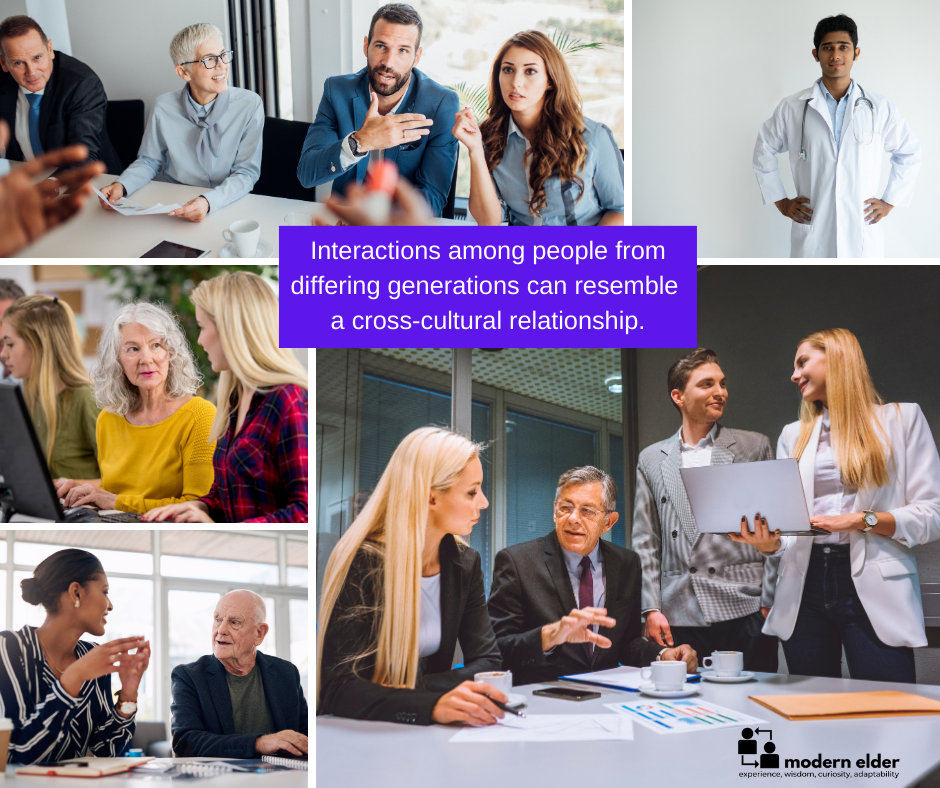
Interactions among people from differing generations can resemble a cross- cultural relationship.

A New Kind of Diversity, Tim Elmore

With five generations in today’s workplace, we can either operate as separate isolationist countries with generation-specific dialects and talents coexisting on one continent, or we can find ways to bridge these generational borders and delight in learning from people both older and younger than us.

In music, art, science, and just about everywhere else, diversity – diversity of age, diversity of background, diversity of thought – ignites the creative spark. Why should it be any different in the workplace?

We’re all just mirrors and reflections of each other. The more I help you grow a skill, the more valuable you are on our team, and the more your newfound skills can be learned and copied by others, adding more value still.

Building bridges across generations will happen when both sides realize just how much they have to learn from each other. When wisdom flows in both directions, there’s a huge collateral benefit for the company manifesting as gains in creativity, productivity, and communication.

Creating connections across the decades, if not a generation, between those who share employer and a mission can open up all kinds of possibilities.

Collaboration Practices

1. Create Psychological Safety

Your capacity to collaborate will improve if you create team norms that help everyone feel that the group is there to support you and the mission, as opposed to undermining you.

2. Make Collaboration Part of the Culture

Make sure that all action items at the end of a meeting are shared by two people rather than one. This forces team members to work together, come to mutual agreement, and present their findings or solution as a united front.

3. Study a Personality Tool that Resonates with You

Even the most emotionally fluent among us can benefit from personality-typing tools to help us better read other and build stronger personal connections. They are especially valuable in looking at how group chemistry is affected by the alchemy of the various personality types within the group.

4. Craft an Implicit (or Explicit) Trade Agreement

Specific individuals on your team may be very knowledgeable about a subject in which you feel lost. Start building a connection with that person and when you feel like trust has been established, ask them if they can spend some time teaching you about this subject. Make it reciprocal, forcing you to ask the question, “What do I have to offer?”

When was the last time you invited a promising young leader the opportunity to have a front-row seat to experience a healthy, collaborative team interaction?

– adapted from Wisdom@Work, Chip Conley

The Secret to Building a Visionary Organization

Many leaders view retirement – whether a few years or a few decades away – as a finish line.

But increasingly these leaders, especially for those who are closer to retirement, are finding that being too young to retire but too old to find a job has become a critical issue.

Retirement doesn’t have to be the last great thing a leader does. It can be the gateway to a leader’s greatest season of influence.

We may live ten years longer than our parents and may even work twenty years longer, yet power is moving to those ten years younger.

Are leaders in this age group facing a decades long “irrelevancy gap”?

Many of us feel like we’re growing whole rather than growing old. What if there was a new, modern archetype of elderhood, one that was worn as a badge of honor, not cloaked in shame?

Chip Conley

THE QUICK SUMMARY – Wisdom @ Work: The Making of a Modern Elder by Chip Conley

Experience is making a comeback. Learn how to repurpose your wisdom.

At age 52, after selling the company he founded and ran as CEO for 24 years, rebel boutique hotelier Chip Conley was looking at an open horizon in midlife. Then he received a call from the young founders of Airbnb, asking him to help grow their disruptive start-up into a global hospitality giant. He had the industry experience, but Conley was lacking in the digital fluency of his 20-something colleagues. He didn’t write code, or have an Uber or Lyft app on his phone, was twice the age of the average Airbnb employee, and would be reporting to a CEO young enough to be his son. Conley quickly discovered that while he’d been hired as a teacher and mentor, he was also in many ways a student and intern. What emerged is the secret to thriving as a mid-life worker: learning to marry wisdom and experience with curiosity, a beginner’s mind, and a willingness to evolve, all hallmarks of the “Modern Elder.”

In a world that venerates the new, bright, and shiny, many of us are left feeling invisible, undervalued, and threatened by the “digital natives” nipping at our heels. But Conley argues that experience is on the brink of a comeback. Because at a time when power is shifting younger, companies are finally waking up to the value of the humility, emotional intelligence, and wisdom that come with age. And while digital skills might have only the shelf life of the latest fad or gadget, the human skills that mid-career workers possess–like good judgment, specialized knowledge, and the ability to collaborate and coach – never expire.

A SIMPLE SOLUTION

You don’t have to be on the other side of fifty to find the concept of becoming a “Modern Elder” relevant. The age at which we’re feeling self-consciously “old” is now creeping into some people’s thirties.

Digital platforms are disrupting virtually all industries, and the result is that more and more companies are relentlessly pursuing young hires, seemingly placing high DQ (digital intelligence) above all other skills.

The problem is that many of these young digital leaders are being thrust into positions of power with little experience or guidance.

At the same time, there exists a generation of older workers with invaluable skills – high EQ (emotional intelligence), good judgment born out of decades of experience, specialized knowledge, and a vast network of contacts.

With more generations in the workplace than ever before, elders have so much to offer those younger than them.

What if Modern Elders were the secret ingredient for the visionary organizations of tomorrow? What lessons must a Modern Elder learn?

Evolve

If we’re too wedded to the past and to the costume of a traditional elder – making wise pronouncements from the pulpit – we aren’t likely to grow much of a congregation.

As we enter midlife, we embark upon a creative evolution that amplifies our specialness while editing out the extraneous. After a lifetime of accumulation, we can concentrate on what we do best, what gives us meaning, and what we want to leave behind.

Sometimes, reframing your identity is not an internal shift in your values, but an external rearranging of your life to once again give priority to that which is most life-affirming for you.

Learn

There is great value in adopting a beginner’s mind and how to use this fresh perspective to increase your ability to learn.

Our world is awash in knowledge, but often wanting in wisdom. To stay relevant, it’s not just about learning something new, it’s also about learning new ways to access the information at our fingertips.

Teaching and learning are symbiotic. You can’t be a teaching legend without living on the learning edge.

Collaborate

By leveraging your ability to collaborate, you can make something bigger.

With five generations in today’s workplace, we can either operate as separate isolationist countries with generation-specific dialects and talents coexisting on one continent, or we can find ways to bridge these generational borders and delight in learning from people both older and younger than us.

Counsel

A byproduct of being seen as the elder at work is becoming the confidant of younger employees who want to bathe in your fountain of wisdom and are likely to be more candid with you as they don’t see you as a competitive threat.

While collaboration is a team sport, counseling is one-on-one, becoming a confident to your younger colleagues.

Smart companies know that while their competitors may outsource “counsel” to outside coaches who may offer some general wisdom, being a wise advisor can be so much more effective when an advisor is a wise elder who is in the trenches day to day with the advisee

Chip Conley, Wisdom @ Work: The Making of a Modern Elder

A NEXT STEP

Author Chip Conley devotes extensive help to leaders who want to go through the four lessons listed above. In order to get a taste of these resources, set aside some time to consider each of the following:

Evolve

Ask a minimum of a half-dozen coworkers, friends, or family to answer the following question: “When you think of me in good times or bad, what are the core qualities that I exhibit? What are the positive ones? And what are the more challenging ones?”

Before you read anyone else’s answers, answer these yourself, being as candid as you can, knowing you don’t need to share this with anyone else.

  • Can you identify your identity?
  • What are the durable traits or qualities you want your reputation built on?
  • What qualities are you ready to part ways with?

The capacity for change with a ballast of continuity defines the Modern Elder.

Learn

While it contradicts the stereotype that older people become more narrow-minded and set in their ways, there’s glorious evidence that post-fifty, many elders return to a childlike sense of wonder.

  • How can you become more curious?
  • What’s a subject – unrelated to your work – in which you could become one of the world’s leading experts?
  • How will your create necessary time in your schedule for wondering about the world?

Essential for a Modern Elder is the desire to experience something new and unexpected rather than regress into what is comfortable and familiar.

Collaborate

Your capacity to collaborate will improve if you create team norms that help everyone feel that the group is there to support you and the mission, as opposed to undermining you. Here are a few group norms that have proven to be effective:

  • Try to encourage everyone to participate in group discussions, especially those representing diverse demographics and viewpoints.
  • Lead by example by not interrupting teammates during conversations and giving credit to people for their earlier idea as you built upon it.
  • Call out intergroup conflicts so you can resolve matters in person.

As a Modern Elder, we have the capacity to be a “first-class noticer,” paying close attention to what is happening around us, and helping make sure everyone on the team is contributing.

Counsel

You may learn that your true value comes in those times when you get the counselor role right. Here are some best practices in counseling:

  • Listen both to the story and for the story and beware of pre-judging.
  • Assuming it feels appropriate, self-reveal something about your history that will help others understand they’re not alone.
  • Prove your loyal – first and foremost by explicitly committing to confidentiality.

Spiritually radiant, physically vital, and socially responsible Modern Elders feel generative when they create the space for those younger than them to accelerate their learning by means of providing wise counsel.


Part of a regular series on 27gen, entitled Wednesday Weekly Reader

During my elementary school years one of the things I looked forward to the most was the delivery of “My Weekly Reader,” a weekly educational magazine designed for children and containing news-based, current events.

It became a regular part of my love for reading, and helped develop my curiosity about the world around us.