From Confusion to Clarity: Unlocking True Productivity with Slow Methods

Our current definition of “productivity” is broken. It pushes us to treat busyness as a proxy for useful effort, leading to impossibly lengthy task lists and ceaseless meetings. We’re overwhelmed by all we have to do and on the edge of burnout, left to decide between giving into soul-sapping hustle culture or rejecting ambition altogether. But are these really our only choices?

Long before the arrival of pinging inboxes and clogged schedules, history’s most creative and impactful philosophers, scientists, artists, and writers mastered the art of producing valuable work with staying power.

In this timely and provocative book, Cal Newport harnesses the wisdom of these traditional knowledge workers to radically transform our modern jobs.

Drawing from deep research on the habits and mindsets of a varied cast of storied thinkers – from Galileo and Isaac Newton, to Jane Austen and Georgia O’Keefe – Newport lays out the key principles of “slow productivity,” a more sustainable alternative to the aimless overwhelm that defines our current moment. Combining cultural criticism with systematic pragmatism, Newport deconstructs the absurdities inherent in standard notions of productivity, and then provides step-by-step advice for cultivating a slower, more humane alternative.

From the aggressive rethinking of workload management, to introducing seasonal variation, to shifting your performance toward long-term quality, Slow Productivity provides a roadmap for escaping overload and arriving instead at a more timeless approach to pursuing meaningful accomplishment. The world of work is due for a new revolution. Slow productivity is exactly what we need.


Newport’s initial research evolved into the central theme explored in his book: that the problem faced by knowledge workers may not lie in productivity per se, but rather in a flawed definition of productivity that has become prevalent in recent decades.

The overwhelming burden we experience stems from the belief that “good” work demands increasing busyness – swift responses to emails and chats, more meetings, tasks, and hours. However, upon closer examination, this premise lacks a solid foundation. It led him to consider that alternative productivity approaches could be equally valid, such as prioritizing intentionality over constant activity.

It became evident that the practices of traditional knowledge workers (the writer John McPhee is Newport’s ongoing example) were not only inspiring but could, with adjustments for contemporary job realities, offer valuable insights into reshaping our understanding of professional achievement in the modern era.

These insights prompted a reevaluation of how we approach work, culminating in an alternative to the prevailing norms of exhaustion:

Slow Productivity

A philosophy for organizing knowledge work efforts in a sustainable and meaningful manner, based on the following three principles:


This philosophy rejects busyness, viewing overload as a hindrance to meaningful results rather than a badge of honor. It advocates for a more balanced and humane pace, emphasizing quality over performative busyness.

In the latter part of the book, Newport elaborates on the core principles of this philosophy, providing both theoretical justification and practical advice for implementing them in various professional contexts.

Newport’s aim is not merely to offer tips for alleviating job exhaustion or to vent frustrations about exploitative work cultures, though he addresses these issues. Instead, he proposes a new paradigm for individuals and organizations to rethink productivity and accomplishment, aiming to rescue knowledge work from unsustainable freneticism and foster a more sustainable approach.

While not every workplace may immediately embrace this intentional rhythm, Newport argues that it is more universally applicable than commonly assumed. He seeks to demonstrate that achieving without burnout is not only achievable but should be the standard.

To embark on this journey, Newport encourages readers to first understand how the knowledge sector arrived at its current dysfunctional relationship with productivity. By grasping the haphazardness of its formation, rejecting the status quo becomes more feasible.


Part of a regular series on 27gen, entitled Wednesday Weekly Reader.

During my elementary school years one of the things I looked forward to the most was the delivery of “My Weekly Reader,” a weekly educational magazine designed for children and containing news-based, current events.

It became a regular part of my love for reading, and helped develop my curiosity about the world around us.
Beyond Passion: Navigating Your Career with Purpose and Expertise

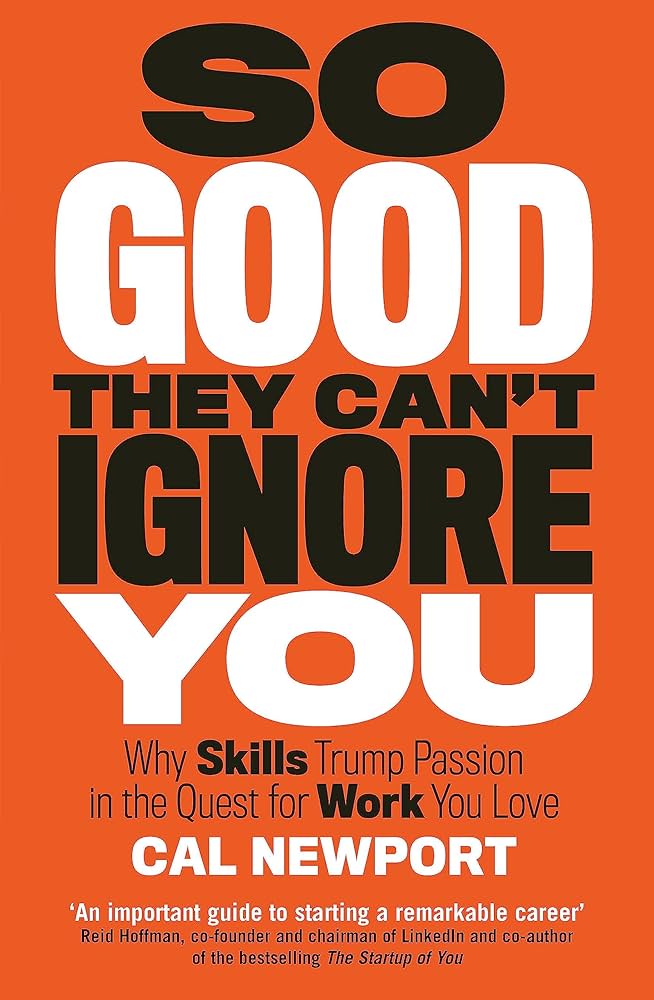
Cal Newport’s clearly-written manifesto flies in the face of conventional wisdom by suggesting that it should be a person’s talent and skill – and not necessarily their passion – that determines their career path.

Newport, who graduated from Dartmouth College (Phi Beta Kappa) and earned a PhD. from MIT, contends that trying to find what drives us, instead of focusing on areas in which we naturally excel, is ultimately harmful and frustrating to job seekers.

The title is a direct quote from comedian Steve Martin who, when once asked why he was successful in his career, immediately replied: “Be so good they can’t ignore you” and that’s the main basis for Newport’s book. Skill and ability trump passion.

Inspired by former Apple CEO Steve Jobs’ famous Stanford University commencement speech in which Jobs urges idealistic grads to chase their dreams, Newport takes issue with that advice, claiming that not only is this advice Pollyannish, but that Jobs himself never followed his own advice.

From there, Newport presents compelling scientific and contemporary case study evidence that the key to one’s career success is to find out what you do well, where you have built up your ‘career capital,’ and then to put all of your efforts into that direction.


So Good They Can’t Ignore You by Cal Newport is a thought-provoking book that explores the relationship between passion and career success.

Cal Newport challenges the conventional wisdom that one should follow their passion to find a fulfilling career. Instead, he argues that passion is something you develop over time by becoming exceptionally good at what you do. Newport introduces the concept of “career capital,” which refers to the skills, knowledge, and expertise you acquire in your field. He suggests that building career capital should be the primary focus, as it allows you to gain more control over your career and find work that you’re passionate about.

The book is organized into several chapters, each discussing key principles for building a fulfilling career. Newport emphasizes the importance of deliberate practice, developing rare and valuable skills, and seeking out “stretch” projects that challenge your abilities. He also encourages readers to adopt a craftsman mindset, which involves a dedication to continuous improvement and excellence in their work.

So Good They Can’t Ignore You offers a refreshing perspective on career development that is highly relevant to my goal of becoming a “modern elder” who guides and nurtures younger generations. Newport’s book is well-organized, providing a clear and systematic framework for achieving career success.

Newport’s emphasis on deliberate practice and skill development aligns with my interest in voracious reading and continuous learning. It values good arguments over mere authority, providing a well-reasoned approach to career development.

The book’s central premise – that passion follows expertise and not the other way around – provides a valuable perspective for those looking to excel in their careers and provide guidance to younger generations. It encourages professionals to focus on acquiring the skills and knowledge that make them indispensable, which is essential in the role as a mentor.

In summary, So Good They Can’t Ignore You by Cal Newport is an insightful and actionable book that provided unique and valuable insight on my journey to becoming a “modern elder.” It provides a strategic approach to career development and personal growth that is both comprehensive and practical.


Part of a regular series on 27gen, entitled Wednesday Weekly Reader

During my elementary school years one of the things I looked forward to the most was the delivery of “My Weekly Reader,” a weekly educational magazine designed for children and containing news-based, current events.

It became a regular part of my love for reading, and helped develop my curiosity about the world around us.


Fight Information Overload by Going Minimal

Information overload.

You live it every day – Facebook, Twitter, LinkedIn, and Instagram. You’re more informed and connected than ever.

Yet, if you’re honest, you’re probably feeling more distracted than ever.

More lonely. More restless.

According to studies done by Barna Research:

  • 71% of people feel overwhelmed by the amount of information they need to stay up to date.
  • 36% of adults stop what they’re doing to check a text or message when it comes in.
  • 35% of adults think their personal electronics sometimes separate them from other people.

Being hyperlinked changes every aspect of our lives – and often, not for the better.

THE QUICK SUMMARY – Digital Minimalism: Choosing a Focused Life in a Noisy World by Cal Newport

Minimalism is the art of knowing how much is just enough. Digital minimalism applies this idea to our personal technology. It’s the key to living a focused life in an increasingly noisy world.

In this timely and enlightening book, the bestselling author of Deep Work introduces a philosophy for technology use that has already improved countless lives.

Digital minimalists are all around us. They’re the calm, happy people who can hold long conversations without furtive glances at their phones. They can get lost in a good book, a woodworking project, or a leisurely morning run. They can have fun with friends and family without the obsessive urge to document the experience. They stay informed about the news of the day, but don’t feel overwhelmed by it. They don’t experience “fear of missing out” because they already know which activities provide them meaning and satisfaction.

Now, Newport gives us a name for this quiet movement, and makes a persuasive case for its urgency in our tech-saturated world. Common sense tips, like turning off notifications, or occasional rituals like observing a digital Sabbath, don’t go far enough in helping us take back control of our technological lives, and attempts to unplug completely are complicated by the demands of family, friends and work. What we need instead is a thoughtful method to decide what tools to use, for what purposes, and under what conditions.

Drawing on a diverse array of real-life examples, from Amish farmers to harried parents to Silicon Valley programmers, Newport identifies the common practices of digital minimalists and the ideas that underpin them. He shows how digital minimalists are rethinking their relationship to social media, rediscovering the pleasures of the offline world, and reconnecting with their inner selves through regular periods of solitude. He then shares strategies for integrating these practices into your life, starting with a thirty-day “digital declutter” process that has already helped thousands feel less overwhelmed and more in control.

Technology is intrinsically neither good nor bad. The key is using it to support your goals and values, rather than letting it use you. This book shows the way.

A SIMPLE SOLUTION

While many leaders believe in the power of digital platforms, and recognize the importance of various specific applications, a growing number of those same leaders feel as though their current relationship with technology is unsustainable – to the point that if something doesn’t change soon, they will reach a breaking point.

According to author Cal Newport, people don’t succumb to screens because they’re lazy, but instead billions of dollars have been invested to make this outcome inevitable.

It seems we have stumbled backward into a digital life we didn’t sign up for.

My research on digital minimalism has revealed the existence of a loosely organized “attention resistance movement,” made up of individuals who combine high-tech tools with disciplined operating procedures to conduct surgical strikes on popular attention economy services – dropping in to extract value, and then slipping away before the attention traps set by those companies can spring shut.

The tactics below have proved successful in shunting aside relentless efforts to capture your attention.

Delete Social Media from Your Phone

The smartphone versions of social media sites are much more adept at hijacking your attention than the versions accessed through a web browser on your laptop or desktop computer. Because you always have your phone with you, every occasion becomes an opportunity to check your feeds. If you’re going to use social media, stay far away from the mobile versions of these services, as they pose a significantly bigger risk to our time and attention. This practice suggests you remove all social media apps from your phone. You don’t have to quit these services, you just have to quit accessing them on the go.

Turn Your Devices Into Single-Purpose Computers

The sentiment that temporarily blocking features of a general-purpose computer reduces its potential is common for tools that do just that. It’s also flawed: it represents a misunderstanding of computation and productivity that benefits the large digital attention economy conglomerates much more than the individual users that they exploit. As many have discovered, the rapid switching between different applications tends to make the human’s interaction with the computer less productive in terms of the quality and quantity of what is produced. This practice of blocking might at first seem overly aggressive, but what it’s actually doing is bringing you back closer to the ideal of sing-purpose computing that’s much more compatible with our human attention systems.

Use Social Media Like a Professional

Social media professionals approach these tools differently than the average user. They seek to extract large amounts of value for their professional and (to a lesser degree) personal lives, while avoiding much of the low-value distortion these services deploy to lure users into compulsive behavior. Their disciplined professionalism, in other words, provides a great example for any digital minimalist looking to join the attention resistance. To a social media pro, the idea of endlessly surfing your feed in search of entertainment is a trap (these platforms have been designed to take more and more of your attention) – an act of being used by these services instead of using them to your own advantage.

Embrace Slow Media

To embrace news media from a mind-set of slowness requires first and foremost that you focus only on the highest-quality sources. Breaking news, for example, is almost always much lower quality than the reporting that’s possible once an event has occurred and journalists have had time to process it. Similarly, consider limiting yourself to the best of the best when it comes to selecting individual writers you follow. Another important aspect of slow news is the decisions you make regarding how and when this consumption occurs. The key to embracing Slow Media is the general commitment to maximizing the quality of what you consume and the conditions under which you consume it.

Dumb Down Your Smartphone

Declaring your freedom from you smartphone is probably the most serious step you can take toward embracing the attention resistance. Dumbing down your phone, of course, is a big decision. Convincing yourself that a dumb phone can satisfy your need so that its benefits outweigh its costs is not necessarily easy. Indeed, it might require a leap of faith – a commitment to test life without a smartphone to see what it’s really like.

Cal Newport, Digital Minimalism: Choosing a Focused Life in a Noisy World

A NEXT STEP

According to author Cal Newport, if you are exhausted by your “digital device addiction,” it’s not only possible to say, “No More,” it’s actually not that hard.

Set aside some time (without your phone!) to review the following five suggestions listed above. For each, make a Pro/Con list for what it would mean to your life if you took that action.

Review the list, and make a decision to embrace at least one of the actions for the next week.

After the week has passed, reflect on what taking that action meant to you, in terms of time gained, relationships grown, etc.

Consider another action to undertake, and follow the same suggestions.

At the end of one month’s experiments, talk with your spouse or a close colleague who would have noticed the changes in your routine and its results. What do they have to say?

Excerpt taken from SUMS Remix 126-1, released September 2019.


Part of a weekly series on 27gen, entitled Wednesday Weekly Reader

Regular daily reading of books is an important part of my life. It even extends to my vocation, where as Vision Room Curator for Auxano I am responsible for publishing SUMS Remix, a biweekly book “excerpt” for church leaders. Each Wednesday on 27gen I will be taking a look back at previous issues of SUMS Remix and publishing an excerpt.

>>Purchase SUMS Remix here<<

>> Purchase prior issues of SUMS Remix here<<