
January and February – Seeds of Rebellion Part Six
In September 1774, four thousand Massachusetts farmers marched on the Middlesex County courthouse in Concord. They weren’t there to petition. They weren’t there to protest peacefully. They came armed, organized, and determined to shut down the king’s justice system by force. Crown-appointed officials resigned on the spot, reading their humiliating recantations aloud to the assembled crowd. No shots were fired, but make no mistake – this was insurrection. Seven months before Lexington and Concord made the history books, ordinary colonists had already begun their revolution.
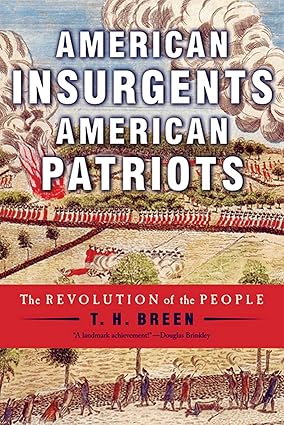
This is the scene T. H. Breen places at the center of his 2010 book American Insurgents, American Patriots: The Revolution of the People. At a time when “insurgent” had become synonymous with irregular fighters in Iraq and Afghanistan, Breen reclaimed the term for America’s founding generation. His message was clear: the American Revolution wasn’t won by philosophical debate or the wise deliberations of the Continental Congress. It was forged by tens of thousands of ordinary people who formed armed militias, enforced extralegal boycotts with threats and violence, and systematically dismantled British authority in the countryside – all before independence was even declared.
In 2026, as Americans grapple with questions about political violence, the legitimacy of institutions, and the boundaries of patriotic dissent, Breen’s book offers an unsettling reminder: the nation’s founding moment was an insurgency first and a revolution second.
The Historian Who Listened to Common People
T. H. Breen, professor emeritus at Northwestern University, had built his career studying colonial commerce and consumer culture. His earlier work, The Marketplace of Revolution (2004), examined how boycotts of British goods created a shared political identity among colonists. But Breen sensed something was missing from the standard narrative. The Revolution, as typically told, moved from the Stamp Act to the Boston Tea Party to the Declaration of Independence – a story of ideas, protests, and elite decision-making.
What about the thousands of farmers who never attended a Continental Congress? What about the militia companies drilling on village greens? What about the committees of inspection that dragged loyalists from their homes? Breen spent years in local archives, reading the petitions, resolutions, and testimonies of people whose names rarely appear in history books. What he found was a popular insurgency that preceded and enabled the more familiar political revolution.
Writing in the shadow of the Iraq War, Breen was acutely aware of how the language of insurgency had changed. “American politicians who have condemned insurgencies in other countries might do well to remember that the United States owes its independence to just such people,” he writes. His timing was deliberate. American Insurgents, American Patriots appeared as the Tea Party movement was rising and as Americans debated whether revolutionary rhetoric had any place in contemporary politics. Breen didn’t offer easy answers, but he demanded historical honesty about what revolution actually looked like.
The Core Argument: Revolution From Below
Breen’s central thesis upends the traditional narrative that the Revolution was primarily an ideological movement led by educated elites. Instead, he argues that the American Revolution succeeded because of a massive popular insurgency that created revolutionary conditions on the ground before independence was declared. As he puts it: “The Revolution was not the result of a powerful, centralized movement. It was the product of separate local responses to a constitutional crisis that suddenly sparked a powerful sense of rage.”
The book traces three critical phases. First, between 1774 and early 1775, colonists in hundreds of communities organized themselves into extralegal committees and militia companies. These bodies didn’t wait for the Continental Congress to tell them what to do. They seized control of local governance, purged loyalists from positions of authority, and enforced compliance with the Continental Association’s boycott of British goods. This was, Breen argues, “America’s first insurgency” – a coordinated but locally driven uprising that destroyed British authority outside major coastal cities.
Second, these local insurgents had to justify their actions to themselves. Breen emphasizes that most colonists saw themselves as loyal British subjects in 1774. Taking up arms against constituted authority required powerful psychological and ideological work. Here’s where the language of patriotism became crucial. By calling themselves “patriots” and their opponents “enemies of America,” insurgents transformed acts that might otherwise seem like treason into virtuous defense of rights. Breen writes: “The insurgents invented patriotism, not as a celebration of what they already possessed, but as a justification for taking extraordinary risks.”
Third, the insurgency had to transform into a sustainable revolutionary movement. This required creating new institutions, maintaining discipline, and preventing the movement from fracturing into competing factions or collapsing into chaos. The real achievement, Breen argues, wasn’t declaring independence in July 1776 – it was the fact that tens of thousands of armed, angry colonists managed to organize themselves into an effective fighting force without descending into anarchy.
The Voice of Popular Revolution
Breen’s prose balances scholarly rigor with narrative drive, and he has a gift for finding voices that bring eighteenth-century insurgency to life. Consider this passage about the moment ordinary colonists realized they had crossed the point of no return:
“By the spring of 1775 the people had created a revolutionary society. In scores of rural villages they had organized resistance to Great Britain; they had nullified imperial law; they had taken up arms. And after months of insurgency, they discovered that they were no longer subjects of the British Empire. The insurgents had become patriots.”
This transformation – from insurgent to patriot – captures Breen’s central insight. The terms weren’t opposites; they were sequential. You became a patriot by first becoming an insurgent.
Elsewhere, Breen quotes a letter from a British officer who witnessed the courthouse takeovers: “The people are in a perfect frenzy… Government is completely dissolved.” This wasn’t hyperbole. In county after county, the king’s government simply ceased to function because ordinary people refused to recognize its authority. Breen observes: “What the British witnessed in 1774 was not a protest movement that got out of hand. It was a systematic, purposeful transfer of power from imperial officials to popular committees – enforced, when necessary, by the threat of violence.”
Perhaps most strikingly, Breen gives voice to the loyalists who found themselves targets of patriot enforcement. One Massachusetts man described being forced to recant his opposition to the Revolution before a crowd: “I was obliged to subscribe and swear to everything they demanded… I must do it or be drove from my farm.” These testimonies complicate any romanticized view of the Revolution. The insurgency created patriots partly through persuasion and shared grievances – but also through intimidation and coercion.
Dialogue with Bernard Bailyn and the Ideological School
Earlier in this series, we examined Bernard Bailyn’s The Ideological Origins of the American Revolution, which argued that the Revolution was fundamentally an intellectual movement driven by colonists’ fears of political conspiracy and ministerial tyranny. Bailyn’s revolutionaries were steeped in opposition Whig ideology and classical republicanism. They mobilized because they believed British policy represented a deliberate plot to enslave free Americans.
Breen doesn’t reject Bailyn’s thesis – he complicates it. Yes, ideology mattered. Yes, colonists read pamphlets and worried about corruption. But Breen asks: how did those ideas actually spread to farmers in western Massachusetts or backcountry Virginia? How did abstract political theory translate into thousands of men willing to risk their lives?
His answer is that popular mobilization preceded and shaped ideological development as much as the reverse. “The insurgents did not wait for refined constitutional arguments,” Breen writes. “They acted first and developed their justifications as they went.” Local committees and militia companies became schools for revolutionary thinking, places where ordinary people learned to articulate their grievances and connect them to broader principles.
Where Bailyn emphasized pamphlets and political thought, Breen emphasizes newspapers, tavern conversations, and community meetings. Where Bailyn focused on the vertical transmission of ideas from elite thinkers to the broader population, Breen reveals horizontal networks of communication among ordinary colonists who shared rumors, fears, and strategies for resistance.
The two interpretations aren’t contradictory – they’re complementary. Bailyn explains why educated colonists came to believe revolution was necessary. Breen explains how those beliefs became a mass movement. Together, they reveal a Revolution that worked on multiple levels simultaneously: philosophical debates among elites, popular mobilization in the countryside, and the constant interaction between the two.
What We’ve Learned Since 2010
Breen’s book arrived at a particular moment in American historiography. The “history from below” approach had been gaining ground for decades, but accounts of the Revolution still tended to privilege founding fathers over ordinary people. American Insurgents, American Patriots helped shift the field’s center of gravity.
Since 2010, historians have built on Breen’s insights in several ways. Holger Hoock’s Scars of Independence (2017) examined the Revolution’s violence in unflinching detail, revealing just how brutal the insurgency could be. Where Breen acknowledged violence but emphasized political organization, Hoock showed tar-and-feathering, property destruction, and vigilante justice as central to the revolutionary experience.
Similarly, recent scholarship on loyalism has enriched our understanding of those on the receiving end of patriot insurgency. Maya Jasanoff’s Liberty’s Exiles (2011) followed the tens of thousands of loyalists who fled revolutionary violence, many of them ordinary people who simply refused to join the insurgency. These works remind us that Breen’s insurgents weren’t universally welcomed – they created patriots partly by driving out or silencing dissent.
Scholarship on slavery and the Revolution has also complicated Breen’s narrative. His book focuses heavily on New England and the Mid-Atlantic, regions where the insurgency could draw on relatively egalitarian political culture. But as historians have shown, Southern insurgents faced a different calculus: how could slaveholders lead a revolution for liberty while maintaining a system of human bondage? The answer often involved excluding enslaved people from the category of “the people” who deserved rights – a contradiction Breen acknowledges but doesn’t fully explore.
Finally, digital humanities tools have allowed historians to map revolutionary mobilization with unprecedented precision. We now have detailed data on committee formation, militia musters, and communication networks that confirm Breen’s intuition: the Revolution spread through local, grassroots organization rather than top-down direction.
Why Read This Book in 2026?
On January 6, 2021, Americans watched as insurgents stormed the Capitol, claiming they were patriots defending the Constitution. In the years since, debates about political violence, institutional legitimacy, and the meaning of patriotism have consumed American politics. Militia groups invoke revolutionary heritage. Protesters on both left and right claim the mantle of 1776. Politicians compare their opponents to tyrants and themselves to founding-era resistance fighters.
In this context, Breen’s book is essential – and uncomfortable. It forces readers to confront the fact that America was born from an insurgency that used intimidation, destroyed livelihoods, and forced people to choose sides under threat of violence. The Revolution succeeded not because it was genteel or legalistic, but because enough ordinary people were willing to take up arms against constituted authority and create new political institutions through force.
This doesn’t mean every modern insurgent is a patriot, or that revolutionary violence is automatically legitimate. Breen himself carefully distinguishes between different kinds of political violence and their justifications. But he does insist that Americans can’t celebrate their revolutionary heritage while pretending it was anything other than insurgency.

The book also offers a model for understanding how ordinary people become political actors. Breen shows that most colonists didn’t join the Revolution because they read John Locke or Thomas Paine. They mobilized because their neighbors mobilized, because they feared being labeled enemies of the community, because local institutions gave them frameworks for collective action. Understanding this process – how ideas become movements, how movements enforce conformity, how insurgents justify their actions – is crucial for anyone trying to make sense of contemporary political mobilization.
Perhaps most importantly, American Insurgents, American Patriots reminds us that the American Revolution was genuinely uncertain. It could have failed. It could have fractured into competing movements. It could have produced tyranny rather than republican government. The fact that insurgents became patriots and patriots built a lasting republic wasn’t inevitable – it was an achievement that required leadership, luck, and constant negotiation.
As we navigate our own period of institutional crisis and political polarization, that historical contingency matters. The founders weren’t demigods whose every action deserves reverence. They were insurgents who took enormous risks, made difficult compromises, and built something unprecedented. Their example can inspire – but only if we’re honest about what they actually did and how uncertain their success really was.
Breen’s book adds more understanding to where America came from. It will complicate easy narratives about founding principles and remind us that revolutions are made by ordinary people making extraordinary choices – for better and for worse.
A Note on This Series
This journey through Revolutionary history is as much about the evolution of historical understanding as the Revolution itself. History isn’t static – each generation reinterprets the past through its own concerns, asking different questions and prioritizing different sources. By reading these books in dialogue across 250 years, we’ll witness how scholarship evolves, how narratives get challenged, and how forgotten stories resurface.
This isn’t about declaring one interpretation “right” and another “wrong,” but appreciating the richness that emerges when multiple perspectives illuminate the same transformative moment. These books won’t provide definitive answers – history rarely does – but they equip us to think more clearly about how real people facing genuine uncertainty chose independence, how ideas had consequences, and how the work of creating a more perfect union continues. As we mark this anniversary, we honor the Revolutionary generation by reading deeply, thinking critically, and engaging seriously with both the brilliance and blind spots of what they created.
 27gen.com