
March and April – The Gathering Storm, Part Five
Two hundred and fifty years after 1776, one outsider’s pamphlet still challenges us to ask what self-governance actually requires – beyond bullets and borders.
The Times That Try Men’s Souls
In September 1776, a middle-aged English immigrant named Thomas Paine stood on the New Jersey shore and watched the British navy pound the American position at Kips Bay into splinters. Washington’s army – ragged, terrified, outnumbered – broke and ran. New York was lost. The Revolution seemed to be dying before it had fully lived.
Paine did not run. He picked up a musket, slogged south through the mud of New Jersey with the retreating troops, and then, camped on the banks of the Delaware with his drum as a writing desk, composed one of the most consequential sentences in American history. The pamphlet that followed, “The American Crisis”, was read aloud to Washington’s shivering men on Christmas Eve, 1776. Two days later they crossed the Delaware and took Trenton. The Revolution survived – and with it, the radical idea that a people could govern themselves without kings.
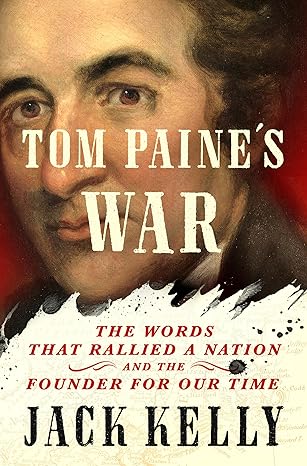
That moment is the beating heart of Jack Kelly’s Tom Paine’s War: The Words That Rallied a Nation and the Founder for Our Time, published in late 2025 as America marks the 250th anniversary of independence. It arrives, pointedly, at a moment when the word “democracy” again feels less like a settled inheritance and more like a contested claim.
About the Author
Kelly is a Hudson Valley-based historian and award-winning author whose previous books – including Band of Giants (which earned the DAR History Medal) and God Save Benedict Arnold – stake out a distinctive niche: military history told with novelistic intimacy, centering figures the mainstream narrative has pushed to the margins. He is a fellow of the New York Foundation for the Arts and a regular presence on NPR, C-Span, and PBS history programming.
The timing of Tom Paine’s War is deliberate. Kelly has stated plainly that he wrote the book in part because Paine – the Revolution’s most radical democrat, its most furious anti-monarchist – has been systematically sidelined from the Founders’ canon. Jefferson got a memorial on the National Mall. Madison shaped the Constitution. Paine, who arguably did more than anyone to convince ordinary Americans that independence was not just desirable but possible, died poor, mostly forgotten, and denied an American burial site for years. Kelly wants to correct that erasure. As Booklist noted in a starred review, he “explains why Paine and his writing mattered 250 years ago and why they matter now.”
The Core Argument: Words as Weapons
Kelly’s thesis is deceptively simple: the American Revolution was not merely won by armies. It was first won in print. Without Common Sense in January 1776, there is no Declaration of Independence in July. Without The American Crisis in December 1776, Washington’s army may well have dissolved entirely.
But Kelly pushes further than the standard “ideas matter” claim. He argues that Paine’s genius was populist translation – the ability to take Enlightenment philosophy that had circulated among educated elites and render it as plain speech for tradesmen, farmers, and sailors. In an era when much of the population could not read, Paine’s prose was designed to be heard aloud. Short sentences. Hammer-blow rhythms. The kind of clarity that sounds obvious only after someone has achieved it.
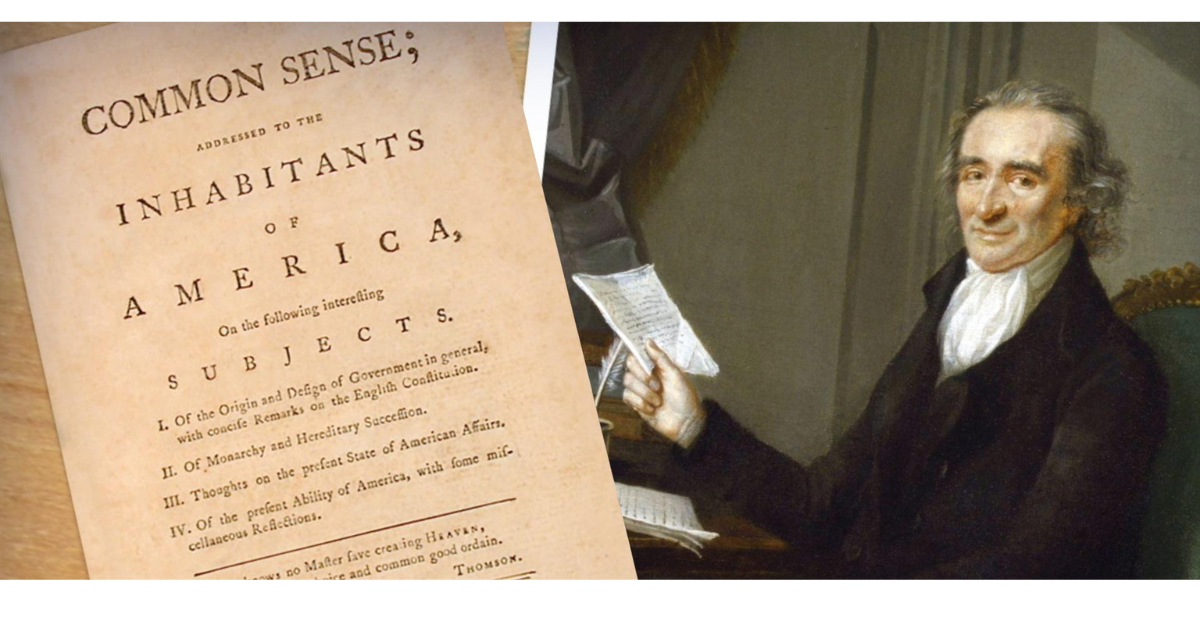
Kelly’s structural choice reinforces this argument in an unusual way. Rather than marching through Paine’s life chronologically, the book opens in the fire of battle – the chaos of Kips Bay, the retreat through New Jersey – and works backward to explain how Paine got there. The effect is to root his ideas in lived, embodied experience. Common Sense was not written in a comfortable study. It was written by a man who had felt the class brutality of English society firsthand, who had crossed the Atlantic with nothing, and who had then witnessed what empire looked like when it trained its cannons on its own colonists. Kelly insists that moral authority cannot be separated from biography.
The Voice of the Book
Kelly writes with precision and pace. His battle scenes have drawn wide praise – one reviewer for the Sons of the American Revolution called them “perhaps the most vivid, chilling, yet exhilarating I have ever read in a book about the American Revolution.” He also excels at making eighteenth-century ideological combat feel urgent. When he quotes British secretary Ambrose Serle on the naval bombardment – that few “even in the army and navy had ever heard” such a roar – it is to measure the scale of what Paine was writing against.
The book also carries a pointed contemporary edge. Kelly explicitly links Paine’s secular, reason-based republicanism to present debates about the founding’s religious character. This is Kelly at his most directly polemical – and, at 250 years’ distance from the events, arguably his most relevant.
Dialogue with Other Works in This Series
Tom Paine’s War agrees with Bernard Bailyn’s The Ideological Origins of the American Revolution. Bailyn’s landmark 1967 study showed that the Revolution was driven by a coherent ideology rooted in English radical Whig thought. Kelly affirms this: Paine absorbed and weaponized that tradition. Both books insist ideas, not just economics, drove independence.
Where Bailyn analyzed the intellectual scaffolding of revolutionary ideology from the perspective of elites who consumed pamphlet culture, Kelly focuses on production – on the act of writing under fire, literally – and on reception, on what it meant for Paine’s words to be shouted across a campfire to men who could not read. These are different and complementary lenses, and Kelly’s is, in some ways, the more democratic one.
Additionally, Tom Paine’s War adds nuance to Robert Middlekauff’s The Glorious Cause.
Middlekauff’s imposing survey treats Paine as one voice among many. Kelly corrects the balance, arguing that Common Sense and The American Crisis were not merely supporting documents but load-bearing pillars – without them the military campaign may have collapsed.
Historical Reassessment: What We Know Now
Scholarship since the 1990s – particularly work on Atlantic world networks, print culture, and marginalized voices in the Revolution – has actually strengthened Kelly’s core case rather than complicated it. Historians like Alfred Young (The Shoemaker and the Tea Party) and Gary Nash (The Unknown American Revolution) have documented how deeply ordinary working people – not just gentleman-farmers and merchants – drove independence. Paine was their theorist. He was a working-class English immigrant writing for and about people the constitutional convention would later leave out.
Kelly also refutes a persistent myth: that Paine’s radicalism made him a marginal figure even in his own time. In fact, Common Sense sold approximately 100,000 copies within three months of publication – in a colonial population of roughly 2.5 million. By modern ratios, that would be a book selling tens of millions of copies in weeks. The question of why this man was subsequently written out of the Founders’ story is itself a historical and political question Kelly leaves hovering, productively, over every page.
Why Read This in 2026?
As we approach the 250th anniversary of independence, with democratic norms contested and the language of self-governance often hollowed into slogan, Tom Paine’s War offers something rare: a reminder that the Revolution’s most essential argument was not constitutional, legal, or military. It was moral. Paine said monarchy was a fraud, aristocracy a crime, and self-governance not a privilege but a birthright. He said it simply enough that anyone could understand it, and urgently enough that people acted on it. Kelly’s achievement is to make that argument feel, once again, like news.
The book is not without its critics. Its non-linear structure can feel meandering, and Kelly’s thesis – words matter – is stated more than it is fully argued at the historiographical level. Readers seeking to know more will want to start with reading Paine’s Common Sense and The American Crisis if they have not already done so. But for the common reader who wants both the battlefield drama and the intellectual stakes of 1776 woven into a single, propulsive narrative, Tom Paine’s War is a genuine gift of the anniversary year.
Paine himself would have approved of a book written not for specialists but for citizens. That may be the highest compliment the man deserves.
A Note on This Series
This journey through Revolutionary history is as much about the evolution of historical understanding as the Revolution itself. History isn’t static – each generation reinterprets the past through its own concerns, asking different questions and prioritizing different sources. By reading these books in dialogue across 250 years, we’ll witness how scholarship evolves, how narratives get challenged, and how forgotten stories resurface.
This isn’t about declaring one interpretation “right” and another “wrong,” but appreciating the richness that emerges when multiple perspectives illuminate the same transformative moment. These books won’t provide definitive answers – history rarely does – but they equip us to think more clearly about how real people facing genuine uncertainty chose independence, how ideas had consequences, and how the work of creating a more perfect union continues. As we mark this anniversary, we honor the Revolutionary generation by reading deeply, thinking critically, and engaging seriously with both the brilliance and blind spots of what they created.
 27gen.com