Before the First Shot, There Was the First Sentence


Why the American Revolution Was Written Before It Was Fought

Scroll. Refresh. Skim. In our world, information arrives instantly and in overwhelming volume. News breaks in seconds, arguments metastasize in minutes, and public opinion can shift before lunch. We live inside an always-on torrent of words, images, and reactions – so fast that reflection often lags behind reaction.

Now imagine the opposite.

Imagine waiting weeks for a newspaper. Imagine arguments unfolding over months. Imagine political ideas traveling by horseback, ship, or memory. Imagine reading the same pamphlet aloud to neighbors because it might be the only new text your community sees for weeks. In the years leading up to the American Revolution, information moved slowly – but when it arrived, it mattered profoundly.

As we approach the 250th anniversary of the Declaration of Independence and the Revolution that followed, it’s tempting to focus on the drama of muskets and marches, of midnight rides and battlefield heroics. Those moments deserve attention. But they came late in the story. Long before the first shot was fired, the Revolution was already underway – through sermons, in ink, on paper, through the written word.

This year-long series will explore the American Revolution as a reading event before it became a fighting one. It’s important to reference the books, pamphlets, sermons, letters, and newspapers that didn’t merely comment on the Revolution but made it possible. To understand how thirteen disparate colonies became a people capable of declaring independence, we must first understand how they learned to read, argue, and imagine together.


A Culture Prepared for Words

By the mid-18th century, British North America possessed a surprising advantage: a population unusually comfortable with texts. Literacy rates – especially among white men, and to a notable extent among women in New England – were high by European standards. But this wasn’t literacy for convenience alone. Colonists didn’t just read to conduct business; they read to make meaning.

This habit had deep roots in Protestant culture. Sermons were long and intellectually demanding. Congregants were expected to follow complex theological arguments, grounded in careful textual interpretation. Disagreement wasn’t a flaw in the system – it was a feature. Competing interpretations of scripture trained people to weigh evidence, assess authority, and argue their case using words.
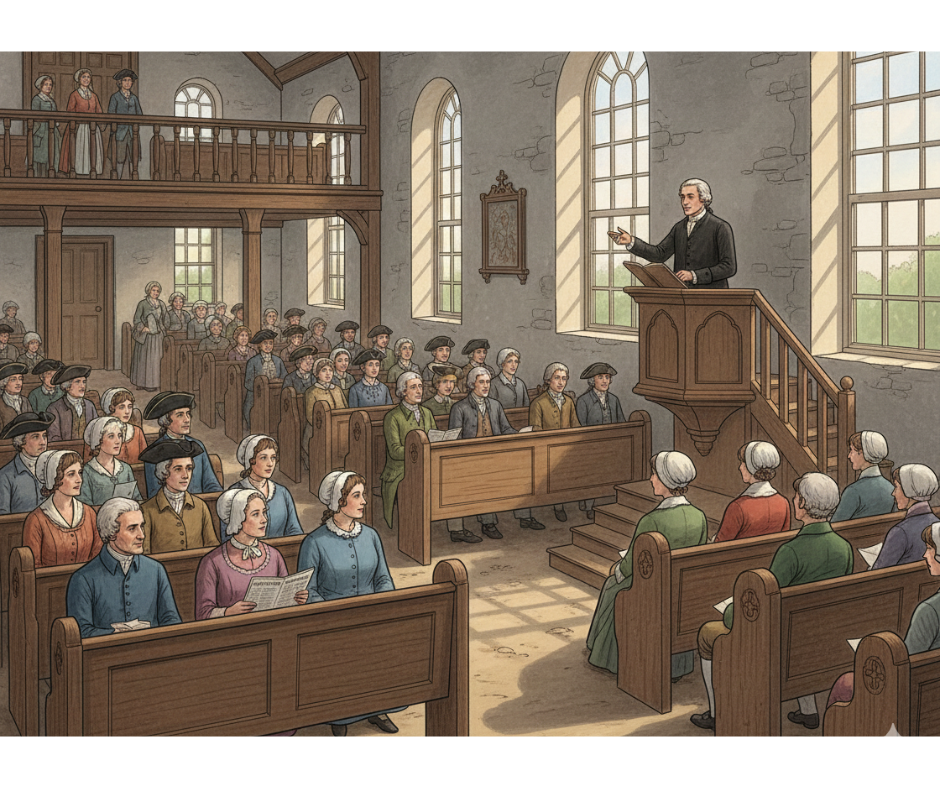
Long before colonists debated Parliament, they had debated doctrine. They had learned that texts mattered, that interpretation mattered, and that authority could be questioned on paper. When political conflict with Britain intensified after 1763, the colonies already possessed a population capable of sustained written argument. The Revolution did not have to invent this capacity; it inherited it.

Pamphlets: The Engine of Revolutionary Thought

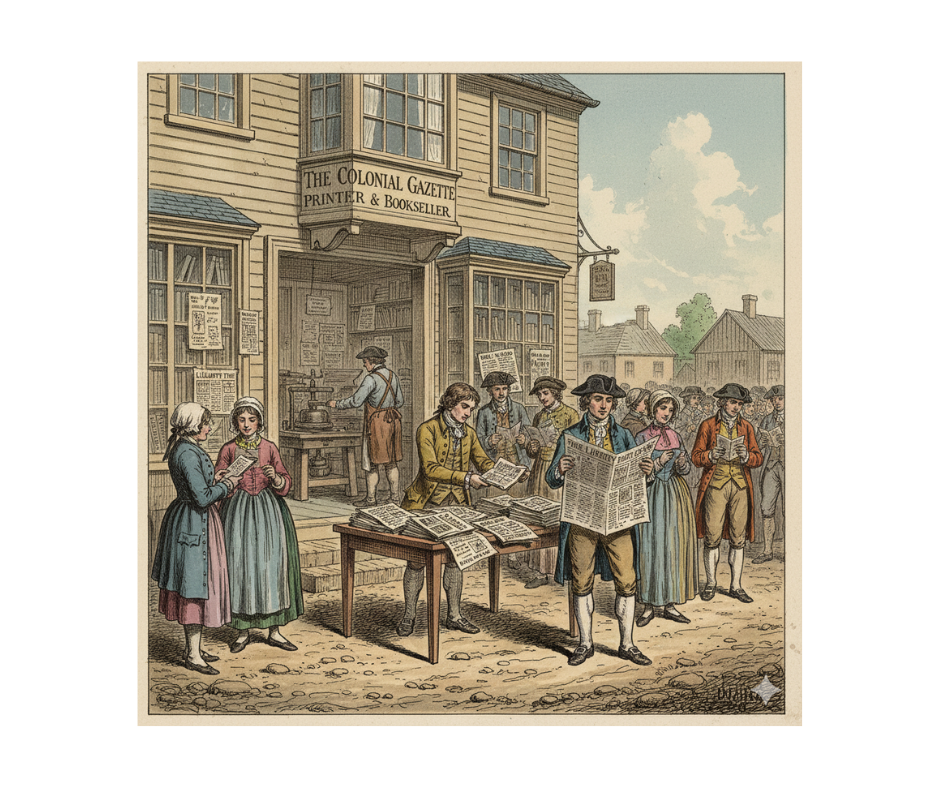
If there was a dominant medium of revolutionary persuasion, it was the pamphlet. Cheap to print, easy to distribute, and brief enough to be read in a single sitting, pamphlets functioned as the social media of their day – though slower, denser, and far more deliberate.

Pamphlets could be passed hand to hand, read aloud in taverns, or discussed in homes and meetinghouses. A single copy could reach dozens. Writers often used pseudonyms, which encouraged boldness and protected reputations. The result was an explosion of argument.

The Stamp Act crisis of 1765 unleashed a wave of pamphlets asserting that Parliament had violated colonial rights. These texts did something crucial: they framed resistance not as rebellion, but as fidelity – to law, to history, to inherited rights. The argument was not “we reject authority,” but “you have misunderstood it.”

Over time, pamphlets standardized the language of resistance. Words like “liberty,” “tyranny,” and “rights” acquired shared meaning across colonies that otherwise differed dramatically in economy, religion, and culture. The Revolution began to sound the same everywhere because people were reading the same arguments.

That shared vocabulary mattered more than we often realize. You cannot coordinate a movement if people lack common terms for their grievances. Pamphlets supplied the grammar of revolt.
When Independence Became Readable

No single text illustrates the power of the written word better than Thomas Paine’s Common Sense. Published in January 1776, it did not introduce radically new ideas. What it did was far more important: it made independence understandable.

Paine stripped away legal jargon and elite restraint. He wrote plainly, emotionally, and morally. He asked readers to imagine a future not tethered to monarchy. He treated independence not as a technical problem but as common sense.

The impact was electric. Tens of thousands of copies circulated in a population of roughly two and a half million. More importantly, it shifted the terms of debate. After Common Sense, the question was no longer whether independence was unthinkable, but whether it was unavoidable.

This is a recurring theme we will return to throughout this series: revolutions require not just anger or injustice, but imagination. Before Americans could fight for independence, they had to read their way into believing it was possible.

Newspapers and the Birth of a Shared Story

Pamphlets sparked arguments, but newspapers sustained them. Colonial newspapers reprinted essays, letters, speeches, and resolutions from other colonies, creating a shared political timeline. Events in Boston were read about in Charleston. Decisions in London were debated in Philadelphia.

This slow but steady flow of information had an unexpected benefit. Arguments unfolded over weeks and months, allowing readers time to absorb, discuss, and respond. Political persuasion was cumulative rather than explosive.

Writers often adopted classical pseudonyms – Brutus, Cato, Publius – signaling that this conflict belonged to a larger historical tradition. Readers were invited to see themselves not as isolated subjects but as participants in a drama that stretched back to Rome and beyond.

The colonies were not just informed by newspapers; they were formed by them.

Writing as Organization, Not Just Opinion

Words did more than persuade. They organized.

Letters between merchants, ministers, and political leaders coordinated boycotts and protests. Committees of Correspondence formalized writing as a tool of governance, linking towns and colonies long before any central authority existed.

Trust traveled on paper. So did strategy. Long before independence was declared, Americans were already practicing self-government through correspondence. Writing became the connective tissue of resistance.

This is an often-overlooked point: the Revolution did not spring fully formed in 1776. It was rehearsed for years in letters, resolutions, and shared texts. Americans learned how to govern themselves by writing to one another.

A Revolution Argued from Texts

Perhaps the most striking feature of the American Revolution is how insistently textual it was. Colonists grounded their resistance in written authorities: Magna Carta, English common law, colonial charters. Their case was not emotional alone; it was documentary.

Parliament responded with statutes. Colonists responded with interpretations. What ultimately broke was not communication, but agreement on what the texts meant. When shared interpretation failed, violence followed.

Even the Declaration of Independence reflects this mindset. It is not a manifesto shouted to the crowd, but an argument addressed to “a candid world.” It assumes readers. It assumes judgment. It seeks legitimacy through persuasion.

Why This Matters Now

As we approach the 250th anniversary of the founding of the United States of America, revisiting the Revolution through its reading life offers a timely corrective. It reminds us that the nation was not born from impulse, but from prolonged argument. That independence was not seized in a moment, but constructed over years of writing, reading, and debate.

This series will follow that paper trail as historians and biographers examine the texts that shaped revolutionary thought, the ideas they carried, and the habits of mind they formed. Not to romanticize the past, but to better understand it.

In an age of instant information, the Revolution invites us to remember a different tempo of change – one where ideas traveled slowly, but took root deeply. Before there was a nation, there was a conversation. And before there was a battle, there was a sentence.

The United States, in many ways, was written into existence.

As we embark on this exploration of how words shaped revolution, it’s worth anchoring ourselves in the broader journey of reflection unfolding in 2026. 

In What Does 1776 Mean in 2026? A Year of Revolutionary Reading, I invited readers to mark the semiquincentennial not simply with celebration, but with deep engagement in the very texts that have shaped our understanding of independence over the past 250 years. This series positions 1776 as more than a date – it’s a lens through which we can examine the ideas, individuals, and interpretations that have animated American history from the Bicentennial to today. My focus on the written word about the Revolution challenges us to slow down and read the past with care, recognizing that the arguments, debates, and narratives we inherit matter as much as the events they describe.


What’s up the rest of the month: We begin with the world the revolutionaries inherited, exploring Alan Taylor’s American Colonies and Bernard Bailyn’s Ideological Origins of the American Revolution – establishing the essential foundations for understanding how British subjects became American rebels.
images created with Gemini

You can find the entire series listing here.

What Does 1776 Mean in 2026? A Year of Revolutionary Reading

My love of American history began not in a classroom, but at home with a schoolteacher mother and a father who loved to read. My father passed along that love of reading to me. Those early lessons took on special meaning when I graduated from high school in 1976, surrounded by the red, white, and blue pageantry of America’s Bicentennial celebration. 

That summer of tall ships and fireworks, of patriotic fervor and historical reflection, and even marching in Disney World’s “America on Parade” planted something deep within me – a conviction that understanding our past is essential to navigating our present and future

Now 50 years later, as we approach America’s 250th anniversary in 2026, I find myself reflecting once again on the remarkable journey of this imperfect yet extraordinary experiment in self-governance. 

This series is my attempt to honor both my parent’s gift and that pivotal Bicentennial year by exploring the moments, movements, and individuals that created the unique country we call the United States of America.


On July 4, 2026, the United States will mark 250 years since fifty-six men affixed their signatures to a document that changed the world. The Declaration of Independence – just 1,320 words in its final form – proclaimed not merely a separation from Britain but articulated principles that would echo through centuries: that all men are created equal, that governments derive their power from the consent of the governed, that people have the right to alter or abolish systems that deny their fundamental freedoms.

But those fifty-six signatures didn’t appear out of nowhere. The Declaration was the culmination of more than a decade of escalating tensions, philosophical debates, violent confrontations, and painful deliberations. It emerged from smoky taverns and elegant parlors, from passionate pamphlets and private letters, from town meetings and colonial assemblies. It was shaped by brilliant minds and ordinary citizens, by idealists and pragmatists, by those who saw its promises and those whom it excluded.

As we approach this momentous anniversary, I want to embark on a year-long exploration of the books that help us understand not just what happened in 1776, but why it happened, who made it happen, and what it has meant across two and a half centuries. This is a journey through the written word about the written word – an examination of how historians, biographers, and interpreters have wrestled with the meaning of American independence.

Why Books? Why Now?

The Revolutionary period is perhaps the most written-about era in American history, and that abundance presents both opportunity and challenge. 

  • Where does one begin? 
  • Which voices matter most? 
  • How do we move beyond the mythology to understand the messy, complicated, human reality of revolution?

Books give us something that isolated facts cannot: context, interpretation, argument, and narrative. A great book about 1776 doesn’t just tell us what happened – it helps us understand the forces that shaped events, the ideas that animated the actors, and the consequences that rippled forward through time. The best books argue with each other, challenge conventional wisdom, recover forgotten voices, and force us to reconsider what we thought we knew.

Over the coming months, I want to invite you to read your way through the Revolution, examining at least a dozen essential works that illuminate different facets of this transformative period. We’ll encounter military campaigns and diplomatic negotiations, philosophical treatises and personal correspondence, grand declarations and intimate doubts. We’ll see the Revolution through the eyes of its famous architects – Adams, Jefferson, Franklin – and through the perspectives often marginalized in traditional histories: women, enslaved people, Native Americans, and ordinary colonists whose names we’ll never know but whose participation made independence possible.

The Books That Await Us

The reading list spans generations of scholarship, from Bernard Bailyn’s revolutionary (in both senses) analysis of colonial ideology to Gary Nash’s recovery of the “unknown” American Revolution. We’ll immerse ourselves in David McCullough’s intimate portraits of the founding generation, experiencing their fears and ambitions as if we’re reading over their shoulders. We’ll grapple with Gordon Wood’s interpretations of just how radical this revolution really was, and we’ll examine the Declaration itself through David Armitage’s global lens, understanding how this American document became a template for independence movements worldwide.

Some of these books will transport us to specific moments – the sweltering Philadelphia summer when delegates debated each phrase of the Declaration, the frozen desperation of Washington’s army in the winter of 1776, the coffeehouse conversations where ideas about natural rights and popular sovereignty crackled through the air. Others will challenge us to think more deeply about contradictions and complexities: 

  • How could men who proclaimed all men equal hold other human beings in bondage? 
  • How could colonists who resented British taxation deny representation to half their population?
  • What did independence mean to those who didn’t sign the Declaration, who couldn’t sign it, who actively opposed it?

A Conversation Across Centuries

What makes this journey particularly fascinating is that we’re not just reading about the Revolution – we’re reading about how people have understood the Revolution across 250 years. History isn’t static; each generation interprets the past through its own concerns and values. The historians writing in the 1960s asked different questions than those writing today. The documents that seemed important in 1826 differ from those scholars prioritize in 2026.

By reading these books in dialogue with each other, we’ll see how historical understanding evolves. We’ll watch as newer scholarship challenges older narratives, as primary sources get reinterpreted, as forgotten stories get recovered. Bernard Bailyn opened new ways of understanding colonial ideology in the 1960s; Gary Nash, writing decades later, insisted we expand our frame to include those Bailyn’s sources largely ignored. This isn’t about one being “right” and another “wrong” – it’s about the richness that emerges when multiple perspectives illuminate the same transformative moment.

The Path Forward

Beginning this month, we’ll follow a roughly chronological path through the Revolutionary period, though we’ll make deliberate detours along the way. We’ll start with the deep background – the colonial world that made revolution thinkable – before moving through the escalating crisis of the 1760s and 1770s. We’ll live through the pivotal year of 1776 month by month, watching as rebellion became revolution and revolution became a declaration of independence.

A possibility, as summer turns to fall: we’ll step back and ask harder questions.

  • Whose revolution was this, really?
  • What about the people whose stories don’t appear in the Declaration, whose freedom wasn’t proclaimed on July 4, 1776?
  • How have historians with different methods, different politics, different moral concerns made sense of this complicated legacy?

Each month, the focus will be on multiple books, exploring not just their arguments but their artistry – the way great historical writing makes the past come alive, the way a well-chosen anecdote can illuminate broad themes, the way primary sources in the hands of skilled interpreters can still surprise us centuries later. I plan to include key quotes from these works, letting you hear the distinctive voices of different authors, the varied ways historians craft their narratives.

I always want to connect past to present. The questions the founders grappled with – about power and liberty, unity and diversity, ideals and interests – remain our questions. The contradictions they failed to resolve – most devastatingly around slavery – shaped American history for centuries and resonate still. Understanding 1776 means understanding ourselves.

Why This Matters in 2026

A 250th anniversary is more than nostalgia or celebration. It’s an opportunity for national reflection and, perhaps, reckoning. 

  • What has the Declaration’s promise of equality meant across two and a half centuries? 
  • How much of that promise has been fulfilled? 
  • How much remains aspirational? What do we owe to the founders’ courage and vision? 
  • What do we owe to those they excluded, oppressed, or ignored?

The books we’ll read don’t answer these questions definitively – history rarely does. But they give us the tools to think more clearly, to argue more precisely, to understand more fully. They remind us that the Revolution wasn’t inevitable, that independence was chosen by real people facing genuine uncertainty, that ideas have consequences, and that the work of creating a more perfect union didn’t end in 1776 or 1789 or at any point since.

As we prepare to mark this anniversary, there’s no better way to honor the Revolutionary generation than by reading deeply, thinking critically, and engaging seriously with what they created – both its brilliance and its blind spots. The Declaration of Independence changed the world, but understanding how and why requires more than reciting its famous phrases. It requires the kind of sustained attention that only books can provide.

Join the Journey

Over the coming months, I hope these articles will arrive like letters from another time – invitations to walk alongside historians as they piece together the past, to sit with biographers as they bring individuals back to life, to witness through primary sources the anxieties and exhilarations of a world being remade.

Whether you’re a devoted student of American history or someone who vaguely remembers learning about 1776 in school, whether you’ve read everything about the Revolution or nothing at all, this series will meet you where you are. Each article will stand alone, but together they’ll form a mosaic – a complex, nuanced portrait of how the United States came to declare its independence and what that declaration has meant.

The road to independence was long, uncertain, and traveled by countless people whose commitment to an idea transformed thirteen colonies into a new nation. The road to understanding independence is equally long, equally rich with discovery. 


Next week: Before the First Shot, There Was the First Sentence: Why the American Revolution Was Written Before It Was Fought


You can find the entire series listing here.